GDPR Compliance Checklist for Shopify Stores Expanding into the EU in 2026
- gdpr compliance
- gdpr for shopify stores
- gdpr for shopify
Launched
March, 2026

Expanding your Shopify store into the European market is one of the most rewarding growth moves a brand can make. The EU represents more than 450 million consumers with high purchasing power, strong brand loyalty, and a well-developed ecommerce infrastructure. However, selling into the EU also brings a legal obligation that trips up more merchants than almost any other requirement: GDPR compliance.
The General Data Protection Regulation has been in force since 2018, and enforcement has only intensified. In 2023 and 2024 alone, EU regulators issued billions in fines — including fines against major technology brands — for data-handling failures that often started with something as simple as a misconfigured cookie banner.
For Shopify merchants, the good news is that compliance is achievable without a legal team or months of work. This guide provides a practical, step-by-step GDPR checklist built specifically for Shopify stores entering or expanding in the EU. It covers everything from cookie consent and privacy policies to Google Consent Mode v2 and customer data rights.
This guide is written for Shopify merchants and the agencies that support them. It does not constitute legal advice. For specific legal questions, consult a qualified data protection solicitor.
What Is GDPR and Why Does It Apply to Your Shopify Store?
GDPR (General Data Protection Regulation) is an EU law that governs how personal data about EU residents is collected, stored, processed, and shared. Critically, it applies to any business that sells to or markets to EU residents — regardless of where the business is based.
If you are a UK brand launching in Germany, a US brand targeting French consumers, or an Australian store adding a European shipping zone, GDPR applies the moment EU residents interact with your store.
Personal data under GDPR includes far more than names and email addresses. It also covers:
- IP addresses collected during browsing
- Cookie identifiers used for advertising and analytics
- Purchase history and behavioural data
- Location data
- Any information that can be used to identify an individual
The core GDPR principles ecommerce merchants need to understand are straightforward: you must have a lawful basis for processing personal data, be transparent about what you collect and why, honour customer rights, and keep the data secure.
Failing to meet these obligations carries not only financial risk but also reputational damage in trust-sensitive markets you are only just entering.
The GDPR Compliance Checklist for Shopify Stores
Use this checklist as your EU-expansion readiness guide. Each item is a concrete action you should complete before, or immediately after, going live in the EU.
1. Implement a GDPR-Compliant Cookie Consent Banner
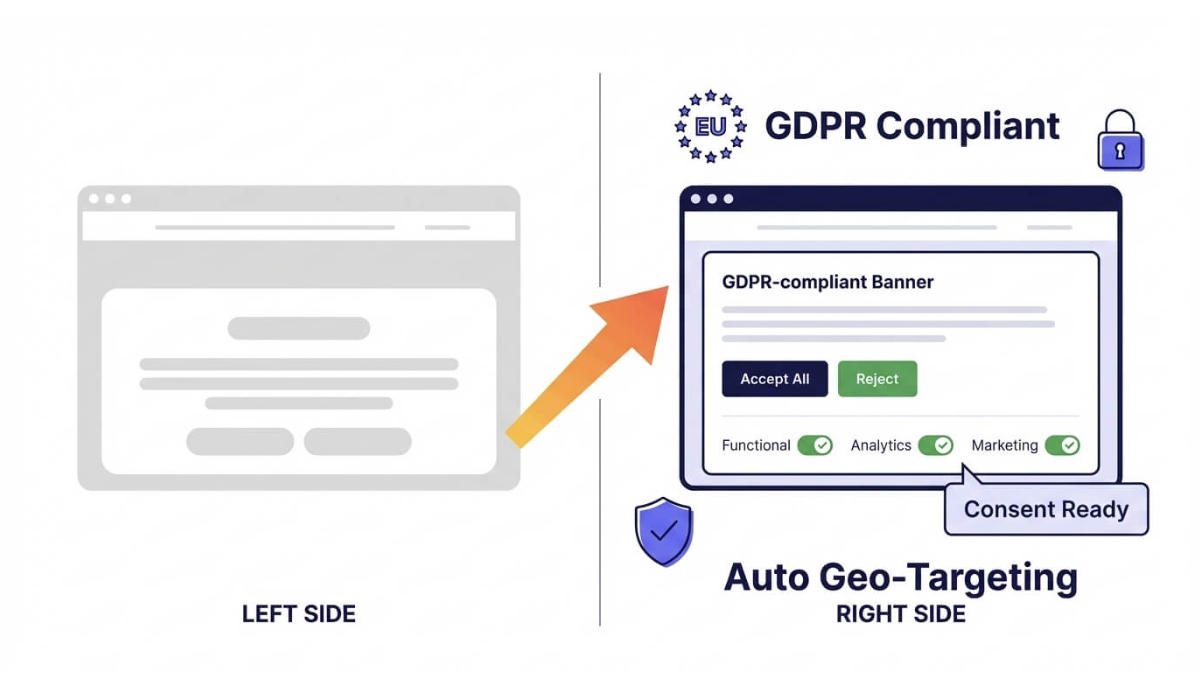
This is the most visible requirement — and the one most merchants get wrong. Under GDPR, you cannot set non-essential cookies (advertising, analytics, personalisation) until the visitor has given explicit, informed consent.
A compliant banner must:
- Appear before any non-essential cookies are set
- Offer clear, equally visible Accept and Reject options
- Provide granular control over cookie categories
- Store a timestamped record of consent
- Allow users to withdraw consent as easily as they gave it
For Shopify stores, Consentmo is purpose-built for this. It delivers native GDPR-compliant consent with automatic geo-targeting, so EU visitors receive the correct experience while other regions can be configured differently. It also includes certified Google Consent Mode v2 integration.
2. Establish a Lawful Basis for Every Type of Data Processing
GDPR requires a documented lawful basis for every processing activity. The most relevant for ecommerce are:
- Consent: e.g., marketing opt-in at checkout
- Contractual necessity: e.g., processing a shipping address to fulfil an order
- Legitimate interests: requires a documented balancing test
Relying on legitimate interests as a catch-all is risky — regulators scrutinise it closely. For marketing emails, retargeting, and advanced analytics, consent is usually the safest basis.
Map your data flows and document the lawful basis for each. This becomes part of your Records of Processing Activities (ROPA).
3. Write a GDPR-Compliant Privacy Policy
Your privacy policy must be written in plain language and cover:
- What personal data you collect and how
- Why you collect it and the lawful basis for each activity
- Who you share it with, including third-party apps and advertising platforms
- How long you retain it
- Customer rights over their data
- Your contact details and complaint process
Treat the policy as a living document. Update it whenever you add new apps, change your marketing stack, or expand into new regions.
If you operate in Germany specifically, note that German regulators often apply particularly strict standards and may also require an Impressum — a legal disclosure page — even for international brands selling to German consumers.
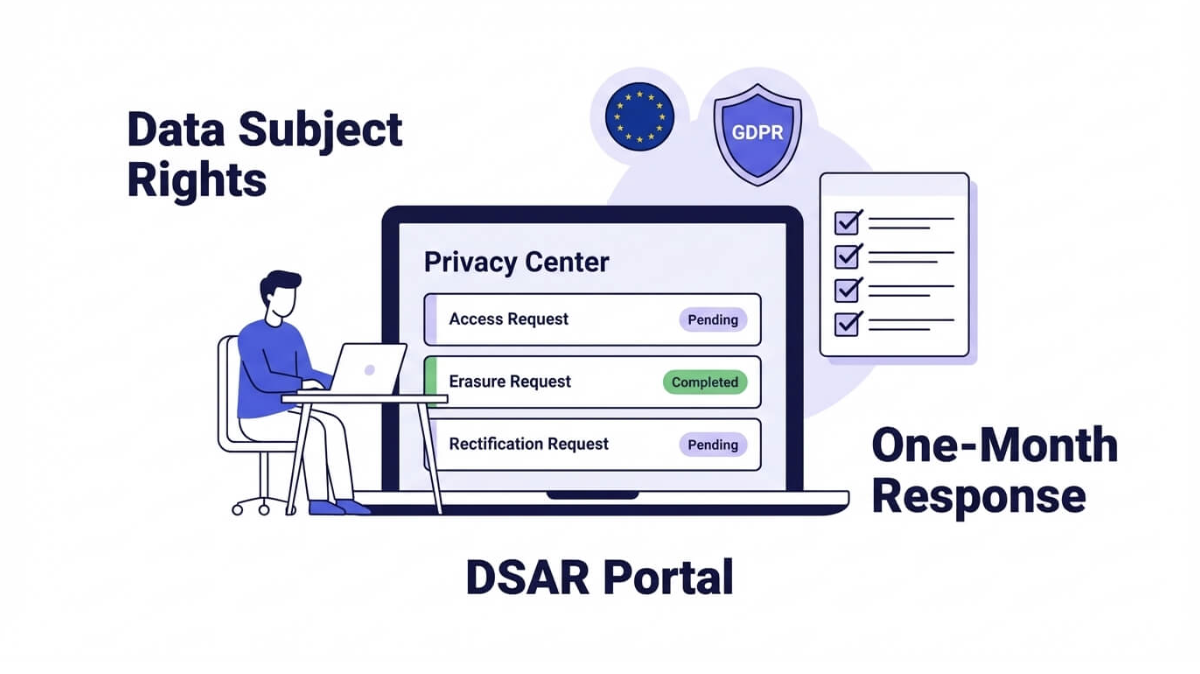
4. Set Up a Data Subject Rights Process
GDPR gives EU residents important rights over their personal data. The ones most likely to be exercised by customers are:
- Right of access (DSAR): the right to request a copy of the data you hold about them
- Right to erasure: the right to request deletion of their data
- Right to rectification: the right to correct inaccurate data
- Right to object: the right to object to processing based on legitimate interests or direct marketing
You must respond to most requests within one calendar month. For many Shopify stores, the challenge is not willingness — it is having a structured process. Without one, requests can get lost in support inboxes or go unanswered.
A dedicated privacy request page — sometimes called a DSAR portal — is often the most effective solution. Consentmo's Privacy Center provides exactly this: a branded, embeddable page where customers can submit privacy requests, have their identity verified, and receive automated processing — all without manual intervention from your team. For stores expanding to multiple regions, it consolidates GDPR, CCPA, PIPEDA, and other regional privacy requests into a single managed workflow.
5. Audit Your Third-Party Apps and Integrations
Every app that processes customer data is a data processor under GDPR. You are responsible for ensuring they meet relevant data protection requirements. This means:
- Reviewing the privacy policies and Data Processing Agreements (DPAs) of every significant app
- Ensuring apps that transfer data outside the EU have appropriate safeguards in place, such as Standard Contractual Clauses or adequacy decisions
- Removing apps you no longer actively use — dormant apps may still hold customer data
- Listing all third-party data processors in your privacy policy
Common areas of risk for Shopify stores expanding into the EU: email marketing platforms that set tracking pixels, chat and support tools that log conversation data, analytics tools that use persistent cookies, and review platforms that collect reviewer personal data.
6. Configure Google Consent Mode v2
If you run Google Ads, use Google Analytics, or rely on any Google Marketing Platform product, Google Consent Mode v2 is not optional for EU traffic. It became mandatory in early 2024 for advertisers who want to maintain access to conversion modelling and audience features.
Consent Mode v2 enables modelled conversions — Google uses privacy-safe signals to model what would likely have happened without full tracking data, allowing you to maintain campaign performance while respecting user consent. It requires two new consent signals: ad_user_data and ad_personalisation.
Consentmo has native Google Consent Mode v2 integration and is certified by Google as a Consent Management Platform — which means the signal passing is verified and maintained by the app, rather than something you need to configure manually or test independently.
7. Handle Cross-Border Data Transfers Correctly
Most Shopify stores use US-based services. The EU-US Data Privacy Framework, adopted in 2023, provides a legal mechanism for data transfers to certified US organisations. Check whether your key data processors — email platform, analytics, CRM, support stack — are certified under this framework or have Standard Contractual Clauses in place, and document it.
8. Secure Your Store and Its Data
GDPR requires appropriate technical and organisational measures to protect personal data. For a Shopify store, this means:
- Ensuring your store runs on HTTPS — Shopify handles this by default
- Using strong, unique passwords and enabling two-factor authentication on your Shopify admin
- Limiting admin access — only give team members the level of access they genuinely need
- Having a data breach response plan — GDPR requires notifying your supervisory authority within 72 hours of becoming aware of a breach that poses risk to individuals
- Regularly reviewing which apps have access to your store data
9. Add a Cookie Policy and Update Your Store's Legal Pages
Beyond your privacy policy, a compliant EU store should have:
- A cookie policy: a dedicated page listing every cookie your store sets, categorised by purpose, with retention periods and the third parties involved
- Updated terms and conditions that reflect your data practices where relevant
- A clear privacy notice at key data collection points — checkout, newsletter sign-up, and contact forms — wherever you ask for personal data
Your cookie consent banner should link directly to your cookie policy so visitors can review what they are accepting before they decide.
10. Localise Your Compliance for Key EU Markets
GDPR is EU-wide, but individual member states have implemented national variations that can affect your obligations. A few worth noting:
- Germany: strict cookie consent interpretation, Impressum requirement, and active enforcement from state-level data protection authorities
- France: CNIL guidance requires explicit consent for analytics as well as advertising, with no grace period for non-compliant banners
- Netherlands: the Dutch DPA (AP) has been active in enforcement, particularly around tracking and profiling
If you are expanding to multiple EU markets simultaneously — which is common with Shopify Markets — a geo-targeting cookie consent solution is essential. Showing the same banner to all EU visitors when French expectations are stricter than Swedish ones is both a compliance risk and a missed opportunity to calibrate consent rates by market.
Your GDPR Readiness Checklist at a Glance
Use this summary before you go live in any EU market:
- Cookie consent banner with Accept/Reject options and granular controls
- Lawful basis documented for every data processing activity
- Privacy policy updated for EU compliance and written in plain language
- Data subject rights process in place with a DSAR portal
- Third-party app DPAs reviewed and documented
- Google Consent Mode v2 configured and verified
- Cross-border data transfer mechanisms confirmed for US-based services
- Store security measures and breach response plan in place
- Cookie policy published and linked from your consent banner
- Market-specific requirements reviewed for target EU countries
How Grumspot Handles GDPR as Part of EU Expansion Projects
When we work with brands expanding into the EU, GDPR compliance is built into the technical setup — never an afterthought. Our internationalisation service includes regional consent configuration, Google tag setup, and connecting you with the right compliance tools to keep ongoing operations simple.
We recommend Consentmo as our preferred Shopify GDPR app and privacy compliance layer for Shopify stores. It is native to Shopify, Google-certified, supports IAB TCF, and uses intelligent geo-targeting so one app manages the compliance logic for every market you enter.
Getting compliant before launch is almost always cheaper and less stressful than fixing issues under regulatory pressure. If you are planning EU expansion and want it done right from day one, get in touch with the Grumspot team. We have helped brands across Europe, North America, and Asia-Pacific navigate exactly this — often alongside Conversion Rate Optimisation projects that deliver measurable revenue growth in new markets.
Frequently Asked Questions
Does GDPR apply to my Shopify store if I am based outside the EU?
Yes. It applies the moment you offer goods or services to EU residents or monitor their behaviour — regardless of where your business is based.
What is the difference between GDPR and UK GDPR?
Since Brexit, the UK has its own version — the UK GDPR — which is largely equivalent to the EU version but administered by the UK's Information Commissioner's Office (ICO). Stores selling to both EU and UK customers technically operate under both frameworks, though for most practical purposes the requirements are very similar.
Can I use a free cookie consent app and still be GDPR compliant?
Some free tools meet the minimum technical requirements, but most lack Google Consent Mode v2 integration, proper consent logging, geo-targeting, and audit-ready records. For serious EU expansion, a professional solution is strongly recommended.
How long do I have to respond to a DSAR?
One calendar month in most cases, extendable by a further two months for complex requests — provided you inform the requester of the extension within the initial one-month period.
What happens if I do not comply with GDPR?
Fines operate on a two-tier structure. Serious violations — including unlawful processing of personal data or failure to obtain valid consent — can reach €20 million or 4% of global annual turnover, whichever is higher. Regulators can also issue enforcement orders, restrict processing activities, or require compulsory audits.
Let's build something together
If you like what you saw, let's jump on a quick call and discuss your project

Related posts
Check out some similar posts.