Cost of ecommerce website development: A Practical Budget Guide
- cost of ecommerce website development
Launched
February, 2026
So, how much does an e-commerce website actually cost in the UK? The short answer is anywhere from £1,000 for a simple starter site to well over £25,000 for a complex, custom-built platform. The final price tag really hinges on what you need—the scope, the level of custom design, and the technology you choose. Let's break down what that means for your business.
A Snapshot of Ecommerce Development Costs
Trying to pin down a single price for an e-commerce website can feel a bit like asking, "How much does a house cost?". It's not one figure but a wide spectrum. The final cost is shaped by your business goals, specific technical requirements, and the agency or freelancer you partner with.
Think of it this way: you could get started with a simple, template-based site, which is like leasing a small, ready-to-go shop. It’s fast and affordable. Or, you might need a fully bespoke flagship store built from scratch, designed to handle massive scale and unique customer journeys. Naturally, each path comes with a very different budget and timeline.
To give you a clearer picture, we've outlined the typical investment levels. This isn't just about the money; it’s about understanding what you get at each stage.
Typical Investment Tiers
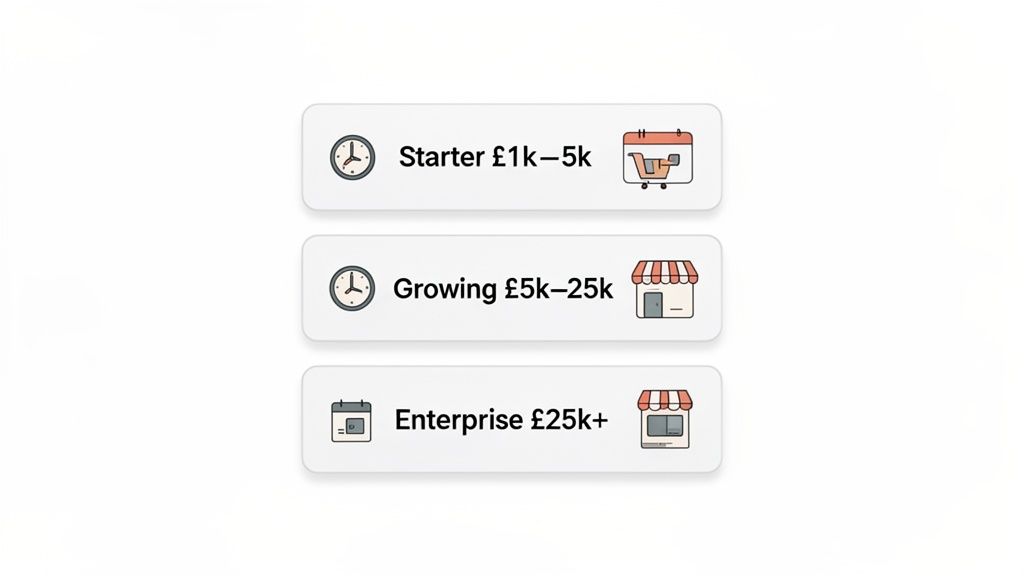
Here’s a realistic look at what you can expect to spend as your business grows. Keep in mind these are ballpark figures—your specific feature list and the agency's rates will cause them to vary.
To help you budget effectively, here’s a quick overview of typical costs and timelines for e-commerce projects in the UK.
Ecommerce Development Cost and Timeline Estimates in the UK
| Development Path | Estimated Cost (GBP) | Average Timeline | Best Suited For |
|---|---|---|---|
| Starter Store | £1,000 - £5,000 | 2-4 Weeks | New businesses, startups, and solo entrepreneurs testing a product idea. |
| Growing Brand | £5,000 - £25,000 | 1-3 Months | Established SMEs needing custom features, design, and integrations. |
| Enterprise-Level | £25,000+ | 3-6+ Months | High-volume retailers with complex operational needs and international sales. |
This table should give you a solid starting point for your budget discussions. If you're leaning towards a platform like Shopify, for example, it's worth getting to grips with their fee structure. You can learn more about https://grumspot.com/blog/shopify-pricing-everything-you-need-to-know to see how those monthly costs fit into the bigger picture.
The biggest mistake we see is businesses underestimating the project's scope right from the start. A detailed project brief is the single best tool you have for getting an accurate quote and preventing nasty budget surprises later on.
Ultimately, your budget needs to be a direct reflection of your business goals. For a wider view on website expenses that go beyond e-commerce, this guide on how much a website should cost offers some great context. Now, let’s dig into exactly what drives these costs.
Understanding the Key Drivers of Your Website Cost
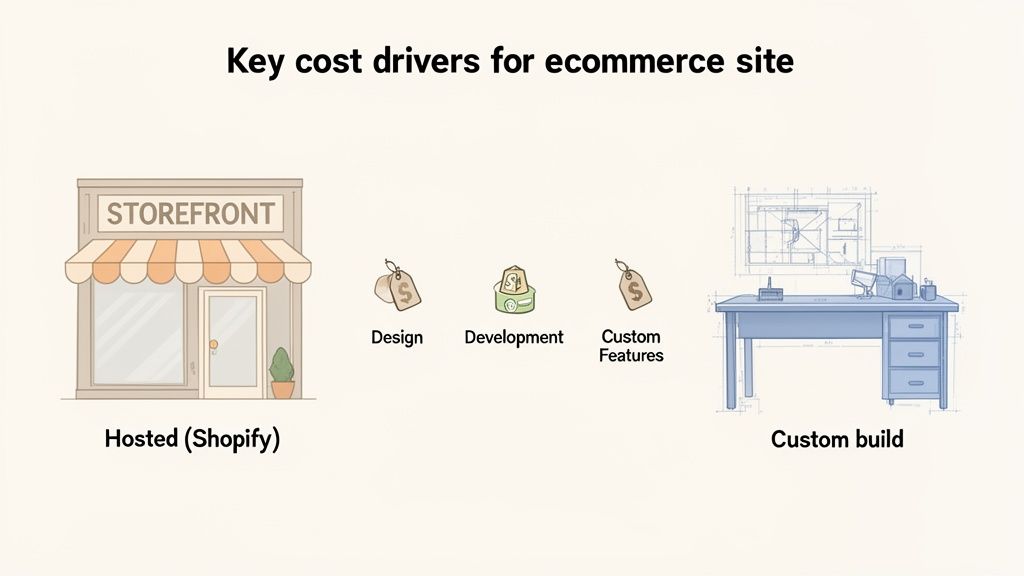
The final price tag on your ecommerce website is a sum of its parts, not one single figure. It helps to think of it like building a house: the total cost is a collection of choices about the foundation, the materials, the size, and all the custom finishes. Getting a handle on these core components helps you see exactly where your money is going and allows you to make much smarter investment decisions.
Essentially, four main pillars determine the cost of ecommerce website development: the platform you choose, the complexity of the design, the depth of the development work, and any custom features you absolutely need. Each one acts as a lever that can either raise or lower your overall budget.
The Platform: Your Digital Foundation
Choosing your ecommerce platform is the single most foundational decision you'll make. It directly shapes your budget, your day-to-day operations, and what’s possible for your business down the line. It's like deciding between leasing a ready-to-go retail space in a popular shopping centre versus hiring an architect to design a custom flagship store from the ground up.
SaaS Platforms (e.g., Shopify, BigCommerce): These are your "leased retail space" options. You pay a monthly fee for a powerful, ready-made ecosystem that includes hosting, security, and a solid set of core features. This path gets you to market faster with a much lower upfront cost, but you're working within a pre-defined framework.
Open-Source Platforms (e.g., WooCommerce, Magento): This is closer to owning the building but having to furnish, secure, and maintain it all yourself. The software is free, but you're on the hook for hosting, security updates, and all the development. This gives you more flexibility but requires a significantly larger budget for both the initial build and ongoing technical management.
Custom-Built (Headless): This is the bespoke flagship store, designed and built from scratch. Here, developers build a completely unique system tailored to your exact operational needs. It offers unparalleled control and performance but comes with the highest development cost and the longest timeline by far.
For most businesses, especially those just starting out or looking to scale efficiently, a powerful SaaS platform like Shopify usually provides the ideal balance of cost, performance, and flexibility.
Design and User Experience: The Customer-Facing Blueprint
Your website’s design isn't just about looking good; it’s about how your customers actually use your site. A confusing or clunky user experience (UX) will absolutely kill your conversions, while a smooth, intuitive one can send them soaring. In fact, research shows that a staggering 94% of a customer's first impression is purely design-related.
Your investment here is driven by a few key factors:
Template vs. Custom Design: Using a pre-built theme is the most budget-friendly route, costing anywhere from nothing to a few hundred pounds. Customising that theme to match your brand adds to the cost, while a completely bespoke design created from scratch by a UX/UI designer will be a significant line item in your budget.
Responsive Design: It’s a given that your site has to work flawlessly on desktops, tablets, and mobiles. While most modern themes are responsive out of the box, ensuring a truly optimised mobile experience often requires specific design and development work, which adds to the cost.
Great design isn't just about aesthetics; it's about reducing friction. Every click a customer doesn't have to make to find and buy a product is a small victory that contributes to your bottom line.
Development and Custom Features: Building Your Engine
This is where the design blueprints become a living, breathing, functional store. Development costs are directly tied to the hours a developer spends writing code to build out your pages, implement features, and connect all the different systems that make your business run. The more complex the request, the more time it takes.
Custom features are any bits of functionality that don't come as standard with your chosen platform. They are often the biggest variable in the cost of an ecommerce website and can swing a budget dramatically.
Simple Customisations: This might be something like a unique promotional banner, a tailored contact form, or a specific layout for a collection page.
Complex Integrations: This is much more involved. It means connecting your store to third-party systems like an Enterprise Resource Planning (ERP) tool, a Customer Relationship Management (CRM) platform like Salesforce, or specialised logistics software.
Bespoke Apps: If you need a completely unique feature—like a complex product customiser or a subscription builder—that doesn't already exist on the app market, you'll need to commission developers to build it for you.
Each of these adds layers of complexity, requiring skilled developers to ensure they work seamlessly without breaking anything or slowing down your site. The key is to carefully prioritise which features are essential for launch versus those that are "nice-to-haves" for a later phase. This approach lets you manage your budget effectively without sacrificing your core business goals.
Choosing Your Partner: Freelancers vs. Agencies
Once you’ve mapped out your project, you hit a major fork in the road: who’s actually going to build this thing? This decision is huge. It doesn’t just affect the initial cost of ecommerce website development; it shapes your timeline, the quality of the final product, and where your business can go from here. It’s the classic debate – do you go with a talented freelancer or a full-service agency?
Think of it this way. A freelancer is like a master carpenter. You hire them for their specific, expert craft, and they build the whole thing themselves. An agency, on the other hand, is like a general contractor with a whole crew – designers (the architects), developers (the builders), project managers, and even conversion experts (the interior designers).
Neither path is inherently better, but one is likely a better fit for your specific budget, project complexity, and long-term goals. Let's break down what each brings to the table.
The Freelancer Approach
Hiring a freelance developer is often the go-to for smaller, well-defined projects. It’s usually seen as the more budget-friendly route, and for good reason. You're paying for one person's time and skill set, which is perfect for startups or businesses with straightforward needs.
The biggest draws are the direct line of communication and the lower price tag. You’re working one-on-one with the person doing the work, which keeps things agile and personal. This setup shines when your project scope is tight and you don't need a massive team with varied expertise.
In the UK, a freelancer will typically charge between £2,000 and £5,000 for a standard ecommerce website. Their day rates can swing from £240 for someone more junior to £550 for a seasoned pro, with developers in London often at the higher end. For a simple WooCommerce site, you might be looking at 5-10 days of work, landing you somewhere around the £3,000 mark.
The catch? Capacity. A freelancer is still just one person. If they get sick, go on holiday, or get swamped with other projects, yours can grind to a halt. Their expertise is also usually concentrated. An amazing developer isn't necessarily a brilliant UX designer or a conversion rate optimisation wizard.
The Agency Advantage
Going with an agency is a different beast entirely. It's an investment in a full, coordinated team. Yes, the initial cost is higher, but what you get in return is a deep pool of specialists—designers, developers, strategists, and project managers—all working in sync.
This integrated approach is the right call for businesses with more complex requirements or big plans for growth. An agency can manage the entire journey, from market research and branding to tricky backend integrations and post-launch marketing support. They bring structure, accountability, and, critically, the ability to scale.
Here’s what you gain by partnering with an agency:
- Diverse Expertise: With a full team, every part of your project is handled by someone who specialises in it. Our guide to Shopify store design services dives deeper into how this kind of collaboration produces a much stronger result.
- Redundancy and Reliability: The project doesn't stop if one person is out of action. There's always someone to pick up the slack, which removes the "single point of failure" risk you run with a freelancer.
- Strategic Oversight: A good agency doesn't just follow instructions; they think strategically. They work to align the website with your wider business goals, ensuring it's not just a pretty storefront but a powerful engine for growth.
An agency partnership is about more than just getting a website built; it's about creating a long-term business asset. You're not just buying lines of code—you're investing in a strategic partner who can grow alongside you.
As you weigh your options, getting your head around how to effectively outsource web development is key to making a smart choice. The right agency provides both a safety net and a springboard, making sure your ecommerce platform is solid, scalable, and built to convert from day one.
Budgeting for Different Project Scopes
To put all this theory into practice, let's move away from abstract cost drivers and look at some real-world examples. The easiest way to get your head around the cost of ecommerce website development is to see what typical projects actually cost. A startup testing the waters has completely different needs to an international retailer, and their budgets will reflect that.
We'll walk through three common scenarios below. Think of these as blueprints you can use for your own financial planning, helping you match your budget to your business goals.
The Small Business Starter Store
Picture a local artisan launching their first online shop. The goal is simple: get online fast, sell a small handful of products (fewer than 50), and see what happens without risking a huge amount of cash. A platform like Shopify is a no-brainer here.
The whole game is about speed and efficiency. The budget will mostly go towards:
- Platform Setup: This is the basic blocking and tackling – setting up the Shopify account, connecting payment options like Stripe and PayPal, and figuring out shipping rates.
- Theme Customisation: You'd pick a premium theme (£150-£300) and have a developer tweak it with your logo, brand colours, and fonts. No heavy, custom coding is needed.
- Essential App Integrations: This just means installing a few key apps for email marketing (like Klaviyo), basic SEO, and maybe customer reviews.
- Content and Product Upload: The developer or agency will upload your first batch of products and set up the standard pages like 'About Us' and 'Contact'.
For a project this size, you can expect a professional build to land somewhere in the £3,000 to £8,000 range. It's usually a quick turnaround, too, often just 3-6 weeks from start to finish.
The Growing Brand with Custom Requirements
Now, let's think about a business that's already got its sea legs. They've outgrown their first website, have a product that sells, get steady traffic, and now need more powerful features to keep growing. This is the point where they might need to connect their online shop to an inventory management system or a third-party logistics (3PL) partner.
This is where the investment really starts to climb. The budget has to cover more complex and time-consuming work:
- Custom Design (UX/UI): You're moving beyond a pre-built template. This involves proper wireframing and designing a unique user experience from scratch, one that's built specifically for your customers.
- Advanced Integrations: This is a big one. It could mean building a custom connection to an ERP or CRM system to keep customer data and stock levels in sync without anyone lifting a finger.
- Bespoke Feature Development: Maybe the brand needs a product customiser, a 'build-a-box' subscription feature, or a private wholesale portal for B2B clients. These all require custom coding.
- Data Migration: If you're switching platforms, moving all your customer, order, and product data over securely is a delicate but crucial task.
Recent industry data shows just how big this jump is. A 2026 look at UK agency pricing shows that while a standard Shopify or WooCommerce site might be £5,000 to £15,000, that number shoots up to £12,000-£40,000 for complex projects with ERP integrations or multiple languages. A build like this could take anywhere from 2 to 4 months. You can dig deeper in this guide to UK website pricing.
The infographic below does a great job of showing the cost difference between hiring a freelancer and an agency, which is a key decision at this stage.
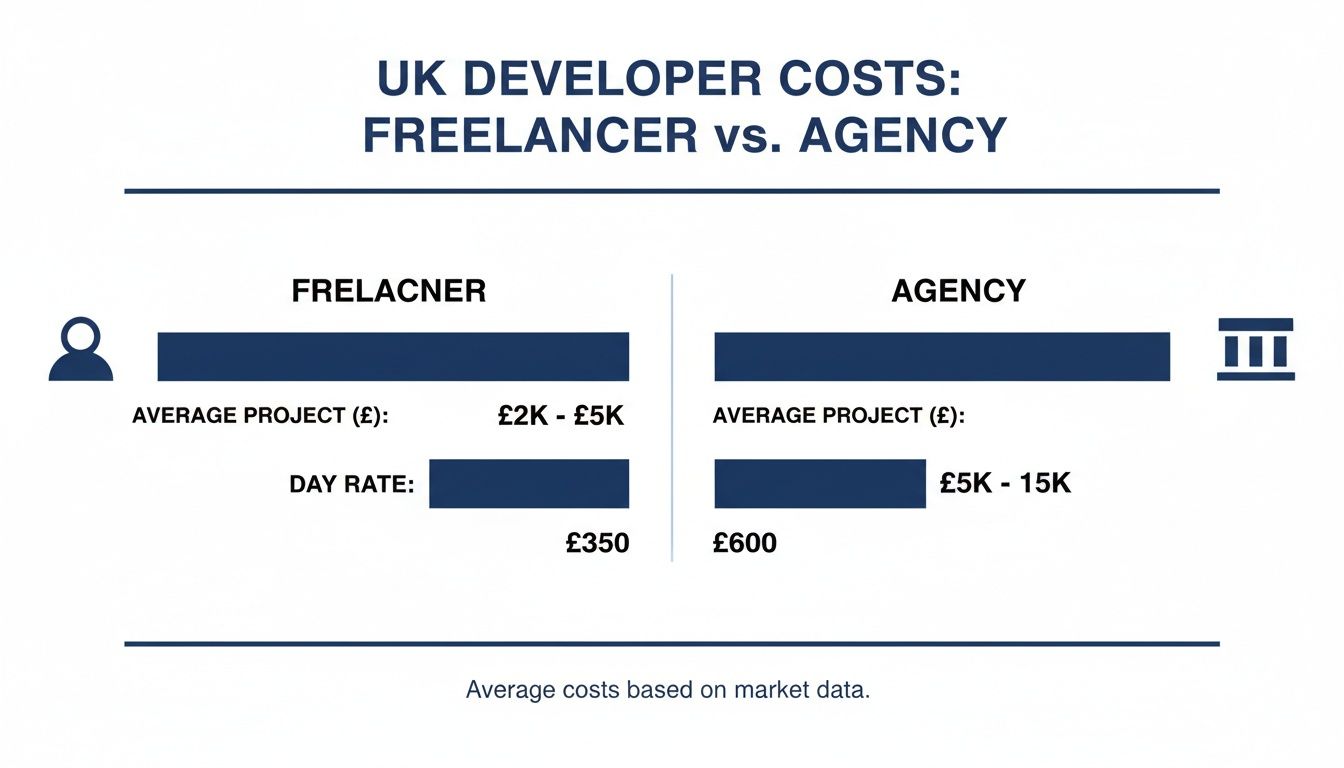
As you can see, freelancers are a more affordable entry point, but agencies charge a premium for the wider team, strategic input, and broader expertise they bring to the table.
The Enterprise-Level Platform
Finally, let's consider a large-scale retailer. We're talking high-volume sales, international markets, and seriously complex operations. This kind of business needs a rock-solid, scalable, and highly customised platform, often built on an enterprise solution like Shopify Plus or a headless commerce setup.
The investment here is massive, reflecting just how complex and critical the platform is.
For an enterprise business, the website isn't just a sales channel; it's the central nervous system of the entire operation. The budget has to guarantee performance, security, and scalability at the absolute highest level.
The big-ticket items on the invoice will include:
- Headless Architecture: Separating the front-end (what the customer sees) from the back-end (the commerce engine) for ultimate flexibility and lightning-fast performance.
- Multiple System Integrations: Deep, two-way connections with multiple systems like global ERPs, PIMs (Product Information Management), and powerful marketing automation tools.
- Internationalisation: Building multi-language, multi-currency shops with specific pricing, content, and payment methods for each region.
- Custom App Development: Engineering private, bespoke apps to handle unique business rules, like complex loyalty programmes or advanced B2B ordering systems.
The cost for an enterprise build typically starts at £40,000 and can easily sail past £100,000. Timelines often stretch beyond six months, but this is a long-term strategic investment in infrastructure designed to support a multi-million-pound business.
Planning for Hidden Costs and Ongoing Investments
Getting your ecommerce website live is a huge achievement, but it's really just the starting line, not the finish. The initial build cost is only the first chapter of the story. Far too many business owners get caught out by the recurring expenses needed to keep a store healthy, secure, and competitive, which can completely change the long-term cost of an ecommerce website.
Thinking of your website as a one-and-done purchase is like buying a brand new car and forgetting it needs petrol, insurance, and an annual MOT. It simply won't run without continuous investment. These ongoing costs aren't just drains on your budget; they're essential investments in your store's stability, security, and its very ability to make money.
Beyond the Initial Build
The moment your site goes live, a whole new set of costs begins. These aren't sneaky "hidden fees" but predictable, operational necessities for any serious online business. Factoring them into your budget from day one is the best way to avoid nasty surprises and ensure you have the funds to keep your digital shopfront in top shape.
Here are the usual suspects when it comes to recurring investments:
- Hosting and Domain: Your site needs a place to live on the internet (hosting) and an address (your domain name). While platforms like Shopify bundle this in, self-hosted sites on platforms like Magento require separate plans. Domain renewals are a small but regular annual cost.
- App and Plugin Subscriptions: Those fantastic apps that handle your email marketing, loyalty programmes, or advanced search often run on monthly or annual subscriptions.
- Payment Gateway Fees: Every single sale has a cost attached. Payment processors like Stripe or PayPal will typically take a percentage plus a small fixed fee from every transaction.
- SSL Certificate: This is the little padlock that secures your customers' data and is absolutely non-negotiable for building trust. It's often included in hosting plans but can sometimes be a separate annual fee you need to cover.
The Value of a Maintenance Retainer
One of the smartest ongoing investments you can make is a technical maintenance retainer with your development agency. This isn't just an emergency fund for when things break; it's proactive care designed to stop problems from ever happening.
A maintenance plan turns your website from a static, depreciating asset into an evolving business tool. It’s the difference between a store that slowly breaks down and one that continuously improves its performance and profitability.
A solid retainer ensures your site is always up-to-date, secure, and running fast. It typically covers things like applying security patches, handling platform updates, fixing bugs as they appear, and monitoring performance. This proactive work prevents costly downtime, protecting both your revenue and your brand's reputation.
Budgeting for Growth and Optimisation
The most successful ecommerce brands are never truly "finished" with their websites. Beyond just keeping the lights on, you need to budget for continuous improvement. This is where you actively work to increase your store's value through things like conversion rate optimisation (CRO) and technical SEO.
This is especially critical for larger businesses. For an enterprise-level ecommerce site in the UK, costs can easily climb into the £15,000-£100,000+ range, often involving a custom CMS with deep integrations into a CRM or ERP system. While a DIY build might seem tempting at first, it almost always fails when you need to scale, whereas a professional agency can guarantee high uptime and deliver measurable gains from CRO.
Putting money into CRO means you're constantly testing and tweaking your site's design and user journey to persuade more visitors to become customers. Meanwhile, technical SEO ensures search engines can properly crawl and rank your site, driving that all-important organic traffic. These aren't one-off tasks but ongoing processes that deliver a direct return on your investment, transforming your website into a powerful, evolving revenue engine. If you're considering building unique features, our guide to custom Shopify app development offers some great context.
How to Maximise Your Return on Investment
When you're looking at a big investment like a new ecommerce site, it's easy to get fixated on the initial cost. But the smartest founders shift their perspective. A high-quality website isn’t just an expense; it’s an asset that should be generating revenue for years to come.
Thinking about a strong return on your investment needs to start way before a single line of code is written. It all begins with a clear plan.
The single best tool you have for controlling the cost of ecommerce website development and guaranteeing you get real value is a detailed project brief. This document is your blueprint. It spells out your business goals, who you're trying to sell to, what technical features you need, and, most importantly, what success actually looks like for you.
A crystal-clear brief cuts through the noise. It gets you and your development partner on the same page from the very beginning, preventing costly misunderstandings and turning a potentially chaotic project into a predictable, goal-driven partnership.
Starting Smart with a Minimum Viable Product
One of the most common pitfalls is trying to build every feature you can dream of right out of the gate. A far better approach is to launch with a Minimum Viable Product (MVP). Think of it as launching the simplest, most essential version of your store first.
An MVP isn't about building a cheap or half-finished website. It's about creating a solid foundation with only the core features you need to serve your first customers and prove your business idea has legs. This strategy gives you some serious advantages:
- Launch Faster: Getting your store live in weeks instead of months means you can start making sales and gathering real customer feedback almost immediately.
- Reduce Upfront Risk: You're committing less capital at the start, which allows you to test the waters without betting the farm on an unproven concept.
- Learn from Real Data: Instead of guessing what your customers want, you use their actual behaviour on the site to decide which features to build next.
This cycle of launching, learning, and improving is infinitely more powerful than trying to build the "perfect" store in a vacuum. It ensures every pound you spend is guided by what your customers genuinely need.
By prioritising features and launching an MVP, you transform your development project from a massive one-off expense into a series of smaller, data-driven investments, each designed to deliver a measurable return.
Asking the Right Questions
Choosing the right development partner is every bit as important as the brief you write. To find a team that really gets your vision, you need to go beyond just looking at their portfolio and price list.
Here are a few essential questions you should ask any agency you're considering:
- How do you handle project management and communication? You're looking for signs of a clear process, regular check-ins, and a dedicated person you can talk to.
- Can you show me case studies from similar projects? This isn't just about pretty pictures; it's proof they have relevant experience and a track record of delivering results.
- What does your support and maintenance look like after the site goes live? A great partner doesn't disappear once the launch party is over. They stick around to help you grow.
Finding a partner who understands your business is the key. They won't just build you a store; they'll build a foundation for long-term, sustainable growth.
Frequently Asked Questions
When you're trying to budget for a new online shop, the numbers can feel a bit overwhelming. It's completely normal to have questions. Let's clear up some of the most common ones we hear from business owners just like you.
What Is the Cheapest Way to Build an Ecommerce Website?
Hands down, the most affordable route is to use a platform like Shopify or Wix and start with a pre-made template. These services are brilliant because they roll hosting, security, and design tools into one monthly subscription.
This "do-it-yourself" approach means you can get your doors open with a very small initial outlay. Just remember that you'll be working within the platform's limits, and you might need to budget for paid apps later on to get more advanced features.
How Much Does a Typical Ecommerce Website Cost?
There's no one-size-fits-all answer, but the costs do tend to fall into a few predictable brackets depending on what you need. A professional build for a small business using a template usually lands somewhere between £1,000 and £5,000.
If you're an established business that needs a custom design and has to connect to other systems (like your inventory software), you're more likely looking at a budget between £5,000 and £25,000. For large-scale, enterprise projects with completely bespoke features and heavy-duty integrations, costs typically start at £25,000 and can climb much higher.
A crucial tip: Your launch cost isn't the final number. Always plan to set aside an extra 15-20% of the initial project cost each year for maintenance, support, and app fees. This is what keeps your site secure, fast, and running properly.
Can I Build an Ecommerce Website Myself?
You absolutely can. Modern platforms like Shopify are built for people who aren't developers. You can set up a perfectly good shop without touching a single line of code, which is a fantastic way to test a business idea without a massive financial commitment.
The trade-off, however, is expertise. Working with a professional agency brings a huge amount of experience to the table—not just in making things look good, but in building a customer journey that actually converts. A well-built site from an expert provides a much stronger foundation for serious, long-term growth.
Ready to build an ecommerce store that performs as beautifully as it looks? The team at Grumspot specialises in fixing, building, and scaling high-converting Shopify experiences. Find out how we can help your business grow.
Let's build something together
If you like what you saw, let's jump on a quick call and discuss your project
Related posts
Check out some similar posts.