Your Guide to Shopify Store Design Services
- shopify design agency
- shopify experts
Launched
February, 2026
Let's be honest, in a sea of online stores, a standard Shopify theme just doesn't cut it anymore. If you want to build a brand that truly grabs attention and turns visitors into loyal customers, you need more than just a pretty template. That's where professional Shopify store design services come in.
This guide will break down what a real design partner can do for you, and how their know-how can take your ecommerce idea and shape it into a powerhouse of a store.
Why Investing in Shopify Design Services Matters
Your Shopify store is so much more than a digital product list. It's the online home for your brand, your main sales engine, and the first impression for countless customers. A basic theme gets you online, sure, but it rarely has the unique features or persuasive design needed to truly stand out and make serious money. Professional design services close that gap, transforming a cookie-cutter template into a custom-built, sales-driven machine.
Think about it like setting up a brick-and-mortar shop. You could rent a generic, empty box, or you could create a bespoke space that shows off your brand's personality and guides shoppers effortlessly. Which one do you think will deliver a better experience and ring up more sales? A professional agency applies that exact same logic to your website.
The Growing Demand for Expert Design
It's not just a hunch; the demand for specialist Shopify design is booming. The global market is set to jump from $6.66 billion in 2021 to a massive $9.39 billion by 2025. Here in the UK, we're expected to make up a hefty 16.09% of the entire European market by 2025, largely thanks to our love for mobile shopping.
This isn't just a fleeting trend. It shows that businesses everywhere are waking up to the fact that expert design isn't a "nice-to-have"—it's a must-have investment for growth. This whole shift is about creating fantastic user experiences that lead directly to a purchase. An agency's real value is in its ability to marry beautiful design with smart, data-backed strategy.
A beautiful store that doesn’t convert is just an expensive digital brochure. The goal of professional design is to create a seamless path from discovery to checkout, removing friction and building trust at every step.
Beyond Aesthetics to Business Growth
A proper design partner isn't just focused on colours and fonts; they're obsessed with your business metrics. Their work has a direct impact on the things that actually determine your store's success:
- Improved User Experience (UX): They make your site a pleasure to use, which keeps people browsing for longer. It just feels right.
- Higher Conversion Rates: Every part of your site, from the product pages to the final checkout form, is fine-tuned to encourage that "buy now" click. If you want to get into the nitty-gritty, you can learn more about what conversion rate optimisation is.
- Enhanced Brand Perception: A slick, professional website instantly builds credibility and makes customers feel they can trust you.
- Technical Excellence: They ensure your store is lightning-fast, looks great on a phone, and is free from the technical glitches that make shoppers abandon their carts.
At the end of the day, the goal is simple. Investing in professional Shopify design is all about driving real Ecommerce Growth.
What a Shopify Design Agency Actually Delivers
When you hire a Shopify design agency, you're not just buying a new theme or a quick visual refresh. Think of it less like redecorating and more like commissioning an architect and a master builder for your digital flagship store. It’s an investment in a commercial engine, built from the ground up to attract, engage, and convert customers.
The deliverables go way beyond a pretty homepage. They touch every part of your online business, from the customer's first impression to the complex back-end systems that keep everything running smoothly.
From First Impressions to Flawless Function
At the heart of it all is bespoke storefront design. This isn't about scrolling through a theme marketplace. It's a deep, strategic process focused on User Experience (UX) and User Interface (UI). A great agency becomes an expert on your customer, crafting intuitive navigation, compelling product pages, and a checkout process so smooth that shoppers glide right through it.
But a beautiful design is only half the story. The technical foundation has to be absolutely solid. Here’s what a top-tier agency builds under the hood:
- Custom Theme Development: They can build a unique theme from scratch that perfectly captures your brand and supports how you do business, freeing you from the "cookie-cutter" limitations of off-the-shelf options.
- Mobile-First Responsive Design: With over 70% of ecommerce sales now happening on mobile, agencies design for the smartphone experience first. Your store will look and work perfectly on a small screen, then scale up beautifully for tablets and desktops.
- Performance Optimisation: It's all about speed. A fast-loading site keeps customers happy and search engines happy. Agencies obsess over shaving milliseconds off page load times because they know slow sites kill sales.
Think of it like this: a stunning shop with a door that won't open is worthless. An agency's job is to build a beautiful storefront and ensure every technical "door" and "window" works perfectly for every single visitor.
Building for Growth and Smarter Selling
Beyond the launch, the best agencies shift their focus to your long-term growth. This is what separates a one-time contractor from a true strategic partner. They provide solutions designed to boost your revenue and make your operations more efficient.
A huge part of this is Conversion Rate Optimisation (CRO). Agencies dig into your analytics, watch how users behave, and run A/B tests to find and eliminate friction points. These small, data-driven tweaks can lead to massive gains in sales without you having to spend a single extra penny on advertising.
At the same time, a proper SEO audit ensures your store is set up to climb the search engine rankings, bringing you a steady stream of valuable organic traffic long after the initial project is complete.
To give you a clearer picture, here’s a breakdown of the core services you can expect from a professional Shopify design agency.
Scope of Shopify Design Services at a Glance
| Service Category | Typical Deliverables | Business Impact |
|---|---|---|
| Storefront Design & UX | Custom theme design, UI/UX wireframes, mobile-first development, brand identity integration. | Creates a memorable brand experience that builds trust and guides users to purchase, boosting conversion rates. |
| Technical Development | Performance optimisation, app integration, custom feature development, migration to Shopify 2.0/Plus. | Ensures a fast, stable, and scalable store that can handle growth and complex operational needs without a hitch. |
| Growth & Optimisation | Conversion Rate Optimisation (CRO) audits, A/B testing, SEO setup, analytics configuration. | Increases the value of every visitor by turning more browsers into buyers and driving high-quality organic traffic. |
| Advanced Solutions | ERP/CRM integrations, subscription model setup (e.g., ReCharge), custom app development. | Automates key business processes, unlocks recurring revenue streams, and solves unique business challenges. |
As you can see, the scope extends far beyond simple web design into the very core of your business strategy and operations.
Expanding Your Ecommerce Ecosystem
As your business scales, your needs will get more complex. A good agency sees this coming and builds a platform ready for that expansion. This is where you graduate from a simple online shop to a sophisticated ecommerce machine. You can learn more about how deep these capabilities run by exploring custom store development for Shopify.
Here are some of the advanced solutions you should expect a skilled agency to deliver:
- Seamless Platform Migrations: Expertly moving your store from platforms like Magento or BigCommerce to Shopify 2.0 or Shopify Plus, all without losing precious data or search rankings.
- Complex System Integrations: Connecting your Shopify store to your essential business tools, like Enterprise Resource Planning (ERP) systems, Customer Relationship Management (CRM) software, and third-party logistics (3PL) providers.
- Subscription Model Setup: Designing and implementing recurring revenue models, allowing you to build a predictable, loyal customer base.
- Custom App Development: Building private or public Shopify apps when an off-the-shelf solution just won’t cut it, solving your unique business problems.
- Internationalisation: Setting up your store for global sales with multi-language, multi-currency, and localised payment options to help you conquer new markets.
Navigating the Design and Development Process
Bringing a Shopify design agency on board can feel like a big commitment, but a clear, well-structured process makes all the difference. You wouldn't build a house without a detailed blueprint, right? A professional agency works the same way, guiding you through a planned journey so every decision is strategic and the final result hits your goals.
This partnership approach means no nasty surprises along the way, keeping your project on track and on budget. It turns what could be a really overwhelming task into a manageable—and often exciting—collaboration to build a powerful sales tool for your brand.
This flow chart gives you a bird's-eye view of the typical stages you'll go through with a Shopify agency.
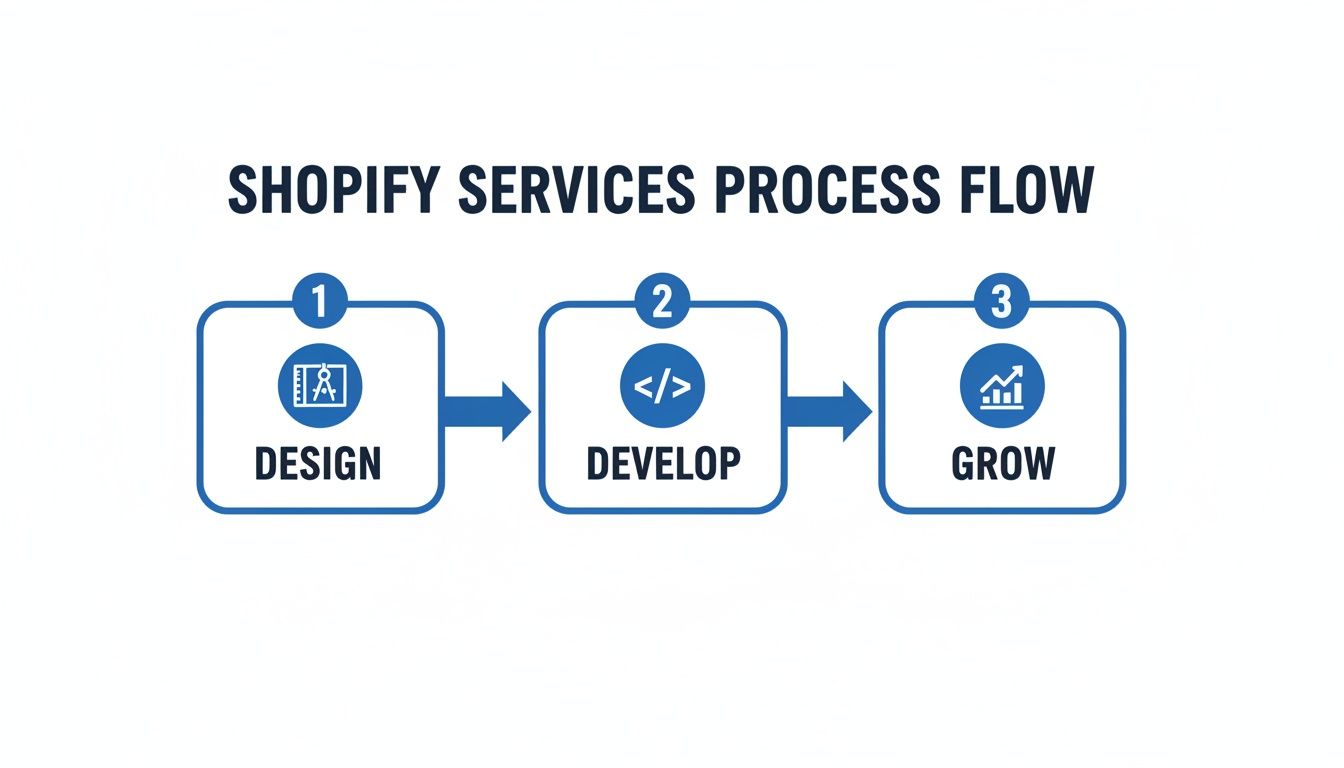
As you can see, the journey doesn't just stop at launch. The real aim is to build a platform that's ready for continuous improvement and growth from day one.
Stage 1: Discovery and Strategy
Honestly, this is the most important part of the whole project. Before a single design element is created, the agency needs to get right inside your business. They need to understand your brand's story, who your customers are, what your competitors are up to, and—most crucially—what you need to achieve commercially. This is less about aesthetics and more about business intelligence.
This deep dive usually involves:
- Stakeholder Workshops: Getting everyone in a room (virtual or otherwise) to agree on project goals, key performance indicators (KPIs), and what success actually looks like.
- Audience Research: Building out detailed customer personas. These aren't just for show; they inform every single design and user experience choice.
- Technical Audit: A proper look under the bonnet of your current setup (if you have one) to spot opportunities and potential hurdles.
The main thing you'll get from this stage is a detailed project brief or strategy document. Think of this as the North Star for the entire project, making sure both your team and the agency are always pulling in the same direction.
Stage 2: Design and User Experience
With a rock-solid strategy in place, the creative work can finally kick off. This isn't just about making your site look pretty; it’s about crafting a customer journey that feels effortless and persuasive. The process generally moves from simple sketches to pixel-perfect designs.
First up, the team will create wireframes. These are the basic skeletal layouts of your store’s key pages. They focus purely on structure and function, mapping out where things like navigation, product filters, and 'buy now' buttons will go.
Once you’ve approved the wireframes, the agency moves on to high-fidelity mockups. These are the full-colour, static designs that show exactly how the final store will look and feel, complete with your branding, fonts, and imagery. This is your chance to see the vision come to life and give detailed feedback before any code gets written. As you move through the project, remember that good communication is key; it's worth brushing up on some client communication best practices to help things run smoothly.
Stage 3: Development and Quality Assurance
Once you’ve signed off on the designs, the developers take the wheel. Their job is to translate those beautiful static mockups into a fully working, interactive Shopify store. This is a very technical phase where the team writes clean, efficient code to build out your custom theme and plug in any necessary apps or other systems.
A common mistake is thinking development is a straightforward, A-to-B process. In reality, most modern agencies work in an agile way, breaking the build into smaller "sprints." This allows for regular check-ins and tiny course corrections, ensuring the final product is a perfect match for the design you approved.
Before your store can go live, it has to get through some serious Quality Assurance (QA) testing. A dedicated QA team will meticulously click every link, test every button, and fill out every form across a whole range of devices and browsers. They check for everything from layouts breaking on a mobile phone to performance issues that could slow your site down. Site speed is massive for conversions, so for a deeper dive, check out our Shopify store speed optimisation checklist. This whole phase is designed to guarantee a flawless launch for your customers.
Stage 4: Launch and Post-Launch Support
The launch is the big moment—the culmination of everyone's hard work. The agency will handle the entire process of pushing your new site live, usually at a quiet time like the middle of the night to minimise any disruption. But their job isn't over yet.
Any good agency will provide post-launch support to iron out any unexpected bugs and ensure a smooth handover. They'll also run you and your team through comprehensive training sessions, giving you the confidence to manage the new store yourselves, from adding new products to updating the homepage. This final step is what turns the project from a one-off job into a valuable, long-term asset for your business.
Getting to Grips with Shopify Agency Pricing Models
Budgeting for professional Shopify store design services can feel like you're trying to hit a moving target, but it’s actually more straightforward than you might think. Agencies don’t just pull numbers out of thin air; they typically use a few well-defined pricing structures.
Getting your head around these models is the first step to finding a partner that fits both your budget and your vision for the business. Let's look at the three most common ways agencies charge for their work.
One-Off Project Fees
This is the simplest model of the lot. A one-off project fee is a fixed price for a specific, clearly defined job. It's a bit like hiring a builder to construct an extension; you agree on the blueprints, the materials, and the total cost before the first brick is laid.
This approach is perfect for projects with a clear beginning and end, such as:
- Building a completely new, bespoke store from scratch.
- Moving your shop from another platform like Magento over to Shopify Plus.
- Carrying out a major redesign of your current Shopify site.
The big win here is predictability. You know exactly what you’re paying and what you’re getting in return. This makes financial planning a breeze and eliminates any worries about costs spiralling out of control. It works best when you have a rock-solid idea of what you want, but it can be less forgiving if you want to make significant changes halfway through.
Monthly Retainers
Think of a monthly retainer as having a team of Shopify experts on speed dial. You pay a recurring fee, and in return, you get continuous, proactive support from an agency's designers, developers, and strategists. This isn't about a single project; it's a long-term partnership focused purely on growth.
This model is designed for ambitious brands that view their website not as a static brochure but as a dynamic sales machine that requires constant fine-tuning.
A retainer shifts the relationship from a one-time transaction to a strategic partnership. The goal isn't just to 'build' the store, but to actively 'grow' it through ongoing improvements to conversion rates, user experience, and overall performance.
Work covered by a retainer often includes ongoing CRO and A/B testing, adding new features, essential technical upkeep, and regular strategy sessions. It’s the ideal setup for established businesses that are serious about staying ahead of the competition.
Hourly Billing
The most flexible way to pay is hourly billing, where you're charged for the exact amount of time the agency spends on your tasks. It’s brilliant for smaller, ad-hoc jobs or when you need a quick fix without committing to a massive project.
You might opt for an hourly rate to:
- Track down and fix a pesky technical bug.
- Make a small design adjustment to a product page.
- Get an expert opinion on a new app you're thinking of installing.
While this offers great agility, the trade-off is a lack of budget predictability. Costs can be difficult to forecast without a set scope, which is why it’s usually best for smaller, well-defined tasks. The key here is to work with an agency that provides detailed time-tracking reports so you always know where your money is going.
How to Choose the Right Shopify Design Partner
Picking the right partner for your Shopify store design is probably the most important decision you’ll make in this whole process. Get it right, and you’ve got a strategic partner who becomes an extension of your team, driving real growth. But get it wrong, and you’re looking at months of frustration, a burnt budget, and a store that just doesn't perform.
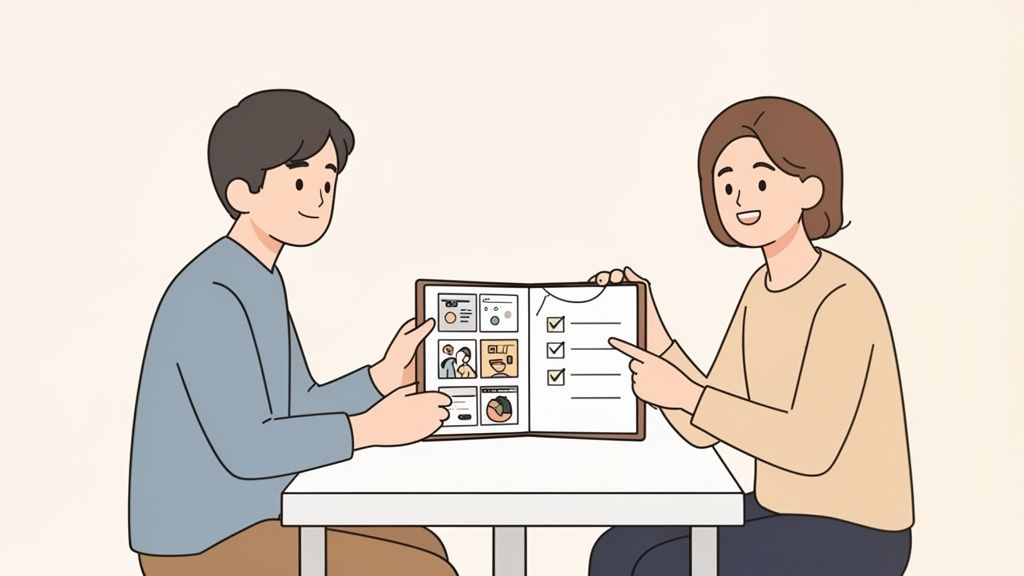
To hire with confidence, you need to go in with a plan. It’s not about being dazzled by a slick presentation; it’s about digging deep to find real proof of their technical skills, strategic thinking, and a solid track record of delivering results you can actually measure.
Look Beyond the Pretty Pictures
Every agency is going to show you a portfolio packed with beautiful websites. That’s a given. Your job is to look past the shiny veneer and analyse their work through a commercial lens. A gorgeous design is completely useless if it doesn't actually guide your customers to the checkout.
When you're flicking through their past projects, ask yourself a few questions:
- Is the navigation intuitive? Can you find what you’re looking for easily, without having to think about it?
- Are the product pages persuasive? Do they use great photography, clear calls-to-action, and compelling copy to build desire and trust?
- Is the checkout process frictionless? How many clicks does it take to buy something? Are there annoying pop-ups or distractions getting in the way?
This isn’t about your personal taste. It’s about spotting a conversion-first design philosophy. The best agencies design with the customer journey at the heart of everything, meticulously crafting each element to reduce friction and, ultimately, boost sales.
Demand Proof of Performance
Client testimonials are nice, but detailed case studies are what really matter. Vague claims like "they increased our sales" just don't cut it. You need to see cold, hard data that shows they can move the needle on the metrics that matter to your business.
A top-tier agency doesn't just deliver a website; they deliver results. Their case studies should be filled with hard numbers, showcasing uplifts in conversion rates, average order value, and revenue.
Look for specific examples of how they solved a client's problem. Maybe they built a custom product bundling feature that pushed up the Average Order Value (AOV). Or perhaps their SEO audit led to a tangible jump in organic traffic. This is the kind of proof that separates the real experts from the rest.
Consider this: the average conversion rate for UK Shopify stores is a surprisingly low 1.4%. That fact alone highlights a huge opportunity for improvement. An agency that can show you exactly how they’ve helped businesses smash that benchmark has the expertise you need. You can read more about these key Shopify statistics and what they mean for UK merchants.
The Agency Selection Checklist
Finding the right partner is about more than just a gut feeling. A structured checklist helps you compare apples to apples and make an informed decision, not an emotional one. Use this table to systematically evaluate each potential agency.
| Evaluation Criterion | What to Look For | Red Flags to Avoid |
|---|---|---|
| Portfolio & Case Studies | Data-driven results (conversion lift, AOV), designs that match your aesthetic, industry-relevant experience. | Vague success claims, outdated designs, no measurable results shown. |
| Technical Expertise | In-house developers, experience with complex integrations (ERP, CRM), a strong focus on page speed. | Outsourced development, hesitation when asked about technical challenges, no performance optimisation strategy. |
| Communication & Process | A dedicated project manager, clear timelines, a structured feedback process, weekly progress updates. | Vague timelines, no single point of contact, disorganised communication channels, "we'll figure it out as we go". |
| Strategic Approach | Questions about your business goals, target audience, and long-term vision. | A sole focus on design aesthetics without asking about business objectives, a one-size-fits-all approach. |
| Team & Culture Fit | A team that feels like a genuine partner, transparent and honest communication, chemistry during calls. | A pure "vendor" relationship, poor responsiveness, a feeling that you're just another project number. |
By the end of this process, you should have a clear picture of which agency not only has the skills but also feels like the right fit for your team.
Ask the Right Questions
Your first few calls with an agency are a two-way street. They're sizing you up, and you should be doing the same. This is your chance to probe their process, communication style, and technical depth. Don't be afraid to get into the details.
Here are a few essential questions to get you started:
Process and Communication:
- What does your typical project timeline look like, from the first discovery call to launch day?
- Who will be my main point of contact, and how often can I expect to hear from them?
- How do you guys handle feedback and revisions? Is there a set number of rounds?
Technical Expertise:
- Do you build custom themes from the ground up or do you work with pre-existing ones?
- Can you give me an example of a really complex integration you’ve handled, like with an ERP or a custom CRM?
- How do you tackle site speed and performance optimisation during the build?
Strategic Alignment:
- How will you make sure the final design actually reflects our brand and helps us hit our sales targets?
- What happens after the site goes live? Do you offer support or optimisation retainers?
- How do you measure whether a project was successful once it’s out in the wild?
Their answers will tell you everything you need to know about their professionalism and whether their way of working will click with yours. A partner who gives you clear, confident, and straight answers is one you can trust to see your project through to a successful launch. At the end of the day, it's about finding a team whose culture and expertise are a perfect match for your ambitions.
Common Pitfalls to Avoid When Hiring an Agency
Knowing what can go wrong when you hire someone for Shopify store design services is the best way to keep your project on track and your budget in one piece. Kicking off a new build or a redesign is exciting, but a few common missteps can quickly sour the whole experience. Think of this section as your playbook for a smooth, successful partnership.
One of the biggest project killers is scope creep. It always starts with a seemingly small request. "Could we just add a quick feature here?" or "What if we tweaked this page layout a little?" Individually, these changes feel minor, but they stack up fast. Before you know it, the project's complexity has ballooned, the deadline is a distant memory, and the budget is blown.
The only real defence against scope creep is an ironclad project brief. Before a single line of code is written, you need to document every feature, deliverable, and goal. This document becomes the North Star for both you and your agency, making sure everyone is pulling in the same direction.
Misaligned Priorities: Aesthetics vs. Conversions
Another classic mistake is falling for a design that looks incredible but doesn't actually sell anything. It's easy to be wowed by a visually stunning concept that might win awards, but if it doesn't guide customers to the checkout, it's a commercial failure.
A top-tier agency knows how to balance beautiful design with functionality that converts. They'll back up their design choices with data, explaining why a certain layout or call-to-action is placed where it is to improve the user journey and drive sales. Your focus should always be on clarity, usability, and persuasion—not just pretty pictures.
A successful Shopify store is a carefully engineered sales machine, not just a digital art gallery. Every pixel should have a purpose, and that purpose should be to move a customer closer to making a purchase.
Communication Breakdowns and Hidden Costs
When communication breaks down, the entire project can turn toxic. Vague updates, missed check-ins, and slow response times breed uncertainty and destroy trust. You need to set clear expectations from day one for how you'll communicate.
To get ahead of this, make sure your agreement includes a clear communication plan:
- A dedicated point of contact: Who is your go-to person at the agency?
- Regular progress updates: Will you have weekly calls or daily stand-ups?
- Defined feedback loops: How do you submit feedback, and what's the expected turnaround time for changes?
Just as damaging are the hidden costs that pop up unexpectedly. Some agencies might tempt you with a low initial quote, only to pile on extra charges later for "out-of-scope" work, essential apps, or post-launch support. Your contract should spell out exactly what's included and, just as importantly, what isn't. There should be zero financial surprises.
The Dangers of a One-Size-Fits-All Approach
Finally, be cautious of any agency that pushes a templated solution without first getting to know your brand, your audience, and your business goals. Your business is unique, with its own challenges and opportunities. Your Shopify store needs to be built to tackle them head-on.
An agency that jumps straight into design without a proper discovery phase is waving a massive red flag. A real partner invests time upfront to learn your business inside and out. It’s this initial strategic work that leads to a custom solution that delivers real, measurable results and ensures your investment pays off for years to come.
Frequently Asked Questions
When you start looking into professional Shopify store design services, a lot of questions pop up. We get it. Here are some straight-talking answers to the most common queries we hear, designed to help you understand the investment, timelines, and what it all means for your brand.
How Much Does Professional Shopify Store Design Cost?
The price tag can swing pretty wildly, and it all comes down to what you actually need. For a straightforward brand refresh that involves customising an existing theme, you might be looking at a few thousand pounds. It's a fantastic option for new businesses that need to get up and running without breaking the bank.
On the other end of the spectrum, a completely bespoke Shopify Plus build is a different beast entirely. We’re talking custom-coded features, complex integrations, and a one-of-a-kind design. These projects typically start around £20,000 and can go north of £100,000. Any good agency will give you a transparent, itemised quote, so you’ll know exactly where your money is going, whether it’s a fixed project fee or a monthly retainer for ongoing support.
How Long Does a Shopify Project Take?
Just like cost, the timeline is tied directly to the project's scope. If you're launching a store using a pre-built theme with some customisations, you could be live in as little as 4-6 weeks. This is perfect if speed to market is your top priority.
A full-scale custom design and development project is more of a marathon than a sprint, usually taking 3-4 months from the first kickoff meeting to launch day. If you're migrating a large, complex store from a platform like Magento, expect it to take longer due to the sheer volume of data and technical hurdles. Your agency should provide a detailed project plan with clear milestones from the get-go.
The most important thing is a clear timeline with defined stages. This ensures everyone is aligned and the project moves forward without unnecessary delays, turning a complex process into a manageable one.
Can I Manage the Store Myself Afterwards?
Absolutely! That’s one of the best things about Shopify. Its back-end is built for business owners, not coders. A top-tier agency doesn’t just build your store; they empower you to run it. They should provide thorough training to get your team comfortable with managing day-to-day operations.
You'll be able to confidently handle things like:
- Adding new products and updating existing ones.
- Managing inventory levels and organising collections.
- Writing blog posts and tweaking page content.
- Setting up sales and managing discount codes.
And for the more technical bits or ongoing strategy, you can always keep the agency on a flexible support retainer.
What Is the Difference Between Theme Customisation and a Custom Build?
Think of it like buying a house. Theme customisation is like buying a fantastic new-build and then redecorating it to match your style. You're working with a solid, pre-existing structure but making it your own. It's a quicker and more budget-friendly route, ideal for startups or businesses with fairly standard e-commerce needs.
A custom build, on the other hand, is like hiring an architect to design and build your dream home from the ground up. Every single element is created exclusively for your business. This gives you complete creative freedom for a truly unique user experience and allows for highly specific functionality, but it naturally requires a much bigger investment in both time and money.
Ready to transform your Shopify store into a high-performing sales engine? At Grumspot, we deliver bespoke design and development that drives real growth. Let's build your success story together.
Let's build something together
If you like what you saw, let's jump on a quick call and discuss your project
Related posts
Check out some similar posts.