How to Increase Average Order Value A UK Merchant's Playbook
- upselling tactics
- UK ecommerce
Launched
February, 2026
If you want to grow your ecommerce business, you have two basic levers: get more customers or get your existing customers to spend more. While acquisition is crucial, the real secret to profitable growth often lies in the latter.
To increase your average order value (AOV), you need a smart strategy that encourages customers to add more to their baskets. Think strategic product bundles, compelling free shipping thresholds, and well-timed upsells. It’s about boosting revenue and profitability without constantly pouring more money into customer acquisition.
Understanding Average Order Value For UK Brands
Average Order Value, or AOV, is one of those ecommerce metrics you simply can't ignore. It’s a health check for your business, telling you precisely how much customers spend, on average, every time they place an order.
The formula couldn't be simpler: Total Revenue ÷ Total Number of Orders = Average Order Value. So, if your Shopify store pulled in £50,000 from 1,000 orders last month, your AOV is a neat £50. Simple, right? But the implications are huge.
Why AOV Is A Strategic Lever For Growth
When you focus on increasing your AOV, you're directly padding your bottom line. It’s your best defence against the ever-rising costs of acquiring customers, especially on paid ad platforms. A higher AOV makes every single conversion more profitable, which means your return on ad spend (ROAS) gets a healthy boost.
But it’s not just about the immediate cash injection. A strong AOV often leads to a higher customer lifetime value (CLV). Customers who find real value in your bundles or upsells tend to be more satisfied and are more likely to come back for more. It’s a virtuous cycle.
Of course, to effectively implement these AOV-boosting tactics, you need the right tech stack. Exploring The Ultimate Ecommerce Platform Comparison for Business Growth can be a massive help in making sure your platform can support these kinds of growth initiatives.
Shifting your focus from pure acquisition to maximising the value of each transaction builds a much more resilient and profitable business. A 10% increase in AOV will almost always have a bigger impact on your margin than a 10% increase in traffic.
Setting Realistic AOV Benchmarks
So, what’s a “good” AOV? Honestly, it depends. The UK market is diverse, and benchmarks vary wildly from one industry to another. A fashion brand might be happy with an AOV of £80, whereas a furniture store could easily see figures over £250.
Several factors will influence your number:
- Product Price Points: Naturally, if you sell higher-ticket items, your AOV will be higher.
- Industry Norms: The baseline for consumer electronics is worlds away from that of beauty products.
- Business Model: Subscription businesses might have a lower initial AOV, but they make up for it with a much stronger CLV.
The real goal isn't to hit some arbitrary industry number. It's to steadily and consistently increase your own baseline AOV, month after month. This playbook is designed to show you exactly how to do that.
Powerful Upselling And Cross-Selling Tactics To Implement Now
Everyone knows upselling and cross-selling are core to lifting average order value, but getting them right is more art than science. Today’s shoppers can spot a clumsy, aggressive sales pitch a mile off. The real goal isn't to shoehorn an unwanted product into their cart; it’s to be a genuinely helpful guide, showing them solutions they might not have even considered.
The secret sauce is all in the timing and relevance. A perfectly placed offer feels less like a sales tactic and more like a personalised service, making the whole shopping experience better. When you nail this, you don't just see a healthier AOV—you build real trust by showing customers you get what they need. For a solid primer on the fundamentals, this guide on Upselling and Cross-Selling is a great starting point.
Pre-Purchase Upsells On The Product Page
Your Product Detail Page (PDP) is prime real estate for your first—and often best—shot at an upsell. A customer on this page has serious buying intent, but they haven't yet pulled the trigger. This is the perfect moment to introduce a premium or upgraded version of the exact product they're looking at.
Think about it: someone eyeing a standard 250g bag of coffee could easily be tempted by a 1kg bag that offers much better value per gram. Or a shopper considering a basic moisturiser might see an option with added SPF protection for just a few quid more.
This approach works because it anchors the customer to their original choice. The upsell is framed not as a different product, but as a marginal price increase for a significant bump in value or features. It’s simply a better version of what they already want.
In-Cart Cross-Selling And Bundling
Once an item makes it into the cart, the customer's commitment level shoots way up. Now's the time for smart cross-selling. The classic "frequently bought together" section is a goldmine here, as long as the suggestions are genuinely useful.
If someone buys a camera, they're almost certainly going to need a memory card, a spare battery, or a protective case. A customer purchasing a new dress shirt? They’re a perfect candidate for matching cufflinks or a silk tie. These aren't random suggestions; they're thoughtful additions that solve a problem and make the customer's life easier. To explore the tools that make this happen, have a look at our rundown of 10 essential Shopify apps for higher conversion rates.
This infographic breaks down the simple but crucial formula for calculating AOV, showing how revenue and order count are directly linked.
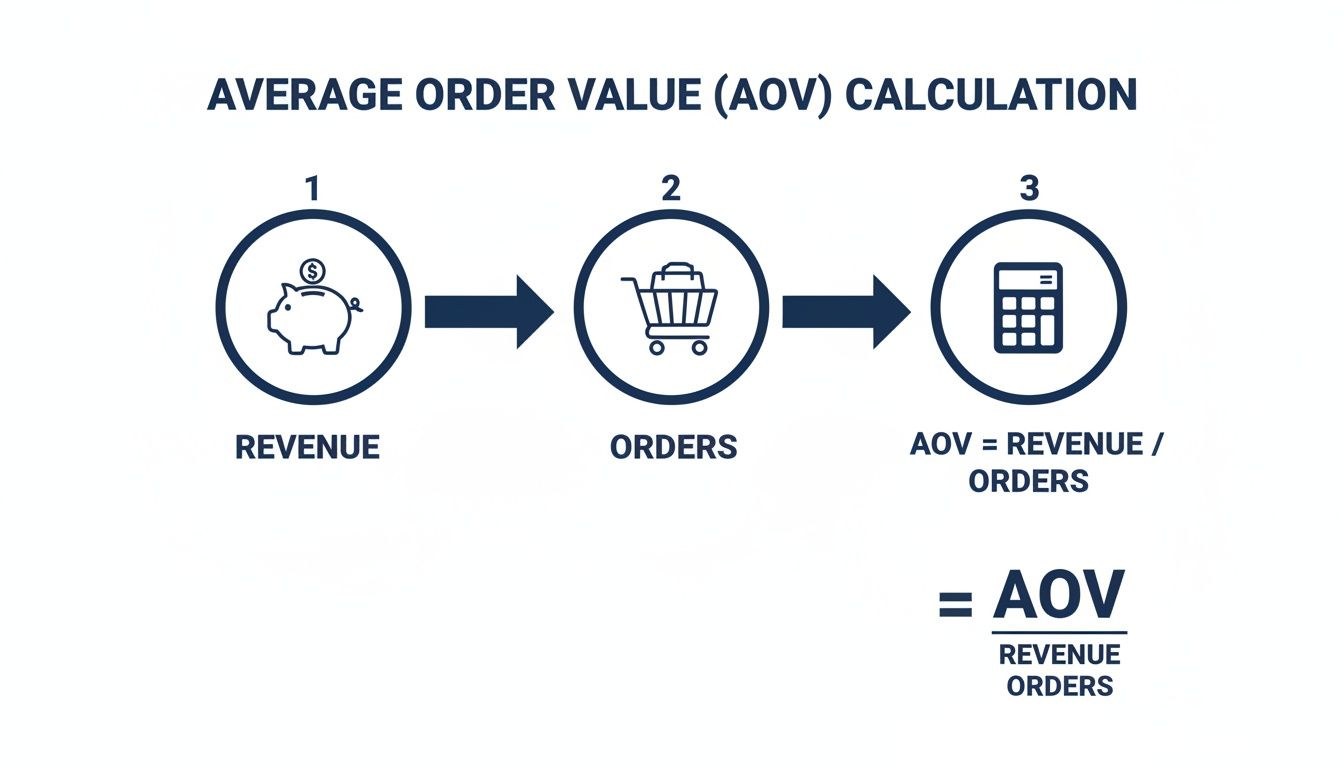
As you can see, boosting AOV comes down to increasing total revenue without the number of orders necessarily changing, or at least having revenue grow at a much faster rate.
Post-Purchase One-Click Add-Ons
The post-purchase offer is probably the most potent—and most overlooked—tactic in the playbook. Why? Because the initial transaction is already done. There's zero risk of spooking them into abandoning their cart. They've already put their trust (and their card details) in your hands, and their "buyer's high" is at its peak.
This is the ideal moment to slide in a compelling, low-cost item they can add with a single click.
- Offer a related accessory. Just sold a laptop? A discounted protective sleeve is a no-brainer.
- Suggest a sample-sized product. If a customer just bought a full-sized bottle of shampoo, they’d likely be interested in trying the matching conditioner for just a few pounds.
- Provide an exclusive, time-sensitive discount. "Add this travel kit to your order for 50% off, just for today."
The data doesn't lie. Personalisation and smart upsells are having a huge impact on UK Shopify stores. While overall online sales grew by a modest 1%, average transaction values jumped by 7% year-over-year. It's also worth noting where customers are buying from. Desktop orders average around £98, significantly higher than the £75 average on smartphones, which tells you there's a big opportunity to present more complex or higher-value offers on larger screens.
The Art Of Strategic Bundling And Product Grouping
If an upsell is about upgrading a single choice, bundling is about expanding the entire purchase. It's one of the most reliable and customer-friendly ways to lift your average order value because it taps directly into powerful psychological triggers: convenience, perceived value, and the simple joy of discovery.
When you group products together intelligently, you're not just moving more units; you're selling a complete solution. You take the guesswork out of it for your customers, saving them the mental energy of hunting down complementary products on their own. This small shift from selling individual items to offering curated experiences can be a complete game-changer for your AOV.
Why Bundling Is So Effective
The real power of a good bundle is how it reframes the customer’s perception of value. Instead of mentally adding up the cost of each individual item, their focus shifts to the overall saving and the convenience of getting everything they need in one go.
This strategy is especially potent in the UK e-commerce landscape, where shoppers are more value-conscious than ever. Strategic bundling has proven to be an effective counter to rising costs, with the Food & Drink sector seeing an 8.83% year-over-year jump in AOV in December 2025 alone. The tactic works because it aligns perfectly with the 'savvy shopper' mentality, helping brands outperform the market even when overall e-commerce growth is slow. You can dig into more UK e-commerce trends and what drives them on netguru.com.
A well-designed bundle feels less like a sales pitch and more like an expert recommendation. It tells the customer, "We know what works well together, and we've made it easy for you to get the complete package at a better price."
AOV Boosting Tactics Comparison
To see where bundling fits into the wider AOV strategy, let's compare it against other common tactics. Each has its place, but their impact and complexity can vary significantly.
| Tactic | Potential AOV Lift | Implementation Complexity | Best For |
|---|---|---|---|
| Product Bundles | High (10-60%) | Medium (Requires app or custom dev) | Selling complementary items or creating gift sets. |
| In-Cart Upsells | Medium (5-20%) | Low-Medium (App-based) | Suggesting related items or upgrades before checkout. |
| Free Shipping Threshold | Low-Medium (5-15%) | Low (Shopify settings) | Motivating customers to add one more small item. |
| Post-Purchase Upsells | Medium (5-20%) | Low-Medium (App-based) | Offering a one-click add-on after payment is complete. |
| Subscriptions | High (Increases LTV) | Medium (App-based) | Brands with consumable products and repeat customers. |
This table shows that while bundles require a bit more setup, their potential payoff is one of the highest. They actively help customers discover and buy more in a single, seamless transaction.
Different Types Of Bundles To Consider
Not all bundles are created equal, and the right approach really depends on your product catalogue and how your customers shop. The goal is always to find the format that offers the most value with the least friction.
Here are a few proven bundling techniques to get you started:
- Pure Bundles: These are fixed sets of products that can only be bought together. Think of a skincare brand's "Complete Morning Routine Kit" or a "Newborn Starter Pack." This is brilliant for introducing customers to a full range of your products at once.
- Mixed Bundles: This is your classic "buy more, save more" deal. You've seen it everywhere: "Buy any three t-shirts for £50" or "Get a free lens cleaner when you buy any camera." It gives customers a sense of control while encouraging them to pop more in their basket.
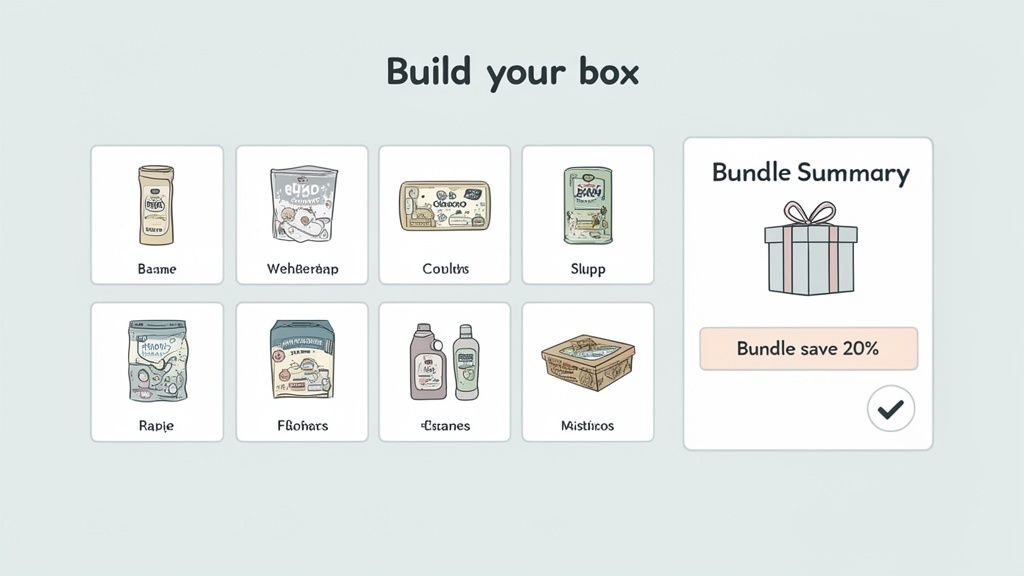
- 'Build Your Own Box' Bundles: This interactive format puts the customer firmly in the driver's seat and is hugely popular for gifts, food, and cosmetics. Letting people choose from a curated selection to build their own package combines the appeal of a discount with the satisfaction of personalisation.
A Case Study In AOV Transformation
The 'build your own box' model can produce truly dramatic results. We recently worked with a client to develop a custom bundle creator app, and the impact was immediate. By giving customers the freedom to build their own unique product assortments, the brand saw a staggering 61% lift in AOV.
The success wasn't just about the discount; it was about the experience. The interactive nature of the bundle builder turned a standard transaction into a genuinely engaging activity. Customers became more invested and, as a result, explored—and bought—far more of the product range.
How To Spot Your Best Bundling Opportunities
Finding the right products to pair together isn't about guesswork; it's about data. The first place you need to look is your existing Shopify analytics.
Start by asking yourself these questions:
- Which products do people already buy together? Your order data is a goldmine. If customers are consistently buying your shampoo and conditioner at the same time, that's your most obvious bundle right there.
- What's my hero product? Identify your absolute bestseller and then think about what accessories or companion products would make it even better. If you sell a popular coffee maker, bundling it with filters, a bag of beans, and a branded mug is a natural fit.
- What products are great for new customers? Grouping smaller, lower-priced items into a "taster pack" or "starter kit" can be an excellent way to win over new customers who might be hesitant to commit to a full-sized product on their first visit.
By digging into this data, you can move from hunches to a data-driven bundling strategy. You'll not only increase your average order value but also provide genuine, thoughtful value to your customers.
Using Shipping Thresholds And Tiered Discounts To Encourage Spending
Let's be honest, unexpected shipping costs are one of the biggest reasons people abandon their carts. I’ve seen it kill conversion rates time and time again. But what if you could flip that on its head? When you frame it correctly, shipping can actually be one of your most effective tools for bumping up your average order value.
The psychology here is pretty straightforward. People hate paying for delivery. In fact, research shows around 58% of shoppers will actively add more to their basket just to avoid a shipping fee.
The key is to move beyond a static "free shipping over £50" banner slapped at the top of your site. A smart strategy is about setting your threshold deliberately and, crucially, communicating it dynamically throughout the shopping journey. You’re essentially turning the shipping fee from a penalty into an achievable goal.
Setting The Perfect Free Shipping Threshold
Your free shipping threshold can't be a random number you've guessed. There’s a sweet spot, and from what I've seen across countless stores, it's usually 15-20% above your current Average Order Value.
Why? Because this amount feels attainable. It nudges a customer to add one more small item, rather than making them feel like they have to double their order. For example, if your AOV is sitting at £65, a £75 free shipping threshold is the perfect target. It encourages that extra spend without creating so much friction that they just give up.
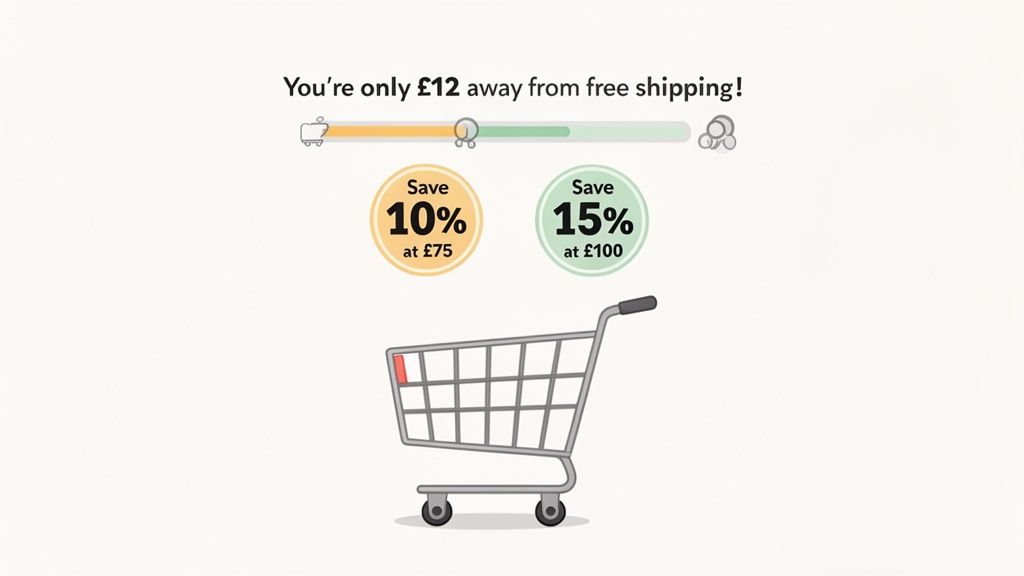
A dynamic message in the cart that says, "You're only £12 away from free shipping!" is incredibly powerful. It instantly reframes the situation from a negative ("I have to pay for delivery") to a positive challenge ("I'm so close to getting a reward!"). This simple bit of gamification works wonders.
Implementing Dynamic Cart Messaging On Shopify
The good news is that many modern Shopify themes have a free shipping progress bar built right in. You can typically switch this on in your theme customiser, usually under the "Cart" or "Header" settings.
If your theme doesn't have it, or you want more control, the Shopify App Store is your best bet. When you're browsing for an app, look for these features:
- Real-time updates: The progress bar and messaging need to change instantly as items are added or removed.
- Product suggestions: The best apps can recommend specific, low-cost products to help a customer cross the threshold.
- Geotargeting: If you sell internationally, being able to set different shipping thresholds for different countries is a must-have.
The Power Of Tiered Discounts
While free shipping appeals to our logical side (avoiding a fee), tiered discounts tap into our desire for a great deal. This strategy is all about offering bigger and better discounts as the basket value goes up, gamifying the spending process and making larger orders feel like a real win.
A classic tiered structure might look like this:
- Spend £75, get 10% off
- Spend £100, get 15% off
- Spend £150, get 20% off
This works so well because it gives the customer a clear ladder to climb. A shopper who has £85 in their basket can see they’re just £15 away from a bigger discount. It’s an easy decision to add one more thing, encouraging them to browse a little longer to hit that next rewarding milestone.
Choosing The Right Discount Structure
Before you roll this out, you absolutely have to make sure your margins can handle it. Run the numbers and model out the potential impact on your profitability.
You have a few ways you can structure these tiers:
- Percentage-Based: The most common method, offering a simple percentage off the total order.
- Fixed Amount: A set monetary value, like "Save £10 on orders over £100". This can be much easier to control from a margin perspective.
- Free Gift: Offer a free product when a customer hits a certain spend. This is a fantastic option if the gift has a high perceived value but is relatively low-cost for you.
Setting these up on Shopify is simple enough. You can use the native "Discounts" feature in your Shopify admin to create automatic discounts that kick in when certain cart conditions are met. For more complex logic or eye-catching visual promotions in the cart, you'll find plenty of apps in the Shopify App Store that give you the extra functionality needed to create a compelling offer.
Building Loyalty and Recurring Revenue with Subscriptions
While tactics like bundling and shipping thresholds give you an immediate AOV lift, a truly sustainable growth strategy is built on something far more durable: loyalty. The real win isn't just a bigger one-off sale; it's turning a single transaction into a long-term relationship. This is precisely where subscription models and membership programmes come into their own.
By moving from one-time purchases to predictable, recurring revenue, you not only stabilise your cash flow but also dramatically increase customer lifetime value (LTV). What's more, subscribers often have a higher AOV over time. They become more invested in your brand and are far more likely to add new products or upgrades to their recurring orders.
Identifying Your Best Subscription Candidates
Let's be realistic: not every product is a natural fit for a 'subscribe and save' model. The best candidates are almost always consumables—things customers use up and need to buy again. Sift through your product catalogue and ask yourself, which items already drive repeat purchase behaviour?
Your best bets for subscription success are usually in these categories:
- Coffee and Tea: These are daily rituals, making them perfect for monthly deliveries.
- Vitamins and Supplements: Health routines depend on consistency, so automated re-ordering is a genuine convenience.
- Skincare and Cosmetics: Products like moisturisers, cleansers, or foundation are used daily and run out on a predictable schedule.
- Pet Food and Supplies: A classic example. For devoted pet owners, running out is simply not an option.
- Cleaning Products: Household essentials that are always needed.
The trick is to frame your subscription as a convenience service, not just a discount. You’re telling the customer, "Never run out of your favourites again." That combination of convenience and savings is what makes the model so powerful.
Structuring a Compelling Membership Programme
Beyond simple product subscriptions, a dedicated membership programme can create a powerful sense of community and exclusivity. This is about more than just a discount; it's about making your most loyal customers feel like VIPs with access to perks others don't get.
A great programme needs a mix of real and perceived benefits that your customers will actually value. Think about offering things like:
- Exclusive Content: Early access to new product launches, behind-the-scenes content, or expert tutorials.
- Members-Only Products: Limited-edition items or special colourways available only to subscribers.
- Priority Customer Service: A dedicated support line or faster response times for members.
- Free Shipping on All Orders: This is a huge psychological win that encourages more frequent, smaller purchases between their main subscription deliveries.
The aim is to build a value proposition so strong that the monthly or annual fee feels like an absolute bargain. To get into the nitty-gritty, you can learn more about how expert subscription services can be integrated seamlessly into your store.
Choosing the Right Shopify Subscription App
You'll need a dedicated app to implement a robust subscription service on Shopify. The ecosystem is well-established, with several excellent options available. For UK merchants, two of the most popular choices are Recharge and Skio, and each has its own strengths.
Recharge is the long-standing industry leader. It's known for its powerful features, rock-solid reliability, and extensive integrations. It’s a fantastic choice for established brands that need deep customisation or have complex logistical requirements.
Skio, on the other hand, is a more modern contender that’s gained a lot of traction for its slick user interface and clever features, like group subscriptions and passwordless logins. It often appeals to brands looking for a polished out-of-the-box experience and innovative marketing tools.
When you're comparing platforms, focus on the customer's experience. How easily can they manage their own subscription? Can they swap products, skip a delivery, or change the frequency without any fuss? A frictionless management portal is non-negotiable for reducing churn and keeping your subscribers happy. By putting loyalty first, you don't just increase your AOV for a single month—you build a foundation for consistent, predictable growth.
Measuring Success And Optimising Your AOV Strategy
So, you’ve launched a new upsell flow or a free shipping threshold. That's a great first step, but it's only half the battle. If you're not tracking performance, you’re basically flying blind. You have no real way of knowing which efforts are actually moving the needle.
For any kind of sustainable growth, you need a data-driven approach.
This means looking beyond just the AOV figure itself. While it’s the headline metric, a truly successful strategy balances it with other crucial Key Performance Indicators (KPIs). For example, I’ve seen new bundle offers that looked great on paper and did increase AOV, but they also accidentally tanked the site's overall conversion rate. The result? Less total revenue.
The goal is not just to increase average order value in isolation. It's to find the sweet spot where AOV, conversion rate, and customer lifetime value (LTV) all work together to drive profitable growth. A win in one area shouldn't come at a significant cost to another.
Key Metrics To Track
To get a complete picture, you need to monitor a handful of core metrics. Think of these KPIs as providing the essential context for your AOV number, helping you make smart decisions and refine your strategy over time.
Your AOV dashboard should definitely include:
- Conversion Rate: The percentage of visitors who actually make a purchase. You have to keep a very close eye on this when testing any new offers. If you need a refresher on the basics, our guide on what conversion rate optimisation is and how it works is a great place to start.
- Items Per Order: This is a simple but powerful metric. It tells you pretty quickly if your bundling and cross-selling tactics are working.
- Customer Lifetime Value (LTV): Are your AOV-boosting tactics encouraging repeat purchases and building long-term loyalty, or are they one-off tricks?
- Margin Per Order: This one is critical. You must ensure your discounts and offers aren’t eating so far into your profits that the AOV lift becomes meaningless.
Running Effective A/B Tests
Guesswork has no place here. The only way to know for sure what works is to test it. A/B testing is how you validate your ideas with real customer data, turning assumptions into certainties.
Whether you're using a Shopify app like Intelligems or a more advanced platform, the principles are the same: isolate one variable and test it until you get a statistically significant result.
Not sure where to start? Here are a few ideas to get you going:
- Offer Placement: Does a cross-sell perform better on the product page, in a pop-up, or directly in the cart?
- Bundle Composition: Which specific combination of products drives the most sales? Test different product mixes.
- Shipping Threshold: Does a £60 threshold convert better than a £75 one? Small changes can make a big difference.
- Discount Wording: Is "Save 20%" more compelling than "Get £15 Off"? The psychology of pricing is powerful.
By systematically testing and digging into the results in tools like Shopify Analytics and Google Analytics, you create a powerful feedback loop. This process lets you continuously refine your tactics, ensuring every change you make is a data-backed step towards a higher, more profitable average order value.
Common AOV Questions Answered
When you first start trying to boost your average order value, a few questions always pop up. Let's cut through the noise and get straight to the answers you need to build a strategy that genuinely works for your brand.
"How Do I Set the Right Free Shipping Threshold?"
This is probably the most common question I hear. A great starting point is to find your current average order value and then set the free shipping bar about 15-20% higher.
Why that number? It’s the sweet spot. It feels attainable enough to encourage shoppers to add one more small item to their cart, rather than making them feel like they need to double their entire order just to get free delivery.
"How Can I Upsell Without Annoying My Customers?"
Nobody likes a pushy salesperson. The secret to upselling effectively is all about relevance and timing. Your offer should feel like a genuinely helpful suggestion, not a desperate cash grab.
Try offering a premium version of a product right there on the product page. Or, even better, use a one-click add-on after the initial purchase is complete. This respects the customer's decision-making process and doesn't interrupt their path to checkout.
"Are There Other Metrics I Should Track Besides AOV?"
Absolutely. Focusing on AOV in isolation can give you a dangerously narrow view of your store's health. You need to see the bigger picture.
Make sure you're also keeping a close eye on:
- Conversion Rate: This tells you if your new offers are creating friction or scaring potential buyers away.
- Items Per Order: This is a direct indicator of whether your bundling and cross-selling efforts are actually landing.
- Customer Lifetime Value (LTV): Are you building real, long-term loyalty or just chasing short-term gains? LTV has the answer.
"Will Increasing AOV Hurt My Conversion Rate?"
It certainly can, but only if it's done badly. Forcing irrelevant upsells on people or setting a ridiculously high shipping threshold is a one-way ticket to abandoned carts.
Your goal is to find that delicate balance where AOV climbs without your conversion rate taking a nosedive. This is precisely why A/B testing is non-negotiable. It allows you to test your offers and find the perfect equilibrium that boosts total revenue, not just the value of a single transaction.
Always remember to lead with genuine value. A strategy that helps customers discover products they'll love will always win out over one that just feels manipulative.
Ready to turn these insights into a high-performing Shopify Plus store? The expert team at Grumspot specialises in building and optimising ecommerce experiences that drive real growth. Let's talk about scaling your AOV.
Let's build something together
If you like what you saw, let's jump on a quick call and discuss your project

Related posts
Check out some similar posts.
- ecommerce replatforming agency
Choosing an ecommerce replatforming agency? Learn what they do, replatforming signs, costs, timeline...
Read more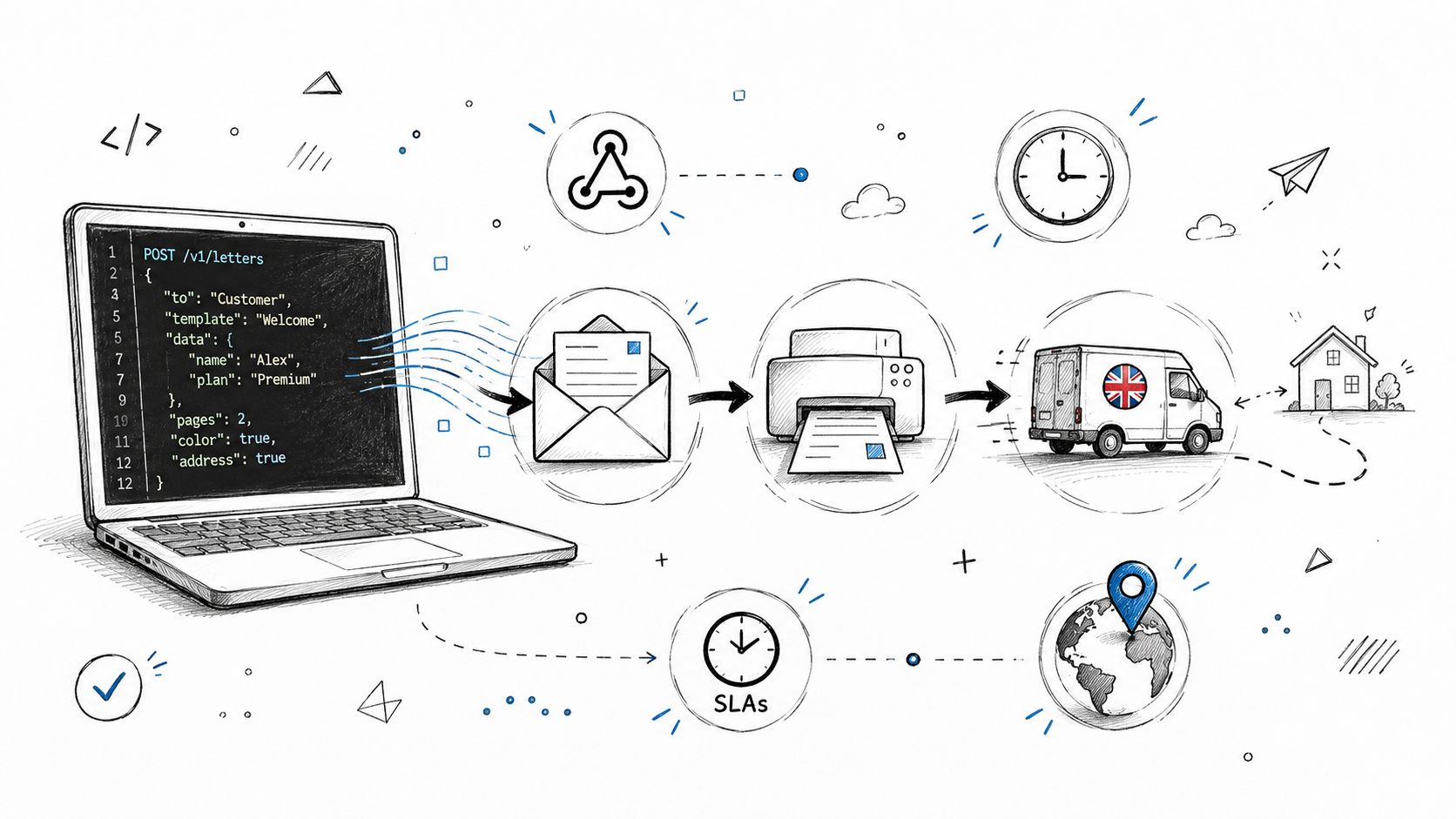
- print and mail API
Learn how a print and mail API works, what to look for in a UK-ready provider, and how to integrate ...
Read more
- Shopify maintenance agency
What is a Shopify maintenance agency and do you need one? Our 2026 guide covers services, pricing, h...
Read more
- Shopify AOV optimization
Boost your revenue with our Shopify AOV optimization guide. Discover actionable tactics, Plus-specif...
Read more