What Is Conversion Rate Optimization A Practical Guide
- what is conversion rate optimization
- cro guide
Launched
January, 2026
Let's cut through the jargon. At its core, Conversion Rate Optimisation (CRO) is the process of fine-tuning your website so that a higher percentage of visitors take the action you want them to. It’s about turning more browsers into buyers, more lurkers into subscribers—all without necessarily spending a penny more on advertising to get them there.
Think of it as making the most of the audience you already have.
Understanding Conversion Rate Optimisation
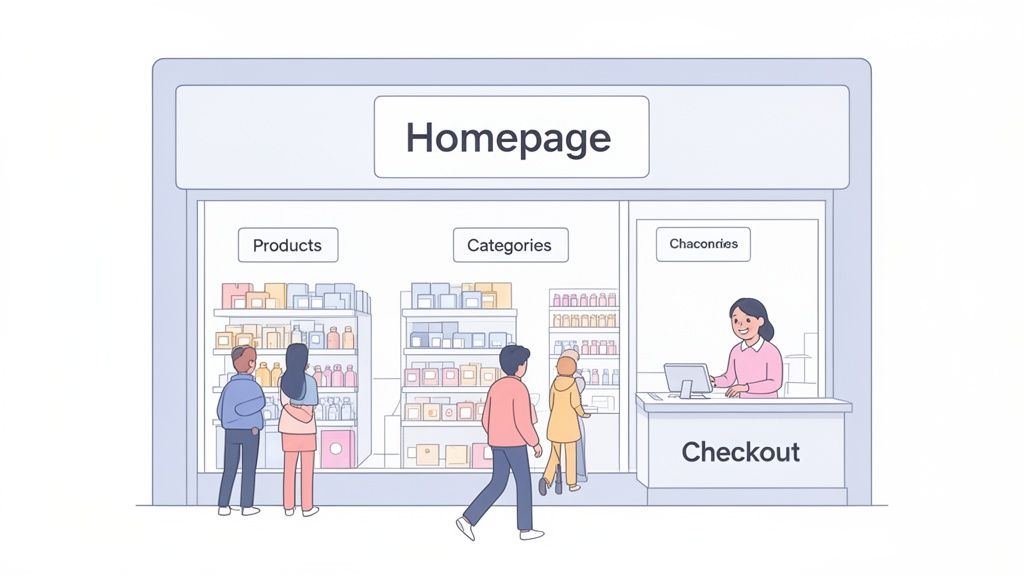
Picture your Shopify store as a high-street shop. You’ve invested in slick marketing to bring people through the door. Great. But what happens next? Are the aisles cluttered? Is the path to the till confusing? Can people easily find what they’re looking for?
CRO is simply applying that same real-world logic to your online store. It's the art and science of perfecting the customer’s journey on your site.
Instead of constantly chasing new traffic, CRO helps you get more value from the visitors who are already there. It's a structured approach that uses data, customer feedback, and disciplined testing to smooth out the bumps in the road and make it incredibly easy for people to say "yes".
The Core Idea Behind CRO
So, what’s the big idea? It’s all about getting inside your customers' heads. You need to understand what drives them, what excites them, and, most importantly, what’s stopping them from converting.
By pinpointing those points of friction—whether it's a clunky checkout form, a page that takes forever to load, or a product description that just doesn't connect—you can make smart, targeted changes.
These aren't wild guesses. They are calculated improvements designed to create a better, more intuitive user experience. A happy user is far more likely to become a customer, which directly boosts your conversion rate. A "conversion" is just a fancy term for any important action you want a visitor to take. This could be anything from:
- Making a purchase
- Adding an item to their basket
- Signing up for your newsletter
- Downloading a lookbook
CRO isn’t a one-and-done task. It's a continuous loop of learning and improving, driven by a deep curiosity about what makes your customers tick. The goal is to build experiences that genuinely serve them better, which in turn fuels sustainable growth for your business.
Key Terms You Need To Know
To really get to grips with CRO, there are a few fundamental terms you'll hear a lot. Understanding these will help you measure what matters and track your progress properly. Here's a quick rundown of the basics.
Core CRO Concepts at a Glance
This table breaks down the fundamental terms you'll encounter as you dive into optimising your e-commerce store.
| Term | Simple Definition | Ecommerce Example |
|---|---|---|
| Conversion | A specific, valuable action a visitor completes on your site. | A customer successfully completes the checkout process. |
| Conversion Rate | The percentage of visitors who complete that specific action. | If 2 out of 100 visitors buy something, your conversion rate is 2%. |
| Call to Action (CTA) | A button or link designed to prompt an immediate response. | An "Add to Basket" or "Buy Now" button on a product page. |
| A/B Testing | Comparing two versions of a webpage to see which performs better. | Testing a green "Buy Now" button versus a blue one to see which gets more clicks. |
If you're ever unsure about your numbers, a handy conversion rate calculator can help you quickly work out this crucial metric.
By optimising what you already have, you build a more efficient, profitable, and customer-friendly business. As a Shopify Plus agency, we've seen this focus on user experience deliver incredible results time and time again. You can see some of the real-world impact by exploring our case studies.
Why CRO Is a Game Changer for Your Business
Conversion Rate Optimisation isn't just another marketing buzzword; it’s a fundamental shift in how you think about growth. Instead of pouring more and more money into the top of the funnel to attract new visitors, CRO is all about getting more value from the people already knocking on your door. It switches the focus from chasing traffic to perfecting the experience.
This one simple change creates a powerful ripple effect across your entire business. When you improve your conversion rate, you’re not just making more sales. You’re making every single pound you spend on advertising, content, or SEO work significantly harder for you.
Reducing Your Customer Acquisition Costs
Let’s break it down. Think about your customer acquisition cost (CAC). You spend your hard-earned marketing budget to bring 1,000 visitors to your site. If your conversion rate is a standard 1%, you walk away with 10 new customers.
But what happens if you focus on optimisation and lift that rate to just 2%? Suddenly, you have 20 customers from the very same traffic and the exact same ad spend. Just like that, you've halved your cost to acquire each customer. This isn't just a minor improvement; it’s a huge leap in efficiency that frees up cash you can reinvest into new products, better customer service, or further marketing.
This is especially true in the UK's mature ecommerce market. Back in the early 2000s, an average conversion rate hovered around a meagre 1.5%. Today, thanks to better user experiences and greater consumer trust, the average is 3.4%. The top-performing UK stores are even pushing past 5%, proving that continuous optimisation is what separates the leaders from the pack. You can explore more about these evolving benchmarks to see how far the industry has come.
Uncovering Deep Customer Insights
Beyond the immediate financial wins, CRO is one of the most powerful research tools you can have. Every A/B test, every tweak to your user experience, is an experiment that teaches you something new about your customers. It’s like having a direct line into their heads.
CRO transforms your website from a simple sales channel into a dynamic learning environment. You stop guessing what customers want and start knowing, based on their actual behaviour.
By analysing what works and what doesn’t, you get to the heart of your audience's motivations, hesitations, and preferences. You start to learn:
- What messaging truly connects: Which headlines actually stop them scrolling? Which value propositions make them click ‘add to basket’?
- Where the friction is: Are they abandoning their cart on the shipping page? Is your navigation sending them in circles?
- What makes them pause before buying: Are the product photos clear enough? Do they feel secure entering their payment details?
These insights are pure gold. They don’t just shape your next test; they inform smarter decisions across the board. Your product team learns which features customers are crying out for, your marketing team discovers new angles for their next campaign, and your support team can pre-empt common frustrations. This is how a business stops just selling to customers and starts truly understanding them.
The Building Blocks of a Powerful CRO Strategy
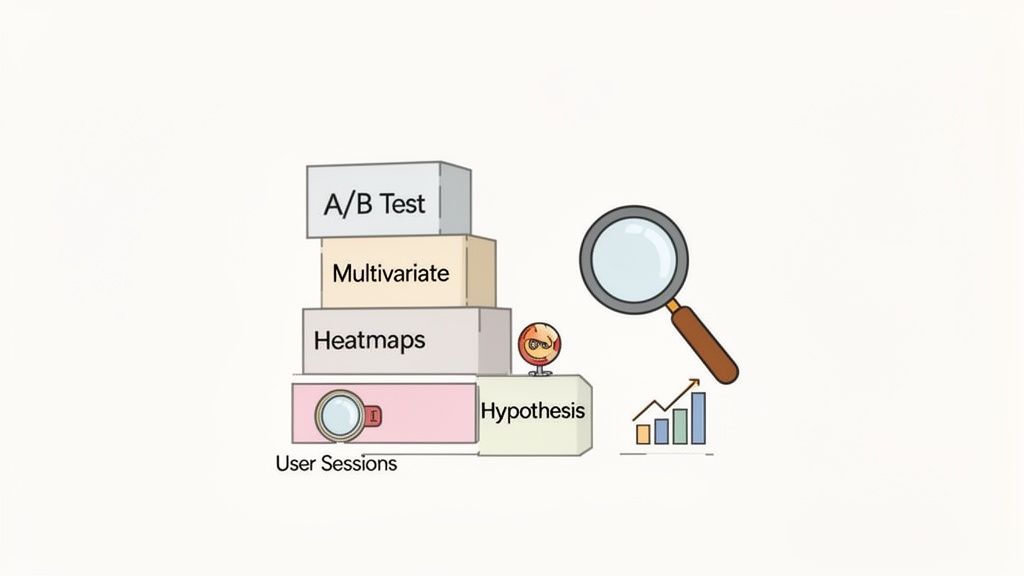
A solid CRO programme isn't built on guesswork or lucky shots in the dark. It's a systematic process, grounded in proven methods and a specific toolkit that helps you uncover real opportunities for growth. Think of these elements as the foundations that turn random tweaks into a reliable engine for improving your store's performance.
At its core, CRO is all about understanding how your customers behave and then scientifically testing changes to make their experience better. This process boils down to two distinct but complementary approaches: quantitative and qualitative analysis. One tells you what is happening on your site, and the other tells you why.
Quantitative Analysis: The Hard Data
Quantitative analysis is all about the numbers. It’s the statistical evidence you need to move forward with confidence, measuring user actions at scale to pinpoint performance problems and validate your ideas for improvement.
Controlled testing is the cornerstone of this data-driven approach.
- A/B Testing: This is the most common and straightforward type of test. You simply create two versions of a single element—say, a headline, a button colour, or an image—and show each version to a different segment of your audience. The one that gets more conversions wins. For example, does a "Shop Now" button work better than "Discover the Collection" on your main banner? A/B testing gives you a definitive, data-backed answer.
- Multivariate Testing: Think of this as A/B testing on steroids. Instead of testing just one change, you test multiple combinations at once. You might test two different headlines, two images, and two calls-to-action all at the same time to discover the single best-performing combination. It needs a lot more traffic to get reliable results, but it can seriously speed up your learning curve.
These testing methods are crucial because they take personal bias and gut feelings out of the decision-making process. They let you prove, with cold, hard data, that a specific change actually leads to a better result.
Qualitative Analysis: Understanding the "Why"
While numbers tell you what’s happening, they rarely tell you why. That's where qualitative analysis comes in. It helps you build empathy for your users by observing their experiences directly, uncovering their frustrations, and listening to their feedback.
A powerful CRO strategy often includes a strong focus on improving the overall customer experience. Learn more about how to master your strategy with this guide on customer experience optimization.
Some of the most popular qualitative tools include:
- Heatmaps: These are fantastic visual guides showing where people click, move their mouse, and scroll. A heatmap might instantly reveal that customers are constantly clicking on a non-interactive image, signalling they expect it to be a link.
- Session Recordings: This is like looking over a user's shoulder as they browse your site. You can watch a replay of their exact mouse movements, clicks, and scrolls as they navigate, add items to their basket, or abandon the checkout. It's an invaluable way to spot bugs or points of confusion.
- User Surveys and Polls: Sometimes, the simplest way to get an answer is just to ask. Short, pop-up surveys can ask visitors why they’re leaving or what stopped them from buying today, giving you direct, actionable feedback.
These qualitative insights are often the source of your best test ideas. When you combine them with solid quantitative data, you get a complete picture of your store's performance. Understanding these elements is one thing, but applying them correctly is what really drives change. You might be interested in learning more about the 8 UX design principles that can boost Shopify store sales.
A Step-by-Step Guide to Implementing CRO
Knowing the building blocks of CRO is one thing; putting them together into a repeatable system is how you drive real, sustainable growth. Proper conversion rate optimisation isn't about throwing spaghetti at the wall to see what sticks. It's a disciplined, cyclical process that turns data into action and action into measurable results.
This structured approach takes the guesswork out of the equation and helps you build momentum. Each test cycle delivers fresh insights, making your next effort smarter and more effective than the last. Let's walk through the exact framework the pros use to turn underperforming pages into high-conversion assets.
Step 1: Research and Data Analysis
You can't fix a problem until you truly understand it. This first phase is all about discovery. You'll be using both quantitative (the 'what') and qualitative (the 'why') data to find out exactly where your website is leaking money and, crucially, why. Don't be tempted to skip this part; it’s the bedrock for everything that follows.
Your goal here is to gather evidence, not just opinions. Start by diving into your analytics to spot high-traffic pages that just aren't performing well. Look for things like product pages with surprisingly high exit rates or checkout steps where a huge chunk of users just disappear.
Then, you layer on the human side of the story with tools like heatmaps and session recordings. These let you see how people are actually behaving on those problem pages. Are they clicking on things that aren't links? Are they getting frustrated and rage-clicking a broken button? This combination of hard numbers and real user behaviour tells you where to focus your efforts for the biggest impact.
Step 2: Form a Strong Hypothesis
Armed with your research, it’s time to make an educated guess—your hypothesis. A strong hypothesis isn’t just a vague idea. It’s a sharp, testable statement that connects a specific change to an expected result, all backed up by the evidence you just uncovered.
A solid hypothesis usually follows this simple structure: "If we [make this specific change], then [this specific metric] will improve, because [this reason based on your data]."
For instance:
"If we replace the generic 'Submit' button on our contact form with 'Get My Free Quote', then form submissions will increase, because the new copy is more specific and highlights the value for the user."
This format forces you to be crystal clear. It spells out exactly what you're changing, what you expect to happen, and the logic behind it. This becomes the central question your test is designed to answer.
Step 3: Design and Develop Your Test
Now for the fun part: bringing your hypothesis to life. This step is all about creating the new version of your page or element—the "challenger" or "variation"—that you'll pit against the current version, known as the "control".
The devil is in the details here. Make sure your new design is polished, bug-free, and perfectly reflects the one change you outlined in your hypothesis. If you’re testing a new call-to-action button, for example, every other element on the page must stay exactly the same. This is how you isolate the variable and ensure you're only measuring the impact of that single change.
Step 4: Execute and Analyse the Results
With your control and variation ready to go, it’s time to run the experiment. Using an A/B testing tool, you'll split your website traffic between the two versions and let the software track which one does a better job of hitting your conversion goal.
It’s absolutely vital to let the test run long enough to reach statistical significance—that’s usually a 95% confidence level or higher. This is your proof that the results aren't just a fluke or random chance. Once the test concludes, you'll have a clear winner.
Finally, dig into the results. Did your hypothesis hold up? If it did, fantastic! Roll out the winning version to 100% of your audience. If it didn't, don't look at it as a failure—see it as a lesson. The data just taught you something valuable about your customers. Use that new insight to form your next, even smarter, hypothesis. This is the loop that drives continuous improvement.
Setting Realistic Goals with CRO Benchmarks
One of the first questions I always get asked about CRO is, "What's a good conversion rate?" And the honest answer? There's no magic number. A rate that's incredible for one industry could be a serious red flag for another. The key to setting achievable goals is understanding where your business fits into the bigger picture.
Chasing an arbitrary number like 5% without any context is just setting yourself up for failure. A much smarter approach is to use industry benchmarks as your starting point. This lets you see how you stack up against direct competitors and, more importantly, helps you understand the unique buying habits of your specific audience. It's all about context.
Why Industry Averages Matter
Every ecommerce sector has its own rhythm. Big-ticket items that require a lot of thought, like a custom sofa, will naturally have a much lower conversion rate than everyday essentials like pet food. Factors like product cost, how often people buy, and the customer's research process all play a massive role.
A look at UK-specific conversion rate benchmarks makes these differences crystal clear.
UK Ecommerce Conversion Rates by Industry
This table offers a snapshot of average conversion rates across various UK ecommerce sectors, providing some useful context for where your own performance might sit.
| Industry Sector | Average Conversion Rate (%) |
|---|---|
| Food & Drink | 11.1% |
| Tools & Construction | 8.4% |
| Fashion & Jewellery | 1.9% |
| Sports & Recreation | 1.18% - 1.62% |
As you can see, essential categories like groceries convert exceptionally well at 11.1%, while tools and construction supplies hit a solid 8.4%. This makes sense—these are often need-based, recurring purchases. In contrast, discretionary sectors like fashion and jewellery hover around 1.9%, reflecting the extra consideration that goes into those decisions. You can discover more UK ecommerce insights to help frame your own store's performance.
Understanding these benchmarks helps you grasp what's normal for your market. From there, you can start applying a structured process to improve.
This simple cycle—research, test, and learn—is the engine that powers all successful CRO efforts.
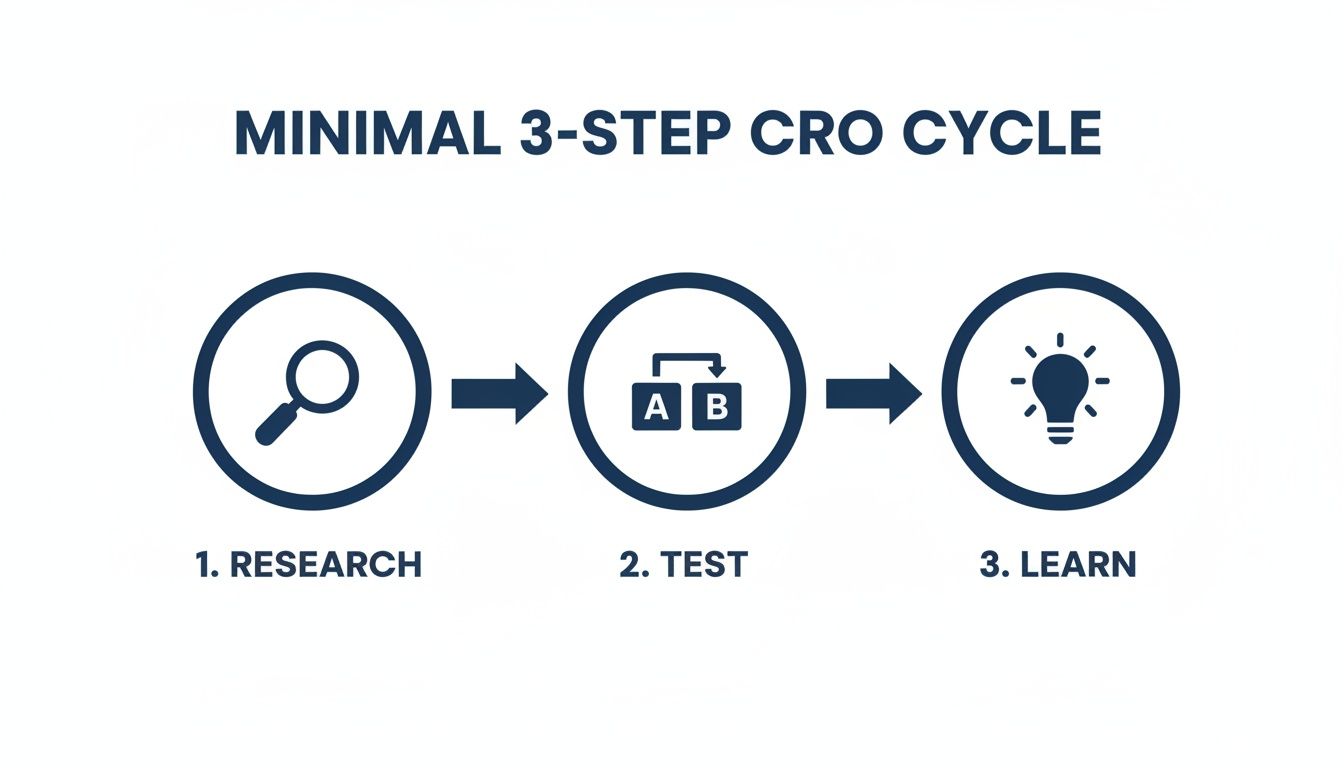
It’s this continuous loop of improvement that will help you steadily push your numbers up and edge closer to (and hopefully beyond) those industry benchmarks.
The Great Desktop vs. Mobile Divide
Another crucial benchmark is the performance gap between different devices. It's no secret that mobile brings in the lion's share of ecommerce traffic, but when you look at who's actually buying, it's a different story. Desktop users still convert at a much higher rate.
Why does this gap exist? It usually comes down to a few things:
- Ease of Use: Let's face it, filling out checkout forms and typing in card details is just less fiddly on a big screen with a proper keyboard.
- Purchase Intent: A session on a desktop often signals a stronger intent to buy. Mobile browsing, on the other hand, is frequently about discovery and research while on the go.
- Perceived Security: Some shoppers simply feel safer finalising a transaction on their home computer.
The most important benchmark is always your own. Your number one goal should be to continuously improve on your own current conversion rate. Even a small jump from 1.5% to 1.8% translates to a massive 20% increase in conversions from the exact same traffic.
Ultimately, industry benchmarks give you a vital sense of perspective. They show you what's possible in your market and can shine a light on huge opportunities, like closing that mobile conversion gap. By combining industry data with your own metrics, you can stop guessing and start setting intelligent, data-driven goals that lead to real growth.
Partnering with Grumspot for Advanced Growth
As we’ve seen, mastering conversion rate optimisation isn’t a one-and-done project. It’s a relentless cycle of deep analysis, creative problem-solving, and disciplined testing. For busy Shopify Plus merchants, finding the time—let alone the specialised in-house expertise—to run this kind of programme effectively is a massive hurdle.
That’s precisely where a dedicated partner changes the game. At Grumspot, our entire approach is built on a conversion-first design philosophy. We’re not just theorists; our team is made up of senior Shopify developers, UX designers, and data-obsessed CRO specialists who live and breathe ecommerce performance. Our job is to deliver tangible, measurable growth.
An On-Demand Team for Your Shopify Store
Think of our retainer model as having an expert CRO team on tap, ready to put all the strategies in this guide into action. We diagnose why stores are underperforming, find the biggest opportunities to scale revenue, and turn your Shopify Plus site into the high-performance conversion engine it should be.
One of the first places we often look is the mobile experience, because the data tells a compelling story. While mobile devices drive a staggering 73% of all retail site traffic, their conversion rate lags at just 2.9%. Compare that to desktop’s much healthier 4.8%. This gap isn't random; it's caused by friction, slow load times, and clunky checkout flows on smaller screens. Fixing those issues can unlock a huge amount of revenue from the traffic you’re already getting. Discover more insights about these ecommerce benchmarks.
Grumspot’s approach is not about one-off projects; it’s about becoming an integrated part of your growth strategy. We provide the expertise and execution power needed to build a sustainable system of continuous improvement, freeing you to focus on your products and customers.
When you work with us, you’re not just hiring a freelancer. You’re gaining a team that truly understands the nuances of what is conversion rate optimization for a scaling Shopify Plus brand. We’ll handle the deep-dive data analysis, the user research, and the technical heavy lifting required to consistently improve your store’s performance, month after month.
Ready to see how a dedicated team can accelerate your growth? Learn more about our conversion rate optimisation services and find out how we can help you build a more profitable online store.
Your CRO Questions, Answered
As you start to explore conversion rate optimisation, it’s natural for a few questions to surface. Moving from the 'what' to the 'how' is where the real work begins. Let's tackle some of the most common queries to clear up the practical side of things and get you started on solid ground.
We'll look at how long it takes to see results, the crucial difference between CRO and SEO, and whether you should DIY your optimisation or call in the experts.
How Long Does It Take to See CRO Results?
This is the big one, and the most truthful answer is: it varies. Sometimes you get a "quick win"—maybe you fix a broken checkout button on a popular product and see an uplift within days. But a proper CRO programme isn't about one-off fixes; it's a long-term strategy for steady growth.
The timeline for any single experiment really comes down to a few things:
- Website Traffic: The more visitors you get, the quicker you'll collect enough data to know if your change made a real difference. A store with high traffic might see a clear result in two weeks, whereas a smaller shop could need a month or more for the same test.
- The Change Being Tested: A complete overhaul of your product page will probably give you a strong signal—good or bad—much faster than a tiny tweak to a button colour.
- Your Sales Cycle: If you sell high-ticket items that people spend weeks thinking about, the true impact of a change won't be obvious overnight. You need to give customers time to move through their natural buying journey.
The real aim of CRO isn’t to find a single magic bullet. It’s about building a system of continuous improvement that creates lasting momentum. Every test, whether it wins or loses, teaches you something valuable that makes your next move even smarter.
How Are SEO and CRO Different?
Think of SEO and CRO as a brilliant partnership for your business. They have different roles, but they amplify each other's efforts enormously.
SEO’s job is to get more of the right people to your website. It’s all about attracting visitors from search engines, boosting your online visibility, and driving traffic to your digital doorstep.
CRO’s job is to convert those visitors into customers once they're on your site. It focuses on making their experience so smooth and persuasive that they’re compelled to take action, whether that's making a purchase or signing up.
One brings in the crowd; the other makes sure the show is worth watching. While they're separate disciplines, they’re closely linked. For instance, a fantastic user experience (a cornerstone of CRO) often leads to lower bounce rates and more time on site—signals that can give your SEO rankings a nice little boost.
Should I Do CRO Myself or Hire an Agency?
Plenty of businesses can—and should—kick off their own CRO efforts. Getting familiar with tools like Google Analytics to spot struggling pages and running a few simple A/B tests is an excellent way to grasp the basics and build an optimisation mindset.
But as your business grows, so does the complexity. This is where an expert agency like Grumspot can really accelerate your growth. We come equipped with specialised tools, dedicated expertise, and an objective, data-first viewpoint that’s free from internal bias. Our team brings years of experience across different industries, helping us spot high-impact opportunities faster and run sophisticated experiments that deliver predictable, meaningful growth for your store.
Ready to stop guessing and start growing with a data-driven CRO strategy? The expert team at Grumspot can build and execute a complete optimisation programme for your Shopify Plus store. Find out how we can help you scale.
Let's build something together
If you like what you saw, let's jump on a quick call and discuss your project
Related posts
Check out some similar posts.
- website conversion rate optimisation
Master website conversion rate optimisation with our 2026 e-commerce playbook. Audit, test, measure,...
Read more