Finding Your Shopify Plus Development Agency in the UK
- shopify plus development agency
Launched
February, 2026

So, when do you pull the trigger and bring in a Shopify Plus development agency? It’s not about hitting a certain revenue number; it's about recognising when your current setup is starting to hold you back. This moment often arrives disguised as a series of frustrating operational headaches—the kind that off-the-shelf apps and a lone freelancer just can't solve anymore.
If your business is scaling fast, you'll eventually hit a wall. It’s the point where site crashes during flash sales become a real threat, or your attempts to connect essential business systems feel like forcing a square peg into a round hole. This isn't a sign of failure. It's the opposite—it's a clear signal you're ready to graduate to a more robust, scalable solution.
When to Partner with a Shopify Plus Development Agency
Is your Shopify store groaning under the weight of its own success? Many ambitious brands reach this critical point. The technical limitations and operational bottlenecks you're facing are precisely the challenges a specialised agency is equipped to handle. They don't just fix problems; they build the infrastructure for your next stage of growth.

Recognising the Growth Ceiling
The signs you need an expert partner are often hiding in plain sight, masquerading as daily frustrations. Do any of these sound painfully familiar?
- Flash Sale Failures: Your site slows to a crawl—or worse, crashes completely—during a Black Friday rush. You’re not just losing sales; you're losing customer trust with every spinning wheel.
- Integration Nightmares: Getting your store to talk to your ERP, 3PL, or PIM system is a manual, error-prone mess that sucks up your team's valuable time.
- International Expansion Hurdles: You're trying to expand globally, but managing multiple currencies, local payment methods, and regional compliance has turned into a logistical nightmare.
- Customisation Roadblocks: Your brilliant idea for complex product bundles or a unique subscription model is impossible to build with any existing app on the Shopify App Store.
If you're nodding along, you’ve hit the limits of a standard setup. This is where a Shopify Plus development agency shifts from being a potential expense to a critical investment. Their job is to build a technical foundation that supports your ambition, not stifle it. You can explore our guide on the core benefits of Shopify Plus to see what the platform itself makes possible.
Strategic Scalability Beyond a Standard Setup
Working with a Shopify Plus agency is about more than just fixing what's broken. It's about unlocking serious growth through strategic e-commerce automation for growth. These partners move far beyond simple theme tweaks. They architect scalable systems designed to boost efficiency and drive revenue.
The Shopify ecosystem in the UK is exploding, with live stores jumping from roughly 152,000 to over 208,000 in just over a year. That makes it the second-largest market in the world. In a crowded field, a basic store just won't cut it anymore. You need a genuine competitive edge, and a specialist agency can help you build it.
Know What You Need Before You Start Looking
Kicking off a successful partnership with a Shopify Plus agency doesn't start with that first introductory email. It actually starts with some serious internal groundwork. You need to get crystal clear on what you want to achieve before you even think about talking to potential partners.
Jumping into conversations without a solid plan is the quickest way to end up with scope creep, budget blowouts, and a final product that doesn't quite hit the mark. The top-tier agencies I’ve worked with can spot a disorganised client from a mile away, and they gravitate towards businesses that have their act together.
Before you can sell your vision to an agency, you have to define it for yourself. This isn't about vague statements like "we need a better website". It's about drilling down into the specific technical fixes and business outcomes that will move the needle for you. A well-thought-out project brief is your best friend here.
Start with an Honest Look at Your Business
First things first, you need to take a hard look at your current setup. What are the biggest bottlenecks, the most frustrating manual processes, and the technical limitations that are actively slowing your growth? This kind of internal audit is how you turn those everyday headaches into a solid list of requirements.
Think carefully about these key areas:
- Moving Platforms: Are you stuck on an old Magento or WooCommerce site? You'll need to map out every critical feature you currently use, figure out what data absolutely must come with you (like customer and order histories), and list all the existing integrations that need to be rebuilt.
- Custom App Requirements: Do you have a unique way of doing business that off-the-shelf apps just can't handle? Maybe it's a super-specific product bundling system, a non-standard subscription model, or a custom-built returns portal. Whatever it is, you need to define the exact functionality you're after.
- Essential Integrations: Make a comprehensive list of every system your store talks to. This is non-negotiable. We're talking about your ERP, warehouse management system (WMS), PIM tools, or your 3PL provider. If it's essential to your operations, it goes on the list.
- Going Headless: Are you thinking about a headless build for maximum front-end control and lightning-fast speed? It's a huge technical and financial undertaking, so be ready to explain precisely why you think it’s the right move for your brand.
A detailed brief doesn't just help you get accurate quotes; it shows a potential Shopify Plus agency that you're a serious, organised client. It sets a professional, collaborative tone right from the very beginning.
To help you map this out, here’s a breakdown of the core services you might need. Thinking through these will help you identify and prioritise what’s most important for your business right now.
Essential Services from a Shopify Plus Agency
| Service Area | What It Solves | Example Scenario |
|---|---|---|
| Platform Migration | Moving from a legacy system (e.g., Magento, WooCommerce) to Shopify Plus without losing critical data or SEO rankings. | A clothing brand wants to replatform from Magento 2, needing to bring over 100,000 customer accounts and 500,000 past orders. |
| Custom App Development | Building unique functionality that isn’t available in the Shopify App Store to solve specific business challenges. | A furniture company needs a custom product configurator that lets customers choose fabrics, legs, and finishes, with real-time price updates. |
| Third-Party Integrations | Connecting your Shopify store to essential business systems like ERPs, 3PLs, or CRM platforms for seamless data flow. | A high-volume D2C brand needs to sync inventory, orders, and shipping data in real-time with their NetSuite ERP. |
| Conversion Rate Optimisation (CRO) | Using data analysis, A/B testing, and user experience (UX) improvements to increase the percentage of visitors who make a purchase. | An online retailer notices high cart abandonment and wants an agency to test a redesigned checkout process to reduce friction. |
| Internationalisation | Expanding into new global markets with multiple stores, currencies, languages, and localised payment options using Shopify Markets. | A UK-based cosmetics brand is launching in Germany and France and needs dedicated storefronts with local languages and payment methods like Klarna. |
Taking the time to define your needs across these areas gives you a much clearer picture of the kind of partner you're looking for.
Turn Your Business Goals into Real Numbers
Once you’ve got your technical wish list sorted, the next step is to tie everything back to tangible business goals. An agency isn't just there to tick off a list of features; they're your partner in driving growth. If your objectives are fuzzy, your results will be too.
This is where you turn your request from a simple to-do list into a strategic proposal. It gives an agency the context they need to recommend solutions you might not have even thought of.
From Vague Goal to Actionable KPI
| Instead Of This... | Try This Specific Goal... |
|---|---|
| "Improve our conversion rate." | "Increase our sitewide conversion rate from 1.8% to 2.5% within six months of the new site launching." |
| "We need to sell more." | "Lift our Average Order Value (AOV) by 15% by implementing a new post-purchase upsell feature." |
| "Make the site faster." | "Get a 'Good' score on all Core Web Vitals, specifically aiming for a Largest Contentful Paint (LCP) under 2.5 seconds." |
| "Expand into Europe." | "Launch fully localised storefronts for Germany and France, including local currency and payment options, by Q4." |
This level of clarity allows a Shopify Plus development agency to come back with a strategy, not just a price tag. It shows you're focused on ROI and establishes clear benchmarks for success long after the project is live.
How to Properly Vet Potential Agency Partners
Choosing the right Shopify Plus development agency isn't like hiring a contractor; it’s more like bringing on a new business partner. A slick portfolio looks great, but it barely scratches the surface. You need a team with the technical chops to bring your vision to life and, just as importantly, the strategic insight to challenge and improve it.
This process is about digging deeper. You’ll need to methodically evaluate their technical expertise, critically analyse their past work, and get a genuine feel for their team culture and communication style. You're looking for an extension of your own team, not just a group of outsourced coders.
The first step is always an internal one: assessing your own project needs. This helps you clarify exactly what you're looking for before you even start the search.
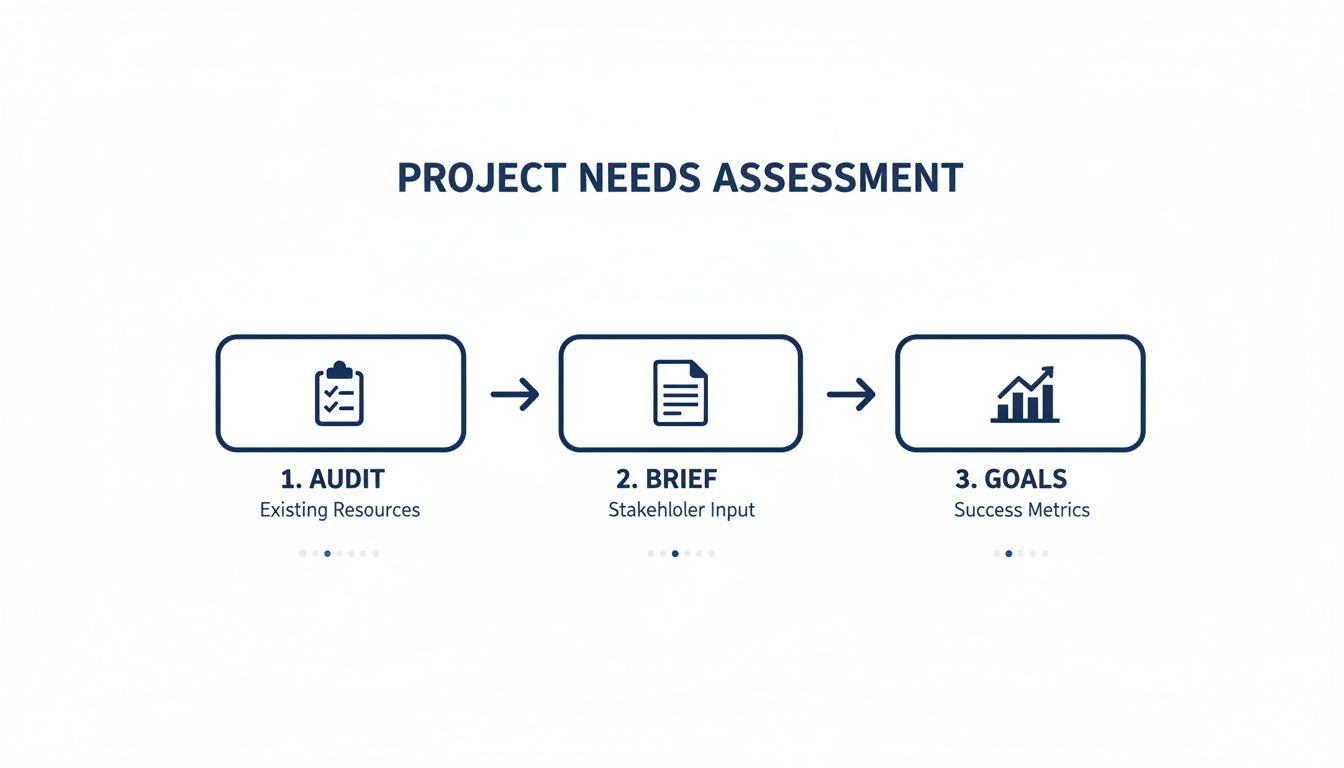
Moving from a simple audit of your current setup to defining clear, concrete goals ensures you approach potential partners with a strategic plan, not just a vague wish list.
Assessing Technical Capabilities
Your first real checkpoint is their technical know-how. An agency that can't speak fluently about the modern Shopify ecosystem is an immediate red flag. You need a team that lives and breathes Shopify Plus, with hands-on experience using its most powerful and complex features.
Here’s what to probe for:
- Shopify APIs and Functions: Don't just ask if they use them. Ask for specific examples of how they’ve used Shopify's APIs to build custom solutions. Have they used Shopify Functions to create unique discount logic or shipping rules directly on Shopify's backend? This proves they can move well beyond simple theme customisation.
- Headless Commerce Experience: If a headless build is even a possibility on your roadmap, they absolutely must have experience with frameworks like Hydrogen and Oxygen. Get them to talk about past headless projects, the challenges they ran into, and the actual performance gains they delivered for the client.
- Integration Expertise: This is a big one. Discuss their experience connecting Shopify Plus to complex third-party systems like ERPs, PIMs, or 3PLs. Focus on how they ensured seamless, real-time data synchronisation and handled any hiccups along the way.
Looking Beyond Pretty Designs
Case studies are your window into their work, but you have to read between the lines. A beautiful website is one thing; a high-performing one that drives revenue is another beast entirely. When you’re reviewing their portfolio, hunt for tangible, measurable results that tie directly back to core business metrics.
Don't be swayed by aesthetics alone. Ask for the hard numbers. A top-tier agency will be proud to share data on conversion rate lifts, AOV increases, and improvements to Core Web Vitals that came directly from their work.
If a case study talks endlessly about design but conveniently forgets to mention performance, it's a clear sign their focus might not be aligned with your growth goals.
Verifying Their Credentials and Culture
Once you're confident in their technical skills, it’s time to look at the softer—but equally critical—side of the partnership. The UK has a fantastic roster of top-tier Shopify Plus agencies, with leading experts powering many of the nation's 208,000+ live stores.
Your final checks should include these non-negotiables:
- Official Shopify Plus Partner Status: This is your baseline. The "Plus Partner" badge isn't just for show; it's an exclusive, vetted status awarded only to agencies with proven, repeatable success on enterprise-level projects. It’s Shopify’s official stamp of approval. You can discover more about leading Shopify agencies in the United Kingdom to find certified partners near you.
- Project Management Methodology: How do they actually run projects? Most modern agencies use an Agile approach, which allows for flexibility and iterative progress. Ask about their communication cadence, the project management tools they use (like Asana or Jira), and who your dedicated day-to-day contact will be.
- Client References: A confident agency will have no problem providing references. When you speak to their past clients, ask about the experience—not just the final outcome. Was the agency responsive? Proactive? Did they feel like a genuine partner? This kind of candid insight is absolutely invaluable.
Getting to Grips with Agency Pricing and Your RFP
Trying to compare agency proposals can feel like comparing apples and oranges. One agency might pitch a fixed project fee, while another suggests a monthly retainer. Without understanding what these models mean for your project, it’s easy to get lost, mismanage your budget, and end up with nasty financial surprises down the line.
The good news is that most agencies stick to one of three common models: fixed-price projects, monthly retainers, or a time and materials approach. A solid Shopify Plus development agency will be upfront about how they work and explain why their chosen model makes the most sense for what you’re trying to achieve.
Decoding the Three Main Pricing Models
So, what’s the real-world difference between these models? Let's break them down.
Fixed-Price Projects: This one is pretty straightforward. You agree on a precise scope of work for one single, locked-in price. It's a great fit for projects with a crystal-clear finish line, like migrating your store from Magento to Shopify Plus or building a specific custom app. The biggest advantage is you know exactly what you're spending. The catch? If you want to add anything new mid-project—what we call scope creep—it'll mean a new contract and a new price, which can slow things down.
Monthly Retainers: A retainer is all about building a long-term partnership. You pay a set amount each month, which gets you a dedicated block of hours or a pre-agreed list of tasks. This is the perfect model for ongoing work like conversion rate optimisation (CRO), rolling out new features, or proactive site maintenance. It's like having your own expert dev team on call without the costs of hiring them full-time.
Time and Materials (T&M): Here, you simply pay for the actual hours the agency’s team spends on your project. This model gives you incredible flexibility, making it ideal for really complex builds where the full scope is a bit of a moving target. While it allows you to be agile and adapt as you go, it also comes with the highest budget risk. You’ll need rock-solid communication and weekly check-ins to keep costs under control.
The right pricing model really boils down to your project's clarity and what you want to achieve long-term. A one-off migration is perfect for a fixed price, but if you're aiming for continuous growth, a retainer is your best bet.
How to Write an RFP That Gets You What You Need
A well-crafted Request for Proposal (RFP) is your secret weapon for getting clear, comparable quotes. To properly weigh your options, you need to understand the agencies' detailed pricing structures. A good RFP forces potential partners to address your specific requirements, cutting through the generic sales fluff.
Don’t worry, your RFP doesn't need to be a 50-page epic. It just needs to be thorough.
What to Include in Your RFP
- Company Background: Start with a quick introduction. Who are you, what do you sell, and where do you sit in the market?
- Project Overview: Get to the "why." Are you replatforming because your current site is slow? Are you expanding into Europe? Is your conversion rate in the gutter?
- Detailed Requirements: This is the meat of the document. List every technical need, every must-have feature, and every integration you can think of. The more detail, the more accurate the quotes will be.
- How You'll Measure Success: Be explicit about what a "win" looks like. Refer back to your KPIs. Are you aiming to "increase AOV by 15%" or "hit a Core Web Vitals score of 90+"? Put it in writing.
- Budget and Timeline: Be realistic. Provide a budget range you're comfortable with and a target go-live date. This immediately helps agencies know if they're a good fit and allows them to propose a workable plan.
A strong RFP paves the way for a successful partnership from day one. To get a better handle on potential costs, our guide on the cost of ecommerce website development is a great place to start.
Building a Successful Long-Term Partnership
Signing the contract isn't the finish line; it’s the starting gun. The real work of building a fruitful, long-term relationship with your Shopify Plus agency begins the moment you kick things off. A strong, structured onboarding sets the tone for everything that follows, turning what could be a simple vendor transaction into a collaborative engine for growth.
This initial phase is all about laying down the ground rules and getting expectations crystal clear on both sides. It’s where you move beyond the project brief and into the practical, day-to-day reality of how you’ll work together. Any great agency will take the lead here, but it's your active involvement that will make it a success.
Establishing a Rock-Solid Foundation
The kickoff meeting is your first real chance to get both teams perfectly aligned. This is where you shift from high-level goals to the nuts and bolts of how the project will actually run. Absolute clarity is the name of the game.
To get started on the right foot, make sure you cover these bases:
- Defining Communication Rhythms: Agree on a clear schedule for check-ins. Will it be daily stand-ups on Slack? Weekly progress calls? Monthly strategic reviews? A predictable communication cadence is your best defence against misunderstandings and keeps everyone accountable.
- Choosing Project Management Tools: Settle on the main platform for tracking tasks and progress. Whether it’s Asana, Jira, or something else, make sure your key team members are properly onboarded and comfortable with it from day one.
- Assigning Key Stakeholders: Clearly map out the main points of contact. Who signs off on designs? Who's the technical lead for integration queries? This simple step prevents so much confusion and so many bottlenecks down the line.
A great partnership thrives on transparency and shared understanding. The real goal of onboarding isn't just to start the work, but to build a system where both teams can operate efficiently and, most importantly, trust each other's processes.
Measuring What Truly Matters for Growth
Once the work is underway, the focus needs to shift from deliverables to outcomes. It’s far too easy to get caught up in tracking how many tasks have been completed. A truly successful partnership, however, is measured by its impact on your bottom line. Your agency’s work should always be tied directly to tangible business growth, ensuring their efforts generate a clear return on your investment.
Shopify Plus merchants in the UK often see incredible revenue growth, with many enterprise brands handling millions in annual sales and processing thousands of checkouts per minute during peak times. To keep that momentum going, your agency has to focus on metrics that reflect this high-growth reality. You can find out more about the performance of UK Shopify brands on charle.co.uk.
Instead of getting bogged down in project velocity, prioritise these business-critical Key Performance Indicators (KPIs):
- Conversion Rate Improvement: Is that new feature or UX tweak actually getting more visitors to click "buy"? You need to track this by device, traffic source, and customer segment to get the full picture.
- Average Order Value (AOV) Growth: Are the new upselling, cross-selling, or bundling features actually increasing the value of each transaction?
- Site Performance Gains: Keep a close eye on Core Web Vitals. Improvements in metrics like Largest Contentful Paint (LCP) and Interaction to Next Paint (INP) have a direct impact on user experience and, consequently, your search rankings.
By focusing on these results, you ensure your Shopify Plus development agency is acting as a genuine growth partner—one who is constantly optimising your store for peak performance and profitability.
Common Questions About Hiring an Agency
Stepping into the world of specialist agencies can feel a bit daunting, and it's natural to have a lot of questions. Getting straight answers is the only way to feel confident you're making the right call. We've pulled together the questions we hear most often from UK merchants looking for a top-tier Shopify Plus development agency.
The goal here isn't to give you vague ballpark figures, but to offer some realistic insights so you can budget and plan with your eyes open. Knowing this stuff will put you in a much stronger position when you start talking to potential partners.
What’s the Typical Cost of a Shopify Plus Agency in the UK?
This is the big one, and the honest answer is: it varies massively. For a major project like a full-scale store build or a complex migration from a platform like Magento, you're likely looking at a range between £20,000 and £100,000+. What pushes the price up? Things like deep customisation, the number of third-party systems you need to connect, and the sheer volume of data that needs to be brought across.
When it comes to ongoing work, most agencies will suggest a retainer. Think of this as a monthly agreement for continuous development, conversion rate optimisation (CRO), and strategic input. In the UK, these retainers typically start around £3,000 per month and can go up to £15,000+. The final number really depends on how much work you need and the size of the team dedicated to your account.
My advice? Never move forward without a detailed proposal that breaks down every single cost. It should be a direct response to the comprehensive brief you’ve put together. This is your best defence against hidden fees and surprise invoices down the line.
How Long Does a Shopify Plus Project Usually Take?
Just like cost, the timeline is completely tied to the complexity of the job. A fairly standard project—like building out a highly customised theme or handling a platform migration—generally lands in the 3 to 6-month window. That timeframe gives everyone enough breathing room for proper discovery, design, development, thorough testing, and a launch that doesn't feel rushed.
Of course, more ambitious projects will take longer. If your plans involve a totally bespoke app, a headless commerce setup, or a tricky integration with a major ERP system, you could be looking at 6 to 12 months. A smart agency will often suggest launching a Minimum Viable Product (MVP) first. This gets you trading and earning much faster, while they continue to build out the more advanced features in later phases.
Shopify Partner vs Shopify Plus Partner: What’s the Difference?
This is a really important distinction to understand. You'll see lots of agencies calling themselves Shopify Partners, but the "Shopify Plus Partner" badge is a different beast entirely. It’s an exclusive, invitation-only status that Shopify itself awards to a very select group.
To even be considered, an agency has to prove they have consistently delivered exceptional results for enterprise-level brands. They go through a tough vetting process where Shopify scrutinises their technical skills, project management processes, and, most importantly, their client success stories. For any serious, high-stakes project, you should absolutely be looking for an official Shopify Plus Partner.
At Grumspot, we provide the specialised expertise your growing brand needs to scale effectively on Shopify Plus. From seamless migrations and custom app development to data-driven CRO, our team is ready to become your dedicated growth partner. Get in touch with Grumspot to discuss your project today.
Let's build something together
If you like what you saw, let's jump on a quick call and discuss your project

Related posts
Check out some similar posts.