Shopify Plus vs Shopify Advanced A UK Merchant's Guide
- shopify plus vs shopify advanced
- shopify plans uk
- ecommerce platform comparison
- shopify plus features
Launched
February, 2026
Picking between Shopify Advanced and Shopify Plus is a huge decision for any scaling UK merchant. At its core, the choice really comes down to this: Advanced gives you powerful features within a familiar framework, while Plus opens up an enterprise-level ecosystem built for complex, high-volume businesses.
Think of Advanced as the absolute peak for a growing business on the standard Shopify platform. Plus, on the other hand, is the starting line for true enterprise e-commerce.
Shopify Plus vs Advanced: A Quick Comparison
It can often feel like you're deciding between a top-of-the-line sports car and a custom-built logistics truck. Both are incredibly capable, but they're engineered to solve completely different problems. Shopify Advanced is perfect for businesses that have pushed past the limits of the standard plans. They need more sophisticated tools for reporting, shipping, and managing a growing team but can still thrive with a single, powerful storefront.
Shopify Plus, however, is built for an entirely different league of merchant. It's designed for brands grappling with the complexities of massive sales volume, multi-country expansion, and intricate operational workflows. This isn't just an upgrade; it's a fundamental platform shift. It unlocks exclusive tools, dedicated support, and, crucially, the ability to deeply customise your checkout—a non-negotiable for optimising conversions when you're operating at scale.
So, the whole Shopify Plus vs Shopify Advanced debate isn't about which one is "better." It's about which one fits your business's current size and, more importantly, its future ambitions. One is the pinnacle of Shopify's core offering; the other is the gateway to enterprise-grade commerce.
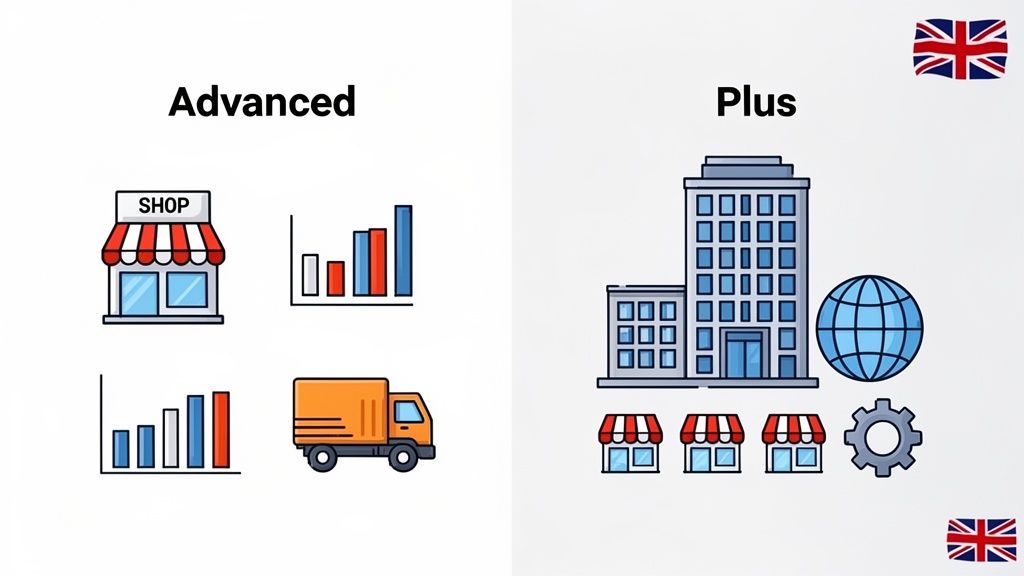
To make things clearer, let’s get straight to the features that truly separate the two. The table below cuts through the noise and shows you exactly where the plans differ on the things that matter most.
Shopify Advanced vs Plus Key Differentiators
This side-by-side overview highlights the most critical features and capabilities separating Shopify Advanced from Shopify Plus.
| Feature | Shopify Advanced | Shopify Plus |
|---|---|---|
| Ideal For | High-growth, single-store businesses needing advanced analytics and shipping. | Enterprise-level, multi-store brands requiring deep customisation and automation. |
| Checkout | Standard Shopify checkout with branding customisation. | Fully customisable with Checkout Extensibility for bespoke user experiences. |
| Store Management | One primary storefront. | One primary store plus nine additional "expansion" stores for internationalisation. |
| Automation | Limited to third-party apps. | Native automation with Shopify Flow for complex, multi-system workflows. |
| Staff Accounts | Up to 15 staff accounts. | Unlimited staff accounts with advanced permission settings. |
| B2B Functionality | Basic wholesale features via discount codes. | Comprehensive B2B on Shopify suite with dedicated storefronts and catalogues. |
| Support | Standard Shopify support. | Dedicated Merchant Success Manager and Launch Engineer. |
| Pricing Model | Fixed monthly fee (£259-£344/month). | Variable pricing starting at ~$2,300/month, based on sales volume. |
As you can see, the differences aren't just minor perks. They represent a significant jump in capability, control, and support designed for businesses with fundamentally different operational needs.
Understanding The Core Capabilities Of Each Plan
To properly compare Shopify Plus and Shopify Advanced, you need to look past a simple feature list. Each plan was built with a completely different type of merchant in mind. Getting to grips with that core purpose is the first real step in making the right decision for your business's future.
Shopify Advanced is the top of the ladder for ambitious businesses running on the standard Shopify framework. It’s the highest tier of the core platform, designed for merchants who've nailed the basics and now need more sophisticated tools to handle growth and sharpen their operations. Think of it as the natural upgrade for a successful store that's starting to push the limits of the standard 'Shopify' plan.
Shopify Advanced: The Scaler's Toolkit
The features you get with Shopify Advanced are there to solve the common growing pains of a single, successful storefront. It’s a toolkit for boosting your operational efficiency and getting a much clearer picture of your customers, all without needing a massive enterprise-level overhaul.
Its real power is focused in three key areas:
- Advanced Report Building: This lets you create custom reports and filter your data with far more precision. For example, a UK-based fashion brand could build a report tracking sales of a specific product line by city, helping them fine-tune local marketing spend for the best results.
- Real-Time Carrier Shipping: This feature is a lifesaver. It automatically calculates precise shipping costs from third-party carriers right at the checkout. This stops you from under or overcharging on postage, which is crucial for protecting your margins as order volumes climb.
- Expanded Staff Accounts: With support for up to 15 staff accounts, you can give access to your growing marketing, customer service, and fulfilment teams, each with their own set of permissions.
Shopify Advanced is for the business that needs better data, more accurate shipping, and a bigger team, but still operates mainly through one powerful online store. It's all about optimising what you've already built.
Shopify Plus: The Enterprise Command Centre
Shopify Plus, on the other hand, isn't just another plan—it's an entirely different ecosystem. It was engineered from the ground up for businesses whose scale and complexity have outgrown the single-store model. This is where you graduate from simply running a store to managing a full-scale e-commerce operation. For a deeper dive, you can learn more about the benefits of Shopify Plus in our detailed guide.
The capabilities here are less about small improvements and more about unlocking entirely new ways of doing business.
The Plus ecosystem is built around its exclusive tools:
- Shopify Organisation Admin: This is the central nervous system for a multi-store empire. From one single login, you can manage all your storefronts, staff, and analytics. It's an absolute game-changer for brands expanding internationally or running multiple distinct brand sites.
- Unlimited Staff Accounts: Enterprise teams can easily run into the hundreds. This feature removes any ceiling on growth and gives you granular control over user roles across your entire organisation.
- Dedicated Support: The level of support Plus merchants get is in a different league. You're assigned a Launch Engineer to handle migration and a Merchant Success Manager for ongoing strategic guidance.
- Exclusive API Access: Plus gives you much higher API call limits and access to exclusive APIs. This is essential for building robust integrations with your enterprise resource planning (ERP) systems, customer relationship management (CRM) platforms, and other business-critical software.
A Detailed Breakdown Of Features And Functionality
Okay, let's get past the high-level summaries. The real difference between Shopify Plus and Shopify Advanced reveals itself in the day-to-day tools you'll be using. It’s these subtle but powerful distinctions in the features that will ultimately define your shop's potential for growth, customisation, and operational agility.
Let's dissect the practical differences that truly matter for ambitious UK brands.
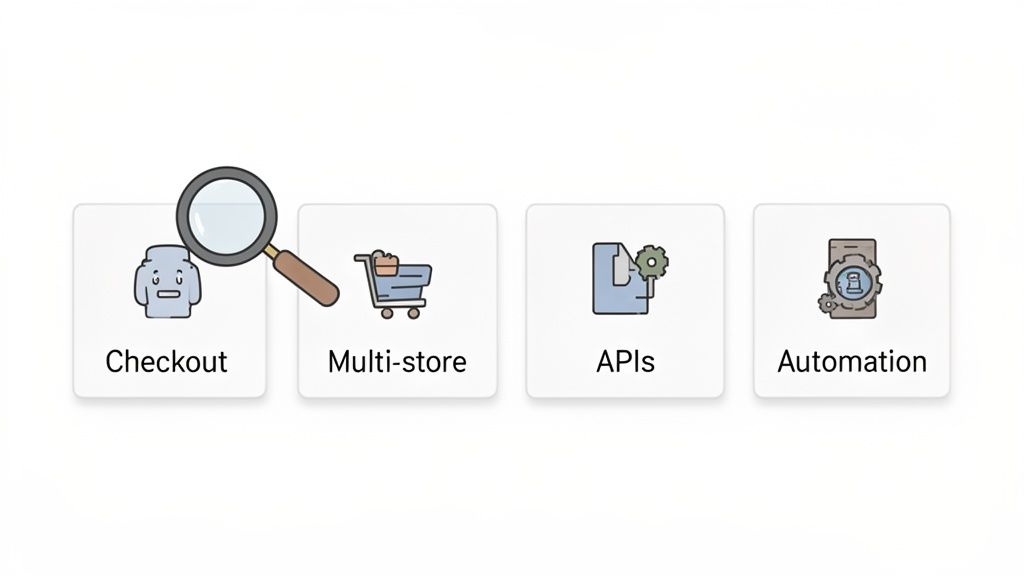
These four pillars are where the two plans really diverge, affecting everything from the customer's first click to your team's back-end workflow.
Checkout Customisation: The Conversion Battleground
The checkout is where you win or lose the sale. On Shopify Advanced, you can tweak colours, fonts, and logos to stay on-brand, but the checkout’s core structure is fixed. It’s a proven, high-converting flow, but it isn’t your flow.
Shopify Plus completely changes the game. You get access to Checkout Extensibility, a powerful framework that allows for deep, meaningful modifications. The comprehensive Shopify Plus checkout customization is a massive advantage, letting you fine-tune the final, most critical step of the customer journey.
This means you can do things like:
- Add custom fields for delivery instructions or gift messages.
- Integrate loyalty point redemption right at the payment step.
- Weave in unique upsell or cross-sell offers directly within the checkout itself.
The Takeaway: Shopify Advanced gives you a branded checkout. Shopify Plus lets you build a bespoke checkout experience, engineered to maximise conversions and perfectly match your business model.
Internationalisation: Single Shop vs. Global Empire
Taking a UK brand international adds layers of complexity, from local pricing and languages to region-specific product catalogues. Shopify Advanced tackles this from a single-store model. You can use Shopify Markets to sell abroad, but you're managing everything from one central storefront.
Shopify Plus, on the other hand, is purpose-built for global commerce. It gives you one primary store plus nine additional expansion stores without any extra monthly fees. This setup allows you to create fully localised shopping experiences for different markets.
For instance, a London-based fashion brand could have:
- A primary
co.ukstore for its home market. - A
destore with German text, prices in Euros, and a product line curated for the German audience. - An
frstore completely tailored to French shoppers.
Each store gets its own localised domain, currency, language, and product set, all managed from a single dashboard. This separation is vital for effective international SEO and running laser-focused marketing campaigns.
Automation And Workflow Management
As your business scales, efficiency becomes everything. On Shopify Advanced, automation often means relying on a patchwork of third-party apps, which can drive up costs and introduce integration headaches. You might need separate apps for inventory alerts, customer tagging, and fraud analysis.
Shopify Plus comes with Shopify Flow, a native, visual workflow builder that acts as your operations command centre. With Flow, you can set up powerful "if this, then that" automations without touching a line of code.
Here are a few real-world examples of what you can do with Shopify Flow:
- Inventory Management: Automatically unpublish products when stock hits a certain low and ping the purchasing team.
- Customer Segmentation: Tag customers based on spending habits (e.g., "High-Value Customer") to personalise marketing.
- Fraud Prevention: Flag and pause high-risk orders for manual review, protecting you from costly chargebacks.
This native tool brings your workflows under one roof, cuts down your reliance on external apps, and saves your team countless hours. It's a cornerstone of the Shopify Plus value proposition.
B2B Capabilities: A World Of Difference
For businesses with a wholesale arm, the gap between the two plans is a chasm. Shopify Advanced offers basic B2B functions, mostly through discount codes and password-protected pages. It’s a workable but often clunky workaround for managing wholesale accounts.
Shopify Plus, however, includes the entire B2B on Shopify suite. This isn’t just an added feature; it's a dedicated platform within Shopify for your wholesale operations. It delivers serious functionality, such as:
- Company Profiles: Assign multiple buyers with different permissions to a single wholesale account.
- Custom Catalogues and Price Lists: Offer specific pricing tiers and product selections to different wholesale clients.
- Net Payment Terms: Automate invoicing and payment tracking for your approved B2B customers.
- Self-Serve Portal: Let your wholesale buyers manage their own orders, check past invoices, and reorder with ease.
This integrated solution provides a slick, professional experience for your B2B customers while dramatically simplifying management for your team. It completely removes the need for a separate, disconnected wholesale platform. When it comes to B2B, the Shopify Plus vs Shopify Advanced debate is less of a comparison and more of a clear line in the sand.
Calculating The True Cost And Return On Investment
When you’re weighing up Shopify Plus against Shopify Advanced, it’s all too easy to fixate on the monthly subscription price. But a proper financial analysis goes much deeper, and it often reveals a clear tipping point where the more expensive plan actually becomes the more profitable choice for a high-volume UK merchant.
The conversation always starts with the base costs, but for any scaling business, it needs to pivot quickly to the most critical factor: transaction fees. This is where the real return on investment (ROI) is hiding. A big part of this decision is getting a firm grip on how to calculate marketing ROI for your entire operation, ensuring the platform you choose actively drives profit.
The Transaction Fee Tipping Point
For UK retailers, the difference in transaction fees presents one of the most compelling financial arguments for moving to Shopify Plus. Merchants on Advanced are on standard rates. In contrast, Shopify Plus merchants get to negotiate volume-based rates that can dramatically improve margins as sales climb. Suddenly, those fees become a powerful financial lever you can pull.
If you want a full breakdown of all the costs involved, our guide on Shopify pricing everything you need to know covers it all.
The logic here is pretty straightforward for high-growth brands. Imagine a UK store processing millions in sales each year; the savings from a slightly better, negotiated payment rate quickly become substantial. What’s more, if you use a third-party payment gateway, the fee on Shopify Plus drops to a mere 0.2%, a huge difference from the higher rates on standard plans. This is what turns the £2,300+ monthly investment in Plus from a simple expense into a calculated financial strategy for scaling.
To make this crystal clear, let's run through a practical scenario. These are hypothetical but realistic rates that show just how quickly the savings stack up.
ROI Scenario Transaction Fee Savings
The table below gives a simple cost analysis, showing how monthly savings on transaction fees grow as your revenue increases when you upgrade from Shopify Advanced to Shopify Plus.
| Monthly Revenue | Approx. Advanced Fee (1.6% + 20p) | Approx. Plus Fee (1.4% + 20p) | Monthly Savings with Plus |
|---|---|---|---|
| £250,000 | £4,000 | £3,500 | £500 |
| £500,000 | £8,000 | £7,000 | £1,000 |
| £1,000,000 | £16,000 | £14,000 | £2,000 |
| £2,000,000 | £32,000 | £28,000 | £4,000 |
As you can see, a business turning over £1,000,000 a month could save around £2,000 on fees alone. That nearly covers the entire base cost of the Plus subscription right there. Once you hit £2,000,000 in monthly revenue, the savings far outweigh the platform cost, delivering a clear, positive ROI from this one factor.
Uncovering The Hidden Savings
But the analysis doesn't stop with direct fee reductions. The total cost of ownership for Shopify Plus includes some significant 'hidden' savings. These come from replacing a stack of expensive third-party apps with powerful, native Plus features.
Just think about these common operational expenses for a scaling business on Shopify Advanced:
- Automation Apps: Tools that do what Shopify Flow does can cost anywhere from £50 to £500+ a month, depending on how complex your workflows are.
- B2B/Wholesale Apps: A solid B2B portal app often comes with a subscription of £200 to £800, and sometimes a percentage of your wholesale revenue on top.
- Launch & Scheduling Tools: Apps for scheduling product drops, theme changes, and flash sales can easily add another £80 per month to the bill.
These costs add up fast, easily tacking on an extra £500-£1,500 to your monthly software spend.
On Shopify Plus, these capabilities are built-in. Shopify Flow, B2B on Shopify, and Launchpad are all included with your subscription, effectively wiping these recurring app costs right off your balance sheet.
This consolidation does more than just save money; it creates a more stable, integrated tech stack. You cut down the risk of app conflicts, streamline your team’s day-to-day work, and get peace of mind knowing your core business functions are supported directly by Shopify’s own enterprise infrastructure.
When you factor in both the transaction fee savings and the app consolidation, the business case for Shopify Plus becomes undeniable for any merchant operating at scale. The true cost isn’t just the subscription fee—it’s the total ecosystem expense.
When to Choose Shopify Advanced
Jumping to the most expensive plan isn't always the smartest play. When you’re weighing up Shopify Plus vs Shopify Advanced, a premature leap can be a costly mistake. Shopify Advanced is really built for high-growth brands that have hit the ceiling of the standard Shopify plan but haven't yet run into the massive operational headaches that call for an enterprise-level solution. It occupies that perfect middle ground for ambitious, single-storefront businesses.
The ideal merchant for Advanced is someone whose main challenges revolve around data, shipping, and managing a growing team. They're likely pulling in solid revenue but are still focused on dialling in their core UK market before diving into the deep end of complex international expansion. Their pain points are specific, and the tools in the Advanced plan are designed to solve them without the overhead of a full enterprise ecosystem.
Is This You? The Advanced Merchant Profile
Picture a successful UK-based skincare brand. They’ve squeezed every last drop of value out of the standard Shopify plan, but now their marketing team needs much more detailed sales reports to prove their ad spend is working. They need to see exactly which channels are driving sales for specific products in specific regions—a level of detail that only the custom report builder in Advanced can provide. This isn't a problem that demands a multi-store setup; it's a data challenge that Advanced is built for.
Or think about a retailer selling bespoke furniture. As orders ramp up, trying to manually calculate shipping for heavy, awkwardly shaped items becomes a logistical nightmare that quickly eats into their profits. The real-time carrier-calculated shipping feature in Advanced is the perfect fix. It serves up accurate, live shipping rates at checkout, protecting their bottom line without needing the global infrastructure of Shopify Plus.
For many scaling UK businesses, Shopify Advanced isn't a temporary stepping stone; it's the destination. It delivers the powerful, targeted tools they need to sharpen operations and boost profitability, all without the huge financial and strategic leap that Shopify Plus represents.
A Practical Checklist for Your Business
If these scenarios sound familiar, Shopify Advanced is probably the right move for you, saving you from a costly and unnecessary migration:
- You need better insights. Your team needs to build custom sales, customer, and marketing reports to make smart decisions, but you don't need to juggle analytics across multiple international stores just yet.
- Shipping costs are eating into margins. You need accurate, real-time shipping calculations to protect your profitability on every order, but you aren’t managing a web of complex international fulfilment centres.
- Your team is getting bigger. You’ve maxed out the five staff accounts on the standard Shopify plan and now need up to 15 seats for your growing team, but you don’t require the unlimited accounts and granular organisational controls of Plus.
- International sales are picking up, but you're keeping it simple. You’re using Shopify Markets effectively to sell abroad from your main store and have no immediate plans to launch fully localised, separate storefronts for different countries.
At the end of the day, if your main operational bottlenecks are better reporting, smarter shipping, and more staff accounts, then Shopify Advanced strikes the perfect balance between power and cost. It’s the logical next step for scaling your business efficiently.
The Tell-Tale Signs You're Ready for Shopify Plus
Knowing when you've genuinely outgrown Shopify Advanced isn't about a single lightbulb moment. It's more like realising a pattern of recurring friction points is holding you back. The debate over Shopify Plus vs Shopify Advanced stops being theoretical and becomes a strategic necessity when your current plan starts creating more problems than it solves. These aren't minor gripes; they are significant bottlenecks throttling your growth.
Often, the first signs are technical. You might see critical third-party integrations start to fail during a flash sale because you're repeatedly hitting your API rate limits. That isn't just a glitch. It's your entire tech stack crying out for more resources, causing chaos everywhere from inventory syncing to customer data management.
This decision tree gives you a clear visual guide to see if your business has hit the point where an upgrade to Shopify Plus is the next logical step.
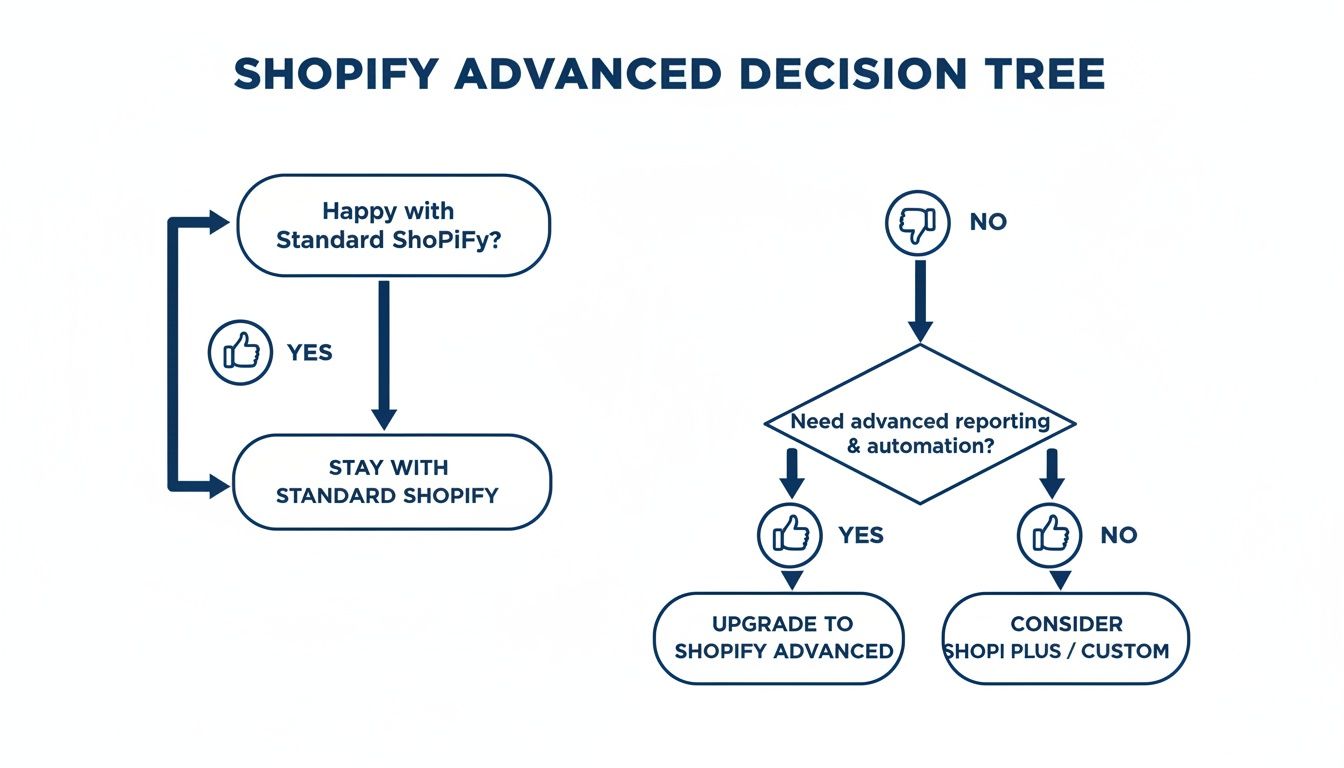
As the diagram shows, the path to Shopify Plus usually begins when the limits of the standard plans start to directly interfere with your growth potential.
When Your Expansion Creates Complexity
Another massive trigger is when your international ambitions clash with operational reality. Let's say you want to launch a dedicated storefront for the German market, complete with local currency, language, and product selections. While you can use Shopify Markets on the Advanced plan, managing a truly distinct, localised experience from a single store quickly becomes a clunky and inefficient process.
Similarly, if your business relies on complex B2B sales or unique subscription models, the standard Shopify checkout will soon become a roadblock. You might need custom fields for purchase orders or a completely different checkout flow for your tiered wholesale clients. The moment you realise you can't build the exact customer journey you need, you've slammed into a hard ceiling with the Advanced plan.
The moment you start building complicated workarounds for core business functions—whether for international sales, B2B portals, or custom checkout logic—is the moment you've started paying an "inefficiency tax." Shopify Plus is designed to eliminate that tax.
Dealing with Operational Drag and the Need for Automation
The pain is often felt internally, too. Trying to run a large team with just 15 staff accounts creates an operational nightmare. You find yourself sharing logins or restricting access in ways that hamstring your marketing, customer service, and fulfilment teams. This isn't just an inconvenience; it's a security risk and a direct drain on your team's productivity.
Finally, take a hard look at your need for automation. As order volume skyrockets, manual processes that were once manageable become totally unsustainable. You need enterprise-level tools to connect your entire tech stack, from your ERP and CRM to your warehouse management system. If your team is wasting hours every week on tasks that a tool like Shopify Flow could easily automate, the cost of not upgrading is already adding up in lost time and human error.
Recognising these signs is the first step. The next is planning and executing a smooth transition, which almost always benefits from specialist expertise. To see how an agency can streamline this move, you can learn more about working with a Shopify Plus development agency and make sure you get the maximum ROI from your investment right from day one. Once these bottlenecks become part of your daily reality, investing in Shopify Plus is no longer a luxury—it’s a necessity for scaling.
Frequently Asked Questions
When you're weighing up Shopify Advanced and Shopify Plus, a few key questions always seem to pop up. These are the practical, nitty-gritty details that often make the final decision for UK businesses. We've gathered the most common ones here to give you straight answers.
Think of this as the final checklist to clear up any lingering doubts before you make the leap.
Can I Customise The Checkout On Shopify Advanced?
With Shopify Advanced, your checkout customisation is really just cosmetic. You can add your logo, match your brand colours, and select fonts through the theme editor, but that’s where it stops. You can’t add new fields, tweak the layout, or fundamentally change how a customer moves through the payment process.
If you need that level of control, you absolutely need Shopify Plus. It unlocks Checkout Extensibility, which lets developers build apps that add bespoke functionality right into the checkout. It's the only way to create a truly unique and tailored checkout experience without compromising security.
What Is The Biggest Hidden Benefit Of Shopify Plus?
It’s easy to focus on the flashy features, but the real game-changer with Shopify Plus is the support network you become part of. You’re not just getting a platform; you’re getting a Launch Engineer to manage your migration and a dedicated Merchant Success Manager for proactive, strategic advice.
This isn't your typical support ticket system. It's a genuine partnership. Your Merchant Success Manager helps you navigate complex technical hurdles, plan your international expansion, and even gives you early access to beta features before anyone else.
How Difficult Is The Migration From Advanced To Plus?
The technical side of moving your core data—products, customers, orders—is surprisingly simple because you’re staying inside the Shopify ecosystem. The heavy lifting isn't about data migration; it's about strategy.
The real challenge is figuring out how to properly implement all the new tools you've just unlocked. How will you use Shopify Flow to automate returns? What's the best way to set up your B2B portals? This is where an experienced Shopify Plus agency becomes essential, ensuring you're not just upgrading your plan but actually upgrading your business from day one.
Are There Exclusive Apps Only For Shopify Plus Merchants?
Yes, and they are significant. Shopify Plus comes with a suite of exclusive, powerful tools that you just can't get on other plans. The big ones are Shopify Flow for automating just about any business process, the full B2B on Shopify suite for wholesale, and Launchpad for scheduling flash sales and product drops.
Beyond the apps, Plus merchants also get higher API rate limits. This might sound technical, but it’s crucial for connecting to complex third-party systems like an ERP or a sophisticated CRM. On the Advanced plan, these integrations can often fail or be too slow to be practical.
If it's clear that Shopify Plus is the right move for your brand, getting the migration right is everything. At Grumspot, we specialise in helping UK businesses make a seamless and impactful upgrade to Shopify Plus. We'll make sure you hit the ground running. Let's discuss how we can scale your e-commerce operations together.
Let's build something together
If you like what you saw, let's jump on a quick call and discuss your project

Related posts
Check out some similar posts.
- benefits of shopify plus
Discover the key benefits of Shopify Plus. Learn how enterprise features like advanced customization...
Read more