Top Web Design Agency Essex: Your 2026 Growth Partner
- web design agency essex
- ecommerce agency essex
- shopify developer essex
- web design essex
- cro agency essex
Launched
May, 2026

A lot of Essex businesses are in the same position right now. The site looks modern enough. The brand colours are right. The homepage slider is polished. But leads are inconsistent, sales feel harder than they should, and every change takes too long.
That usually means the website is being judged by the wrong standard.
A good website in 2026 isn't the one that gets compliments in a meeting. It's the one that loads quickly, ranks cleanly, guides buyers to the right action, and still performs after launch when real traffic, real products, and real customer behaviour expose every weak decision. When seeking a web design agency in Essex, that distinction matters more than ever.
Is Your Website Working for You or Against You
A common scenario looks like this. A business invests in a redesign, signs off on sleek mockups, launches on schedule, then waits for the uplift that never arrives. Traffic doesn't improve much. Enquiries stay flat. Checkout drop-off remains frustratingly high. The site isn't broken, but it isn't pulling its weight.
That gap between appearance and performance is where most disappointment starts. A website can look credible and still fail at the jobs that matter: attracting qualified visitors, explaining the offer fast, reducing friction, and turning intent into revenue.
The agency market doesn't make this easier. The UK web design industry has an estimated 2,206 businesses operating in 2025, according to IBISWorld's UK web design services industry data. For Essex buyers, that means plenty of choice, but also a lot of similar promises. Most agencies can show attractive pages. Far fewer can explain how they handle migration risk, collection architecture, technical SEO, accessibility, site speed, and post-launch testing.
What underperformance usually looks like
You don't need a dramatic failure to have a weak site. More often, the warning signs are operational:
- Sales teams compensate manually: Staff answer the same pre-purchase questions because the site doesn't do enough selling on its own.
- Marketing spends more to get the same result: Paid traffic lands on pages that don't match search intent or buyer readiness.
- Teams avoid making changes: The site is hard to edit, fragile, or dependent on one developer who built it.
- Reporting stays shallow: Meetings focus on page views and aesthetics instead of revenue by landing page, product page drop-off, or checkout friction.
A website becomes expensive long before it becomes obviously broken.
What a better benchmark looks like
A stronger brief starts with business outcomes, not design taste. For an ecommerce brand, that usually means cleaner navigation, stronger category logic, better collection filtering, clearer product information, tighter mobile UX, and a checkout path with fewer reasons to abandon. For lead generation, it means reducing hesitation, making the next step obvious, and capturing demand from search with pages built around actual services and buying questions.
This is why the right web design agency in Essex shouldn't behave like a production supplier. They should act more like a technical growth partner. The key question isn't “Can they make us a nicer site?” It's “Can they build something that performs when customers use it?”
What a Growth-Focused Web Agency Delivers
A standard designer decorates the room. A growth-focused agency checks the foundations, plans the traffic flow, and makes sure the building supports what the business is trying to do.
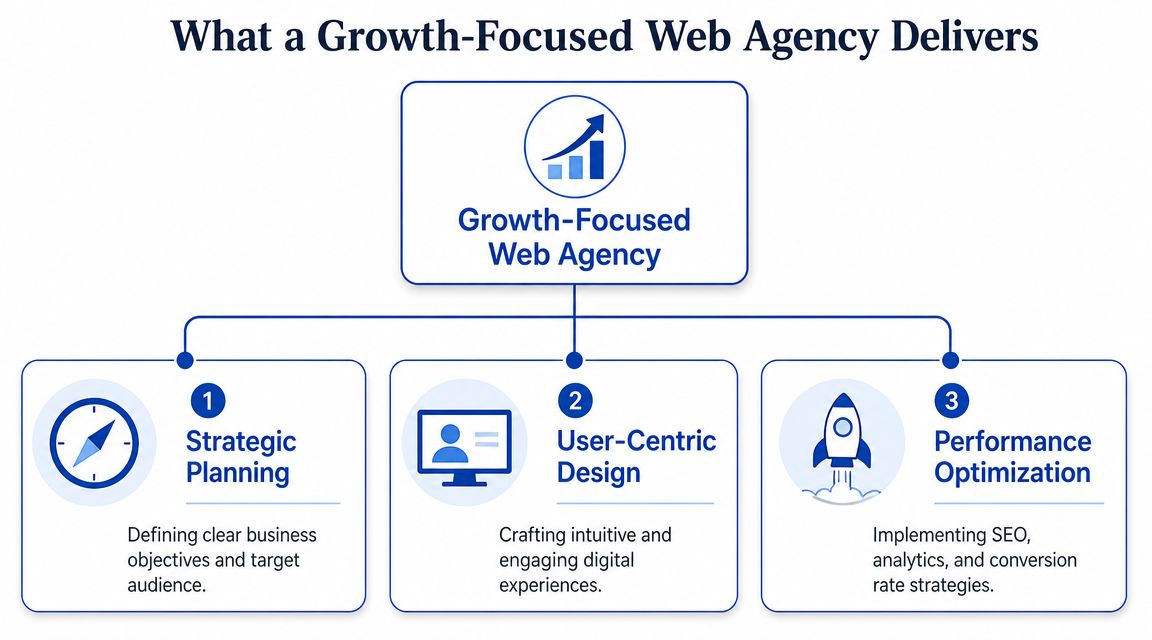
That difference shows up in three areas: strategy, technical execution, and post-launch improvement. If one of those is missing, the site usually looks better than it performs.
Strategy before screens
The strongest projects start with commercial questions. What products drive margin? Which landing pages already convert? Where do customers hesitate? What needs to stay stable during a migration? Which teams need to update content every week without developer help?
Without that groundwork, design reviews drift into subjective feedback. One stakeholder wants more animation. Another wants more copy. Someone asks for a bigger hero banner. None of that fixes weak search intent matching, poor collection structure, or messy product detail pages.
A capable partner should define success before design starts. That usually includes:
- Business goals: Revenue, lead quality, average order value, repeat purchase support, or operational efficiency.
- User journeys: New visitors, returning customers, trade buyers, subscription customers, or international shoppers.
- Technical constraints: Platform limits, app conflicts, CRM dependencies, ERP integrations, stock logic, and fulfilment workflows.
Technical execution that protects revenue
Performance isn't a nice extra. It's directly tied to whether users stay long enough to buy. Google's research found that when page load time increases from 1 second to 3 seconds, the probability of bounce rises by 32%, as cited in Web Knack's discussion of web performance and Essex web design.
For ecommerce teams, that turns front-end decisions into commercial decisions. Heavy scripts, oversized media, bloated themes, and poorly controlled third-party apps all create friction. That friction costs attention first, then revenue.
Practical rule: If an agency can't explain what they're removing, simplifying, or deferring to improve load behaviour, they're probably treating performance as a developer clean-up task instead of a design requirement.
This is also where process matters. A serious build partner should be comfortable with:
- Shopify and Shopify Plus builds: Theme architecture that stays maintainable after launch.
- Platform migrations: Moving from WooCommerce, Magento, or custom systems without damaging key pages or customer experience.
- Technical SEO during rebuilds: Redirect planning, metadata handling, crawl logic, collection and product indexation, and template consistency.
- Measurement setup: Analytics, event tracking, attribution hygiene, and clear definitions of success.
If you're comparing tool stacks, this roundup of best SEO software for agencies is useful because it shows the kind of systems serious teams rely on to audit visibility, track technical issues, and monitor changes after launch. For a more conversion-led perspective, this article on conversion-focused web design is also worth reviewing before you scope a rebuild.
Growth work after launch
Launch day isn't the finish line. It's when the useful data starts arriving.
A growth-oriented agency should have a plan for what happens next. That often includes search landing page refinement, collection page testing, product page content improvements, checkout UX fixes, merchandising experiments, and accessibility remediation based on real usage rather than assumptions. A site that isn't reviewed after launch usually drifts back into the same issues that triggered the redesign.
How to Choose the Right Web Design Partner in Essex
Portfolios are useful, but they're where weak buying decisions often begin. Nice visuals can hide shallow process. A homepage mockup tells you almost nothing about migration planning, analytics discipline, or what happens when the client's internal team needs to update the site under pressure.
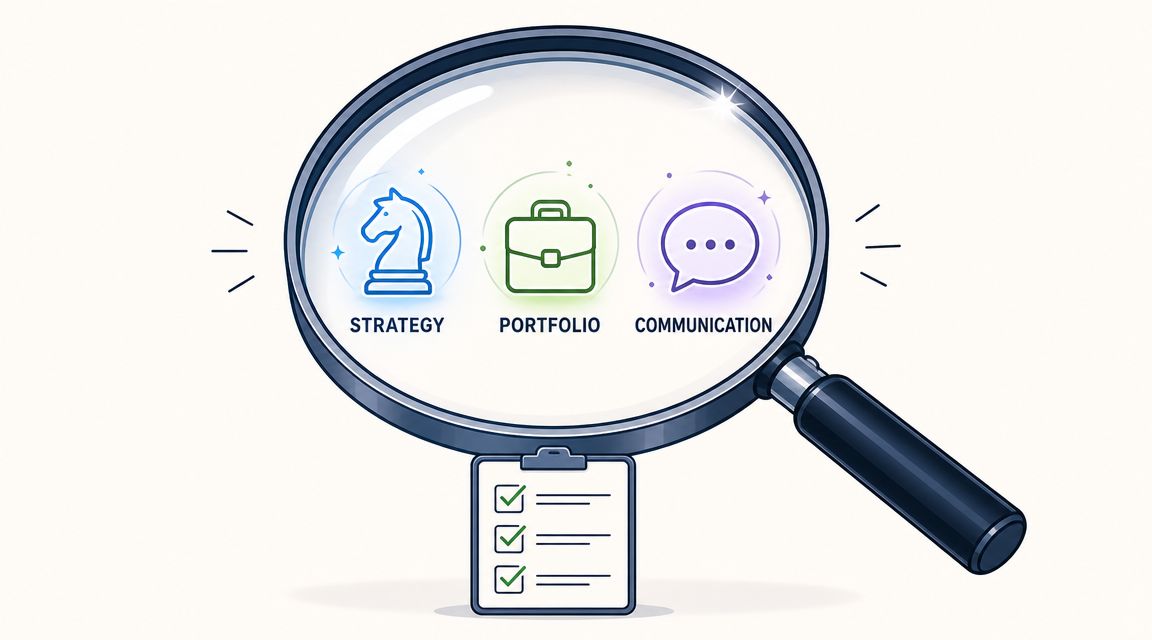
The market is also fragmented, which makes surface-level comparison harder. As noted in Honcho's Essex web design commentary, many agencies present similar-looking services, so buyers need to ask deeper questions about process, especially around areas like accessibility that affect usability, SEO, and compliance.
Look past the portfolio
The right agency should be able to walk you through decisions, not just outcomes. Ask them what changed between the initial brief and final solution. Ask what they removed. Ask what they tested. Ask what they learned after launch.
A useful review of any agency candidate should include these checks:
- Case study depth: Do they explain the problem, constraints, and trade-offs, or just show finished screenshots?
- Technical confidence: Can they speak clearly about platform limitations, app bloat, redirects, schema, and content governance?
- Post-launch model: Do they disappear after launch, or do they offer structured optimisation work?
- Accessibility approach: Do they treat accessibility as a practical design and development standard, or as a vague line item?
Questions that reveal whether they can actually help
Ask direct questions and listen for precise answers.
How do you protect SEO during a rebuild or migration?
You want to hear about redirect mapping, crawl preservation, template consistency, and launch QA. You don't want to hear “Google will reindex it”.What do you measure after launch?
Serious partners talk about conversion paths, drop-off points, landing page performance, search visibility, and user behaviour. Weak partners talk only about the launch being complete.How do you handle accessibility from the start?
The right answer covers audits, semantic structure, keyboard use, colour contrast, focus states, form labelling, and ongoing remediation.Who does the work? Some agencies sell senior strategy and deliver junior execution. That's not always a problem, but you should know who's responsible for UX, development, QA, and support.
For a broader selection framework, this guide to selecting a digital marketing agency gives a helpful outside view on evaluating process and accountability. If you want a web-specific checklist, this article on how to choose a web design agency covers the questions that usually separate a capable partner from a presentation-led one.
A short walkthrough can also help you spot red flags before you commit:
Red flags worth taking seriously
Some warning signs are easy to miss during a smooth sales process.
If an agency can't explain how success will be measured after launch, they're selling deliverables, not outcomes.
Watch for these:
- Everything is custom, but nothing is explained: That often means inflated complexity.
- No mention of content structure: Design can't fix unclear navigation or weak category logic.
- Accessibility is brushed off: That usually signals weak QA and weak front-end discipline.
- Support is vague: If ownership after launch is unclear, issues will sit unresolved.
Local Essex Agency vs Global Remote Specialist
Location matters less than many buyers think. What matters more is whether the team fits the job. A straightforward brochure site for a local service business has different needs from a multi-market Shopify rebuild with subscriptions, bundles, and ERP dependencies.
A local agency can make collaboration easier. A remote specialist can bring deeper platform experience. Neither model is automatically right.
Choosing your agency model
| Factor | Local Essex Agency | Remote Specialist Agency |
|---|---|---|
| Meetings and collaboration | Easier face-to-face workshops, useful when stakeholders need in-person alignment | Usually handled through calls, shared docs, and recorded walkthroughs |
| Local market familiarity | Often understands regional service businesses and nearby competitors | May need more onboarding on local customer context |
| Specialist ecommerce depth | Can vary widely. Some are broad digital agencies first | Often stronger where the project needs platform-specific expertise |
| Speed of communication | Convenient if you prefer in-office sessions | Can be excellent if the team runs organised async processes |
| Project complexity fit | Strong option for simpler sites or local lead generation projects | Strong option for migrations, complex integrations, and ongoing optimisation |
| Decision making | Familiar working style for owner-led businesses | Better fit when structured documentation and sprint-style delivery matter |
What should decide it
If the project is simple, local chemistry can matter a lot. A nearby team may understand your service area, your customer language, and the pace your internal team can handle.
If the project is technically demanding, local proximity shouldn't outweigh capability. Platform migrations, subscription logic, advanced merchandising, international storefront structure, or custom app work all benefit from specialist experience. In those cases, the quality of planning, QA, and post-launch support matters more than whether the team can drive to your office.
The best choice usually comes from matching the agency model to the commercial risk of the project. The more revenue depends on the site, the less sensible it is to hire on convenience alone.
Real Results from E-commerce Projects
A key test of a redesign is what happens after launch. That matters even more when digital revenue is such a large part of retail behaviour. The Office for National Statistics reported that internet sales accounted for 26.6% of all retail sales in March 2026, as referenced in Parallel's analysis of website design in Essex. If a new site doesn't improve how a business captures online demand, the redesign hasn't done its job.
What good results actually look like
Strong ecommerce outcomes usually come from operational fixes disguised as design work.
A store rebuild might improve conversion because collection pages stop forcing users to work so hard. Filters become clearer. Product cards answer more pre-purchase questions. Mobile layouts stop hiding important information below awkward blocks. Checkout distractions get removed. None of that sounds glamorous in a pitch, but it's often where revenue moves.
Another project may focus less on the storefront and more on catalogue logic. If bundles are hard to understand, variant selection is clumsy, or complementary products aren't surfaced at the right moment, customers buy less than they intended. Better merchandising architecture often outperforms cosmetic redesign work.
Post-launch performance matters more than launch-day praise.
The patterns behind stronger ecommerce projects
Across successful projects, the same themes show up repeatedly:
- Migration discipline: Important URLs are protected, content is cleaned up, and dead sections aren't dragged into the new build.
- Sharper information hierarchy: Customers see delivery, returns, compatibility, stock, and pricing details at the moment they need them.
- Theme restraint: The build avoids unnecessary effects, duplicate apps, and sections that create editing complexity.
- Continuous review: Teams watch what users do after launch and refine based on evidence.
In practice, that's where a specialist Shopify partner can differ from a generic web design agency in Essex. Some teams focus on launch output. Others focus on what happens when paid traffic, organic traffic, repeat customers, and operational updates collide with the live site. Grumspot operates in that second category, with work centred on Shopify design, development, migration, audits, and CRO for stores that need technical and commercial improvement rather than a visual refresh alone.
What not to mistake for success
A polished homepage isn't proof. Neither is a brand deck, a smoother animation style, or positive internal feedback from stakeholders who already know the business.
Treat these as supporting details, not outcomes:
- A prettier interface without better user flow
- A faster approval process that skips technical QA
- A feature-heavy build that adds maintenance burden
- A launch announcement with no plan for iteration
The best ecommerce projects don't just look more current. They make the buying journey simpler, clearer, and harder to abandon.
Decoding Web Design Pricing in 2026
Website pricing confuses buyers because agencies often bundle very different work under the same label. “Web design” might mean a brochure site with a template. It might mean a full ecommerce rebuild with UX research, migration planning, technical SEO, custom functionality, analytics setup, and post-launch CRO support. Those aren't comparable purchases.
That's why price shopping without scope clarity usually ends badly. The cheapest proposal often excludes the work that protects revenue, while the most expensive one isn't always the most rigorous.
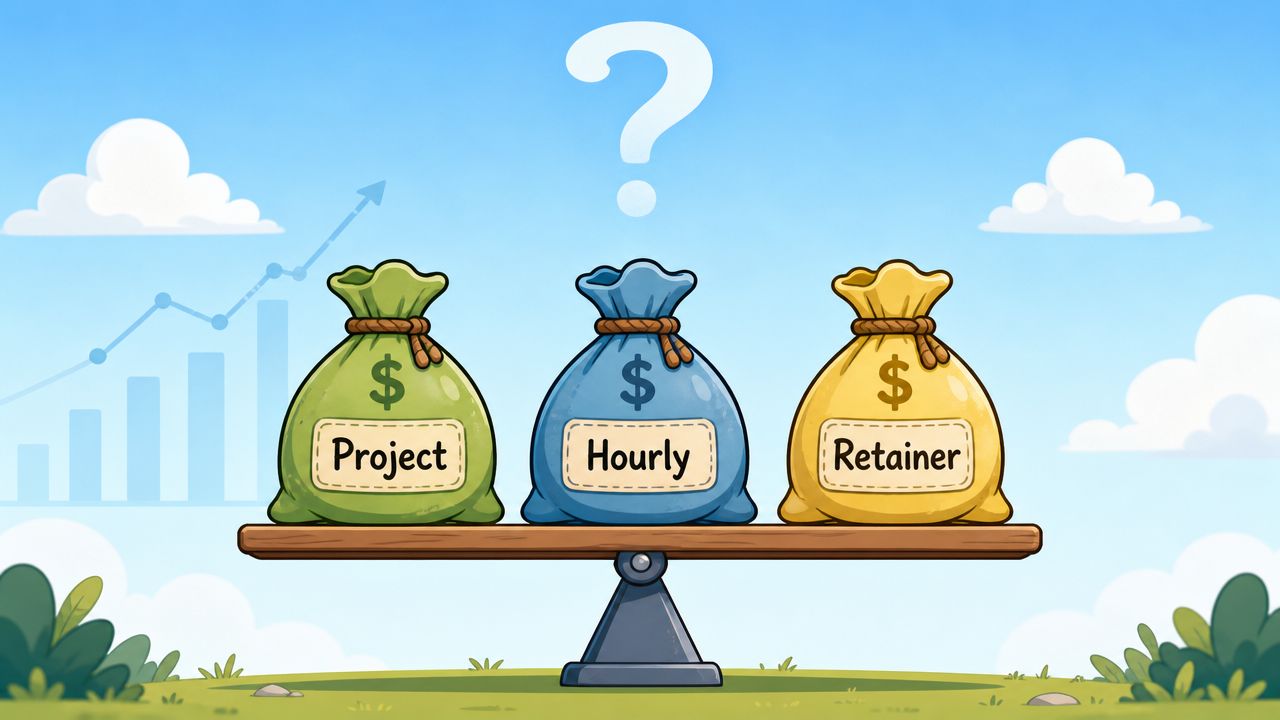
Project fee or retainer
Most agencies work in one of two models.
A project fee fits a defined build. That normally covers discovery, UX/UI design, development, QA, content population to an agreed scope, launch support, and limited post-launch fixes. It's a sensible model when the business needs a site live by a clear deadline and the required functionality is well understood.
A retainer fits ongoing improvement. That usually covers CRO work, merchandising changes, landing page creation, technical support, testing, bug fixing, search-related fixes, and regular strategy input. For ecommerce teams, this model often makes more sense after a rebuild because the site keeps evolving.
What actually changes the price
The biggest cost drivers are usually complexity and risk, not page count.
A simple service-led site tends to be cheaper because it has fewer moving parts. An ecommerce site becomes more expensive when the brief includes product data cleanup, custom theme components, subscriptions, bundles, trade pricing, market-specific content, app rationalisation, ERP or CRM integration, and migration planning.
Look closely at whether the proposal includes:
- Discovery and strategy: Not just design time
- Content structure work: Navigation, collection logic, and page purpose
- Technical SEO support: Especially important for rebuilds
- Accessibility QA: Not as an afterthought
- Training and handover: So your team can run the site properly
- Post-launch support: Because issues rarely end on launch day
Cheap builds are often expensive to run. Expensive builds are often poor value too. The right question is whether the scope matches the commercial importance of the site.
How to budget sensibly
Instead of asking “What does a website cost?”, ask “What kind of website operation do we need?” That pushes the conversation toward staffing, complexity, business risk, and the likely need for iteration.
If you're planning a Shopify project, this breakdown of Shopify website design cost is useful for understanding how scope, custom work, and support requirements affect pricing.
A practical budget review should compare proposals against four things: what is being built, what is being protected, what is being measured, and what happens after launch. If a quote can't answer those, it isn't transparent enough to trust.
Your Next Step Towards a High-Performing Website
Choosing a web design agency in Essex isn't really a creative decision. It's an operational and commercial one.
The right partner should improve how your business acquires traffic, converts intent, supports customers, and manages change after launch. That's why pretty mockups and broad service lists aren't enough. You need to know how the agency thinks about speed, search visibility, accessibility, platform fit, measurement, and ongoing optimisation.
A weak agency relationship usually leaves you with a nicer version of the same problems. A strong one gives you a site that your marketing team can scale, your customers can use without friction, and your business can grow on.
If you're reviewing agencies now, keep the shortlist honest. Ask how they handle migration risk. Ask how they measure performance. Ask what they do in the first month after launch. Ask who will be doing the work day to day. The answers will tell you more than the portfolio ever will.
And if your current website already feels like a constraint, don't wait for a full redesign brief to start getting clarity. A technical and conversion audit often reveals whether the issue is platform fit, theme bloat, poor structure, weak content hierarchy, or lack of post-launch ownership.
If you want a practical second opinion before committing to a rebuild, Grumspot can help assess your current store, flag the biggest technical and conversion issues, and outline what a sensible next step looks like without forcing you into a full project.
Let's build something together
If you like what you saw, let's jump on a quick call and discuss your project
Related posts
Check out some similar posts.