How to Choose a Web Design Agency for Growth in 2026
- how to choose a web design agency
- web design agency
- ecommerce agency
- shopify agency
- vendor selection
Launched
May, 2026
You're probably in one of two situations right now. Either your current site no longer fits the business, or you've spoken to a few agencies and every conversation sounds polished but hard to compare.
That's where many businesses go wrong. They judge agencies by homepage aesthetics, a smooth sales pitch, or a proposal total at the bottom of a PDF. None of those tells you whether the agency can manage a migration, preserve SEO, integrate with your ERP, improve conversion paths, or support the site once it goes live.
The decision matters because the supplier market is crowded. In the UK alone, the web design industry is estimated at 2,041 professional businesses serving more than 2.7 million active websites, which is exactly why style alone is a weak filter and verifiable experience matters more when choosing a partner, as noted in Made By Shape's UK web design market overview.
A good agency doesn't just make a site look current. It reduces delivery risk, builds the right technical foundation, and helps the business keep improving after launch. That's the standard to use if you're serious about growth.
Define Your Project Before You Search for an Agency
The most expensive mistake happens before you contact anyone. A team says, “We need a new website,” then starts booking calls with agencies before agreeing what the project is meant to do.
That creates weak proposals and bad comparisons. One agency prices a redesign. Another assumes a migration. A third includes SEO support and post-launch optimisation. Everyone appears to be quoting for the same thing, but they aren't.
Start with business outcomes, not pages
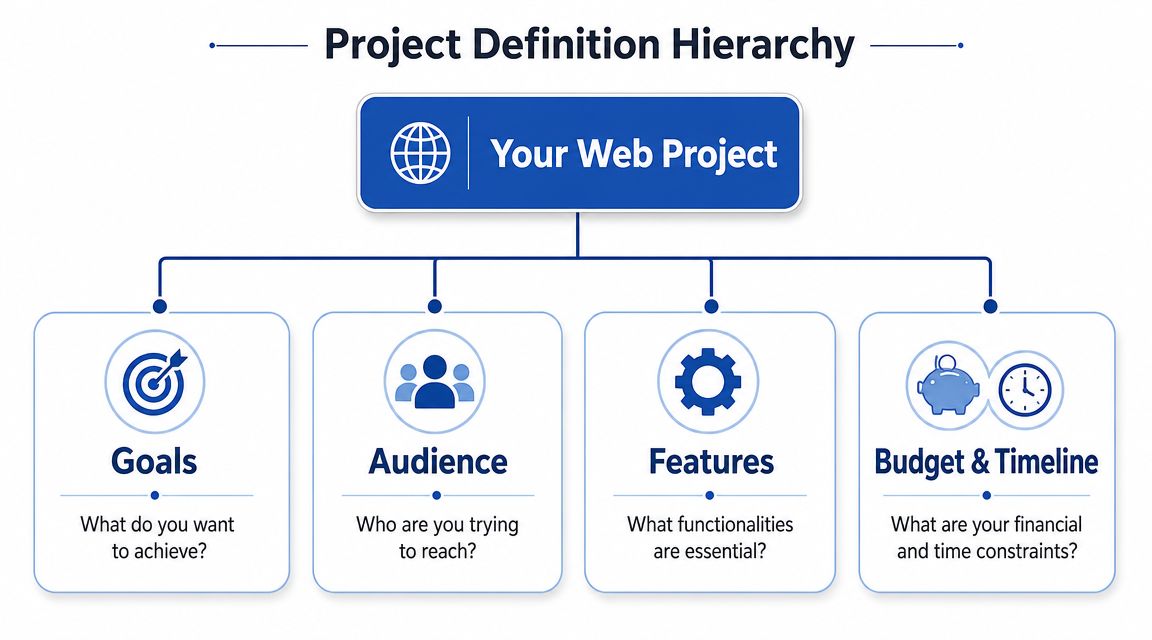
A useful brief begins with business goals. Not “modernise the site”. Not “improve the brand”. Those may be valid intentions, but they aren't decision criteria.
Ask instead:
- Revenue question: Is the site meant to improve conversion, support larger average baskets, reduce friction in checkout journeys, or enable a new product model such as subscriptions or bundles?
- Operational question: Is the project tied to platform migration, catalogue restructuring, market expansion, or internal workflow problems?
- Marketing question: Do you need stronger landing page control, better technical SEO, cleaner tracking, or a content structure that supports acquisition?
If your team can't state what success looks like, an agency will fill in the blanks for you. That usually means they'll optimise for what they sell most easily.
Define audience, journeys, and constraints
Most briefs skip straight to features. That's backwards. Before listing apps, templates, or integrations, map who the site is for and what those users need to accomplish.
Write down:
- Primary customer groups
- Top user journeys
- Critical friction points on the current site
- Commercial constraints such as seasonality, launch windows, or stock complexity
- Internal constraints such as stakeholder availability, content ownership, and legal review
If content is part of the project, decide early whether you're rewriting, restructuring, or migrating existing material. Teams often underestimate this. A lot of “web design” delays are content governance problems. If your team needs help framing that workstream, this guide from Scheduler.social on content strategy is a useful primer because it forces clarity around audience, messaging, and publishing priorities before design starts.
Practical rule: If the brief can't tell an agency who the buyer is, what needs to change commercially, and what systems the site must connect to, the brief isn't ready.
Specify the platform and technical reality
Buyers often become too vague. If you know the project needs Shopify or Shopify Plus, say so. If you need subscriptions, B2B functionality, multilingual setup, ERP syncing, CRM connectivity, or custom checkout logic, put that in writing.
UK-focused guidance warns that the most common technical pitfall is failing to validate whether the vendor can deliver the specific commerce or CMS architecture you need, including integrations, custom development, support, and the right mix of strategy, UX, development, and project management skills, as outlined in Blue Archer's agency selection guidance.
That's why a serious brief should include:
| Brief component | What to define |
|---|---|
| Business objective | What the site must improve |
| Platform | Shopify, Shopify Plus, or another stack |
| Integrations | ERP, CRM, fulfilment, subscriptions, reviews, search |
| Migration scope | Content, products, customers, redirects, tracking |
| SEO needs | Technical remediation, collection structure, templates |
| Post-launch needs | CRO, maintenance, support, feature releases |
Budget range also matters. Not because agencies should race to your ceiling, but because the right scope depends on the level of investment and the timeline. If you're weighing what a realistic ecommerce build includes, Grumspot has a practical breakdown of Shopify website design cost.
How to Judge Portfolios and Read Case Studies
You shortlist an agency because the work looks expensive. Six months later, the new site is live, conversion is flat, merchandising is harder than before, and your team is stuck with a theme that fights every change request. That usually starts with a weak portfolio review.
A portfolio should answer a harder question than "Do we like the look of this?" It should show whether the agency can solve problems that affect revenue, operations, and growth.
Design taste matters. It just sits lower on the list than commercial fit.
Look for work that matches your business reality
A polished DTC storefront does not prove an agency can handle a B2B catalogue, a subscription model, a multilingual rollout, or a replatform with years of SEO equity at risk. "Ecommerce experience" is too broad to be useful unless you examine what kind of ecommerce they deliver.
Review portfolios through three filters:
- Business model fit: Have they worked with brands that sell the way you sell, whether that means wholesale, subscriptions, bundles, international markets, or large catalogues?
- Platform fit: Have they delivered projects on the platform you need, especially if you are assessing a Shopify development agency for a migration or rebuild?
- Problem fit: Have they fixed the kinds of issues that matter in your project, such as poor conversion on mobile, messy category structures, slow merchandising workflows, weak search, or a complicated replatform?
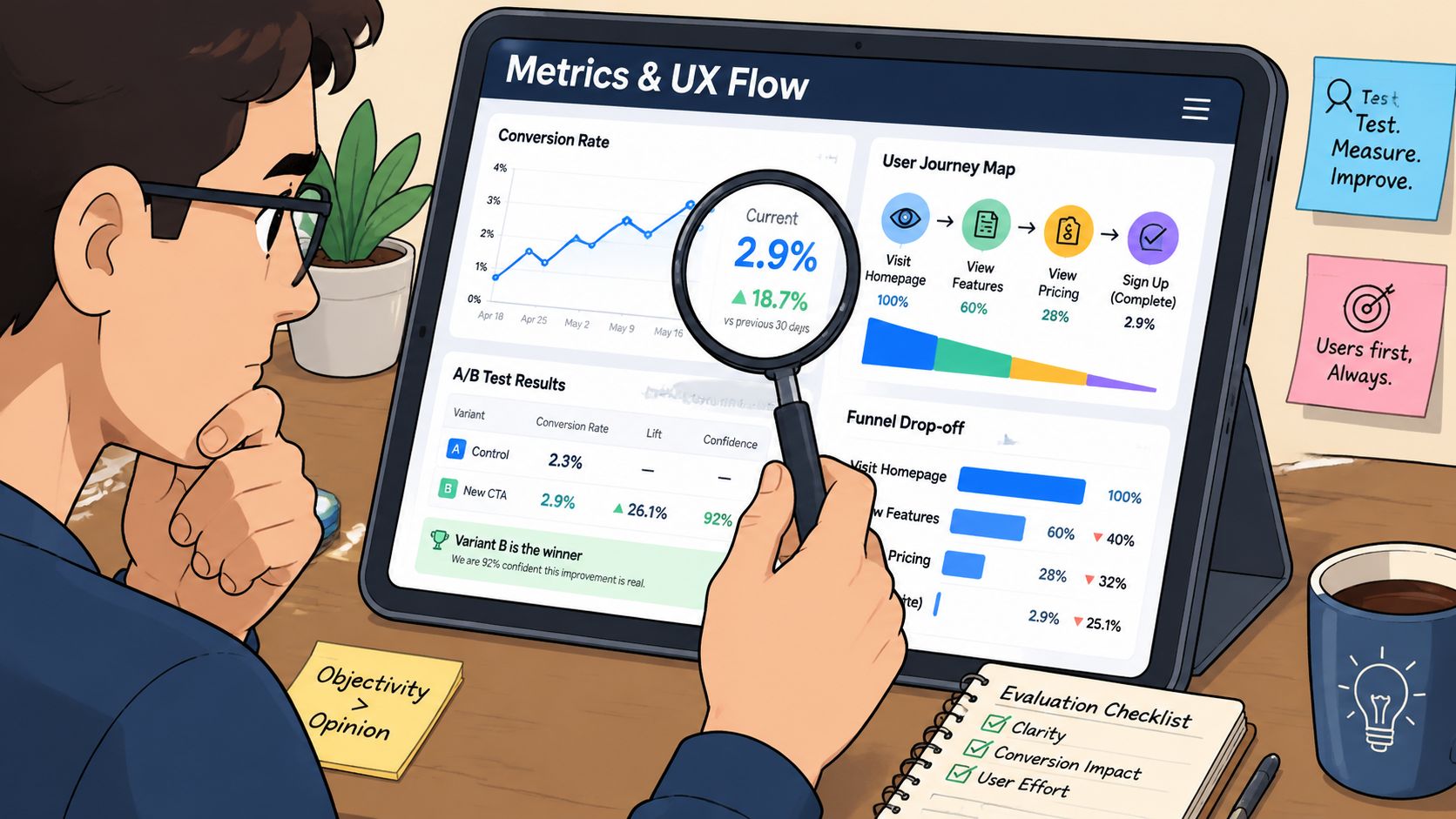
Agencies often present variety as proof of strength. Sometimes it is. Sometimes it means they have no real specialism and apply the same process to every client. The stronger signal is relevance. If your brief involves a Shopify migration, retention-led merchandising, and complex integrations, the useful portfolio pieces are the ones that show those conditions clearly.
Read case studies like an investor, not an art director
A strong case study explains the commercial context, the constraints, the decisions, and the result. A weak one hides behind adjectives.
Treat vague language as a warning sign. Phrases like "improved UX", "refreshed the brand", or "created a better customer journey" say very little unless the agency explains what changed and why those changes mattered.
A credible case study usually gives you four things:
- The business problem: declining conversion, poor mobile performance, rising acquisition costs, migration risk, operational inefficiency
- The strategic choice: why they changed information architecture, simplified templates, rebuilt PDPs, or phased features
- The delivery reality: what made the project difficult, including inherited technical debt, stakeholder conflict, timeline pressure, or integration constraints
- The outcome: a measured result, a documented operational improvement, or a clear post-launch plan if final numbers were not yet available
Good agencies can also explain trade-offs. They should be able to say, plainly, why they delayed a feature, simplified a design pattern, or chose a lower-risk implementation to protect launch timing. That is the kind of judgement you want in a partner.
Ask what happened behind the screenshots
Large visuals are easy to admire and hard to audit. The useful part of a portfolio review happens in conversation.
Ask specific questions about the work in front of you:
- What was the client trying to improve before the project started?
- What constraints shaped the solution?
- Which parts of the build were technically difficult?
- What did you decide to leave out of phase one, and why?
- What happened in the first three months after launch?
- Would you structure the project differently if you ran it again?
Those questions expose how the agency thinks under pressure. They also tell you whether the team can talk candidly about outcomes instead of presenting every project as a flawless success.
Then check the live site yourself. Use mobile. Test search, filtering, product discovery, cart behaviour, and checkout handoff. Look at collection logic and how promotions are surfaced. If the case study talks about conversion strategy, the live experience should show disciplined choices, not just attractive layouts.
A strong portfolio proves the agency can adapt its approach to different commercial problems. It does not just prove they have a style.
Vetting Technical Capabilities and Development Processes
A polished design portfolio can hide weak engineering. That's common. Some agencies are excellent at concepts and poor at implementation. Others rely heavily on freelancers or white-label partners, which isn't necessarily a problem, but it becomes one if they can't explain who builds what and how quality is controlled.
The real test is whether the agency can ship a stable, scalable site under commercial pressure.
Ask how they build, not just what they build
Most clients ask to see examples. Fewer ask about workflow. That's where risk lives.
A competent ecommerce agency should be able to explain, in plain English, how work moves from discovery into UX, design, development, QA, launch, and support. They should also explain where decisions get documented, how scope changes are handled, and how they test before release.
Here are questions worth asking:
- Who writes technical specifications and who signs them off?
- How do you handle staging, QA, and regression testing?
- What's your approach to redirects, metadata, and technical SEO during migration?
- How do you test app compatibility and third-party integrations?
- What happens if launch readiness slips?
- Who owns code, theme assets, and documentation when the project is complete?
If the answers are vague, the process is probably vague too.
Operational fit is the issue most buyers miss
A lot of agency selection advice overweights visual output and underweights operational delivery. That's the wrong balance for ecommerce.
The reason is simple. UK non-store retailing represented 26.6% of all retail sales volumes in March 2026, which makes technical reliability, migration planning, testing, and post-launch iteration commercially significant, as discussed in Cliq Studios' guidance on choosing a web design agency.
For Shopify projects, that means you need confidence in areas such as:
| Technical area | What to probe |
|---|---|
| Migration planning | Data mapping, redirects, product structure, downtime avoidance |
| Integrations | ERP, CRM, subscriptions, search, reviews, fulfilment |
| Theme development | Performance, maintainability, section architecture |
| QA process | Device testing, checkout flows, analytics validation |
| SEO handling | Template logic, crawlability, metadata, redirects |
| Post-launch workflow | Bug triage, release cadence, ownership, support access |
One practical benchmark is whether the agency can discuss edge cases calmly. Ask about bundles, international pricing, app conflicts, customer account migrations, or feed dependencies. Strong teams won't pretend nothing ever goes wrong. They'll explain how they reduce the chance of failure.
Watch how they communicate during the sales process
Responsiveness in pre-sales often predicts responsiveness in delivery. If an agency takes too long to answer basic questions, avoids specifics, or sends generic replies, expect more of that once the project begins.
That's one reason some brands prefer specialist partners over broad digital studios. For example, if your project is Shopify-heavy, a focused Shopify development agency may be easier to assess than a generalist firm that treats ecommerce as one service among many.
Slow, fuzzy communication early on is rarely a one-off. It usually reflects how the account will be run later.
Comparing Proposals and Understanding Pricing Models
By the time proposals arrive, participants are often tired. They've sat through discovery calls, repeated the brief, and now want to choose quickly. That's exactly when bad decisions happen.
The wrong move is comparing proposals by total cost alone. The right move is comparing assumptions.
Read the scope before the price
Two proposals can land in the same budget range and still describe very different projects. One may include discovery workshops, UX, technical SEO input, QA, and launch support. Another may only include design and development hours with broad wording around “standard setup”.
Start by checking whether each proposal clearly defines:
- Deliverables
- Dependencies
- Timeline and milestones
- Revision limits
- What is explicitly excluded
- Post-launch support terms
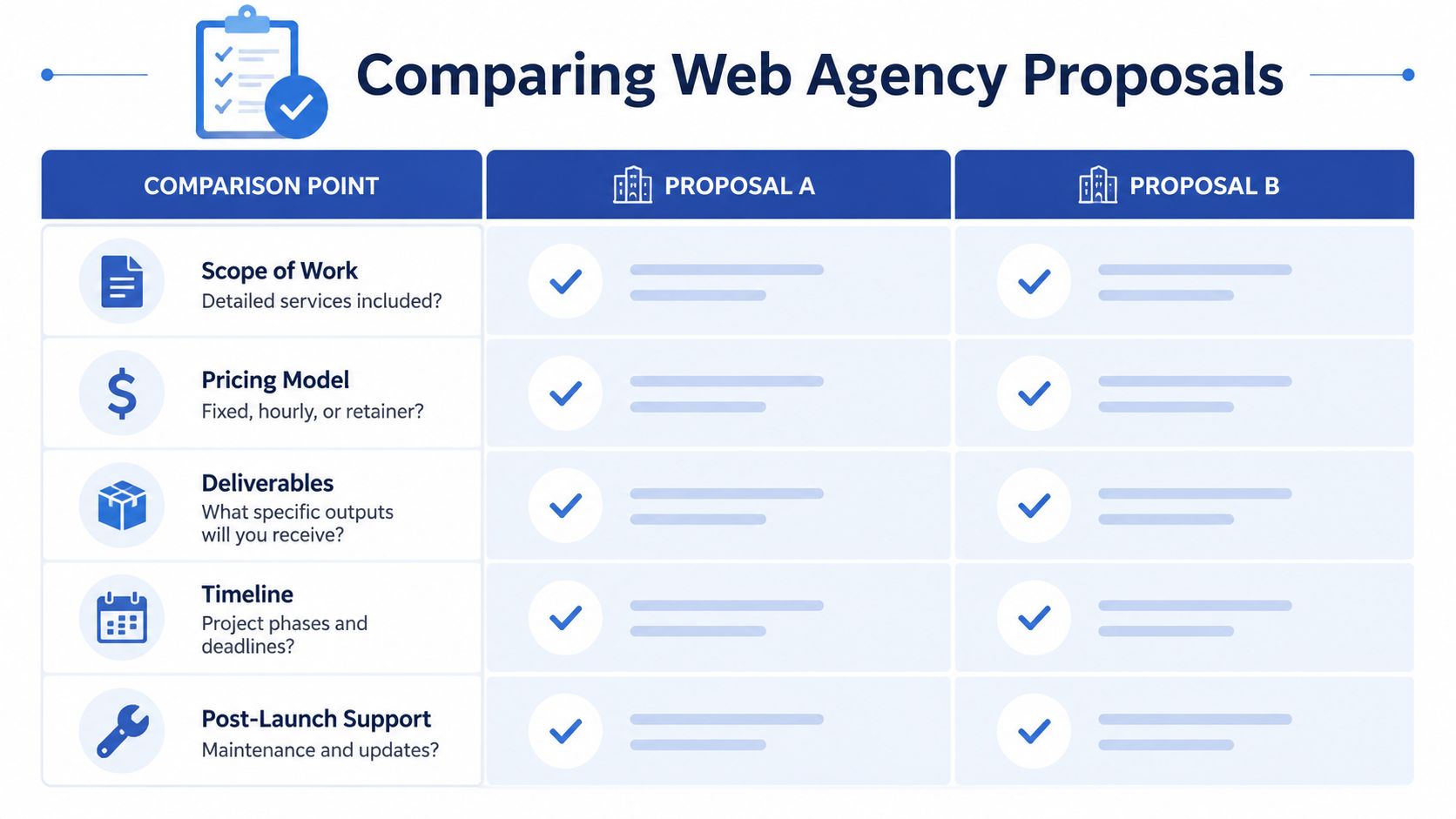
If a proposal says “SEO-ready build” or “migration support” without listing the actual tasks, ask for detail. Those phrases often hide major gaps.
Compare the pricing model, not just the fee
Different pricing models suit different risk profiles.
| Pricing model | Usually works best when | Watch-outs |
|---|---|---|
| Fixed project fee | Scope is well defined and approvals are organised | Change requests can become contentious |
| Time and materials | Requirements may evolve or involve unknowns | Budget control depends on strong management |
| Monthly retainer | You need phased delivery and ongoing iteration | Ensure priorities, hours, and response times are clear |
A project fee can look safer but become expensive if the original scope is thin. Time and materials can be fairer for complex builds, but only if the agency is disciplined about estimation and reporting. Retainers are often strong for brands that treat the website as an ongoing growth channel rather than a one-off launch. If that's the direction you're considering, it helps to understand how a Shopify monthly development plan is usually structured.
For a quick visual comparison of what proposal language can hide, this short video is worth watching before final interviews.
Use a due diligence window instead of rushing
Structured review beats instinct. UK-facing guidance suggests shortlisting 3 to 5 agencies and allowing roughly 4 to 8 weeks for due diligence, including proposal review, references, and final interviews, according to Stan Vision's agency selection process.
That timeframe matters because it creates space to spot hidden issues such as weak scoping, unclear ownership, vague support arrangements, or an agency that talks confidently but documents poorly.
Decision test: If you removed the price page from a proposal, would the scope still be clear enough for procurement, marketing, and operations to agree on what's being bought?
Evaluating Team Chemistry and Post-Launch Support
Agency selection isn't only a capability exercise. It's also a working relationship decision.
The team you meet in the pitch may not be the team you work with day to day. That's why chemistry should never be assessed as “did we like the salesperson?” The better question is whether the delivery team communicates clearly, handles pressure well, and behaves like a partner when trade-offs appear.
Meet the people who will actually run the work
Before you sign, ask to meet the project manager, lead strategist, designer, and technical lead if those roles exist. You want to hear how they think and how they talk to each other.
Pay attention to practical signals:
- Do they answer directly, or does one person dominate and protect the rest of the team?
- Can the developer explain technical choices without hiding behind jargon?
- Does the project lead sound organised when discussing approvals, dependencies, and risk?
- Do they challenge your assumptions constructively, or just agree with everything?
Good team chemistry doesn't mean the agency always says yes. It means they can disagree without becoming defensive and can guide decisions without creating confusion.
Post-launch support is part of the buying decision
A website launch is a handover point, not the finish line. In practice, brands often discover new content needs, merchandising changes, tracking issues, app conflicts, and CRO opportunities once real users interact with the new site.
That's one reason UK agency selection advice increasingly emphasises strategic capability and long-term support. The market has shifted from one-off brochure work toward continuous, conversion-focused delivery, so measurable results and post-launch optimisation now matter far more, as explained in American Eagle's guidance on choosing a web design agency.
Ask specifically:
- What support is included immediately after launch?
- How are bugs prioritised and resolved?
- Who updates content, landing pages, and merchandising modules?
- Do you offer CRO, experimentation, or audit support after launch?
- What happens if we need new features in month two, not month six?
A useful way to judge partnership quality
References help, but ask better reference questions. Don't ask, “Were you happy?” Ask what happened when something became difficult.
A revealing set of questions includes:
| Reference question | What it uncovers |
|---|---|
| What changed during the project? | Flexibility and change control |
| How did they handle problems? | Delivery maturity |
| Were deadlines managed realistically? | Planning quality |
| Who did you actually work with? | Team continuity |
| Did they stay useful after launch? | Long-term value |
The strongest agency relationships feel operationally calm. Issues still happen, but the team explains them early, documents decisions, and keeps momentum.
Your Agency Selection Checklist and Key Questions
By the final round, the job isn't to find the agency with the nicest deck. It's to remove avoidable risk and choose the partner most likely to deliver the right outcome.
A simple scoring sheet helps. It forces your team to judge agencies on the same criteria rather than debating impressions after each call.
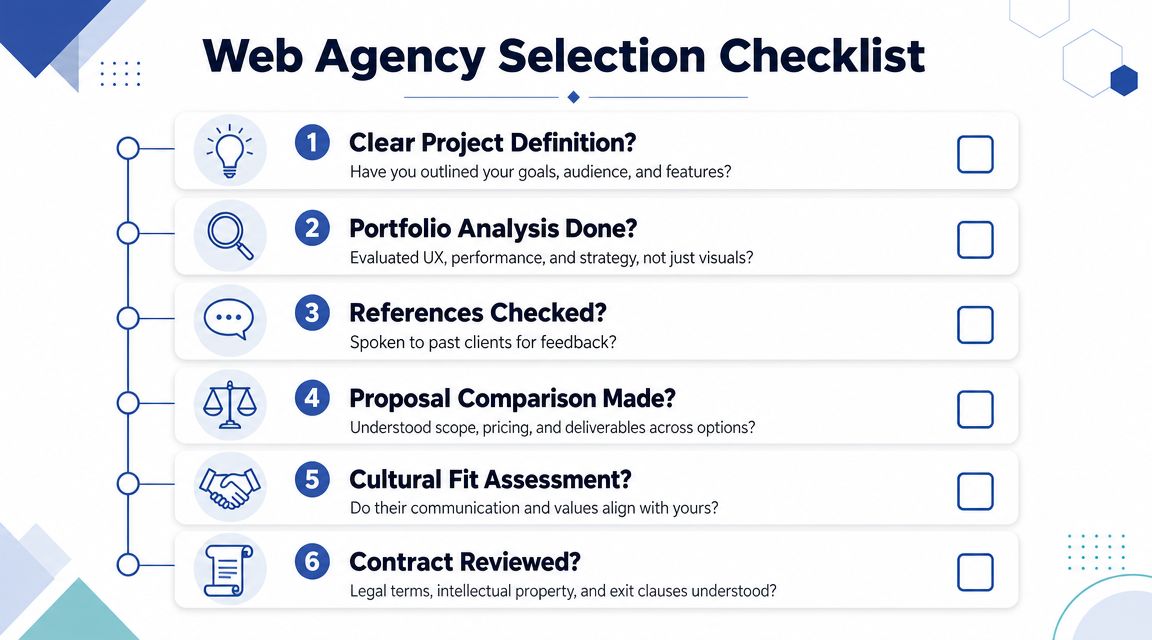
Agency vetting checklist
| Vetting Area | Key Check / Question | Agency A Score (1-5) | Agency B Score (1-5) |
|---|---|---|---|
| Project Definition | Did they understand the business goal, not just the design request? | ||
| Portfolio Relevance | Have they solved similar commercial and technical problems? | ||
| Case Study Quality | Did they show clear thinking, delivery detail, and credible outcomes? | ||
| Technical Capability | Can they explain architecture, QA, integrations, and migration handling? | ||
| Proposal Clarity | Are deliverables, exclusions, ownership, and support terms explicit? | ||
| Team Fit | Do you trust the actual delivery team to communicate well under pressure? | ||
| Post-Launch Support | Is there a realistic plan for fixes, optimisation, and future work? |
The shortlist questions worth asking in final interviews
These questions tend to cut through rehearsed sales language.
- What assumptions are you making about our brief that could change cost or timing?
- Which part of this project do you see as highest risk, and how would you mitigate it?
- What would make you advise against a migration or redesign right now?
- How do you handle a disagreement between strategy, design, and development?
- Can you show us how you document scope changes and approvals?
- What will we own at the end of the engagement?
- What support requests do clients usually make in the first month after launch?
- What kind of client slows your team down?
- Tell us about a project that became difficult. What happened and what did you change?
- How do you decide what belongs in phase one versus later phases?
The strongest answers are usually specific, calm, and slightly unglamorous. Mature agencies talk about process, risk, constraints, and trade-offs. Immature ones default to reassurance.
Final decision filters
If two agencies look close, use these tie-breakers:
- Choose the one that understood the business model fastest.
- Choose the one that documented the scope most clearly.
- Choose the one that identified risks before you asked.
- Choose the team you'd trust in a tense launch week.
That last point matters more than buyers think. Most projects feel smooth at the pitch stage. Pressure appears later, when content is late, integrations break, stakeholders disagree, or launch timing becomes tight. You want the agency that stays sharp when the easy part is over.
If an agency can explain what could go wrong, how they'd handle it, and what they need from you to succeed, that's usually a healthier sign than polished certainty.
Frequently Asked Questions
How much does it cost to hire a web design agency?
Cost depends on scope, platform, integration complexity, content requirements, and whether you need strategy and post-launch support or only design and build. A brochure-style site, a Shopify store rebuild, and a migration with ERP, subscriptions, and international requirements are not comparable projects.
The better question is what the proposal includes. Ask for a clear breakdown of discovery, UX, design, development, QA, launch, and support. If an estimate is vague, the budget risk is usually hidden rather than removed.
Should I hire a freelancer or an agency?
A freelancer can be a good fit for a simple site, a narrowly defined design task, or a business with low technical complexity. An agency is usually the safer option when the project involves multiple disciplines such as UX, development, SEO, integrations, migration planning, and post-launch optimisation.
The decision comes down to failure points. If one person becomes unavailable, can the work continue? If design decisions affect tracking, SEO, or integrations, who catches that? The more moving parts involved, the more useful a multi-disciplinary team becomes.
What are the biggest red flags when choosing a web design agency?
The strongest red flags appear early:
- Vague answers: They can't explain process, deliverables, or technical decisions clearly.
- Portfolio theatre: The work looks polished, but they can't discuss the business problem behind it.
- Thin proposals: Scope is broad, exclusions are missing, and support terms are fuzzy.
- Weak communication: Replies are slow, generic, or inconsistent during pre-sales.
- No operational detail: They talk about design taste but avoid migration, QA, ownership, and integrations.
- Overpromising: Everything sounds easy, fast, and low-risk.
If you're asking how to choose a web design agency, that's the lens to use. Don't buy aesthetics in isolation. Buy clarity, competence, and the ability to keep improving the site after launch.
If you're reviewing Shopify-focused partners and want a second opinion on scope, migration risk, or post-launch support requirements, Grumspot works with brands on bespoke storefronts, Shopify 2.0 migrations, audits, CRO, and ongoing development retainers. Even if you're still comparing options, a specialist perspective can help you ask better questions before you commit.
Let's build something together
If you like what you saw, let's jump on a quick call and discuss your project
Related posts
Check out some similar posts.

- web design agency sheffield
Find the best web design agency Sheffield. Our 2026 guide covers vetting portfolios, pricing, Shopif...
Read more
- Shopify Plus migration agency
Is it time to upgrade? Find out how a Shopify Plus migration agency can streamline your move, protec...
Read more
- shopify design agency
Discover how a shopify design agency can transform your store with conversion-focused design, fast p...
Read more
- shopify plus agency
What is a Shopify Plus agency? Learn what they do, the benefits of partnership, and how to choose th...
Read more