Explore what is headless ecommerce: A Clear Guide to Modern Online Stores
- headless ecommerce
- ecommerce architecture
- shopify plus
- omnichannel retail
- api-first commerce
Launched
February, 2026

So, what is headless ecommerce all about? Put simply, it’s about separating your customer-facing storefront (the ‘head’) from all the back-end machinery that runs your business (the ‘body’). This split, or decoupling, gives you complete creative control. You can build incredible, high-performance customer experiences on any channel you can imagine, free from the constraints of your ecommerce platform’s built-in templates.
Untangling Headless Ecommerce with a Simple Analogy
To really get our heads around this, let's start with a simple analogy. Think of a traditional, all-in-one restaurant. The kitchen and the dining room are fused together as a single, fixed unit. The menu, the décor, the seating, and the service are all bundled. If you wanted to completely change the dining room's theme, you'd likely have to shut the whole place down for a while. This is a lot like a traditional ecommerce store—everything is tightly woven into one system.
Now, let's picture a modern ‘ghost kitchen.’ This is a high-powered, centralised kitchen (your back-end) built purely for efficiency. It has no dining room of its own. Instead, it prepares food and sends it out to countless different places: a food delivery app, a pop-up stall at a music festival, a corporate catering event. Each of these customer-facing outlets (your front-ends) has a totally different look, feel, and experience, but they're all powered by that same, super-efficient kitchen.
The Decoupled Advantage
That ‘ghost kitchen’ model is the heart of headless ecommerce. By separating the front-end ‘head’ from the back-end ‘body,’ you unlock the freedom to innovate at speed. You can design a completely custom website, a slick mobile app, an in-store kiosk, or even an experience for a smart mirror—all pulling product information and processing orders from the same central system. For a deeper dive into the foundational definition, this guide on What is Headless Commerce is a great resource.
The magic that connects these two parts is an Application Programming Interface (API). Think of the API as a waiter, taking customer orders from any front-end and delivering them to the back-end kitchen to be fulfilled. This decoupling is precisely why so many brands are making the switch. In the UK, headless ecommerce adoption has exploded, with an estimated 85% of businesses now operating on a headless architecture. That puts the UK ahead of both Australia (72%) and the US (68%). This massive shift away from traditional monolithic platforms is all about giving retailers the power to deliver truly seamless shopping experiences across a growing number of digital touchpoints. You can find more fascinating insights into these headless commerce trends on swell.is.
How Headless Architecture Actually Works
To really get your head around headless ecommerce, it helps to look under the bonnet. The whole system is built on three core parts that work together, but it’s a lot simpler than it sounds. Think of it as a well-oiled team where everyone is a specialist in their own area.
First, you’ve got the back-end. This is the engine room, your command centre for everything commerce-related. A platform like Shopify or Shopify Plus handles this part perfectly, managing all the heavy lifting behind the scenes. We're talking about inventory, payments, order management, and customer data—all the crucial business logic that keeps the lights on.
Then there’s the front-end, which is what people often call the "head." This is absolutely everything your customer sees, touches, and interacts with. It could be your stunning website, a slick mobile app, an interactive kiosk in-store, or even a smart mirror. Because it’s completely separate from the back-end, you have total creative freedom to build it with whatever technology you want.
The API: The Essential Connector
So, how do these two completely separate systems talk to each other? That’s where the third and most important piece of the puzzle comes in: the API (Application Programming Interface).
The best way to think of the API is as a super-efficient waiter. It’s constantly running back and forth, carrying requests and information between the front-end and the back-end.
Imagine a customer adds a product to their basket on your custom-built website (the front-end). The API immediately zips that request over to your Shopify back-end. Shopify checks its stock levels, processes the request, and sends a confirmation back through the API. The API then delivers that message to the front-end, and voila—the customer's basket updates instantly.
This visual perfectly illustrates the simple but powerful relationship between the back-end, the API, and all the different front-ends it can feed.
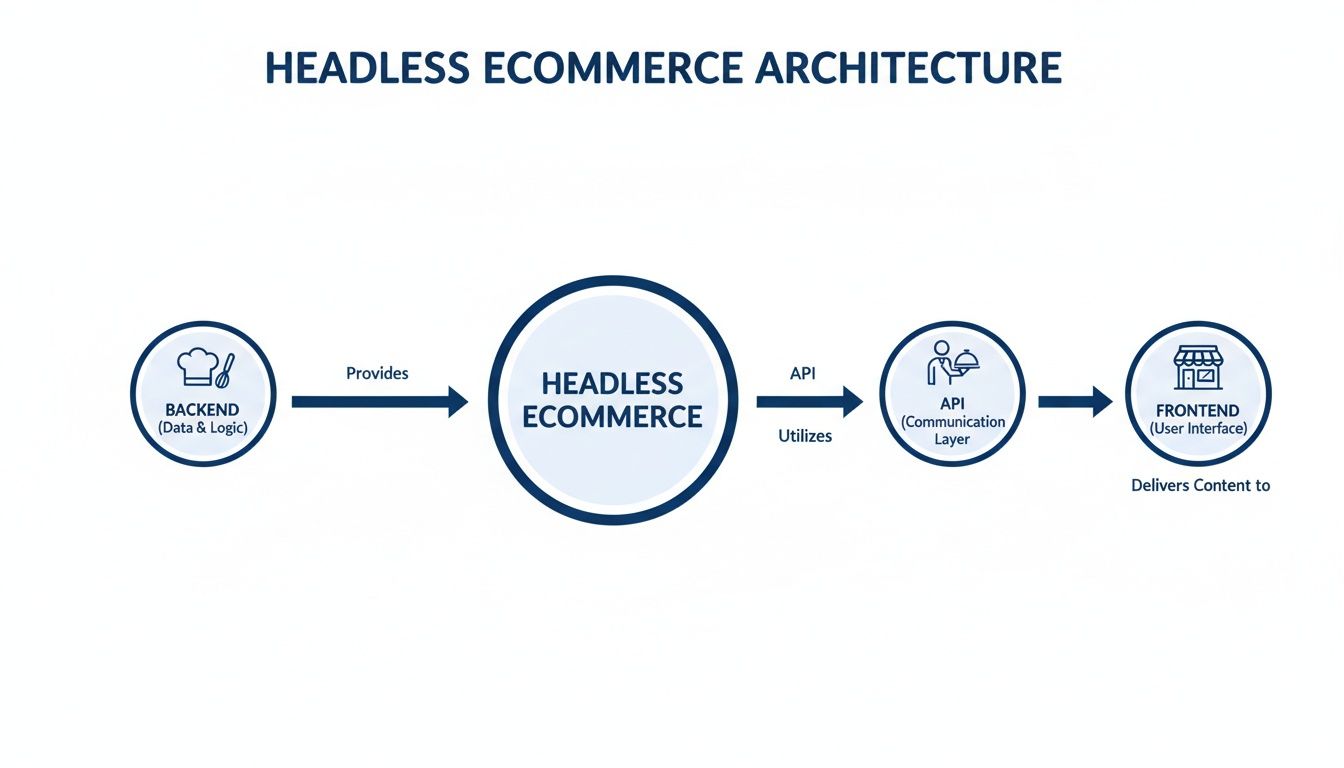
As the diagram shows, one solid back-end can power a whole host of different customer experiences, all thanks to the API.
This seamless, real-time communication is what really unlocks the magic of headless. Your developers are no longer stuck working within the confines of a traditional theme. They can finally use the best tools for the job to build the exact customer experience you’ve always wanted.
The main thing to remember is this: The API isn't just a technical pipe. It's what gives you all the flexibility. It guarantees your powerful commerce engine can connect to any front-end you can dream up, without the two being locked together.
Unlocking Developer Freedom and Performance
This separation gives your developers the freedom to work on the front-end without ever having to worry about breaking the core business logic in the back-end. They can pick and choose from modern frameworks like React, Vue.js, or Svelte to build unbelievably fast and engaging user interfaces. For brands wanting to dive deeper, our guide on custom app development for Shopify store owners is a great resource.
A huge win for headless is having pinpoint control over the user experience. By using dedicated prototyping tools and techniques for e-commerce UX optimization, brands can fine-tune every little detail of their storefront to get the best results. This intense focus on the front-end pays off in some big ways:
- Blazing-Fast Site Speed: The front-end is a lightweight, custom-built application, which means it can be fine-tuned for pure performance. The result? Near-instant page loads that customers love.
- Enhanced SEO: Google rewards speed. With incredible site performance and top-notch Core Web Vitals, headless sites often gain a serious advantage in search rankings.
- Total Creative Control: You're no longer stuck with a pre-built template. You can build a unique digital flagship that truly reflects your brand’s personality and vision.
At the end of the day, this setup is all about separating concerns. Your back-end does one thing exceptionally well: commerce. Your front-end does another: delivering an amazing customer experience. The API is simply the reliable bridge that lets them both shine.
Why Top Brands Are Going Headless
The move to headless ecommerce isn't just some technical fad; it's a serious business decision, one driven by brands chasing real, measurable results. Ambitious companies are breaking free from the cookie-cutter templates of traditional platforms to give themselves a proper competitive advantage. When you boil it down, it all comes down to three key benefits that directly improve the customer experience and, of course, the bottom line.
First off, and perhaps the most obvious benefit, is the sheer creative freedom it gives you. A headless setup lets brands design and build a truly bespoke digital flagship. Instead of being boxed in by a theme's rigid structure, your design and development teams are free to create unique, content-rich shopping experiences that genuinely reflect your brand's personality and help you stand out.
What this really means is you can seamlessly weave commerce into any part of your digital presence. Think interactive lookbooks, blog posts that let you shop right from the page, or even video content. No more clunky workarounds. For brands that rely on powerful storytelling and visual merchandising, this freedom to innovate on the front-end is an absolute game-changer.
Achieving Superior Performance and Speed
The second major reason brands are switching is the dramatic improvement in site speed and performance. Because the customer-facing front-end is completely separate from the back-end, it can be fine-tuned for one thing and one thing only: speed. Developers can use modern, lightweight frameworks to build storefronts that load in the blink of an eye.
This isn't just a minor tweak; it has a direct and significant impact on crucial business metrics. Faster load times lead to better Google Core Web Vitals scores, which can give your SEO rankings a welcome boost. More importantly, a quick, responsive site removes friction for shoppers, which means lower bounce rates and higher conversion rates.
These performance gains aren't just theoretical, either. In the UK, retailers going headless are seeing an average 20% decrease in website load times. This directly leads to more sales, as every one-second improvement in load time can boost conversions by 2%. The fashion sector, in particular, has seen incredible results, with some brands reporting 37% increases in conversions, 26% bumps in Average Order Value (AOV), and 23% reductions in bounce rates. You can discover more insights about the future of UK ecommerce and its performance metrics.
Embracing True Omnichannel Retail
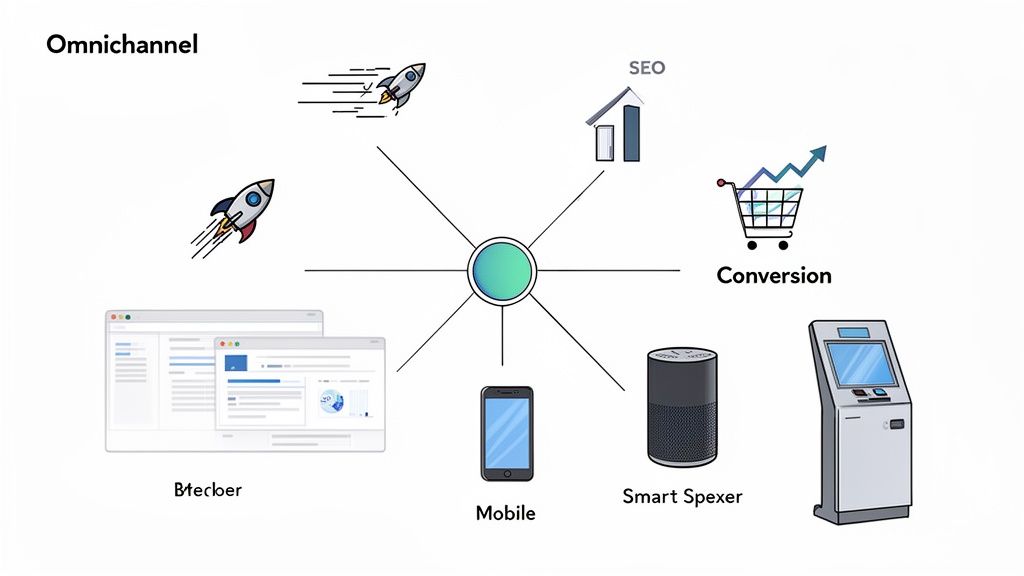
Finally, headless architecture is what truly unlocks an omnichannel retail strategy. Today's customers interact with brands across countless touchpoints, and they expect a seamless, consistent experience on every single one of them.
With a traditional, all-in-one platform, trying to manage all these different experiences can be a logistical nightmare, often requiring separate systems and a ton of duplicated effort. Headless solves this problem quite elegantly.
By using a single, centralised back-end to manage all your products, orders, and customer data, you can power an endless array of front-end experiences. This single source of truth ensures consistency and efficiency across your entire digital ecosystem.
This centralised approach means you can:
- Launch a custom website with a unique, brand-forward design.
- Develop a native mobile app that offers a fast, optimised shopping experience.
- Install in-store kiosks that allow customers to browse your full catalogue.
- Experiment with emerging channels like voice-activated shopping or smart-home devices.
Each of these front-end "heads" is built specifically for its own context, but they all plug back into the same reliable back-end "body" using APIs. This allows brands to meet their customers wherever they are, creating a cohesive brand journey that builds loyalty and drives long-term growth. From reducing cart abandonment to creating fluid brand interactions, the benefits translate directly into a stronger, more resilient business.
Of course, here is the rewritten section with a more human, expert tone.
Is Headless Right For You? Challenges and Considerations
While the benefits of headless ecommerce sound fantastic, it’s not a magic wand for every business. Before you dive in, you need a clear-eyed look at the hurdles. The incredible speed and flexibility you gain come with a whole new set of responsibilities, and jumping in without understanding the trade-offs can lead to some expensive headaches.
Think of it this way: launching a standard theme-based store is like buying a high-quality, pre-built house. It's ready to move into. Going headless is like hiring an architect and a construction crew to build your dream home from the ground up. The result can be spectacular, but the initial investment in custom development, API integrations, and infrastructure is significantly higher.
Taking on Total Ownership and Technical Expertise
The complete creative freedom of headless comes with a matching level of responsibility. When you separate the front-end (the "head") from the back-end, your team is suddenly in charge of building, managing, and optimising the entire customer-facing experience. This isn't a one-and-done project; it's an ongoing commitment.
This responsibility covers a lot of ground that a platform like Shopify typically handles for you out of the box:
- Front-End Hosting: You'll need to choose, set up, and pay for a separate hosting service for your custom storefront.
- Security and Compliance: It's on you to secure the front-end from threats and make sure it stays compliant with standards like PCI for payments.
- Performance Monitoring: Keeping those lightning-fast load times requires constant monitoring and fine-tuning.
- Updates and Maintenance: Your developers are responsible for every software update, bug fix, and feature enhancement on the front-end.
This level of ownership really demands a dedicated team of skilled developers who are comfortable with modern JavaScript frameworks, APIs, and cloud infrastructure. If you don't have that talent in-house, you'll need to find a specialist agency to partner with. For some perspective on handling these kinds of technical projects, our guide on expert Shopify migration services offers some valuable insights.
A headless architecture shifts significant technical responsibility from the platform provider to your business. This demands a strong in-house development team or a trusted agency partner to manage the complexities of a custom front-end.
Who Should Seriously Consider Headless?
So, when does taking on all these challenges actually make sense? Headless isn't for fixing something that isn't broken. It's for ambitious brands that have hit the limits of what a traditional setup can do and need more control to reach their goals.
It's a great fit if your business falls into one of these categories:
- Content-Driven Brands: Think businesses that want to weave rich articles, lookbooks, or video seamlessly into the shopping experience.
- Omnichannel Retailers: Perfect for companies needing to run a website, a mobile app, and maybe even in-store kiosks all from one central product catalogue.
- Performance-Obsessed Stores: Ideal for brands where every millisecond of loading time has a direct, measurable impact on the bottom line.
- Highly Customised Experiences: For businesses dreaming up a user experience so unique that a pre-built theme just can't make it happen.
On the flip side, a traditional, all-in-one platform is still the best choice for many businesses. Startups, small to medium-sized retailers, and brands with straightforward product catalogues can thrive on a theme-based solution. If your main goal is to get to market quickly with a store that’s reliable and easy to manage, the traditional path is often the most practical and cost-effective.
To help you map this out, here’s a simple framework to see where your business fits.
Headless Decision Framework For Your Business
This table breaks down the key factors to help you decide if a headless architecture is the right move for your brand right now.
| Consideration | Ideal for Headless | May Prefer Traditional |
|---|---|---|
| Business Stage | Established, high-growth, or enterprise-level business. | Startup, small, or medium-sized business. |
| Technical Resources | Strong in-house development team or budget for a specialist agency. | Limited technical staff or reliance on app-based solutions. |
| Budget | Higher upfront and ongoing budget for custom development and infrastructure. | Prefers predictable, lower monthly platform fees. |
| User Experience | Requires a completely unique, highly customised UX that themes cannot support. | A high-quality, optimised theme meets business and customer needs. |
| Content & Commerce | Needs to deeply integrate rich, dynamic content (blogs, videos) with products. | Standard blog and product pages are sufficient for content strategy. |
| Performance Needs | Every millisecond counts; competes in a market where speed is a key differentiator. | Standard platform performance is fast enough to meet conversion goals. |
| Speed to Market | Willing to invest more time upfront for a tailored long-term solution. | Needs to launch quickly and efficiently. |
| Omnichannel Strategy | Actively selling across multiple channels (web, mobile app, IoT, kiosks). | Primarily focused on a single ecommerce storefront. |
Ultimately, the choice isn't about which approach is "better" in a vacuum, but which one is the right strategic fit for your business's specific goals, resources, and ambition.
Going Headless with Shopify and Shopify Plus
For countless ambitious brands, Shopify is the engine powering their entire e-commerce operation. It’s familiar, powerful, and reliable. So, when the conversation turns to headless, a common question pops up: do we have to leave the platform we know and love?
The answer is a resounding no. In fact, Shopify has invested heavily in making itself a premier back-end for headless builds.
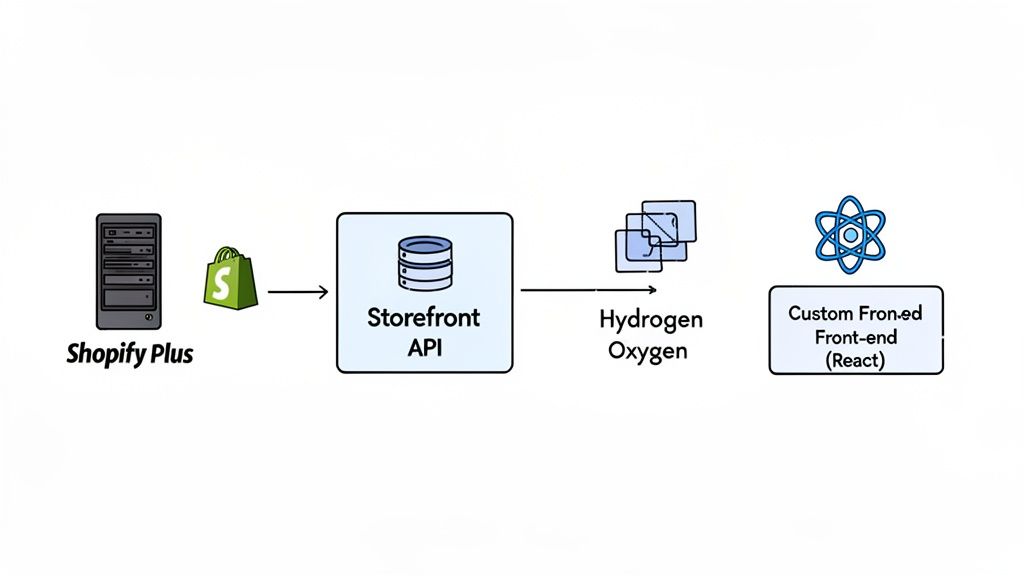
It all hinges on Shopify’s Storefront API. Think of this as a dedicated, high-speed line of communication designed to connect a custom-built front-end directly to your Shopify back-end. The API gives developers direct access to all the core commerce functions they need—products, collections, customer accounts, and the checkout—without being shackled to a Shopify theme. This means you can keep managing your business from the familiar Shopify admin while offering a completely bespoke experience to your customers.
Accelerating Development with Hydrogen and Oxygen
Shopify recognised that building a custom storefront from the ground up can be a complex undertaking. To simplify the journey and make headless more accessible, they introduced a powerful toolkit specifically for this purpose: Hydrogen and Oxygen.
Hydrogen: This is Shopify’s own front-end web development framework, built on the popular React library. It’s packed with pre-built components, hooks, and utilities that are already wired up to the Storefront API. This means your developers don’t have to build common features like product galleries or shopping cart functions from scratch, which dramatically speeds up the development timeline.
Oxygen: Once you’ve built your custom storefront with Hydrogen, you need somewhere to host it. Oxygen is Shopify’s global hosting solution, engineered for lightning-fast performance. With just a single click, you can deploy your Hydrogen storefront to a worldwide network, ensuring your customers get the fastest possible load times, no matter where they are.
Together, Hydrogen and Oxygen provide an integrated, end-to-end solution for building and deploying a headless Shopify store. This combination lowers the technical barrier to entry and allows brands to go headless with far more confidence and speed, knowing the tools are perfectly optimised for the Shopify ecosystem.
By providing both the framework (Hydrogen) and the hosting (Oxygen), Shopify has created a streamlined path for brands to achieve the creative freedom of headless without the typical complexities of managing a custom tech stack.
Navigating a Headless Migration on Shopify Plus
So, what does moving to a headless setup on Shopify Plus actually involve? It’s more than just flicking a technical switch; it’s a strategic project that demands careful planning and execution. The process generally follows a clear set of steps to ensure a smooth transition from a theme-based store to a custom front-end. If you want to dive deeper into the platform's capabilities, you can explore the many benefits of Shopify Plus in our detailed guide.
A headless migration is a multi-stage process that involves tight coordination between your team and your development partner. Here’s how it usually unfolds:
- Technology Stack Selection: The first decision is choosing the right front-end framework (like Hydrogen, Next.js, or Nuxt.js). You'll also need to decide on a Content Management System (CMS) if you plan to blend rich content and commerce heavily.
- Front-End Development: This is the core of the project. Developers get to work building the custom user interface and experience from the ground up, connecting it all to your Shopify back-end via the Storefront API.
- App and Integration Reconnection: This is a big one. Many of your existing Shopify App Store apps that modify the front-end simply won't work out of the box. Your team will need to find API-based alternatives or build custom solutions to replicate essential functionality for things like reviews, loyalty programmes, or search.
- Testing and Deployment: Rigorous testing across all devices and browsers is crucial to iron out any bugs before going live. Once everything is perfect, the new front-end is deployed, often using a solution like Oxygen or another global hosting provider.
Ultimately, going headless with Shopify Plus is about gaining complete control over your brand’s digital experience without sacrificing the robust, scalable commerce engine you rely on every single day.
Real-World Examples of Headless Commerce in Action
The theory behind headless commerce is interesting, but what does it actually look like when a brand gets it right? Seeing how big names have used this architecture to solve real problems is where the concept truly comes to life. These aren't just technical experiments; they're stories of how unhooking the front-end from the back-end leads to brilliant customer experiences and, ultimately, better business results.
Let’s dive into a couple of examples that show the real-world impact of going headless, from blazingly fast websites to creative marketing that just wasn’t possible before.
Creating Immersive Content and Commerce Experiences
One of the best things about headless is how it lets you weave rich, engaging content directly into the shopping experience. Take a major apparel brand, for instance. They were tired of the standard, boring product grids and wanted their website to feel more like a glossy magazine—a place where beautiful lookbooks and articles would naturally lead you to the products.
A traditional, theme-based website would have made this feel clunky and disconnected. By going headless, they set their teams free. Their marketing crew could use a top-tier Content Management System (CMS) to build stunning editorial features, while the developers created a completely custom front-end that pulled in that content and elegantly wrapped it around the product data from their Shopify back-end.
The outcome was a game-changer. By focusing on a content-first journey, they saw a major boost in two vital areas:
- Time on site increased as shoppers got lost in the brand's world and stories.
- Average order value (AOV) grew because the immersive experience inspired customers to discover and buy more.
This is a perfect illustration of how headless helps brands sell a lifestyle, not just a product, making for much deeper connections with their customers.
By separating content from commerce, brands are no longer forced to choose between a great blog and a great store. Headless architecture allows them to have both, integrated perfectly on a single, high-performance site.
Achieving Unbeatable Mobile Performance
In today's world, a slow mobile site is a killer. A leading UK-based cosmetics company realised their mobile conversion rates were trailing way behind desktop. Their old, all-in-one site was just too slow and clunky on a phone, leading to painful loading times and shoppers abandoning their carts out of frustration.
Their solution was to go headless, with a laser focus on building a mobile-first Progressive Web App (PWA) for the front-end. PWAs are incredibly light and fast, giving users an app-like feel right in their browser without any downloads. This new front-end connected to their e-commerce platform via API to manage all the product info and checkout functions.
The results were immediate and frankly, spectacular. After launching the new headless storefront, they saw:
- A 50% reduction in mobile page load times, making shopping feel smooth and instant.
- A 40% increase in mobile conversion rates in the first three months alone.
- A clear improvement in their mobile search rankings, thanks to much better Core Web Vitals.
This case really drives home the point: for any business that relies on mobile traffic, headless isn't just a "nice-to-have". It's a strategic move that can unlock a huge audience you might currently be losing.
Got Questions About Headless Ecommerce?
Jumping into a new architecture like headless is a big decision, and it’s completely normal to have a few questions. We see the same practical queries pop up time and again from brands weighing up whether this is the right move for them. Let’s get them answered.
Is Headless More Expensive Than a Standard Shopify Theme?
In the short term, yes. A headless build is a custom job, meaning the upfront costs for front-end development are higher than just customising an off-the-shelf Shopify theme. But it’s best to think of this as a long-term investment in your brand's future.
The payoff comes from the boost in performance, unparalleled flexibility, and higher conversion rates that a headless site can deliver. Over time, this often leads to a much stronger return on your initial investment. Plus, for ambitious brands that are constantly testing and iterating, the ability to tweak the front-end without touching the back-end can actually bring down your development costs in the long run.
How Does Headless Commerce Affect My Website's SEO?
If you get it right, headless commerce can be a massive win for your SEO. The biggest advantage is the raw speed and brilliant Core Web Vitals scores you can achieve. Since the front-end is separate, it can be fine-tuned for performance in ways a traditional theme just can't match.
A faster website isn't just a nice-to-have; it's a direct signal to search engines that your site offers a superior user experience, which is often rewarded with better visibility.
But here’s the catch: a headless setup demands serious technical SEO expertise. Your development team needs to be on the ball with everything from sitemaps and structured data to canonical tags and making sure the site is easy for Google to crawl. To really see the benefits and avoid any nasty surprises, you’ll want to work with a team that lives and breathes technical SEO.
How Long Does It Take to Build a Headless Ecommerce Site?
There’s no one-size-fits-all answer here, as the timeline really depends on what you need. The complexity of your design, the number of third-party tools you need to integrate, and the specific features you’re after all play a huge part.
As a rough guide, you should probably plan for a headless build to take anywhere from three to six months, sometimes longer. It’s a more involved process than a standard theme setup because you’re essentially creating a completely unique user experience from scratch. The trick is to find a partner with a clear, well-oiled process to keep things moving without cutting corners. This usually breaks down into a few key phases:
- Discovery and Strategy: Nailing down your goals and the technical roadmap.
- Design and UX/UI: Crafting the look, feel, and flow of the site.
- Development and Integration: Building the front-end and wiring up all the APIs.
- Testing and Launch: Making absolutely sure everything is flawless before the big reveal.
At Grumspot, we specialise in building high-performance headless storefronts on Shopify Plus that drive growth. If you're ready to unlock unparalleled speed and flexibility, let's talk about building your brand's future. Learn more about our development services.
Let's build something together
If you like what you saw, let's jump on a quick call and discuss your project
Related posts
Check out some similar posts.

- shopify store credit
Learn how to set up Shopify store credit with built-in tools or apps. Covers policy design, refund w...
Read more
- headless commerce agency
Discover what a headless commerce agency does, when to choose headless over Shopify Plus themes, typ...
Read more
- unified commerce platform
Learn how a unified commerce platform connects channels, ERPs, and CRMs to drive growth. Practical g...
Read more
- composable commerce platform
Learn what a composable commerce platform is, how it differs from monoliths, and how UK Shopify Plus...
Read more