10 App Monetization Strategies for 2026: Boost Your Revenue
- app monetisation strategies
- app monetisation
- saas pricing models
- shopify app development
- recurring revenue
Launched
June, 2026
You can build a strong app, win installs, even earn praise from users, and still end up with a weak business. The usual advice around app monetization strategies skips the hard part. It lists models as if they're interchangeable, when they're not. A subscription isn't just a billing choice. Ads aren't just “free revenue”. A marketplace cut can be brilliant in one category and fatal in another.
That's the gap. The question isn't “Which monetisation models exist?” It's “What has to be true for this model to work well for this product, this audience, and this stage of the business?” If you get that wrong, you don't just leave money on the table. You distort the roadmap, attract the wrong customers, and train users to value the wrong parts of the product.
That's especially obvious in the Shopify app ecosystem. The same merchant-facing app can monetise through a flat subscription, usage billing, setup services, revenue share, or a hybrid of all four. An email app, a reporting app, a subscriptions app, and a shipping utility all solve business problems inside the same platform, but they shouldn't price the same way. The merchant's buying logic is different. The implementation burden is different. The proof of value is different.
In the UK, that choice matters even more because payment flows, privacy expectations, and market maturity shape what converts and what scales. General guides often stop at subscriptions, ads, and IAPs. They rarely address the practical question of whether a UK publisher should keep payment inside the app or push high-intent buyers to web checkout after store policy changes, even though that decision can materially affect net revenue and flexibility, as Adjust's guide to app monetization explains.
1. Freemium Model / Freemium + Premium Support
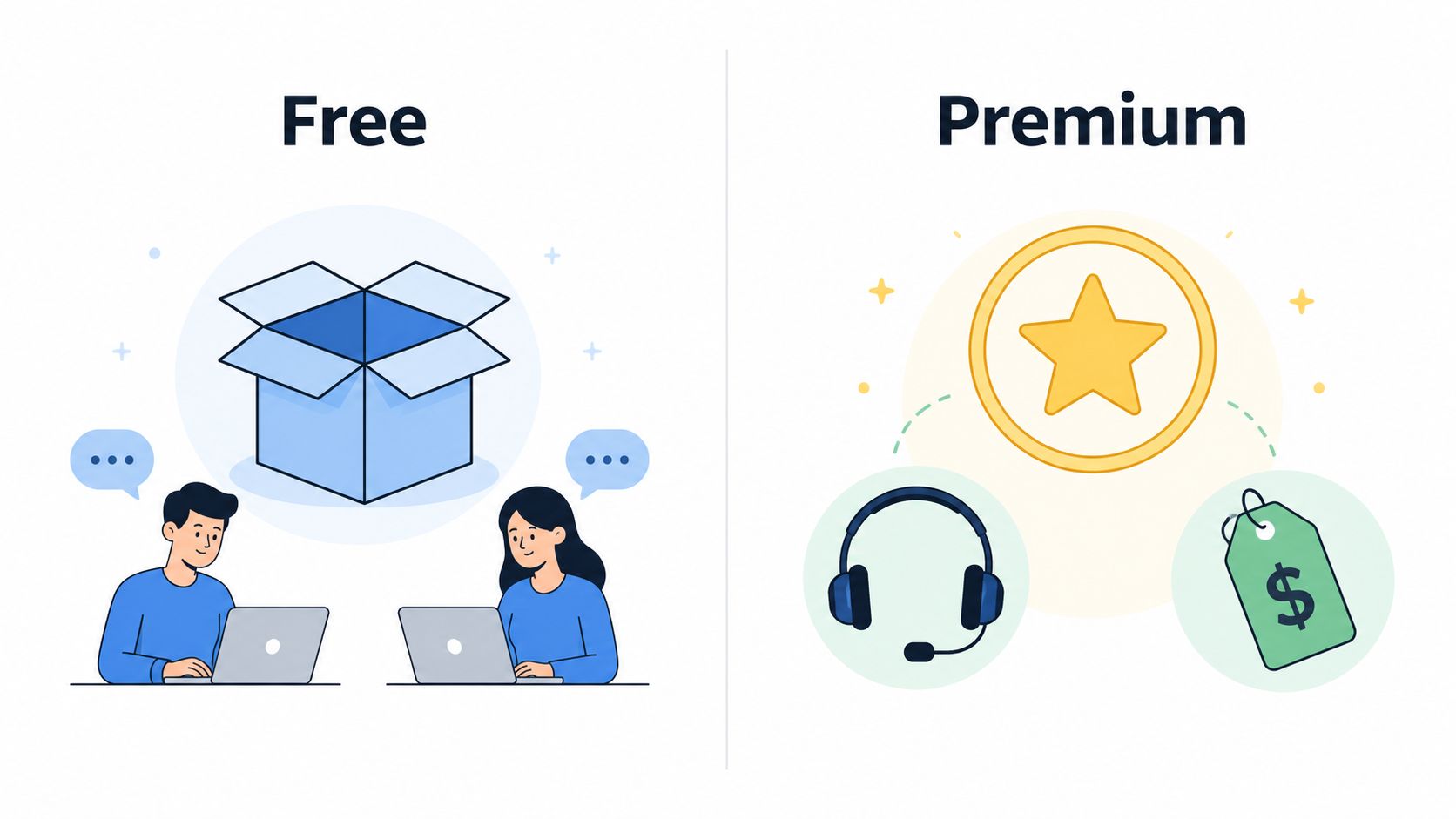
A freemium model works when the free product delivers a complete first win, not a crippled teaser. Users need to solve a real problem before you ask them to pay. If the free tier only demonstrates constraints, people don't upgrade. They leave.
That's why Canva, Slack, Figma, Zapier, Klaviyo, and HubSpot all use free access differently. The free tier creates habit and trust. The paid layer provides speed, scale, control, or team coordination. In Shopify terms, think of an app that gives merchants basic reporting or simple automation for free, then charges for advanced segmentation, implementation help, or dedicated support when the store grows.
Where freemium breaks
Freemium fails when the premium layer is vague. “More features” isn't enough. The user has to understand why the paid version changes their outcome.
A Shopify app selling to merchants should usually make one of these upgrade triggers obvious:
- Volume pressure: The merchant hits order, product, contact, or workflow limits.
- Team pressure: More staff need access, controls, approvals, or reporting.
- Risk pressure: The merchant wants stronger support, migration help, or an SLA.
- Growth pressure: The free tier worked, and now they need more automation or deeper integrations.
Premium support is often the overlooked revenue lever. Some customers don't need more features. They need faster onboarding, a direct line to someone technical, and confidence that a broken workflow won't sit in a queue.
Practical rule: Charge for human effort when implementation complexity is part of the value, not as a patch for bad product design.
Metrics that matter
For freemium, I watch product-qualified users more closely than raw signups. A large free base means very little if users never hit the behaviours that predict payment.
Track:
- Activation events: Which actions prove the user reached first value.
- Free-to-paid conversion: By source, persona, and feature usage.
- Support load by tier: Free users can become expensive if boundaries are weak.
- Upgrade trigger points: Which limits or moments lead to healthy conversions.
- Retention after upgrade: Some freemium apps convert well but disappoint once paid.
The best version of freemium doesn't hide value. It puts value in the user's hands early, then sells speed, scale, certainty, or service once the need is proven.
2. Subscription Model (SaaS)
Subscriptions are the cleanest choice when your app delivers ongoing value and keeps improving the customer's business over time. Reporting, retention, support, search, subscriptions management, and automation apps fit this model well. That's why so many Shopify apps, from Klaviyo to Recharge to Gorgias, use recurring billing.
The catch is simple. Recurring billing only feels fair when recurring value is obvious. If users can complete the core job in a week and rarely return, a monthly fee starts to feel like rent.
What makes subscriptions work
Strong subscription apps have a clear value metric. Merchants understand what they're paying for and why the next tier exists. That might be contacts, orders, seats, stores, workflows, or advanced features. Weak subscription apps lump everything into arbitrary plans and then wonder why upgrades stall.
In the UK, subscriptions need extra discipline around plan mix and localisation. Paddle's guide notes that UK merchants should localise pricing by country purchasing power, and that month-2 retention is the strongest predictor of long-term subscriber value. It also advises testing monthly-to-annual upsell paths only after retention is proven in cohort data, which is directly relevant for UK-focused mobile app monetisation planning in Paddle's guide.
That point gets missed all the time. Teams rush to annual plans because annual revenue looks attractive on a spreadsheet. But if retention isn't there, annual pricing won't fix the underlying problem. It only hides it for longer.
What to track in a subscription app
Use operational metrics, not just billing totals.
- Cohort retention: Especially early retention after onboarding.
- Churn by plan: Some tiers attract poor-fit customers.
- Expansion revenue: Good subscription products grow accounts over time.
- Feature adoption: Paid users should use the features that justify the plan.
- Trial-to-paid conversion: Trial design and onboarding quality are tightly linked.
For Shopify founders, this usually connects back to onboarding. A merchant who installs your app and doesn't complete the setup won't become a durable subscriber. If you're building recurring revenue into a merchant workflow, Shopify subscription store setup is a useful lens for thinking about operational complexity before pricing the product.
Subscription pricing isn't a monetisation model by itself. It's a promise that the product will keep earning the fee every billing cycle.
3. Usage-Based / Consumption Pricing
Usage pricing is the right answer when your cost to serve, or the customer's value received, scales with activity. If an app sends messages, processes data, executes automations, runs API calls, or handles transactions, charging by consumption often feels more honest than forcing every customer into a fixed plan.
Twilio, AWS, Stripe, SendGrid, and many workflow tools built their pricing logic around this principle. In the Shopify world, it also fits apps where usage varies wildly between merchants. One store may run a handful of automations each day. Another may trigger thousands.
The trust problem with metered billing
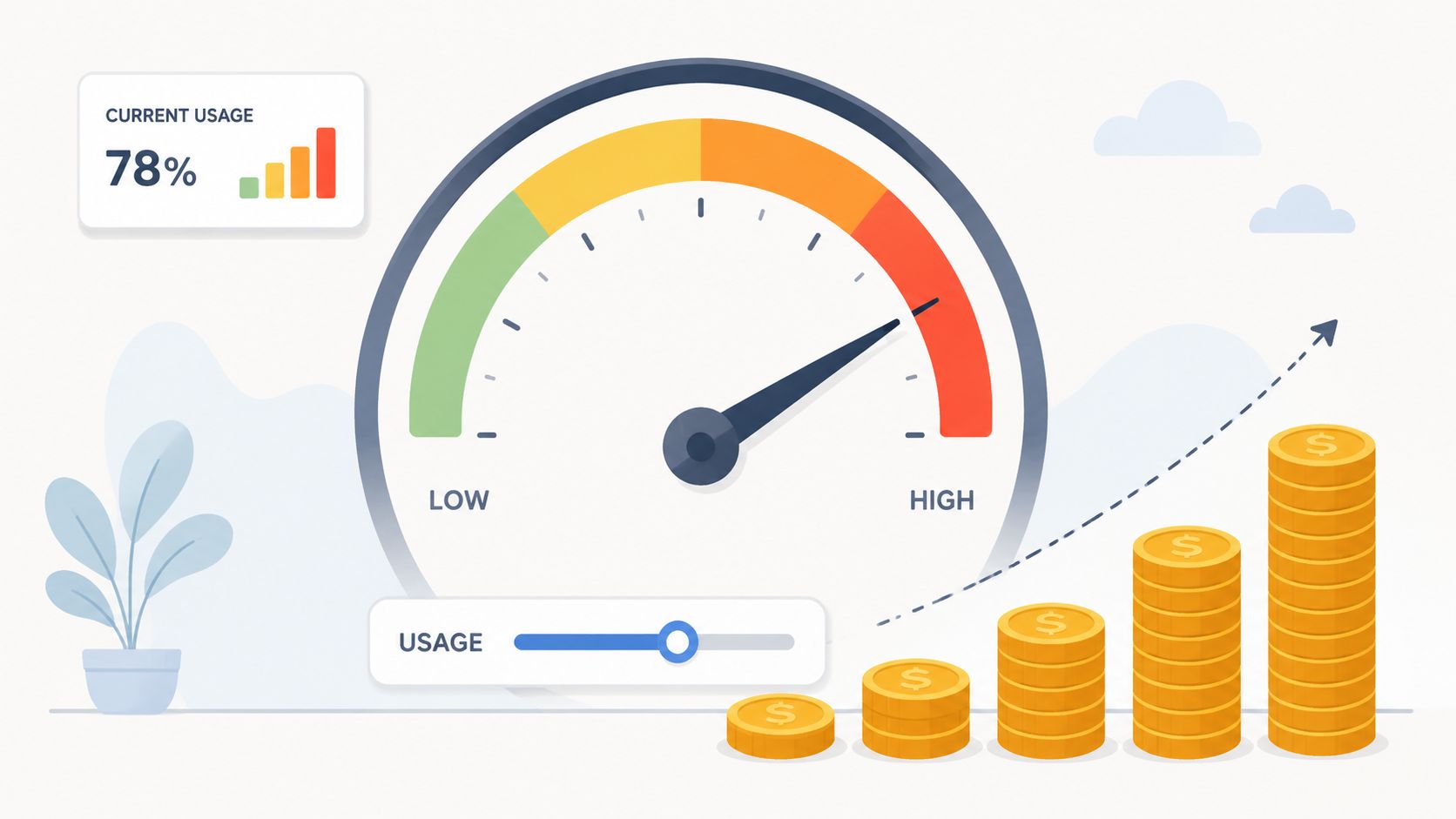
Usage pricing can win deals faster because the entry point feels lower risk. It can also create anxiety. If users can't predict their bill, they hesitate to adopt the product extensively.
The fix isn't complicated, but it takes discipline:
- Show usage in real time: Don't make customers wait for invoices to understand cost.
- Set alerts before thresholds: People should never be surprised by overages.
- Offer caps or commitment options: Predictability matters to finance teams.
- Tie the meter to value: “Tasks completed” is easier to accept than a vague internal unit.
I've seen usage billing work best when paired with a small platform fee. That gives you baseline revenue and gives the customer a sense of product access, while still scaling price with actual use.
Metrics that reveal whether it's healthy
Consumption businesses can look strong while hiding poor account quality. Revenue may rise because a few customers use a lot, while everyone else sits dormant.
Watch these closely:
- Revenue concentration: Don't rely too heavily on a few high-usage accounts.
- Usage per active customer: This shows whether the product is becoming core.
- Overage complaints and support tickets: These are often pricing UX issues.
- Gross margin by customer segment: Heavy usage can expose expensive accounts.
- Conversion from free or trial into paid usage: Early habit formation matters.
Usage-based pricing is one of the most practical app monetization strategies for infrastructure-heavy apps. It's also one of the easiest to damage with bad communication. If users don't trust the meter, they won't scale with you.
4. One-Time Purchase / Perpetual Licence
One-time pricing still works, but only in narrower situations than many founders want to admit. It suits assets, templates, specialised utilities, and products where the value is delivered upfront. Shopify themes are the clearest example. A merchant buys the asset once because the purchase itself provides the result.
That's very different from a service app that requires hosting, support, ongoing maintenance, and continuous integration work. Trying to force a perpetual licence onto a living SaaS product usually creates support debt and weak cash flow.
Good fit versus bad fit
A one-time purchase is a strong choice when:
- The product is self-contained: A theme, toolkit, or focused utility.
- The customer expects ownership: They want to buy the asset and use it.
- Update costs are manageable: You're not promising endless service from a one-off fee.
- The category is comparison-driven: Buyers can understand the value before purchase.
Adobe Creative Suite and traditional Microsoft Office used to fit this logic well. In ecommerce, some merchants still prefer one-time payments for tools that solve a single implementation problem without becoming an ongoing operating layer.
If your product needs constant updates to stay useful, be careful. Customers will still expect support, bug fixes, compatibility work, and onboarding help long after that first payment lands.
What to track if you choose it
The commercial risk with perpetual licences isn't conversion. It's revenue decay. Once your initial launch wave passes, new sales have to replace the absence of recurring revenue.
Track:
- New customer acquisition efficiency: You need a steady inflow of fresh buyers.
- Refund and complaint patterns: These reveal expectation gaps quickly.
- Support burden per sale: One-time products can become support traps.
- Upgrade take-up for major versions: This indicates whether users still value ongoing development.
For merchants evaluating fixed-cost software decisions, Shopify pricing considerations for apps and stores are useful context because they shape what “one-time value” really means inside a wider commerce stack.
A perpetual licence works best when the product behaves more like an asset than a service.
5. Tiered / Feature-Based Pricing
Tiered pricing is often chosen by default, and that's exactly why so many get it wrong. They create three plans because every SaaS company has three plans, not because they've identified three distinct levels of customer value.
Good tiering segments demand. Bad tiering just adds confusion.
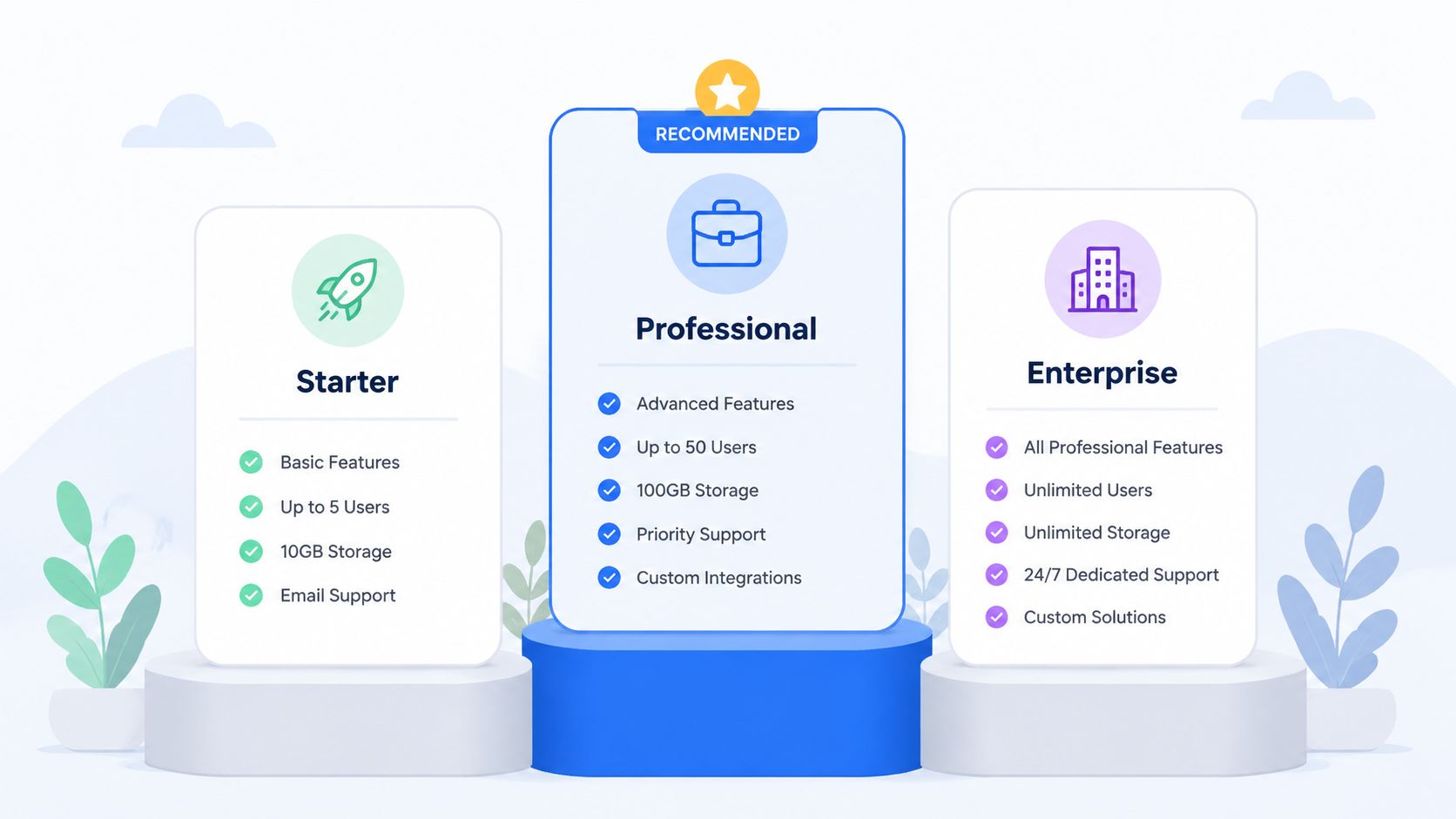
HubSpot, Slack, Mailchimp, Shopify, and Klaviyo all make their tiers legible. Each plan speaks to a different stage of need. The buyer can see what changes as complexity, team size, or business maturity increases.
How to build tiers that actually segment value
The first question is not “What features can we hide in the top plan?” It's “What changes materially for a larger or more advanced customer?”
Useful separators include:
- Operational depth: More automation, analytics, or reporting complexity.
- Scale: More contacts, products, stores, seats, or integrations.
- Governance: Permissions, audit trails, approvals, security controls.
- Service level: Priority support, onboarding, or account management.
Feature-based pricing gets dangerous when you lock away basic usability. If the starter plan feels intentionally frustrating, customers don't graduate. They resent the product.
Metrics worth tracking
Tiered pricing isn't just about average revenue. It's about fit.
- Plan distribution: Which tiers attract most customers, and are they the right ones?
- Upgrade path health: Do customers naturally move upward as they grow?
- Downgrade patterns: These often expose poor packaging.
- Sales friction on the top tier: Enterprise plans may need consultative selling.
- Support cost by tier: Low-tier customers sometimes create the most overhead.
Another UK-specific issue sits underneath tiered pricing. Public advice often tells teams to localise prices but doesn't explain how to shape UK-specific tiers, trial lengths, or bundles around willingness to pay. That's a real content gap called out in Adapty's discussion of monetisation strategy and pricing localisation. The practical takeaway is simple. Don't assume a universal global plan ladder will convert equally well across UK segments.
6. Commission / Revenue Share Model
Revenue share is attractive because it aligns incentives. If you help the customer earn, you earn. For merchants, that can feel safer than paying a large fixed fee before results appear.
This model shows up in subscription commerce, affiliate systems, print-on-demand, influencer tools, and marketplace-style apps. In Shopify-adjacent work, it's especially tempting for apps tied directly to sales, recurring orders, partnerships, or attributed conversions.
Why it works, and why it gets messy
The upside is obvious. Customers like low upfront commitment. The vendor gets paid in proportion to delivered value.
The hard part is definition. What exactly counts as revenue influenced by your app? Gross sales? Net sales? Subscription renewals? Attributed revenue within a time window? Without clean rules, disputes arrive quickly.
Use revenue share when all three conditions are true:
- Value attribution is measurable: The app's contribution can be tracked credibly.
- Customer trust is high: Merchants believe your reporting.
- Cash flow timing is manageable: You can tolerate fluctuations.
A small fixed platform fee often improves this model. It filters unserious accounts and covers baseline support, while the performance component preserves upside.
If the attribution model needs a long sales call to explain, the pricing model is too fragile.
Metrics that decide whether it scales
Revenue share can look founder-friendly because it promises unlimited upside. In practice, it needs strict financial discipline.
Track:
- Take rate quality: Not just the percentage, but whether customers understand it.
- Attributed revenue disputes: A warning sign for trust and reporting design.
- Revenue volatility by account: Some customers create unstable billing patterns.
- Time to realised value: How long before the app starts generating payable outcomes?
- Margin after support and reconciliation: Admin work can eat the upside.
This model works best when your app sits close to a transaction, a renewal event, or a clearly attributable conversion path. It's weakest when value is broad, strategic, or indirect.
7. Marketplace / App Store Model
What are you really buying when you choose a marketplace as a monetisation strategy? In most cases, the answer is distribution with built-in trust, not just a place to list your app.
That matters in ecosystems like Shopify, where merchants often discover tools inside the App Store before they ever search Google or talk to a sales team. Apple's App Store, Google Play, WordPress plugin directories, and Figma's plugin marketplace work the same way. The platform lowers initial friction around discovery, billing, and credibility. It also sets the rules.
That trade-off shapes the business model. A marketplace can reduce customer acquisition costs early, but it also limits how much of the customer relationship you control. Reviews affect conversion. Ranking changes can move revenue fast. Nearby competitors create pricing pressure because merchants compare options in a single session.
Preconditions for success
This model works best when three conditions are in place:
- The platform already concentrates demand: Buyers actively search for solutions inside the store.
- Your app solves a clear, narrow job: Ambiguous products struggle in category-driven discovery.
- You can turn installs into activation quickly: Store traffic is wasted if new users stall after installation.
Shopify is a good example. Merchants often search by problem first, such as subscriptions, upsells, reviews, or inventory sync. Apps that state the use case clearly usually outperform apps with broad positioning, even when the underlying product is stronger.
If you're preparing for the Shopify ecosystem, Shopify public app development matters because approval requirements, onboarding design, and merchant expectations all affect marketplace conversion.
How to make the model work
A marketplace listing is part product marketing, part sales page, and part risk-reduction layer. Teams that treat it as a simple directory entry usually underperform.
Focus on:
- Category fit: Choose the category and headline that match the buyer's intent.
- Install-to-activation rate: Ranking means little if merchants install and abandon.
- Review velocity and review quality: A steady flow of credible reviews often matters more than a one-time spike.
- Payback from marketplace-acquired users: Track whether these users retain and convert as well as users from direct channels.
- Dependence on one platform: If most new revenue comes from a single store, policy changes become a business risk.
The strategic mistake is assuming marketplace presence is the monetisation model by itself. In practice, the store is usually the acquisition layer. Revenue still depends on what happens after install, which pricing structure you attach to the app, and whether the economics hold after platform fees, support load, and churn.
8. White Label / Reseller Model
White label monetisation is less glamorous than direct SaaS, but it can be highly effective when agencies, consultants, or implementation partners already own the client relationship. Instead of selling your app one merchant at a time, you let partners package it under their own service layer.
This works particularly well in ecommerce and martech. Agencies often want repeatable infrastructure they can deploy across clients without rebuilding the same solution every time. HubSpot partner agencies, Shopify Plus service partners, Klaviyo specialists, and hosting resellers all use some version of this model.
Preconditions for success
White labelling only works if your product is stable and your partner operations are disciplined. If onboarding is still chaotic or every customer requires bespoke engineering, reseller channels create more complexity, not less.
The strongest candidates usually have:
- A repeatable implementation process: Partners need playbooks, not heroics.
- Clear boundaries: What the reseller handles versus what you handle.
- Documentation and training: Poor enablement kills channel momentum.
- A product that supports configuration: Enough flexibility without turning into custom development.
A lot of teams underestimate support design here. Your actual customer may be the partner, but the end user still experiences the product. If the partner oversells and underimplements, your brand takes the damage whether it's visible or not.
Metrics to watch in channel-based monetisation
Reseller models can create excellent advantages, but they also hide weak end-user outcomes if you only track wholesale revenue.
Watch:
- Partner activation: How quickly new partners start selling and deploying.
- Revenue per active partner: Not signed partners. Active ones.
- End-customer retention through each partner: Some channels sell badly fitted clients.
- Support escalation rates: A proxy for partner capability.
- Time to implementation: Long launches often choke channel growth.
This model is ideal when your app is valuable but not easy for every buyer to discover or deploy alone. It lets specialists bundle your product into a larger commercial offer.
9. Advertising / Sponsorship Model
What are you really selling with an ad-supported app: attention, intent, or access to a niche audience?
That question matters because advertising is rarely just a fallback for users who will not pay. It is a business choice that changes product design, audience strategy, and the metrics that matter. Ads work best when you have frequent usage, broad reach, or a clearly defined audience that sponsors want to reach. They are a weak fit for products where interruptions hurt trust, slow task completion, or reduce conversion into a higher-value plan.
For Shopify app businesses, that trade-off is even sharper. Most Shopify merchants install apps to solve an operational problem fast. An intrusive ad experience inside a workflow tool can make the product feel cheap, even if the core feature is useful. Sponsorships can make more sense than programmatic ads when the audience is specific, such as merchants looking for shipping, analytics, or financing partners, and the sponsor is relevant to the task at hand.
Analysts at Statista reported that in-app advertising remained a meaningful monetisation model globally in 2024, and the UK market showed stronger dependence on advertising revenue than on in-app purchases or subscriptions in several categories, according to Statista's mobile app monetization data. UK developers have also shifted toward mixed models rather than pure ad monetisation. Mobile marketing industry analysis cited by the Mobile in Association report found that many UK game developers now combine ads with subscriptions instead of relying on one revenue stream alone, as referenced in the Mobile in Association report.
Ads succeed only when the product can absorb them
The first precondition is engagement depth. If users open the app once a week for two minutes, ad inventory stays weak and every interruption carries more risk. The second is audience tolerance. Casual entertainment apps can absorb ads far more easily than merchant tools, finance apps, or anything tied to revenue operations. The third is targeting quality. If you cannot place a sponsor or ad unit that matches the user's context, revenue often comes at the cost of retention.
I have seen teams treat ads as an easy monetisation layer for free users. In practice, they only work cleanly when the product already has stable engagement and a clear reason for users to keep coming back.
A useful way to frame the model is by strategic intent:
- Monetise a large free audience: Best for consumer apps with strong session volume.
- Subsidise acquisition: Ads can offset the cost of serving free users while you build paid conversion elsewhere.
- Create a sponsored utility: A relevant sponsor can fund access if the brand improves distribution or credibility.
- Support a premium upsell: Ad-supported access can widen the top of funnel, while paid plans remove ads or add workflow value.
For Shopify ecosystem products, direct sponsorship is usually the more defensible version of this model. A sponsor that already sells to merchants may pay for visibility inside educational surfaces, reports, benchmarking tools, or lightweight free utilities. That only works if the sponsor fits the user journey. If the placement feels bolted on, merchants notice immediately.
Metrics to track before ad revenue misleads you
Do not evaluate this model on gross ad revenue alone. Track whether monetisation is damaging the product or strengthening it.
Watch:
- Retention by ad-exposed cohort: Compare users who see ads or sponsorship placements against those who do not.
- Session completion rate: Useful in workflow apps where interruptions can break task completion.
- Revenue per thousand sessions, not just impressions: Session economics matter more than raw inventory.
- Upgrade rate to ad-free or premium plans: A strong signal in hybrid setups.
- Sponsor click-through and downstream quality: Measure qualified actions, not vanity engagement.
- Complaint rate and support tickets tied to placements: Fastest way to spot trust damage.
Privacy rules also shape viability. GDPR and the Data Protection Act 2018 affect consent, targeting, and measurement in practical terms. That pushes many teams toward contextual sponsorships, first-party data, and simpler placements instead of aggressive behavioural targeting.
Advertising can work. Sponsorship can work even better. But only if the app has the right audience structure, enough engagement to support the model, and a product experience strong enough to carry the monetisation without weakening the reason users installed it in the first place.
10. Hybrid Pricing / Multiple Revenue Streams
What happens when one pricing model fits your product, but not your whole customer base?
That is usually the point where hybrid pricing starts to make business sense. In practice, this is less about being clever with packaging and more about matching how different merchants buy, adopt, and expand. A Shopify app might charge a base subscription for core functionality, a usage fee for orders or sync volume, and paid onboarding for larger merchants that need implementation help. Each revenue stream maps to a different kind of value.
Hybrid models work best after the app has already proved one clear willingness-to-pay signal. Teams that add multiple monetisation layers too early often create pricing confusion, harder support conversations, and reporting problems they cannot diagnose cleanly. Billing complexity is easy to add and hard to remove.
The better sequence is usually simple:
- Choose one primary model first: Start with the pricing structure that matches the app's main job and clearest value metric.
- Add a second stream for a real operational reason: Common examples include onboarding fees for high-touch merchants, usage charges for costly actions, or premium support for Plus stores.
- Keep the logic visible to the buyer: If a merchant cannot explain your pricing after a quick look, conversion usually suffers.
- Check whether the extra stream improves economics or just hides weak pricing: More line items do not automatically mean a stronger business.
In the Shopify ecosystem, hybrid pricing often appears in apps that serve both self-serve SMB merchants and larger brands with more demanding workflows. A review app may use subscription tiers for feature access, charge for SMS usage, and sell migration or setup services to merchants switching platforms. That mix can raise average revenue per account, but only if the product team can explain the model clearly and the finance stack can attribute revenue correctly.
A short explainer on pricing complexity is worth watching before you add layers:
What to measure in a hybrid business
Hybrid monetisation creates a common reporting trap. Total revenue can rise while the core product remains underpriced or one add-on effectively carries the business.
Track:
- Revenue mix by segment: Separate SMB, mid-market, and enterprise merchants to see which model each group prefers.
- Attach rate for secondary revenue streams: Measure how often onboarding, premium support, or usage add-ons sell alongside the main plan.
- Gross margin by stream: Services, usage, and partner revenue can look attractive at the top line but produce very different margins.
- Expansion path by cohort: Watch how merchants move from flat subscription plans into usage, support, or higher-tier contracts over time.
- Support load per pricing model: Hybrid pricing often raises ticket volume because merchants need billing explanations.
- Pricing comprehension in sales or onboarding calls: If buyers regularly ask how charges are calculated, the model is harder to scale than it looks.
Hybrid pricing is often the right answer for mature apps. It is rarely the right starting point.
Top 10 App Monetization Comparison
| Model | Implementation complexity 🔄 | Resource requirements ⚡ | Expected outcomes 📊 | Ideal use cases 💡 | Key advantages ⭐ |
|---|---|---|---|---|---|
| Freemium / Freemium + Premium Support | Medium–High, build free tier + paid services 🔄 | High, infrastructure + CS/implementation teams ⚡ | High adoption, low initial revenue; slow conversion (2–5%) 📊 | Discovery, viral growth, apps that benefit from try-before-buy | Low CAC, strong virality, clear upsell path ⭐ |
| Subscription (SaaS) | Medium, billing & lifecycle systems 🔄 | Medium, product development + billing ops ⚡ | Predictable recurring revenue and higher LTV 📊 | Core SaaS features, steady-value apps for merchants | Predictability, scalable ARR, easier forecasting ⭐ |
| Usage-Based / Consumption Pricing | High, metering & real-time billing 🔄 | High, telemetry, billing, cost controls ⚡ | Revenue scales with usage but forecasting is variable 📊 | Variable workloads: API, emails, transactions | Fairness to customers; scales with value delivered ⭐ |
| One-Time Purchase / Perpetual Licence | Low, simple sales & licensing 🔄 | Low, one-off delivery and limited support ⚡ | Lump-sum revenue; unpredictable, lower long-term value 📊 | Themes, one-off tools, specialised assets | Simple buying decision; no churn management ⭐ |
| Tiered / Feature-Based Pricing | Medium, design & maintain tier matrix 🔄 | Medium, product segmentation + marketing ⚡ | Higher ARPU via upsells; requires careful tier design 📊 | Multi-segment markets needing clear upgrade paths | Price discrimination; guides customers to optimal plan ⭐ |
| Commission / Revenue Share | Medium, revenue tracking & reporting 🔄 | Medium, analytics, reconciliation systems ⚡ | Low upfront revenue; earnings tied to merchant success 📊 | Apps that directly drive sales (upsells, subscriptions) | Strong incentive alignment; low adoption friction ⭐ |
| Marketplace / App Store | Low–Medium, marketplace compliance & listing 🔄 | Low, platform handles billing/distribution ⚡ | Increased discovery and volume but reduced margins 📊 | Public apps seeking reach via Shopify or similar stores | Immediate reach, trust signals, simpler distribution ⭐ |
| White Label / Reseller | Medium, partner enablement & branding 🔄 | Medium–High, training, partner portal, discounts ⚡ | Predictable channel sales but lower per-sale margin 📊 | Agency/reseller channels, enterprise rollouts | Rapid channel scale with minimal direct sales effort ⭐ |
| Advertising / Sponsorship | Medium, ad integration & targeting systems 🔄 | High, requires very large user base and targeting ⚡ | Low per-user revenue unless massive scale; privacy risk 📊 | Consumer-facing, content-heavy, high-traffic products | Monetises free users without direct charges; multiple ad streams ⭐ |
| Hybrid / Multiple Revenue Streams | Very High, multiple models & integrations 🔄 | Very High, billing, analytics, operations across models ⚡ | Highest revenue potential and CLTV; complex forecasting 📊 | Mature products with diverse customer segments | Diversifies risk; captures maximum value per customer ⭐ |
From Strategy to Revenue: Your Next Steps
The best app monetisation strategy is rarely the one that looks best in a generic roundup. It's the one your product can support operationally, your users can understand quickly, and your team can improve over time. That's why the strongest app monetization strategies are built around product truth, not pricing fashion.
Start with the shape of the value. If your app solves an ongoing workflow problem, subscriptions usually make sense. If usage varies sharply and cost scales with activity, metered pricing is often cleaner. If the product behaves like an asset, a one-time purchase can work. If implementation complexity is part of the core value, premium support and services may deserve their own line item. If your app sits close to a sale or attributable transaction, revenue share can align incentives well. If distribution trust matters more than margin at the start, a marketplace can be the right acquisition engine.
Then stress-test the preconditions. Can users reach value fast enough to support a subscription? Can you explain the meter in plain language if you bill by usage? Can you defend attribution if you take a revenue share? Can your support team handle a free tier without turning freemium into a cost centre? Those questions matter more than copying the pricing page of a bigger company.
In the UK, there's another practical layer. Payment routing, privacy compliance, and localisation aren't side issues. They affect conversion and margin directly. General app monetisation content often treats these as minor implementation details. They're not. If you sell in a mature market, you need to think about pricing localisation, consent quality, annual-versus-monthly behaviour, and whether in-app or web checkout gives you better economics for the category you're in. Those choices belong inside your monetisation strategy from the start.
The best teams also separate revenue from vanity. A sudden bump in trial starts, ad impressions, or top-line billing can hide weak retention, poor plan fit, or expensive support. That's why you need a small core set of metrics tied to the model you choose. For subscriptions, retention and churn quality matter. For freemium, activation and upgrade triggers matter. For usage billing, trust in the meter matters. For hybrid businesses, revenue mix and customer understanding matter.
Test slowly enough to learn something. Too many teams change packaging, pricing, trial flows, and onboarding at the same time, then can't tell which change moved the result. Pick one major monetisation variable, define the behaviour you expect to change, and measure it cleanly. A calmer pricing roadmap usually beats constant reactive tinkering.
If you build for Shopify merchants, this becomes even more concrete because monetisation affects app positioning, billing mechanics, merchant onboarding, and retention. Teams working through those questions may find Grumspot relevant for Shopify app development, pricing implementation, subscription setup, or public app planning, especially when the monetisation model has technical implications as well as commercial ones.
Your first monetisation model doesn't have to be permanent. It does have to be coherent. Choose the model that fits the value you deliver today, instrument it properly, and earn the right to add complexity later.
If you're building or refining a Shopify app and need help turning product value into a workable pricing model, Grumspot can support the technical and commercial side of that work, from public app development and subscription setup to usage-based billing and broader ecommerce implementation.
Let's build something together
If you like what you saw, let's jump on a quick call and discuss your project

Related posts
Check out some similar posts.