Ecommerce CRM Integration Architecture
- ecommerce crm integration
- shopify plus crm
- data mapping
- middleware sync
- customer data
Launched
September, 2026
Most ecommerce CRM integration advice starts with the wrong question. It asks whether Shopify can connect to HubSpot, Salesforce, or another CRM through an API. That's the easy part. The difficult work begins when Shopify, POS, support, loyalty, subscriptions, wholesale, and international storefronts all describe the same customer differently.
A reliable architecture must decide which record is authoritative, how identities are matched, which events matter, and what happens when systems disagree. Without those decisions, a two-way sync moves duplicates and bad field logic faster. The result looks connected in a demo, then becomes a reporting, support, and compliance problem in production.
Redefining Ecommerce CRM Integration Beyond Basic Syncing
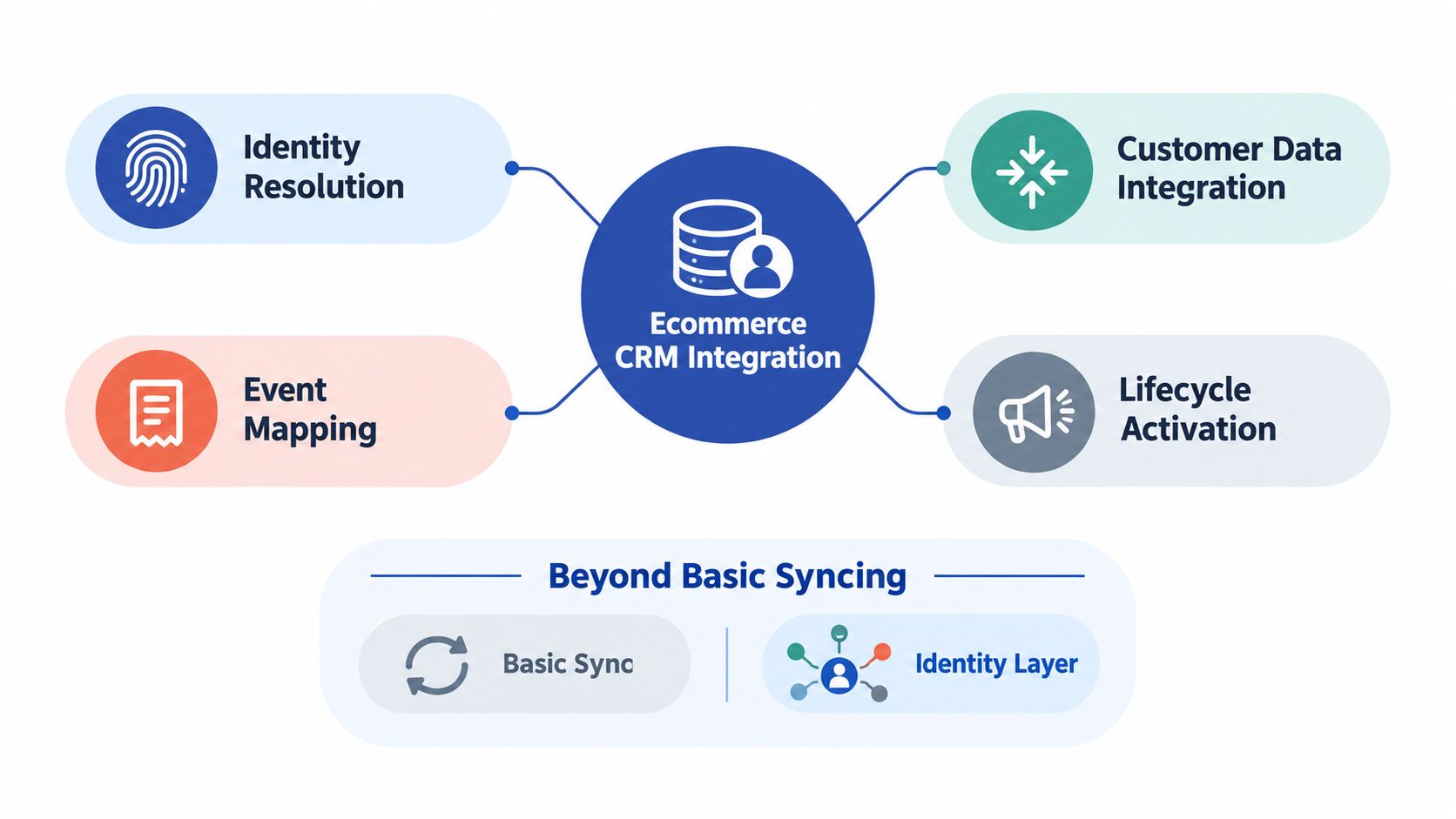
A connector can create a contact when someone places an order. That doesn't create a useful customer view. A scaling Shopify Plus brand needs to connect customer identity, commerce events, service history, consent, and lifecycle status without allowing every platform to overwrite every other platform.
Shopify's guidance on customer data integration frames the problem more accurately. The work involves consolidating data from ecommerce, physical retail, email, loyalty, and wholesale, then phasing the rollout, defining ownership, and reviewing security and data residency before expanding it.
Start with an identity layer
Shopify may identify a buyer by customer ID and email. A POS may use a phone number. A support platform might create a profile from an email alias, while a wholesale system uses a company account and contact relationship. Treating those values as interchangeable creates duplicate records and unreliable segmentation.
Use a stable identity model instead. Keep platform-specific IDs as external references, then define matching rules around normalised email, verified phone, account relationships, and explicit merge decisions. An identity service or integration layer should record why two records were matched, not merely copy fields until they happen to look alike.
The same discipline applies to data ownership:
- Shopify owns commerce state: Orders, fulfilment status, checkout details, and storefront customer accounts should normally originate in Shopify.
- The CRM owns relationship activity: Sales tasks, service context, account ownership, and lifecycle notes belong in the CRM.
- The POS owns retail transactions: Store location and in-person transaction context should remain tied to the retail system, then be exposed to the CRM.
- The consent platform owns permissions: Marketing status must have a clear authority and an audit history.
Practical rule: A field can be synchronised in both directions only when both systems have a documented conflict-resolution rule.
Don't use a single giant customer object as a substitute for an architecture. Model orders, refunds, subscriptions, support cases, companies, and contacts as related objects. That approach survives new channels more effectively than concatenating everything into notes or custom text fields.
For teams researching competitor catalogues, pricing signals, or marketplace data before designing enrichment workflows, ecommerce scraping tools can be a useful reference point. The resulting data still needs provenance, permission checks, and a defined place in the operating model. External research data shouldn't be mixed casually with first-party customer records.
The Revenue Impact of Fragmented Customer Data
Fragmented customer data creates commercial loss long before anyone calls it an integration incident. An order can reach fulfilment while the CRM continues treating the buyer as a prospect. A support agent can receive a case without the order context needed to resolve it. A POS transaction can create a second profile, splitting retention history and understating customer value.
A UK retail systems survey found that 60% of respondents said poor connectivity between systems was draining revenue, while integration failures cost 10% of retailers more than GBP 1 million annually. The same survey identified CRM platforms as a pain point for 32% of retailers. These figures are reported in the UK CRM marketing services market analysis.
The operational pattern is predictable. Teams reconcile orders in spreadsheets, re-import contacts, repair failed workflows manually, and eventually stop trusting dashboards. Batch exports can conceal a broken process until the next scheduled run. Event-driven pipelines surface failures closer to the source, but only when retries, dead-letter handling, and alerting are designed into the integration.
Treat integration as a budget line
Integration deserves a named owner and a budget line, not a spare-time task for whichever developer is available. One UK industry summary reports that 71% of UK businesses use CRM systems, with those users seeing an average 29% sales uplift and 34% productivity gain. The figures, reported by Marvyn's ecommerce CRM overview, do not establish that integration alone caused those results. They do show why CRM now functions as a mainstream operating layer.
| Metric | Value | Business implication |
|---|---|---|
| UK businesses using CRM systems | 71% | CRM integration is a mainstream capability, not an experimental add-on |
| Average sales uplift among cited CRM users | 29% | Commercial teams need trustworthy customer and order context |
| Average productivity gain among cited CRM users | 34% | Reliable automation can affect operating capacity |
| UK retailers reporting revenue drain from poor connectivity | 60% | Connectivity needs commercial ownership |
| Retailers facing integration failures above GBP 1 million annually | 10% | Recovery and governance require planned investment |
| Retailers naming CRM as a systems pain point | 32% | CRM needs attention alongside storefront and POS architecture |
The business case should cover data mapping, identity resolution, observability, migration cleanup, and ongoing maintenance. Middleware appears as a clear invoice item. Dirty records show up later as misdirected campaigns, incorrect service decisions, duplicate outreach, manual rework, and reporting that cannot support a budget decision.
Identity resolution often creates the largest hidden cost. Shopify email, POS phone numbers, guest checkout records, and CRM contacts may describe one person with different identifiers. Matching too aggressively can merge households or business buyers. Matching too cautiously leaves duplicate profiles. Define matching rules, review ambiguous records, and record the reason for each merge or rejection.
For the boundary between back-office systems and relationship data, see this guide to ERP integration with CRM. Connect systems when a defined commercial workflow justifies the data exchange, with an accountable owner responsible for failures and changes.
Mapping Ecommerce Events to CRM Objects
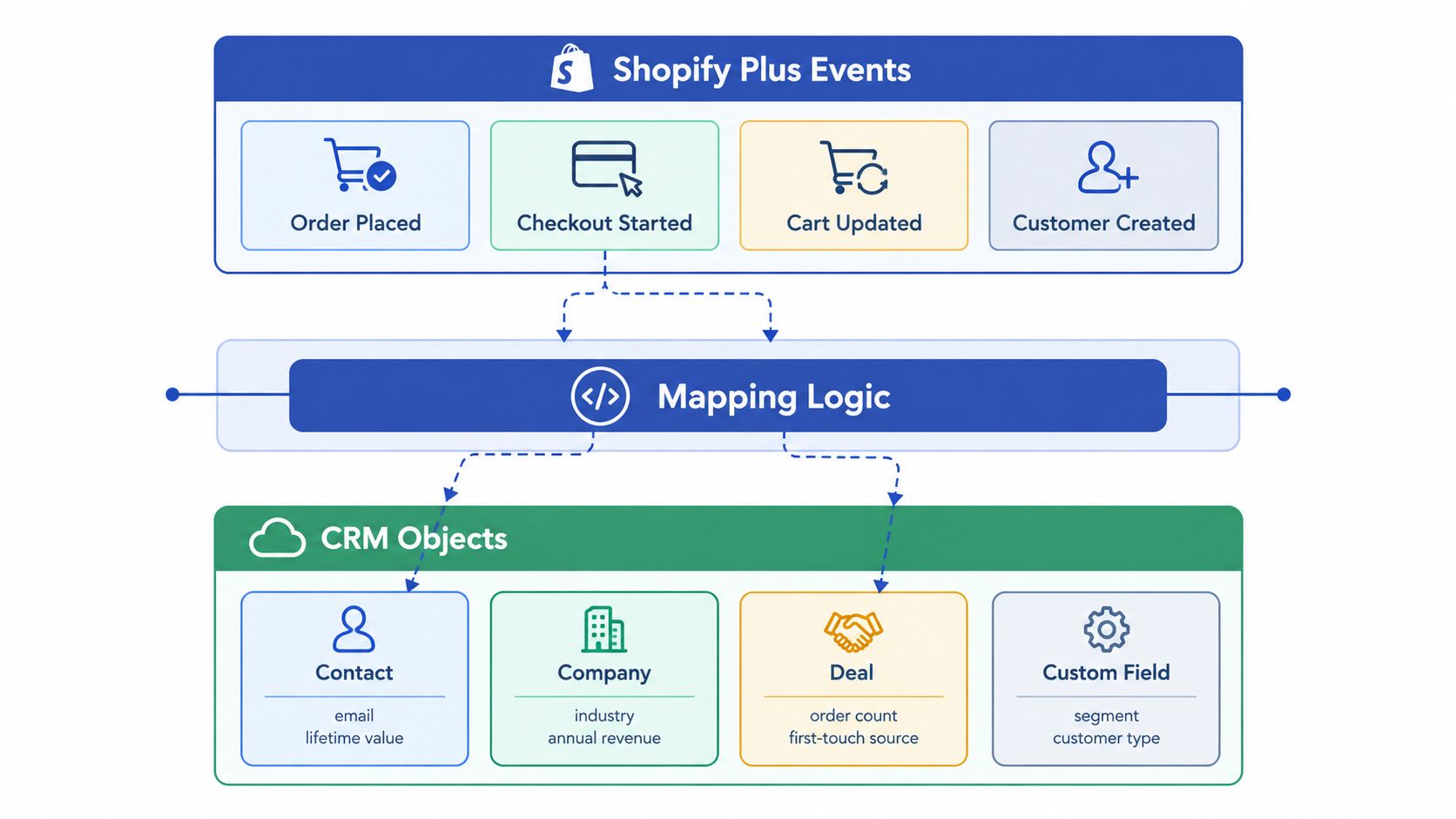
A Shopify event is not a CRM record until its business meaning and relationships are defined. “Order created” might update a contact, create an order object, associate a company, recalculate lifetime value, and start a post-purchase workflow. If the integration only creates or updates a contact, the CRM remains an address book rather than a lifecycle system.
Define the object model before the payload
Start with commercial questions, then map events to objects. Marketing may need a segment for customers who bought a replenishable product but have not reordered. Support may need open refunds and failed fulfilment. Revenue operations may need a company-level view of wholesale activity across stores and channels.
A practical model separates:
- Contact: Person identity, communication preferences, consent, and relationship metadata.
- Company: Wholesale organisation, billing relationship, account owner, and commercial terms.
- Order: Transaction identity, line items, discounts, taxes, fulfilment, and channel.
- Subscription: Plan, status, renewal event, pause, cancellation, and next expected charge.
- Support case: Issue category, status, related order, resolution, and service owner.
- Derived attributes: Order count, last purchase date, product-category affinity, and lifecycle stage.
Store product history as structured line items or related records, not as one text field. The CRM can then filter by SKU, product family, quantity, and return state. For bundles, preserve both the parent bundle and component lines when finance or merchandising needs those views.
Map state changes, not only creation events
The first order is one point in the relationship. Define mappings for each meaningful transition:
- Checkout started: Create or update an anonymous or known session record, without treating intent as revenue.
- Order placed: Create the order object, associate it with the resolved contact, and update lifecycle fields.
- Partial refund: Add a refund event and reduce order-level financial summaries while retaining the original purchase record.
- Subscription paused or cancelled: Update the current state and record the transition timestamp, preserving the original plan history.
- Wholesale tier upgrade: Update the company relationship and commercial tier, with the effective date and approving user.
- Customer merge: Retain source IDs and an audit record so downstream systems can explain the merge or rejection.
Source-of-truth decisions matter more than field count. If Shopify owns a tax exemption status or billing address, a CRM edit must not silently overwrite it.
Give every field a direction and a reason
Create a mapping catalogue containing the source field, destination field, transformation, owner, allowed values, and conflict rule. An email might flow from Shopify to the CRM, while a CRM lifecycle stage flows to marketing automation but not back into Shopify. Record these boundaries before building workflows, because bidirectional syncing can create loops and overwrite valid data.
A mature mapping catalogue should survive subscriptions, wholesale relationships, multiple storefronts, and POS identifiers. That makes the event model more valuable than adding another connector. Review it when object definitions or commercial processes change, and keep rejected or ambiguous identity matches available for operational review.
Choosing the Right Middleware and Sync Strategy
There's no universally correct integration method. The right choice depends on the number of systems, the complexity of transformations, the tolerance for delay, and whether the team can operate the integration after launch.
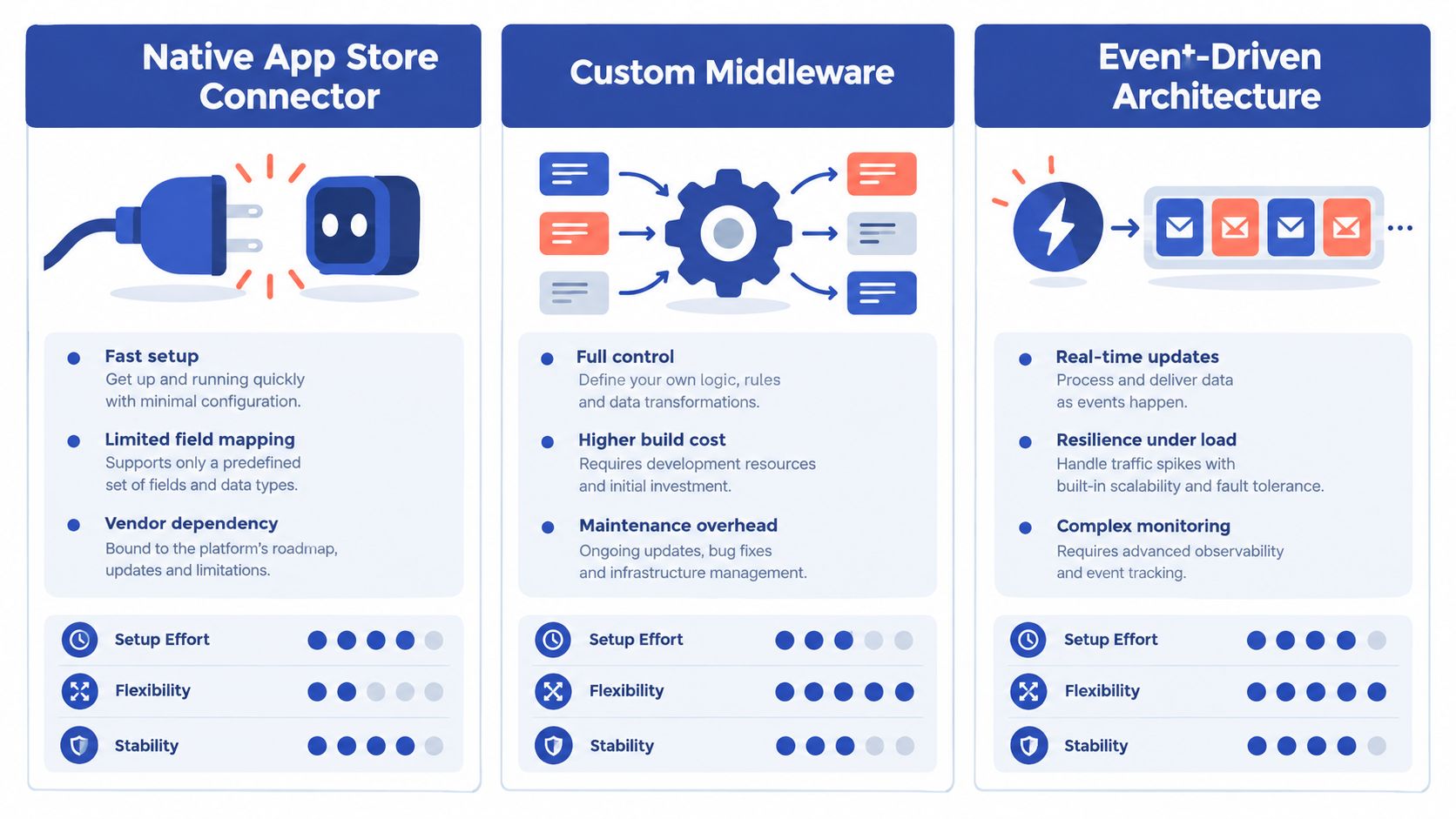
Native connectors are sensible when the workflow is simple and the vendor supports the specific fields you need. They're fast to configure and usually easier for a small team to maintain. They become restrictive when you need one Shopify event to update several CRM objects, preserve historical state, apply identity rules, or coordinate ERP and fulfilment logic.
Compare the three common approaches
| Approach | Works well for | Main trade-off |
|---|---|---|
| Native app connector | Standard customer, order, and marketing synchronisation | Limited mapping and dependence on vendor behaviour |
| iPaaS or managed middleware | Multi-tool workflows with moderate transformation needs | Usage costs, platform dependency, and monitoring overhead |
| Custom middleware | Complex identity, object, and business-rule orchestration | Higher build effort and continuing engineering responsibility |
An iPaaS can be the practical middle ground. It gives teams reusable connectors, transformation steps, queues, and operational visibility without requiring every workflow to be custom-coded. It still needs architecture discipline. A visual workflow can become just as brittle as code when every exception is handled by another branch and nobody owns the mapping.
Custom middleware earns its place when the brand needs deterministic control. Build an integration service around canonical events, idempotency keys, schema validation, retry policies, rate-limit handling, and dead-letter queues. Keep business rules outside individual webhook handlers, so a CRM migration doesn't require rewriting the entire commerce event pipeline.
Choose synchronisation by event behaviour
Real-time webhooks suit events that need immediate action, such as order placement, cancellation, support escalation, or subscription state changes. They need duplicate-event protection because delivery can be retried, delayed, or received more than once.
Batch processing remains useful for historical imports, nightly reconciliation, analytical aggregates, and low-priority enrichment. It's a poor substitute for real-time handling when a customer-facing workflow depends on current state.
The evolution of CRM supports this architectural shift. Klaviyo's account of CRM history and UK retail adoption describes how CRM moved from sales administration towards a cross-channel customer platform, including Fenwick's selection of Salesforce in 2018 as part of its first ecommerce and digital shopping experience. That history matters because omnichannel architecture needs more than a back-office contact sync.
For a practical comparison of available CRM integration tools, assess retries, replay, field transformation, auditability, rate-limit behaviour, and exit options, not just the connector catalogue.
Embedding Data Validation and Governance
The most expensive integration defects often begin before the first API request. A malformed address, shared household email, inconsistent phone format, or duplicate company record can pollute every connected system. Once automation starts using those records, the error becomes a campaign, a support queue, or a revenue report.
Experian UK's validation guidance highlights address, email, and phone validation inside CRM, ERP, and ecommerce applications. The practical implication is clear: validation belongs in the data flow, not in a spreadsheet cleanup exercise after launch.
Put quality checks at the boundary
Validate data when it enters the system and again when a material change occurs. Reject values that cannot support the downstream workflow, quarantine ambiguous records for review, and preserve the original value where auditability requires it.
Useful controls include:
- Email validation: Normalise casing, check structure, and separate marketing permission from mere contactability.
- Phone validation: Store a consistent international format and retain the source value for troubleshooting.
- Address validation: Standardise fields without assuming that a corrected delivery address should change the billing record.
- Duplicate detection: Match using several signals, then send uncertain matches to a review queue rather than auto-merging.
- Reference data: Use controlled values for country, customer type, lifecycle stage, and wholesale tier.
A merge rule must be reversible or at least explainable. Store the source record IDs, match signals, decision timestamp, and actor or process that approved the merge. This protects reporting and gives support teams a way to understand why a customer record changed.
Governance has to be operational
GDPR work isn't limited to adding a consent field. Teams need to know why each field exists, who can access it, how long it should remain available, and how deletion or access requests move across every connected platform.
Assign ownership by domain. Customer operations can own identity policy, ecommerce can own order state, finance can own tax and billing rules, and marketing can own campaign permissions. The technical team should implement those decisions, not invent them in transformation code.
Use role-based access for sensitive customer data, log administrative changes, and document processors and data flows. A governance review should happen after new channels, regions, or vendors are added.
For a migration-focused checklist, use this guide to validate data after migration. The objective isn't a perfectly clean database on launch day. It's a repeatable process that prevents dirty data from becoming the default state.
Testing and Scaling the Integration Architecture
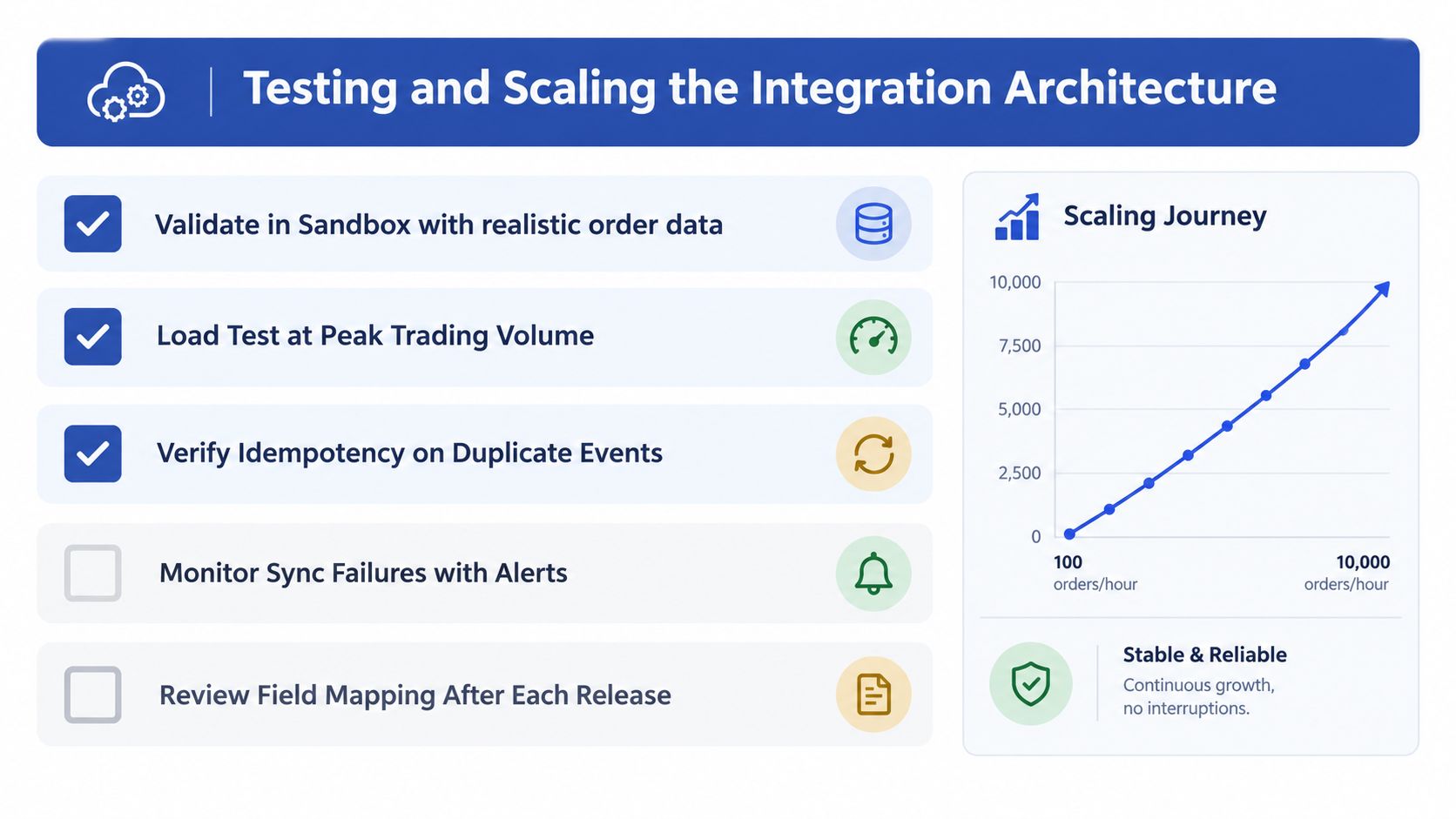
A sandbox test can confirm that a webhook works. It can't prove that the architecture handles duplicate delivery, partial refunds, out-of-order events, rate limits, identity conflicts, or a release that changes a field type.
Test the integration as an operational system. Every event should have a traceable ID, processing state, destination response, retry history, and final outcome. If an order is absent from the CRM, an engineer should be able to identify whether Shopify didn't emit it, middleware rejected it, the CRM throttled it, or a mapping rule discarded it.
Build a test matrix around failure
Use realistic records rather than minimal fixtures. Include guest checkout, known customers, shared addresses, wholesale contacts, bundle orders, partial refunds, subscription changes, failed payments, and customers with existing duplicates.
Your release checklist should include:
- Replay tests: Send the same event repeatedly and confirm idempotent results.
- Ordering tests: Deliver fulfilment, refund, and cancellation events in unexpected sequences.
- Rate-limit tests: Slow the destination deliberately and verify queueing, backoff, and recovery.
- Mapping tests: Check required fields, controlled values, associations, and field ownership.
- Privacy tests: Verify access restrictions, consent propagation, deletion workflows, and audit records.
- Reconciliation tests: Compare source totals and destination totals, then investigate every difference.
Load testing must target the middleware and destination APIs, not just the storefront. Measure queue depth, processing latency, retry volume, dead-letter growth, and database contention. A system that keeps accepting webhooks while accumulating undelivered messages in the background isn't healthy.
Monitor business symptoms as well as technical metrics
Technical alerts should notify owners when an event fails, a queue grows, a schema changes, or a destination rejects a payload. Commercial checks should detect missing order associations, sudden changes in customer counts, unexpected lifecycle movements, and segments that become empty.
Design for expansion by separating tenant, market, channel, and currency attributes from the core identity. New storefronts and B2B relationships should add configuration and reference data, not force a rewrite of the identity model.
The UK CRM marketing services market is estimated at USD 1.93 billion in 2025 and projected to reach USD 3.11 billion by 2031, while implementation and integration represented 34.96% of the service type share in 2025, according to SourceForge's UK market summary. The projection reinforces the need to budget for operation, monitoring, and change management rather than stopping at the initial build.
A dependable ecommerce CRM integration is one your team can replay, explain, repair, and extend without manually reconstructing customer history. That's the standard to use before peak trading, a replatform, or another channel launch.
Grumspot designs and builds Shopify Plus CRM integrations with real-time data synchronisation, workflow automation, custom backend logic, and support for complex ecommerce architectures. If your Shopify, POS, CRM, ERP, or fulfilment data is fragmented, visit Grumspot to discuss a governed integration plan built around your source-of-truth decisions.
Let's build something together
If you like what you saw, let's jump on a quick call and discuss your project

Related posts
Check out some similar posts.
- first party data
Master first party data collection with consent-based capture, Shopify integration, and activation t...
Read more