First Party Data Collection: Revenue-Boosting Tactics
- first party data
- ecommerce data
- consent marketing
- Shopify analytics
- customer data
Launched
August, 2026
If your paid media reports have started to feel slippery, you're not alone. One week, attribution looks tidy, the next week it's full of gaps, broken paths, and anonymous traffic you can't tie back to a customer with confidence.
That's usually the point where teams start looking at first party data collection as if it's a capture problem. It isn't just that. The harder part is getting consented data out of the form, off the site, and into the systems that make money, like email, CRM, and personalisation workflows, before the signal goes stale.
Why First Party Data Became a Survival Skill
A lot of ecommerce teams only saw how fragile their measurement stack was once browser restrictions and cookie loss started breaking attribution. One month they were making tidy decisions from paid social and retargeting reports, and the next they were dealing with partial journeys, missing conversions, and audience lists that no longer held up across channels.
That shift became structurally important after the GDPR took effect on 25 May 2018, because relying on third-party data became costlier and riskier, while consent-based owned channels became the practical route for durable customer profiles, websites, apps, CRM systems, and email lists (Omnibound on first-party data statistics). In the UK, lawful tracking is still framed around transparency, consent, and purpose limitation, so the operational logic changed too. Brands that want to measure, personalise, and convert at scale need data they collected directly, not data assembled from opaque sources.
The catch is that collection alone does not solve the problem. A consented email address or preference profile only becomes valuable once it lands in the systems that use it, and many teams still lose time between capture, sync, and activation.
What changed in the real world
The commercial difference is straightforward. First-party data is usually more accurate and more reusable across lifecycle marketing than brokered or inferred data, which matters when you are trying to keep retention flows, customer lifetime campaigns, and remarketing stable under stricter rules. For ecommerce and subscription businesses, that is not a nice-to-have. It is the difference between having a customer record you can activate and having a pile of disconnected identifiers.
Practical rule: if a channel disappears tomorrow, the data you still own is the data that will keep revenue moving.
Industry reporting shows the same direction of travel. A 2024 IAB study cited in industry research found that 71% of brands, agencies, and publishers were already growing or planning to grow their first-party datasets, up from 41% two years earlier, a 30-point increase and roughly a 73% relative rise in adoption intent (TechRT first-party data statistics). That is not a niche tactic. It is the operating model for teams that still need dependable audience control.
Collection Methods That Actually Convert
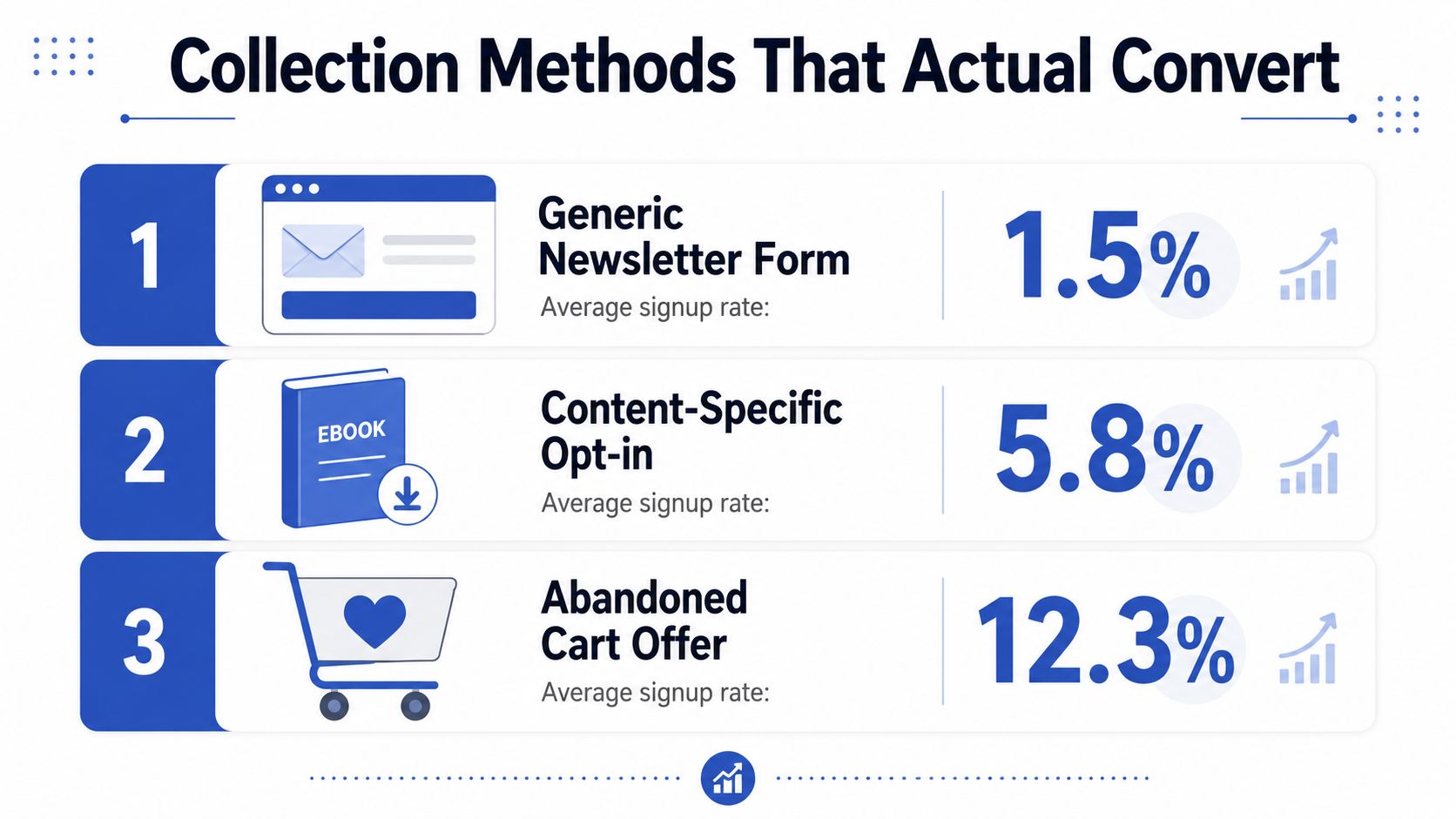
A lot of sites still treat data capture like a single newsletter popup problem. That's where the numbers disappoint, because a standard form is rarely enough on its own. Industry reporting on ecommerce first-party data collection notes that standard forms average about 2% newsletter signup conversion, while optimized approaches can reach roughly 9%, and gamified or highly incentivised widgets can convert at 10 to 30% under strong offers (OpenSend first-party data collection rate statistics).
Start where the intent is already visible
The best-performing capture points usually sit where buyers are already leaning in. That includes product views, checkout starts, account creation, loyalty enrolment, gated content, and post-purchase flows. You're not asking for data cold. You're exchanging it for something the visitor already wants, whether that's faster checkout, a useful discount, or a loyalty benefit.
A simple rule helps here. If the field doesn't support an actual downstream use case, cut it. Extra fields reduce completion, but the cost is worse: they create low-quality records that never make it into email or CRM cleanly enough to use.
Use different touchpoints for different jobs
A newsletter popup is fine for broad list growth, but it's a blunt instrument. Content-specific opt-ins work better when the user has shown topic intent, and purchase-adjacent offers work better when the visitor is already close to conversion. The point is to match the ask to the intent, not to force every visitor through the same capture pattern.
- On-site forms: keep them short, ask only for the fields you need, and test whether one field fewer improves completion without killing downstream segmentation.
- Login prompts: use them when returning customers already have a reason to save preferences, orders, or favourites.
- Purchase events: capture consent and preference data after checkout, when trust is highest and friction is lowest.
- Loyalty programmes: tie value to repeat behaviour, not just an email address, so the data has a reason to stay active.
- SMS and email capture: separate the asks. A visitor who wants email updates may not want SMS, and mixing the two often depresses trust.
If the incentive is vague, the signup is weak. If the value is clear, the data quality usually improves with it.
A common mistake is relying on one low-friction form and expecting scale. A better system layers multiple collection points across the journey, keeps the offer specific, and lets the data feed directly into the next workflow instead of sitting in a dead-end list.
Navigating UK Privacy and Consent Requirements
First party data collection in the UK doesn't survive on “collect more” advice. It survives on defensible choices about what you ask for, when you ask for it, and how long you keep it. UK GDPR and PECR force that discipline, and the ICO's emphasis on transparency, purpose limitation, and valid consent where required means the collection design has to match the legal basis, not the other way around.
That's why the gap between strategy and execution is so wide. A team can have a great signup rate and still build a risky programme if the banner copy is vague, the purpose is too broad, or the retention period is longer than the use case needs. The operational question is not whether you can collect more data. It's whether each field, trigger, and storage rule can survive scrutiny.
What defensible collection looks like
In practice, defensible collection is boring in the best possible way. The purpose is stated clearly, the user knows what they're signing up for, and the data captured is proportionate to the job it needs to do. If you ask for an email address to send back-in-stock alerts, don't repurpose that field for unrelated segmentation without a proper basis and consent review.
The ICO's complaint and incident figures show why this matters operationally. The regulator reported 177,366 data protection complaints in 2023/24, up from 13,331 in 2022/23, and 940 cyber incidents were reported in the same year (Henry Stewart Publications PDF on effective first-party data collection). That doesn't mean every ecommerce store is in crisis. It does mean collection, governance, and security are no longer just marketing concerns.
Avoid the common compliance traps
Most problems start in the small details. Teams over-collect fields because “we might need them later.” They keep personal data indefinitely because no one owns retention. Or they capture consent but can't prove when, where, and for what purpose it was granted.
A useful check is to ask three questions before shipping any new form or tracking event.
- Is this field necessary? If not, remove it.
- Is the purpose clear to the user? If not, rewrite the prompt.
- Can we prove consent and use it consistently across systems? If not, the workflow isn't ready.
For Shopify merchants expanding beyond the UK, the regulatory surface gets wider fast, so a good starting point is a practical GDPR compliance checklist for Shopify stores expanding into the EU in 2026. The key point is the same either way. Good consent design protects revenue because it keeps your activation stack usable later.
Technical Implementation on Shopify
A Shopify store can collect plenty of signal and still fail at activation if the implementation is messy. The usual failure mode is fragmented identity. One system knows the email address, another knows the browser session, a third knows the purchase, and no one can stitch those records together quickly enough to trigger the right message.
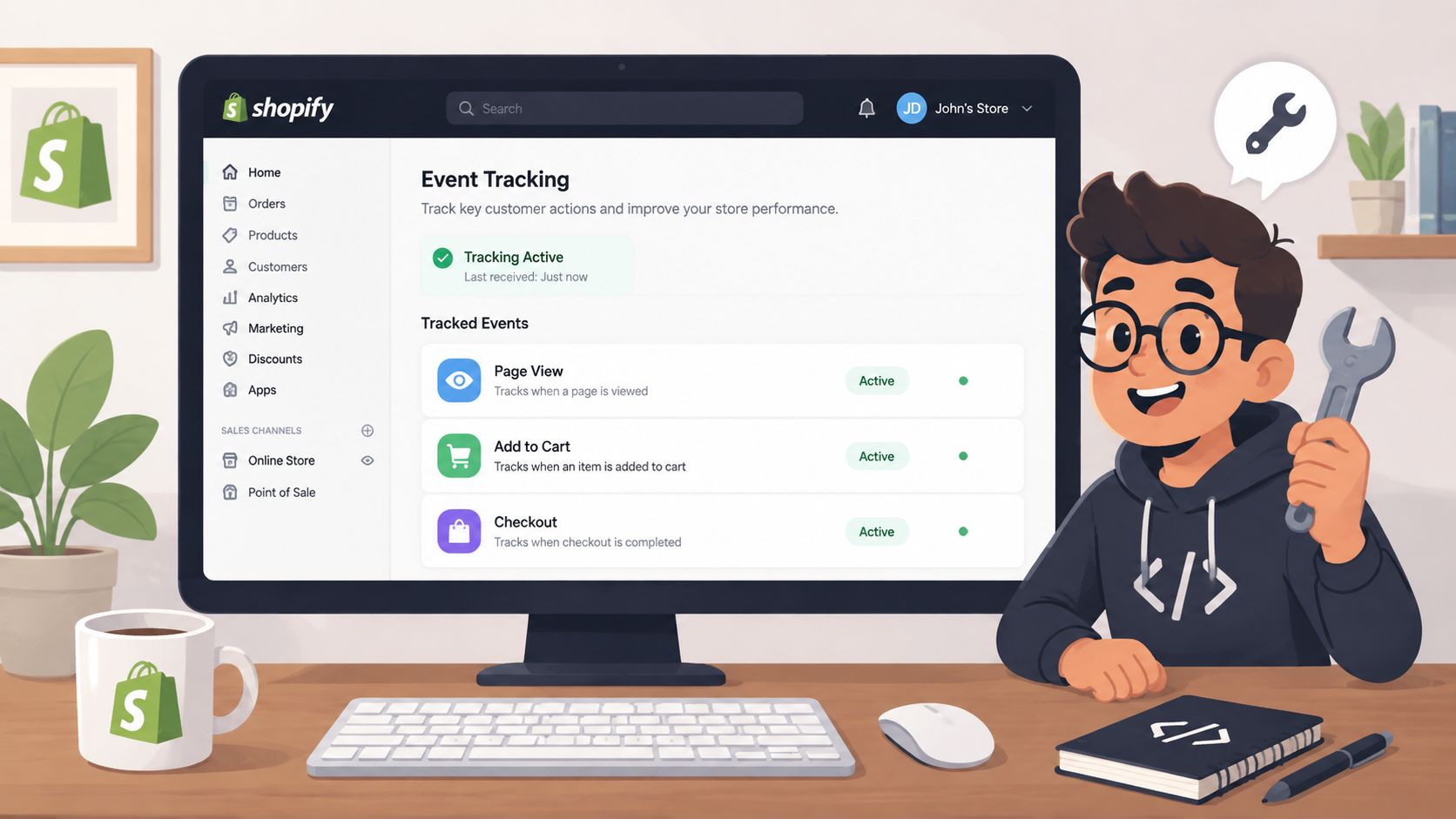
The first job is to define the events you care about. For most stores, that means product views, add-to-cart, checkout start, purchase, account creation, newsletter signup, and loyalty enrolment. Once the event list is stable, map each event to the destination that needs it, usually an analytics tool, a CRM, and one or more activation tools.
Build the tracking stack around consent and identity
Your data layer should separate anonymous behaviour from known customer records, then link them only when the user has identified themselves. That sounds obvious, but it gets broken constantly when apps fire inconsistent event names or when checkout and storefront capture different identifiers. Standardise the naming once, then keep it the same across the storefront, app, and post-purchase flows.
A clean Shopify setup usually needs three pieces.
- Event capture: front-end events for behaviour, server-side events for durable transaction records.
- Webhook handling: purchase and customer webhooks to keep CRM and downstream tools up to date.
- Consent propagation: a clear signal that tells each tool what can be recorded and what must wait.
The biggest win comes from sending data into a CDP or comparable central layer before it reaches email and CRM. That gives you one place to clean duplicates, normalise fields, and route consented profiles into the correct destinations. If you skip that step, every app becomes its own source of truth, and the activation team spends half its time fixing records instead of using them.
Don't let implementation get scattered
On Shopify, the temptation is to install another app for every new event. That creates brittle behaviour fast. A better pattern is to keep the capture layer lean, use webhooks where server-side reliability matters, and document exactly which event powers which journey.
For stores that need more involved integrations, structured implementation help matters, especially when the stack includes custom apps, ERP sync, or CRM hand-offs. A useful reference point is the kind of integration work covered in Shopify third-party integration services, because most first-party systems fail at the seams between tools, not in the form field itself.
The technical aim is simple. Every consented record should arrive in the right system, with the right identifiers, fast enough to be useful before the shopper's intent cools off.
From Collection to Activation Without Bottlenecks
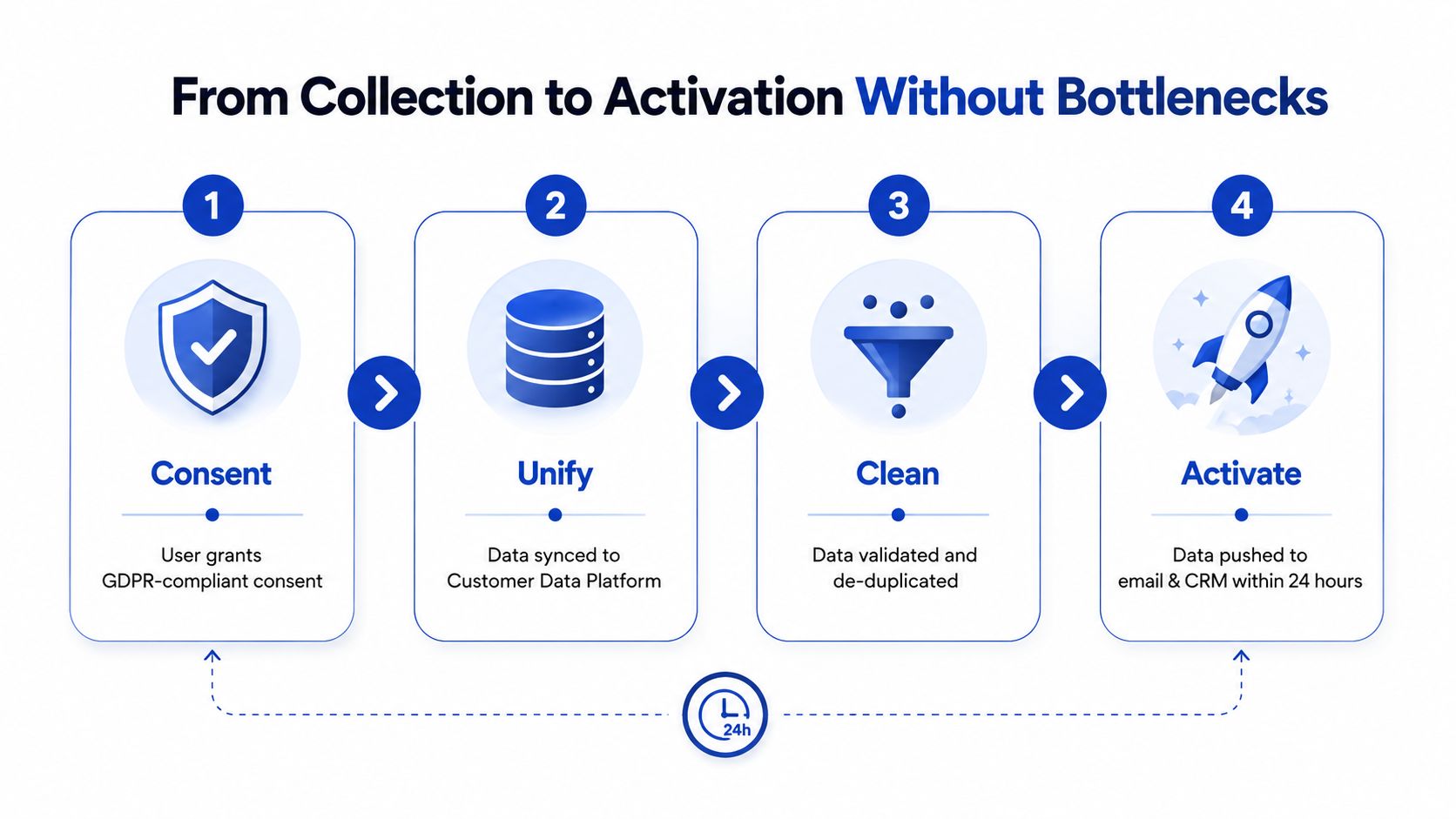
Collecting a new email address is not the hard part anymore. The hard part is whether that address gets unified, cleaned, and pushed into the tools that can act on it before the next buying window closes. That operational lag is where a lot of revenue disappears.
A survey of 2,400 marketers reported a 34% median first-party data activation rate, with the top quartile at 67% and the bottom quartile at 11% (Visionary Marketing first-party data statistics 2026). These figures matter because they reveal a key bottleneck. Marketers often aren't struggling to collect data, they're struggling to activate it consistently.
Fix the hand-off, not just the capture
If consented data lands in a spreadsheet, the process is already losing time. A better path sends the record into a CDP or CRM immediately, checks for duplicates, enriches only the fields you can justify, and then triggers the right campaign. That pipeline is what turns a signup into a usable customer profile.
The fastest teams usually do four things well. They unify identifiers early, they clean records before they hit campaign logic, they standardise the data model, and they make the activation owner visible. When one team owns collection and another owns activation, the hand-off has to be documented, or the profile goes stale.
Segment for action, not for decoration
A segment that never gets used is just a tidy folder. The useful segments are the ones tied to clear revenue actions, like replenishment reminders, cart recovery, win-back, and post-purchase cross-sell. That means the segment definition should be built backward from the workflow, not forward from the raw data.
A simple activation workflow often looks like this.
- Identify the trigger. A signup, purchase, or browsing signal starts the flow.
- Confirm consent status. If the user didn't opt in, the record should not enter the channel that needs permission.
- Resolve identity. Match the anonymous event to the known profile where possible.
- Push to the destination. Email, CRM, or personalisation tool receives the record with the minimum fields needed to act.
The difference between teams with decent capture and teams with decent revenue is usually speed. If the record is still waiting to be cleaned when the customer is ready to buy again, the opportunity has already passed.
Designing for Measurement Resilience
The common assumption is that more first-party data automatically means better measurement. It doesn't. If users refuse tracking, block tags, or split behaviour across devices and sessions, you can collect a large volume of data and still have a weak view of what's happening.
That's why server-side and consent-based tracking should be treated as a resilience problem, not just an attribution upgrade. UK adults spent an average of 4 hours 20 minutes per day online in Ofcom's Online Nation 2024, while ecommerce journeys are still being compressed by browser privacy controls and consent choices (Braze first-party data article). In other words, the opportunity is large, but the observable share of the journey keeps shrinking.
Build measurement that survives partial visibility
A resilient stack assumes you won't always get full-page tracking. It uses server-side events where possible, respects consent at every layer, and accepts that some journeys will remain partially visible. The job is not to make every session perfectly trackable. The job is to keep enough trustworthy signal to make better decisions than guesswork.
That means three things matter more than raw event volume.
- Consistency: the same event should mean the same thing across systems.
- Consent awareness: you should know which records are eligible for which forms of measurement.
- Fallback logic: when browser tracking fails, server-side or CRM-linked events should still preserve key purchase signals.
For teams that want a cleaner way to evaluate tests without over-reading noise, a disciplined approach to statistical significance testing helps prevent false confidence when the sample is messy. The point is not to make every metric perfect. It's to make the decision-making reliable enough that the stack can keep working even when tracking conditions are poor.
Resist the false comfort of full funnels
Full-funnel reporting looks reassuring right up until consent loss and browser restrictions break it. Then teams start taking action on half-visible journeys and calling it insight. A more resilient system accepts incomplete data, prefers trusted sources over decorative dashboards, and uses first-party signals to anchor the parts of the journey that matter most.
That mindset is what keeps measurement useful. It's also what keeps activation from being built on shaky assumptions.
Implementation Playbook and Governance Framework
Most first-party programmes fail because nobody owns the operating rhythm. The capture team ships forms, the CRM team cleans data, and the campaign team waits for lists that never arrive in a usable state. A governance framework fixes that by making collection, quality, and activation part of the same working system.
The commercial case is straightforward. Businesses that use first-party data can see stronger revenue performance, which is why more brands, agencies, and publishers have been growing or planning to grow their first-party datasets. The signal is clear. This is now core infrastructure, not a side project.
Use a practical governance cadence
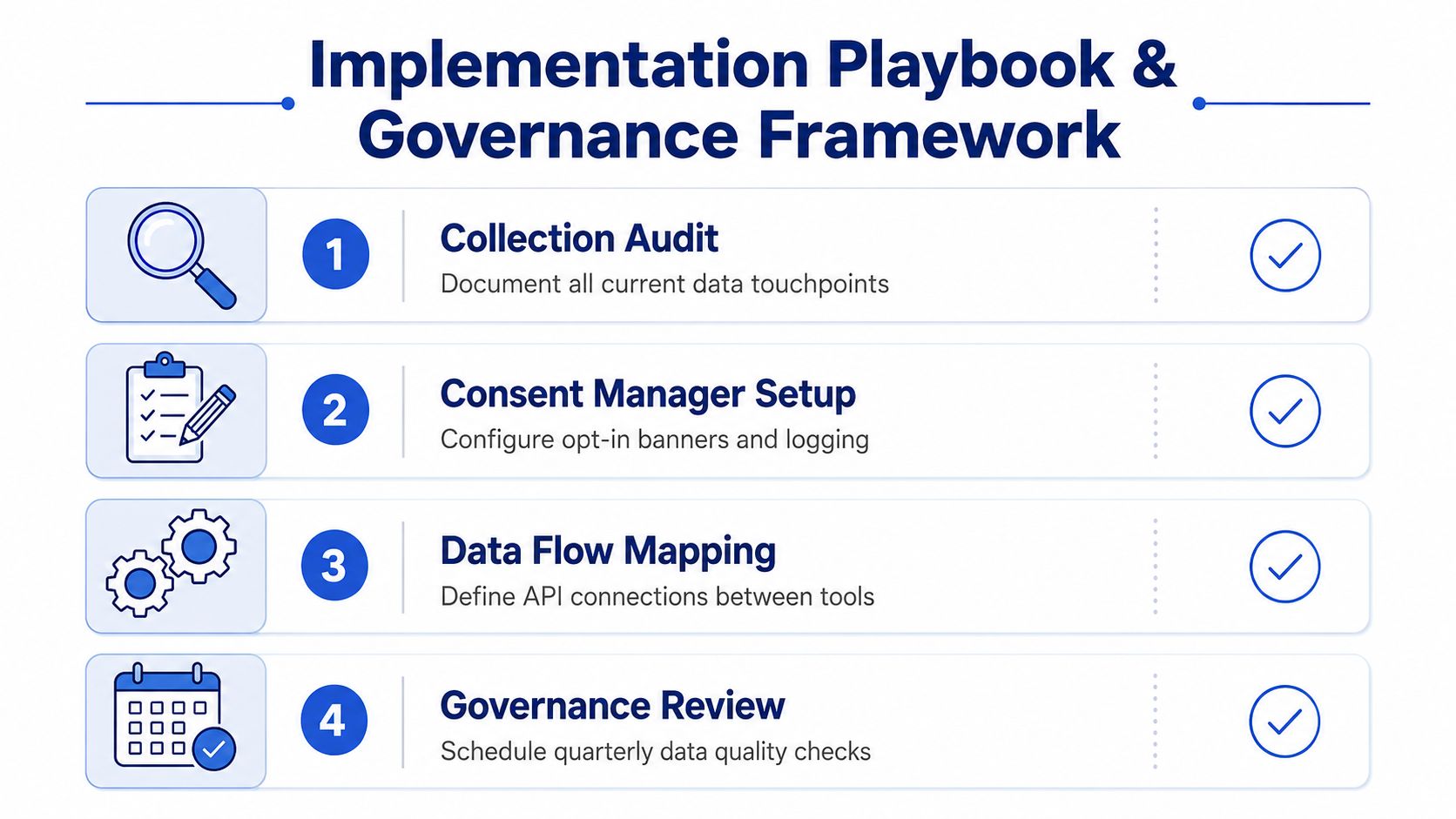
Start with a collection audit. List every touchpoint that captures personal data, then mark which ones feed email, CRM, analytics, or personalisation. If a touchpoint does not feed a live workflow, it is usually just adding risk and extra cleanup later.
Then tighten the consent manager setup. The banner, preference centre, and logging logic should all agree on the same consent status, or your activation stack will behave inconsistently. After that, map the data flow between tools so everyone can see where the profile is created, where it gets cleaned, and where it gets activated.
The best governance system is the one your team can actually maintain every month.
A quarterly review is usually enough to catch drift before it turns into a bigger problem. Check for broken event names, duplicate records, stale fields, and campaigns that never received the data they were meant to use. If a field is no longer helping a customer journey, remove it or rework it so it earns its place.
Keep the checklist short and usable
Governance should make the system easier to run, not harder. The working checklist is simple.
- Document touchpoints: know where data enters the business.
- Verify consent logs: make sure consent status follows the record.
- Inspect delivery paths: confirm the data reaches email and CRM quickly.
- Review quality regularly: clean stale or duplicated records before they spread.
The test is speed from capture to use. Consented data that sits in a queue for days is not helping email targeting, CRM follow-up, or personalisation. The teams that get this right build a clear handoff from form submission to downstream activation, with ownership at each step and a short review cycle that keeps the system honest.
The point of first-party data collection is not to accumulate more records. It is to create a system that turns consented behaviour into revenue without breaking trust.
Let's build something together
If you like what you saw, let's jump on a quick call and discuss your project

Related posts
Check out some similar posts.
- zero party data
Learn what zero party data is, why it matters for ecommerce, and how to collect and use it for perso...
Read more
- ecommerce crm integration
Master ecommerce CRM integration with technical strategies for data mapping, middleware, and identit...
Read more
- predictive analytics ecommerce
Discover how predictive analytics ecommerce drives revenue through demand forecasting, churn prevent...
Read more
- product information management
Unlock growth with product information management (PIM). Learn its e-commerce benefits and how to ch...
Read more