Ecommerce Returns Management: Your Practical Playbook
- ecommerce returns management
- returns workflow
- Shopify returns
- reverse logistics
- returns automation
Launched
October, 2026
A customer opens a return portal because a jumper doesn't fit. The default screen offers a refund, the label is generated, and the original order value starts moving out of the business. Meanwhile, the warehouse waits for the parcel, finance records a reduction in revenue, and support prepares for another “where is my refund?” ticket.
That workflow is common, but it reflects an outdated view of returns. Ecommerce returns management should be designed as a revenue-recovery system, with the exchange capture rate at its centre. A refund may complete the transaction operationally, but an exchange preserves more of the original commercial opportunity.
Why Returns Can Become a Margin Problem Overnight
A returns queue can turn into a margin problem before anyone changes the returns policy. A third-party logistics warehouse receives parcels, an operations lead reconciles refunds against Shopify orders, and finance sees gross sales that look healthy while contribution margin weakens underneath.
The cost isn't limited to the postage label. A refunded item travels back through the network, waits for receipt, consumes warehouse labour, needs inspection and grading, and may return to stock too late for the original selling window. If the item can't be sold at full price, the business absorbs further value loss. The original acquisition spend also produced no retained order.
UK returns intensity makes this particularly material. Retail Economics and ZigZag project £25.1bn in non-food online returns in the UK in 2025, compared with £26.7bn in 2024, while the overall returns rate is projected to ease from 21% to 19.5% as fees and tighter policies influence behaviour. The same UK returns benchmark from Retail Economics and ZigZag reports that serial returners represent 11% of customers but nearly a quarter of all returns, so a uniform policy treats low-risk and high-cost behaviour as if they're identical.
The resolution mix matters more than the policy window
A refund-first policy turns every eligible return into a cash-out event. The customer gets money back, the warehouse processes a unit, and the brand must acquire or convert another order to recover the commercial value.
The UK gap is stark. One 2025/2026 benchmark reports that 78% of UK returned items were refunded, while only 6% were exchanged, and says only 6% of UK retailers were actively encouraging exchanges. That UK exchange-first returns analysis is more useful than a simple return-rate benchmark because it identifies the lever a brand can redesign without changing its catalogue.
| Category | Return rate | Refund % | Exchange % | Store credit % |
|---|---|---|---|---|
| UK non-food online returns | 19.5% projected for 2025 | Not specified | Not specified | Not specified |
| UK returned items, all categories | Not specified | 78% | 6% | Not specified |
| UK clothing | 23.6% average | Not specified | Not specified | Not specified |
The objective isn't to make every return difficult. It's to route the right customer towards the right resolution. A sizing issue can become an exchange. A customer who wants a different colour can receive an immediate variant recommendation. A faulty item should bypass persuasion and move directly into a service recovery path.
Return reasons provide the starting point. UK data identifies sizing as the dominant reason at about 77% of returns, followed by late delivery at 27% and item-not-as-described at 8%, as reported in the ZigZag annual returns report. That points towards better product detail pages, fit guidance, variant matching and delivery communication, not a blanket restriction on all returns. For practical guidance on connecting fit improvements with measurement, use this sizing UX and analytics guide.
Practical rule: Measure the refund-to-exchange mix before trying to reduce the number of returns. Recovering a sale can be more valuable than preventing a legitimate customer resolution.
Designing a Returns Policy Built for Exchange Capture
A returns policy shouldn't exist as a long block of legal copy that customers interpret after something goes wrong. It should operate as a set of decision rules that the portal, support team, warehouse and finance system apply consistently.
Start with the customer's likely reason for returning. A size issue, a faulty product, a late delivery and a wrong item shipped shouldn't enter the same experience. Each needs a distinct resolution path, a different fee rule and, in some cases, a different approval requirement.
Use the policy as a decision tree
The first policy decision is the return window. A short window can reduce the volume of old stock arriving at the warehouse, while a longer window may support purchase confidence for considered purchases. A brand might test a standard window of 30 days, a more generous 60-day window for selected categories, or a longer 365-day promise where product durability and customer lifetime value justify the operational exposure.
The window shouldn't be the only condition. Combine it with:
- Order date: Apply the rule that was active when the customer purchased, rather than forcing support to interpret historical policy pages.
- SKU eligibility: Exclude final-sale or hygiene-sensitive products where the commercial and safety requirements differ.
- Return reason: Treat “wrong size” differently from “faulty item” or “wrong SKU”.
- Customer risk: Route repeated high-cost patterns to review without making every customer prove intent.
Fees are the second control. Free returns reduce friction but place the reverse-logistics cost on the merchant. Customer-paid labels may protect margin, but they can also make a legitimate exchange feel punitive. A tiered approach is usually more defensible: waive the fee for faulty items, late deliveries and fulfilment errors, then apply a stated fee to discretionary returns where the customer received the correct product.
The third control is the exchange incentive. For apparel, a brand might offer 10% bonus credit on exchanges initiated within 14 days, then apply a paid return label after 30 days. For beauty, an unopened product could move straight to store credit, with the portal making the credit available before the customer waits for a card refund. These are policy examples, not universal rules. The correct offer depends on margin, stock depth and the cost of the incentive.
Encode exceptions before launch
Faulty items, late deliveries and wrong SKUs should leave the standard exchange funnel early. Give those customers a direct resolution, then capture the issue for quality assurance and fulfilment review. Final-sale products should show their status before the customer submits the order, not after the parcel arrives at the warehouse.
On Shopify Plus, store return reasons as structured tags or attributes rather than free-text notes. Shopify Flow can trigger actions based on those values, while Shopify Functions can support conditional shipping logic where the implementation requires it. A returns platform can then offer exchange, credit or refund in the correct order without relying on an agent to reinterpret the policy.
The same rules must appear in the returns portal, help centre, order confirmation, dispatch email and packing slip. If one channel promises free returns and another introduces a fee, the system may be technically correct while the customer experience is not.
Building the Returns Tech Stack on Shopify Plus
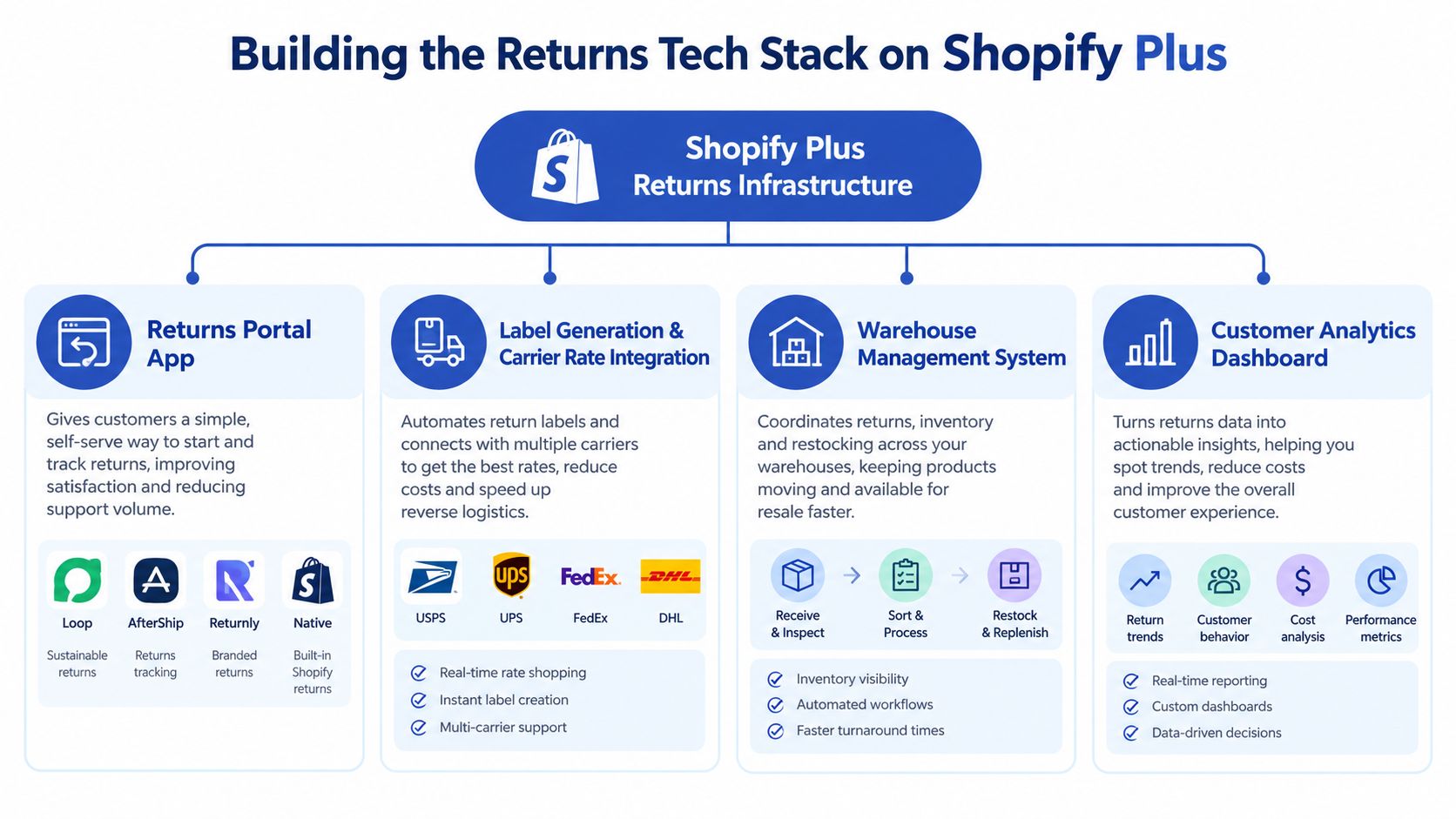
A Shopify Plus returns stack should make the commercial decision first and the logistics decision second. The portal asks why the customer is returning, presents the most appropriate resolution, creates the necessary record, and passes the return into fulfilment and finance without duplicating events.
The portal is the customer-facing layer. Tools such as Loop, AfterShip Returns and Returnly can provide structured flows, while a native build may suit a brand with unusual policy logic and strong internal engineering capacity. Buying reduces implementation time, but introduces subscription cost and dependency on the vendor's exchange and accounting model. Building gives control, but the team owns every edge case, carrier integration and maintenance task.
Label generation sits below that layer. Carrier rate shopping can control the cost and destination of a label, particularly when a brand uses different warehouses or service levels. The trade-off is resilience. If a carrier API fails, the portal needs a fallback process rather than leaving a customer unable to complete a return.
Map every event to a system of record
A useful Shopify Plus data flow looks like this:
- The customer starts a return in the portal.
- The portal checks the original order, SKU eligibility, reason code and customer segment.
- The system creates a return authorisation and label.
- An exchange request creates a Shopify draft order or equivalent exchange transaction, with inventory checked before the offer is confirmed.
- A refund writes back to Shopify as a refund, with any applicable restocking fee represented clearly in the transaction.
- The warehouse management system receives the parcel, records condition and updates disposition.
- The analytics layer joins the return event to the original order, product, customer and eventual resolution.
That sequence avoids treating an exchange as a note attached to a refund. An exchange is a new inventory and accounting event, so the system must reserve or reallocate the replacement unit without double-selling it during the return window.
The warehouse management system is where a returned item becomes either recovered value or lost value. It should support inspection, condition grading, quarantine and destination decisions. A fraud layer can use order tags, purchase history and behaviour signals to route selected cases for manual review. Options include Ravelin, Riskified or Shopify Fraud Analysis on Plus, but the choice should follow the signals the operation can act on.
For brands connecting returns to broader customer data, this ecommerce CRM integration resource is relevant because return behaviour shouldn't remain isolated from customer service, retention and lifecycle marketing.
Integration warning: The most damaging failures are often mundane. Duplicate refund webhooks, inventory counts that differ between the portal and Shopify, and carrier labels that fail without an operational fallback can create more work than the original manual process.
A chargeback monitoring layer also has a place beside returns, not inside the exchange decision itself. Teams assessing adjacent controls can review Disputely chargeback alerts as one example of how payment disputes may be surfaced separately from legitimate product returns.
Mapping the End-to-End Returns Workflow
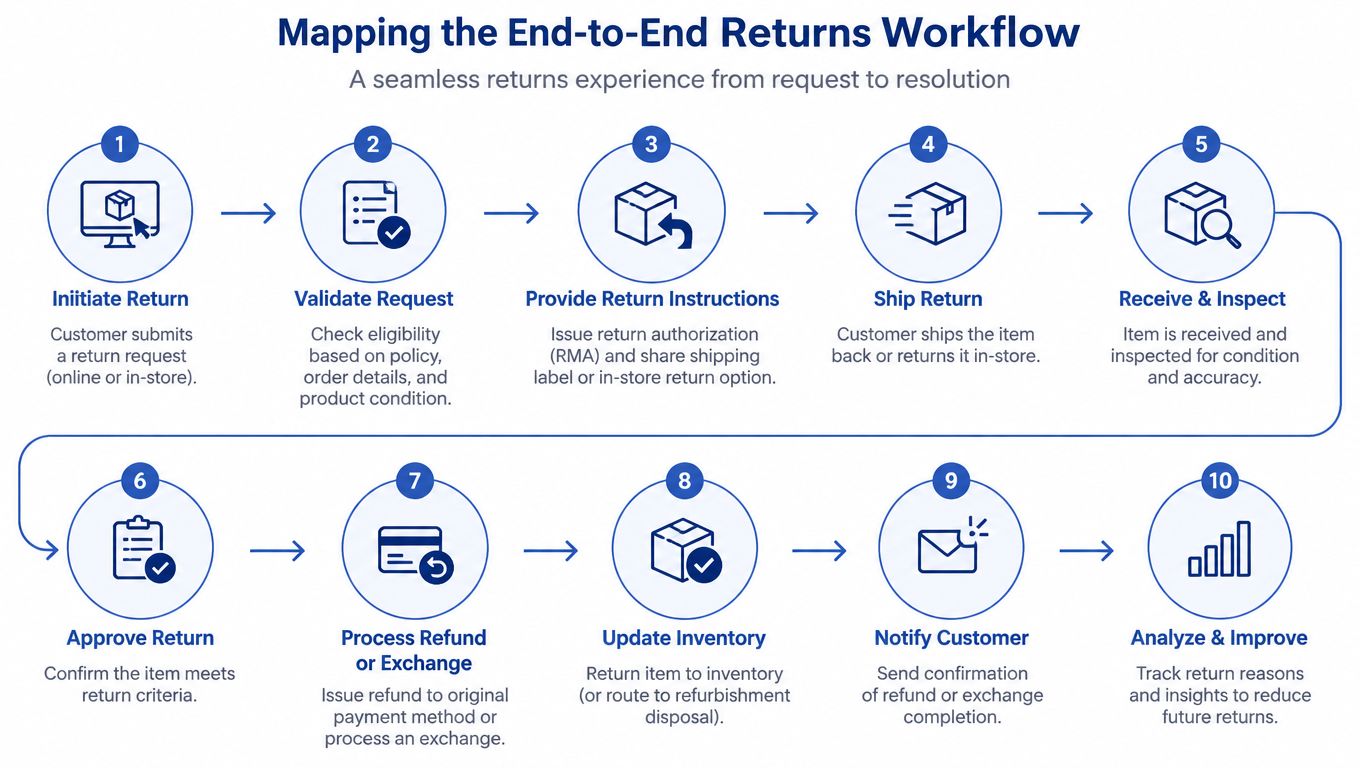
A return is a chain of ownership changes. The customer initiates it, the portal validates it, the carrier moves it, the warehouse assesses it, and the commerce stack records the resolution. A good workflow makes the next actor obvious and prevents the same decision from being made twice.
Assign an owner to each stage
Customer initiation: The customer selects the order and item from account history, email or the branded returns page. The portal records the reason and preferred resolution. Missing order data or an ineligible SKU should produce a clear explanation, not a generic error.
RMA generation: The returns application creates a return authorisation and assigns a reference. Shopify Flow can notify support or apply an order tag when a selected reason, product group or customer cohort needs attention.
Label dispatch: The carrier layer generates the label and determines the destination. If the item belongs to a different warehouse, the routing rule should select that location before the customer hands over the parcel.
Carrier movement: Tracking events update the return record and trigger customer messages. The support team should see whether the parcel is awaiting handover, in transit or delivered before responding to a status request.
Warehouse receipt: The 3PL or warehouse team scans the parcel and matches its contents to the RMA. The system should stop treating “label created” as “return received” at this point.
Inspection and grading: A trained operator checks the item against defined criteria. An A-stock item can return to normal inventory, a B-stock item can move to an outlet route, and a damaged or questionable unit can enter quarantine or refurbishment. Human judgement remains important for ambiguous damage, missing components and suspected abuse.
Final resolution: Refund, exchange and store credit each require a separate transaction path. A refund closes the financial obligation. An exchange must also confirm replacement inventory and create the downstream order. Store credit needs a ledger that support and finance can reconcile.
The exceptions need their own routes. A lost parcel should trigger carrier investigation rather than an immediate warehouse refund. A damaged-on-arrival claim may require evidence and quality review. A wrong item shipped is a fulfilment failure, so the customer shouldn't be pushed through the same fee logic as a discretionary return. Fraud signals should create a manual review queue with a documented reason for the decision.
The workflow should also protect inventory accuracy. If an exchange is promised before receipt, the replacement unit needs a reservation or controlled allocation. Otherwise, the customer can receive an exchange confirmation for stock that another customer has already bought.
For a wider view of reverse-logistics design across markets, the 2026 returns workflows Australia resource offers useful context on how routing, carriers and warehouse handoffs affect the operational model.
Returns UX as a Post-Purchase Conversion Channel
The returns portal is a merchandising surface that appears after the original purchase, when the customer already knows the brand and has a specific product need. Treating it as a dead-end form wastes a valuable opportunity to preserve the order.
Give customers several reliable entry points: order history, the dispatch or delivery email, a branded returns page and in-chat support. Each should open the same return record, not a different form with different policy logic. Pre-filling the order and item details removes avoidable typing and reduces the chance of selecting the wrong product.
Order the choices deliberately
The customer should see a short decision tree:
- Confirm the item and order.
- Select the reason in plain language.
- Show the best resolution first.
- Offer suitable replacement variants.
- Present store credit with its incentive.
- Keep the refund option visible, but not as the automatic default.
For “too small” or “too large”, show the same product in available sizes before suggesting a different product. For colour dissatisfaction, filter recommendations by the same variant family and current stock. A recommendation that ignores size, colour or availability makes the exchange path look unreliable.
Instant credit can remove the wait between returning the original product and choosing its replacement. Automated labels and pre-filled RMAs reduce effort. Proactive updates after handover, receipt and processing reduce the need for customers to contact support for basic status information.
The interface should also distinguish high-service exceptions. A faulty item needs a direct route to replacement or refund. A late delivery needs acknowledgement and a resolution that doesn't imply the customer caused the problem. A final-sale item should display its eligibility before submission, with a support option where a genuine defect exists.
Measure the interface, not just the outcome
Three measures expose whether the portal is changing behaviour:
- Resolution-step reach: How many eligible customers reach the point where exchange, credit and refund are displayed?
- Exchange capture rate: How many completed returns resolve through an exchange rather than a refund?
- Support deflection: How many return-status and policy questions are resolved by the portal and notifications instead of an agent?
If customers start a return but abandon before seeing a replacement, the problem may be page order, stock visibility or unclear incentive copy. If they reach the resolution screen but still choose refunds, test the exchange offer and variant experience before adding more policy restrictions.
Product visualisation can support the same principle before purchase. Brands exploring richer pre-purchase clarity may find this augmented reality product visualisation guide useful, particularly where customers struggle to judge colour, scale or fit from static imagery.
Tracking the KPIs That Prove Returns Are Working
A returns dashboard should lead with money, then explain the behaviour producing that result. The headline measure is net return cost as a percentage of revenue:
(Refund value + reverse logistics + processing labour - recovered revenue) ÷ gross sales
Recovered revenue includes the value retained through exchanges and store credit, subject to the finance team's chosen accounting treatment. The formula matters because a lower return rate can hide a worse outcome if the remaining returns are expensive, heavily discounted or mostly refunded.
The second layer measures the resolution mix and speed. Track exchange capture, refund rate, store-credit uptake, initiation-to-refund time and initiation-to-exchange-shipped time. The UK benchmark shows 78.1% of return value ending in refunds, with only 5.8% converting to exchanges, and an average return taking 9.97 days from initiation to processing. Those figures come from the 2025 UK State of Ecommerce Returns report, and they provide a directional comparison rather than a universal target.
| KPI | Formula | Target / Benchmark | Operational lever |
|---|---|---|---|
| Net return cost | (Refunds + logistics + labour - recovered revenue) ÷ gross sales | Establish a baseline before changing policy | Review fees, grading, recovery and exchange design |
| Exchange capture rate | Exchanged returns ÷ completed returns | Compare with the UK 5.8% benchmark cited above | Reorder portal choices and improve variant stock visibility |
| Refund rate | Refunded returns ÷ completed returns | Compare with the UK 78.1% benchmark cited above | Test exchange-first routing and credit incentives |
| Initiation-to-processed time | Processed timestamp - initiation timestamp | Diagnose against the UK 9.97-day benchmark cited above | Improve carrier handoffs and warehouse queues |
| Return reason mix | Returns by reason ÷ completed returns | Use the UK sizing, delivery and description pattern as context | Fix fit guidance, fulfilment and product-page accuracy |
| SKU return rate | Returned units for SKU ÷ sold units for SKU | Set an internal baseline by category | Review sizing, quality and merchandising |
| Grade recovery mix | Units by grade ÷ received units | Establish a warehouse baseline | Standardise restock, outlet and quarantine decisions |
| Fraud flag rate | Flagged returns ÷ return requests | Monitor false positives with support outcomes | Refine cohort rules and manual-review thresholds |
When the refund-to-exchange ratio worsens, don't immediately shorten the window. Check whether the exchange choice appears after the refund, whether replacement stock is accurate, whether the incentive is understandable and whether the customer can complete the swap without waiting.
Timing needs equal attention. The same UK report records 3.96 days in transit and 6.31 days to final delivery, showing how a return can spend substantial time moving or waiting before the brand completes the resolution. Measure each handoff separately, because “processing time” alone won't tell you whether the carrier, warehouse queue or finance automation is responsible.
Your 30-Day Returns Management Rollout Plan
A first rollout should improve the commercial decision and the visibility around it. It shouldn't attempt to automate every warehouse exception or renegotiate every carrier contract at the same time.
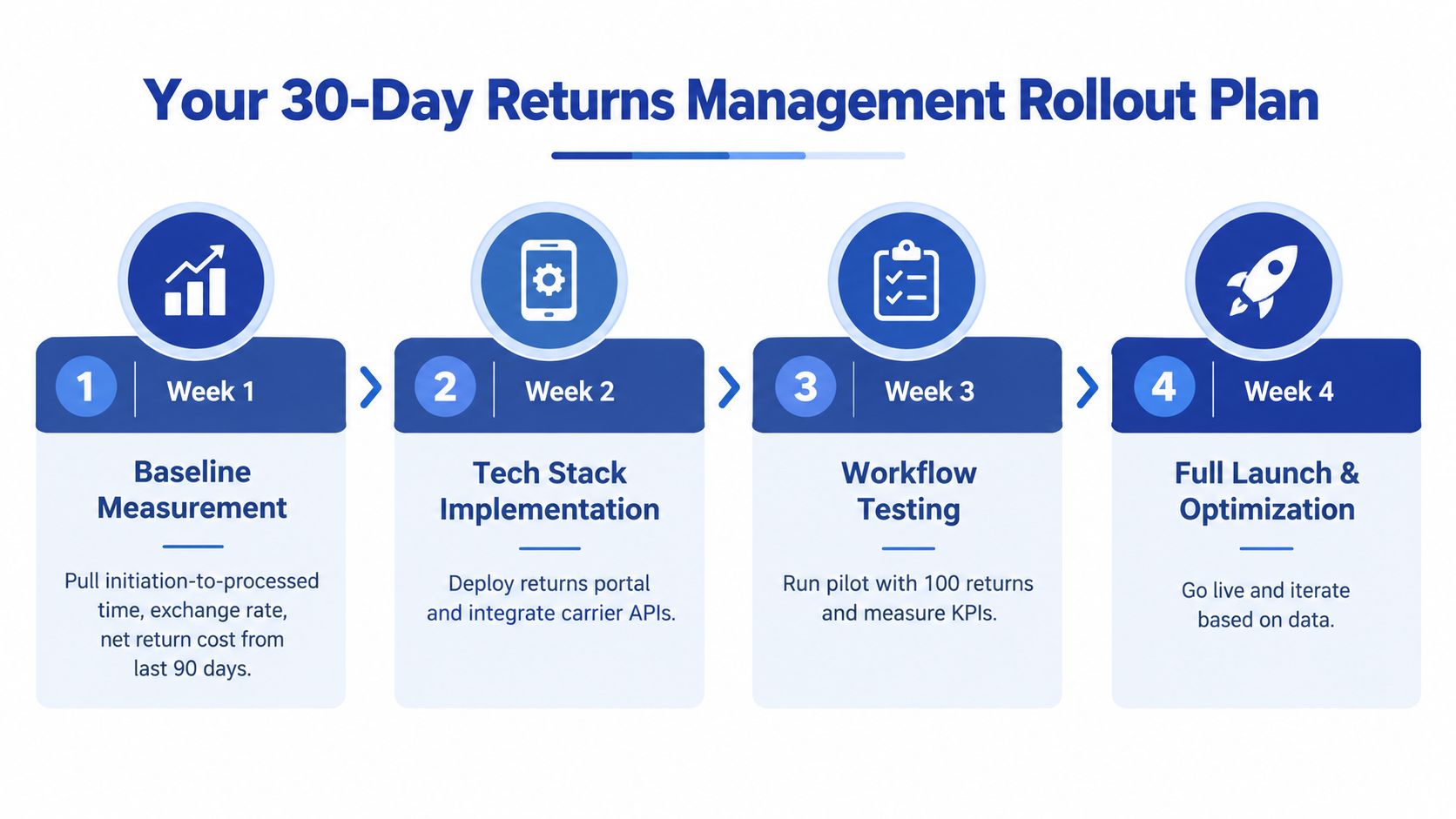
Week one sets the baseline
Pull the last 90 days of return initiations, processed returns, refunds, exchanges, store credit, reason codes, processing times and warehouse outcomes. Reconcile the data to Shopify orders and finance records before calculating net return cost. If the event timestamps don't agree, fix that data issue before judging the operation.
Create a simple view by SKU, category, reason, customer cohort and resolution. The purpose isn't to produce a perfect data warehouse in a week. It's to identify whether the biggest leak comes from sizing, fulfilment, slow processing, refund-first UX or poor stock availability.
Week two turns policy into rules
Bring finance, support, fulfilment and merchandising into one working session. Agree the standard window, fee logic, incentive structure and exception matrix. Write the decision rules in plain language, then map each rule to an order tag, return reason or Flow trigger.
Test the customer-facing copy against actual cases. A customer should know whether a faulty product receives a free label, whether a final-sale item is eligible and what happens after choosing an exchange. If the support team needs to interpret the rule manually, the policy isn't ready for automation.
Week three implements the core flow
Configure the portal around exchange-first resolution. Connect label generation, Shopify order data, inventory availability and the warehouse receiving process. Make sure refund and exchange events are idempotent, so a repeated webhook can't issue a second refund or create duplicate exchange orders.
Run controlled tests across ordinary returns, faulty items, wrong SKUs, late deliveries, unavailable variants and flagged customers. Include carrier-label failure and delayed tracking in the test set. A workflow that works only when every API responds perfectly isn't production-ready.
Week four launches with measurement
Train support on the exception matrix and provide scripts that explain the reason for a decision without creating inconsistent promises. Give the warehouse clear grading criteria and require every disposition to update the system of record. Start a weekly review of net return cost, exchange capture, refund rate, processing time, reason mix, grading and fraud flags.
Defer advanced grading automation, complex multi-warehouse optimisation and carrier negotiation until the core exchange path is stable. Those initiatives may matter later, but they shouldn't distract from the first commercial test: can the brand move more eligible returns into exchanges or credit while keeping the customer experience clear?
Launch gate: Don't judge the new policy from the first few orders. Check whether the event data is complete, whether the warehouse is processing the intended route and whether customers can actually see and complete the exchange option.
Grumspot helps Shopify and Shopify Plus brands design and build conversion-focused storefronts, custom workflows and integrations with fulfilment, ERP and CRM systems. If your returns experience is leaking revenue through refund-first journeys or manual reconciliation, visit Grumspot to discuss a practical Shopify implementation that puts exchange capture and measurable margin recovery at the centre.
Let's build something together
If you like what you saw, let's jump on a quick call and discuss your project
Related posts
Check out some similar posts.