How to Hire a Shopify Expert for Your Growing Store
- shopify developer uk
- ecommerce development
Launched
February, 2026

Deciding to bring in a Shopify expert is a real turning point. It's the moment you shift from just running your online shop to strategically growing it. This usually happens when you start hitting technical walls, your growth flatlines, or you realise you just don't have the specialised skills needed to keep up with the competition.
Knowing When It's Time to Hire a Shopify Expert
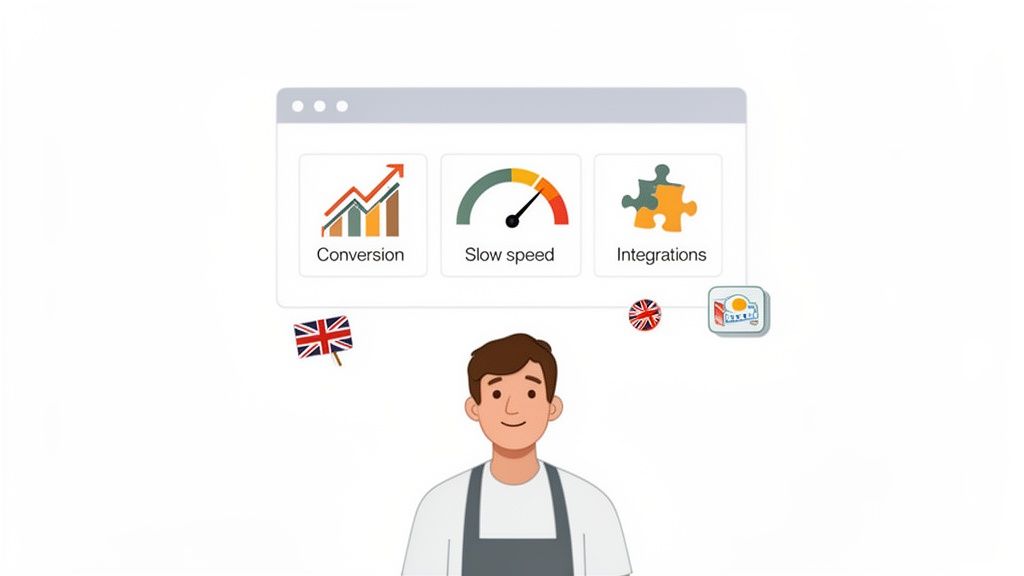
It’s tempting to try and do everything yourself, especially in the early days. But holding on for too long can be a costly mistake. There are some tell-tale signs that it’s time to call in a professional, and ignoring them often means lost sales, unhappy customers, and watching your competitors pull ahead.
Spotting these triggers is half the battle. You’ve done the hard work of building a solid foundation, but now you’re up against challenges that need a level of expertise that directly affects your bank balance.
What’s Ailing Your Store?
Think of your Shopify store like the engine in a performance car. When it's finely tuned, everything just works. But when one small part starts to fail, it can drag the whole system down. The trick is to spot the problem before it leads to a total breakdown.
I’ve seen this countless times. A UK-based fashion brand, for instance, might notice their conversion rate has suddenly nosedived. The traffic is still there, but people just aren't buying. This is a classic symptom a Shopify expert can jump on, quickly finding issues with a clunky checkout process, a slow-loading page, or a poor mobile experience.
Another common one is the subscription box company that just can't grow any further. Their off-the-shelf theme simply can't handle the complex rules they need for different subscription tiers or custom bundles. They're stuck, unable to increase their average order value. That’s a clear signal that they need a custom-built solution.
An expert isn't just for building a store from scratch. They are strategic partners who solve specific, costly problems that block growth—like fixing a slow site that’s killing your SEO or integrating a complex inventory system that’s causing fulfilment delays.
A Quick Self-Assessment Checklist
Before you even think about looking for help, run through this checklist. It will help you get crystal clear on why you need an expert, which in turn helps you figure out if you're looking at a one-off project or a longer-term partnership.
- Performance Bottlenecks: Is your site speed score below 70 on Google PageSpeed Insights? A slow site is a conversion killer and hurts your SEO. Simple as that.
- Conversion Rate Issues: Has your conversion rate flatlined or dropped over the last three months? An expert can run a proper conversion rate audit to find and fix the friction points.
- Technical Limitations: Need to connect your store to a third-party ERP, CRM, or warehouse system that doesn't have a pre-built Shopify app? That’s going to require custom API work.
- Internationalisation Headaches: Are you struggling to set up multi-currency payments, local payment options, or region-specific shipping rules for your UK and international customers?
- Growth Stagnation: Have you completely outgrown your theme? If you can't add features like advanced product filters, smart upsells, or a loyalty programme, it's holding you back.
The UK ecommerce scene is incredibly crowded. With over 240,926 live Shopify stores as of November 2025, it’s the second-biggest market in the world behind the US. Shopify powers more than 20% of all ecommerce platforms here. This is exactly why smart UK business owners are bringing in specialists like Grumspot to get an edge. If you want to dive deeper, you can explore more Shopify platform insights and statistics to get a sense of the competitive landscape.
Defining Your Project Scope and Budget
Before you even start looking for a Shopify expert, you need to give them a clear map of what you want to achieve. A vague request like "make my store better" is a recipe for disaster. You'll get equally vague proposals and costs that can quickly spiral out of control.
Think of it this way: a detailed project brief is the foundation of your entire partnership. It gets everyone on the same page from day one and stops expensive misunderstandings from derailing your project later. It’s your best defence against scope creep—that all-too-common problem where small, unbudgeted tweaks slowly inflate your timeline and budget.
From Business Goals to a Concrete Brief
The most effective project briefs I've ever seen all have one thing in common: they connect every single task to a clear business outcome. So, start there. What are you actually trying to accomplish? Are you looking to boost your average order value (AOV), improve your conversion rate, or maybe cut down on customer service tickets?
Get specific. Really specific.
For example, instead of saying "I want more sales," frame it as a measurable goal: "Increase AOV by 15% within six months by implementing a product bundling feature and a tiered free shipping incentive."
See the difference? That single sentence tells a potential expert exactly what success looks like and hints at the technical solutions needed to get there.
Your brief needs to meticulously outline the 'what' and the 'why'. Here’s what I always recommend including:
- Your Business Objectives: What specific, measurable goal will this project hit? Think "Reduce cart abandonment by 10%" or "Improve site speed to under 2 seconds."
- Your Target Audience: Who are you actually selling to? Give them your customer profiles so they understand the user experience you’re aiming for.
- Technical Must-Haves: Is there anything that’s non-negotiable? For instance, "Must integrate with our custom fulfilment software via its REST API."
- Design and Inspiration: Don't be shy. Send links to competitor sites or other online stores you love. Crucially, explain what you like about their design, checkout flow, or a particular feature.
A strong project brief is your most powerful tool in this whole process. It forces you to get clear on your own thinking and allows experts to give you accurate quotes and realistic timelines. It's the ultimate time and money saver.
Setting a Realistic Project Budget
This is often the trickiest part. Costs can vary wildly in the Shopify world. A simple theme tweak might only set you back a few hundred pounds, but a full-scale Shopify Plus migration with custom integrations can easily run into the tens of thousands.
Being upfront about your budget filters out experts who aren't a good fit right from the start. For a more detailed breakdown, our guide on the cost of ecommerce website development can help you set some realistic expectations.
It helps to understand the different kinds of projects and what they typically involve.
Common Shopify Projects and Their Scope
| Project Type | Typical Scope & Complexity | Why It's Needed |
|---|---|---|
| Theme Customisation | Minor CSS changes, adding a pre-built section, or font adjustments. Low complexity. | You're mostly happy with your theme but need small visual tweaks to align it perfectly with your brand. |
| Custom App Development | Building a unique feature that doesn't exist in the App Store, like a complex product customiser. | You have a specific business need that off-the-shelf apps can't solve, giving you a competitive edge. |
| Full Store Rebuild | A complete redesign and redevelopment, often moving to a Shopify 2.0 theme. High complexity. | Your current site is outdated, slow, or can't support your growth. You need a foundational overhaul. |
| Systems Integration | Connecting Shopify to an ERP, CRM, or a third-party logistics (3PL) provider. | You need to automate data flow between your business systems to streamline operations and cut down on manual work. |
By getting clear on both your project scope and your budget, you set yourself up for productive conversations. This prep work allows you to find a Shopify expert who not only has the right skills but who also genuinely understands your vision and can deliver it without breaking the bank.
Choosing Between a Shopify Agency and a Freelancer
Deciding who to trust with your store is one of the biggest calls you’ll make. Do you need a single, focused specialist, or are you looking for a long-term growth partner? The right choice really boils down to your project’s complexity, your budget, and frankly, how you prefer to work.
There's no single 'best' answer here. A freelancer can be the perfect fit for a well-defined task, like a specific theme customisation or integrating a new app. You get direct communication and often a more accessible price point for those targeted jobs.
On the other hand, if you're plotting a complete store rebuild or a multi-channel growth strategy, a Shopify agency brings an entire team to the table. Suddenly, you have a project manager, a developer, a UX designer, and maybe even a conversion rate optimisation (CRO) specialist all pulling in the same direction.
Weighing Your Options
The trick is to match the partner to the problem. Let’s say your goal is to add a custom product bundling feature to bump up your Average Order Value (AOV). A talented freelance developer is probably all you need. They can scope it, build it, and hand it over. Simple.
But what if your ambition is a full-scale brand overhaul and a migration to Shopify Plus? That’s a different beast entirely. An agency is almost certainly the right call. They have the established processes and manpower to juggle the dozens of interconnected tasks—from data migration and SEO preservation to custom design and post-launch support.
The demand for this level of expertise is surging. The European Shopify Designer Services market, with the UK leading the charge at a 16.09% share, has exploded, growing by over 71% between 2021 and 2025. This rapid growth fuels the need for agencies like Grumspot, which are built to handle these larger, more complex projects at speed. You can get more insight into this from the latest Shopify services market report for Europe.
This simple decision tree can help you visualise whether your project scope points towards a new build or just optimising what you already have.
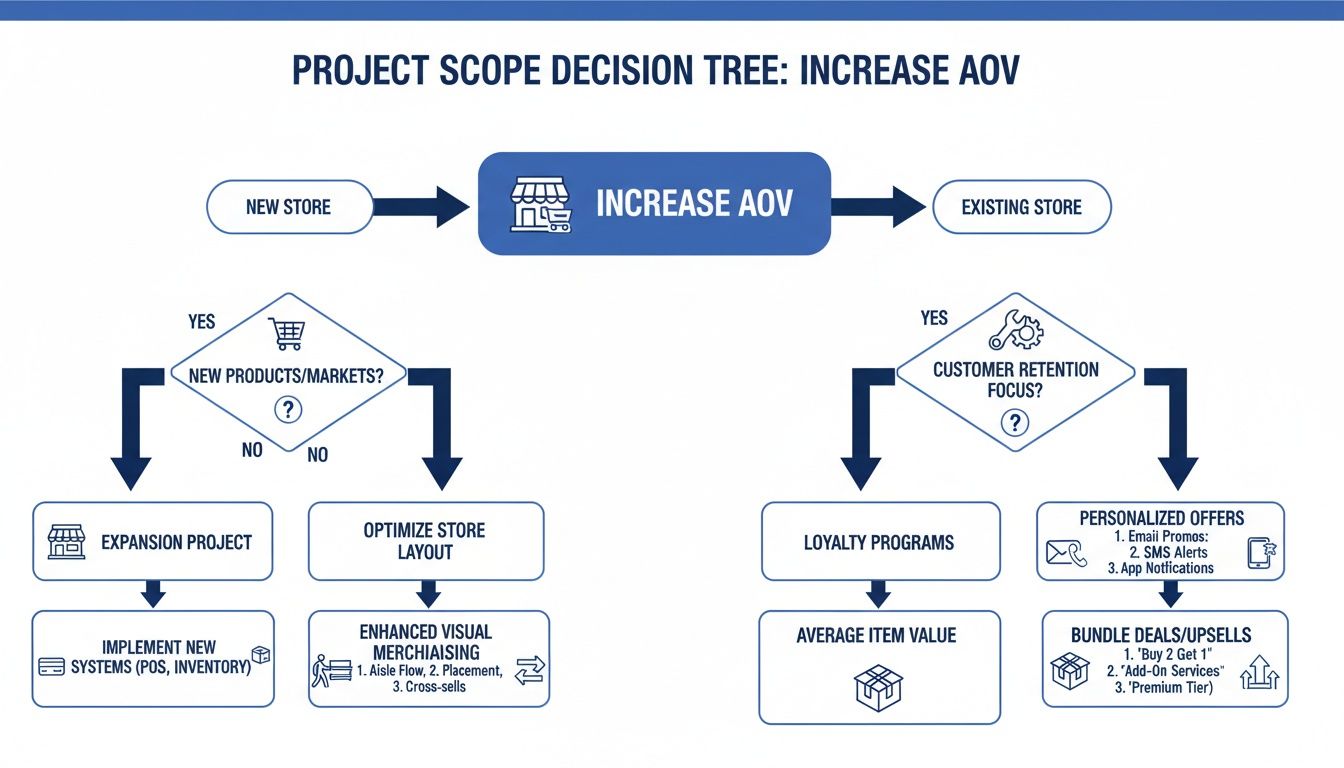
As the diagram shows, improving AOV isn't a one-size-fits-all job; the path you take depends heavily on whether you're starting from scratch or refining an established store.
A freelancer is your specialist surgeon for a specific operation. An agency is your full medical team for comprehensive, long-term health. Knowing which you need is the first step to a successful outcome.
A Head-to-Head Comparison
To make the decision a bit clearer, let's break down the key differences. This isn't just about cost; it’s about availability, accountability, and the ability to grow. When you hire a Shopify expert, you’re buying both a specific set of skills and a particular way of working.
Here’s a look at how the two models really stack up.
Shopify Agency vs Freelancer: Which Is Right For You?
| Factor | Shopify Agency (e.g., Grumspot) | Freelance Shopify Expert |
|---|---|---|
| Range of Skills | A full, integrated team of specialists: developers, designers, project managers, and CRO experts. | Typically a specialist in one or two areas, such as theme development or app integration. |
| Cost Structure | Higher initial investment, often project-based or on a monthly retainer for ongoing work. | Generally lower cost, usually charged by the hour or as a fixed price for a specific task. |
| Availability | Structured availability with a dedicated project manager as your main point of contact. Built-in redundancy if someone is ill. | Direct communication, but availability can be a risk. If they get sick or take a holiday, your project stalls. |
| Project Management | Formalised processes using tools like Asana or Jira. Provides clear timelines, milestones, and progress tracking. | Management style varies. You may be responsible for managing the project and ensuring deadlines are met. |
| Scalability | Can easily scale up resources to meet growing demands or handle multiple complex projects at once. | Limited ability to scale. They are a team of one and can only take on so much work at a time. |
| Accountability | A single contract holds the entire agency accountable for the final outcome. Quality assurance is part of the process. | Accountability rests solely on one individual. The quality and outcome depend entirely on their personal skill and integrity. |
Ultimately, choosing between a freelancer and an agency comes down to risk versus complexity. For a small, well-defined project with a tight budget, a trusted freelancer is an excellent option. For ambitious, multi-layered projects where you need a reliable, scalable partner for the long haul, an agency provides the structure and breadth of expertise you need to succeed.
For a deeper dive, explore our guide on what to expect from professional Shopify store design services.
How to Vet Your Candidates and Find a True Expert
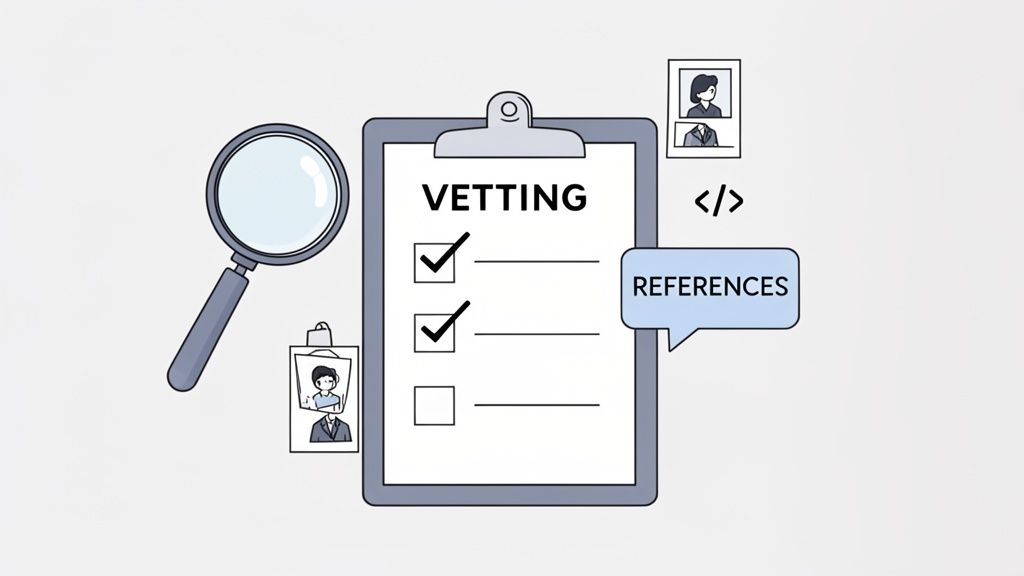
Finding a list of potential Shopify developers isn't the hard part. The real work begins when you need to separate the genuine experts from those who just talk a good game. A flashy portfolio is one thing, but you need a partner who truly understands the commercial realities of ecommerce and can deliver tangible results.
This is where a methodical vetting process becomes your best friend. It’s not about just ticking boxes; it’s about digging deep to verify their technical skills, business sense, and professional reliability. Without a solid plan, it's all too easy to be swayed by a slick sales pitch, only to find yourself with a project that's late, over budget, or simply doesn't work.
Sizing Up Their Technical Skills
First things first: you have to confirm they have the technical chops. A real Shopify expert possesses a deep, practical understanding of the entire Shopify ecosystem, going far beyond surface-level theme customisations. Their skills should be a direct match for the challenges and goals you’ve already outlined.
Your aim here is to get a feel for their depth of knowledge across the platform's core technologies. It's often helpful to think about the qualities that define the Top Shopify SEO Experts, as their skill sets frequently overlap with what you'd expect from a top-tier developer.
Look for hard evidence of their expertise in these key areas:
- Liquid Proficiency: Shopify's templating language is non-negotiable. Ask for examples of custom sections or logic they’ve built from scratch, not just minor tweaks. For example, can they code a "featured collection" section for a theme that doesn't have one?
- API and Integrations: A seasoned expert should be comfortable with Shopify's APIs (like the Admin API or Storefront API). They need to be able to connect your store with essential third-party systems like an ERP, a 3PL, or a CRM.
- Headless Commerce Experience: If you're exploring a headless build for peak performance and flexibility, you need someone with proven experience using modern frameworks like Hydrogen and Oxygen. This is a highly specialised skill, so don't take their word for it.
- App Development Standards: Does your project involve a custom app? Ask if they have experience building to the official ‘Built for Shopify’ standards. This certification shows a commitment to quality, security, and performance.
A candidate who can only talk about changing colours and fonts is a theme customiser, not a Shopify expert. You're looking for someone who can solve complex business problems with code, not just make things look pretty.
Analysing Their Portfolio and Past Work
A portfolio should be more than a gallery of pretty websites. It should tell a story of problems solved and results delivered. As you review a candidate’s past projects, your focus should be on the 'why' and the 'how', not just the final design.
I once consulted for a client who was about to hire a developer based on a beautiful portfolio. But when we dug in, we realised every site was slow and had terrible mobile usability. The developer was a great designer but lacked the technical skills to build a high-performing store.
This is exactly why you have to look beyond the visuals.
What to Look for in a Portfolio
- Tangible Results: Look for case studies that include actual data. Did their work lead to a 15% increase in conversion rate? A 20% lift in AOV? A 50% improvement in site speed? Numbers speak louder than screenshots.
- Relevant Experience: Have they worked with businesses in your niche or solved problems similar to yours? Experience with a UK-based subscription box company is far more relevant to you than their work for a US-based B2B wholesaler.
- Shopify Plus Expertise: For ambitious, scaling brands, direct experience with Shopify Plus is critical. If an upgrade is on your roadmap, you might want to look into hiring a specialised https://grumspot.com/blog/shopify-plus-development-agency to handle the complexities. Ask them specifically about their work with Shopify Scripts, Flow, and Launchpad.
- Live Site Review: Don't just look at pictures. Visit the live sites in their portfolio. Test them on both desktop and mobile. How fast do they load? Is the checkout process smooth? Do you spot any bugs?
Don't Skip the Reference Checks
Finally, never, ever skip the reference check. This step can uncover insights you’ll never get from a CV or an interview. It’s your chance to hear directly from past clients what it was really like to work with them.
When you get a reference on the phone, don’t just ask if they were happy. Get specific.
- "How was their communication throughout the project?"
- "Did they stick to the agreed timeline and budget?"
- "How did they handle unexpected challenges or feedback?"
- "What was the single biggest impact their work had on your business?"
A true professional will have a list of happy clients ready to go. If a candidate is hesitant to provide references, that's a massive red flag. By being diligent in these three areas—technical skills, portfolio analysis, and reference checks—you dramatically increase your chances of finding a genuine Shopify expert who can become a valuable partner in your business's growth.
Interview Questions, Pricing Models, and Red Flags
So, you’ve done the hard work of vetting candidates and now have a shortlist of promising Shopify experts. Excellent. This is the final stretch, where you'll dig deep into their expertise, get a handle on their pricing, and keep a sharp eye out for any warning signs.
This stage is about confirming you’re hiring a genuine strategic partner who can solve business problems, not just a coder who ticks boxes. The quality of your questions will absolutely dictate the quality of the answers you get back.
Probing Questions to Ask a Shopify Expert
Generic questions get you generic, rehearsed answers. You need to push past that. The key is to use scenario-based questions that force them to think on their feet and show you their problem-solving process. How they respond reveals their technical depth, communication style, and commercial awareness all at once.
For example, asking "Can you improve site speed?" is a dead-end question. Of course, they'll say yes. A much better approach is to give them a real-world situation and see how they tackle it.
Here are a few targeted questions I’ve found work well:
- Scenario-Based: "Let’s imagine a key product page is taking over five seconds to load. Walk me through your step-by-step process for diagnosing and fixing the issue. What specific tools would you use?"
- Technical Depth: "Our current theme doesn't have a section on the homepage for recent blog posts. How would you approach adding one? Talk me through the pros and cons of using a third-party app versus writing custom Liquid code for this."
- Strategic Thinking: "We've set a goal to increase our Average Order Value by 20% this year. What are three specific strategies you would propose, and how would you actually implement them on our Shopify store?"
- Past Experience: "Tell me about a time a project went completely off the rails. What went wrong, and what concrete steps did you take to get it back on track?"
Listen for specific, confident answers. Vague responses or an inability to outline a clear process should set off alarm bells.
The goal of an interview isn’t just to verify the skills they’ve listed on a profile. It’s to see how they think. A true expert won’t just tell you what they’d do; they’ll explain why it’s the best approach for your specific business.
Understanding Common Pricing Models
Once you're confident in their abilities, the conversation will naturally turn to money. Getting to grips with the different pricing models helps you choose the structure that best suits your project and budget, avoiding nasty financial surprises down the line.
Each model has its place; the right one depends entirely on your needs.
- Hourly Rate: This is very common for freelancers and works best for small, one-off tasks or ongoing support where the scope is a bit unpredictable. The risk here is that costs can quickly spiral if the project isn't managed tightly.
- Fixed-Project Price: This is the way to go for well-defined projects, like a full store rebuild or developing a custom feature. You get a clear, upfront cost, which is brilliant for budgeting. The key is to have an incredibly detailed project brief to prevent scope creep later.
- Monthly Retainer: This is perfect if you’re looking for a long-term partner for continuous improvement, conversion rate optimisation, and general technical support. Agencies like Grumspot often offer this model, giving you access to a full team for a flat monthly fee.
Whatever the model, always insist on a detailed proposal that breaks down all the costs. A true professional will have no problem justifying their pricing and explaining exactly what you're getting for your money.
Critical Red Flags to Watch For
While you’ve already vetted your candidates, some warning signs only pop up during these final conversations. Spotting them now can save you from a very expensive and frustrating hiring mistake.
Be wary of any Shopify expert who shows these signs.
Warning Signs During the Final Stages
| Red Flag | Why It's a Problem | What to Do |
|---|---|---|
| Vague Proposals | A proposal that lacks specific deliverables, milestones, and timelines is a recipe for disaster. It points to a lack of planning. | Insist on a detailed scope of work. If they can't or won't provide one, walk away. |
| No Measurable Results | If their case studies only talk about pretty designs and lack hard data (e.g., conversion uplift, speed improvements), they might not be results-driven. | Ask for specific KPIs from past projects. No numbers often means no real impact. |
| Poor Communication | Slow response times, unclear answers, or an unwillingness to jump on a call during the hiring process are a preview of what's to come. | Communication is the backbone of any successful project. Don't compromise on this. |
| Pressure to Start Immediately | A high-pressure sales tactic can be a sign that they're desperate for work, which is often linked to poor quality or unreliability. | A good partner will have a healthy pipeline and will respect your need to make a considered decision. |
Ultimately, you have to trust your gut. If something feels off, it probably is. The right person is a combination of proven skills, fair pricing, and a professional attitude that gives you complete confidence.
Onboarding Your New Partner and Measuring Success
Signing on the dotted line isn't the end of the hiring process—it’s the real beginning. Getting this next part right, the onboarding, is what separates a good hire from a great partnership. A clumsy start is a recipe for missed deadlines, crossed wires, and a whole lot of frustration.
That first week is absolutely critical. The goal is to get your new expert everything they need to start delivering value, without completely burying them in information. Think of it less as a data dump and more as setting the tempo for how you'll work together from here on out.
Setting Up for a Smooth Start
Before a single line of code gets written, you need to sort out the basics: access and communication. Think of it as a pre-flight checklist for your project.
- System Access: Get them set up with secure, role-based access to your Shopify Admin, Google Analytics, key apps, and your theme’s code repository (like GitHub).
- Communication Channels: Create a dedicated Slack channel for quick daily chats and updates. I also recommend a standing weekly video call to talk through progress, tackle any roadblocks, and set priorities for the week ahead.
- Documentation: Hand over any brand guidelines, project briefs, or existing technical documents. The more context they have, the better.
A great partnership is built on clear communication and shared goals from day one. An expert who asks for these things proactively is a green flag; it shows they have a professional process and are ready to deliver.
Defining and Tracking Success Metrics
So, how do you actually know if hiring an expert was worth it? You need to connect their work to real, tangible business results. Success isn't just a "nicer-looking website"; it's a measurable lift in your store’s performance. This means you need to define your Key Performance Indicators (KPIs) right at the start.
Sit down with your expert and agree on the handful of core metrics that matter most for this project. Common ones I always track include:
- Conversion Rate: The ultimate test of your store’s effectiveness.
- Average Order Value (AOV): How much is each customer spending?
- Site Speed Score: A massive factor for both user experience and SEO.
- Cart Abandonment Rate: Shows you exactly where the friction is in your checkout.
To really get the most from this relationship, it helps to see the bigger picture. Understanding proven strategies for online business growth can help you see how the technical work fits into your wider commercial goals. By tracking these KPIs together, you build a transparent, results-focused partnership that keeps everyone aligned on what truly matters—growing your business.
Your Questions, Answered
Hiring a Shopify expert for the first time? It’s natural to have questions. Here are some straightforward answers to the things we get asked most often.
What's the Real Cost of Hiring a Shopify Expert?
This is usually the first question on everyone's mind, and the honest answer is: it completely depends on what you need. A quick theme fix might only set you back a few hundred pounds, but a complex, ground-up Shopify Plus build with custom app integrations could easily run into the tens of thousands.
The key is getting a transparent, itemised proposal. You'll generally come across three main pricing structures:
- Hourly Rates: Perfect for small, one-off jobs or if you need ongoing, flexible support.
- Fixed-Project Fees: The best choice for projects with a clear start and end, like a full website build. This gives you cost certainty from day one.
- Monthly Retainers: A great fit for long-term relationships where you need continuous work, like conversion rate optimisation or feature development.
Can I Just Hire Someone for a Small, One-Off Job?
Of course. Plenty of brilliant freelancers and even some agencies are happy to tackle smaller, well-defined tasks. Think fixing a pesky bug, adding a custom section to your theme, or getting a tricky app configured just right.
For these smaller jobs, make sure your brief is crystal clear. Agreeing on a fixed price is usually the way to go for both you and the expert, as it locks in the deliverables and the cost right from the start.
You don't always need a massive project to see a big impact. Sometimes, the right expert can solve a critical problem that's been bottlenecking your sales in just a couple of hours.
What Does 'Built for Shopify' Actually Mean?
If you're exploring custom app development, you'll likely hear the term ‘Built for Shopify’. This isn't just marketing fluff; it's an official badge of honour from Shopify itself. It means an app has passed rigorous checks for quality, security, speed, and ease of use.
When an expert or agency has experience creating apps that earn this certification, it’s a massive green flag. It tells you they understand the Shopify ecosystem inside and out and can build reliable, high-quality solutions that won't break your store.
Ready to stop fixing and start scaling? The expert team at Grumspot builds high-performance Shopify stores that convert. Get in touch today for a free consultation.
Let's build something together
If you like what you saw, let's jump on a quick call and discuss your project

Related posts
Check out some similar posts.

- outsource Shopify development
Ready to outsource Shopify development? Our 2026 playbook covers finding partners, vetting, pricing,...
Read more
- Shopify monthly development plan
Learn how a Shopify monthly development plan works to scale your store. Our 2026 guide covers pricin...
Read more
- Shopify Plus store build
Get expert guidance for your Shopify Plus store build. Master planning, migration, launch, and scali...
Read more
- built for Shopify app development
Your complete guide to Built for Shopify app development. Learn to plan, build, test, and launch a c...
Read more