How to Set Up an Ecommerce Business: 2026 UK Guide
- how to set up an ecommerce business
- ecommerce uk
- start online store
- shopify guide
- ecommerce business plan
Launched
May, 2026
You've got a product idea, a supplier shortlist, a name you don't hate, and a browser full of tabs telling you to “just launch”. That's usually where the confusion starts. New founders tend to think the next step is choosing a theme or setting up Instagram. It usually isn't.
The first job is making sound decisions in the right order. That matters because the UK ecommerce market is already large, mature, and crowded. UK online retail sales reached £127.41 billion in 2024, the internet economy has been estimated at over 20% of GDP, 97% of UK households had internet access in 2024, and 92% of adults had recently bought goods or services online, according to this UK ecommerce market summary citing ONS data. That tells you two things straight away. Customers are already online, and they already know what a good ecommerce experience looks like.
So if you're learning how to set up an ecommerce business, the main challenge isn't convincing people to shop online. It's building a store that feels credible from the first click, works properly on mobile, and holds together operationally once orders start coming in.
From an agency side, the stores that last don't win because they launched fastest. They win because strategy, tech, and marketing were aligned early. Product promise, fulfilment model, site UX, checkout, analytics, and acquisition all support the same commercial goal. When one of those pieces is weak, the business feels weak even if the product is good.
Introduction From Idea to First Sale
A lot of founders come in with the same assumption. They think launch day is the milestone that matters most. It isn't. The more important moment is when you stop treating the business as a shop build and start treating it as a system.
That system has to do three jobs at once. It needs to attract the right buyer, convert that buyer without friction, and fulfil the order in a way that makes a second purchase likely. If any one of those breaks, growth becomes expensive.
Practical rule: Don't separate strategy, store build, and marketing. In ecommerce, each one exposes mistakes made in the others.
The UK is a forgiving market in one sense and unforgiving in another. You don't have to educate customers on buying online. They're already there. But because online buying is mainstream, people expect professional basics from day one. Clean navigation. Fast mobile browsing. Transparent pricing. Sensible delivery messaging. A checkout that doesn't create doubt.
That's why a practical launch plan starts before design mock-ups and ad campaigns. You need a blueprint, a sourcing model you can deliver on, a storefront built for conversion, operational processes that won't collapse under pressure, and a launch plan that doesn't rely on luck.
Crafting Your Ecommerce Business Blueprint
Most ecommerce mistakes happen before the store exists. Founders commit to products, branding, and platforms before they've validated demand. Then they spend months polishing the wrong idea.
The cleaner sequence is simple. In the UK, guidance recommends validation before build through customer surveys, competitor analysis, and Google Trends, followed by a written business plan covering target market, financial projections, product strategy, and marketing plan before registering at gov.uk, as outlined in Xero's guide to starting an e-commerce business in the UK.
Validate before you build
Validation doesn't need to be complicated. It needs to be honest.
Start with a few direct questions:
- Who is the customer really? Don't say “women aged 25 to 45” or “anyone who likes fitness”. Define the problem they're trying to solve, the context they buy in, and what would make them switch from what they already use.
- What are they buying instead? Your real competitors often aren't stores that look like yours. They're Amazon, marketplaces, supermarkets, existing habits, or doing nothing at all.
- What would make the offer feel better? Better can mean faster delivery, clearer ingredients, stronger gifting value, improved design, easier replenishment, or a more trustworthy brand.
Google Trends is useful for directional demand. It won't build the business for you, but it can stop you mistaking a personal interest for a market. Competitor analysis is even more useful if you look at it properly. Don't just note what they sell. Check how they structure bundles, how they write product pages, how they handle shipping, and where they create trust.
Write a plan that can survive contact with reality
A business plan for ecommerce doesn't need corporate jargon. It does need decisions.
Include these five parts:
Target market
Spell out who you're selling to, what job the product does, and why they'd buy from you instead of a familiar alternative.Product strategy
Define the range at launch. Too many stores start with too many products because variety feels safer. It usually makes merchandising, purchasing, and messaging harder.Financial projections
Keep this grounded. Work through product cost, packaging, shipping, payment fees, marketing spend, and returns exposure. If the numbers only work in a perfect month, they don't work.Marketing plan
Decide how customers will discover you. SEO, paid social, Google Ads, email capture, creators, marketplaces, and partnerships all work differently. Pick based on your product and margin, not what's fashionable.Operational model Map who handles stock, support, fulfilment, refunds, and supplier delays. At this stage, many “small” launch decisions become expensive later.
If you can't explain the offer in one or two plain sentences, the customer probably won't understand it either.
Handle registration and structure early
Registering the business shouldn't be the first thing you do, but it shouldn't be left until the night before launch either. Once the concept has been validated and the plan exists, choose your business structure, set up the admin properly, and make sure your accounting process is clean from the beginning.
One practical point gets overlooked here. Choose systems that talk to each other. Founders often pick a storefront first and only later think about accounting, stock control, and reporting. That creates manual work immediately. If your platform can integrate cleanly with accounting software, you'll save time and avoid messy reconciliation once orders begin to stack up.
Defining Your Product and Sourcing Strategy
What you sell matters. How you source it matters just as much.
A weak sourcing decision can wreck a promising brand. You might have strong creative, solid demand, and a well-built site, but if your margins are thin, delivery is inconsistent, or quality control is patchy, customer acquisition becomes a treadmill.
Pick the model before you pick the catalogue
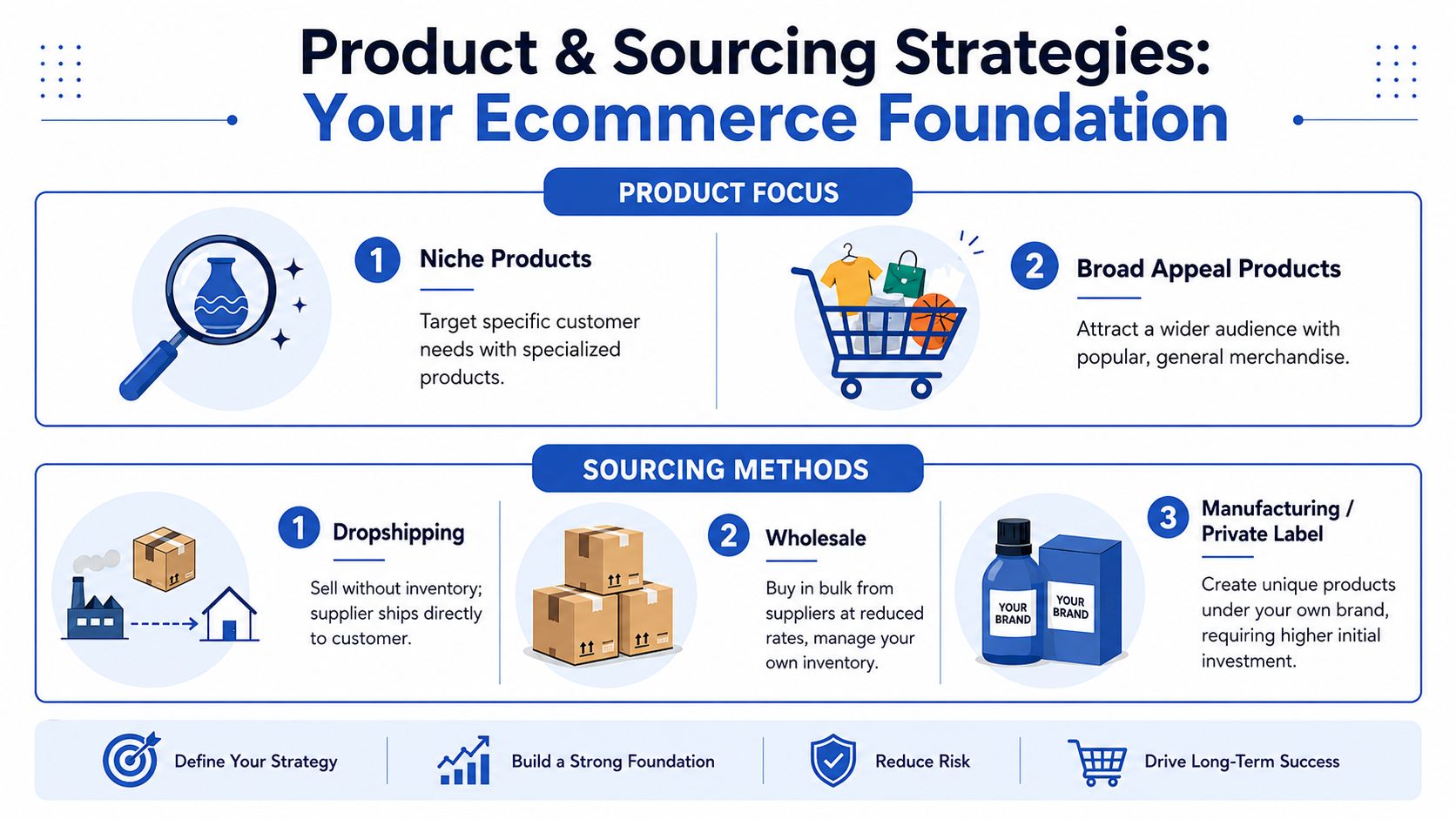
Most founders start by choosing products. A better move is choosing the operating model that supports the brand you want to build.
| Model | Upfront Cost | Profit Margin | Inventory Risk | Fulfilment Control |
|---|---|---|---|---|
| Manufacturing or private label | Higher | Often stronger if pricing holds | Higher | High |
| Wholesale and hold stock | Medium to higher | Moderate to strong depending on buy price | Medium to higher | High |
| Dropshipping | Lower | Often tighter | Lower | Low |
| Print on demand | Lower | Often tighter | Lower | Low to medium |
This isn't a scorecard. It's a trade-off map.
If you manufacture or private label, you get more control over positioning, packaging, and differentiation. You also take on more risk. Wholesale gives you faster market entry and more predictable supply if you choose well, but it can be hard to defend on price or uniqueness. Dropshipping and print on demand lower the barrier to entry, but they often create headaches in delivery speed, product consistency, and support.
The no-inventory promise has limits
The appeal of starting without inventory is obvious. Lower cash exposure, less storage pressure, and fewer sunk costs if the idea doesn't work. But that advice is often too clean for the UK market.
As Printful's discussion of starting ecommerce without money notes, a key issue is whether low-inventory models can hold up once trust and fulfilment expectations are considered, especially in a market where buyers expect fast, reliable delivery. That's the part most “start for free” content skips.
Here's what tends to happen in practice:
- Dropshipping works for testing if you need fast feedback on offer and demand.
- It struggles for brand-building when delivery windows are vague, packaging is generic, or customer support depends on a supplier you don't control.
- Print on demand can work well for creator-led brands, niche communities, and low-SKU launches where design is the value.
- Holding stock starts to make sense once winning products are clear and fulfilment reliability becomes a competitive advantage.
Fast launch models are useful for validation. They're rarely the final operating model for a serious brand.
Match sourcing to your brand promise
If your brand promise is premium quality, giftability, or fast repeat purchase, you probably need more control. If your product is trend-led, highly testable, or audience-driven, a leaner model may be enough at the start.
Use these decision filters:
Control needed
If the customer experience depends on pack presentation, insert cards, subscription logic, or multi-item bundling, low-control fulfilment will become a problem.Tolerance for returns and complaints
Products with fit, colour expectation, or fragile components create more service pressure. That's easier to manage when you control stock and dispatch.Expected repeat purchase behaviour
If retention matters, consistency matters. Customers won't reorder if the first experience feels uncertain.Margin room for paid acquisition
Thin margin products are far less forgiving once you add paid traffic and support overhead.
A lot of new merchants ask which model is “best”. That's the wrong question. The useful question is which model lets you keep your promise to the customer without destroying the economics.
Building a High-Converting Shopify Storefront
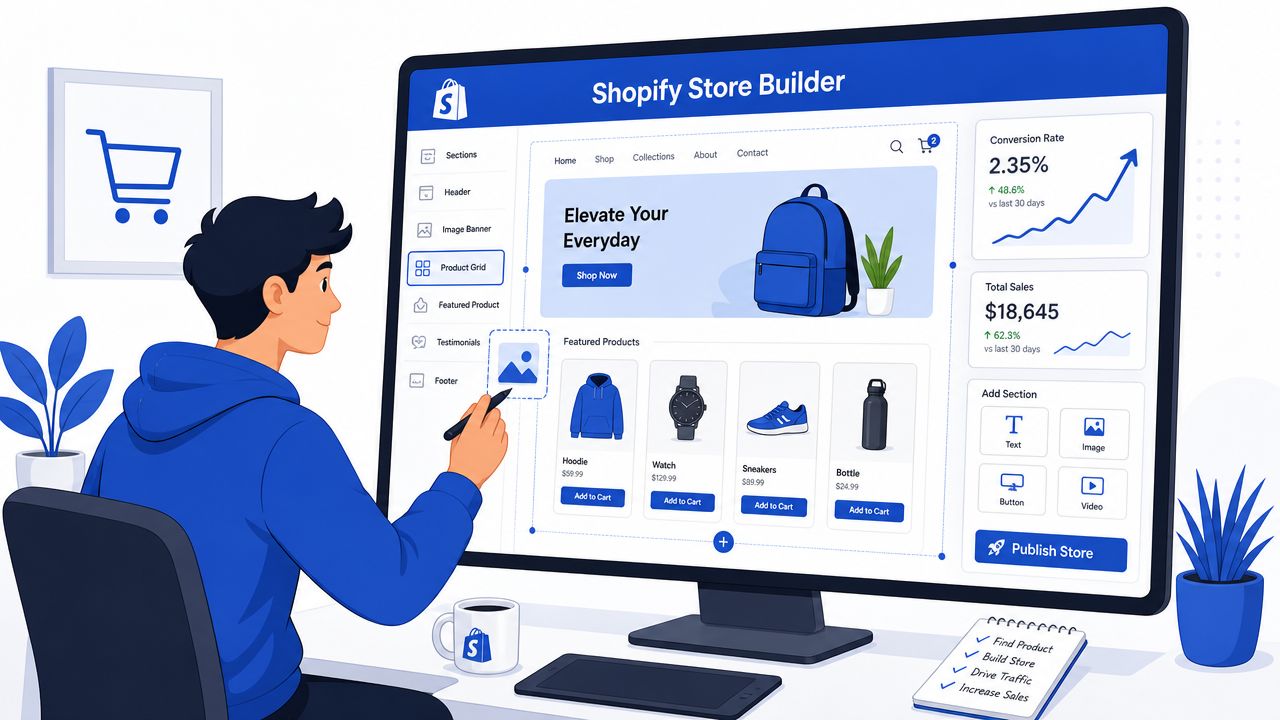
Once the business model is clear, Shopify is the most practical route for many founders because it balances speed, usability, ecosystem depth, and room to scale. It's not magic. It just removes a lot of technical friction that slows early-stage merchants down.
A Shopify store should never be treated as a digital brochure. It's a sales environment. Every template choice, content block, app, and page element should help the customer move from curiosity to confidence.
Start with the core pages that actually sell
Founders often over-focus on homepage aesthetics and under-invest in the pages that do the commercial work.
The essentials are:
- Homepage that states what you sell, who it's for, and why it's worth attention within seconds.
- Collection pages that help shoppers browse by need, category, or use case.
- Product pages that remove doubt through imagery, clear copy, delivery expectations, and trust signals.
- About page that gives the brand a believable reason to exist.
- Policy pages that are easy to find and written for humans, not just compliance.
- Contact page that shows a real route to support.
If you're building on Shopify and want a practical walkthrough of structure, setup, and design choices, this guide to building a Shopify store is a useful reference point.
Design for conversion, not approval
A good-looking store can still convert badly. That usually happens when design decisions serve the founder's taste more than the shopper's task.
Focus on these conversion fundamentals:
Product pages must answer buying questions quickly
Customers usually want the same things fast. What is it? Why is it better? How do I choose the right option? When will it arrive? Can I return it?
Strong product pages usually include:
- Clear image hierarchy with simple primary images and useful secondary detail shots
- Short-form summary copy near the buy box
- Scannable supporting information lower on the page
- Visible trust content such as reviews, FAQs, delivery information, and returns guidance
- Logical option selection so variants don't feel confusing
Mobile deserves first priority
Most founders still review their store on a desktop and assume mobile will be fine. That's backwards. In most launches, mobile is where discovery starts, where ads land, and where weak UX gets punished.
Check the basics carefully:
- thumb-friendly menu behaviour
- readable text without awkward line breaks
- sticky add-to-cart where appropriate
- fast-loading media
- checkout fields that don't feel painful on a phone
Agency habit: Review the entire buying journey on mobile before anyone signs off the desktop design.
Be selective with apps
The Shopify App Store is useful, but early stores often over-install. Every extra app adds cost, complexity, and the chance of front-end slowdown or app conflicts.
Useful app categories usually include:
- Email capture and automation
- Reviews and user-generated content
- Customer support
- Upsell or bundle functionality
- Analytics and heatmaps
- Subscription tools if the model fits
What doesn't work is adding apps to compensate for weak strategy. If the product offer is muddy or the site architecture is poor, no app will rescue conversion.
Later in the build, it helps to watch another store setup flow end-to-end before final decisions lock in:
Build the store you can operate
Agency experience matters. The best storefront isn't the one with the most features. It's the one your team can manage without breaking merchandising, content updates, or reporting every week.
That means sensible navigation, a theme you won't outgrow immediately, app choices that solve real problems, and backend workflows that don't require a developer every time you launch a collection. If you know custom logic, subscriptions, ERP syncs, or advanced merchandising are already on the horizon, plan for that now instead of rebuilding after first traction.
Setting Up Payments, Shipping, and Operations
The store isn't live because the homepage looks polished. It's live when a customer can pay easily, receive the order as promised, and get help without friction if something goes wrong.
Many new merchants underperform in a key area. They spend weeks on branding and then treat payments, delivery, and returns as admin tasks. Customers see them differently. They experience them as trust signals.
The UK retail market has a high online share, and ecommerce habits remained at a structurally higher level after the pandemic period. UK guidance on selling online also stresses that businesses must clearly show price, delivery charges, cancellation rights, and contact details before purchase, as summarised in this UK ecommerce statistics and guidance roundup. That isn't just compliance. It's the baseline for credibility.
Set up checkout to reduce hesitation
Customers want familiar payment methods and a checkout that feels secure. Keep the experience simple and avoid unnecessary field friction.
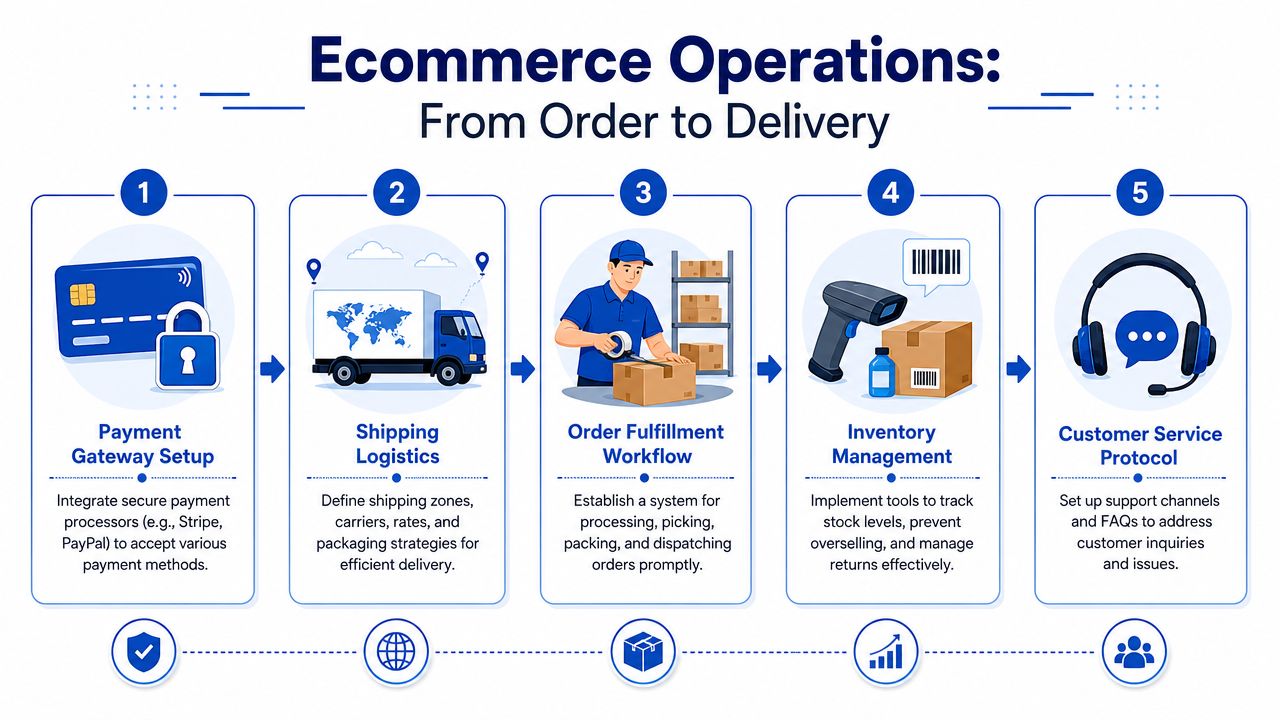
A practical payment setup usually includes:
- Primary gateway choice such as Shopify Payments where suitable, because native setups often reduce complexity
- Secondary trusted method such as PayPal if it fits your audience
- Clean billing and shipping flow with no confusing surprises
- Visible policy access from cart and checkout-adjacent pages
Don't force account creation at launch unless your model needs it. Guest-friendly checkout usually removes resistance for first-time buyers.
Shipping strategy is part of your marketing
Shipping isn't a backend detail. It changes conversion rate, average basket decisions, and support volume.
You need to decide:
| Shipping decision | What to think about |
|---|---|
| Rate structure | Flat rate, included shipping, or variable rates based on order profile |
| Courier choice | Reliability, tracking quality, collection process, and service coverage |
| Dispatch promise | What you can actually fulfil consistently, not what sounds attractive |
| Returns workflow | How customers start a return and how quickly the process is resolved |
The common mistake is setting promises based on hope. If your supplier dispatches slowly, your courier misses collections, or your team packs orders in the evening after another full-time job, write policies around reality.
Customers forgive longer delivery windows more easily than broken promises.
Build operations before they become urgent
Once orders arrive, operational gaps show up fast. Stock gets oversold. Returns pile up. Customer emails become inconsistent. Manual processes that looked manageable at five orders become messy at twenty.
That's why inventory handling needs attention early. A solid ecommerce inventory management guide is useful reading if you're choosing between simple stock tracking and more advanced workflows. For Shopify-specific planning, this overview of inventory management for ecommerce helps map where store setup and stock operations overlap.
Your minimum operational setup should include:
- Order workflow for payment review, picking, packing, dispatch, and exception handling
- Stock logic that prevents overselling and flags low availability
- Customer service channel with a response process, even if it's only email at first
- Returns and refund handling that is documented and consistent
- Policy pages for shipping, returns, privacy, and terms
You don't need a huge ops stack at launch. You do need discipline. Stores rarely fail because they lacked software. They fail because nobody owned the process.
Creating Your Go-to-Market Launch Plan
A finished store with no launch plan is just an expensive draft. Traffic doesn't appear because the site exists.
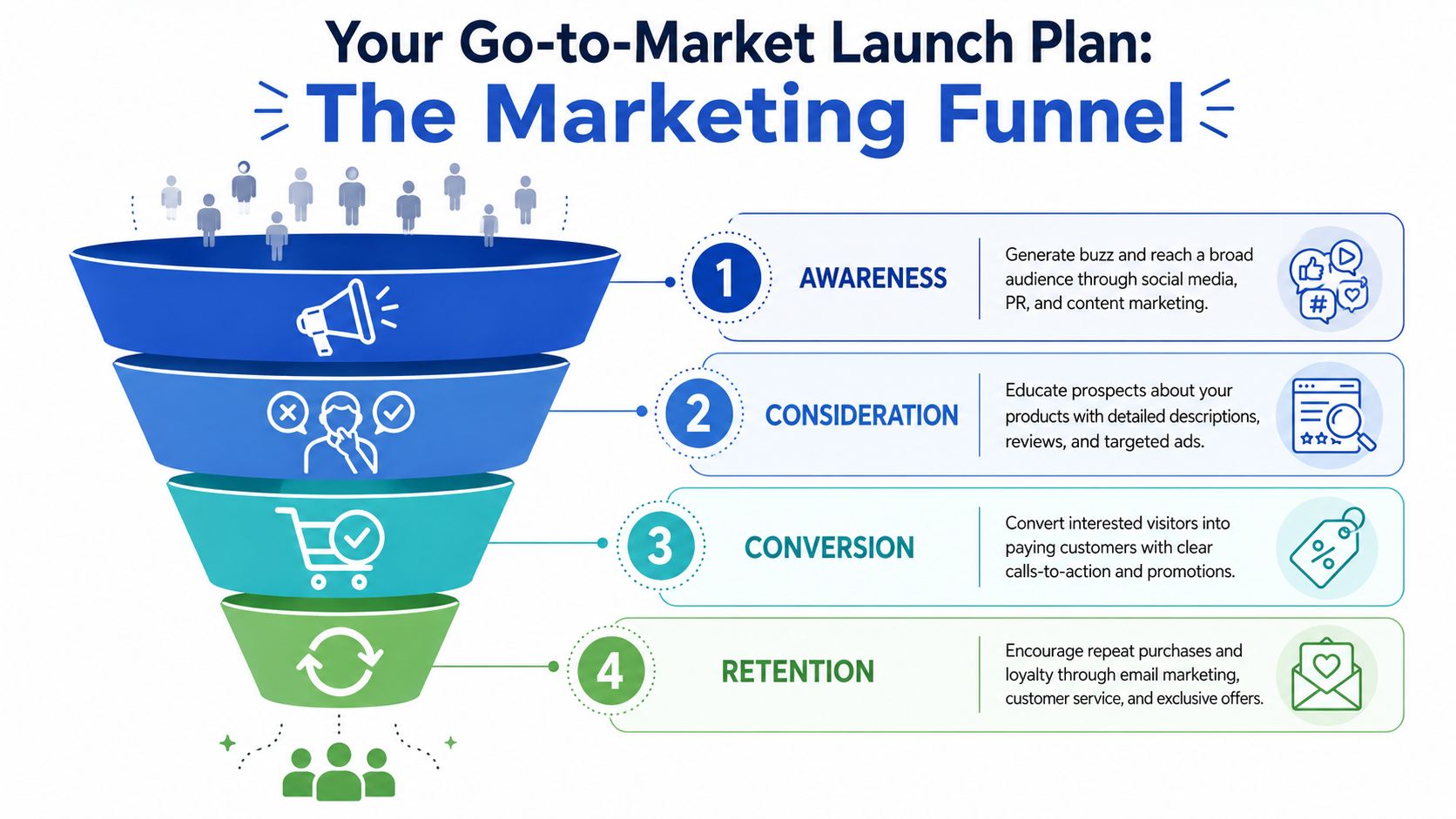
The best launch plans work in phases. They build attention before opening, concentrate demand on launch, and then shift quickly into repeatable acquisition rather than one-off excitement.
Pre-launch needs a reason to exist
If your store is still being built, your marketing can still start.
Create a simple coming soon page and collect email sign-ups. Start posting product development, packaging previews, problem-solution content, and behind-the-scenes material on the channels your audience already uses. If the product fits, seed samples with creators or niche communities before launch so you're not shouting into silence on day one.
The key is relevance. Don't post because you feel you should be “active”. Post material that helps people understand the product, imagine using it, or feel part of the launch.
Launch day should be coordinated, not chaotic
A launch doesn't need to be dramatic. It does need to be organised.
Keep a simple checklist:
- Email list first because these are your warmest early buyers
- Social posts scheduled across your active channels
- Paid campaigns checked if you're using Meta or Google from day one
- Support monitored so customer questions don't sit unanswered
- Site tested again on mobile, cart, and checkout before traffic goes live
One thing I'd stress to new founders is this: don't burn your launch on a weak offer. If there's going to be a launch incentive, bundle, limited first drop, or founder's note, prepare it properly. “We're live” on its own usually isn't persuasive enough.
Post-launch is where the business actually begins
The channels worth focusing on depend on product type, margin, and customer behaviour, but most stores need a mix of short-term demand capture and long-term brand building.
A practical starter mix looks like this:
Search demand capture
Google Search and Shopping matter when buyers already know what they want. If your products solve an obvious need or sit in an established category, search can be one of the cleaner early channels.
Paid social for attention and testing
Meta is often useful for visual products, gifting, lifestyle items, and founder-led brands. Early campaigns should test hooks, product angles, and audiences. They shouldn't assume the first creative concept is right.
Email for owned retention
Email starts before launch and keeps earning after it. Welcome flows, abandoned basket recovery, post-purchase follow-up, and restock messaging usually do more dependable work than another round of generic social posts.
SEO and content for compounding visibility
SEO takes longer but helps reduce dependence on paid channels over time. Collection pages, product pages, buying guides, comparison content, and answer-based blog posts can all support organic discovery if they're built around real search intent.
Launch marketing works best when every channel says the same thing in a slightly different format.
A lot of new merchants spread themselves too thin here. They open TikTok, Instagram, Pinterest, email, Google Ads, Meta Ads, blog content, and influencer outreach all at once. That usually creates mediocre execution everywhere. Pick a small set of channels you can run properly, then expand once the offer and messaging are proven.
Analysing Performance and Planning for Growth
The first sale proves someone wants the product. It doesn't prove the business is healthy.
Growth comes from reading the right signals and improving the store in small, commercial ways. That means using Shopify Analytics, Google Analytics, and whatever reporting your marketing platforms provide to understand where friction sits.
Watch behaviour, not vanity
The useful questions are usually straightforward:
- Are the right people landing on the site?
- Which pages are losing buying intent?
- Are product pages doing their job?
- Is cart abandonment linked to shipping, trust, or pricing friction?
- Which products attract first purchases and which ones drive repeat interest?
If traffic is weak, the problem may be targeting or demand capture. If traffic is healthy but product page engagement is poor, your offer or merchandising may be off. If carts are strong but completed orders are soft, checkout friction or delivery concerns may be getting in the way.
Treat CRO as routine, not a rescue job
Conversion rate optimisation is just structured improvement. Better product page hierarchy. Clearer delivery messaging. Stronger product bundles. Smarter collection sorting. Cleaner mobile UX. More convincing social proof placement.
You don't need dramatic redesigns to improve performance. You need a habit of testing what customers are responding to.
Changes worth prioritising often include:
- Sharper product page copy that answers buying objections faster
- Better collection logic so visitors find products by need, not just category
- Improved cart messaging around delivery and returns
- Smarter cross-sells based on use case, not random product pairing
- Cleaner homepage priorities so the main offer doesn't get buried
If you want a practical view of what scaling levers to review once the basics are stable, this guide to ecommerce growth strategies is a solid next read.
Growth has to survive cash burn
Founders need to stay unsentimental. A store can look busy and still be fragile.
As this guide to starting an online e-commerce business notes, founders need to budget for recurring costs such as website hosting, payment processing, warehousing, shipping, and marketing. The real difference between a lean launch and a viable launch is often monthly cash burn, not the initial build.
That should shape your growth decisions:
| Growth area | Risk if mishandled |
|---|---|
| More apps and tooling | Rising costs and slower store performance |
| Aggressive paid spend | Revenue growth without healthy contribution |
| More SKUs | Inventory complexity and weaker merchandising |
| New channels | Attention split before the core channel works |
Scale the parts of the business that are already proving themselves. Don't add complexity to escape fundamentals that still need fixing.
If you want help setting up a store that connects strategy, Shopify build, and conversion planning from the start, Grumspot works on launches, rebuilds, and growth-focused ecommerce projects with a practical Shopify-first approach.
Let's build something together
If you like what you saw, let's jump on a quick call and discuss your project

Related posts
Check out some similar posts.

- build shopify store
Learn how to build shopify store with our 2026 UK guide. Covers planning, setup, design, launch, & s...
Read more