Optimize Inventory Management Ecommerce: UK Guide 2026
- inventory management ecommerce
- shopify inventory
- ecommerce fulfilment
- stock control uk
- retail inventory
Launched
May, 2026
Your bestseller goes viral on a Friday afternoon. Shopify shows healthy stock. Amazon still says available. Your warehouse team starts picking. Then customer service flags the problem. The same units have been promised twice, returns from earlier in the week haven't been processed back correctly, and one marketplace feed is lagging behind reality.
That's how inventory problems usually show up in ecommerce. Not as a neat reporting issue, but as cancelled orders, refund emails, angry reviews, and rushed supplier calls.
In inventory management ecommerce, the job isn't “keeping count”. The job is protecting the promise your storefront makes to the customer. If the site says an item is available for next-day dispatch, your systems and fulfilment operation need to make that true. In the UK, that gets harder because delivery performance isn't uniform, returns can flood stock files with bad data, and marketplace rules don't care whether your ERP sync failed at 2:13 pm.
Why Smart Inventory Management Matters Now
A lot of merchants only take inventory seriously after one bad peak period. Black Friday is the usual trigger. A promo lands, paid traffic spikes, the hero SKU starts moving, and suddenly the stock position is wrong in three places at once. The commercial damage isn't just the missed sale. It's the follow-up cost. Support tickets, split shipments, manual stock checks, and ad spend wasted on a product you can't fulfil.
That pressure intensified when ecommerce became a larger share of UK retail. The Office for National Statistics reported that online sales accounted for 34.5% of all retail sales in December 2021, after peaking at 37.2% in January 2021, while the British Retail Consortium noted sustained supply chain pressure from disruption, workforce shortages, and longer lead times in the same period, as summarised in this overview of ecommerce inventory management. For operators, that meant stock accuracy and replenishment stopped being back-office admin and became a front-line commercial issue.
The real cost of getting stock wrong
When stock data is wrong, every team pays for it.
- Marketing pays first: campaigns keep pushing traffic to products that can't be fulfilled cleanly.
- Customer service absorbs the frustration: agents spend their day apologising for delays, substitutions, and cancellations.
- Operations works around the problem: warehouse teams start making judgement calls because the system no longer reflects the shelf.
- Finance feels it later: emergency purchasing, write-downs, and messy reconciliations pile up.
I've seen stores with strong creative, solid conversion rates, and healthy demand still underperform because the stock file couldn't be trusted. Good merchandising can't rescue bad availability logic.
Speed only works when the stock promise is real
A lot of brands focus on front-end speed, but fulfilment design matters just as much once the order is placed. If you're reviewing warehouse flow, pick paths, and receiving accuracy, this guide to designing e-commerce fulfillment for speed is a useful operational reference because layout and process directly affect how reliably inventory data turns into shipped orders.
The same goes for channel planning. UK merchants are dealing with a market that expects convenience, fast delivery, and accurate availability across storefronts and marketplaces. Broader Shopify and ecommerce statistics help frame that commercial context, but on the ground the issue is simpler. If stock accuracy is weak, growth gets expensive very quickly.
Practical rule: If your team has to “double-check the system” before approving a campaign or taking a large order, you don't have inventory control. You have inventory suspicion.
Understanding Core Inventory Concepts
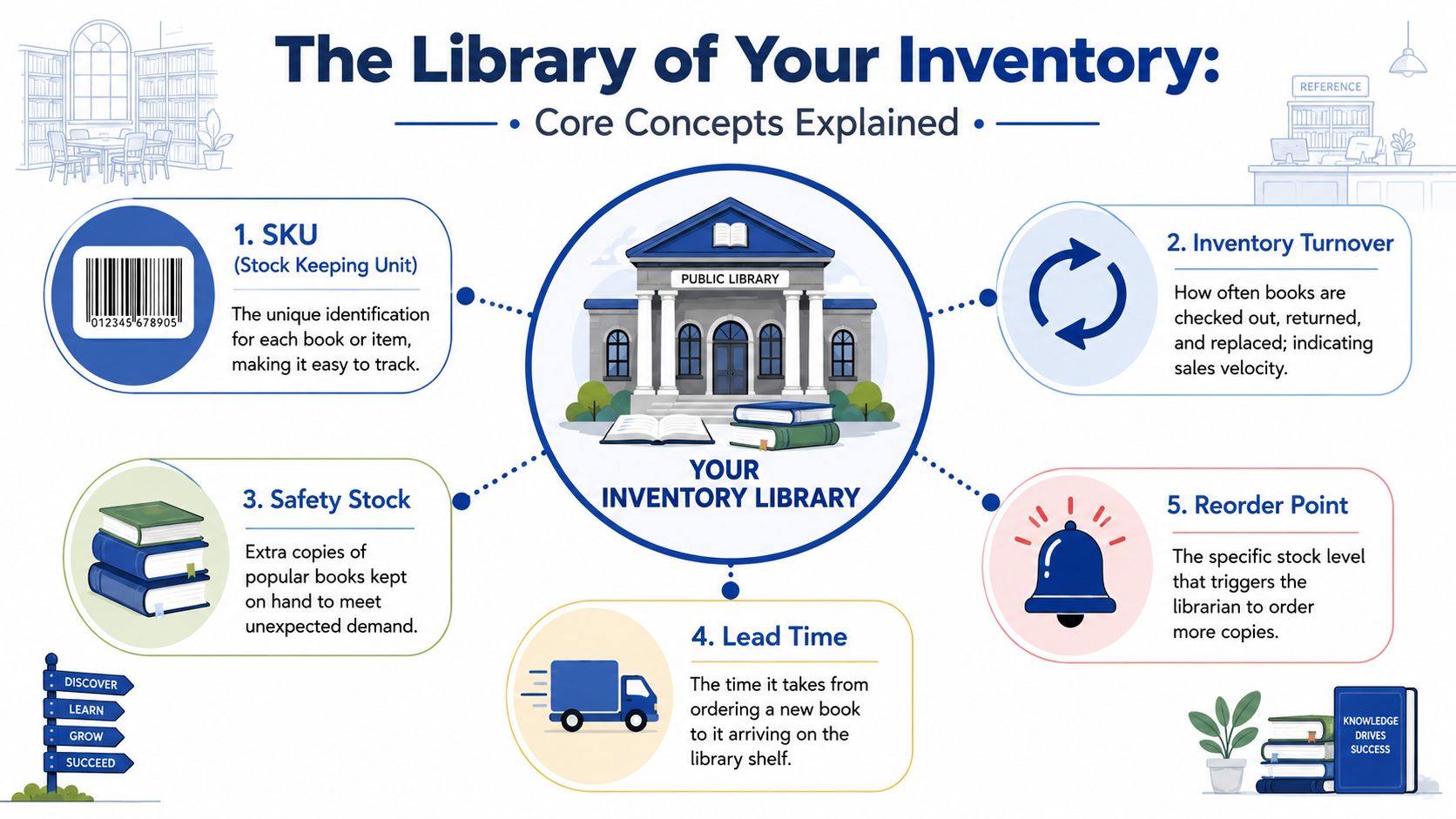
Think about your stock like a busy public library. The library owns thousands of books, but not every book is available to lend right now. Some are checked out. Some are reserved. Some are in transit between branches. Some are being repaired after damage. Ecommerce inventory works the same way.
If you mix up what you own with what you can promise, you create oversells.
Stock on hand and available to sell
Stock on hand is everything physically in your control. Available-to-sell is what can be offered to customers after reservations, open orders, damaged units, returns holds, and marketplace allocations are accounted for.
That distinction sounds basic, but it's where many stores go wrong. A merchant sees 80 units in the building and assumes 80 can be sold. In practice, some are already committed, some are in quarantine after return, and some belong to a wholesale order due out tomorrow morning.
The system has to reflect that difference in real time.
The British Retail Consortium estimated UK retail stock loss at £4.1 billion in 2022/23, and the same summary notes that inaccurate stock records in ecommerce lead directly to overselling and lost revenue, which is why a perpetual inventory system updated by sales, returns, and receipts is the critical control in modern operations, as outlined in this review of ecommerce inventory management systems.
SKUs, barcodes, and location logic
A SKU is the item's unique identity inside your business. In the library analogy, it's the equivalent of the exact catalogue record for one edition of one title, not just “a blue book”. In ecommerce, “Black T-Shirt” is useless. “Black T-Shirt / Large / EU fit / 2025 batch” is operationally useful.
Barcodes then make that SKU scannable at speed. They reduce manual entry, receiving mistakes, and picking errors. If your warehouse team still relies on visual matching for similar items, the failure isn't a people problem. It's a system design problem.
Location logic matters too. “Warehouse A” isn't detailed enough once volume grows. You need bin, shelf, or zone-level accuracy for any operation that wants reliable picks and credible stock counts.
Periodic and perpetual inventory
A periodic system updates inventory during scheduled counts. That's workable for a very small store with low order volume and a simple catalogue. It breaks once you add multiple sales channels, daily returns, or more than one fulfilment location.
A perpetual system updates inventory whenever something happens:
- A sale occurs: stock reduces immediately.
- A return is received: stock either re-enters saleable inventory or moves to a hold state.
- A purchase order arrives: stock increases only after receiving confirms quantity and condition.
- A manual adjustment is made: the reason should be logged, not guessed.
This is why spreadsheets struggle. They can store data, but they don't naturally behave like live operational systems.
For merchants that need a broader operational view, this guide to successful inventory management is worth reading alongside your own workflows. The important point is simple. Inventory visibility isn't a monthly stocktake exercise. It's a live event stream.
If a sale, return, receipt, or transfer can happen without updating available stock immediately, the storefront will eventually promise something the business can't deliver.
Choosing Your Inventory Model and System
Inventory models sound academic until cash is tight and lead times slip. Then the model matters a lot. It decides how much risk you carry, how much stock you hold, and how often your team has to intervene manually.
Most Shopify merchants don't need a pure textbook model. They need a workable operating posture. In practice, that usually means combining a prioritisation method with a replenishment method and then supporting both with software that can execute the rules.
Three models merchants use most
ABC analysis helps you decide which products deserve the closest control. Your top-priority items get tighter forecasting, faster review cycles, and more attention from purchasing. This is useful when a small part of the catalogue drives a large share of revenue or customer expectation.
EOQ, or Economic Order Quantity, is a balancing model. The idea is to order enough to reduce frequent purchasing and freight friction, but not so much that cash gets trapped in slow-moving stock. Hardware, consumables, and stable repeat-purchase catalogues often benefit from this thinking because demand is usually less erratic.
Just-in-Time, or JIT, aims to keep on-hand stock lean by receiving goods close to the point of demand. It can work well for made-to-order, low-storage, or trend-sensitive ranges. It can also fail spectacularly if suppliers slip, customs adds friction, or demand spikes faster than expected.
Comparison of Ecommerce Inventory Models
| Model | Best For | Key Benefit | Main Risk |
|---|---|---|---|
| ABC Analysis | Large catalogues with uneven SKU importance | Focuses attention on the products that matter most | Lower-priority items can be neglected until they become a problem |
| EOQ | Stable demand and predictable purchasing cycles | Balances ordering frequency with holding cost | Assumptions break if demand or lead time becomes volatile |
| JIT | Lean operations and dependable suppliers | Reduces storage pressure and excess stock | Low buffer leaves little room for delays or sudden demand shifts |
What works in real stores
A fashion brand with rapid assortment changes may use ABC logic to identify hero lines, then run a leaner purchasing model on trend-led pieces where overbuying is dangerous. A parts supplier may use EOQ for dependable sellers and hold deeper buffers on items with awkward supplier lead times.
What doesn't work is copying a model because it sounds efficient.
- JIT fails when merchants confuse low stock with good stock.
- EOQ fails when holding cost is considered but channel volatility is ignored.
- ABC fails when teams classify products once and never review them again.
The software choice matters just as much as the model. If Shopify is your customer-facing layer but your purchasing rules live in a disconnected spreadsheet, the model isn't operational. It's theoretical. Once you start adding bundles, pre-orders, marketplace allocations, and multi-location fulfilment, you usually need ERP or inventory system support with cleaner automation. A proper Shopify ERP integration then becomes less of a technical nice-to-have and more of a control requirement.
How to choose without overcomplicating it
Use these decision filters:
- Catalogue shape: a small, stable range can tolerate simpler logic than a broad catalogue with variants and bundles.
- Supplier reliability: if inbound timing is inconsistent, lean models become dangerous quickly.
- Cash position: holding more stock protects service, but it also ties up capital.
- Operational discipline: advanced rules are useless if receiving, returns, and transfers aren't processed properly.
The best model is the one your team can execute consistently under pressure, not the one that looks smartest in a planning deck.
Forecasting Demand and Managing Reorders
Forecasting gets overcomplicated fast. Most merchants don't need a data science lecture. They need a repeatable way to decide when to buy more stock, how much risk to buffer, and when to override the model because reality changed.
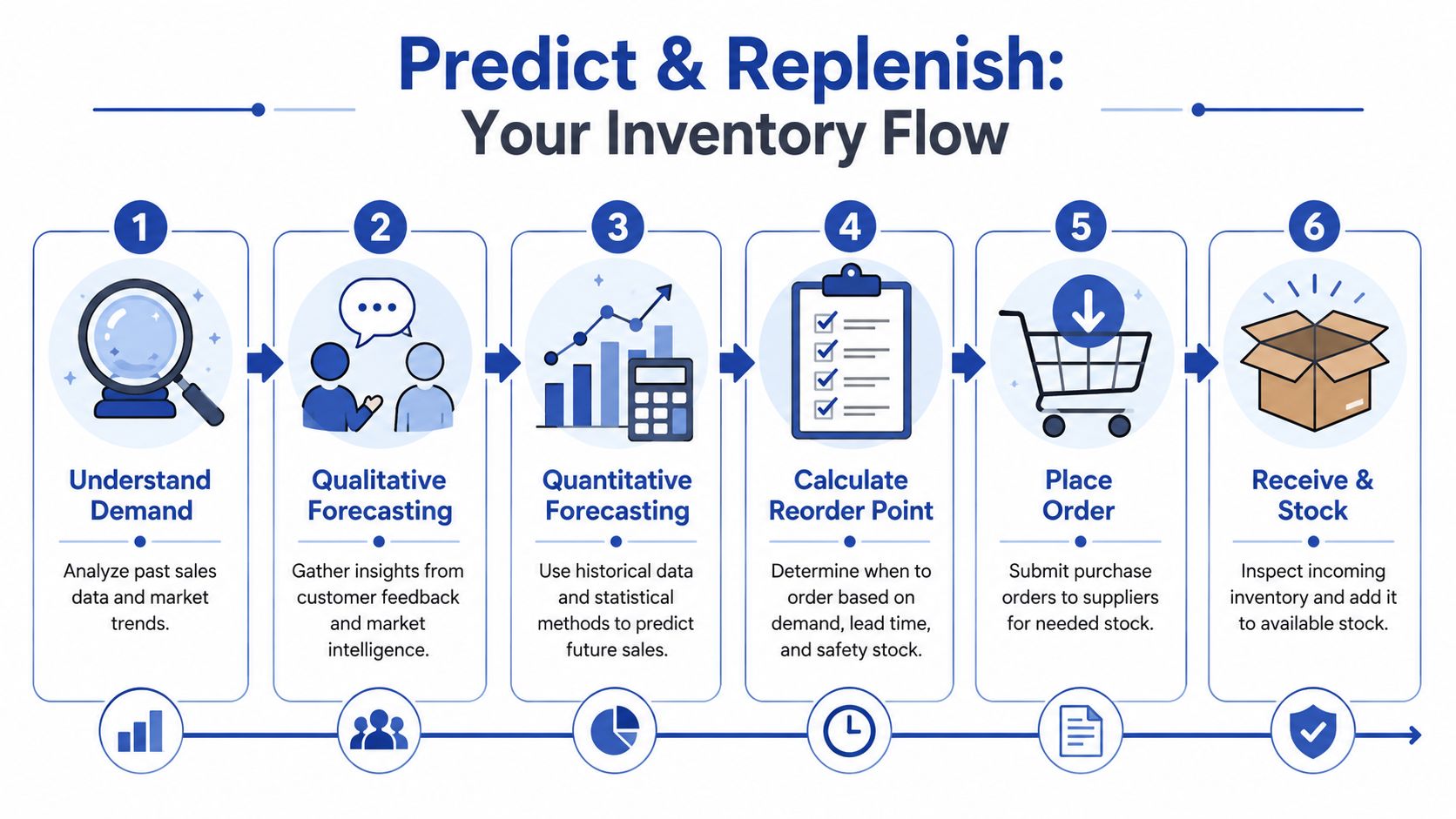
At the centre of that is the reorder point. It tells you when stock has fallen low enough that a replenishment order should be triggered. The classic formula is simple:
Reorder point = demand during lead time + safety stock
That formula is useful, but the difficult bit is never the maths. It's choosing realistic inputs.
Forecasting methods that are practical
A merchant usually needs both qualitative and quantitative judgement.
Quantitative forecasting looks at what the item has sold historically. That's your baseline. Use a rolling sales average rather than a single snapshot, especially if the SKU is active in promotions or exposed to seasonal swings.
Qualitative forecasting adds context that the raw sales file can't see. A planned influencer campaign, a bank holiday weekend, a product mention in the press, or a supplier warning all matter. If your model ignores those signals, your reorder point becomes tidy but misleading.
Why UK replenishment needs a buffer mindset
A strong UK ecommerce replenishment model has to account for lead time variability, not just average demand. The practical guidance is to model lead time in days and use a rolling sales average so reorder points adjust dynamically, especially for volatile SKUs, because customs friction, port congestion, and supplier delays can stretch replenishment cycles beyond plan, as explained in this guide to reorder points and ecommerce inventory.
That changes how you treat safety stock. It isn't spare stock for the sake of it. It's a deliberate buffer against uncertainty.
A worked example without false precision
Say a SKU typically sells steadily each day and your supplier usually replenishes within a known window. You estimate demand during the lead time, then add a safety stock layer to cover the fact that deliveries don't always arrive when expected and demand doesn't always behave nicely.
If lead time stretches, the reorder point rises.
If sales accelerate, the reorder point rises.
If both happen together during a promotion, the old reorder point becomes dangerous.
That's why “set and forget” reorder rules fail.
A short explainer can help if your team needs a visual walkthrough of replenishment basics:
Reorder habits that actually hold up
- Review volatile SKUs more often: hero products, promoted lines, and seasonal items need tighter monitoring than slow, steady stock.
- Separate supplier averages from supplier reality: a nominal lead time is not the same as an achieved lead time.
- Include returns logic: returned units are not automatically saleable units.
- Adjust before peak periods: Christmas, gifting windows, and campaign bursts should trigger a policy review, not hope.
A reorder point is a decision rule, not a comfort blanket. If the assumptions are stale, the number is stale too.
Key KPIs to Measure Inventory Performance
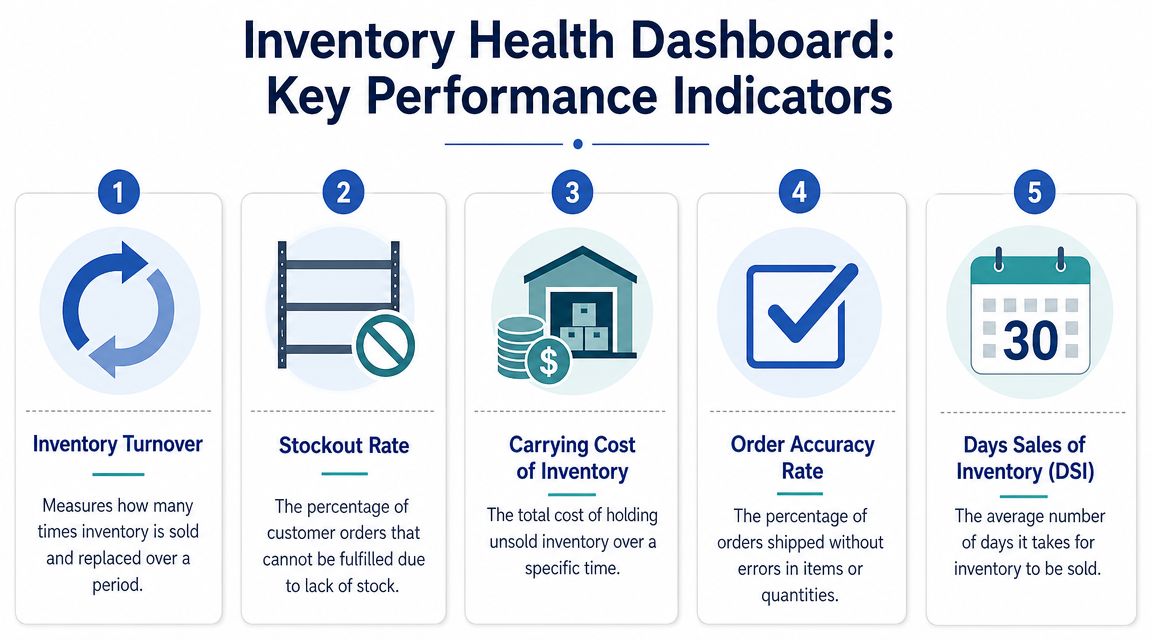
Most inventory dashboards are crowded with numbers that don't change decisions. The useful KPIs are the ones that tell you where stock is too slow, too thin, or too messy to trust.
If you're running inventory management ecommerce properly, your KPI set should help three teams act. Buying needs to know what to reorder. Operations needs to know where process is breaking. Commercial teams need to know whether availability is helping or hurting conversion.
The metrics worth watching
| KPI | Simple formula | What it tells you | What to do if it looks wrong |
|---|---|---|---|
| Inventory Turnover | Cost of goods sold ÷ average inventory | How quickly stock is moving through the business | If it's low, review slow movers, pricing, and purchasing quantities |
| Sell-Through Rate | Units sold ÷ units received | How much of incoming stock is converting into sales | If it's weak, reassess demand planning or product-market fit |
| Stock-to-Sales Ratio | Stock on hand ÷ sales over a period | Whether stockholding is too heavy for current demand | If it's high, reduce buys or clear excess inventory |
| GMROI | Gross margin ÷ average inventory cost | How much gross margin your inventory investment is producing | If it's poor, trim low-margin slow stock and prioritise healthier lines |
What good operators look for
Turnover is the clearest signal of whether stock is alive or stagnant. A low turnover result often means you bought too much, backed the wrong assortment, or failed to move stale product early enough.
Sell-through is especially useful after a launch, a seasonal buy, or a campaign. It shows whether stock is converting at the pace you expected. If it isn't, the answer may be merchandising, pricing, or that the original buy was too optimistic.
Stock-to-sales ratio is a reality check. It stops teams from feeling comfortable just because shelves are full. Plenty of merchants are “well stocked” in all the wrong products.
GMROI forces margin discipline into purchasing decisions. Revenue alone can hide weak stock investment. A line may sell, but if it ties up too much cash for too little margin, it isn't doing enough work.
Add a few operational signals
I also like to pair those financial and trading KPIs with operational checks:
- Adjustment frequency: too many manual corrections usually point to process or integration issues.
- Return-to-resale time: if returned stock sits in limbo, available inventory will be understated.
- Order accuracy: if the wrong items leave the warehouse, your stock file degrades quickly.
A useful KPI dashboard should provoke action, not just reporting. If a metric changes and nobody knows what to do next, it doesn't belong on the first screen.
Integrating Your Tech Stack for Seamless Control
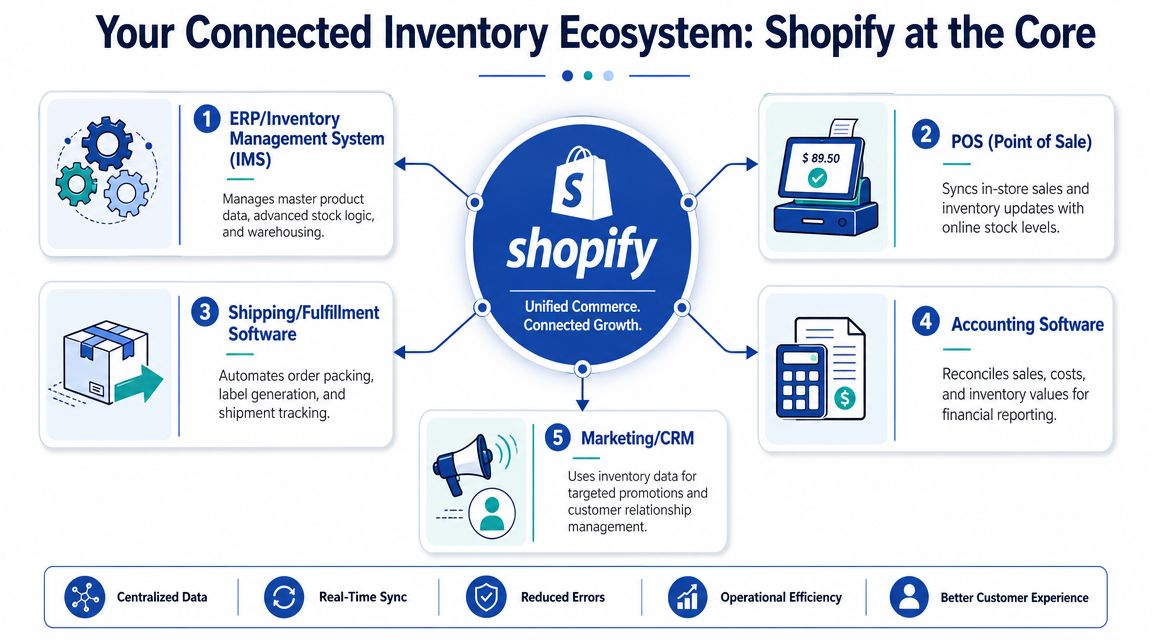
Once a merchant outgrows spreadsheets, the main problem usually isn't a lack of data. It's that the data lives in separate systems that disagree with each other. Shopify shows one number. The warehouse management system shows another. The ERP still hasn't processed a return. The marketplace connector is delayed. Customer service is left trying to work out which number is real.
That's why the tech stack has to behave like a connected control system, not a pile of apps.
What each system is actually for
Shopify is usually the commercial front end. It holds product presentation, channel activity, and customer orders. It should not be forced to behave like a full ERP if the business has become more operationally complex than that.
ERP systems manage financial control, purchasing, product master data, and broader business logic. They're where landed inventory value, supplier records, and purchasing workflows often live.
WMS tools run warehouse reality. They handle receiving, putaway, bin locations, picks, packing, and dispatch confirmation. If the ERP is the ledger, the WMS is the warehouse floor.
3PL platforms sit outside your business but still affect your stock truth. If they don't push fast, accurate inventory events back into your ecosystem, your available-to-sell number drifts.
Why data quality is the real issue
For UK merchants selling across channels, inventory control is heavily constrained by data quality. UK retail research has highlighted stock accuracy as a weak point, and multichannel selling increases the risk of fragmented stock records. The practical issue for Shopify Plus merchants is that demand spikes, VAT expectations, and channel mix should change replenishment logic, especially when ERP and fulfilment systems are involved, as discussed in this article on inventory management for ecommerce businesses.
That's the part many generic guides miss. Integration isn't only about moving data. It's about moving the right status.
A returned item might need one of several states:
- Saleable: it can go straight back into available inventory.
- Inspection hold: it exists physically but must not be offered for sale yet.
- Damaged or incomplete: it should remain excluded from stock promises.
- Supplier return or write-off: it belongs in a non-saleable bucket.
If every system can't recognise those distinctions, “synced inventory” still won't be trustworthy.
What good integrations do
A good stack does four things reliably:
- It keeps master data clean. SKU IDs, variants, bundles, and location records should map consistently.
- It pushes events quickly. Sales, receipts, returns, cancellations, and transfers should update stock without delay.
- It preserves business rules. Marketplace reserve stock, pre-order logic, and channel allocations need clear handling.
- It reconciles exceptions. Failed syncs, duplicate orders, and receiving discrepancies should be visible, not buried.
This is also where service partners can matter. If you're connecting Shopify with ERP, 3PL, CRM, or custom middleware, firms offering Shopify third-party integration services can help define data flows and failure handling. Grumspot is one example of an agency that works on Shopify integrations, including ERP and fulfilment sync, which is directly relevant when stock accuracy depends on more than one platform.
Your stack doesn't need more software. It needs one dependable source of stock truth, plus clear ownership of how inventory events move through the system.
The warning signs that your stack is fragmented
- The finance team and warehouse team export separate inventory reports
- Marketplace quantities are manually adjusted after promotions
- Returns are processed operationally but not reflected in saleable stock promptly
- Bundles and kits deplete inconsistently across channels
- Customer service checks stock by messaging the warehouse
Once those symptoms appear, inventory management ecommerce becomes less about reporting and more about architecture.
Common Pitfalls and an Implementation Checklist
The common mistake is thinking inventory control starts and ends with stock tracking software. It doesn't. Software can sync counts, but it can't rescue poor receiving discipline, unclear return states, or bad SKU design.
That matters even more in the UK, where generic advice often ignores operational friction around delivery performance and returns. A key challenge is deciding how much additional safety stock is needed to absorb regional delivery delays and return-related uncertainty without tying up too much working capital, as described in this piece on inventory management challenges.
Pitfalls that keep causing damage
Some problems show up in nearly every audit.
- Manual adjustments with no reason code: if stock changes but nobody records why, recurring errors stay hidden.
- Returns treated as instant inventory: a parcel arriving back at the warehouse is not automatically saleable stock.
- Infrequent cycle counts: annual stocktakes won't protect a store trading daily across multiple channels.
- One stock pool for every channel: marketplaces, wholesale, and DTC often need different allocation logic.
- No ownership of exceptions: failed syncs sit in the background until a customer spots the issue first.
A practical implementation checklist
Use this as an audit list, not a theory exercise.
Define SKU structure properly
Every variant needs a unique, durable identifier. Avoid vague naming that forces warehouse staff to interpret products visually.Separate stock states
Create clear distinctions between on hand, committed, saleable, returned, damaged, and incoming inventory.Choose a perpetual inventory setup
Sales, returns, receipts, cancellations, and transfers should all update stock continuously.Map every location
If you hold stock across a warehouse, shop, 3PL, or returns centre, each location needs explicit rules and visibility.Set reorder rules by SKU behaviour
Don't apply one blanket policy to hero SKUs, long-tail items, and seasonal products.Build a returns workflow
Decide who inspects returns, how they're graded, and when they return to available stock.Schedule cycle counts
Count regularly by category, location, or risk level. Don't wait for a year-end surprise.Create an exception queue
Failed integrations, negative stock, duplicate SKUs, and mismatched receipts should appear in one operational view.Test peak-period logic before peak arrives
Promotions, channel allocations, and fulfilment cut-offs should be pressure-tested before the busiest week of the year.Assign ownership
One person should own inventory truth. Not purchasing alone, not warehouse alone, not ecommerce alone. Someone has to arbitrate the number.
Stores rarely lose control because one big thing breaks. They lose control because small stock errors are allowed to accumulate until the available-to-sell number becomes fiction.
Inventory control gets better when the business stops treating it as a warehouse task and starts treating it as a trading system.
If your Shopify store is wrestling with overselling, disconnected stock data, or messy ERP and fulfilment workflows, Grumspot can help audit the setup, identify the points where inventory truth breaks down, and implement the integrations and operational fixes needed to keep stock, orders, and customer promises aligned.
Let's build something together
If you like what you saw, let's jump on a quick call and discuss your project

Related posts
Check out some similar posts.

- multi-channel inventory management
Master multi-channel inventory management for Shopify. Learn sync methods, ERP integrations & a road...
Read more
- warehouse management system integration
Optimize your Shopify operations with seamless warehouse management system integration. Learn to pla...
Read more
- seasonal demand forecasting
Master seasonal demand forecasting with our guide. Source data, select models, & integrate with Shop...
Read more