Shopify Custom Theme Development for UK Brands
- shopify custom theme development
- shopify expert uk
- ecommerce website design
- shopify plus agency
- bespoke shopify themes
Launched
March, 2026

So, what exactly is Shopify custom theme development?
Think of it this way: you can either rent a standard shop space or hire an architect to design a flagship store that’s built from the ground up, just for you. Custom development is the architect approach. It’s about creating a completely unique storefront that’s tailored precisely to your brand.
While a pre-built theme from the Shopify Theme Store is a fantastic starting point for many, custom development gives you total control over how your brand is perceived, how customers navigate your site, and what unique features you can offer.
Understanding Shopify Custom Themes
Your Shopify theme is more than just a lick of paint. It’s the entire blueprint for your customer's online experience—from the moment they land on your homepage to the final click at checkout. It dictates the layout, the flow, and the overall feel of your digital shop.
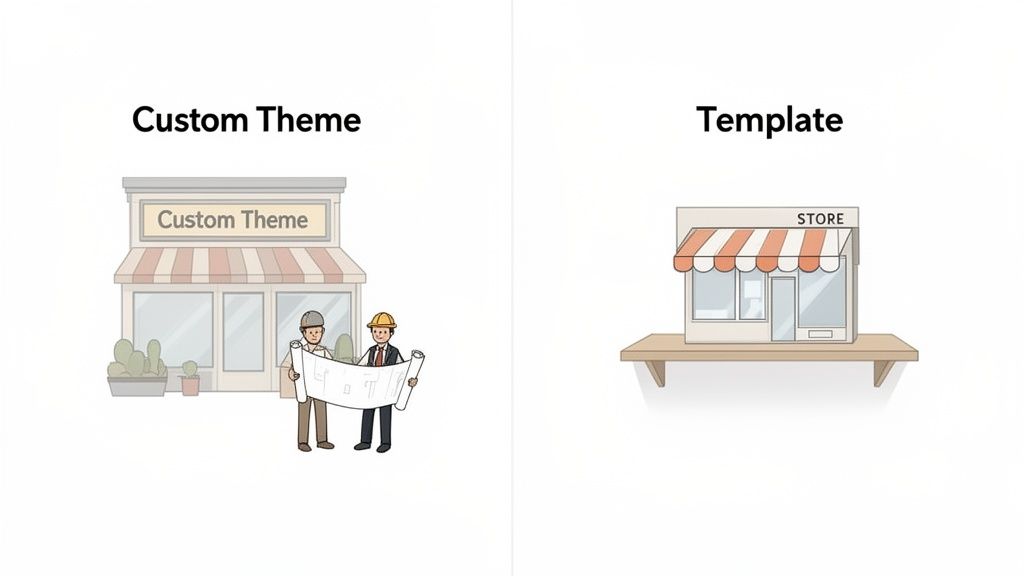
The themes you find on the marketplace are designed to appeal to a wide audience, so they come with standardised features. Shopify custom theme development, on the other hand, is a different game entirely. It’s a process where a theme is built exclusively for your business, ensuring every pixel, interaction, and function serves a specific purpose. For ambitious UK brands, this is a powerful way to carve out a distinct identity in a crowded market.
What Makes a Custom Theme Different
A custom theme isn't just about picking unique colours and fonts; it's about crafting a strategic asset that works for your business. The real differences come down to three key areas: flexibility, performance, and pure brand alignment.
A pre-built theme often comes packed with code for features you’ll never use, which can weigh down your site and slow it down. A custom theme is the opposite. It contains only the clean, necessary code for your specific requirements, resulting in a much faster, more responsive experience for shoppers.
A custom theme is your brand’s digital DNA, encoded into every customer interaction. It moves beyond generic templates to create an experience that is uniquely yours, driving both brand loyalty and conversions.
This bespoke approach also lets you solve unique business problems. For instance, if you need a sophisticated product bundler, an interactive 'build-your-own' tool, or intricate filtering for a massive catalogue, these can be built directly into the theme’s foundation. Trying to achieve this with an off-the-shelf theme often means wrestling with multiple, and sometimes conflicting, third-party apps.
To help you weigh your options, let’s break down the three main paths you can take for your Shopify store's design.
Comparing Theme Options Custom Build vs Customisation vs Template
The table below gives you a clear side-by-side look at what to expect from each approach, helping you decide which is the right fit for your budget, goals, and ambition.
| Attribute | Custom Theme Development | Theme Customisation | Pre-built Theme |
|---|---|---|---|
| Uniqueness | 100% Unique to your brand. No other store will look or function like yours. | Moderately Unique. Based on a template but with significant visual and functional changes. | Not Unique. Thousands of other stores use the same base template. |
| Flexibility | Unlimited. Any feature or design you can imagine can be built. | Limited. Restricted by the theme's original code and structure. | Very Limited. Only the options provided by the theme developer are available. |
| Performance | Optimised for Speed. Built with clean, minimal code tailored to your needs. | Variable. Depends on the base theme and the quality of customisations. | Good to Poor. Often bloated with code for features you may not use. |
| Cost | High Initial Investment. Typically starts from £5,000 and can exceed £50,000. | Moderate Cost. Cheaper than a full build but more than a simple template. | Low Cost. Usually between £150 - £300 one-time payment. |
| Best For | Established brands, high-growth businesses, and stores with complex needs. | Businesses needing more than a template but not ready for a full custom build. | New businesses, startups, and stores with standard product offerings. |
Ultimately, choosing between these options depends on where your business is today and where you want it to be tomorrow. A pre-built theme is a great entry point, but a custom theme is an investment in long-term growth and a truly standout brand experience.
The Business Case for a Custom Shopify Theme
Thinking about a custom Shopify theme? It’s easy to see it as just a facelift for your store, but that’s missing the bigger picture. A custom theme is a serious business decision—an investment in building a high-performance sales engine from the ground up, designed specifically for your commercial goals. It’s about turning your online store into a true digital flagship that actively drives growth.
Instead of trying to bend a pre-made template to fit your operations, you build the theme around your ideal processes. This is how you unlock powerful growth strategies, like those in this guide to 12 Powerful Ecommerce Growth Strategies, by creating a platform perfectly suited to your market and customer journey.
Supercharge Speed and Conversions
One of the biggest wins with shopify custom theme development is pure performance. Off-the-shelf themes are often bloated with code for features you’ll never use, and all that extra weight can seriously slow your site down. When even a one-second delay in page load time can cause a 7% drop in conversions, that excess code is costing you money.
A custom theme, on the other hand, is built lean. It contains only the code you actually need. This clean, optimised foundation leads to much faster loading times, a huge factor for both your customers' experience and your search engine rankings. A zippier site keeps people engaged and slashes bounce rates, which feeds directly into a higher conversion rate.
A custom theme is not a cost; it’s an investment in a high-performance sales asset. By building for speed and a unique user experience from day one, you are creating a durable competitive advantage that pays dividends in customer loyalty and revenue.
Craft a Unique Brand Experience
In a crowded online marketplace, your brand's identity is your most valuable asset. A custom theme gives you the freedom to create a completely unique user experience (UX) that telegraphs your brand at every single touchpoint. From bespoke animations to an intuitive navigation flow designed around your specific product catalogue, you get to control the entire customer journey.
This is a level of control that generic templates just can't match. It builds trust and creates a memorable experience that sticks with shoppers. You can design product pages that tell a compelling story, build interactive lookbooks, or even integrate guided selling tools that help customers find their perfect item.
Support Complex Business Logic
As your business grows, so do your operational needs. A custom theme is built from the start to handle your specific requirements, so you don't have to rely on a patchwork of apps that might slow things down or conflict with each other.
- Sophisticated Product Options: Do you offer product bundles, subscriptions, or ‘build-your-own’ customisation? These can be woven directly into a custom theme’s core logic for a seamless customer experience.
- Internationalisation: If you’re selling across borders, a custom theme can flawlessly handle different languages, currencies, and regional compliance rules.
- Advanced Integrations: Need to connect to a specific ERP, CRM, or fulfilment system? A custom build makes sure these critical systems work in perfect harmony with your storefront.
Just look at the UK eCommerce market, home to 209,079 Shopify stores. It’s a competitive space, and while custom themes aren't the norm globally, we see many UK Shopify Plus merchants adopting them to manage complex operations. This gives them a real conversion edge, especially as mobile commerce continues to dominate and demand a perfectly responsive and lightning-fast design. You can dig into more data on custom theme adoption trends in the UK. Ultimately, this investment transforms your store from a simple sales channel into a powerful, adaptable business platform that’s ready for whatever comes next.
Your Custom Theme Development Roadmap
Building a Shopify custom theme from scratch can feel like a massive undertaking. But when you break it down, the whole thing becomes a series of clear, manageable steps. Think of this as your project playbook, guiding you from that initial spark of an idea all the way to a live, high-performing online store.
Following a structured process isn't just about ticking boxes. It’s about preventing scope creep, keeping everyone on the same page, and making sure the final product is genuinely brilliant.
This simple diagram shows how a well-run development process connects the dots between technical excellence and real business results. It all starts with a fast theme, which leads to a better user experience and, you guessed it, more sales.
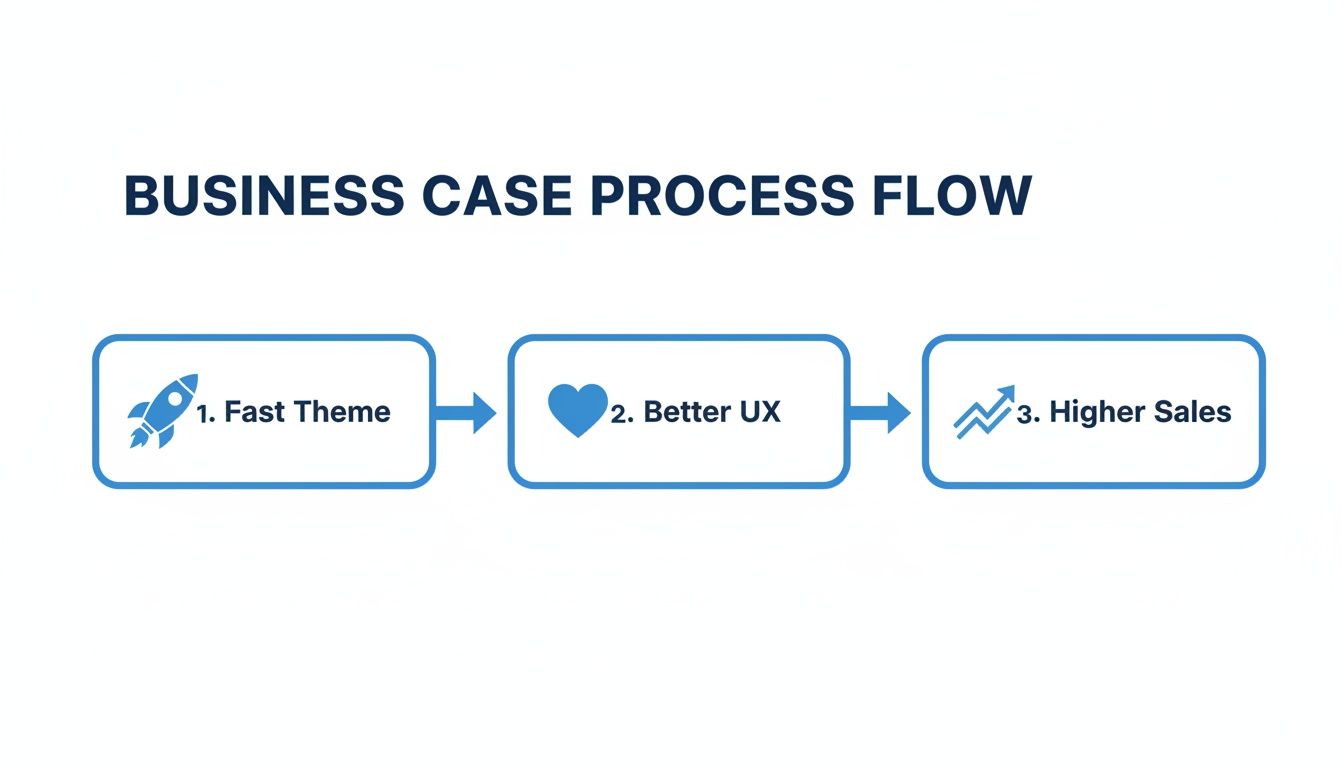
This visual gets to the heart of a successful custom build: when performance leads the way, commercial success follows. Let's walk through each phase of the journey.
Phase 1: Discovery and Strategy
Honestly, this is the most important part of the entire project. Before anyone even thinks about writing code, we need to get under the skin of your business. This means deep-dive workshops and detailed planning to map everything out.
We’ll work together to set clear project goals, define your key performance indicators (KPIs), understand who your customers are, and document every technical and functional requirement. Getting this right from the start ensures the project is built on a solid foundation. It's where we figure out the "why" behind what we're building.
Phase 2: UX and UI Design
Once the strategy is locked in, our attention turns to the customer. First up is User Experience (UX) design, where we create the architectural blueprint of your site through wireframes and user flow diagrams. The goal here is simple: map out the easiest, most intuitive path for customers to find what they need and make a purchase.
Next, the User Interface (UI) design phase breathes life into that blueprint. This is where your brand's visual identity—your colours, fonts, and imagery—gets applied to the wireframes. The result is a set of pixel-perfect mock-ups that show exactly how your new store will look and feel, designed to be both beautiful and built for conversion.
Phase 3: Theme Development and Build
This is where the magic happens, and visual designs are transformed into a fully working Shopify theme. Using the approved mock-ups as their guide, your development partner will start bringing your store to life with code.
This phase is a busy one and typically includes:
- Setting up the development environment: A safe, separate "sandbox" version of your store is created so we can build and test without affecting your live site.
- Coding the front-end: This involves writing clean, efficient HTML, CSS, and JavaScript to build all the customer-facing parts of your theme.
- Integrating with Shopify: We use Shopify's Liquid templating language and APIs to wire up the design to Shopify’s back-end, pulling in your products, collections, and customer information.
- Building custom features: Any unique functionality we identified during the discovery phase gets built from the ground up.
A disciplined development process isn't just about writing code; it's about translating a strategic vision into a tangible, high-performance asset. Each phase builds upon the last, ensuring the final theme is perfectly aligned with your business objectives.
Phase 4: Quality Assurance and Testing
With the initial build complete, the theme moves into a rigorous testing phase. Quality Assurance (QA) is absolutely vital for catching any bugs or glitches before your customers do.
Your new theme is put through its paces across a huge range of devices, browsers, and screen sizes to make sure it looks and works perfectly everywhere. We test everything from links and forms to the full checkout process and page speed performance. This ensures your store is solid, reliable, and ready for launch day.
Phase 5: Launch and Deployment
After all the tests are passed and you’ve given the final sign-off, it’s time to go live. The launch itself is a carefully planned event designed to happen with little to no downtime.
Your development team will push the new theme to your live Shopify store, run a final sweep of post-launch checks, and keep a close eye on the site to make sure everything is running smoothly. This is the moment your hard work and vision finally become a reality for your customers.
Phase 6: Post-Launch Support and Optimisation
The project doesn’t just stop once the site is live. The best development partners will stick around to provide ongoing support, helping you grow and adapt over time. This might involve fixing any small issues that crop up, training your team, or adding new features as your business expands.
More importantly, this phase often turns into a cycle of continuous improvement. By looking at analytics and listening to user feedback, we can make data-driven tweaks to the theme, ensuring your investment keeps paying dividends long after launch.
When you decide to build a custom Shopify theme, you’re not just choosing a new look. You’re making critical technical decisions that will define your store's speed, flexibility, and ability to grow for years to come.
A stunning design is what captures your customer's eye, but it's the technology running quietly in the background that delivers the experience. Getting these choices right from the start is the difference between a website that just works and one that truly performs. Let's break down the technical side of things so you can have a confident conversation with your development team.
The Foundation: Liquid and Online Store 2.0
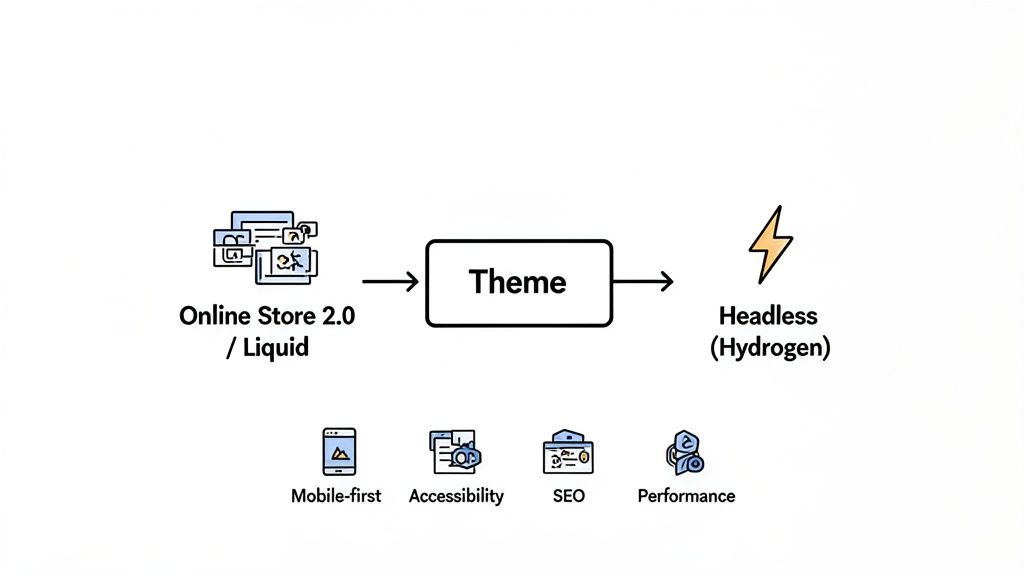
Most Shopify themes are built using Liquid, which is Shopify’s own templating language. The simplest way to think about it is as the glue connecting your Shopify admin panel to the customer-facing website. Liquid is what pulls your product titles, prices, and images from your database and displays them correctly on the page.
For years, this worked well, but the real revolution came with Online Store 2.0 (OS 2.0). This was a complete overhaul of Shopify’s theme architecture. Before OS 2.0, deep customisation was mostly confined to the homepage. If you wanted to add a unique content block to a product page, it often meant calling a developer.
Now, with OS 2.0's "sections everywhere" feature, that limitation is gone. We can build bespoke, reusable components—like a unique "Shop the Look" gallery or a detailed "Our Materials" section—that you can then drag, drop, and reorder on any page. This gives you incredible freedom to manage your own content without writing a single line of code.
The High-Performance Option: Headless Commerce
While OS 2.0 gives you immense flexibility, some brands need to push the boundaries of performance even further. This is where headless commerce comes into play.
Think of your Shopify store as having two distinct parts: the back-end (your admin panel for products, orders, and customers) and the front-end (the website your shoppers interact with). A headless approach essentially separates the two. Shopify continues to power your entire back-end, but your storefront is a completely separate, custom-built application that communicates with Shopify through APIs.
This model, often built with a framework like Shopify Hydrogen, allows for lightning-fast, app-like experiences.
Headless commerce offers maximum performance and creative freedom by decoupling the front-end experience from the back-end logic. It's the ultimate choice for brands where speed and a unique user experience are non-negotiable.
It’s an advanced approach, but it’s perfect for ambitious, content-heavy brands that want to deliver a truly unique digital experience. If you’re curious, you can learn more about whether https://grumspot.com/blog/headless-commerce-solutions are the right fit for your business.
Non-Negotiable Standards for Any Custom Build
No matter which architecture you land on, there are three principles that should be baked into every custom theme project. These aren’t optional extras; they're the absolute bedrock of a successful online store.
- Mobile-First Design: The majority of UK e-commerce traffic now comes from smartphones. Your theme has to be built for the small screen first, ensuring a perfect experience for every visitor, not just those on a desktop computer.
- Web Accessibility (WCAG): A great website is one that everyone can use, including people with disabilities. Adhering to the Web Content Accessibility Guidelines (WCAG) isn't just about doing the right thing; it opens up your store to a wider audience and helps you avoid potential legal trouble.
- Built-in Technical SEO: You can have the best-looking site in the world, but it’s useless if no one can find it. A custom theme must be built from day one with search engine optimisation in mind. This means clean code, fast load times, logical heading structures, and schema markup that helps Google understand and rank your pages.
As you plan out the technical details, don't forget to look at the entire customer journey. A custom build opens up new possibilities for Shopify checkout page customization, allowing you to create a seamless and optimised path from the first click all the way to the final payment.
Budgeting for Your Custom Shopify Theme
Let’s talk about the important bit: the money. Getting your head around a realistic budget is the very first step to making a Shopify custom theme development project a success. The costs can swing wildly, so knowing what actually influences the final price tag helps you plan properly and find an agency that’s the right fit for your budget.
This isn't just about paying for code; it's an investment in a high-performance asset built from the ground up for your business. Think of it as a spectrum, ranging from a solid custom foundation to a full-blown enterprise solution. You can get a deeper look at what goes into the final number in our detailed guide to Shopify website design costs in the UK.
Understanding the Key Cost Drivers
So, what actually moves the needle on the price of a custom theme? A quote is really just a reflection of the time and expertise needed to make your vision a reality. A few key factors have the biggest say in the final budget.
These are the main things that will shape your project's scope and cost:
- Design Complexity: A simple, clean design with a handful of page templates is much quicker to build than a highly stylised site with intricate animations and unique user interactions. The more bespoke the look and feel, the more it will cost.
- Number of Unique Templates: Your homepage, product pages, and collection pages each need their own template. If you want different layouts for different types of products, for example, each new template adds to the development time.
- Custom App Integrations: While standard apps are plug-and-play, getting your store to talk to a third-party ERP, CRM, or even a private app you've built yourself requires specialist work. Making these systems work seamlessly with your theme’s front-end is a significant cost.
- Data Migration: Moving house from another platform like Magento or WooCommerce? Shifting all your products, customers, and order history over safely and accurately is a delicate operation that adds to the project’s bottom line.
A Tiered Look at Custom Theme Pricing
To give you a clearer picture, let's break down what you can generally expect to pay at different levels. These are ballpark figures, of course, but they offer a useful starting point for your budget.
| Tier | Typical Price Range (UK) | What It Includes |
|---|---|---|
| Starter Custom Build | £5,000 – £15,000 | A bespoke theme with a unique design, built on OS 2.0. This covers essential page templates (homepage, product, collection, blog) and mobile-first optimisation. |
| Growth-Focused Build | £15,000 – £30,000 | Everything in the starter tier, plus more complex UI/UX design, custom feature development (like product bundlers), and basic third-party system integrations. |
| Enterprise Shopify Plus | £30,000 – £50,000+ | A completely bespoke solution for high-volume merchants. This includes advanced features, headless commerce architecture (optional), deep ERP/CRM integrations, and internationalisation. |
Investing in a custom theme is a strategic play to get ahead of the competition. The cost reflects the creation of a unique, high-performance sales tool that is exclusively yours, built to hit specific business goals and drive conversions.
The UK's eCommerce scene is buzzing, with over 209,000 Shopify websites—a number that proves how important it is to stand out. While only a small fraction of stores globally go for a custom theme, the payoff is huge, especially for Shopify Plus merchants who often report much better conversion rates. The price tag for an enterprise build might seem steep, but for UK brands aiming to scale, a bespoke theme is a very smart bet. You can explore more about these compelling Shopify statistics and market trends.
Choosing the Right Shopify Development Partner
Picking the right team for your Shopify custom theme development is probably the single most important decision you'll make in this entire process. The success of your new theme doesn’t just come down to clean code; it hinges on finding a partner that acts as a genuine extension of your own team—someone who is truly invested in your growth. This isn't about hiring a few coders; it's about finding a strategic ally.
When you begin looking at different agencies, you have to look past the glossy portfolios. A gallery of beautiful websites is a nice start, but it hardly tells the whole story. To find a partner who gets the commercial realities of e-commerce, you need to dig a bit deeper.
Verifying Expertise and Focus
First things first: check for any official recognition from Shopify. You're looking for agencies that are designated as Shopify Experts or, even better, Shopify Plus Partners. This isn't just a shiny badge they can put on their website. It's proof that Shopify itself has vetted their work, confirming they know how to build high-quality, scalable stores on the platform.
This certification is your shortcut to filtering out the amateurs. It signals a team that’s on top of the latest features, best practices, and technical standards needed for a top-tier build. It’s a reliable way to narrow your focus to developers with a proven track record.
Choosing a development partner is like hiring a co-pilot for your business. You need someone with proven technical skill, a clear communication style, and a shared focus on reaching your commercial destination—not just someone who can fly the plane.
Beyond any official status, try to get a feel for their core philosophy. Do they get excited talking about design aesthetics, or do they immediately start asking about your business outcomes? The best partners always lead with a conversion-rate optimisation (CRO) and user experience (UX) mindset. They should be asking about your average order value, customer lifetime value, and business goals long before they ever bring up colour palettes.
Essential Criteria for Your Shortlist
As you start to narrow down your options, use this checklist to see how each potential partner stacks up. A solid agency will tick all these boxes, proving they have the right structure and mindset for a successful project and a lasting relationship.
- Transparent Communication: How do they actually manage their projects? Look for clear processes, the promise of regular updates (like daily check-ins), and direct access to the people working on your theme. Vague answers and slow response times are huge red flags.
- Flexible Engagement Models: Business needs are never static. A great partner will offer flexibility, whether that means a one-off project to get you launched quickly or a monthly retainer that gives you an on-demand team for ongoing improvements and support.
- Long-Term Growth Focus: Steer clear of partners who seem interested only in this one project. The best agencies want to build a long-term relationship. They’ll use data from your new theme to drive continuous improvement long after the launch. They should be just as interested in your six-month performance as they are in the initial build.
By using this framework, you'll be in a much better position to find the right Shopify development agency that will not only build you a brilliant theme but also help you scale your business for years to come.
Your Custom Theme Questions, Answered
Stepping into the world of Shopify custom theme development is a big move, and of course, you'll have questions. We get it. To cut through the noise, we’ve put together straightforward answers to the questions we hear most often from ambitious brands.
How Long Does a Custom Theme Take to Build?
This is the big one, and the honest answer is: it really depends on the scale of the project. There's no one-size-fits-all timeline.
For a relatively straightforward custom theme with a few unique page templates, you're likely looking at around 6 to 8 weeks from our first chat to launch day. However, for a more complex, enterprise-level build—think headless architecture, deep system integrations, or a host of intricate features—that timeline can easily stretch to 12 to 16 weeks, sometimes more. Any trustworthy partner will lay this all out for you in a detailed project plan with clear milestones.
Can I Still Use My Existing Shopify Apps?
For the most part, yes. The vast majority of apps on the Shopify App Store are built to play nicely with any theme, custom ones included. As part of the discovery phase, a good development team will audit your current apps to flag any potential conflicts right from the start.
But here’s the real advantage of going custom: you can drastically cut down on your reliance on apps. Features that often require an app, like mega menus, product bundling, or advanced collection filters, can be built directly into the theme itself. This nearly always leads to a faster site and a much cleaner experience for your customers.
What Kind of Support Can I Expect After We Go Live?
The relationship shouldn't just stop the moment your new site is launched. A reputable agency will stick around to make sure everything runs smoothly and sets you up for long-term growth.
This is what that support should look like:
- A Warranty Period: A typical 30-60 day window where the agency fixes any bugs or technical hiccups that crop up post-launch, completely free of charge.
- Ongoing Retainers: Many brands choose a monthly support retainer. This gives you an on-demand team for making continuous improvements, adding new features, and handling proactive site maintenance.
- Proper Training: Your team needs to feel confident managing the new site. You should receive thorough training on how to use all the new custom features and sections, giving you the power to manage your own content without needing a developer for every little change.
Is a Custom Theme Actually Better for SEO?
When built correctly, a custom theme offers a huge advantage for Search Engine Optimisation (SEO). Off-the-shelf themes can be bloated with heavy, unused code that slows your site down—and site speed is a massive ranking factor for Google. A custom theme, on the other hand, is built to be lean and fast from its very foundation.
A custom theme gives you complete control over your site's technical SEO foundation. You can ensure perfect heading structures, clean code, advanced schema markup, and optimal mobile performance—all crucial elements that off-the-shelf themes can't always guarantee.
This level of control means your development team can implement SEO best practices at the core of your website, giving you a powerful and lasting edge in search results.
Ready to build a Shopify store that performs as beautifully as it looks? Grumspot is a Shopify Plus agency that delivers bespoke storefronts designed for conversion. We combine conversion-first design with expert development to help you unlock your brand's full potential. Schedule a free consultation with our team today.
Let's build something together
If you like what you saw, let's jump on a quick call and discuss your project
Related posts
Check out some similar posts.

- web design agency southampton
Find the best web design agency Southampton. Our 2026 guide covers vetting, pricing, red flags & cho...
Read more
- ecommerce development uk
Your complete guide to ecommerce development UK. Learn to plan, hire an agency, choose a tech stack ...
Read more
- web design agency hampshire
Grumspot is a leading web design agency hampshire specializing in Shopify Plus. We build high-conver...
Read more
- shopify plus agency
What is a Shopify Plus agency? Learn what they do, the benefits of partnership, and how to choose th...
Read more