How to Hire a Shopify Development Agency and Scale Your Store
- shopify development agency
- shopify plus partner
- ecommerce development
- hire shopify developers
- uk ecommerce
Launched
March, 2026
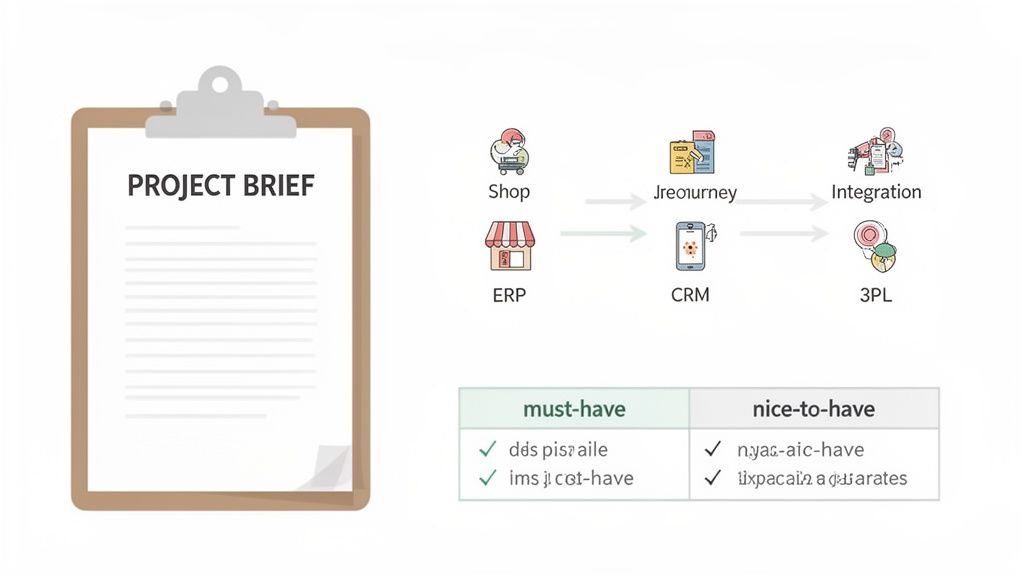
Before you even think about talking to a Shopify development agency, the most important work starts with you. Getting your own house in order first is the single best way to avoid the classic pitfalls of a web project: wildly inaccurate quotes, painful delays, and a final product that misses the mark.
A solid project scope isn't just a document; it's the blueprint that ensures you and your future agency are building the exact same thing.
From Business Goals to Technical Blueprints
The first job is to connect your big-picture business goals to specific, technical needs. Simply telling an agency you want to "increase sales" is far too vague. You need to think about how you'll do that and what tools a developer needs to build for you.
Let’s say your goal is to "increase average order value (AOV)". That's a great start, but what does it mean in practice? It could translate into several concrete features:
- Product Bundling: Building a feature that lets customers buy related items together for a small discount.
- Tiered Shipping Thresholds: Implementing a dynamic free shipping bar that encourages customers to add one more item to their cart.
- Post-Purchase Upsells: Integrating a one-click offer on the thank you page after an order is complete.
Going through this process forces you to define what success actually looks like. The more detailed you are now, the more accurate—and comparable—the agency proposals will be later.
Sorting Your Must-Haves From Your Nice-to-Haves
I've seen countless projects get bogged down because every single feature was treated as a top priority. To keep your budget and timeline in check, you have to be ruthless. Split your requirements into two lists: ‘Must-Haves’ and ‘Nice-to-Haves’.
A clear line between what's essential for launch and what can wait is the most effective way to prevent scope creep. It creates a realistic roadmap and allows an agency to propose a phased approach, delivering core value first.
Imagine you're a brand migrating from Magento. Your lists might look something like this:
Must-Haves (Non-Negotiable):
- A flawless migration of all customer, order, and product data.
- The ability to replicate our existing tiered pricing for B2B customers.
- Integration with our ERP for real-time inventory synchronisation.
Nice-to-Haves (For Phase 2 or if the budget allows):
- A new loyalty programme.
- An augmented reality (AR) feature for trying on products.
- Developing a custom mobile app.
This clarity stops agencies from quoting for features you don't need right away, giving you a much clearer picture of the initial investment. If you're starting from a blank slate and need some ideas, our guide on how to build a Shopify store can help you think through the fundamentals.
Mapping Out Integrations and User Journeys
Modern e-commerce sites are rarely standalone. They're complex hubs connected to many other systems. Your brief must detail every single platform that needs to talk to your Shopify store, including your CRM, ERP, and any third-party logistics (3PL) partners.
For each integration, get specific about the data flow. Does your ERP push inventory levels to Shopify, or does Shopify send order details back to the ERP? The more precise you are, the fewer surprises there will be.
At the same time, think through your key user journeys. Go beyond the standard "add to cart, checkout" flow and map out the paths unique to your business.
- How does a new customer sign up for your subscription box?
- What’s the exact process for a customer returning an item via their online account?
- How does a wholesale partner log in to see their specific pricing tiers?
Outlining these critical paths shows a potential Shopify development agency that you understand the real-world complexities of your own operations. This foresight is crucial when you hire to scale, turning what could be a simple build into a long-term strategic partnership.
Evaluating an Agency's Technical and Strategic Skills
So, you’ve got your project goals mapped out. Now for the hard part: finding a partner who can actually deliver, not just talk a good game. A slick sales pitch and a pretty portfolio don’t always mean you’re getting a high-performing store. A top-tier Shopify development agency is a rare blend of deep technical skill and sharp strategic thinking—they build stores that not only look good but are engineered to convert and scale.
The UK e-commerce scene has exploded, now pulling in over £120 billion a year. Shopify is a huge and growing piece of that pie. On the enterprise side, Britain is actually leading Europe with more than 5,700 Shopify Plus stores, attracting massive brands like Gymshark. This is exactly why a good agency is worth its weight in gold; they handle the complex migrations, custom app builds, and conversion-focused redesigns that big brands need to thrive.
Probing Their Technical Proficiency
Technical expertise is the absolute bedrock of a successful project. You have to be sure an agency can wrestle with the complexities of modern e-commerce. It’s time to look past the promises and ask for solid proof of their experience.
A great place to start is their fluency with Shopify’s latest technology. Don't be afraid to get specific and ask about their work with:
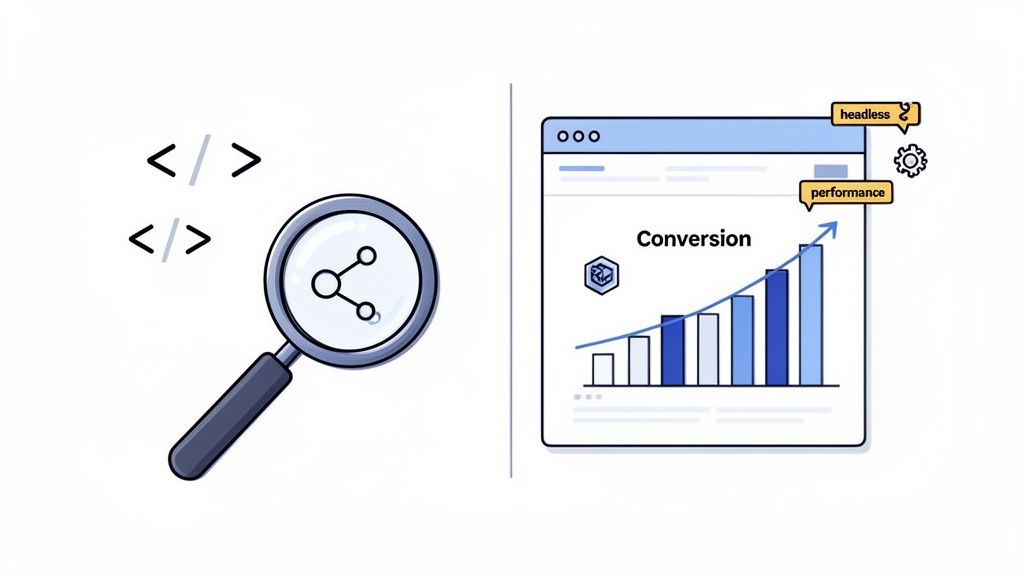
- Headless Commerce: Have they actually built stores using Shopify's Hydrogen framework or other headless tech? This approach gives you incredible performance and flexibility, but it’s a highly specialised skill.
- Shopify 2.0 Architecture: A competent agency should live and breathe Online Store 2.0. This means creating customisable sections on every page and using metafields to manage dynamic content. If they’re still talking about the old theme architecture, that’s a huge red flag.
- API Integrations: Ask them to show you examples of complex, custom integrations with third-party systems like an ERP or a bespoke CRM. Their ability to make different parts of your tech stack talk to each other is vital for smooth operations.
Don’t just take their word for it. In an interview, ask them to walk you through the technical architecture of a recent project. A genuinely proficient team can clearly explain why they made certain technical decisions and the challenges they overcame to get there.
Adopting a Conversion-First Mindset
Let's be blunt: a beautiful website that doesn’t sell anything is just a very expensive digital brochure. A truly valuable agency puts conversions and business results first. This "conversion-first" philosophy should be woven into everything they do, from the initial design mock-ups to the final line of code.
When you’re looking through an agency’s portfolio, dig deeper than the attractive screenshots. Their case studies ought to tell a story of strategic wins.
- Do they show off real business metrics like improved conversion rates, a higher average order value (AOV), or a drop in cart abandonment?
- Do they explain how their choices led to these results? For instance, did a redesigned checkout flow boost mobile conversions by 15%?
- Can they talk you through their process for A/B testing and using data to inform their design choices?
An agency that leads with data and results is one that understands their real job is to grow your business. It's what separates a standard development service from a genuine growth partnership.
Gauging Their Specialised Expertise
As your business scales, your needs will get more complicated. A generalist agency might be fine for launching a basic store, but growth demands specialised knowledge. You need a partner who can solve the unique challenges you'll face down the road.
Think about your growth strategy and see if the agency has proven experience in those critical areas.
Key Specialisations to Look For:
- Internationalisation: Experience with multi-language and multi-currency setups using Shopify Markets, including localised content and different payment gateways.
- Subscription Models: Deep knowledge of building and managing recurring revenue, including customising subscription logic and integrating with platforms like ReCharge.
- Complex Data Migrations: A proven track record of migrating large, messy catalogues and customer histories from platforms like Magento or BigCommerce without losing data or tanking your SEO.
- B2B and Wholesale: Expertise in setting up B2B-on-Shopify, which involves things like customer-specific pricing, net payment terms, and private storefronts.
Choosing an agency with the right mix of technical skill, strategic focus, and specialised knowledge is the surest way to get a real return on your investment. It’s about finding a partner who can deliver today while also anticipating and solving the challenges of tomorrow.
Key Questions for Your Agency Interviews
You’ve got your project scope locked down and a shortlist of agencies that look good on paper. Now for the real test: the interviews. This is where you have to look past the slick portfolios and find out how a Shopify development agency really works when things get complicated.
The goal here isn't just to tick boxes on a skills checklist. You need to understand their process, their communication habits, and most importantly, how they solve problems. To do that, you have to ask questions that force them to tell you a story, not just recite their sales pitch.
Uncovering Their Process and Problem-Solving Skills
Any agency can say they're “agile” or “collaborative.” Those words are meaningless without proof. The only way to get a genuine feel for their approach is to have them talk you through actual scenarios—the good, the bad, and the ugly. This is how you'll see how they handle the inevitable bumps in the road.
Here are a few questions I’ve found get right to the heart of how a team operates:
"Walk me through a time a Shopify project went seriously off-track. What was the root cause, how did your team spot it, and what specific steps did you take to get it back on course?"
- A good answer involves them taking ownership, not pointing fingers at a past client. I listen for details on how they communicated the issue, how they re-prioritised tasks, and what they learned from the experience to prevent it from happening again.
"Describe your quality assurance and testing process. Who is actually responsible for it, and when does it happen during the project lifecycle?"
- An answer like "we test everything" is an immediate red flag. I want to hear about a structured process: peer code reviews, a dedicated QA team, and rigorous testing across multiple browsers and devices before a feature ever makes its way to you for review.
"How do you build a site that’s optimised for Core Web Vitals and mobile speed right from the start, not as an afterthought?"
- They should be talking about things like performance budgets, image compression strategies, lazy loading, and keeping app bloat to a minimum during development. A top-tier Shopify development agency designs for performance from day one.
A great agency won’t just answer your questions; they’ll ask you insightful ones in return. If they aren’t probing into your business goals, customer demographics, and operational challenges, they’re likely more focused on just building a website than on delivering a business solution.
Questions About Communication and Collaboration
I’ve seen more projects fail due to poor communication than technical incompetence. A lack of transparency is a trust killer and the fastest way to derail a project. These questions will help you get a clear picture of what the day-to-day working relationship will look like.
- Who will be my main point of contact? Is that person also the project manager?
- What tools do you use for project management and our daily chats (e.g., Slack, Asana, Jira)?
- How often should I expect updates, and what do those updates look like?
- How do you manage scope creep when we need to add a new feature mid-project?
The answers here give you a real sense of their client management style. You’re looking for a partner who is proactive with updates and has a clear, fair process for handling changes—not one who goes dark for weeks at a time.
To help you prepare, we've summarised some of the most critical questions to ask during your agency interviews. Think of this as your core checklist to ensure you cover all the bases.
Agency Vetting Checklist Core Questions
| Category | Key Question to Ask | What to Listen For |
|---|---|---|
| Technical & Process | "Walk me through a time a project went off-track. What happened, and how did you fix it?" | Honesty, ownership, and a clear problem-solving process. Avoids blaming the client. |
| Performance | "How do you ensure the site is optimised for Core Web Vitals from day one?" | Discussion of performance budgets, image optimisation, and clean code—not just fixing it later. |
| Quality Assurance | "Describe your QA and testing process. Who is responsible?" | A multi-step process involving peer reviews, dedicated testers, and cross-device testing. |
| Communication | "Who is my main point of contact, and how frequent are your updates?" | A clear structure, a dedicated contact, and a proactive communication schedule (e.g., weekly calls, daily stand-ups). |
| Collaboration | "How do you handle scope creep or requests for new features mid-project?" | A defined change-request process that is fair and transparent, not a casual "we'll figure it out." |
Having these questions ready will help you compare agencies on what truly matters: their ability to deliver a great result while being a great partner to work with.
Crafting a Request for Proposal That Gets Results
For bigger, more complex projects, a formal Request for Proposal (RFP) is the way to go. A well-thought-out RFP is your best shot at getting clear, comparable quotes from different agencies. If you're vague, you'll get a pile of proposals that are impossible to compare.
Your RFP needs to give agencies everything they need to give you an accurate and thoughtful proposal. Make sure it includes:
- A Company Overview: Who are you, what do you sell, and who is your ideal customer?
- The Project Brief: This is the detailed scope you already defined, separating your 'must-haves' from your 'nice-to-haves'.
- Your Tech Stack: List all the current systems that need to play nicely together, like your ERP, CRM, or 3PL provider.
- Your Success Metrics: Be specific. Are you trying to achieve a 20% lift in conversion rate, shave 1 second off your average page load time, or cut manual order processing time by 50%?
- Budget and Timeline: Don't be shy. Providing a realistic range for both helps agencies propose a solution that actually fits your constraints.
When you provide this much detail, you force agencies to properly think through your project. It allows you to make a true 'apples-to-apples' comparison of their proposals, ensuring you pick a partner based on their expertise and value, not just the lowest price.
Getting to Grips with Agency Pricing and Engagement Models
Let's talk about the money. Trying to figure out what a Shopify agency will cost can feel like guesswork, but it doesn't have to be. To find a partner that makes sense for your budget, you first need to understand the two main ways agencies structure their fees: the fixed-price project and the monthly retainer.
A fixed-price project is just what it says on the tin. You agree on a very specific list of deliverables—say, a full website build or a complex theme overhaul—for one, all-in price. This approach works brilliantly when you have a crystal-clear vision and a well-defined scope. You know exactly what you’re getting and exactly what you’ll pay.
The catch? That clarity can also be a straightjacket. The moment you want to add a feature or pivot your strategy, you're looking at a new quote and a formal change order. This can really slow things down. It's always a good idea to see how a potential partner handles quoting for web design, as it reveals a lot about their pricing philosophy and how they handle project changes.
The Real Power of a Retainer
The other common model is the monthly retainer. Here, you pay a set fee each month for a block of hours or ongoing access to the agency’s team. Think of it as having an expert e-commerce department on speed dial, without the overheads of hiring an in-house team.
This is the model for ambitious brands focused on growth and continuous improvement. It’s a true partnership.
Retainers are perfect for:
- Constant Optimisation: Regularly running A/B tests, making CRO tweaks, and improving site performance.
- Evolving Your Store: Rolling out new features and functionality as your business needs change.
- Peace of Mind: Having experts ready to jump on bugs, handle security updates, and tackle any emergencies.
With a retainer, the agency gets to know your business inside and out, allowing them to suggest improvements proactively. It’s all about building momentum, not just ticking off a one-and-done project.
UK Pricing Benchmarks for 2026
So, what should you actually budget? Costs can vary wildly based on an agency's size, reputation, and experience. To give you a realistic starting point, here’s a rough guide to what you can expect to see in the UK market for a Shopify development agency in 2026.
| Agency Tier | Typical Project Cost (Fixed) | Typical Monthly Retainer | Who It's For |
|---|---|---|---|
| Boutique Agency | £8,000 - £25,000 | £1,500 - £4,000 | Start-ups and smaller brands needing a solid new store or a major redesign. |
| Mid-Sized Agency | £25,000 - £75,000 | £4,000 - £10,000 | Growing businesses that need complex integrations and a dedicated CRO programme. |
| Shopify Plus Partner | £75,000 - £250,000+ | £10,000 - £30,000+ | Enterprise-level brands needing headless commerce, multi-store setups, and custom app development. |
These are just ballpark figures, of course. For a much more detailed breakdown of what goes into these numbers, have a look at our complete guide on the cost of designing a Shopify website.
The UK is a massive e-commerce market, and that competition has driven up the demand for top-tier agency talent. By 2026, Shopify Plus adoption in the UK has skyrocketed to over 5,700 stores, making it the largest market in Europe for Shopify's enterprise platform. This elite tier now accounts for 31% of Shopify's monthly recurring revenue, and experienced UK agencies are right there, offering the specialised services these larger brands demand.
Red Flags to Look Out For
Choosing the right payment model is one thing, but you also need to know how to spot a bad deal before you sign on the dotted line. A few warning signs during the proposal stage can save you a world of pain later.
The single biggest red flag? A vague proposal. If an agency can't clearly spell out the deliverables, timeline, and exactly what’s included for their quoted price, run. It’s a sign of poor planning or, worse, a strategy to hit you with extra costs down the line.
Be on high alert for any agency that:
- Pushes a long-term contract without a clear, month-by-month plan of what you’ll get for your money.
- Offers a price that seems too good to be true. Rock-bottom quotes almost always lead to cut corners, missed deadlines, or a final invoice full of surprise fees.
- Can't show you real-world case studies with measurable results. They should be able to talk confidently about how they improved a client's conversion rate, average order value, or site speed.
At the end of the day, a great partner will be totally transparent about their costs and flexible enough to find a model that works for your goals. They’ll work with you to build a plan that delivers real, tangible value for your investment.
Your Agency Onboarding and Project Kickoff Checklist
You’ve signed on the dotted line with your chosen Shopify development agency. Now the real work starts. A messy, disorganised beginning can immediately create friction and plant seeds of doubt, whereas a smooth, well-structured onboarding process sets the entire project up for success. This is where you move from contractual agreements to a real, collaborative working rhythm.
The first practical hurdle is access. Your new agency partner will need specific permissions to get their hands dirty, and it’s vital to handle this securely. Be ready to grant collaborator access to your Shopify Admin. You’ll also need to provide view-only or editor permissions for key tools like Google Analytics, your email marketing platform, and any other third-party services they need to integrate.
The Kickoff Meeting Agenda
Think of the kickoff meeting as the formal starting gun for the project. It’s a crucial alignment session where both parties stop being "client and vendor" and become a single, unified team. The goal isn’t just to re-read the scope of work; it’s about making that human connection and setting crystal-clear expectations for how you’ll work together.
Make sure the key decision-makers from your side are in the room, along with the core agency team—especially the project manager and lead developer. A tight, focused agenda is essential to respect everyone’s time.
Key Agenda Items:
- Reconfirm Goals and KPIs: Briefly restate the main business objectives. Are we aiming to boost the conversion rate by 15%, or is the priority to get a new B2B ordering process live before the next quarter?
- Establish Communication Channels: Decide on your primary tools. Will day-to-day chat happen in a shared Slack channel? Will progress be tracked in Asana or Jira? Get it in writing.
- Set Communication Cadence: Agree on how often you’ll hear from them. A weekly status meeting is standard, but what about quick daily check-ins or bi-weekly deep dives?
- Define ‘Done’: This one is huge. Clarify how milestones and features get approved. What does a "completed" feature actually look and function like? Nailing this down now prevents so many "I thought you meant..." conversations later.
A successful kickoff is less about discussing lines of code and more about agreeing on the rules of engagement. When both sides leave that meeting knowing exactly who to talk to, when to expect updates, and how success is measured, you’ve built a solid foundation of trust.
By this point, you should already be clear on the pricing model, which directly impacts how the project will run. The most common structures are fixed-price, retainers, or a mix of both.
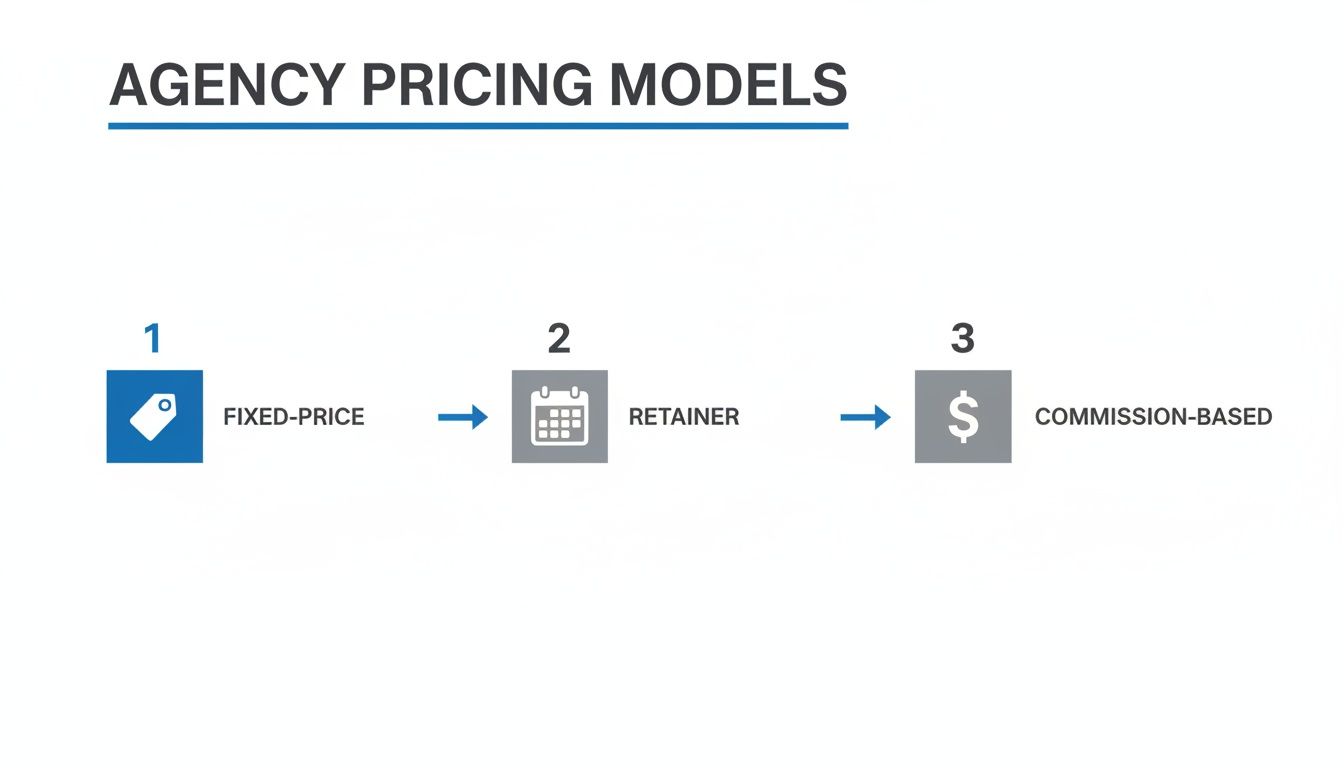
Understanding whether you're in a fixed-scope build or a more flexible retainer agreement is absolutely crucial for setting the right expectations during the onboarding process.
Laying the Groundwork for a Strong Partnership
The UK’s Shopify partner scene has exploded, with a 72% increase in agencies and developers in recent years. With UK e-commerce now worth over £120 billion annually and mobile commanding a massive 68% of Shopify traffic, the demand for expert agencies is at an all-time high. You can discover more insights about the UK Shopify landscape to see just how competitive the market has become.
This boom means that the best agencies have their onboarding down to a fine art. When you prepare your team and your assets ahead of time, you allow your new partner to hit the ground running from day one. A well-organised kickoff doesn't just start the project; it builds the momentum needed to carry you all the way through to a successful launch and beyond.
A Few Final Questions About Hiring a Shopify Agency
Even after all the research and interviews, you probably still have a few questions rolling around in your head. That's completely normal. Choosing a Shopify development agency is a huge decision, and it’s wise to iron out every last detail before you commit.
Think of this as your final sanity check. We'll run through the common questions we hear from merchants just like you, covering everything from platform choices to the all-important budget.
What Is Shopify Plus and Do I Actually Need It?
Put simply, Shopify Plus is Shopify’s enterprise-level platform, designed for high-volume businesses and brands on a steep growth curve. It's not just a shinier version of the standard plans; it’s an entirely different machine, giving you far more power, control, and customisation.
You should seriously consider moving to Shopify Plus if your business is hitting certain milestones:
- You’re processing a large volume of orders and need a rock-solid platform that won’t buckle during major sales events like Black Friday.
- You need to deeply customise your checkout, something that’s locked down on the standard Shopify plans.
- You want to use advanced automation tools like Shopify Flow to handle complex operational workflows without manual effort.
- You’re expanding internationally and need a more sophisticated way to manage multiple stores, currencies, and languages.
If you’re still in the earlier stages of growth, the standard Shopify plans are incredibly powerful and will serve you well. A good agency will be upfront about this and help you figure out if the investment in Plus makes sense now, or if it’s one for the roadmap.
Agency vs Freelancer vs In-House: What Is the Best Fit?
Deciding who to hire is a fundamental crossroads. Should you partner with an agency, bring in a specialist freelancer, or hire a full-time employee? Each path has its own pros and cons, and the right answer really comes down to your budget, project complexity, and long-term vision.
There’s no single “best” option—only the best fit for your specific situation. An agency brings a ready-made team, a freelancer offers focused skill, and an in-house hire provides dedicated attention.
To help you weigh your options, let's look at a quick high-level comparison.
Quick Comparison: Agency vs Freelancer vs In-House
| Factor | Shopify Agency | Freelancer | In-House Team |
|---|---|---|---|
| Expertise | A diverse team of specialists (devs, designers, strategists) under one roof. | Deep skill in one or two specific areas (e.g., theme development or SEO). | Dedicated focus on your brand, but skills are limited to one person's abilities. |
| Cost | Higher initial investment but often provides greater overall value and speed. | More affordable for specific, well-defined tasks or smaller projects. | High fixed cost (salary, benefits) but can be cost-effective for continuous work. |
| Scalability | Can easily scale resources up or down based on your project needs. | Limited capacity; can become a bottleneck if your needs grow quickly. | Scaling requires a slow and expensive hiring process. |
| Speed | Proven processes and a full team lead to faster project completion times. | Turnaround depends on a single person's availability and workload. | Speed is limited by the individual's capacity and competing internal priorities. |
In our experience, agencies are the perfect fit for complex projects and merchants looking for a long-term growth partner. Freelancers are fantastic for smaller, one-off jobs. An in-house team starts to make sense when you have a constant stream of development work and the budget to support a full-time salary.
How Much Does a Shopify Project Typically Cost?
And now for the question on everyone’s mind. The honest answer is: it varies wildly. The cost of working with a Shopify development agency can range from a few thousand pounds for a simple theme tweak to well over six figures for a complex, enterprise-level Shopify Plus build.
Several key factors will influence that final number:
- Project Complexity: A basic theme customisation is a world away from a completely bespoke build with complex third-party app integrations.
- Agency Reputation: Top-tier agencies with a stunning portfolio of well-known clients will naturally have higher rates.
- Scope of Services: Are you just looking for a developer to build the site, or do you also need brand strategy, UX design, SEO, and ongoing marketing support?
As a rough guide, a straightforward project with a smaller agency might start around £8,000. A more comprehensive build with a mid-sized agency often lands in the £25,000 - £75,000 bracket. For a Shopify Plus partner tackling a complex migration or a headless build, you should expect to invest £75,000 or more.
At Grumspot, we believe in clear, transparent pricing for both one-off projects and monthly retainers. Whether you need a full store build or a dedicated team to help you scale, we provide expert execution without the typical agency bloat. Book a call with us today to get a no-nonsense proposal for your project.
Let's build something together
If you like what you saw, let's jump on a quick call and discuss your project
Related posts
Check out some similar posts.
- ecommerce ab testing
Master ecommerce AB testing with a revenue-first playbook. Learn to build hypotheses, calculate samp...
Read more
- ecommerce development uk
Your complete guide to ecommerce development UK. Learn to plan, hire an agency, choose a tech stack ...
Read more
- fraud prevention ecommerce
Secure your UK store with this fraud prevention ecommerce guide. Detect threats, manage chargebacks,...
Read more
- outsource Shopify development
Ready to outsource Shopify development? Our 2026 playbook covers finding partners, vetting, pricing,...
Read more