Hiring a Shopify Website Design Agency That Drives Growth
- shopify website design agency
- shopify plus agency
- ecommerce design
- hire shopify expert
- shopify development
Launched
February, 2026
A Shopify website design agency isn't just there to make your site look good. They’re the strategic partners who build the high-octane sales engine that powers your e-commerce business. They skilfully blend creative design with serious technical know-how to drive your sales and create an experience that keeps customers coming back for more.
What a Shopify Website Design Agency Really Does
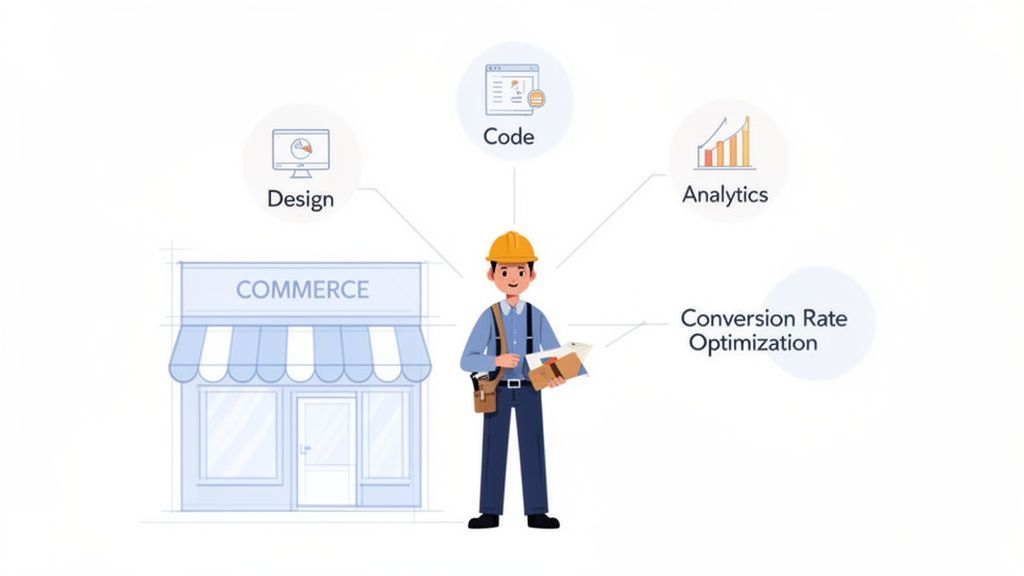
It helps to think of a top-tier Shopify agency as both the master architect and the expert engineering firm for your online shop. Of course, a stunning storefront is part of the package. But their real value is in building a solid, scalable, and conversion-focused platform right from the foundations.
Their role goes way beyond just picking out colours and fonts. A good agency gets stuck into the strategic core of your e-commerce presence, making sure every single decision is aimed at delivering tangible business results. This mindset turns your website from a simple digital brochure into your hardest-working sales tool.
From Initial Strategy to Final Polish
The process of working with a premier Shopify agency kicks off long before anyone even thinks about writing a line of code. It all starts with a deep dive into your brand, your customers, and what you’re trying to achieve commercially. This groundwork is absolutely vital.
A specialist agency will focus on:
- Brand Strategy and Identity: Making sure the website’s look and feel genuinely reflects your brand’s personality and resonates with your ideal customer.
- User Journey Mapping: Charting out the exact path a visitor takes from the moment they land on your site to when they finalise a purchase, smoothing out any bumps along the way.
- Technical Architecture Planning: Figuring out the right mix of apps, integrations, and custom features needed to keep your business operations running like clockwork.
This level of strategic planning ensures the final website isn't just a pretty face. It's a technically sound platform perfectly tuned to your growth goals.
More Than Designers—They Are Growth Partners
Ultimately, the biggest impact a specialised agency has is in its role as a growth partner. They don't just build a site and hand you the keys. They stick around, offering insights and tweaks to make sure your store continues to perform at its best.
A great agency understands that a website launch is not the finish line—it's the starting line. Their work focuses on relentless conversion rate optimisation (CRO), using data to make continuous improvements that directly impact your bottom line.
By blending creative flair with a sharp, analytical approach, these agencies provide a complete service built for long-term success. Getting to grips with the full range of these Shopify store design services is the first step in finding a partner who can genuinely help you scale.
The Core Services That Fuel E-commerce Growth
When you bring a top Shopify agency on board, you’re not just buying a new website theme. You’re investing in a whole system designed to make you money. These services go way beyond just making things look pretty; they’re the individual parts of a well-oiled e-commerce machine, each solving a specific problem, from carving out your brand’s identity to untangling complex back-end logistics.
Forget the one-size-fits-all approach. A specialist agency gets you real results by zeroing in on what actually works in e-commerce. Let’s pull back the curtain and see what these high-impact services really involve and how they feed directly into your sales figures.
Bespoke Theme Development and Design
Sure, you can grab an off-the-shelf Shopify theme, but you risk getting lost in a sea of lookalike stores where your brand just doesn't pop. Bespoke theme development is the answer. It’s about building your digital shopfront from scratch, making sure it’s a genuine reflection of your brand and is perfectly tuned to how your specific customers shop.
Going custom opens up a lot of doors:
- A Truly Unique Brand Experience: Your site won't be a carbon copy of someone else's. This creates a memorable feel that builds brand recognition and, more importantly, trust.
- A Smoother User Journey: Every single element, from the menu to the final click at checkout, is designed with your audience in mind. This removes frustrating roadblocks and makes it dead simple for them to buy.
- Peak Performance: Custom themes are built to be lean and lightning-fast. They don’t have the clunky, bloated code that often slows down pre-made templates. And as we all know, site speed is a massive deal for both conversions and SEO.
Seamless Platform Migrations
Thinking about moving your shop from a platform like Magento, BigCommerce, or WooCommerce over to Shopify? It can feel like a monumental task. A good agency makes this tricky process feel smooth and straightforward. Their whole job is to make sure no critical data gets lost and—crucially—that you don't lose the search engine rankings you’ve worked so hard to earn.
A professionally managed migration involves careful planning to move all your products, customer data, and order history without pulling the plug on your business. This prevents the kind of costly downtime and lost sales that can completely derail a botched move.
Data-Driven Conversion Rate Optimisation
A stunning website that doesn’t turn visitors into paying customers is little more than a very expensive online brochure. This is exactly where Conversion Rate Optimisation (CRO) steps in. It’s a methodical, data-backed process of tweaking your website to get a higher percentage of visitors to do what you want them to do—usually, to make a purchase.
An expert Shopify agency doesn't just guess what might work. They dig into analytics, use tools like heatmaps, and run A/B tests to make informed decisions. They'll methodically fine-tune everything from the colour of a button to the layout of a product page to squeeze the absolute most out of your traffic.
This cycle of continuous improvement means your store is always adapting to what customers want, systematically turning more of your visitors into revenue.
Advanced Integrations and Custom Apps
As your business grows, so do the complexities behind the scenes. A top-tier Shopify agency can connect your store to all the essential business systems you rely on, automating tasks and making everything run more efficiently. This often means deep integrations with:
- Enterprise Resource Planning (ERP) systems to keep inventory and financials in sync.
- Customer Relationship Management (CRM) software to get a single view of your customer.
- Third-Party Logistics (3PL) providers to make order fulfilment a breeze.
But what happens when an off-the-shelf app for a unique business problem simply doesn’t exist? That’s when an agency can step in and build a custom Shopify app designed precisely for you. This can give you a competitive edge that no one else can easily copy. The UK's web design sector, which is deeply connected to Shopify work, brought in £621.3 million in revenue in 2023, which just shows the huge demand for these kinds of technical skills. This growth really underscores how agencies help brands cut through the noise online. You can read more about these web design agency trends on madebyshape.co.uk.
Beyond just building the site, agencies often look at the bigger picture. To ensure their clients don't just launch but also thrive long-term, it's vital to understand how to optimize for AI search and drive real business growth. When a true partner delivers these core services together, they create a powerful foundation for your e-commerce business to grow on for years to come.
Finding the Right Agency: Your Vetting Checklist
Picking a Shopify website design agency is a massive decision. It's not just about the money you're spending; you're handing over a huge amount of trust. The right partner can ignite serious growth, but the wrong one can lead to months of headaches and wasted cash. To sidestep those costly mistakes, you need a solid vetting process that cuts through the slick sales pitch and shiny website.
This guide will give you a practical framework to properly evaluate potential agencies, making sure you find a partner that genuinely gets your business goals. It all starts with taking a proper look at their track record to find proof of real-world results and a design style that actually fits your brand.
This decision tree can help you figure out which agency services make the most sense for your immediate needs—whether that’s a simple visual refresh, a deep dive into conversions, or building out new features.
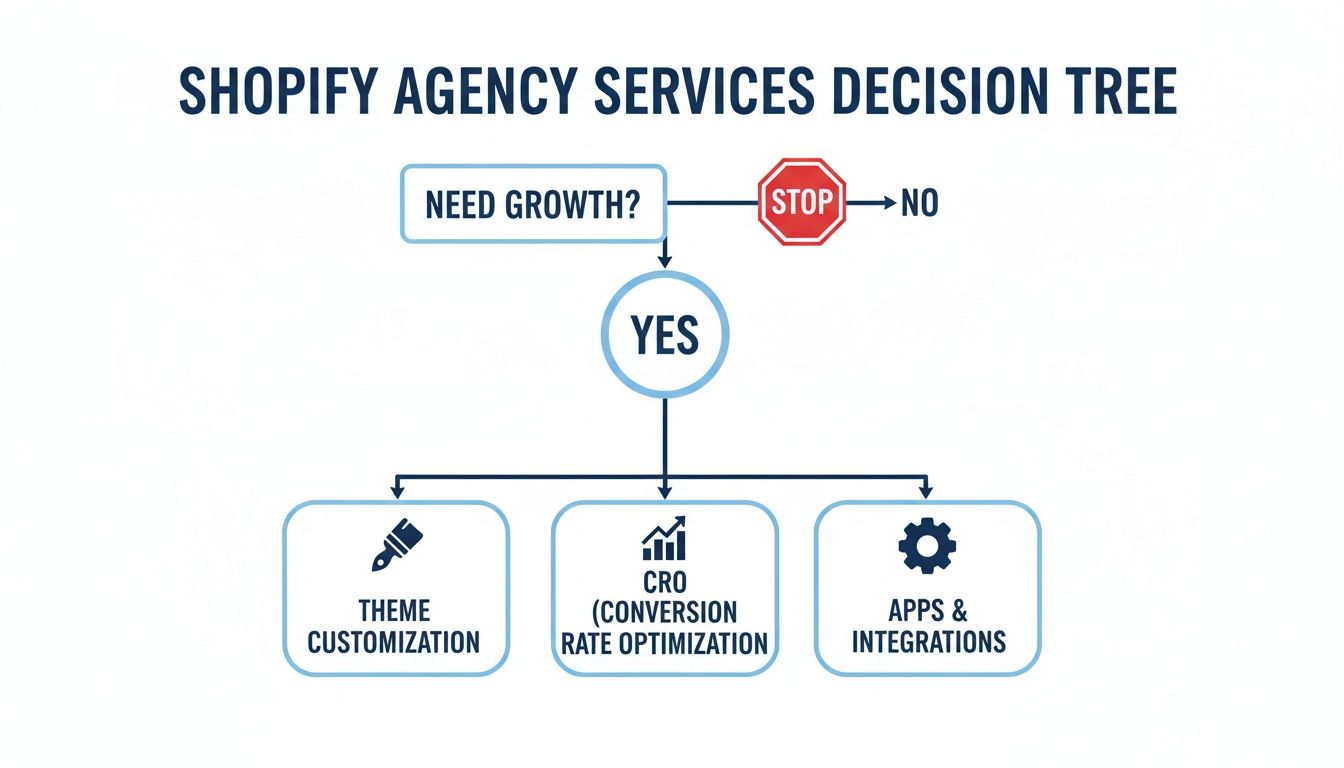
As you can see, if growth is the main objective, the path leads to specialised services like theme development, CRO, or custom app creation.
Scrutinise Their Portfolio and Case Studies
A portfolio should be more than a gallery of pretty websites. Look for proof that the agency has worked in your industry or with businesses of a similar size. An agency that has already helped a fashion brand to scale will probably understand your challenges better than one that mainly works with B2B software companies.
Go beyond the aesthetics and dig into their case studies for measurable results. Vague claims like "improved user experience" just don't cut it. You need to see hard data that shows how their work actually impacted the bottom line.
Look for specific, quantifiable results like these:
- "Increased average order value by 61%."
- "Boosted conversion rates by 20% within three months."
- "Achieved a 50% increase in organic traffic post-launch."
Metrics like these prove the agency ties its design and development work directly to commercial success.
Verify Their Technical Expertise
Not all agencies are built the same when it comes to technical chops. Your vetting process has to confirm they have the development muscle to handle what you need, especially if you’re thinking about complex features or a future move to Shopify Plus.
A truly capable Shopify website design agency won’t just customise a theme; they will architect a solution. They understand the platform’s API limitations, know how to optimise for site speed, and can build custom solutions when off-the-shelf apps fall short.
When you're figuring out the best way to hire an agency, it can be really helpful to look at a detailed guide on how to outsource software development. It gives you a broader perspective on what to look for in a technical partner and how to manage that relationship for the best results.
Agency Evaluation Checklist
To help you stay organised and compare agencies on a level playing field, use this checklist. It breaks down the key areas to investigate, what good looks like, and what should set alarm bells ringing.
| Evaluation Criteria | What to Look For | Red Flags to Watch Out For |
|---|---|---|
| Portfolio & Case Studies | Industry-relevant projects with quantifiable results (e.g., +25% CVR, +40% AOV). Designs that align with your brand's aesthetic. | Vague claims like "enhanced UX" without data. A portfolio with no similar clients or industries. |
| Technical Skills | In-house developers, Shopify Plus experience, custom app development, and headless commerce expertise. | Outsourced development teams, no experience with complex migrations or integrations, reliance on pre-built themes only. |
| Client Testimonials | Direct quotes or video testimonials from named clients. Reviews on platforms like Clutch or Trustpilot. | Generic, anonymous testimonials. A complete lack of verifiable client feedback. |
| Communication & Process | A clear project plan, dedicated project manager, and regular, scheduled updates. Use of project management tools (e.g., Asana, Jira). | Unclear communication channels, no defined process, vague answers about who will manage your project. |
| Growth Focus | Discussion around KPIs, post-launch optimisation strategies (CRO), and long-term partnership potential. | Focus is solely on the one-time build. No mention of how they'll measure success or support you after launch. |
This checklist isn't about ticking boxes for the sake of it; it's a tool to ensure you're asking the right questions and digging deep enough to find a partner who can truly deliver.
Key Questions to Ask Every Potential Agency
Once you’ve shortlisted a few agencies, it’s time to get them on a call. The goal here is to really understand their process, how they communicate, and what success looks like to them. Vague, cookie-cutter answers are a major red flag. You want a partner who has clearly thought these things through.
About Their Process
- Can you walk me through your entire project process, from the first discovery call to post-launch support?
- How do you manage projects and what tools do you use to keep clients in the loop?
- How do you approach user experience (UX) research and data analysis before you even start designing?
About Their Team and Communication 4. Who will be my main point of contact, and how often should I expect to get updates? 5. What’s your process for handling feedback and changes during the design and development stages? 6. How do you make sure the project stays on schedule and on budget?
About Measuring Success 7. What key performance indicators (KPIs) do you track to measure a project's success after it goes live? 8. Can you give me examples of how you've used data to improve a client's site after the initial build? 9. What kind of ongoing support and optimisation do you offer once the website is live?
By asking these sharp questions and carefully picking apart their portfolio, you can move past the sales pitch and find a genuine growth partner.
Getting to Grips with Agency Pricing and Timelines
Trying to nail down the exact cost and timeline for a Shopify project can feel a bit like guesswork. The honest answer is, there’s no one-size-fits-all price. Every store has its own unique ambitions and technical hurdles, which means every project scope is different.
But that doesn't mean you have to go in blind. By understanding the common ways agencies structure their fees and what really drives the schedule, you can set a realistic budget and know what to expect.
Most agencies you talk to will offer one of two main pricing models: a one-off project fee or a monthly retainer. A project fee is a fixed price for a very specific job with a clear beginning and end, like building your new store or migrating you from another platform. It's clean and straightforward.
A monthly retainer, on the other hand, is for ongoing work. Think of it as having a dedicated e-commerce team in your corner, constantly looking for ways to improve your store's performance. They’ll handle everything from fixing bugs to rolling out new features and running A/B tests to boost your sales.
Common Pricing Structures
So, which one is right for you? It really depends on what you need right now. A one-off project is perfect for a big launch or a major overhaul, while a retainer is all about long-term, sustainable growth.
Here’s a quick way to think about it:
- One-Off Project Fees: Ideal for a complete site build, a visual redesign, or a platform migration. You agree on the scope, the cost, and the deadline upfront.
- Monthly Retainers: The best choice for ongoing conversion rate optimisation (CRO), technical support, and gradually adding new features. It gives you the flexibility to adapt and a team focused on your success month after month.
The demand for expert help, particularly flexible retainers, has shot up recently. Shopify's incredible growth in the UK is a huge factor, with store creation worldwide jumping by 32% in 2023. The UK is now the second-largest market, home to 208,000 live stores, including over 5,800 on Shopify Plus. With so much competition, brands need a proper agency partner to get an edge. You can dive deeper into these fascinating Shopify statistics on digitalweblondon.com.
Realistic Project Timelines
Just like the price, the project timeline is tied directly to the complexity of the job. A few simple tweaks might only take a couple of weeks, but a full, custom build is a much bigger undertaking that needs careful planning and execution. Any good agency will walk you through a detailed project plan with clear phases and milestones.
Here are some ballpark estimates to give you a feel for things:
- Theme Customisation (4–8 weeks): This usually involves taking a premium theme, tailoring it to your brand, and integrating a handful of essential apps.
- Custom Store Build (10–16 weeks): We’re talking a completely bespoke design, built from scratch with unique features and some key third-party integrations.
- Shopify Plus Build / Migration (3–6+ months): These are enterprise-level projects. They often involve migrating huge amounts of data, developing custom applications, and creating deep integrations with other business systems, like an ERP.
At the end of the day, the two biggest things that affect both the cost and the timeline are the level of custom design and the complexity of the integrations you need. A beautiful but straightforward theme setup will always be quicker and more affordable than a build that requires lots of custom-coded functionality.
Getting a clear picture of the investment is vital. Taking some time to understand the full cost of e-commerce website development can give you a much stronger financial footing before you start talking to agencies. With these pricing models and timelines in mind, you can go into those conversations with confidence, ready to forge a partnership that will drive real growth.
The Shopify Plus Advantage for Scaling Brands
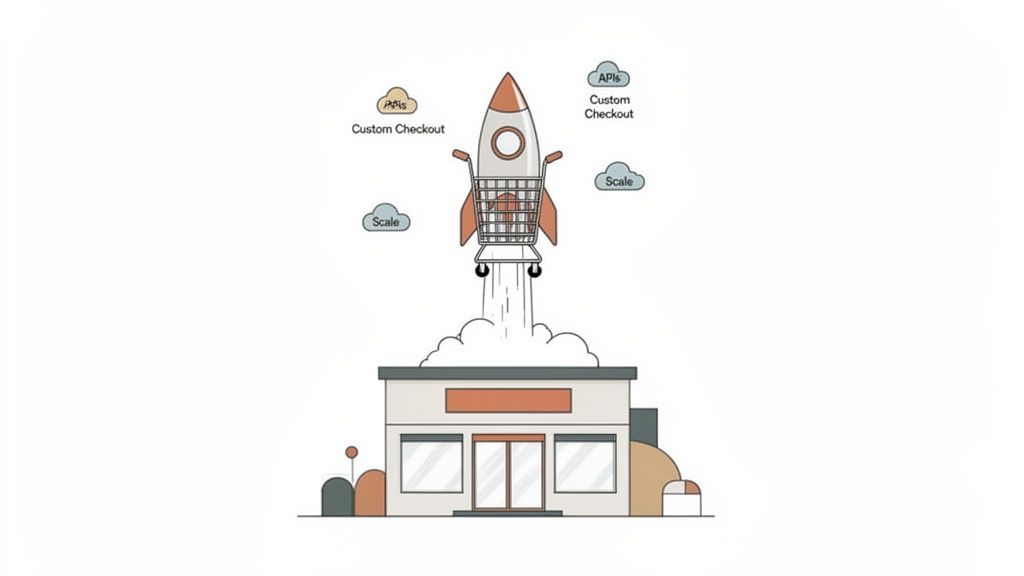
When your brand starts hitting the limits of a standard Shopify plan, it's more than just a good problem to have—it's a clear signal you need more firepower. This is exactly where Shopify Plus enters the picture. It's not just a pricier subscription; it’s an enterprise-level e-commerce platform built for high-volume, ambitious brands that refuse to be held back.
Think of it this way: standard Shopify is like a brilliant sports car—fast, capable, and more than enough for most drivers on the road. Shopify Plus, on the other hand, is a Formula 1 machine. It's engineered for elite performance under the most extreme conditions, but you need a specialist pit crew to get it off the starting grid and winning races. That expert crew is your Shopify website design agency.
Unleashing Enterprise-Grade Features
The real magic of Shopify Plus is hidden in the exclusive tools and flexibility it unlocks. A skilled agency knows exactly how to tap into these features to create bespoke experiences that are simply out of reach on a standard plan.
Some of these game-changing features include:
- Customisable Checkout: The standard Shopify checkout is famously rigid. With Plus, an agency can directly edit the
checkout.liquidfile to build a completely branded, frictionless journey, which is a massive win for reducing cart abandonment. - Expanded API Access: Plus grants much higher API call limits. This is crucial for building robust, complex integrations with your ERP, CRM, and logistics partners, ensuring your entire operation can handle huge order volumes without breaking a sweat.
- Shopify Functions: This is a powerful tool letting developers write custom backend logic. An agency can use it to create unique discount rules, complex shipping calculations, or tiered pricing for B2B customers, all tailored precisely to your business needs.
Building for Unprecedented Scale
A specialised Shopify Plus agency takes these tools and solves the unique challenges that come with rapid growth. They can, for instance, architect your site to handle the massive traffic spike of a Black Friday sale without crashing, protecting your revenue and your brand's reputation when it matters most.
For a growing brand, Shopify Plus isn't a luxury; it's a necessity for competitive advantage. The platform provides the raw power, but only an experienced agency can transform that potential into a scalable, high-converting e-commerce engine.
The UK e-commerce scene is a great example. Shopify is a dominant player here, with around 208,000 live stores, making it the second-largest market in the world. For the brands at the top, Shopify Plus is critical, with its UK presence now at nearly 6,000 stores. This just goes to show the huge demand for agencies that truly specialise in scaling these enterprise-level operations.
Ultimately, getting the most out of Shopify Plus hinges on partnering with an agency that has proven expertise. They bring the technical skill and strategic vision needed to turn your store into a genuine e-commerce powerhouse. To dig deeper, you can explore the specific benefits of Shopify Plus in our detailed guide.
Thinking Beyond the Build: A Partnership for Long-Term Growth
Choosing a Shopify agency isn't just about getting a new website built; it's a major business decision that sets the stage for your future. Think of it as an investment in a long-term partnership aimed squarely at sustainable growth. The right agency becomes a true extension of your team, bringing a potent blend of creative flair, technical know-how, and sharp business sense to your corner.
We've covered a lot of ground in this guide, from essential services like custom theme development and conversion rate optimisation, all the way to the nitty-gritty of vetting potential partners. The whole point is to shift your mindset from seeing an agency as a simple supplier to viewing them as a genuine partner in your growth.
What an Expert Partnership Really Delivers
A top-tier partner brings much more to the table than just clean code and nice graphics. What they’re really building is a high-performance sales machine for your brand—one that's constantly being tweaked and improved for better results. The impact of this kind of collaboration isn't theoretical; it shows up directly on your bottom line.
Here’s what you should expect to see:
- Faster Growth: They'll use data-driven strategies to methodically bump up your conversion rates and average order value.
- A Better Customer Experience: By crafting a fast, intuitive, and enjoyable shopping journey, they'll help you build brand loyalty and keep customers coming back.
- A Real Competitive Edge: A unique, custom-built storefront with features your rivals can't just copy off the shelf.
At the end of the day, a great Shopify agency doesn’t just build you a store; they build you a stronger, more resilient business. They provide the strategic thinking and technical muscle needed to turn your e-commerce vision into a reality that actually makes money.
Armed with the checklists and insights from this guide, you're now ready to confidently assess agencies and pick a partner that truly gets your ambition. Making the right choice is the most important first step you can take to transform your online store into a scalable, profitable, and lasting brand.
Got Questions? We've Got Answers
If you're thinking about bringing in a Shopify design agency, you've probably got a few questions floating around. It's a big decision, after all. Let's tackle some of the most common ones we hear from businesses just like yours.
How Much Does a Shopify Agency Actually Cost?
This is the big one, isn't it? The honest answer is: it depends entirely on what you need. Think of it like building a house – a simple blueprint is one thing, a custom architectural masterpiece is another.
A basic site setup using a premium theme might start from a few thousand pounds. But if you’re after a completely custom-built Shopify Plus store with sophisticated integrations and unique features, you’re looking at an investment in the tens of thousands.
Most agencies price their work in one of two ways:
- One-off Project Fees: You agree on a fixed price for a defined piece of work, like a full site redesign or migrating from another platform.
- Monthly Retainers: This is for ongoing partnership. A typical retainer can range from £3,000 to £10,000+ per month and covers continuous development, strategic guidance, and conversion rate optimisation.
The most important thing? Find an agency that's completely transparent with its pricing. No one likes surprise costs.
What's the Difference Between a Shopify Expert and an Agency?
It really comes down to the scale and scope of the team you're hiring.
A Shopify Expert is usually a highly skilled freelancer, a one-person-band who is brilliant at a specific discipline, like theme development or graphic design. For smaller, clearly defined jobs, they can be a fantastic and cost-effective choice.
A Shopify website design agency, on the other hand, brings a whole team to the table. You're not just hiring a developer; you're getting a UX/UI designer, front-end and back-end developers, a conversion specialist, and a project manager to keep it all on track. This team-based approach is built for tackling more complex, multi-faceted projects.
An agency provides a complete, coordinated strategy. Instead of relying on one person's skillset, you get a dedicated team working in sync to build a powerful e-commerce machine. For brands with serious growth ambitions, it’s a much more scalable solution.
How Long Does a Shopify Website Redesign Take?
Again, it all boils down to complexity. A relatively straightforward redesign using an existing premium theme as a starting point could be wrapped up in as little as 4 to 8 weeks.
For a full-blown custom design and build on Shopify Plus, especially if it includes migrating tons of data or creating bespoke functionality, you need to be more patient. A project of that size and scope will realistically take anywhere from 3 to 6 months from start to finish. Any agency worth its salt will give you a detailed timeline with clear, achievable milestones right from the outset.
Can an Agency Help with SEO and Marketing?
Absolutely. In fact, a top-tier agency bakes technical SEO into the very foundation of your site. They'll make sure your site architecture is sound, your pages load lightning-fast, and everything is perfectly optimised for mobile – all crucial signals for Google.
While many agencies focus squarely on the build and design, most also offer Conversion Rate Optimisation (CRO) as a core service to help you turn more visitors into customers. For things like paid ads, social media, or content strategy, a specialised Shopify website design agency will usually have a little black book of trusted marketing partners they can connect you with, ensuring your launch and marketing campaigns are perfectly aligned.
Ready to turn your Shopify store into a serious revenue-driver? Grumspot is a Shopify Plus agency that fixes, builds, and scales e-commerce experiences at speed. Get in touch today to talk about your project.
Let's build something together
If you like what you saw, let's jump on a quick call and discuss your project
Related posts
Check out some similar posts.
- recently viewed items
Build and optimise recently viewed items on Shopify with code patterns, localStorage, server-side tr...
Read more
- web design agency southampton
Find the best web design agency Southampton. Our 2026 guide covers vetting, pricing, red flags & cho...
Read more
- ecommerce development uk
Your complete guide to ecommerce development UK. Learn to plan, hire an agency, choose a tech stack ...
Read more
- web design agency hampshire
Grumspot is a leading web design agency hampshire specializing in Shopify Plus. We build high-conver...
Read more