Stakeholder Management Approach That Actually Delivers
- stakeholder management approach
- stakeholder mapping
- power interest grid
- engagement plan
- ecommerce stakeholder
Launched
September, 2026

The design freeze is booked for Tuesday. Merchandising wants to reshuffle the category tree, the founder wants a homepage takeover, warehouse operations has found that the proposed checkout interrupts pick and pack, and the CRO agency has delivered a backlog of test ideas nobody has prioritised. The delivery team is calling these scope, UX, and technical issues. They're stakeholder issues wearing different clothes.
A Shopify Plus rebuild, platform migration, or serious CRO programme changes who controls budgets, workflows, data, customer journeys, and operational risk. People affected by that change will influence the work whether you plan for them or not. A practical stakeholder management approach makes that influence visible, gives it a place in the delivery process, and helps the team make decisions before disagreement becomes rework.
Why Every Ecommerce Rebuild Starts with Stakeholders
A storefront rebuild rarely fails because a developer can't implement a component. It fails because the business hasn't agreed what the component is supposed to achieve, who can approve it, or what happens when two teams need different outcomes.
The founder may judge the homepage by brand impact. The merchandising lead may judge it by how quickly seasonal collections can be changed. Paid media may care about landing-page flexibility, while finance focuses on payment risk and margin visibility. Warehouse teams don't care whether the new theme is elegant if the order data arrives in a format their fulfilment process can't use.
Each person has a legitimate concern. Treating them as interruptions creates a predictable pattern. Decisions happen in private conversations, requirements arrive late, and the delivery team spends its time reconciling commitments that were never reconciled at the start.
The work behind the visible work
A rebuild moves more than pixels. It can alter:
- Commercial ownership: Merchandising, trading, and marketing may need to agree who controls navigation, promotions, collection ordering, and campaign content.
- Operational routines: Customer service, fulfilment, finance, and IT may inherit new processes for orders, refunds, inventory, tax, and integrations.
- Decision authority: The person who requested a feature may not be the person who can approve its cost, risk, or release timing.
- Adoption behaviour: Teams may approve a solution and still avoid using it if nobody has prepared them for the change.
The UK Government Project Delivery Functional Standard treats stakeholder engagement as systemic across the full project lifecycle. It calls for stakeholders to be identified, categorised, grouped, and analysed so their interests and influence are represented in planning, with engagement measured and adapted using evidence. The government's stakeholder engagement guidance supports the practical point ecommerce teams often learn late: stakeholder activity belongs inside delivery control, not in a separate communications folder.
Delivery rule: If a stakeholder can delay approval, change a requirement, block an integration, or undermine adoption, they belong in the delivery plan.
A stakeholder management approach is the deliberate practice of identifying the people affected by the work, understanding their needs and influence, and engineering the right involvement at the right point. On a Shopify Plus rebuild, that means connecting stakeholder decisions to tangible outputs such as the product data model, checkout scope, redirect plan, payment setup, UAT scripts, and cutover runbook.
What a Stakeholder Management Approach Actually Is
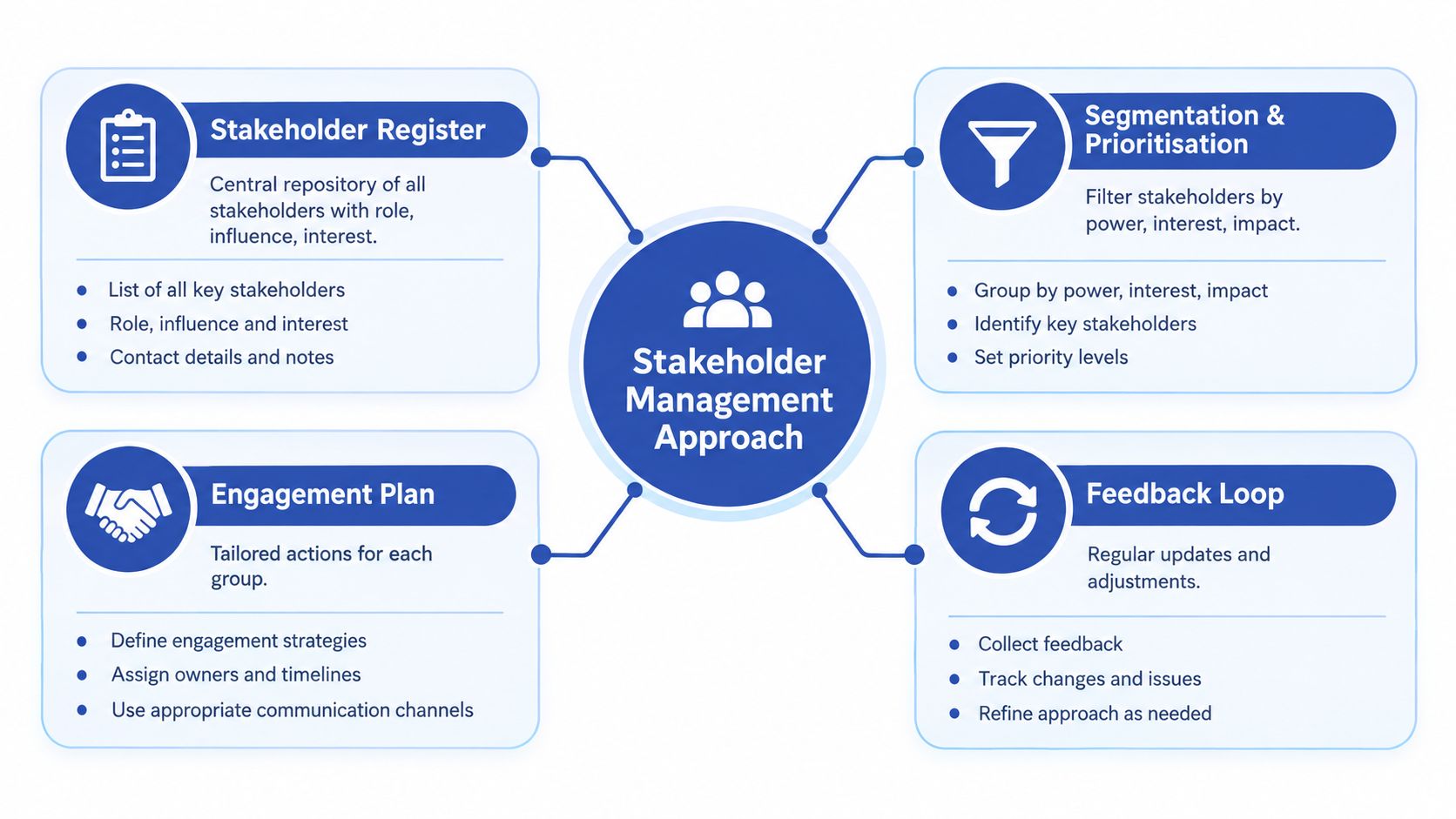
A useful stakeholder management approach is a repeatable operating system, not a polished slide that gets forgotten after discovery. It has four connected parts: a stakeholder register, segmentation and prioritisation, an engagement plan, and a review loop.
Start with a register that names people
The register is the working source of truth. It should identify actual individuals, not just labels such as “marketing” or “the agency”. Capture each person's role, decision rights, interests, risks, preferred communication format, likely stance, and relationship owner.
That distinction matters during a rebuild. The Head of Retention may care about subscription continuity and customer identity, while the CRM manager needs practical detail about event tracking and campaign triggers. Recording both as “marketing” hides the difference and encourages one generic update that serves neither.
Use power and interest to choose where time goes
The power-interest grid turns anxiety into an engagement decision. A high-power, high-interest stakeholder needs close management. A high-power, low-interest stakeholder usually needs concise reassurance and involvement at material decision points. High-interest stakeholders with less formal power should be kept informed because they often expose operational problems early. Low-power, low-interest contacts can be monitored without consuming the team's meeting calendar.
UK public-sector Analysis Function guidance formalises this method. It recommends scoring stakeholder power and interest on a 1-to-10 scale, with three scorers averaging the results to create a more structured map. The guidance also says the map should inform the engagement plan and be refreshed at an interval suited to changing priorities. The Analysis Function stakeholder mapping guidance provides a useful model for ecommerce teams that want something more defensible than instinct.
Turn the map into weekly behaviour
The engagement plan specifies what happens next. For each priority stakeholder, define the purpose, owner, channel, content, frequency, and escalation route. A steering committee may receive a decision-focused status pack. A warehouse lead may need a short workflow demo. A founder may want a commercial checkpoint rather than a ticket-by-ticket review.
The final part is the review loop. A short Friday review can ask who has become more influential, whose interest has dropped, which decision is stuck, and where the current cadence is failing. Update the register and grid after sprint reviews, major scope decisions, UAT, and launch retrospectives. The UK project-delivery guideline describes the broader process as identification, analysis, strategy, communication, execution, monitoring, and revision, with a proportionate and cost-effective approach. The UK project management guidance aligns closely with how a live ecommerce programme needs to operate.
The Three Frameworks Worth Knowing
Mendelow's power-interest grid, RACI, and an engagement plan solve different problems. Choosing one and expecting it to cover the others is how delivery teams end up with clear boxes but unclear behaviour.
Mendelow helps answer where to spend attention. RACI clarifies who owns a decision or deliverable. Engagement planning defines how the relationship will be maintained over time. On a replatform, I'd use the grid to shape steering-group attention, RACI for checkout and product-page decisions, and an engagement plan to keep the founder, category buyers, agencies, and operations aligned throughout the build.
| Framework | Primary purpose | Best fit in ecommerce | Common failure mode |
|---|---|---|---|
| Mendelow power-interest grid | Prioritise stakeholder attention | Replatform steering committees and migration governance | It can mislead when formal power differs from practical blocking power |
| RACI | Clarify delivery and decision rights | Checkout, PDP, integrations, data migration, and UAT ownership | Matrixed teams create overlapping Accountable owners |
| Engagement planning | Define cadence, channel, content, and ownership | Keeping executives, buyers, agencies, and operational teams aligned | It becomes a calendar of meetings without decision intent |
Mendelow tells you who needs your time
A grid is valuable under pressure because it forces a trade-off. You can't manage every stakeholder closely when the team is resolving checkout defects, mapping catalogue data, and preparing redirects. The framework helps identify who needs a working session, who needs a decision summary, and who can receive a controlled update.
It still needs judgement. Legal might appear low interest because its team isn't attending design workshops, but a compliance objection can stop a launch. Influence should reflect the ability to approve, block, redirect, or create operational resistance, not just seniority or meeting attendance.
RACI tells you who decides
RACI is effective when a deliverable has a clear boundary. For example, engineering may be Responsible for implementing checkout extensions, the ecommerce director may be Accountable for the commercial outcome, finance and operations may be Consulted, and customer service may be Informed.
The problem appears when several leaders believe they're Accountable, or when a stakeholder is marked Consulted but never gets a meaningful opportunity to influence the decision. RACI identifies involvement rights, but it doesn't specify the conversation needed to secure alignment.
Product and project responsibilities often overlap in ecommerce, so a plain-language explanation such as product manager explained can help teams separate product direction from delivery coordination before assigning ownership.
Engagement planning keeps relationships useful
An engagement plan gives each relationship a practical rhythm. A category buyer may need fortnightly prototypes and decision logs. A CFO may need a monthly view of cost, risk, and commercial trade-offs. An agency partner may need daily delivery channels and a formal escalation route.
Use all three. The grid sets priority, RACI sets decision rights, and the engagement plan turns both into behaviour.
How to Design and Run the Approach Step by Step
The most reliable process is simple enough to run during a busy build, but specific enough to expose hidden influence. Complete the first four steps before design kickoff. If you wait until late-stage UAT, you're no longer managing stakeholders, you're negotiating under deadline pressure.
Identify every affected party. List internal teams and external partners. Include merchandising, trading, IT, finance, customer service, fulfilment, paid media, CRM, legal, analytics, design, developers, platform partners, and any agency with a decision or dependency. In a Shopify Plus migration, the warehouse systems owner belongs in the register even if they never attend a theme workshop.
Segment using observable behaviour. Score influence and interest based on what each stakeholder can approve, block, redirect, or affect. Don't assume the founder is high interest because they attend the kickoff, and don't classify the Head of Retention as low power because they don't own the budget. Their ability to withhold operational adoption may be more important than their title suggests.
Prioritise around milestones. Give each stakeholder an objective tied to delivery. For the CFO, the objective might be timely approval of payment and migration risk decisions. For the Head of Retention, it might be validated customer-account and subscription flows before UAT. For merchandising, it might be an agreed product taxonomy and content workflow before build completion.
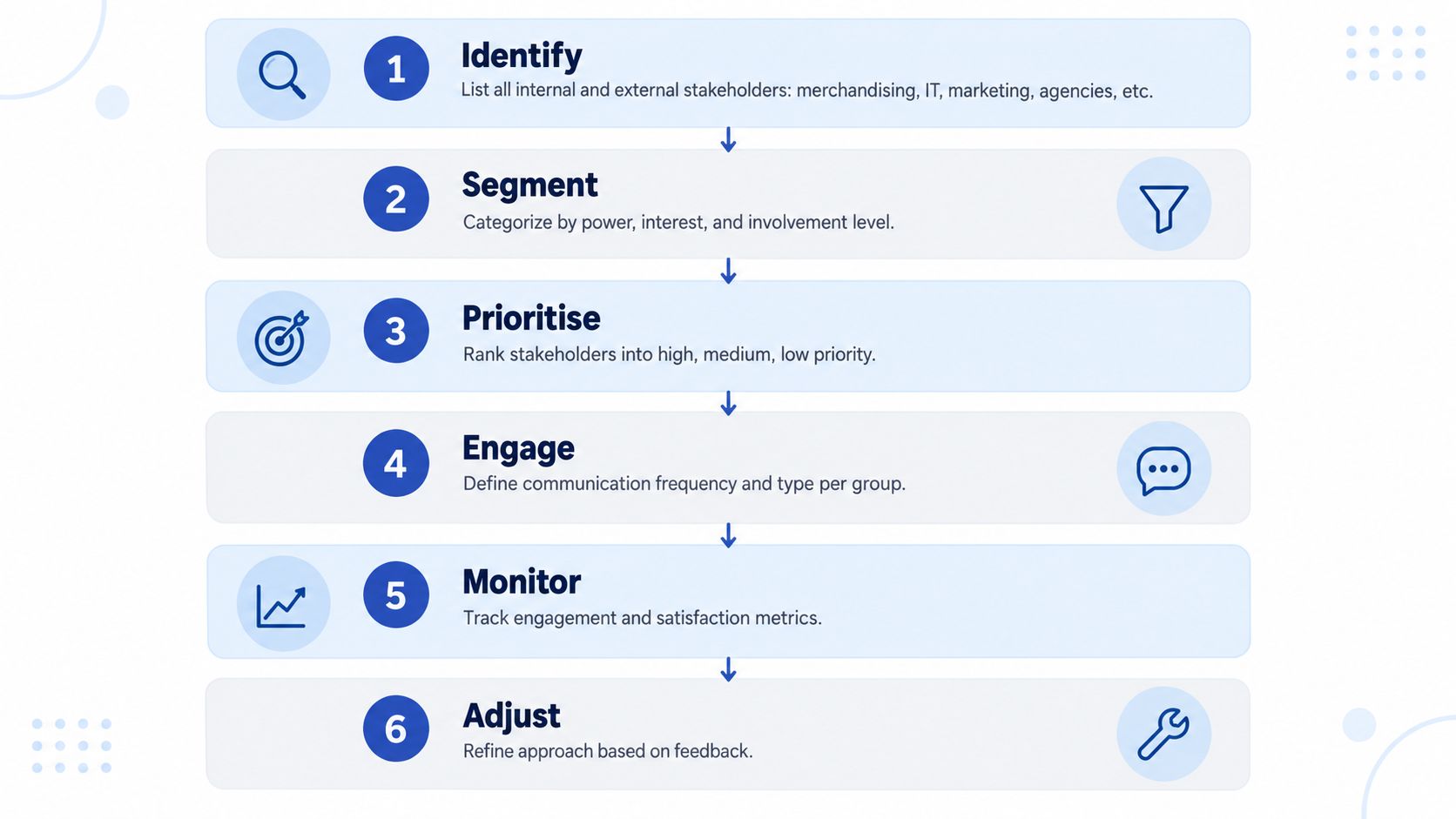
Choose the engagement mix. Match the interaction to the decision. Use working sessions for detailed requirements, demos for experience feedback, written decision logs for governance, and steering meetings for trade-offs that need executive authority. A stakeholder communication playbook is useful when the team needs a shared approach to formats, escalation, and delivery ownership.
Execute with named owners. Every priority stakeholder needs a relationship owner. That person prepares the agenda, records decisions, follows up on actions, watches for disengagement, and escalates before a missed response becomes a sprint dependency. The delivery lead shouldn't personally own every relationship.
Revise after evidence arrives. Review the map after each sprint review, major scope decision, UAT cycle, and post-launch retro. A stakeholder who was neutral during design may become highly influential when fulfilment testing reveals a process change. Update the plan rather than defending the original workshop output.
A practical sequence is to identify and interview stakeholders first, segment and prioritise them next, then agree decision rights and engagement rhythms before the first design review. That order prevents the common mistake of asking people to approve screens before agreeing what authority they have and what business problem the screens must solve.
KPIs and Review Cadences That Prove It Works
Stakeholder work needs evidence, but the wrong measures create false confidence. Meeting attendance alone doesn't prove alignment. A stakeholder can attend every steering meeting and still delay decisions, reject UAT outcomes, or ignore the new workflow after launch.
Track signals that connect relationships to delivery movement. The UK Government Project Delivery Functional Standard expects engagement success to be monitored and adapted using evidence, which is a useful discipline for ecommerce programmes as well. The review cadence should match the speed of the signal.
| KPI | What it signals | Review cadence |
|---|---|---|
| Approval cycle time by stakeholder quadrant | Whether decisions are reaching the right people at the right time | Weekly during active delivery |
| Pulse sentiment from short stakeholder checks | Confidence, concern, or growing resistance | Monthly, with extra checks around UAT and cutover |
| Attendance and decision rate | Whether governance meetings produce participation and outcomes | At every working session and steering meeting |
| Change requests after UAT | Unresolved expectations or late discovery of requirements | After each UAT cycle |
| Feature usage after launch | Whether affected teams are adopting the delivered workflow | During stabilisation and later operational reviews |
| Support ticket themes | Friction that formal project meetings failed to surface | Weekly after go-live, then less frequently once stable |
Read weak signals in context
A low change-request count can mean the scope is understood. It can also mean stakeholders have stopped reviewing the work. Compare it with attendance, response quality, UAT completion, and the tone of feedback. Silence is not approval.
Similarly, a high attendance rate can hide poor decision quality if every meeting ends with “we'll take that away”. Define what counts as a decision, record the owner, and give it a due point in the delivery plan. Guidance on project timeline management can help connect those decisions to dependencies rather than leaving them in meeting notes.
For subscription and retention work, commercial and behavioural signals need context. Teams reviewing recurring revenue and customer behaviour may also want to understand churn with RecurX, but analytics won't replace direct feedback from the people responsible for retention journeys and support.
Intervene when a signal worsens across more than one review, when a critical decision has no active owner, or when UAT reveals a workflow that the responsible team never validated. Don't wait for the migration plan to slip before changing the engagement approach.
Common Pitfalls and Misconceptions in Ecommerce Projects
Senior leaders aren't automatically high-power, high-interest stakeholders. A founder may join the kickoff, delegate the programme, and only reappear when a launch date or brand decision is at risk. Classify the person's current ability and willingness to influence the work, then revisit that assessment when the project enters a sensitive phase.
RACI isn't a stakeholder management approach on its own. It tells you who is Responsible, Accountable, Consulted, and Informed, but it doesn't tell you whether the Accountable person needs a commercial summary, a prototype, a risk workshop, or an escalation call. Teams that stop at RACI often discover that everyone knows the owner and nobody has secured the owner's commitment.
Sign-off also isn't the same as adoption. The checkout team may approve a flow and still bypass the new reporting process. Merchandising may approve a taxonomy and later recreate old workarounds. Customer service may accept the migration plan but remain unprepared for account, delivery, or refund questions after launch.
The failure points I look for first
- Agency treated as one stakeholder: Strategy, design, engineering, and account leadership have different incentives and different ability to affect delivery. Map the individuals who can make or block decisions.
- Executive sponsor omitted: Budget approval doesn't guarantee active sponsorship. When replatform risks surface, the team needs someone with authority to resolve competing priorities.
- Legal and compliance underestimated: Low workshop attendance can hide high blocking power. Confirm approval requirements early.
- Communication confused with engagement: Sending a status report doesn't mean the recipient understood the trade-off or accepted the decision.
- Every stakeholder invited to everything: Large meetings dilute ownership and slow decisions. Invite people for a defined contribution, then document the outcome for everyone else.
- No owner for the relationship: If nobody notices that a stakeholder has stopped responding, the risk remains invisible until it reaches UAT or cutover.
The fixes are candid. Name the person, record the decision right, agree what they need to see, appoint an owner, and review the relationship when the work changes. Keep meetings smaller, make decisions explicit, and treat post-launch adoption as part of delivery rather than a handover problem.
A Shopify Plus Store Rebuild Example and Quick Checklist
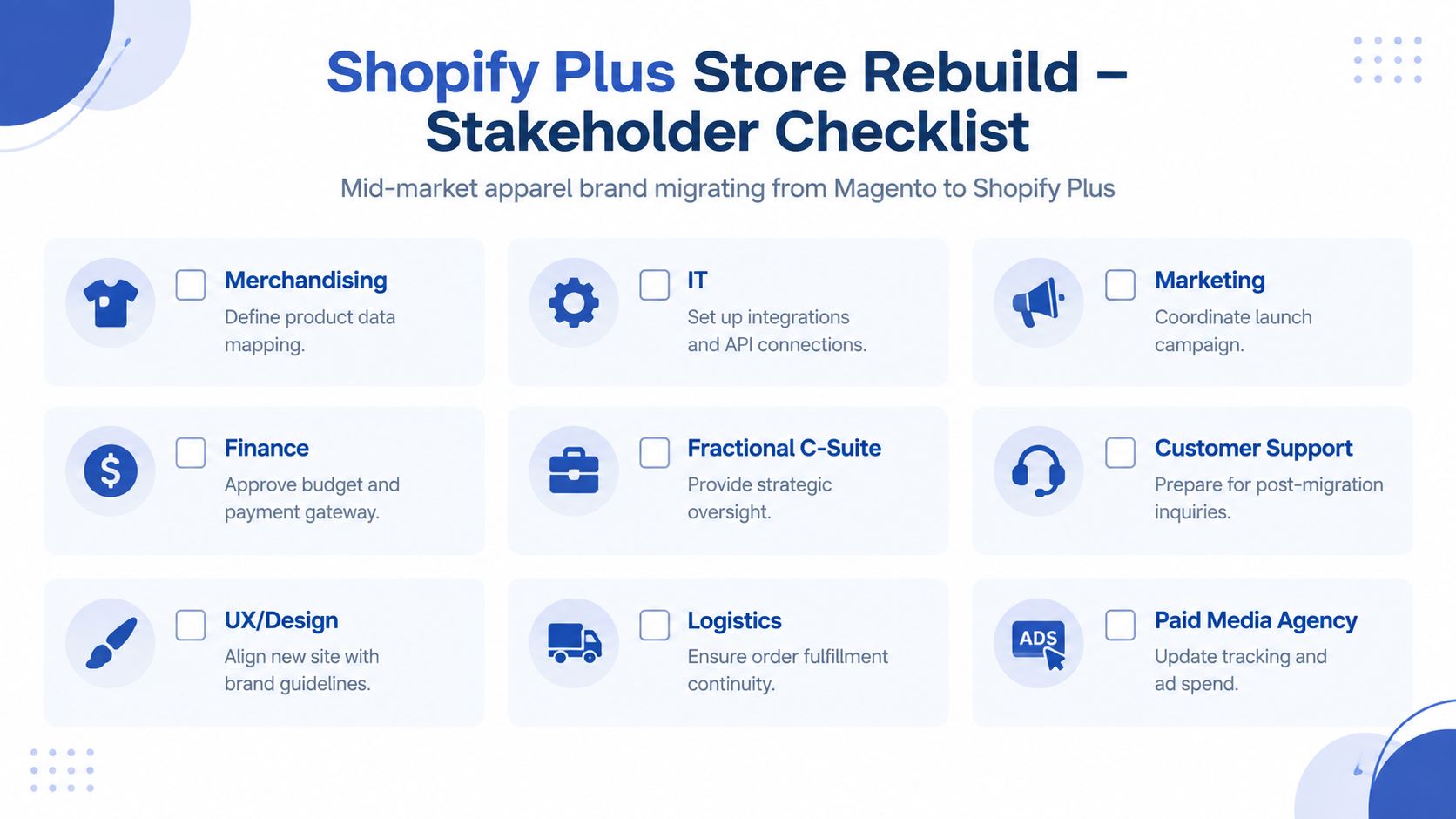
A mid-market apparel brand was migrating from Magento to Shopify Plus. The delivery team mapped nine stakeholders across merchandising, IT, marketing, finance, a fractional C-suite, customer support, UX, logistics, and the paid media agency. The map separated formal authority from practical influence, so the logistics lead received close involvement in order and fulfilment testing rather than being treated as a downstream recipient.
The team attached each relationship to a milestone. Merchandising owned product data mapping decisions, IT coordinated integrations, finance reviewed payment and budget risks, and paid media validated tracking and landing-page requirements. A weekly stakeholder standup gave each owner a place to raise decisions, not just provide status.
That rhythm caught a pricing-rule regression before staging. The issue would have affected promotional logic during cutover, but the right operational stakeholder was present early enough to challenge the implementation. The approach protected the launch by bringing a commercial risk into the delivery conversation before it became a production incident.
A reusable day-one checklist
- Identify: List internal teams, external partners, decision-makers, blockers, users, and operational owners.
- Analyse: Record interests, constraints, influence, decision rights, and likely support or resistance.
- Plan: Place stakeholders on the power-interest grid and define the required cadence, channel, content, and owner.
- Act: Run workshops, demos, steering meetings, decision reviews, and targeted follow-ups tied to real deliverables.
- Review: Check response quality, approval movement, UAT participation, unresolved concerns, and adoption signals.
- Revise: Update the register, map, ownership, and engagement plan after each material change or review point.
For migration validation, pair stakeholder sign-off with a practical guide to validating data after migration. The people who own catalogue, orders, customers, finance, and fulfilment should validate the records and workflows they depend on, not approve a generic statement that “the data looks fine”.
Grumspot helps Shopify and Shopify Plus teams structure stakeholder decisions across rebuilds, migrations, integrations, and CRO work, then turn those decisions into shipped storefront improvements. If your project is losing time to unclear ownership, late feedback, or conflicting priorities, visit Grumspot to discuss the delivery support your team needs.
Let's build something together
If you like what you saw, let's jump on a quick call and discuss your project

Related posts
Check out some similar posts.
- stakeholder communication
Master stakeholder communication with a practical playbook for ecommerce and Shopify projects. Cover...
Read more