Stakeholder Communication Playbook for Ecommerce Projects
- stakeholder communication
- ecommerce project management
- Shopify agency workflow
- communication plan template
- stakeholder mapping
Launched
August, 2026
The project channel is busy, the weekly status email has gone out, and everyone appears to be informed. Then the marketing director discovers that the migration changed the site's SEO structure. The operations lead learns that the ERP integration has slipped. The founder asks why nobody raised the risk earlier. Technically, the team has communicated. Practically, it has left the business exposed.
That gap between frequent updates and useful updates causes a disproportionate amount of friction in ecommerce. Shopify migrations, CRO sprints, subscription builds, and ERP integrations bring together people who measure progress in completely different ways. Developers think in dependencies, marketers think in customer journeys, operations teams think in fulfilment continuity, and executives think in commercial risk.
UK public-sector practice reflects the same underlying lesson. Government engagement standards describe stakeholder communication as planned, transparent, representative, regular, and sustainable, while the Office for National Statistics defines engagement as “any communication” across channels including email, newsletters, meetings, consultations, events, and social media. The UK Government's principles of engagement make the expectation clear: communication should support decisions throughout a project, not just document that a meeting happened.
Why Most Ecommerce Projects Fail at Stakeholder Communication
A Shopify Plus migration can look healthy from the development team's perspective. The new theme is fast, the components are reusable, and the staging store resembles the approved designs. But a storefront isn't just a collection of templates. It carries URL structures, metadata, redirects, merchandising rules, analytics events, content workflows, customer-service processes, and fulfilment dependencies.
In one familiar scenario, the development team ships a polished new storefront while the marketing director discovers that collection URLs have changed without her approval. She now has to investigate organic landing pages, redirect coverage, canonicals, and content ownership under launch pressure. Meanwhile, the operations lead learns that the ERP integration timeline has moved by several weeks because product and order mappings weren't confirmed early enough.

The failure wasn't a lack of activity. It was a failure to connect activity to the people who could make decisions or absorb consequences.
Updates aren't the same as communication
An update reports movement. Communication creates shared understanding and prompts the right response. “Homepage development is complete” is an update. “Homepage development is complete, but the promotional module still needs a decision on discount logic by Thursday to protect the launch plan” is communication.
The second version gives the recipient three things:
- Context: what has changed.
- Consequence: why it matters.
- Action: what someone needs to do next.
This distinction matters because ecommerce projects contain hidden dependencies. A CRO test can alter analytics requirements. A new subscription app can affect customer service scripts. An ERP decision can change checkout, inventory, returns, and finance workflows. If the agency only reports completed tickets, stakeholders receive information without a usable model of the project.
Communication must support confidence
A strong communication system lets stakeholders answer four questions quickly:
- What has changed?
- What does it affect?
- What decision or input is needed?
- What happens if nobody acts?
Project leaders also need to communicate upwards without burying executives in implementation detail. Teams responsible for talking to leadership with confidence at Intonetic will recognise the principle: senior audiences need a clear recommendation, the business implication, and the decision window.
The best agencies treat stakeholder communication as part of delivery quality. They don't wait for confusion to surface in a steering meeting. They expose assumptions early, name owners, record decisions, and make risks visible while there is still time to respond.
Mapping Your Stakeholders Before the Project Starts
Stakeholder mapping should happen before the first sprint, not after the first disagreement. UK Civil Service guidance treats mapping as the first operational step, with the engagement plan built from the map and reviewed as influence, interest, and priorities change. The Civil Service stakeholder mapping guidance offers a useful model for ecommerce teams because it replaces blanket messaging with audience-specific contact.
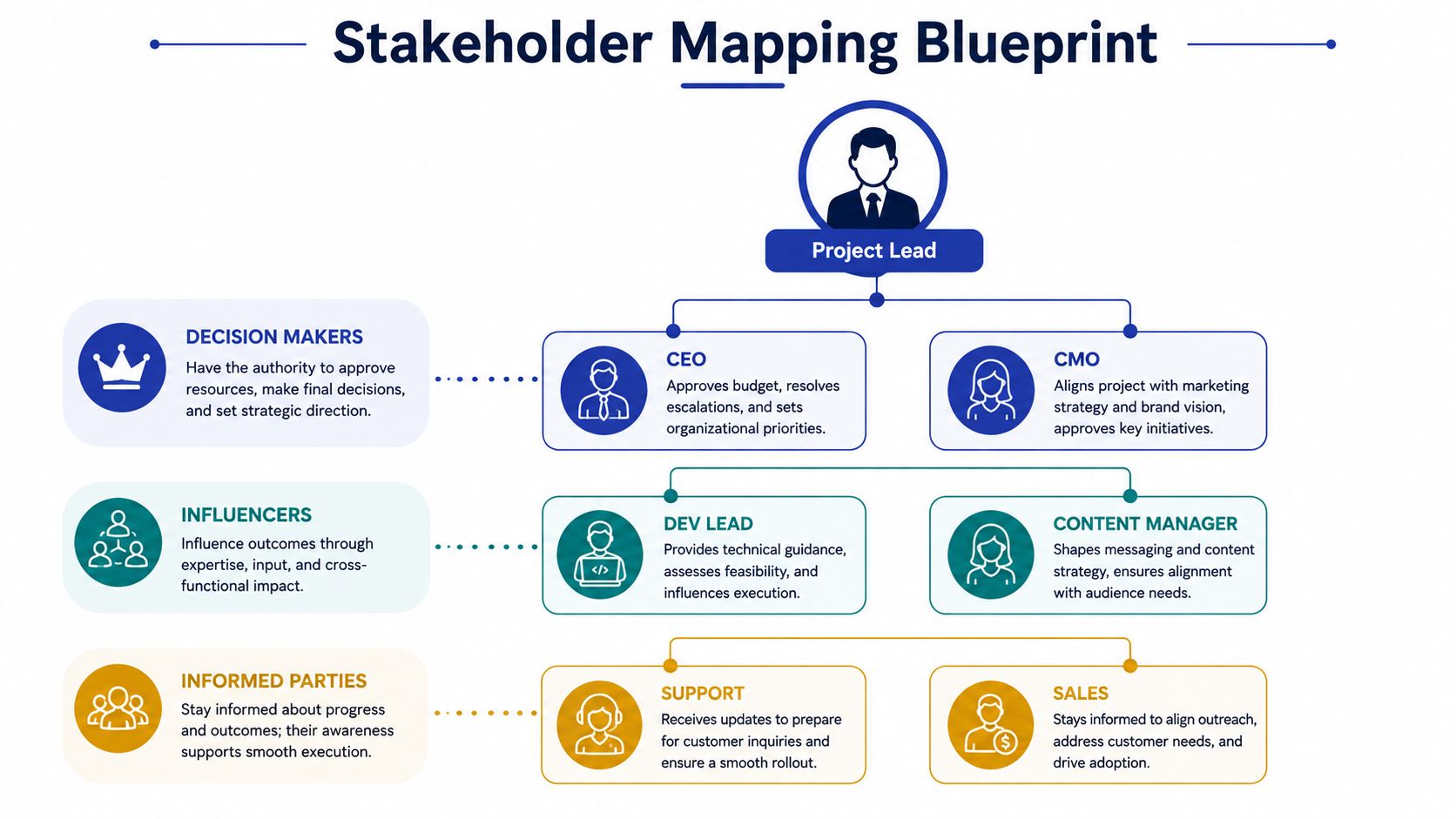
Take a subscription platform rebuild. The obvious stakeholders are the merchant founder, ecommerce director, technical lead, and agency project manager. The complete map is wider:
- Commercial decision makers: founder, CFO, ecommerce director.
- Customer experience owners: marketing director, CRM manager, customer service lead.
- Technical influencers: CTO, development lead, analytics owner, app partners.
- Operational owners: warehouse lead, finance manager, fulfilment provider, ERP vendor.
- Users affected by change: sales, support, merchandising, and customers.
Build the map around decisions
Create a simple power-interest grid, then add a third field for decision rights. Influence tells you who can change the direction of the project. Interest tells you how closely they need to follow it. Decision rights tell you who must approve a change before work proceeds.
A founder may have high influence and high interest, and want frequent visibility. A CTO may have high influence but low interest in design detail, preferring a concise risk summary. A customer-service lead may have moderate influence and high operational interest because a subscription migration changes cancellation, refund, and delivery conversations.
For every stakeholder, record:
| Field | Question to answer |
|---|---|
| Desired outcome | What does success look like to this person? |
| Main concern | What could make them resist or escalate? |
| Decision rights | What can they approve, reject, or unblock? |
| Information need | What detail helps them act confidently? |
| Preferred format | Do they need a call, dashboard, email, or working session? |
| Escalation route | Who should be involved when an issue exceeds their authority? |
The merchant founder might want a short daily note, while the CTO only needs a monthly architectural summary. Don't force both into the same meeting or document. Give the founder confidence about momentum and decisions, and give the CTO evidence about dependencies, technical risk, and maintainability.
Include external partners in the map
ERP vendors, payment providers, fulfilment partners, app developers, and SEO consultants often sit outside the client organisation, but they can control critical path items. Give them named owners, required inputs, deadlines, and escalation contacts. A partner shouldn't first hear about a launch dependency when the project is already in a release freeze.
Mapping also protects scope. A clearly defined stakeholder group can contribute requirements without turning every preference into an approved feature. Use a documented project scope definition to separate goals, assumptions, exclusions, and change requests.
For a visual explanation of how roles and influence connect, use the following walkthrough:
Review the map at each major phase, especially after discovery, design approval, integration testing, and launch. People who were peripheral during discovery can become essential when operational processes change.
Building a Communication Plan That Gets Used
A migration can have daily updates and still leave the merchant unsure whether launch risk is rising. The problem is usually not communication volume. It is that updates lack a clear audience, decision, or next action. A usable plan sits beside the roadmap, decision log, risk register, and sprint board. Each row should state who receives the message, what they need to know, which channel carries it, who sends it, and what happens when the normal rhythm no longer fits.
Start with the purpose, then choose the channel. Slack suits quick clarification between developers and technical partners, but it is a poor place for an executive to reconstruct launch status. Email works for formal approvals and decisions because it leaves a clear record. A project management platform suits assigned actions when the team agrees which notifications require attention. During an ERP integration, a failed mapping should reach the technical owner immediately, while its impact on launch confidence belongs in the stakeholder summary.
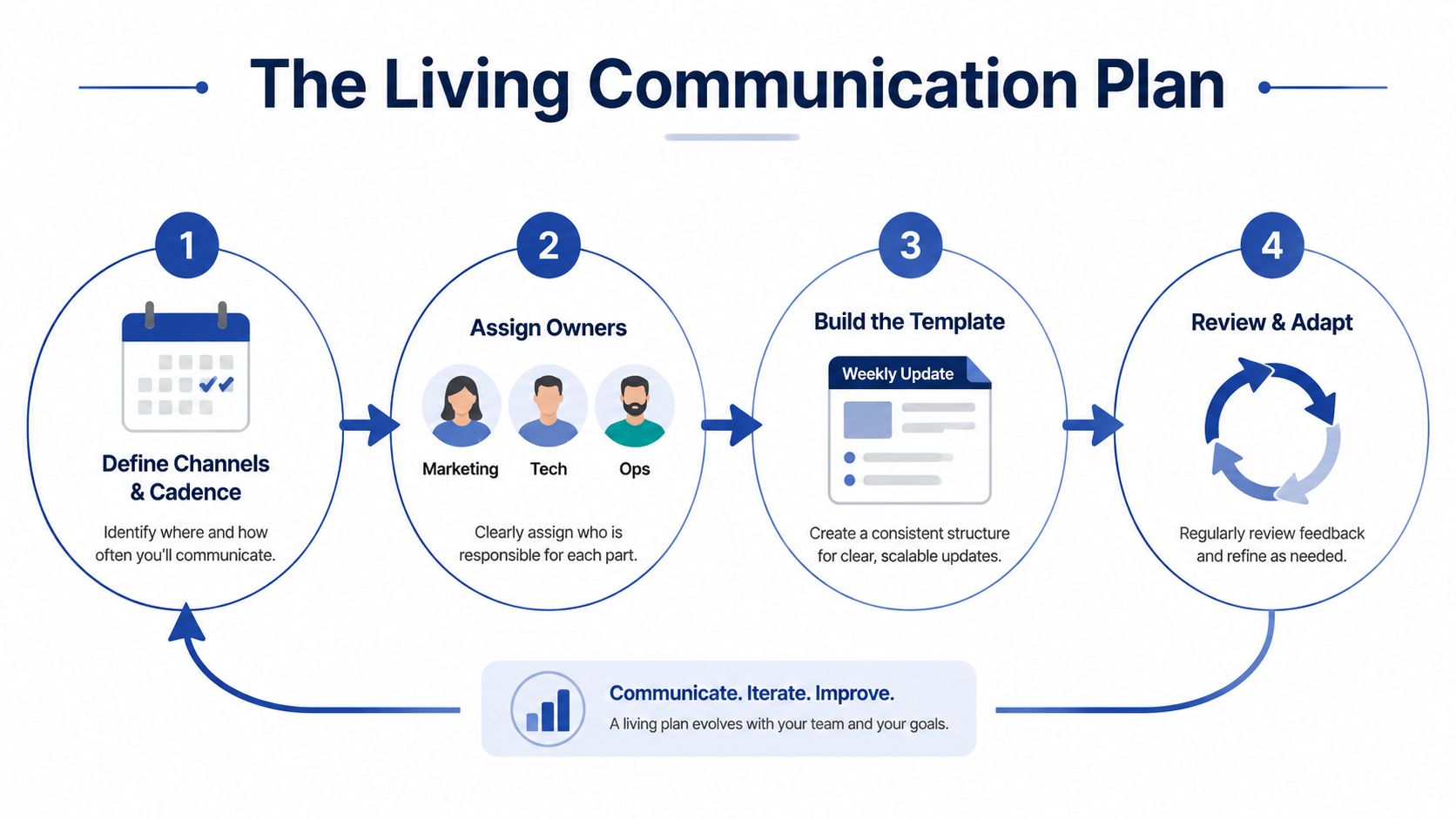
A practical operating rhythm
Give each contact point a defined job:
- Daily: developers and project leads use stand-ups or async check-ins to surface blockers, dependencies, and immediate priorities.
- Weekly: the core team receives a written snapshot covering completed work, current work, decisions needed, risks, and the next milestone.
- Bi-weekly: CRO or design teams review test results, hypotheses, creative decisions, and upcoming experiments with the relevant commercial owners.
- Monthly: sponsors receive a steering summary focused on scope, budget position, timeline confidence, business impact, and unresolved decisions.
These rhythms should respond to risk. A high-risk ERP integration may require more focused working sessions than a stable theme build. A CRO sprint may need fast experiment decisions, while a migration can depend on slower approval windows. Assign a reason to every update so the calendar does not fill with meetings that merely repeat the same status.
Give every message an owner
Name the person responsible for preparing and sending each communication. Record the recipient group, channel, format, and escalation trigger as well.
A weekly update template might contain:
Decision needed: Confirm whether the launch scope includes the new returns portal.
Progress: Product templates and collection filtering are ready for review.
Risk: ERP test data is incomplete, which limits end-to-end validation.
Owner: Operations lead to provide the missing scenarios.
Date: Approval required before the next integration test window.
This format lets the recipient scan and act. It separates completed tasks from evidence that the project remains healthy.
Keep one source of truth for decisions. If a decision happens in Slack, copy it into the decision log with the date, owner, rationale, and affected scope. When assessing agency or technology partners, apply the same discipline to vendor selection criteria, including reporting, ownership, escalation, and integration responsibilities.
Review the plan after a finance owner changes, the launch date moves, or a new app enters the build. Those events can make the original cadence and recipient list obsolete.
Running Effective Meetings and Building Useful Dashboards
Meetings should exist to make decisions, resolve dependencies, or build shared understanding. They shouldn't be used to read a status report aloud. Send written progress before the meeting, then reserve live time for questions that need discussion.
A Shopify 2.0 migration typically needs several meeting types, each with a different job:
| Meeting Type | Purpose | Key Attendees | Cadence | Duration |
|---|---|---|---|---|
| Delivery stand-up | Surface blockers and coordinate work | Developers, QA, project lead | Daily | Short |
| Design review | Approve experience decisions and expose trade-offs | UX, marketing, merchandising | Weekly or as needed | Focused |
| Integration working session | Resolve mappings, dependencies, and test failures | Technical, operations, ERP partner | Based on risk | Focused |
| CRO review | Review hypotheses, implementation, and learning | CRO, analytics, marketing | Bi-weekly | Focused |
| Steering committee | Decide on scope, risk, resources, and timing | Sponsor, client leads, agency lead | Monthly | Structured |
| Launch readiness review | Confirm operational and technical readiness | All accountable owners | Before launch | Detailed |
Use agendas that force action
A useful steering agenda starts with the decisions required, not the project history. Follow it with changes since the last meeting, top risks, upcoming gates, and explicit owners. Every action should have a named owner and due date.
A development stand-up needs less ceremony. Ask what changed, what is blocked, and which dependency needs another team. Don't invite executives to a technical stand-up unless they need to remove a specific obstacle.
Dashboards should follow the same principle. The technical team may need deployment status, open defects, test coverage, and integration failures. The project lead needs milestone confidence, dependency health, unresolved decisions, and scope movement. The executive sponsor needs commercial implications, launch confidence, and the risks requiring intervention.
Avoid metrics that look active but don't drive a decision. Ticket volume, hours logged, and the number of Slack messages can create the appearance of control without showing whether the store is becoming safer to launch.
Measure communication as part of delivery
UK Government communications standards recommend monitoring outputs, outtakes, and outcomes throughout a campaign, with roughly 5% to 10% of total campaign spend allocated to evaluation. The Government Functional Standard for Communications provides a useful benchmark for ecommerce programmes too. Track whether messages were delivered, understood, and acted upon.
For an agency project, that might mean checking:
- Whether decision requests receive responses within the agreed window.
- Whether risks reach the correct owner before they become incidents.
- Whether stakeholders can explain the current scope and launch conditions.
- Whether repeated questions reveal a gap in the dashboard or documentation.
- Whether retrospectives produce changes to the communication plan.
A dashboard is successful when it reduces interpretation. If every stakeholder needs a meeting to understand it, the dashboard is another communication problem.
Choosing Usefulness Over Frequency in Your Communication
More updates don't automatically create more confidence. They can create the opposite effect when stakeholders receive repetitive messages, conflicting versions, and notifications without a clear request.
The Regulator of Social Housing's 2024–2025 stakeholder survey offers a practical reminder about channel fit. 417 stakeholders said letters or email remained the most helpful format, while social media was viewed as less helpful. The stakeholder survey for 2024–2025 isn't an ecommerce performance report, but its channel lesson transfers well: choose the format people can use, not the format that creates the most visible activity.
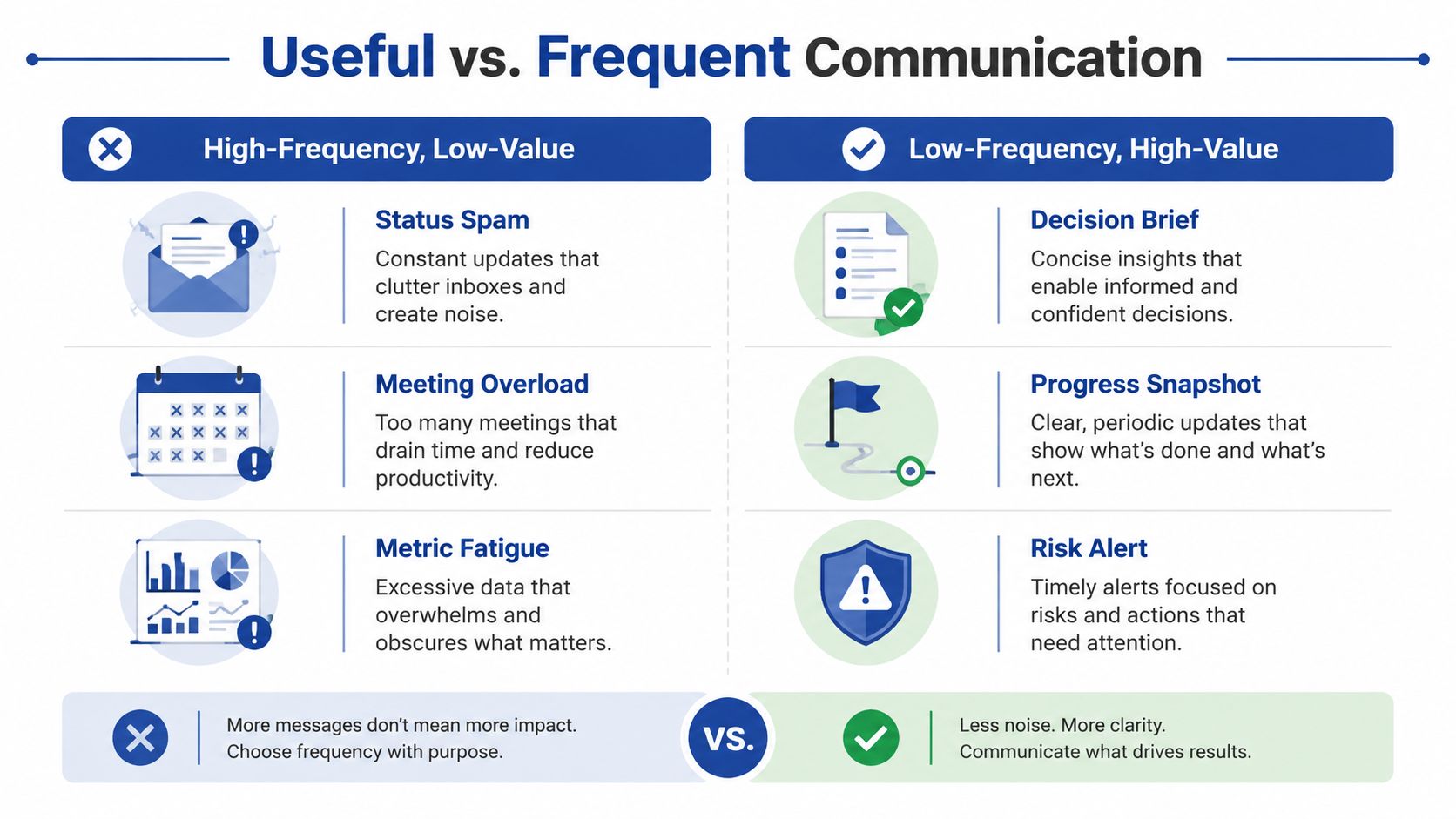
A merchant may prefer a concise email with a decision request over a stream of Slack notifications. A developer may need rapid technical discussion. A CFO may want a monthly risk summary. Use stakeholder preference as a design input, then test whether the chosen format produces the intended response.
Design escalation around consequences
Escalation should never depend on how anxious someone feels about an issue. Define triggers in advance:
- An app integration fails a required test and no workaround has an agreed owner.
- A change affects checkout, fulfilment, payments, data protection, or customer service.
- A launch decision becomes time-sensitive because another dependency is approaching.
- A CRO change produces an unexpected customer or trading risk.
- A scope request affects agreed timing, budget, or acceptance criteria.
The message should move through the right level. The delivery team handles a contained implementation issue. The project lead handles a dependency that threatens a milestone. The executive sponsor handles a trade-off involving scope, investment, or launch risk.
Make feedback part of the system
Ask stakeholders whether the communication is useful, not whether they enjoyed the meeting. A short retro question can reveal more than another status call: “Which update helped you make a decision this month, and which one could we remove?”
The BBSRC stakeholder research shows why frequency alone is a weak measure. Exactly one third of surveyed stakeholders interacted at least monthly in 2018, down from 39% in 2016 and 47% in 2014, while 74% said BBSRC communicated well with their organisation and 57% said it communicated its impact effectively. The BBSRC Corporate Stakeholder Research 2018 demonstrates that communication can be perceived as more effective even when contact happens less often. For ecommerce teams, the implication is direct: optimise for relevance, clarity, and action.
Example Messages for Common Ecommerce Project Moments
Templates work when they reduce thinking at the moment pressure rises. They shouldn't make messages sound robotic. Keep the structure consistent, then adapt the emphasis for the recipient.
Kickoff announcement
For the full project group:
Subject: Shopify migration kickoff, decisions and working rhythm
We're starting the migration with three delivery priorities: preserve organic visibility, protect trading operations, and create a maintainable storefront foundation. The project board is the source of truth for actions, the decision log records approvals, and weekly updates will highlight progress, risks, and decisions needed. Please review the stakeholder map and flag any missing owner before discovery begins.
For the executive sponsor:
Decision needed: Confirm the executive sponsor for launch readiness and the escalation route for scope decisions.
Why it matters: The team needs one accountable route when technical, commercial, and operational priorities conflict.
Required by: Before discovery sign-off.
Weekly update
A weak update lists tickets. A useful one explains movement and asks for action.
This week: Product templates, collection filtering, and analytics event mapping progressed as planned.
Decision needed: Marketing to approve the redirect ownership process.
Risk: The ERP partner still needs representative order scenarios for end-to-end testing.
Impact: Without those scenarios, operations can't validate fulfilment and refund flows.
Next action: Operations lead to provide examples, project lead to confirm the revised test window.
For a technical lead, include dependencies, affected systems, and acceptance criteria. For a marketing director, explain SEO, merchandising, content, or campaign implications. For a CEO, reduce the message to the decision, commercial consequence, and confidence in the next milestone.
Risk escalation
Subject: Action required, subscription app integration risk
The subscription cancellation event isn't passing reliably into the CRM test environment. The team has isolated the issue to the event mapping, but the current workaround hasn't been approved. We recommend pausing the related release until the app partner confirms the mapping and customer service signs off the cancellation flow. Please confirm whether to prioritise this fix over the next CRO sprint.
Launch and post-launch
Launch status: The new storefront is live, core purchase flows have been checked, and the launch watchlist has named owners. The team will monitor trading, support, analytics, and fulfilment signals through the agreed review window. Next, we'll close residual defects, document learnings, and prioritise the first optimisation backlog.
After launch, ask for specific feedback about the process rather than a vague “Any thoughts?” The guide on how to ask for client feedback is useful when you need questions that encourage actionable responses. Ask what created confidence, where information arrived too late, and which meeting or report should change.
Putting It All Together and Avoiding Common Mistakes
Treat stakeholder communication as an operating system for the project, not a collection of emails. Start with a mapping session, record influence and decision rights, agree preferred channels, and publish the first version of the communication plan before delivery begins.
Use this implementation checklist:
- Map the people: Include internal teams, sponsors, partners, and operational users.
- Assign decisions: Record who approves scope, design, SEO, integrations, and launch readiness.
- Set the rhythm: Separate daily delivery coordination from weekly reporting and executive governance.
- Create templates: Prepare the kickoff note, weekly update, risk alert, decision record, and launch message.
- Define escalation: Write down the triggers, owners, and response routes.
- Review usefulness: Ask stakeholders what helped them decide and remove communication that adds noise.
- Transfer knowledge: Store decisions, system context, and operating guidance through a defined knowledge transfer process.
The common mistakes are predictable. Teams forget to refresh the map, allow decisions to remain buried in chat, invite too many people to meetings, and mistake activity for progress. They also collect feedback without changing the system.
Measure whether communication is working through practical signals: decisions are made with less chasing, risks reach the right owner earlier, repeated questions decline, and stakeholders can describe the current scope and next milestone. If those signals don't improve, change the communication design rather than sending more updates.
Grumspot helps ecommerce teams align design, development, CRO, SEO, and complex Shopify integrations through structured updates, shared decision-making, and clear delivery ownership. Visit Grumspot to discuss a migration, storefront build, or integration project where useful stakeholder communication is part of the delivery plan.
Let's build something together
If you like what you saw, let's jump on a quick call and discuss your project

Related posts
Check out some similar posts.

- stakeholder management approach
Learn a stakeholder management approach built for ecommerce, with frameworks, templates, KPIs, and S...
Read more