Project Timeline Management: The Practical Playbook for 2026
- project timeline management
- project planning
- milestone tracking
- timeline templates
- project roadmap
Launched
August, 2026
In the UK Government Major Projects Portfolio, projects take an average of 8.5 years to deliver, according to the 2023–24 IPA Annual Report. Over that kind of delivery cycle, a timeline isn't a decorative Gantt chart. It's the operating model for decisions, dependencies, approvals, resources, risks and stakeholder expectations.
Project timeline management becomes difficult when the work leaves the project team's direct control. A planning authority may extend a decision period, a supplier may miss a handover, or two senior stakeholders may disagree after a deliverable has already entered production. The practical answer isn't to produce a more detailed schedule and hope for the best. It's to build a timeline that makes uncertainty visible, assigns ownership to external dependencies and creates a disciplined way to respond when assumptions change.
The Critical Role of Project Timeline Management
A schedule maker gives a project a shared version of reality. It shows what must happen, who owns each activity, which decisions are still outstanding and where delay will affect the final outcome. Without that shared view, teams often optimise individual tasks while missing the sequence that controls delivery.
The consequences are visible in UK infrastructure data. Analysis of projects undertaken between 2015 and August 2025 found that 79.3% of contracts finished above budget, with an average budget overrun of 17.5%. In a sample of 48 UK road projects, 58% finished late, and those late projects ran 29% longer than estimated on average, as reported in the IPA evidence base. These figures don't prove that every delay causes a particular cost increase, but they show why schedule control and delivery control can't be separated.
The schedule is a decision system
A useful timeline does more than display dates. It helps the project manager ask practical questions:
- What has to be true first? A design may be complete, but procurement can't start until its specification is approved.
- Who controls the next decision? If an external authority owns the activity, the project team needs an engagement plan, not just a task bar.
- What happens if the date moves? The schedule should reveal affected work, contractual commitments and stakeholder communications.
- Which date is fixed? A statutory deadline, a funding condition and an internal preference shouldn't receive the same treatment.
Weak schedules hide uncertainty inside optimistic durations. Strong schedules separate delivery effort from waiting time, record assumptions and expose the critical path. They also make stakeholder frustration easier to manage because people can see whether a missed date resulted from incomplete work, an unresolved decision or a dependency outside the team's authority.
Practical rule: Treat every important date as an assumption with an owner, an evidence base and a response if it slips.
Project timeline management is therefore a governance discipline. It protects cost, sequencing and trust by making the project's real constraints visible early enough for people to act.
Creating a Realistic Project Timeline from Scratch
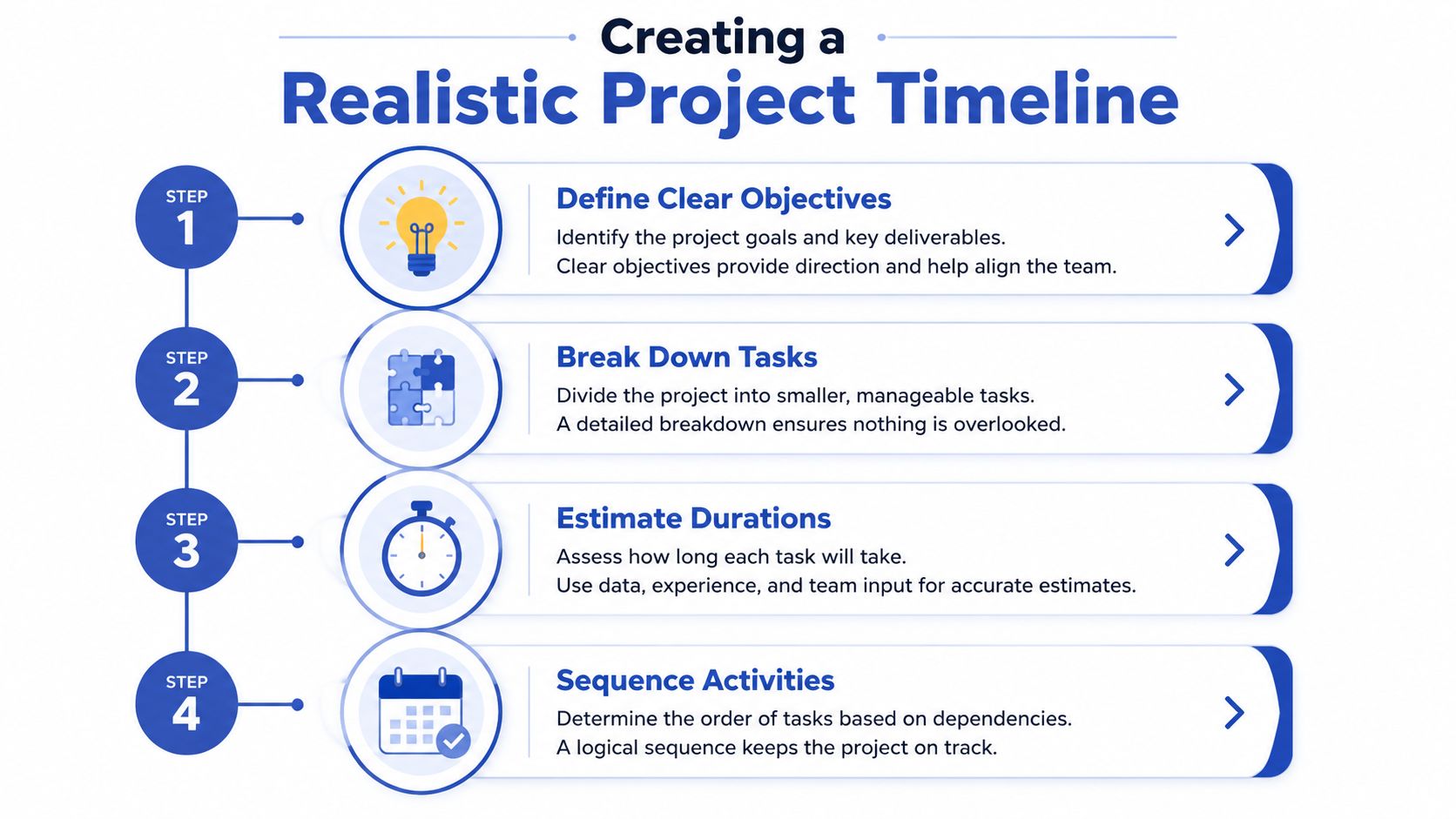
Start with the outcome, not the calendar. Write down the deliverables, acceptance criteria, exclusions and decision rights before assigning dates. A clear project scope definition prevents the common mistake of scheduling a vague ambition as though it were a finished piece of work.
Build the schedule in working layers
Use a work breakdown structure to move from outcome to phase, deliverable, activity and actionable task. A task should have one clear owner and a finish condition that another person can verify. “Complete platform work” is too broad. “Approve checkout interface against signed acceptance criteria” is schedulable.
Then estimate duration with the method that matches the uncertainty:
- Analogous estimating: Use a comparable completed project when the work is familiar and the differences are understood. Adjust for scope, team capacity and external conditions instead of copying an old date.
- Three-point estimating: For uncertain work, record optimistic, most likely and pessimistic outcomes. This exposes assumptions that a single confident number would conceal.
- Bottom-up estimating: Ask the people doing the work to estimate smaller activities, then aggregate them. This takes more effort but usually gives the team a stronger basis for challenge and ownership.
Don't confuse effort with elapsed time. A task may require limited hands-on work but still depend on a review queue, supplier response or public decision. Model those waiting periods explicitly.
Validate before you promise
Invite delivery leads, procurement, legal, operations and external relationship owners into the planning session. Ask each person what could prevent their date from holding, what they need before starting and which assumptions they believe are weak. Their input improves accuracy, but it also creates a record of commitment that a project manager can revisit.
A baseline schedule should include milestones, dependencies, owners, assumptions and approval points. It should also show the difference between a target date and a firm constraint. Use the calendar to sequence work only after the logic has been tested.
Watch this practical walkthrough for a visual treatment of timeline construction:
Review the first version with a simple challenge: if an external decision takes longer than expected, which tasks move, which can continue and who must act? If the schedule can't answer those questions, it isn't ready for commitment.
Mapping Dependencies and Milestones for Clarity
Most timeline failures aren't caused by a team forgetting that work exists. They happen because the relationship between activities is vague. A dependency map turns a list of tasks into delivery logic, showing where one team must wait for another and where work can proceed in parallel.
Map the relationships that control flow
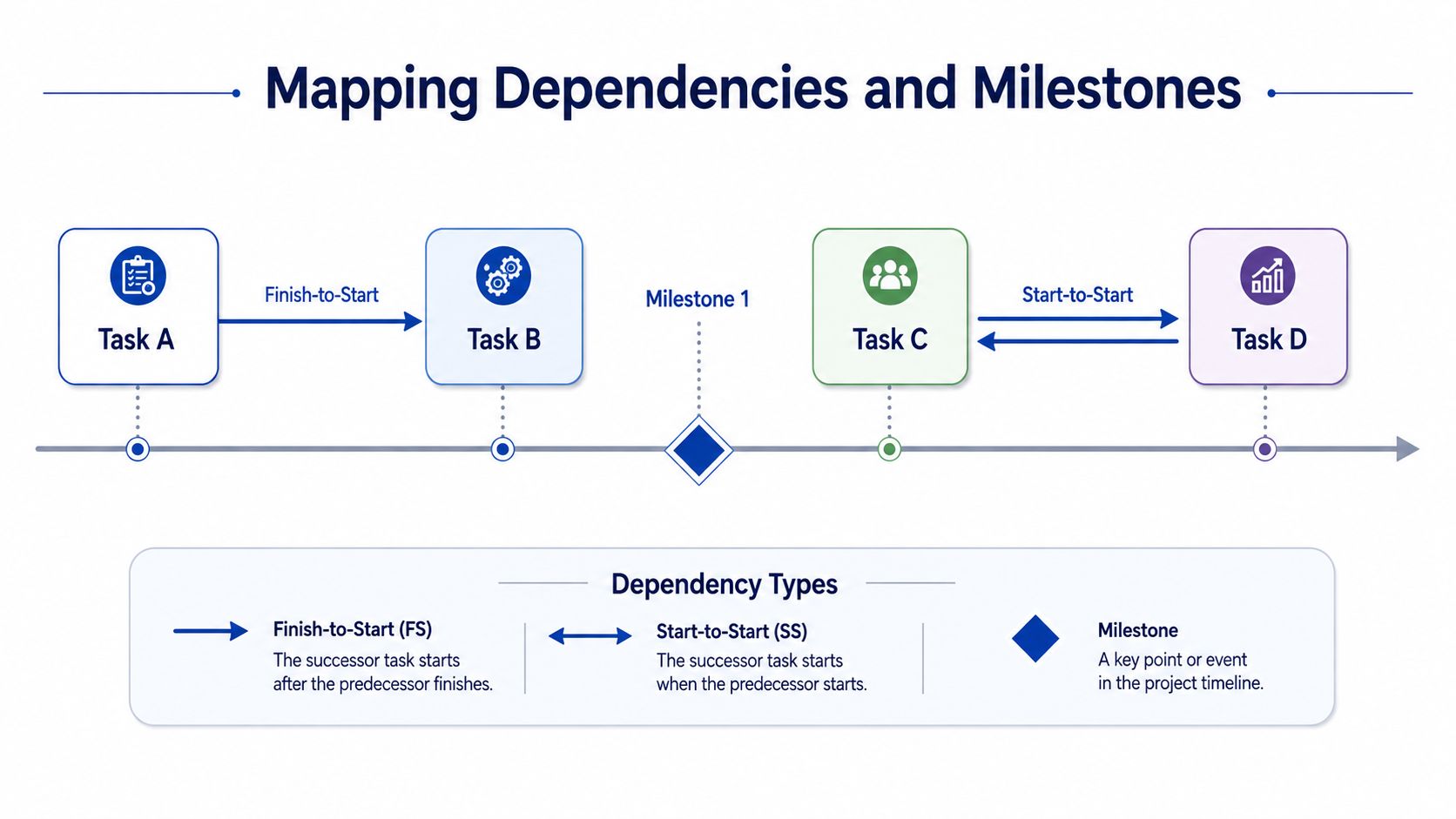
A finish-to-start dependency means Task B can't begin until Task A finishes. This is the clearest relationship, but it shouldn't be used as a default for every connection. A start-to-start dependency allows two activities to begin together, perhaps with one team producing an initial output while another begins preparation. Other relationships may involve a required finish before another activity can finish, or a deliberate waiting period between them.
For each dependency, record:
- The predecessor and successor.
- The reason the relationship exists.
- The person who can release the next activity.
- Any lag, review or approval period.
- The consequence if the predecessor moves.
This approach distinguishes a genuine constraint from a habit. Teams often schedule tasks sequentially because that feels safe, even when partial work could proceed in parallel. The trade-off is that parallel work can create rework if the upstream decision changes, so only overlap activities when the benefit justifies that exposure.
Use milestones for decisions, not decoration
A milestone should represent a meaningful change in project status. Examples include scope approval, design acceptance, procurement authorisation, readiness for testing or a formal go-live decision. Avoid filling the timeline with ceremonial dates that don't trigger action.
Milestones work best when each one has an owner, evidence of completion and a decision attached. If a supplier has been selected, the milestone might require an approved evaluation record and a signed commercial decision, not merely a meeting in the diary. The vendor selection criteria should be agreed before the milestone is treated as achievable.
External approvals deserve their own lane in the schedule. In England, only 20% of major planning decisions made in the year to March 2025 were decided within the 13-week statutory timescale, while 75% relied on extension-of-time agreements, according to the Home Builders Federation analysis. A project timeline that shows only construction effort and omits the approval pathway is structurally optimistic.
Choosing the Right Tools and Cadence for Updates
Choose a timeline tool based on project complexity, collaboration needs and the cost of stale information. A spreadsheet suits a small, stable project with one owner. It becomes fragile when several people edit dates, dependencies remain unlinked and stakeholders work from different copies.
| Tool Type | Key Features | Pros | Cons | Ideal For |
|---|---|---|---|---|
| Spreadsheet | Dates, owners, status fields and manual formulas | Familiar, flexible and inexpensive | Version control and dependency logic require discipline | Small teams with simple sequencing |
| Gantt software | Bars, linked dependencies, milestones and baselines | Clear calendar view and useful critical-path visibility | Can become cluttered without good task design | Multi-phase delivery with fixed relationships |
| Kanban platform | Workflow columns, cards, owners and work-in-progress visibility | Strong for daily execution and changing priorities | Time duration and external approvals may be less visible | Iterative teams managing active work |
| Portfolio platform | Cross-project views, resources, risks and governance data | Helps leaders compare priorities and capacity | Requires configuration and consistent data ownership | Programmes with several connected projects |
| Collaboration workspace | Comments, decisions, files and notifications | Keeps discussion close to the work | Often needs integration with a formal schedule | Distributed teams coordinating decisions |
Use a Gantt view for the committed delivery plan and a Kanban view for work currently in progress. One screen rarely handles both purposes well. Pair a high-level schedule with an operational board when the team needs strategic visibility alongside day-to-day flow.
Teams assessing dedicated project milestone tracking software should test whether it records dependencies, approval status, baseline changes and decision history clearly. A polished interface cannot resolve unclear ownership, missing evidence or inconsistent updates.
Set a cadence that matches risk
Update the working schedule whenever a material event occurs. Examples include a missed handoff, a changed requirement, a delayed approval or a decision that alters downstream work. Waiting for a scheduled meeting allows stale assumptions to spread through the plan.
Match review frequency to exposure. Teams handling active dependencies may need brief delivery checks often enough to identify blocked work early. A more structured milestone review can then confirm forecasts, unresolved risks and decisions required from sponsors. This split keeps routine execution moving without turning every update into a governance meeting.
Every update should answer four questions:
- What changed? Record movement against the baseline.
- Why did it change? Distinguish completed effort from waiting time, rework or decision delay.
- What does it affect? Trace the consequence through linked activities, approvals and handoffs.
- What decision is needed? Name the owner and the date by which action matters.
Approval bottlenecks and stakeholder misalignment often appear first as small date changes. Recording the cause and downstream effect gives sponsors a clearer basis for resolving them before they become delivery delays.
Assign one person responsibility for schedule integrity, while task owners provide timely, evidence-based updates. The timeline earns trust when its dates reflect current conditions, its decisions are recorded and its exceptions have a clear owner.
Managing Risks and Slack in Your Timeline
A schedule without risk treatment is a prediction presented as a plan. Delivery teams already know that suppliers, approvals, resources and requirements can move. The professional response isn't to add unexplained padding everywhere. It's to identify uncertainty, place deliberate slack where it protects the outcome and define the trigger for using it.
Put risk beside the activity it threatens
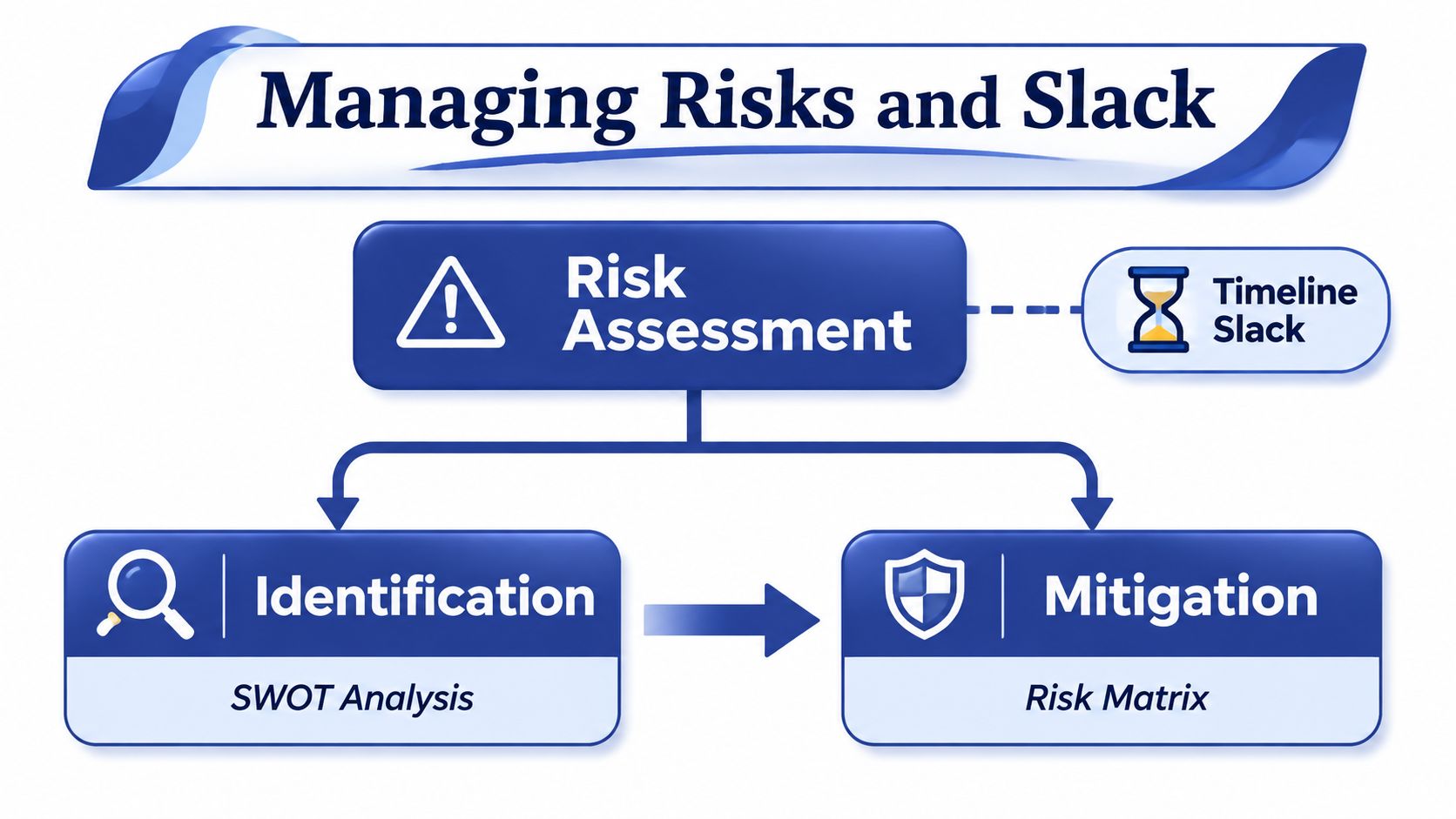
Use a risk register linked to schedule tasks. A useful entry states the cause, event, effect, owner, early warning signal and response. SWOT analysis can expose internal weaknesses and external threats, while a risk matrix helps prioritise the items that deserve active mitigation rather than passive monitoring.
For an approval dependency, mitigation might include earlier pre-application engagement, a complete evidence pack and a named contact responsible for responding to queries. For supplier work, it might include clearer acceptance criteria, an alternative sourcing route or an interim deliverable that lets downstream work continue.
The incident response planning framework should connect to the schedule rather than sit in a separate document. When an issue occurs, the team needs a response path, decision authority and recovery sequence that can be reflected in the live timeline.
Use slack deliberately
Slack, or float, is the time an activity can move without changing a relevant successor or the final completion date. Project managers can place it between uncertain activities, protect a major milestone or hold a shared contingency reserve. The choice depends on the risk profile and the cost of delay.
Local float can protect a specific dependency, but teams may consume it without telling anyone. A central reserve gives the project manager more control, although it can look like hidden padding if the assumptions aren't documented. Both approaches fail when slack is treated as spare time for new scope.
Slack isn't permission to delay. It's a controlled response to uncertainty.
Review the remaining float at each major update. If a risk uses part of the buffer, record the event and reforecast the outcome. If the critical path changes, tell sponsors early. UK evidence reinforces why this discipline matters: a review of infrastructure projects between 2015 and August 2025 reported an average cost outturn 10.8% above contract budget, with 11 out of 25 projects in one sample showing a cost overrun, as documented in Appendix A of the government review. Resilient scheduling won't remove uncertainty, but it gives the team room to respond before a local problem becomes a programme-level failure.
Implementing Effective Change Control Processes
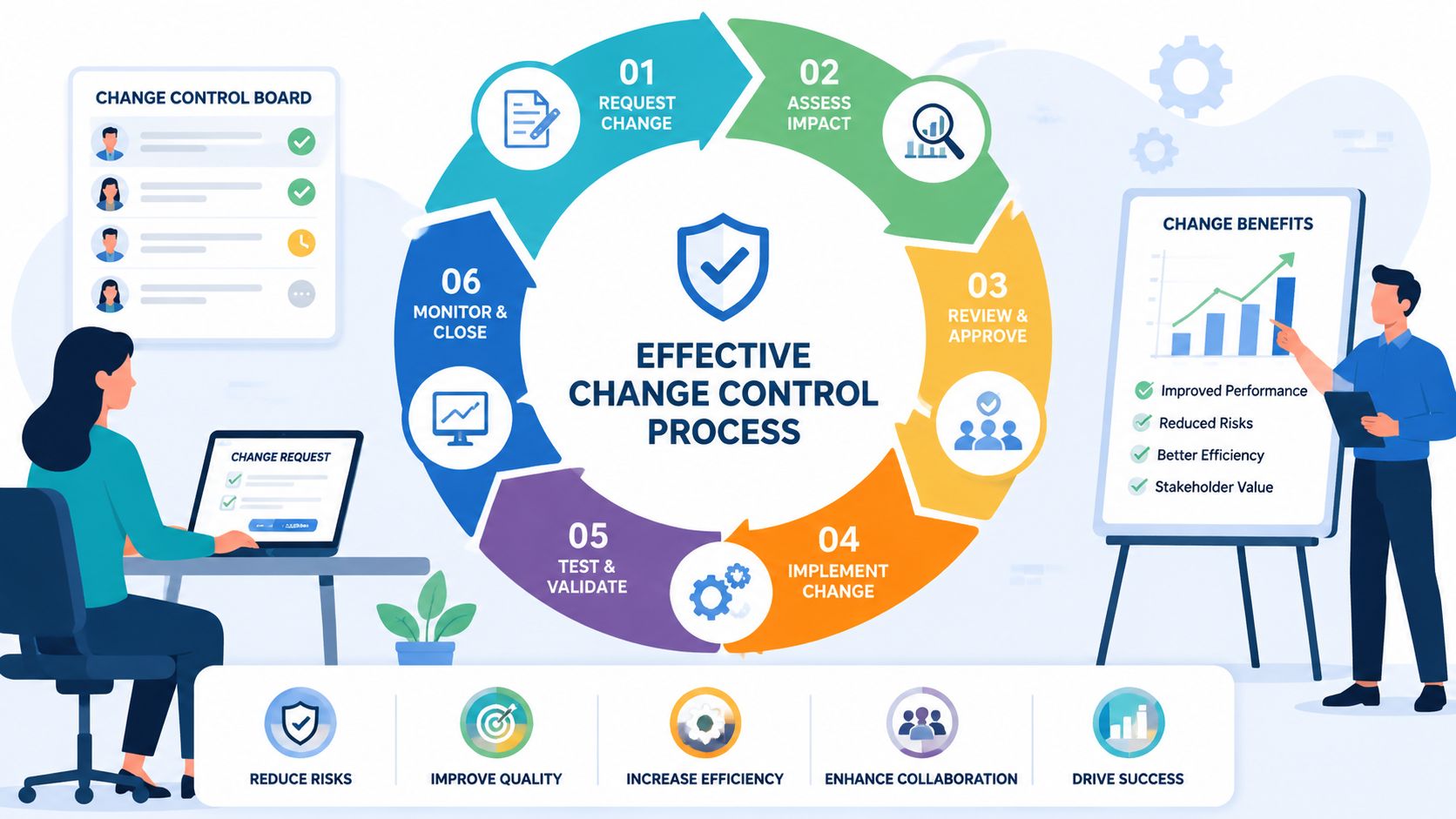
Change is normal. Uncontrolled change is what damages a timeline. A new requirement, revised design or altered approval condition can be reasonable, but the project still needs to show what the change displaces, what it costs in time and who has authorised the trade-off.
Use a visible decision path
A practical change process has six stages:
- Log the request. Describe the requested outcome, reason, originator and urgency.
- Clarify the effect. Confirm whether the request changes scope, quality, resources, dependencies or acceptance criteria.
- Assess schedule impact. Identify affected tasks, milestones, critical-path activities and available slack.
- Develop options. Offer choices such as moving the date, reducing another deliverable, adding capacity or accepting a different level of risk.
- Obtain authority. Route the decision to the person with the right commercial, operational or governance authority.
- Update and communicate. Revise the baseline or approved forecast, record the decision and notify every affected owner.
The project manager shouldn't absorb approved changes into existing tasks. That approach makes the schedule appear stable while the team works longer, accepts hidden risk or misses unrelated commitments.
Make trade-offs explicit
A sponsor who asks for an additional feature may be willing to move a milestone, remove a lower-priority deliverable or provide another specialist. The project team can't make that trade-off on the sponsor's behalf. Presenting the options clearly turns a vague request into an accountable decision.
Keep a change log connected to the schedule. Record the original date, revised date, decision owner, rationale and downstream effect. Don't overwrite history, because trend information helps distinguish a genuine delivery problem from repeated scope expansion.
Communicate changes in the channel people use, then reflect them in the authoritative schedule. A meeting announcement without a timeline update creates competing versions of the plan. A schedule change without a direct explanation creates anxiety and encourages speculation.
A change isn't controlled until the project can show what moved, who approved it and what the team will stop, defer or resource differently.
Key Takeaways for Mastering Project Timeline Management
A reliable timeline starts with a defined outcome and ends with an honest forecast. The middle is active management, not passive tracking. Teams must test assumptions, monitor external decisions, protect critical relationships and make trade-offs visible when conditions change.
UK delivery evidence makes the discipline difficult to dismiss. The median UK project sits at the 65th percentile of comparable projects for duration, meaning it takes longer than 65% of similar projects internationally. The same Centre for Growth analysis found that UK road projects had a 69% overrun rate and an average overrun of 66% of original budget, as included in the UK government infrastructure analysis. These are not reasons to create defensive schedules that nobody believes. They're reasons to replace optimism with evidence, ownership and clear recovery decisions.
The working checklist
Before approving your next baseline, check that the schedule:
- Defines the outcome: Deliverables, acceptance criteria and exclusions are clear.
- Names owners: Every task, decision and external dependency has a responsible person.
- Maps logic: Dependencies explain why work must wait or where parallel delivery is safe.
- Separates dates: Firm constraints, target dates and forecasts aren't presented as equivalent.
- Includes approvals: Waiting time and administrative decisions appear in the critical path.
- Uses evidence: Duration assumptions have been challenged against relevant completed work. The IPA Benchmarking Data Service is designed to compare projected or actual performance with historical projects, including duration data, cost and carbon data, as described in the government project-delivery guidance.
- Protects uncertainty: Slack is assigned deliberately, monitored and never treated as unowned scope.
- Controls change: Each approved change records its impact and the trade-off accepted.
- Sets the rhythm: Owners update the schedule, and leaders act on exceptions rather than waiting for bad news.
The strongest project manager I know isn't the person with the most elaborate schedule. It's the person who can explain, calmly and precisely, why a date is credible, what could move it, who controls that risk and what decision must happen next.
Grumspot helps Shopify Plus teams plan and deliver complex storefront builds, migrations, audits and integrations with structured communication, milestone updates and weekly video calls. Visit Grumspot to discuss a delivery approach that keeps dependencies visible and turns project timeline management into a practical operating rhythm.
Let's build something together
If you like what you saw, let's jump on a quick call and discuss your project
Related posts
Check out some similar posts.