Choose Your Web Design Agency Bristol for 2026
- web design agency bristol
- bristol web design
- shopify agency bristol
- wordpress agency bristol
- digital agency bristol
Launched
May, 2026

Your site needs replacing or fixing. Sales wants better lead quality, marketing wants a CMS the team can easily use, and someone in operations is worried about another painful migration. Then you start looking for a web design agency Bristol firms trust and hit the usual problem. Agencies describe themselves in broad terms, but the key difference often sits underneath in the stack they build on and support.
That is the filter this guide uses.
Rather than sorting Bristol agencies by vague labels such as "creative" or "full service", it groups them by technical specialism. WordPress and Shopify shops belong in one bucket. Umbraco and .NET specialists belong in another. Python and Wagtail agencies belong in another again. If your team already has a platform, that helps you avoid wasting time on agencies that would rather steer you somewhere else. If you are choosing from scratch, it helps you match the CMS to your internal capability, budget, and future roadmap.
I have seen this choice go wrong both ways. A strong generalist can produce good work, but generalists often rely on familiar tools even when the fit is only acceptable. A specialist usually brings better technical judgment, cleaner delivery, and a more realistic view of maintenance. The trade-off is narrower range. If you need a rebrand, custom integrations, ecommerce, and long-term platform support under one roof, a specialist may solve one part well and still leave gaps elsewhere.
If you are still comparing agencies at a higher level, this guide on how to choose a web design agency covers the buying criteria in more detail.
The shortlist below is built to save time. You can scan by stack first, then judge each agency on delivery model, project fit, and the kind of relationship they tend to suit.
1. Atomic Smash
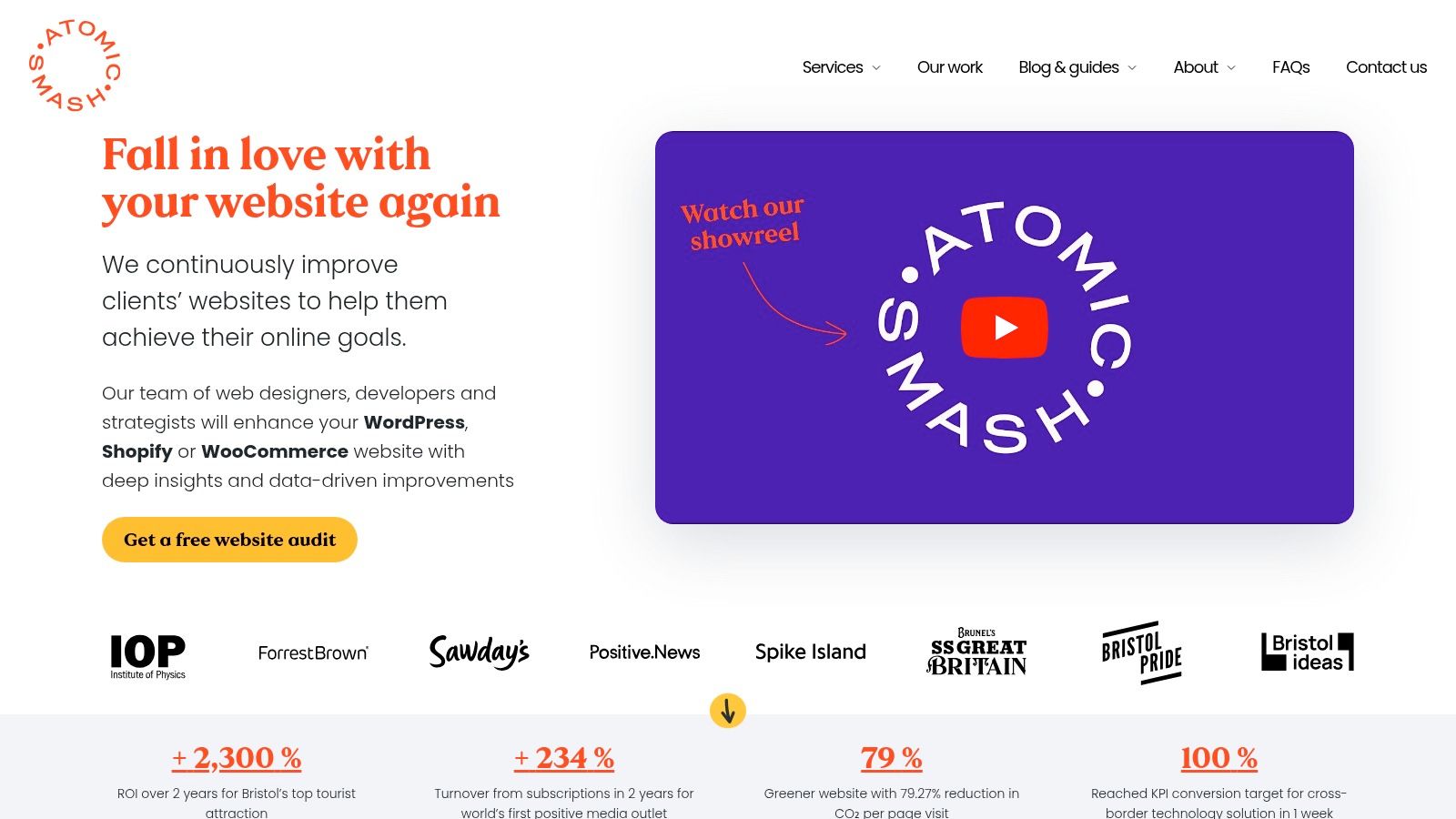
Atomic Smash fits the team that doesn't want a one-and-done site launch. Their positioning is much closer to continuous improvement. If your WordPress, WooCommerce or Shopify site already exists and needs to perform better, that model makes sense.
What stands out is the mix of UX, accessibility, performance and CRO thinking. That usually leads to better decision-making than a pure design-first process, especially when internal teams already know the site has friction but can't isolate where.
Best fit
Atomic Smash is strongest when your site is already commercially important and you need iteration, not theatre. Their free audit entry point also helps if you need a technical and UX view before committing.
- Stack fit: Best for WordPress, WooCommerce and Shopify.
- Working style: Better for retained optimisation than a clean hand-off build.
- Operational angle: Accessibility and sustainable web practices are built into how they deliver.
Practical rule: Hire Atomic Smash if your main question is “how do we improve this site month by month?” Don't hire them if you want a rigid fixed-scope build and no ongoing relationship.
Their approach won't suit every buyer. Some teams want a project, a launch date, and a final handover. Atomic Smash is more useful when you accept that websites need tuning after launch. If you're comparing agencies, this guide on how to choose a web design agency is worth reading before procurement starts.
The main trade-off is stack depth. If your organisation is committed to .NET, Umbraco or Wagtail, Atomic Smash isn't the natural fit. But for WordPress and commerce-led improvement work, they're one of the more pragmatic Bristol options.
Visit Atomic Smash.
2. Gibe Digital
Some projects stop being “web design” projects quite quickly. They turn into platform, integration and engineering projects. That's where Gibe Digital tends to make more sense than a broad creative studio.
Gibe's value is clearest when the brief includes bespoke functionality, back-office integrations, or a CMS that needs to support more complicated workflows. Their Umbraco and .NET bias is the key filter. If that's your stack, they deserve a look. If it isn't, keep moving.
Where Gibe is strongest
A lot of Bristol agencies talk about results in broad terms. Gibe looks more comfortable in technically demanding delivery. That matters for teams who already know they need custom engineering rather than template-led implementation.
Bespoke commerce gets expensive when the agency is learning your systems during the project. It's cheaper when they already think in integrations.
They also appear active in the Umbraco community, which is usually a good signal. In specialist ecosystems, community involvement often tells you more than homepage copy does.
- Use Gibe for: Umbraco, custom commerce, deeper systems work.
- Avoid Gibe for: straightforward WordPress brochure sites or Shopify-first ecommerce.
- Procurement note: expect scope and delivery shape to depend heavily on integration complexity.
If your business operates across Bristol and nearby areas, it can also help to compare whether you need a local engineering-led partner or a broader regional agency. This related look at a web design agency in Bath gives useful context for that choice.
Gibe isn't the flexible answer to every brief. That's a strength, not a weakness. Agencies with a clearer technical point of view are often easier to buy from once you know your platform direction.
Visit Gibe Digital.
3. Mentor Digital
A typical Mentor Digital brief looks like this: several departments need sign-off, the site has to work for editors as well as end users, and the organisation wants hosting, support and governance wrapped into the same relationship. That is a different buying decision from hiring a Bristol agency to launch a fast marketing site on WordPress or Shopify.
Mentor sits in the more operational end of this shortlist. Their fit is strongest with organisations that already expect process, documentation and long-term platform ownership. I would usually point public sector teams, universities, membership bodies and larger content estates in their direction first, especially if the CMS decision is leaning toward Umbraco.
Where Mentor earns its place
Their Umbraco Gold Partner status matters because it signals repeat delivery in that ecosystem, not just a one-off build. Pair that with managed hosting across Azure and AWS, and the offer starts to look less like pure web design and more like ongoing digital operations.
That distinction matters.
A specialist agency with a narrower stack can often move faster and keep scope tighter. Mentor is more useful when internal complexity is the bigger risk. If several stakeholder groups need training, governance, accessibility oversight, content workflows and post-launch support, a larger delivery model can save a lot of friction later, even if the upfront cost is higher.
- Best for: Umbraco-led projects, content-heavy estates, multi-stakeholder organisations, managed hosting and support
- Less suitable for: lean ecommerce brands, simple brochure sites, or teams that want the lightest possible build
- Commercial reality: costs usually rise with integrations, approval layers, infrastructure requirements and support expectations
If ecommerce is part of the brief, challenge the platform choice early. I have seen teams default to a custom content platform when a simpler product-led setup would have done the job. This guide to Shopify website design cost is useful for pressure-testing that assumption before procurement gets too far along.
Visit Mentor Digital.
4. Torchbox
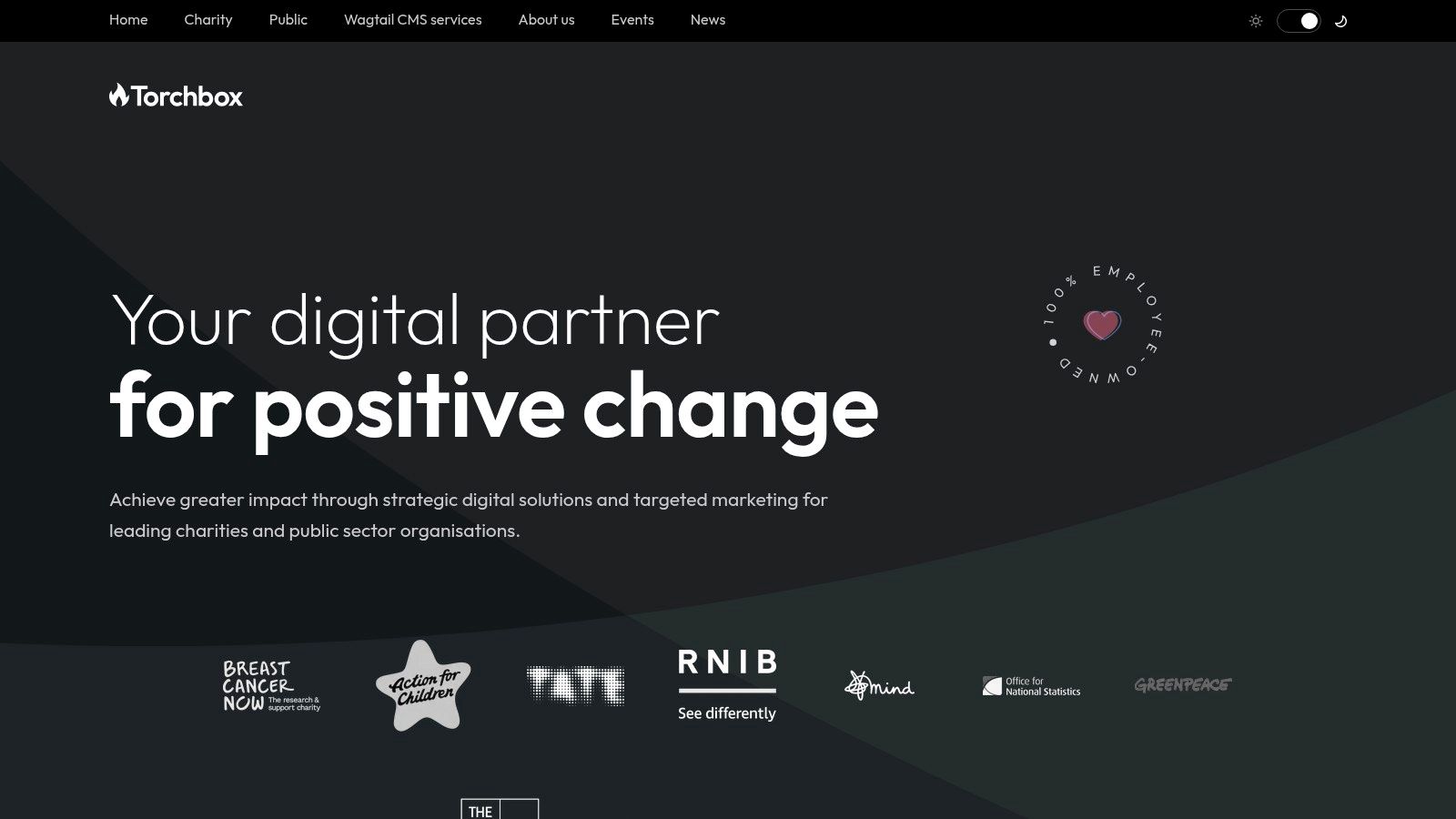
Torchbox is the obvious Bristol-area name for Wagtail and Django work. If your team already knows it wants Wagtail, this shortlist becomes much shorter very quickly.
They're not just a user of the platform. They're closely associated with Wagtail itself, which changes the buying decision. For content-heavy organisations, especially nonprofits, education teams and mission-led institutions, that depth is hard to ignore.
Stack-first selection matters here
Most buyers waste time looking at agencies before narrowing the CMS. Torchbox is the reason to reverse that process. Pick them because you want Wagtail and the kind of engineering culture that comes with it, not because you want a generic web design agency Bristol has on page one.
Their employee-owned structure and B Corp status may also matter if values alignment is part of procurement. For charities and public-interest organisations, that's often more than a soft factor.
- Best for: Wagtail, Django, complex content operations, enterprise-grade support.
- Not ideal for: Shopify builds, standard WordPress sites, or quick-turn brochure projects.
- Buying advice: ask detailed questions about editor workflows, hosting, support and future roadmap, not just launch scope.
Torchbox is rarely the cheapest route, and it shouldn't be judged like one. This is a specialist platform decision. If your content model is complex and your team needs a serious CMS foundation, they're one of the clearest specialist options on this list.
Visit Torchbox.
5. Squarebird
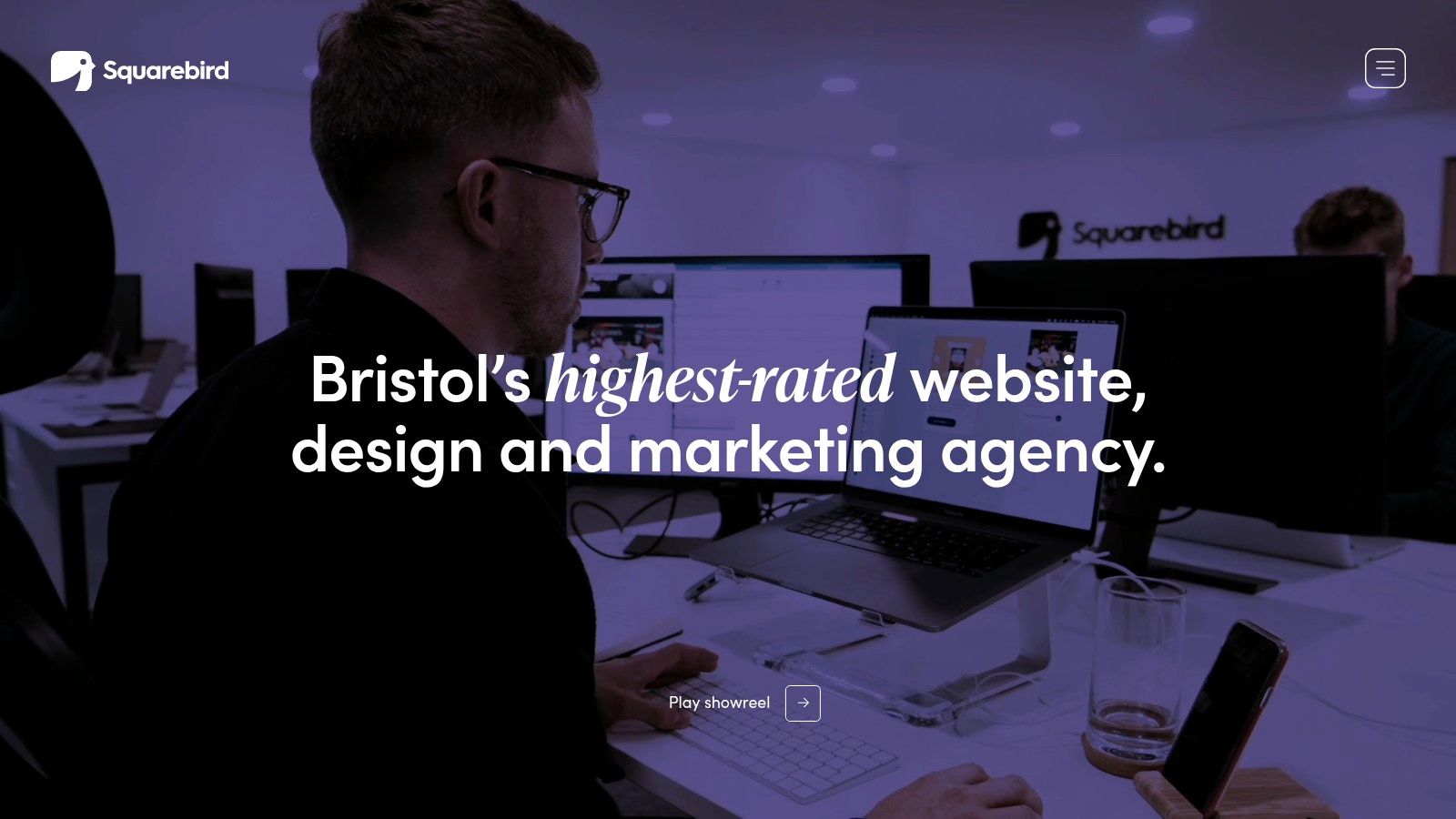
Your marketing manager wants a new site live this quarter. Sales needs leads, not a long platform project. In that situation, Squarebird sits in a different part of the Bristol market from agencies chosen for .NET, Umbraco, Python or Wagtail.
They look more relevant for SMEs that want a WordPress-led website with marketing support wrapped around it. That matters because the buying decision is different. You are not selecting a specialist engineering team to build a complex content platform. You are choosing a supplier that can handle design, build, SEO, content and hosting without your team managing several separate partners.
That model can work well if the website's main job is enquiry generation and day-to-day marketing support. I would usually place them in the generalist WordPress camp rather than the stack-specialist camp, which helps narrow the shortlist quickly if your business already knows what kind of build it needs.
The main practical check is ownership and delivery continuity. Squarebird was acquired by Smarter Web Company, so buyers should ask direct questions about who now handles strategy, development, support and account management. Older case studies do not answer that for you. Current team structure, response times and support terms do.
Do not approve a redesign on visual quality alone if search visibility, analytics and conversion paths already contribute to revenue.
- Good choice for: SMEs wanting a WordPress site plus ongoing marketing support.
- Weaker fit for: .NET or Umbraco builds, Wagtail projects, and specialist Shopify ecommerce work.
- Buying advice: ask who is on the delivery team now, what platform they recommend for your brief, and how post-launch support is run after the acquisition.
Squarebird can still be a sensible option if you want one agency covering the website and the marketing around it. Just judge them on the current operating setup, not the version of the business you may find in older material.
Visit Squarebird.
6. GWS Media
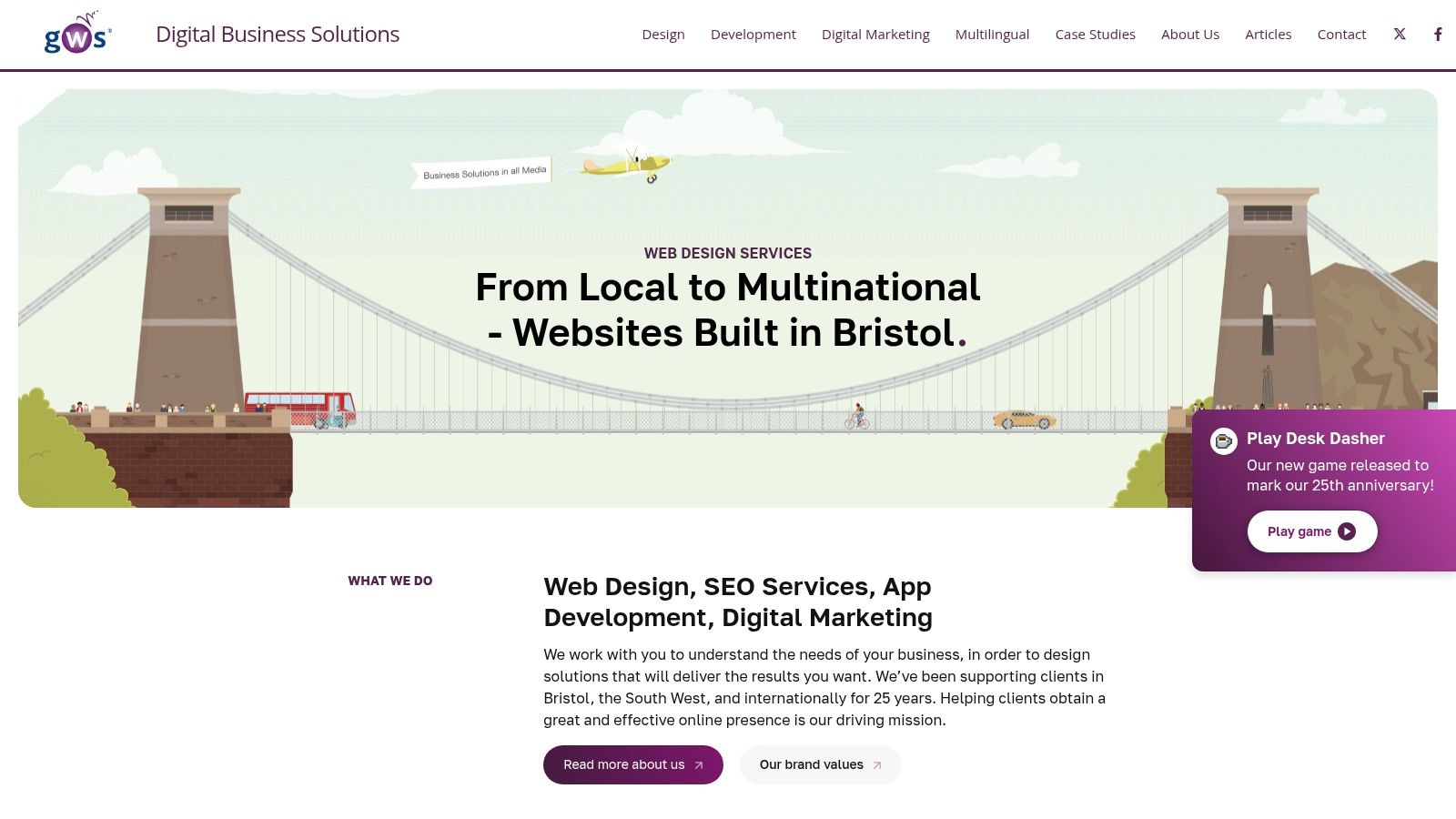
A common brief sounds like this. The site needs a refresh, rankings need attention, someone has to keep content moving, and nobody in-house wants to coordinate a designer, developer, SEO consultant and hosting provider separately.
GWS Media fits that type of job. I would place them in the generalist marketing-led camp rather than the stack-specialist camp, which is useful if you are filtering Bristol agencies by technical focus. If you already know you need Shopify expertise, a .NET build, Umbraco governance, or a Python and Wagtail team, this is probably not the shortlist entry to prioritise. If you need one agency to handle a business website and the ongoing work around it, they make more sense.
Their appeal is operational. Long-running agencies often suit SMEs and regional organisations that want steady delivery, familiar contacts and a supplier that can cover design, development, content and SEO in one retainer.
That convenience has a trade-off.
Breadth usually means less depth in any one platform. For a marketing site, brochure site, or lead generation build, that is often acceptable. For a site tied closely to ecommerce operations, custom integrations, or internal workflows, a specialist team will usually spot risks earlier and make cleaner technical decisions.
- Best for: SMEs that want a managed website with content, SEO and support under one roof.
- Weaker fit: Shopify-first ecommerce, complex .NET or Umbraco projects, and Wagtail-led builds.
- Buying advice: ask what CMS they would recommend for your brief, who handles support after launch, and how they separate design work from ongoing SEO retainers.
Bristol has enough agency depth that you do not need to force a generalist into a specialist brief. GWS Media is the sensible option when the website is mainly a commercial marketing asset and the primary requirement is dependable delivery, not unusual engineering.
Visit GWS Media.
7. Thought & Mortar
Thought & Mortar is the cleanest Shopify-first option on this list. That matters because Bristol agencies often describe themselves as able to build on many platforms, but ecommerce projects usually go better when the team has a strong point of view on one.
If your brief includes migration, product structure, collection logic, information architecture and launch planning inside Shopify, a specialist agency is usually safer than a general web design shop. Bristol has plenty of agencies that mention ecommerce, but local signals suggest buyers increasingly value platform expertise and migration support over generic design language. For example, Bristol agency listings explicitly promote Shopify, WooCommerce, WordPress and custom development, with one local agency saying it “specialise in Shopify and WooCommerce”, another highlighting “WordPress, Shopify and custom” builds, and Clifton Web Design noting it has provided “Bristol website design since 2006”, all of which points to a segmented local market where stack choice matters early in the process. See You and I's Bristol agency positioning.
Why Shopify specialists keep winning certain briefs
Generalist agencies often underestimate what can go wrong during ecommerce redesigns. Collections break. Tracking gets lost. Search visibility drops. Merchandising logic becomes harder to manage. A Shopify specialist is more likely to spot those issues before they become launch-week problems.
- Strong fit: Shopify design, migrations, IA work, close collaboration.
- Poor fit: non-Shopify platforms, enterprise .NET, Wagtail or highly custom content systems.
- Procurement tip: ask how they handle migration mapping, app selection, SEO handover and post-launch support.
The trade-off is focus. Thought & Mortar is narrow by design. If you want one agency for every stack, they aren't it. If you want Shopify-first thinking from discovery through launch, that narrowness is the reason to speak to them.
Visit Thought & Mortar.
Top 7 Bristol Web Design Agencies Comparison
| Agency | Implementation complexity 🔄 | Resource requirements ⚡ | Expected outcomes 📊 | Ideal use cases 💡 | Key advantages ⭐ |
|---|---|---|---|---|---|
| Atomic Smash | 🔄 Moderate, iterative CRO/UX retainer | ⚡ Small–medium team; retainer model | 📊 Measurable conversion uplift and ROI | 💡 SMEs/ecommerce needing CRO, accessibility | ⭐ Data-driven CRO, accessibility focus; free audit |
| Gibe Digital | 🔄 High, bespoke Umbraco/.NET integrations | ⚡ High engineering effort; custom scope | 📊 Robust custom commerce and back‑office links | 💡 Complex ecommerce with deep integrations | ⭐ Strong .NET/Umbraco engineering pedigree |
| Mentor Digital | 🔄 High, end‑to‑end enterprise delivery | ⚡ Large multidisciplinary team; managed hosting | 📊 Stable, scalable content platforms with governance | 💡 Public sector, corporate, content‑rich sites | ⭐ Full‑service delivery + Azure/AWS hosting |
| Torchbox | 🔄 High, enterprise Wagtail/Django projects | ⚡ Senior Wagtail/Django engineers and hosting | 📊 Large content estates and high‑profile launches | 💡 Nonprofits, education, mission‑driven orgs | ⭐ Creator/steward of Wagtail; B Corp values |
| Squarebird | 🔄 Low–Moderate, fast WordPress builds (post‑acquisition) | ⚡ SME-friendly; integrated marketing services | 📊 Quick launches with ongoing optimisation | 💡 SMEs wanting WordPress + marketing retainer | ⭐ One‑stop WordPress + SEO/branding; confirm handover |
| GWS Media | 🔄 Moderate, broad multi‑service delivery | ⚡ In‑house design/dev/SEO; consultative support | 📊 Reliable maintained sites and SEO growth | 💡 Local SMEs seeking continuity and guidance | ⭐ Longstanding regional experience and resources |
| Thought & Mortar | 🔄 Moderate, Shopify discovery then build | ⚡ Boutique Shopify specialists; close collaboration | 📊 Shopify stores optimized for IA and migration | 💡 Shopify merchants seeking specialist partner | ⭐ Certified Shopify Experts; Shopify‑only focus |
Making Your Final Choice A Quick Checklist
You are down to two or three Bristol agencies. The work all looks competent, the calls went well, and the risk now is choosing the team that fits your stack badly enough to create expensive friction six months from launch.
Start with the platform decision, because that cuts through a lot of sales language. A Shopify store, an Umbraco build, and a Wagtail content platform need different habits, different developer depth, and different post-launch support. That is the practical reason this guide groups agencies by technical specialism rather than treating Bristol as one interchangeable pool. If your team already has a stack in place, pick an agency that works in it every week. If you are choosing a stack from scratch, pick the agency whose platform bias matches your internal needs, not just the nicest proposal.
Then check operating model. I have seen Bristol businesses hire a strong specialist and still end up frustrated because the agency was set up for project delivery while the client needed monthly iteration, testing, and content support. Ask who will handle strategy, UX, development, QA, training, and support after launch. Ask what happens when scope changes. Generalists can be a better fit when you need design, dev, SEO, and content under one roof. Specialists are often the better call when the cost of getting the platform wrong is high, especially in ecommerce, where build quality affects trading, fulfilment, reporting, and conversion. If that is your situation, this overview of ecommerce website development services is a useful benchmark for what a serious delivery partner should cover.
Portfolio review should stay practical. Ignore polished mockups for a moment and test the basics. Can you find key information quickly? Does the content structure make sense? On ecommerce sites, can you move from category to product to checkout without confusion? On content-heavy builds, check search, navigation, templates, governance, and editor experience. The best agency for your brief is rarely the one with the flashiest homepage. It is the one that can explain trade-offs clearly and show evidence that similar projects held up after launch.
Pricing needs the same level of scrutiny. Fixed fees suit clear scopes. Retainers suit ongoing improvement. Day-rate or sprint-based work often makes more sense for technically complex builds where requirements change once discovery starts. Cheap proposals usually shift cost into change requests, delayed QA, weak documentation, or a poor handover.
Grumspot is one example of a specialist partner if your shortlist is leaning toward Shopify. It focuses on Shopify Plus design, development, CRO, and technical audits, which matters when the site is a revenue engine rather than a brochure. In a crowded UK agency market, that kind of narrow focus is often easier to assess than a broad claim to handle every platform and every type of brief.
If your shortlist is leaning toward Shopify, Grumspot is worth considering for migrations, conversion-focused redesigns, technical audits and ongoing ecommerce development support.
Let's build something together
If you like what you saw, let's jump on a quick call and discuss your project
Related posts
Check out some similar posts.