Find Your Web Design Agency Bath: 2026 Expert Guide
- web design agency bath
- hire web designer
- shopify agency bath
- ecommerce design
- local seo bath
Launched
May, 2026

Your current site probably still “works”. It loads, it has your phone number, and it says the right things about your business. But if you're searching for a web design agency Bath, there's usually a bigger issue underneath that search. Enquiries are flat. The site feels dated. Mobile users drop off. Or you're trying to sell online and your website behaves more like a leaflet than a sales channel.
That's the real shift. Most Bath businesses don't just need a prettier homepage. They need a site that helps them win trust quickly, reduce friction, and support revenue. That changes how you choose an agency, what questions you ask, and what you should expect to pay for.
Your Website Is More Than a Digital Brochure
A lot of local businesses still approach a website project like a branding exercise. New colours. Cleaner layout. Better photos. That matters, but it's not enough anymore.
The UK web design market is mature. Industry analysis puts UK web design revenue at £621.3 million, with more than 2.7 million active websites and a 0.2% CAGR over the previous five years, according to Made By Shape's industry summary. That doesn't describe a market where being online alone gives you an advantage. It describes a crowded environment where your site has to earn attention.
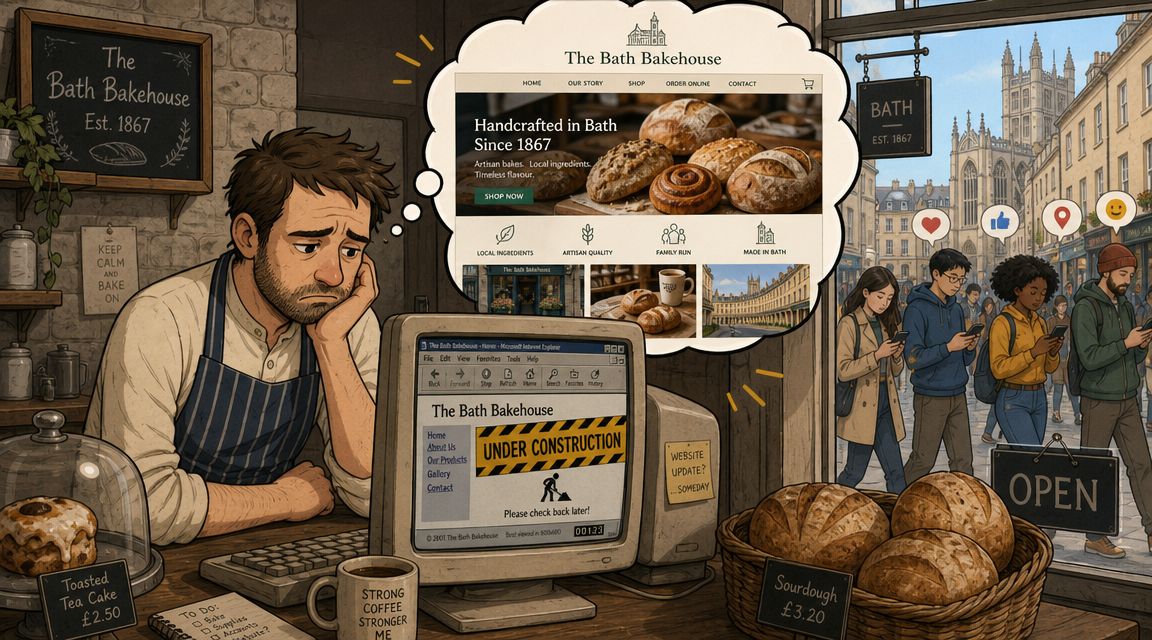
What a modern Bath website actually needs to do
For a local service business, the job might be to generate qualified enquiries. For a retailer, it might be to improve product discovery and checkout flow. For a manufacturer, it could be to support sales conversations with better proof, clearer information, and stronger lead capture.
A good site today works like a system, not a poster. It needs to connect messaging, structure, speed, UX, and conversion points. That's why the strongest projects are usually built around commercial outcomes, not page counts.
If your current brief sounds like “we need a new website”, tighten it. The sharper version is usually something closer to “we need a site that turns more of our existing traffic into enquiries or sales”. That's the difference between hiring a designer and hiring a growth-minded partner.
The old brochure model breaks down fast
Brochure sites tend to look acceptable in a board meeting and underperform in practice. They often have vague calls to action, weak mobile layouts, and insufficient thought given to how users move from interest to action.
That's where conversion-focused web design becomes the better lens. It forces the project back to fundamentals. What does the visitor need to see first? Where do they hesitate? What blocks the next step?
A website that only looks better after launch can still be a poor investment. A website that removes friction is far more valuable.
Define Your Project Goals Before You Search
Most agency selection problems start before the first discovery call. The business owner asks for features, not outcomes. They request pages, animations, filters, or a new CMS, but they can't clearly say what success looks like.
That creates confusion straight away. One agency prices a visual refresh. Another assumes a full strategic rebuild. A third sells a stack of features you may never use.
Write the brief around outcomes, not widgets
Bath has plenty of agencies that can build attractive sites. The gap appears when you need something more commercial. As noted by Intuition Media's review of the local market, many providers still lean toward generic web design, while businesses increasingly need ecommerce migrations and conversion optimisation. If your goal is measurable revenue uplift rather than a redesign for its own sake, you need to say that plainly.
Start with three questions:
What has to improve?
More leads, better-quality leads, more online sales, stronger conversion from mobile users, smoother recruitment applications, fewer support enquiries.What's broken today?
Slow templates, poor navigation, weak trust signals, no clear landing page strategy, awkward product filtering, clumsy checkout flow, or content that doesn't match buyer intent.What must the new site integrate with?
Shopify, WooCommerce, Klaviyo, HubSpot, booking systems, inventory tools, subscription tools, ERP or CRM platforms.
A strong brief is short and commercially clear
You don't need a fifty-page document. You do need enough detail to help the agency scope reality rather than guess.
Include these points:
- Business model: Are you lead generation, ecommerce, mixed, or primarily informational?
- Primary goal: Pick one main objective. Don't make every priority equal.
- Audience: Local homeowners, national B2B buyers, repeat ecommerce customers, trade accounts, students, tourists.
- Technical scope: Replatform, redesign, content migration, SEO preservation, integrations, multilingual setup.
- Internal constraints: Deadlines, approval bottlenecks, limited content, lack of photography, legacy systems.
- Budget range: Not a “what's your best price?” approach. A real range.
Practical rule: If your brief can't explain how the website supports revenue, agencies will fill in the blanks with assumptions.
Don't confuse marketing with web design
A website rarely succeeds in isolation. If you're relying on SEO, paid traffic, email flows, or local search visibility, the agency should understand how the website supports those channels. That's why it helps to review broader proven digital marketing tactics before you start the search. It sharpens your thinking around traffic sources, offer structure, and what the site needs to convert.
What business owners often miss
The most common mistake isn't asking for too much. It's asking for too little. They say they want a “professional website” when what they need is:
- A platform move: for example, from a limited CMS to Shopify or WooCommerce
- A sales process online: clearer landing pages, product pages, forms, bundles, subscriptions
- A performance fix: lighter templates, cleaner code, faster image delivery
- A CRO programme: ongoing testing and iteration after launch
If any of those apply, treat them as part of the brief from day one. Otherwise you'll end up choosing a brochure-site agency for a revenue problem, and that mismatch gets expensive.
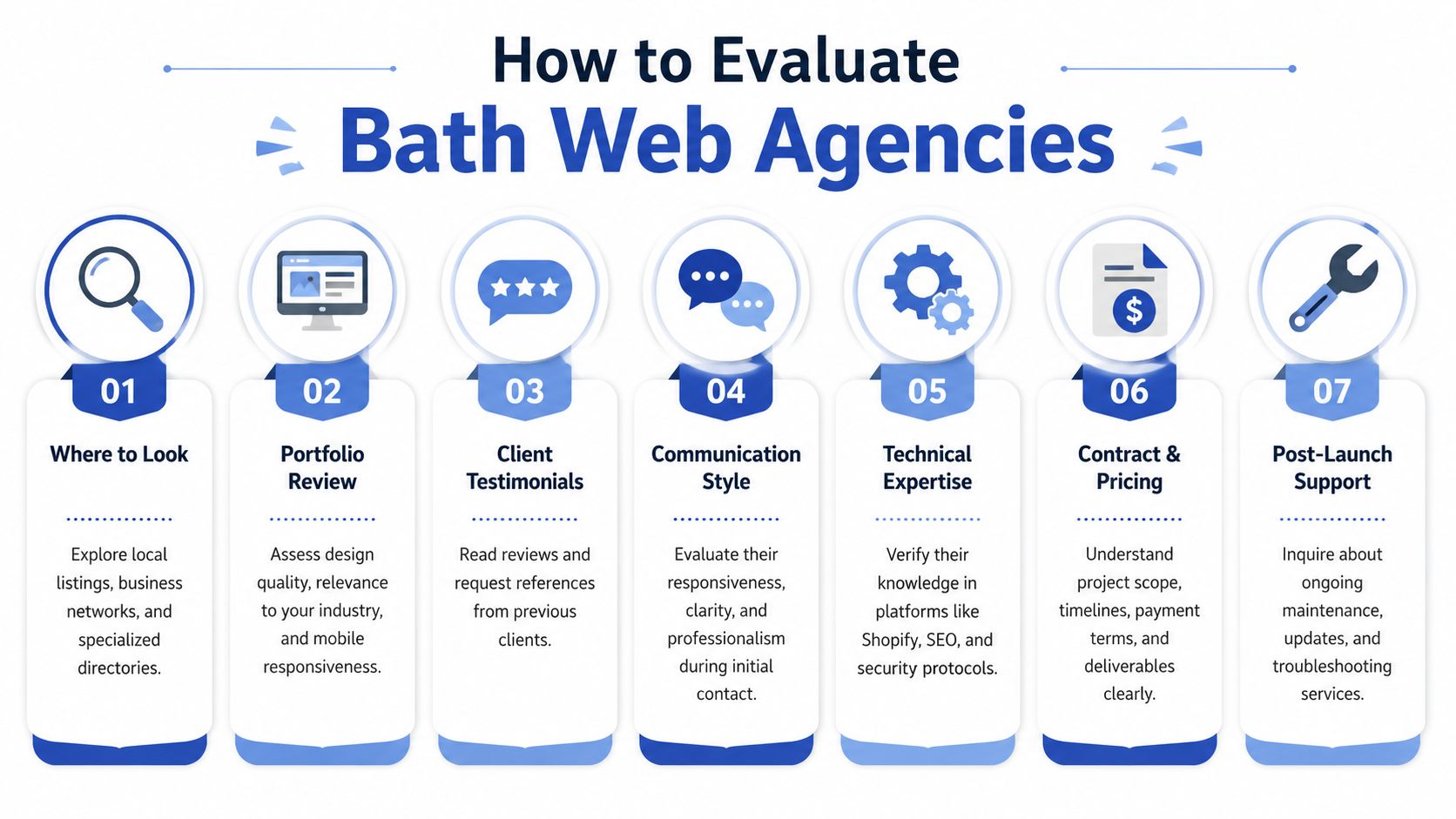
How to Find and Evaluate Bath Web Agencies
Once your brief is clear, the search gets easier. Not effortless, but easier. You can stop reacting to polished sales copy and start checking whether an agency's work matches your actual project.
Start local if local collaboration matters to you. Search Google Maps, local business directories, Bath networking groups, and platform-specific directories if you need Shopify or WooCommerce expertise. Then narrow your list hard.
Judge their own website first
This is the quickest filter. A web design agency's own site tells you a lot about how they think.
According to DesignRush's web design statistics roundup, users form an opinion about a website in about 5 seconds, and 94% of first impressions are design-related. If an agency's own site feels confusing, dated, cluttered, or poor on mobile, don't talk yourself into ignoring that. Their site is their sales tool. If they haven't applied good judgement there, it's risky to assume they'll apply it to yours.
Look for:
- Clarity: Do you understand what they do quickly?
- Relevance: Do they show work in your category or platform?
- Usability: Is the mobile experience clean and easy?
- Proof: Do they explain outcomes, process, and technical capability?
A flashy homepage with no substance is a warning sign.
Review portfolios like a buyer, not a designer
Most portfolios are built to impress visually. Your job is to read them commercially.
Use this checklist:
- Industry fit: Have they worked with businesses like yours, or at least with similar buying journeys?
- Platform depth: Can they handle Shopify, WooCommerce, WordPress, or custom requirements without outsourcing key parts?
- Content judgement: Do their sites prioritise important information, or bury it under visual effects?
- Conversion thinking: Can you spot strong calls to action, clear page hierarchy, filtering, trust signals, and sensible page flow?
- Technical maturity: Do they mention migration handling, performance work, integrations, or SEO preservation?
This walkthrough is useful if you want a visual sense of what to inspect when reviewing agency work:
Ask for the story behind the work
A polished screenshot proves almost nothing on its own. Ask what the problem was, what changed, and how they approached it.
If an agency can only talk about aesthetics, you're probably looking at a design supplier, not a commercial partner.
You should also pay attention to how they communicate before the contract is signed. Clear proposals, sensible questions, honest pushback, and organised follow-up usually indicate a better delivery process later. Slow replies, vague estimates, and jargon-heavy answers usually don't improve once the invoice is paid.
Key Interview Questions and realistic Pricing
Good agency interviews feel less like a pitch and more like a working session. You're trying to discover how they think, not whether they can say the right words.
One of the most useful benchmarks here is UX. Zippia's web design statistics summary states that UX-led websites can achieve a 400% higher visit-to-lead conversion rate. That doesn't mean every redesign will deliver that outcome. It does mean the right question isn't “can you make it look modern?” It's “how do you diagnose and improve user behaviour?”
Questions that separate process from sales talk
Ask these in the first serious call:
How do you run discovery?
Listen for structure. They should mention business goals, user journeys, analytics review, content gaps, and technical dependencies.How do you approach UX before design?
Strong agencies usually talk about wireframes, page hierarchy, conversion paths, mobile behaviour, and validation. Weak ones jump straight to visual style.How do you handle SEO preservation during a rebuild?
You want to hear about URL mapping, redirects, content migration discipline, metadata handling, internal linking, and post-launch checks.How do you measure success after launch?
Useful answers include lead quality, conversion behaviour, page engagement, landing page performance, and testing plans.What integrations have you handled that resemble ours?
If you rely on HubSpot, Klaviyo, inventory systems, subscription apps, or ERPs, get specific.Who does the work? Some agencies sell with seniors and deliver with juniors or freelancers. That's not always bad, but you should know.
What happens if timelines slip because we're slow with content?
Their answer tells you whether they've run real projects before.
If ecommerce is central, it also helps to compare agencies that specialise in platform work. A focused Shopify agency will usually be stronger on product architecture, app trade-offs, checkout logic, and theme performance than a generalist studio.
Pricing is about scope, risk, and depth
Most business owners want a neat price list. Agencies can't give one without scope, but broad ranges are still useful if you treat them as directional.
| Project Type | Description | Estimated Price Range |
|---|---|---|
| Basic brochure site | Small marketing site for a local business, usually with standard templates, core pages, and basic contact flows | Lower range |
| Small ecommerce store | Product catalogue, collection structure, product templates, payments, shipping setup, and essential integrations | Mid range |
| Complex Shopify Plus build or migration | Custom theme work, migration planning, advanced integrations, internationalisation, CRO input, and post-launch support | Higher range |
Those labels are deliberate. In practice, price changes based on content workload, custom functionality, integrations, SEO risk, and how much strategy is included. A cheap quote often excludes the things that protect performance and revenue.
Where hidden costs usually appear
The proposal might only cover design and development. Then extra charges appear for content entry, app setup, product data cleanup, analytics configuration, redirect mapping, QA rounds, training, or post-launch support.
SEO is another area people underestimate. If search visibility matters to your business, budget for it separately or confirm it's scoped properly. This overview of average SEO rates is useful for setting expectations before you assume SEO is “included”.
Cheap websites often become expensive when you add the work required to make them usable, searchable, and commercially viable.
What a sensible quote should include
Ask for a proposal that names:
- Deliverables clearly
- Assumptions and exclusions
- Revision rounds
- Content responsibilities
- Technical setup and integrations
- Migration and SEO handling
- Post-launch support period
- Ownership of assets and accounts
If any of that is fuzzy, the quote isn't ready.
Navigating Shopify Migrations and Technical Risks
A lot of businesses delay a rebuild because they're worried about breaking what already exists. That concern is reasonable. A migration can damage rankings, disrupt tracking, create checkout friction, or lose key content if it's handled casually.
The mistake is assuming the risk comes from migration itself. The risk usually comes from weak process.
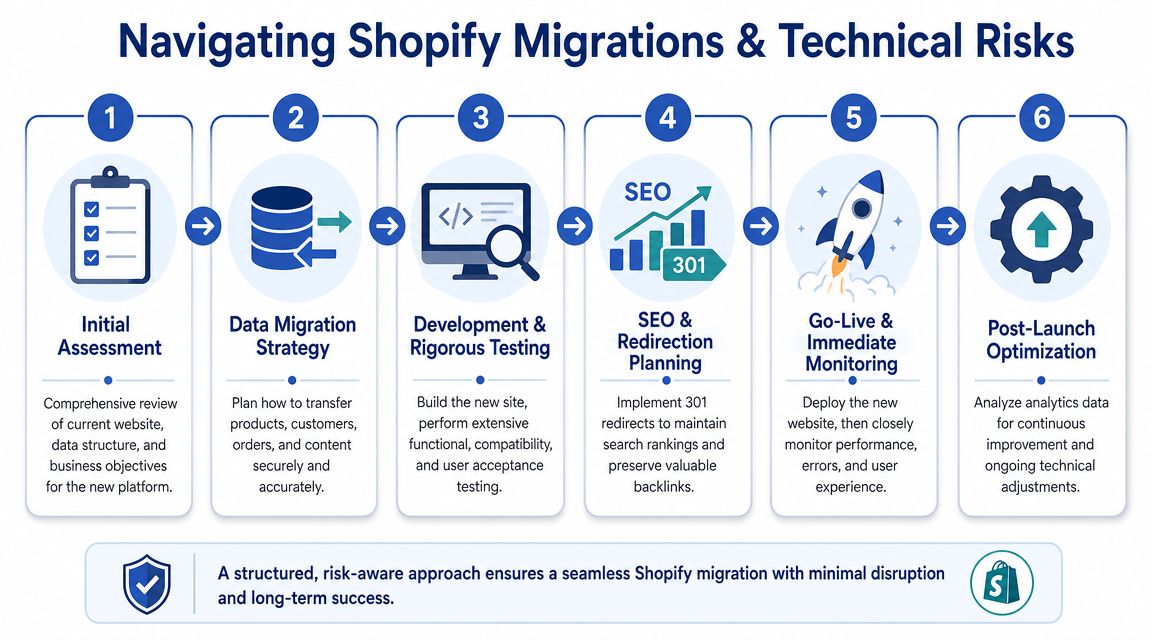
Audit first, redesign second
According to Hostinger's web design statistics roundup, 94% of users abandon a site due to poor design and 39% leave due to slow images. That's why a technical audit has to happen before anyone starts choosing fonts or animation styles.
A proper migration workflow should identify:
- Pages and templates that matter most
- Where trust drops above the fold
- Image and media weight issues
- Mobile navigation problems
- Tracking gaps
- Checkout friction
- Content that must be preserved or rewritten
- URLs that need redirect planning
This work is tedious. It's also where a lot of project value sits.
Common migration failures
When agencies oversimplify platform moves, the same problems appear again and again:
- Redirect neglect: old URLs vanish and rankings slip
- Template-first thinking: the new theme looks cleaner but preserves the same UX mistakes
- Bloated app stacks: functionality gets patched in with too many third-party tools
- Weak QA: variants, discount logic, forms, and email flows break after launch
- No content governance: product data, collection copy, and page messaging become inconsistent
Good migration work is less about “moving the site” and more about preserving what performs while removing what slows users down.
What to ask for in a migration plan
A serious agency should be able to explain its sequence. Not in abstract terms. In practical terms.
Ask for:
A benchmark of the current site
What's being measured before work starts?A redirect and SEO preservation plan
How will they protect existing search equity?A data migration method
Products, customers, collections, content, and historical structures need careful handling.A QA framework
Which user flows get tested before launch?A post-launch review window
How quickly do they monitor errors, UX issues, and conversion behaviour?
If Shopify is the destination, this guide to Shopify migration SEO preservation is a useful benchmark for the level of planning you should expect.
Your Agency Onboarding Timeline
A well-run project feels organised from the first week. You know who's involved, what you need to provide, when decisions are due, and what happens if something gets delayed.
Many clients underestimate how much momentum depends on them. Agencies can't build around missing content, inaccessible accounts, or slow approvals. The first month usually sets the tone for everything that follows.
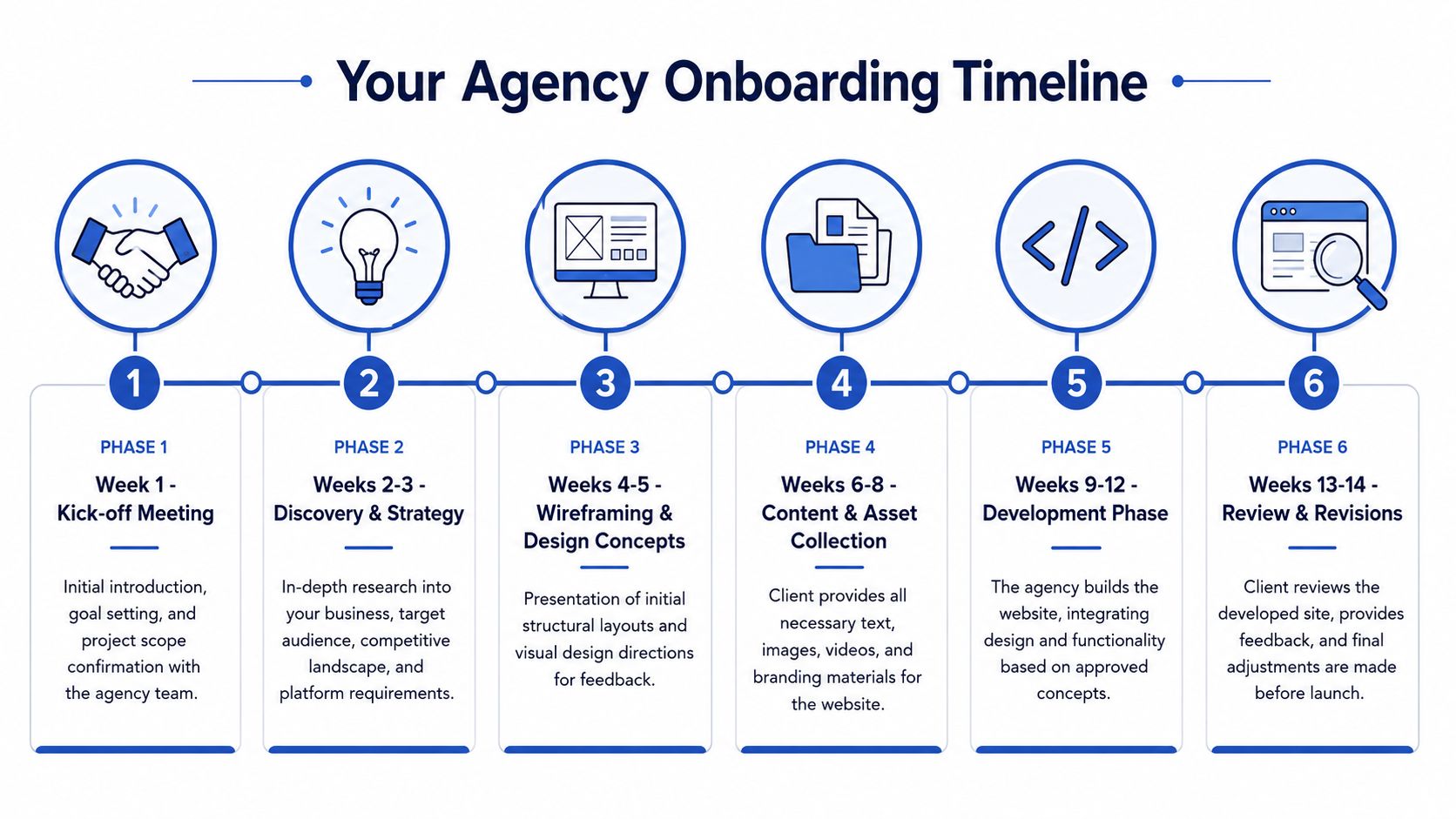
Week one starts with access and alignment
The kickoff should confirm commercial goals, project scope, stakeholders, and communication rhythm. The agency will usually ask for access to analytics, ad platforms, domain settings, CMS logins, merchant accounts, and any connected tools like Klaviyo or HubSpot.
You should also expect discussion around approvals. If three directors need to comment on every design round, that needs to be explicit now, not discovered halfway through.
Discovery only works if your team participates
The next phase usually involves research, content review, technical assessment, and early architecture planning. Internal knowledge matters most during these activities. Your team knows the sales objections, common customer questions, and operational constraints. If that insight doesn't make it into the project, the new site will look polished but miss the mark.
Useful client contributions during onboarding include:
- Sales insight: what prospects ask before they buy
- Customer language: how buyers describe the problem
- Operational detail: delivery terms, service areas, lead times, account processes
- Commercial priorities: highest-margin products, best-fit leads, repeat-purchase opportunities
Expect early structure before polished visuals
Good agencies usually move into wireframes or structural concepts before final design. That's healthy. It's easier to fix hierarchy, messaging flow, and page logic at this point than later in development.
Watch for these onboarding signals:
- A clear project plan: dates, responsibilities, milestones
- One source of truth: shared workspace, task tracker, or project board
- Defined feedback windows: not endless rolling comments
- Early technical clarification: integrations, data, content, SEO, platform constraints
The smoothest projects aren't the ones with the fewest revisions. They're the ones where both sides make decisions quickly and with the right information.
Content is often the real bottleneck
The design and build may move quickly. Content usually doesn't. If you need new copy, photography, product data cleanup, or page-level proof points, deal with that early. Otherwise the project stalls while everyone waits for “final content” that never arrives on time.
By the time onboarding is done well, you should feel less uncertainty, not more. You should know what the agency is doing, what your team owes them, and how success will be judged after launch.
If your business needs more than a brochure site, Grumspot is one option to consider for Shopify design, rebuilds, migrations, CRO-focused UX work, and technical audits. The key is fit. Choose the agency that can show a clear process for protecting revenue, improving user journeys, and handling the platform complexity your project involves.
Let's build something together
If you like what you saw, let's jump on a quick call and discuss your project
Related posts
Check out some similar posts.

- web design agency southampton
Find the best web design agency Southampton. Our 2026 guide covers vetting, pricing, red flags & cho...
Read more
- web design agency sheffield
Find the best web design agency Sheffield. Our 2026 guide covers vetting portfolios, pricing, Shopif...
Read more
- web design agency leeds
Our 2026 guide helps you find & hire the best web design agency leeds. Get checklists, pricing bench...
Read more
- web design agency manchester
Find the best web design agency Manchester has to offer. Our 2026 guide covers services, pricing, qu...
Read more