Web Design Agency Glasgow: Grow Your Business in 2026
- web design agency glasgow
- ecommerce glasgow
- shopify agency scotland
- web design pricing
- choose web agency
Launched
May, 2026

You're probably looking at agency sites, comparing layouts, colours, and portfolios, and still feeling no clearer about who to hire.
That's normal. Most Glasgow business owners don't struggle to find a web design agency. They struggle to judge one. Almost every agency says it builds modern, bespoke, user-focused websites. Very few tell you whether the site will generate more leads, protect your search visibility during a rebuild, or convert better on mobile after launch.
A website isn't a branding exercise with a contact form attached. It's part sales asset, part operational tool, part conversion system. If it looks polished but loads slowly, hides the call to action, or breaks key journeys on mobile, it won't help your business grow.
Your Website Is More Than a Digital Brochure
A lot of businesses start with the wrong question. They ask, “What should our new site look like?” The better question is, “What should this site do for the business?”
That change in thinking matters because you're not buying pixels. You're investing in an asset that should help people trust you, understand your offer, and take action. For some firms that means more qualified enquiries. For others it means a smoother ecommerce journey, fewer drop-offs, or less reliance on paid traffic.
The market itself supports that view. The UK web design sector generated £621.3 million in revenue in 2023, with 2,041 agencies operating nationwide, and demand for web development has risen 62.6% since 2020 according to industry analysis of UK web design agency statistics and trends. That doesn't describe a novelty purchase. It describes a mature business investment category where buyers expect a website to keep producing value after launch.
What business owners often get wrong
The usual mistake is treating the build like a one-off project with a finish line. Approve the homepage. Sign off the copy. Launch the site. Move on.
That approach misses what actually determines results:
- Message clarity: Can a first-time visitor understand what you do and why they should choose you?
- Journey design: Does the site guide users towards an enquiry, booking, or purchase without friction?
- Technical quality: Will the site load reliably, behave properly on mobile, and support search visibility?
- Measurement: Can you track form submissions, checkout behaviour, and page-level performance after launch?
A strong website reduces hesitation. A weak one creates more of it.
What a good investment looks like
A worthwhile site should do more than refresh your brand. It should help your sales process, support your marketing, and remove avoidable friction from the customer journey.
That's the actual standard to use when evaluating any web design agency in Glasgow. Not whether the portfolio is stylish. Whether the agency understands how design decisions connect to enquiries, revenue, and long-term performance.
What a Modern Glasgow Web Agency Actually Provides
Hiring a web design agency shouldn't mean hiring someone to “make the site nicer”. If that's the brief, you'll probably get a nicer site and the same business problems.
A capable agency works more like an architect and builder combined. It helps define what needs to be built, why it matters, and how the finished site should perform under real-world conditions.

Strategy comes before design
If an agency jumps straight to mockups, that's usually a warning sign.
The early work should cover your offer, customer intent, key pages, commercial goals, and the actions that matter most. A service business might prioritise quote requests and phone calls. An ecommerce brand might focus on collection-page usability, cart flow, and repeat purchase pathways.
This is also where the agency should help you separate preferences from priorities. You may like a certain visual style. Your customers may need clearer navigation, simpler copy, and stronger trust signals.
UX and UI are not the same thing
Many buyers use “design” as a catch-all term, but the distinction matters. UX concerns how the site works for the user. UI concerns how the interface looks and feels.
If you want a useful breakdown, Cleffex Digital Ltd has a solid primer on understanding UI UX and web design choices. It's worth reading before agency conversations because it helps you ask better questions and avoid paying for surface-level polish when the underlying journey still needs work.
Development is where quality becomes real
A design file isn't a website. The build phase is where commercial intent either survives or gets diluted.
A modern Glasgow agency should be able to handle work such as:
- Platform selection: WordPress, Shopify, or a bespoke stack depending on your business model.
- Front-end build quality: Clean templates, responsive layouts, accessible components, and sensible content structures.
- Integrations: CRM, ERP, booking tools, payment systems, reviews, subscriptions, or marketing automation.
- Content migration: Moving old pages, products, blogs, and metadata without creating avoidable damage.
For ecommerce, platform knowledge matters a lot. A beautiful Shopify store with poor collection logic, awkward filtering, and weak product templates still underperforms.
Growth support is part of the job
Many agencies disappear after launch or shift into basic maintenance. That's not enough if your site is meant to drive growth.
Post-launch support should usually include:
- Performance monitoring so problems are spotted before they hurt sales.
- SEO oversight to catch indexation, redirects, or template issues.
- Conversion work such as testing layouts, messaging, and call-to-action placement.
- Iteration based on user behaviour, not opinion alone.
That's what separates a strategic agency from a website factory. One ships pages. The other helps you improve business outcomes over time.
How to Choose an Agency That Delivers Results
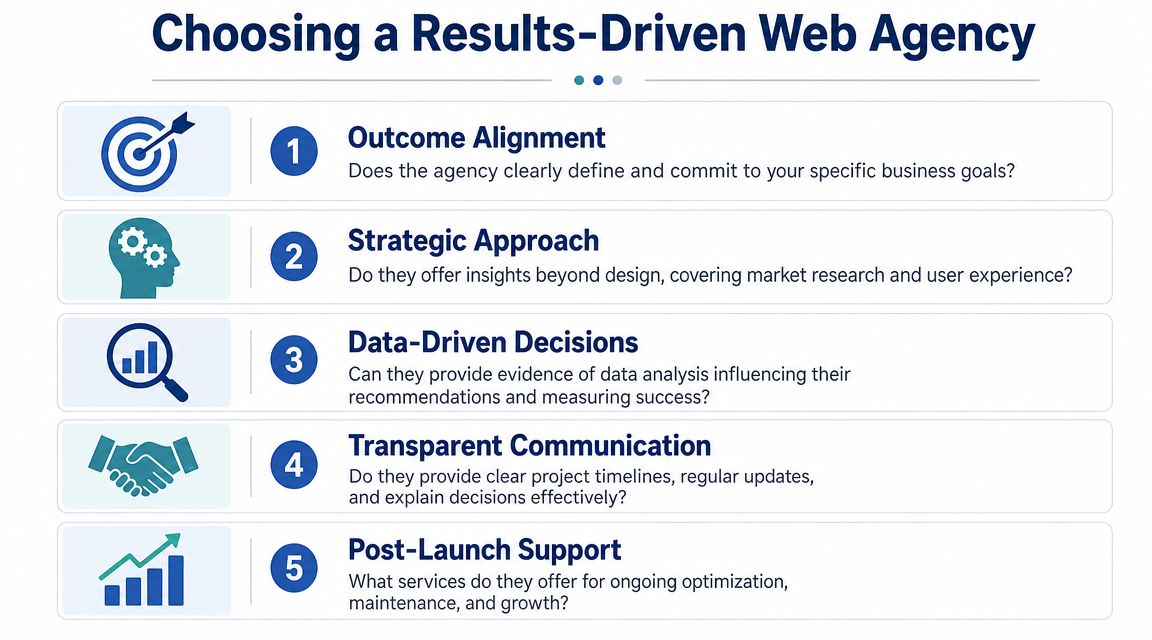
Most businesses still choose agencies by looking at visual style, review scores, and whether the proposal feels polished. Those things matter, but they don't tell you enough about what happens after launch.
A common gap in the market is an agency's ability to prove post-launch success. Many show attractive design work, but far fewer can show how they improved mobile conversion, handled migration risk, or ran structured optimisation after go-live, as noted in this Glasgow web design perspective on post-launch performance proof.
Ask for evidence, not adjectives
“User-focused”, “data-driven”, and “conversion-led” are easy words to put in a proposal. You need to know what they mean in practice.
Ask direct questions such as:
- What changed after launch? Ask for examples of measurable business impact, explained in plain English.
- How do you protect SEO during a redesign? You want to hear about redirects, page mapping, template reviews, and migration QA.
- What happens in the first months after launch? If the answer is limited to bug fixes, growth probably isn't part of the engagement.
- How do you decide what to test or improve? Good agencies should mention analytics, user behaviour, and prioritisation.
- Who is performing the work? Strategy, design, development, and QA shouldn't all depend on one overstretched generalist.
Practical rule: If an agency can only talk about deliverables and not outcomes, you're hiring a supplier, not a growth partner.
A broader set of tips for hiring a digital marketing partner can also help when you're comparing firms that offer overlapping web, SEO, and growth services.
Review the process, not just the portfolio
Portfolio pages are curated. Process reveals how the agency thinks under pressure.
Look for signs of maturity:
- Clear discovery work: They ask about sales cycles, customer objections, and channel mix.
- Structured QA: They test forms, mobile layouts, redirects, and tracking before launch.
- Transparent communication: You know what happens each week and who owns each decision.
- Defined post-launch support: There's a realistic plan for fixes, monitoring, and optimisation.
For a more focused shortlist framework, this guide on how to choose a web design agency is useful because it centres the decision on fit, capability, and commercial thinking rather than appearance alone.
Here's a practical way to compare proposals.
| Evaluation Area | What to Look For | Red Flag |
|---|---|---|
| Strategy | Questions about goals, audience, offer, and conversions | Starts with visuals before understanding the business |
| SEO and migration | Redirect planning, content mapping, technical QA | “We'll keep the same URLs where possible” with no detail |
| Conversion focus | Discussion of user journeys, CTAs, testing, analytics | Vague claims about UX with no measurement plan |
| Communication | Named contacts, milestones, regular reporting | Slow replies and unclear ownership before the project starts |
| Post-launch support | Monitoring, optimisation, maintenance, iteration | Launch treated as the end of the engagement |
A short explainer can also help you hear how agencies frame value and accountability in their own words.
The best agency choice usually feels more disciplined, not more exciting
The right web design agency in Glasgow won't always be the one with the flashiest homepage. It's usually the one that asks harder questions, challenges weak assumptions, and shows you how decisions will be measured after launch.
That discipline protects your budget. It also gives your site a better chance of becoming a working commercial asset instead of another expensive rebuild waiting to happen.
Beyond Visuals The Technical Services That Drive Growth
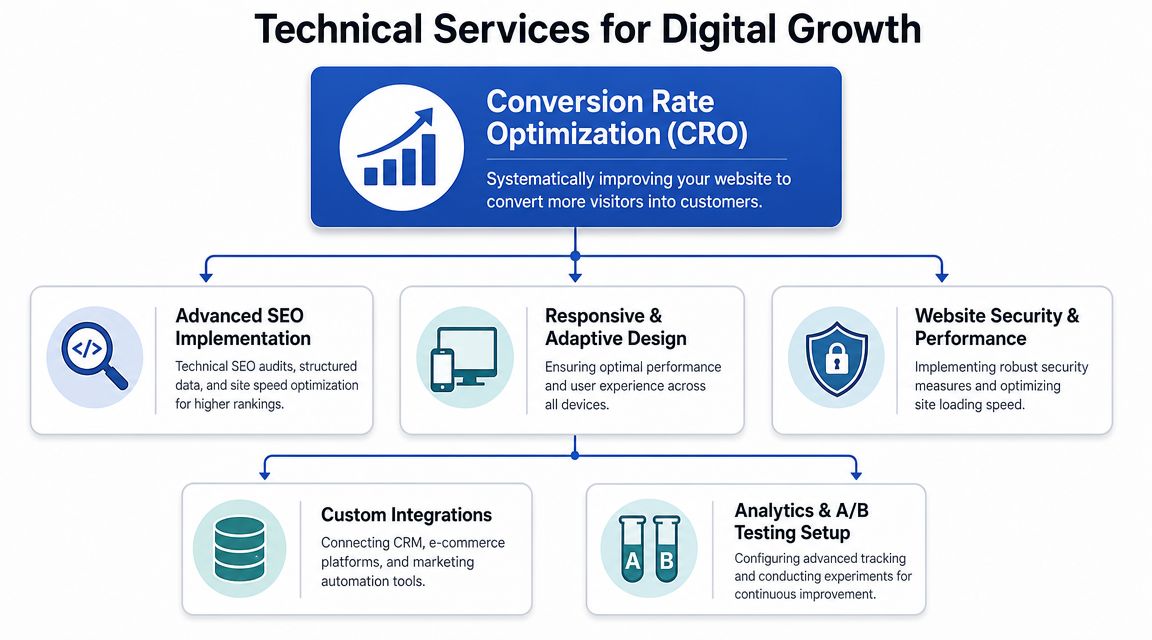
Visual design gets attention because it's easy to see. Technical quality drives outcomes because it shapes what users can do.
If your site loads badly, jumps around during scrolling, stalls when someone taps a button, or fails on weaker devices, the commercial damage starts before anyone reaches your offer. That's why technical work shouldn't sit in the background of an agency pitch. It should be near the centre.
Performance is a growth issue
Google's Core Web Vitals set practical benchmarks for user experience. For a good experience, Largest Contentful Paint should occur within 2.5 seconds and Interaction to Next Paint should be below 200 milliseconds, according to Google-focused guidance on Core Web Vitals thresholds. If a site misses those standards on typical mobile connections, users feel the friction even if they can't name the metric.
In agency terms, that affects decisions such as:
- Image handling: oversized hero banners often hurt load times
- JavaScript use: heavy themes and unnecessary scripts delay interaction
- Font loading: multiple weights and families can slow first render
- Third-party tools: chat widgets, trackers, and embeds often create hidden drag
A premium-looking site that feels slow is still underperforming.
Conversion work is rarely one big redesign
Good conversion work usually comes from many smaller decisions made well.
That includes simplifying navigation, reducing form friction, rewriting headings, improving product page hierarchy, tightening internal search, and testing different call-to-action placements. It also means using analytics correctly so your team can see where users hesitate or abandon key flows.
For ecommerce brands, this often overlaps with platform-specific development. If you're assessing Shopify-focused work, these Shopify development services show the sort of technical scope that matters when conversion, performance, and extensibility all need to work together.
Migrations and integrations carry real risk
A redesign isn't only a design exercise. It's often a systems project.
If you're moving platforms, restructuring URLs, changing templates, or rebuilding an ecommerce catalogue, the agency should understand:
- Redirect planning so old URLs don't collapse into dead ends
- Data migration for products, blogs, customer content, and metadata
- Tracking continuity so reporting doesn't break at launch
- Integration logic across CRM, ERP, fulfilment, subscriptions, or reviews
Many projects become expensive. Not because the homepage changes, but because the business rules behind the website weren't scoped properly.
Faster sites don't win because they're fashionable. They win because they make buying and enquiring easier.
Accessibility and resilience are commercial requirements
A strong site also needs to work for users on weaker devices, slower networks, or shared hardware. That means using semantic HTML, reliable form behaviour, clear contrast, and layouts that don't depend on everything loading perfectly.
In practice, agencies that take this seriously build simpler, sturdier interfaces. They avoid making critical actions depend on brittle front-end effects. They make sure key content appears early. They test important journeys under less-than-ideal conditions.
One practical example in this space is Grumspot, which offers Shopify migrations, technical audits, and conversion-focused ecommerce development for businesses that need storefront performance and post-launch iteration rather than only visual redesign.
Understanding the Web Design Process and Timeline
A lot of frustration in web projects comes from mismatched expectations. The client thinks design starts immediately. The agency is waiting for stakeholder input, content, access, or technical decisions. Weeks disappear.
The smoother projects usually follow a clear sequence. Not because agencies like process for its own sake, but because skipping steps creates expensive rework later.
What happens first
The opening phase is discovery. That includes business goals, audience, competitors, existing site issues, required features, and the actions your site needs users to take.
An agency that handles this well will ask for more than brand assets. It will want context. Sales objections, internal workflows, top-performing pages, weak pages, and any platform constraints all shape the build.
If you want a simple external reference, Wonderment Apps' approach to web projects gives a useful overview of why staged delivery matters.
The usual project flow
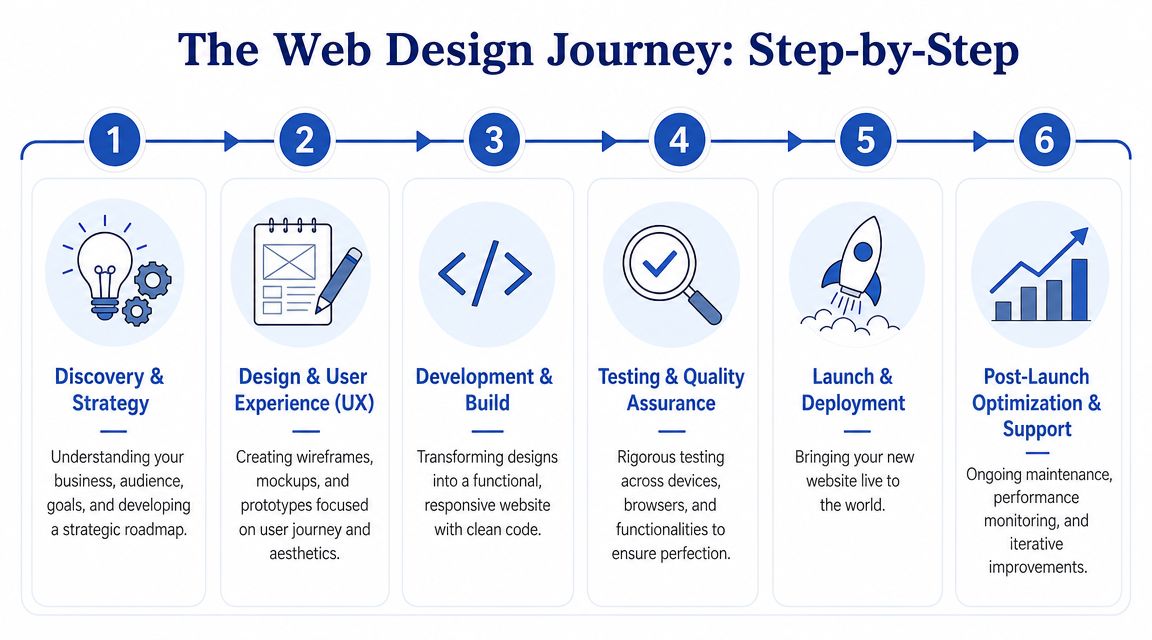
Most professional web projects move through some version of this path:
Discovery and strategy
Scope, goals, audience, site structure, functionality, and success criteria get defined.Design and UX
Wireframes, page concepts, component systems, and user journeys take shape.Development and content population
The approved designs are built into templates and content starts getting added properly.Testing and QA
Forms, mobile layouts, browsers, redirects, tracking, page speed, and accessibility checks get reviewed.Launch and handover
The site goes live, DNS and hosting are coordinated, and your team gets training where needed.Post-launch support
Bugs are fixed, user behaviour gets reviewed, and the first improvements are prioritised.
What slows projects down
Most delays don't come from coding alone. They usually come from decision bottlenecks.
Common issues include:
- Late content: Teams underestimate how long copy, images, and approvals take.
- Too many stakeholders: Feedback becomes contradictory or arrives out of sequence.
- Unclear ownership: Nobody has authority to sign off designs or functionality.
- Scope drift: New features appear mid-project without adjusting timeline or budget.
The best timeline is the one both sides can actually support with decisions, content, and approvals.
A good agency should make those risks visible early. That's one of the clearest signs you're dealing with people who've managed real projects before.
Decoding Web Design Pricing in Glasgow
Price is usually the point where agency conversations become vague. Buyers ask for a cost. Agencies respond with “it depends”. Both sides get frustrated.
Web design pricing does depend on scope, but the logic shouldn't be mysterious. You should be able to understand what you're paying for and what's likely to change the final figure.
What the Glasgow market looks like
DesignRush reports that web designers in Glasgow typically charge $50 to $149 per hour, with project work often ranging from $1,000 to over $10,000, while Clutch listings show over 600 firms in the area and many established agencies in the $100 to $149 per hour bracket, according to Glasgow web design pricing and agency listings. That tells you two things. First, the market is broad. Second, there's a real gap between low-cost execution and more established agency delivery.
What usually drives cost
The homepage design is rarely the main cost driver. Complexity sits elsewhere.
A quote usually changes based on:
- Page and template count: A compact brochure site is not the same as a site with service hubs, resources, and landing pages.
- Platform choice: Shopify, WordPress, and bespoke builds all carry different technical demands.
- Content migration: Moving products, blogs, media, and metadata takes time.
- Integrations: CRM, ERP, bookings, subscriptions, reviews, and fulfilment tools add complexity.
- QA depth: Proper testing across devices, redirects, tracking, and forms is labour.
- Post-launch support: Ongoing optimisation, fixes, and reporting should be priced separately from the initial build unless clearly included.
Cheap quotes often remove the wrong things
A lower quote can still be good value if the scope is simpler. But many cheap proposals only look competitive because they exclude the hard parts.
Watch for missing items such as redirect planning, analytics setup, accessibility checks, technical SEO, product migration, stakeholder workshops, or post-launch support. Those aren't extras if your site needs to perform commercially. They're part of the complete build.
If you're budgeting for ecommerce specifically, this guide on the cost of ecommerce website development is useful for understanding how scope, integrations, and platform requirements affect pricing decisions.
How to compare quotes properly
Don't compare totals alone. Compare assumptions.
Ask each agency:
- What is included in discovery and planning?
- How many templates or page types are covered?
- Who handles content entry and migration?
- What testing is included before launch?
- What happens in the first month after launch?
The better quote is usually the one that makes trade-offs visible. Clear pricing isn't about getting the lowest number. It's about knowing what you're buying, what's excluded, and where the commercial risk sits.
Frequently Asked Questions
Should you hire a local Glasgow agency or a remote one
Local can help when your business benefits from in-person workshops, stakeholder sessions, or a team that understands your regional market. Remote can work perfectly well if communication is structured and the agency is technically strong.
The better question is whether the agency understands your customers, your sales process, and your operating constraints. Geography helps. Capability matters more.
Is a freelancer enough or do you need a full agency
A freelancer can be a good fit for a smaller brochure site with limited complexity. A full agency usually makes more sense when you need strategy, design, development, SEO awareness, QA, and post-launch support working together.
The risk with a solo setup is not quality by itself. It's capacity. If one person handles everything, bottlenecks show up fast when the project includes migration, integrations, or growth work after launch.
How long should a web project take
That depends on scope, content readiness, approval speed, and technical complexity. A small site can move quickly if decisions are made fast. A larger redesign with ecommerce, integrations, and migration requirements takes longer because there are more dependencies and more risk to manage.
If an agency gives you an aggressive timeline before understanding those details, treat that cautiously.
What should you prioritise if your audience includes less technical users
Prioritise clarity, accessibility, and resilience. That matters because 24% of UK adults had no home internet access in 2024 and 7% were offline overall, which means a meaningful share of users may still rely on weaker or shared devices, according to UK audience access context for resilient web design. Your site should work cleanly without assuming perfect connectivity or perfect hardware.
What's the single best sign an agency will deliver business results
It's not style. It's whether they can explain how the site will be measured and improved after launch.
If they talk clearly about conversion paths, tracking, testing, technical quality, and what happens once the site is live, you're having the right conversation.
If you want a web partner that approaches design as a growth system rather than a visual refresh, Grumspot is worth a look. The team focuses on Shopify design, development, migrations, CRO, and technical improvement for businesses that need a site to perform commercially, not just look updated.
Let's build something together
If you like what you saw, let's jump on a quick call and discuss your project
Related posts
Check out some similar posts.