Hiring a Web Design Agency Kent: Your 2026 Guide
- web design agency kent
- shopify agency kent
- hire web designer kent
- ecommerce development kent
- local seo kent
Launched
June, 2026
Your site is probably doing one of two things right now. It's either underperforming while everyone in the business avoids talking about it, or it's become the place where every unresolved commercial problem gets dumped. Leads are weak, the enquiry form is clunky, the shop feels dated, and every agency you speak to promises a “modern refresh”.
That's usually the moment a Kent business owner starts searching for a web design agency in Kent and discovers a wall of near-identical claims. Clean design. SEO-friendly builds. Mobile responsive. Ongoing support. None of that tells you who can help you sell more, generate better enquiries, or migrate an ageing ecommerce setup without breaking operations.
The useful question isn't who can make a better-looking site. It's who can build a website that supports the way your business makes money.
Why Your Website Is More Than a Digital Brochure
A website for a Kent business isn't a branding exercise first. It's business infrastructure. It handles first impressions, trust, lead qualification, product discovery, online sales, customer questions, and often the hand-off into your CRM, booking system, or fulfilment process.
That changes how you should evaluate a web design agency in Kent. You're not buying colours, page layouts, and a homepage hero banner. You're choosing who will shape a revenue channel that has to work when you're asleep, in meetings, or out on site.
The market has already gone digital first
Official ONS data shows that 96% of UK households had internet access in 2024, which means Kent businesses are operating in a market where online presentation is the default expectation, not a nice extra, according to this UK web design statistics summary. If someone hears about your business, they'll usually check your site before they call, enquire, or visit.
That matters because buyers judge credibility fast. They notice stale design, confusing navigation, weak product pages, missing trust signals, and slow mobile experiences long before they speak to you.
Practical rule: If your website can't answer “Can I trust this company?” and “What do I do next?” within a few seconds, it isn't doing its job.
Pretty sites often fail commercially
A lot of agency work still leans too heavily on visual polish. The homepage looks sharp in a proposal deck, but the live site doesn't guide users well. It hides service pages, buries delivery information, uses vague calls to action, and leaves product filtering or checkout logic as an afterthought.
For service firms, that means poor lead quality and wasted admin time. For retailers, it means friction at the exact points where people decide whether to buy.
That's why conversion matters so much more than appearance alone. If you want a grounded explanation of what that looks like in practice, this piece on conversion-focused web design is worth reading alongside your agency search.
Growth now depends on connected systems
The website also sits in a wider commercial stack. It may need to connect with Shopify, email platforms, stock systems, subscriptions, customer support tools, or analytics dashboards. As more firms explore automation and AI for commerce, the gap widens between a brochure site and a site that can actively support operations, sales, and retention.
A Kent agency that only talks about branding won't be enough if your business needs product logic, integrations, or landing pages designed to convert paid traffic.
You don't need a supplier who can “do websites”. You need a team that understands how websites support revenue.
Define Your Project Before You Search for an Agency
Most hiring mistakes happen before the first agency call. The problem isn't always the agency. It's often that the client starts with a vague brief like “we need a new website” and expects the right solution to appear through chemistry and good intentions.
That rarely ends well.
The UK business base is dominated by 5.5 million private-sector businesses in 2024, with 99.9% classed as SMEs, and many rely on external specialists for web work, as summarised in these UK business and web design figures. In that environment, a clear brief is what protects your budget and improves the odds of getting useful work rather than decorative output.
Start with the commercial job
Write down what the site must do for the business. Not what you want it to look like. What job it needs to perform.
For example:
- Lead generation: Do you need more quote requests, better-qualified enquiries, or fewer irrelevant calls?
- Ecommerce: Are you trying to increase online sales, simplify product management, or replace a platform that's holding the team back?
- Operational efficiency: Do you want the site to reduce manual admin through bookings, forms, customer logins, or self-service content?
- Repositioning: Are you moving upmarket, entering a new service area, or targeting a different type of client?
If you can't state the business purpose clearly, an agency will fill the gap with assumptions. That's where expensive drift begins.
Define what is non-negotiable
Kent businesses often approach agencies before they've listed the practical features the site must support. That creates messy proposals and even messier builds.
Use a simple brief with these headings:
| Brief area | What to define |
|---|---|
| Business goal | What the site must help achieve commercially |
| Audience | Who the main buyer is and what they need to see |
| Core pages | Key templates such as home, service, category, product, landing, contact |
| Functionality | Shopify, booking tools, subscriptions, CRM forms, stock sync, search, gated content |
| Content | What already exists, what needs rewriting, what needs photographing |
| Internal ownership | Who signs off copy, design, legal text, and technical decisions |
Answer the awkward questions early
Some of the most useful pre-hiring questions are the ones businesses tend to avoid:
- Who will supply content? Agencies can design around missing copy for a while, but not forever.
- Who owns product data cleanup? If your catalogue is inconsistent, the build will expose it.
- Do you need migration support? Replatforming is not the same as starting from scratch.
- Will the site need CRO input from day one? That matters if paid traffic or ecommerce revenue is involved.
- What absolutely cannot break at launch? Payments, forms, bookings, tracking, and fulfilment usually top the list.
Buyers who define scope properly tend to have better agency conversations because they can judge answers against real needs rather than presentation skills.
A good brief doesn't need to be corporate or polished. It needs to be honest, specific, and useful. That alone will help you rule out agencies that only know how to sell generic redesigns.
How to Evaluate Portfolios for Real Business Impact
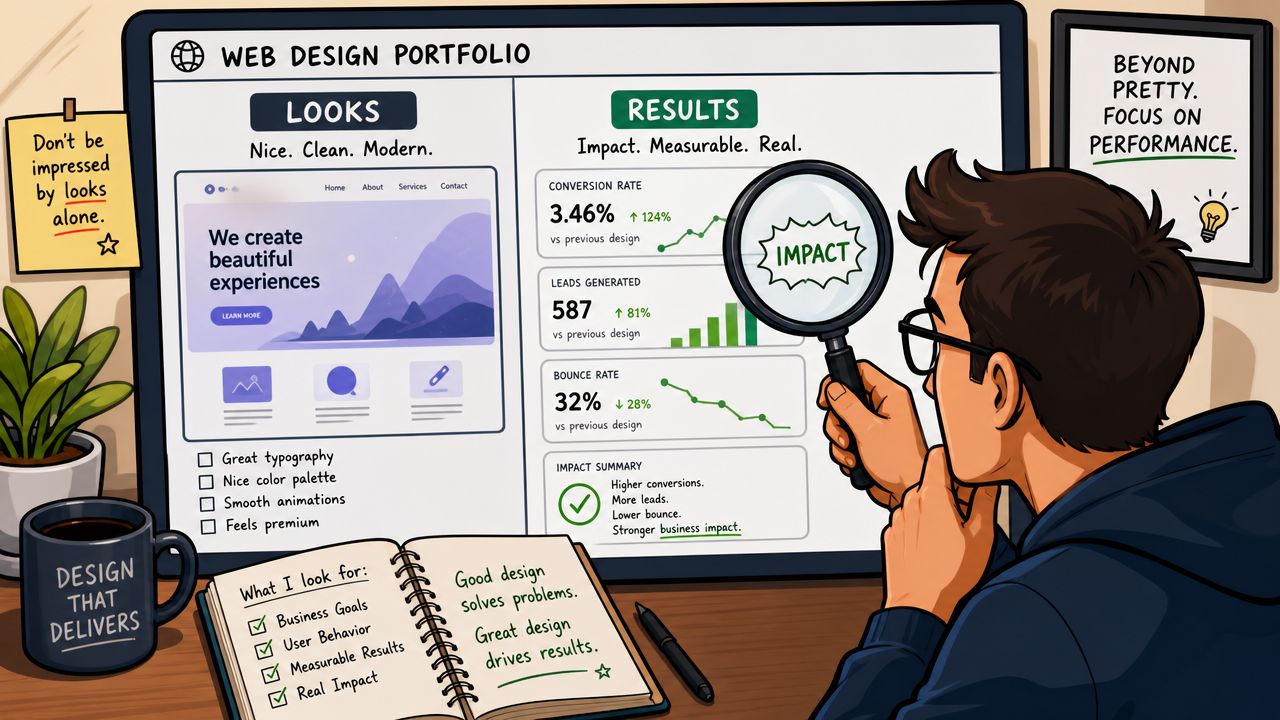
Most portfolios are built to impress at a glance. They show polished screens, brand colours, and tidy mockups. That's fine as far as it goes, but it doesn't tell you whether the agency understands enquiry flow, catalogue structure, conversion friction, or post-launch commercial performance.
When reviewing a web design agency in Kent, look at the work like a buyer, not like a designer.
Check live sites, not just screenshots
Open the actual websites in the portfolio. Then test them on your phone. Click through categories, forms, menus, search, filters, cart flows, and contact paths.
Ask simple questions:
- Is the path obvious? Can a visitor understand what the business offers and what to do next?
- Is mobile treated seriously? Many agency decks still hide weak mobile thinking behind desktop visuals.
- Do service pages carry proof? Look for reviews, process clarity, FAQs, sector detail, or evidence of trust.
- Do product pages help people decide? Strong ecommerce pages reduce uncertainty rather than just displaying items.
Often, many portfolios start to thin out. Good-looking pages are common. Good journeys are not.
Ecommerce skill is different from brochure-site skill
The commercial gap matters because internet sales accounted for 27.0% of total retail sales in Great Britain in December 2025, which means ecommerce capability is commercially significant for UK businesses, as noted in this summary of ONS retail sales context. If you sell online, your agency needs to understand more than layout.
A capable ecommerce team should be able to discuss things like:
| What to look for | Why it matters |
|---|---|
| Platform fit | Shopify, Shopify Plus, WooCommerce, or custom requirements each bring different trade-offs |
| Migration experience | Product data, redirects, customer accounts, content structure, and tracking need careful handling |
| Integrations | ERP, CRM, subscriptions, fulfilment, reviews, search, email, and payments can shape the build |
| Conversion work | Merchandising, cart logic, upsells, navigation, search, and checkout support revenue directly |
If an agency says it “does Shopify” but only shows template setups, that's a warning sign for larger or more operationally complex stores.
A polished Shopify homepage doesn't prove Shopify expertise. The difficult work usually sits in migration planning, data structure, app decisions, integrations, and post-launch optimisation.
Look for evidence of problem solving
A strong portfolio tells you what challenge existed and how the team approached it. Not every agency publishes deep case studies, but they should still be able to explain decisions in practical terms.
Useful signs include:
- Platform rationale: Why this stack was chosen over alternatives
- Content structure: How navigation and page hierarchy were simplified
- Operational considerations: How payments, shipping, or internal workflows were handled
- Testing mindset: Whether the agency thinks beyond launch and into improvement
For a broader decision framework, this guide on how to choose a web design agency gives a useful checklist for comparing portfolio quality against business fit.
Here's a short video worth watching before your shortlist calls. It helps sharpen your eye for what agencies present versus what matters in a real project.
What specialist Shopify work looks like
If your shortlist includes agencies claiming Shopify or Shopify Plus capability, push for specifics.
Ask whether they've handled:
- Theme customisation versus bespoke builds
- Shopify 2.0 migrations
- International storefront requirements
- Subscription logic
- Custom apps or workflow extensions
- ERP, CRM, or fulfilment integrations
- CRO input after launch
This is one area where specialist agencies can be materially different from general web studios. For example, Grumspot focuses on Shopify design, development, migrations, custom apps, and conversion work, which is relevant if your site is a trading platform rather than a brochure. That doesn't make it the right fit for every project, but it does illustrate the difference between general design capability and platform-specific commercial experience.
Decoding Proposals Timelines and Pricing
By the time proposals arrive, most business owners are tired. They've had calls, sat through demos, and heard enough agency language to last the year. That's when people make a bad decision by comparing price alone.
A proposal needs to answer four things clearly. What's being delivered, how the project will run, what it excludes, and how changes will be handled.
What a solid proposal includes
Industry guidance suggests typical web design projects run 8-12 weeks, and that scope creep is the clearest delivery risk because it can inflate hourly-billed work by 25% or more if the specification isn't fixed up front, according to this Kent web design buying guide.
That's why vague proposals are dangerous. If the document only says “design and development of a new website” without a proper definition of pages, features, revision rounds, content responsibilities, and testing, you're looking at future arguments disguised as flexibility.
A useful proposal should spell out:
- Discovery work: Workshops, stakeholder interviews, audits, competitor review, or user-flow planning
- Defined deliverables: Number of templates, design rounds, development scope, CMS setup, migration tasks
- Client responsibilities: Copy, imagery, product uploads, approvals, legal sign-off
- Launch scope: Redirects, analytics setup, quality assurance, training, post-launch support window
Fixed fee, hourly, or retainer
Different pricing models suit different jobs. Problems start when buyers don't understand the trade-off.
| Pricing model | Usually suits | Main trade-off |
|---|---|---|
| Fixed project fee | Well-defined redesigns or builds | Less flexibility if requirements change |
| Hourly billing | Evolving technical work or unclear scope | Budget risk if discovery was weak |
| Monthly retainer | Ongoing CRO, design support, development backlog | Best for continuous work, not one clean build |
If you're comparing ecommerce quotes, this breakdown of building an e-commerce site is useful because it frames costs by moving parts rather than by a single headline number. That's the right way to think about pricing.
For more practical context on the same issue, this article on the cost of ecommerce website development helps when you need to separate platform, functionality, and support costs.
Questions worth asking before you sign
Don't ask “can you do this?” Ask questions that expose how the agency works.
- What exactly is included in discovery, and who participates?
- How many page templates are being designed versus adapted?
- What assumptions have you made about content readiness?
- How are change requests handled once the project is underway?
- Who is the day-to-day contact, and how often will updates be shared?
- What is excluded that clients often assume is included?
- What happens in the first weeks after launch if issues appear?
If two proposals have different prices, look for missing work before you assume one agency is overpriced.
The cheapest quote often wins by leaving out the difficult bits. Data cleanup. Redirect planning. testing. CRO thinking. Analytics setup. Revision control. Training. Those are precisely the tasks that prevent expensive rework later.
Spotting Red Flags Before You Sign
Some agency problems are obvious. Slow replies, sloppy proposals, and pushy sales calls don't need much interpretation. The more costly red flags are quieter. They sound confident in meetings but fall apart once you test the detail.
Independent hiring guidance for web designers tells buyers to define scope and compare portfolios before hiring, and it flags skipping discovery as a major warning sign in the selection process, as reflected in this hiring guidance for web design buyers.
The agency talks before it listens
If an agency can recommend platform, sitemap, features, and timeline before properly understanding your business, that isn't efficiency. It's guesswork.
A capable team should ask about your sales process, margins, internal workflows, existing pain points, platform constraints, and who inside the company will own the project. If those questions never come, the proposal will probably be generic too.
Their portfolio is visual, but commercially empty
You don't need pages of statistics to judge commercial maturity. You do need some proof that the agency thinks in outcomes, not just compositions.
Watch for these warning signs:
- No explanation of business context: Every project is presented as a design exercise
- No mention of platform complexity: Ecommerce work is described as if it were brochure work
- No sign of post-launch thinking: The agency behaves as though launch day is the finish line
- No curiosity about conversion: Calls to action, user flows, and trust content are barely discussed
Process gets fuzzy when you ask practical questions
Ask how feedback is collected. Ask who writes tickets. Ask how staging is handled. Ask what happens if content is late. Ask who approves design before development begins.
Weak agencies start speaking in generalities at this point. Strong ones get more precise.
The wrong agency rarely looks wrong in the first meeting. It usually reveals itself when you ask who does what, when, and how decisions are controlled.
One more thing matters and doesn't appear in proposals often enough. Communication style. If the team dodges direct questions, overcomplicates straightforward points, or keeps changing who owns the conversation, don't ignore it. Those habits get worse under delivery pressure, not better.
Your Agency Vetting Checklist
A shortlist is easier to manage when you score agencies against the same criteria. Otherwise, decisions get distorted by who had the nicest deck or the smoothest salesperson.
Use a simple scoring sheet and fill it in straight after each call. Don't rely on memory.
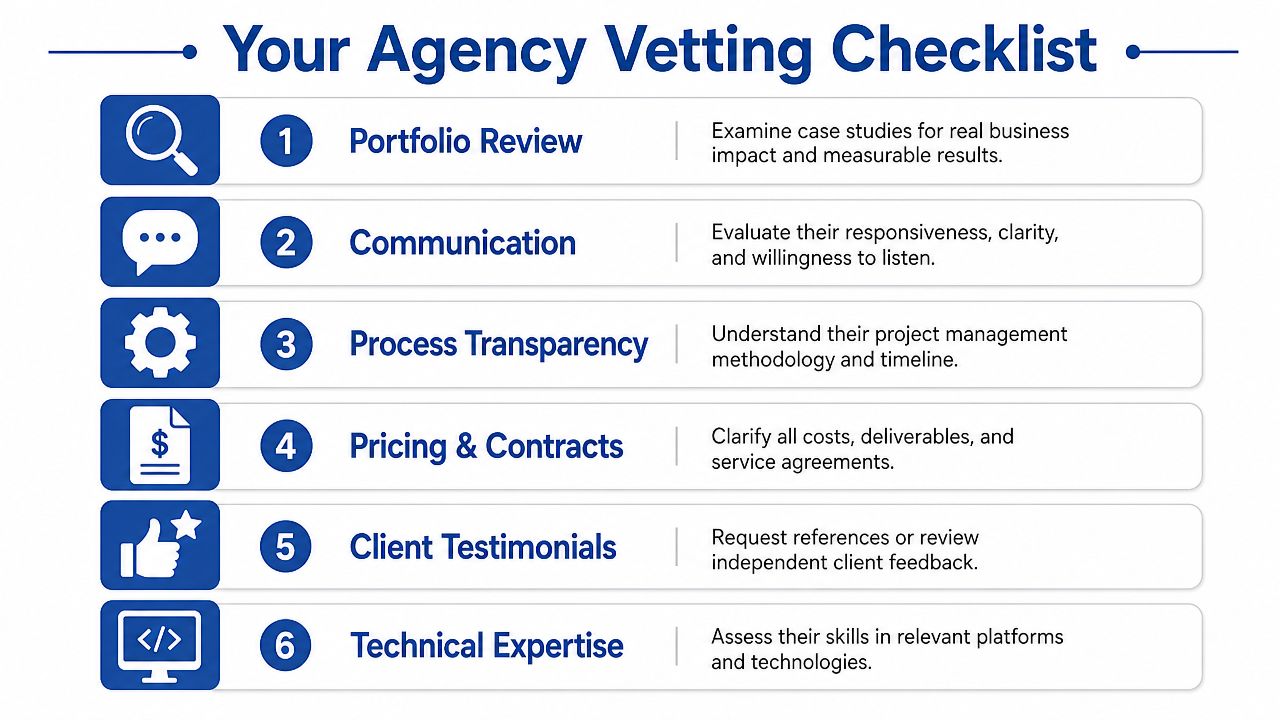
The six areas worth scoring
Start with practical fit, not personality.
- Portfolio relevance: Have they solved problems similar to yours, on the right platform, with believable commercial thinking?
- Communication quality: Do they answer questions directly, explain trade-offs clearly, and listen properly?
- Process transparency: Can they describe milestones, feedback loops, responsibilities, and risk points without hand-waving?
- Pricing clarity: Is the proposal easy to compare, with clear inclusions, exclusions, and change-control rules?
- Client confidence: Can they provide references or independent feedback that helps you sense how the relationship works after the sale?
- Technical capability: Do they understand the stack you need, including ecommerce, integrations, migration, and analytics?
If analytics is a major part of your decision, this piece with insights for growth marketers on analytics agencies is helpful because it sharpens the questions you ask around reporting, attribution, and decision-making support.
Use a scoring table, not gut feel alone
Here's a simple version you can copy into a spreadsheet:
| Vetting Area | What to Ask / Check | Agency 1 Score (1-5) | Agency 2 Score (1-5) |
|---|---|---|---|
| Portfolio Review | Do live examples show relevant platform and business-fit experience? | ||
| Communication | Are answers clear, direct, and commercially aware? | ||
| Process Transparency | Is there a documented workflow with milestones and ownership? | ||
| Pricing & Contracts | Are scope, exclusions, and change handling defined properly? | ||
| Client Testimonials | Can they provide credible references or independent reviews? | ||
| Technical Expertise | Can they handle required integrations, ecommerce features, and tracking needs? |
What a strong final shortlist looks like
By the end, you should be able to answer these questions with confidence:
- Which agency understands how the business makes money?
- Which one has the most relevant platform and delivery experience?
- Which proposal is the clearest, not just the cheapest?
- Which team would you trust when the project hits a difficult week?
That final question matters more than people expect. Websites rarely go wrong because someone picked the wrong shade of blue. They go wrong because ownership is fuzzy, decisions arrive late, content isn't ready, platform complexity was underestimated, or nobody challenged weak assumptions early enough.
Choose the agency that reduces those risks while still building something commercially sharp.
If your project involves Shopify, Shopify Plus, migration work, CRO, or deeper ecommerce integrations, Grumspot is one option to review alongside your shortlist. The team focuses on Shopify design and development, custom app work, audits, and ongoing optimisation, which makes it relevant for businesses that need more than a brochure site.
Let's build something together
If you like what you saw, let's jump on a quick call and discuss your project
Related posts
Check out some similar posts.