What Is Predictive Analytics and How It Boosts Ecommerce
- predictive analytics
- ecommerce
- data science
- machine learning
- business strategy
Launched
July, 2026
In the UK, 72% of businesses were projected to be using predictive analytics by 2026, according to SAS's overview of predictive analytics. That figure changes the usual framing. Predictive analytics isn't a niche data science experiment anymore. It's becoming a normal way to make decisions.
For an ecommerce team, the appeal is easy to understand. A retailer wants to know which visitors are likely to buy, which products may run low next month, and which customers need a better offer before they drift away. Without a predictive approach, those decisions rely on instinct, rough averages, or reports that only explain what has already happened.
Introduction to Predictive Analytics
Predictive analytics means using data, statistical algorithms, and machine learning techniques to estimate the likelihood of future outcomes from historical patterns. In plain language, it asks: based on what happened before, what's likely to happen next?
That matters in online retail because stores make future-facing choices every day. A merchandiser has to place stock orders before demand peaks. A marketer has to decide which audience deserves more budget before the campaign ends. A CRM manager has to choose who gets the next message before that customer disappears. If you want a useful primer on Boosting marketing ROI with predictive analytics, that resource pairs well with this topic because it focuses on what teams do after they spot likely outcomes.
The practical value comes from action, not prediction alone. A model that flags a likely purchase is only useful if your store changes the offer, message, or timing.
Many readers first encounter the idea through personalisation. If that's your angle, Grumspot's article on hyper-personalisation in ecommerce is a helpful companion because predictive systems often sit behind those customized experiences.
Predictive analytics moves a business from reacting to yesterday's report to acting on tomorrow's probability.
Understanding Predictive Analytics Concepts
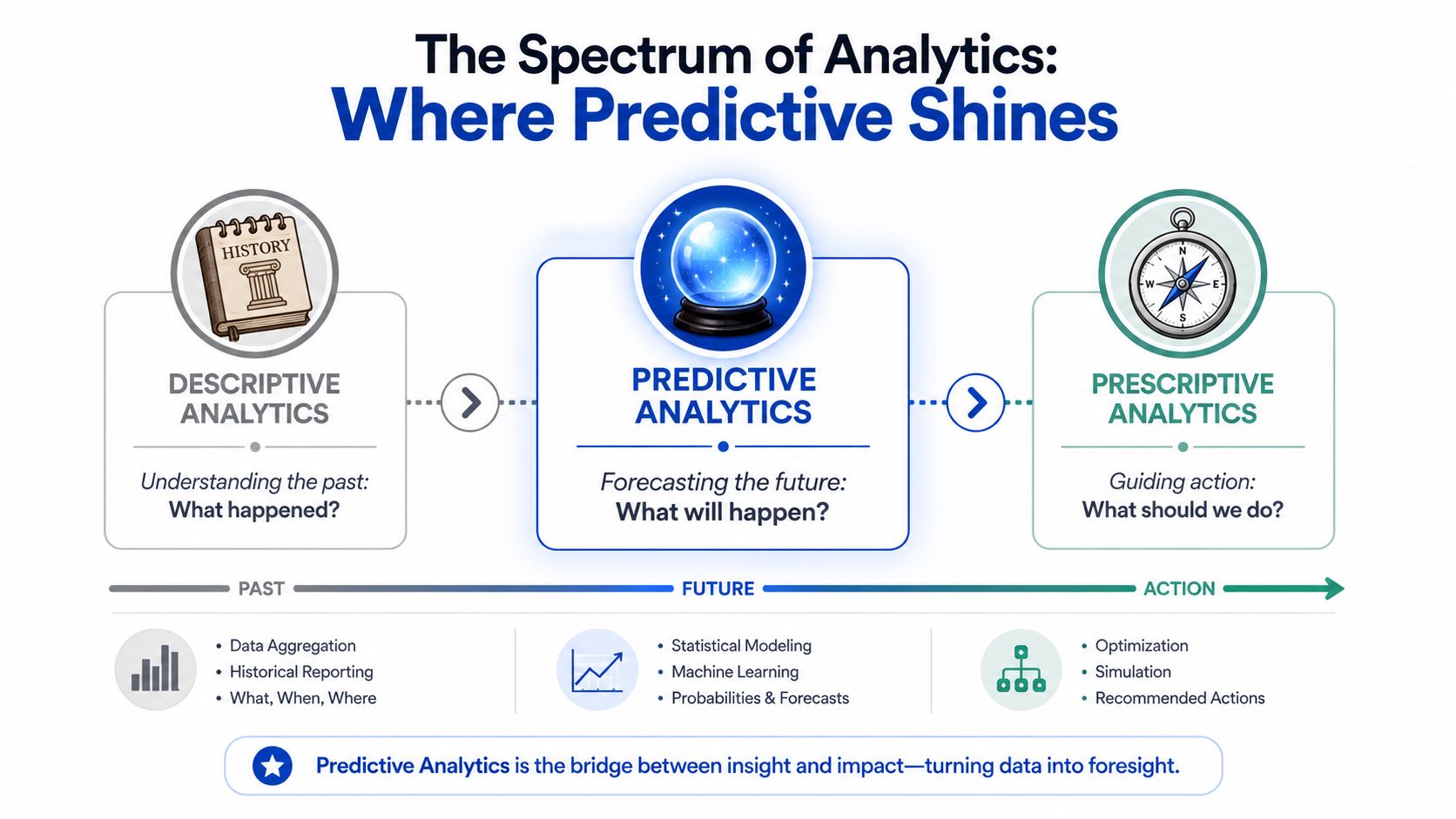
A lot of confusion starts because analytics terms sound similar. The clearest way to answer what is predictive analytics is to place it between two other types of analysis.
The three main types
| Type | Core question | Simple analogy |
|---|---|---|
| Descriptive analytics | What happened? | Yesterday's weather report |
| Predictive analytics | What will probably happen? | Tomorrow's weather forecast |
| Prescriptive analytics | What should we do next? | Advice to carry an umbrella |
Descriptive analytics looks backwards. It tells you that traffic fell, returns rose, or one product line sold well.
Predictive analytics looks forwards. It studies past signals and estimates future behaviour. For example, it can estimate whether a shopper is likely to purchase, whether a customer segment may churn, or whether demand may rise for a seasonal item.
Prescriptive analytics goes a step further and supports action. It might suggest which audience to target, which stock level to hold, or which intervention to trigger.
The core building blocks
Three words matter most:
- Data means the historical information the model learns from.
- Model means the mathematical structure that detects patterns.
- Outcome means the event you want to estimate, such as a purchase or a stockout.
In ecommerce, those inputs often include browsing activity, basket behaviour, product details, purchase history, timestamps, and campaign interactions.
The commercial context also matters. The UK predictive analytics market was valued at USD 2.8 billion in 2024 and is projected to reach USD 11.5 billion by 2032, while the wider UK data analytics market reached USD 4.2 billion in 2025 and is projected to grow to USD 25.9 billion by 2034, according to this UK market forecast summary. That growth reflects a shift in how organisations operate. They don't just want dashboards. They want forward-looking decision support.
How Predictive Analytics Works
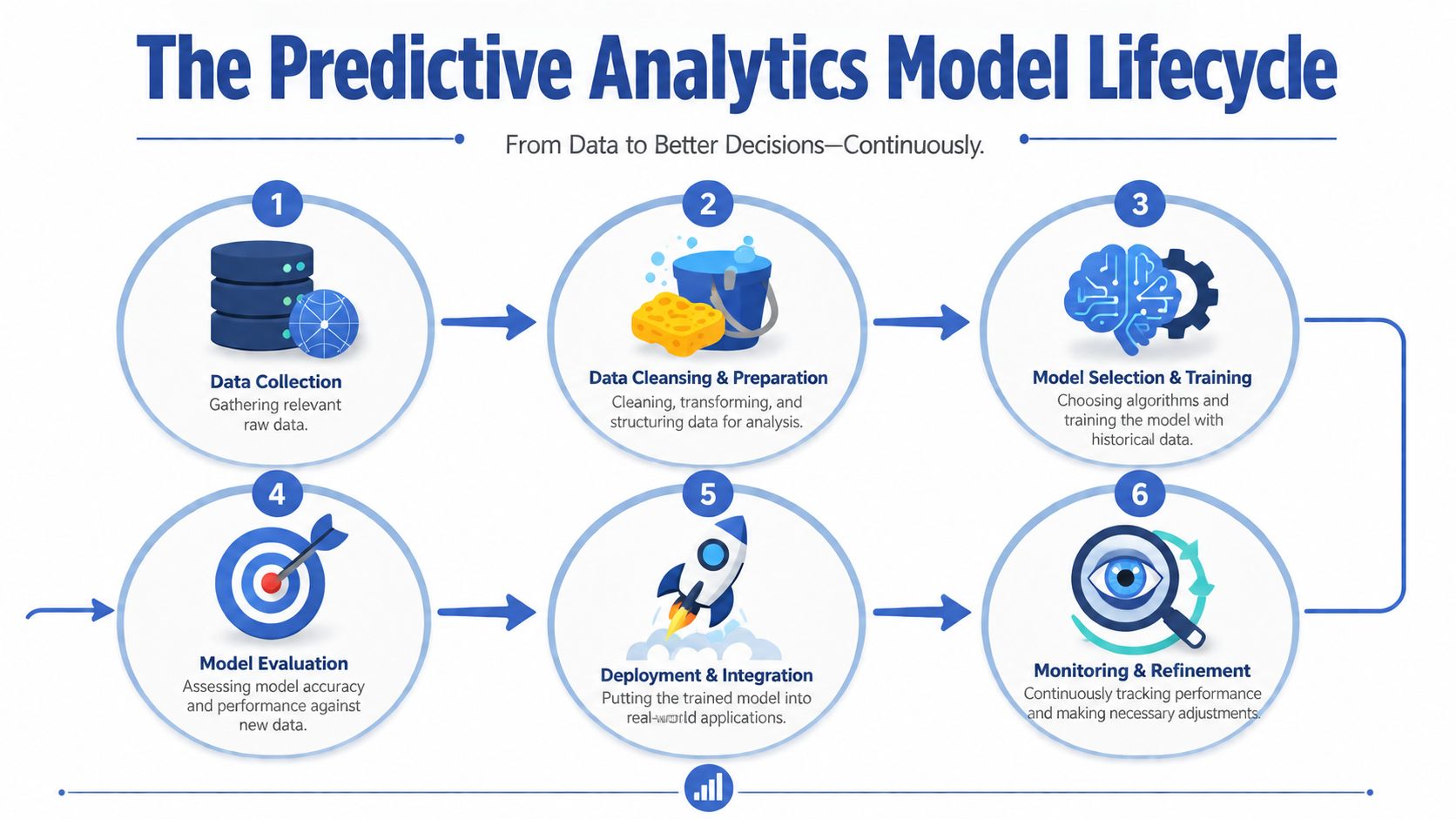
The mechanics sound technical, but the flow is easier to grasp, much like cooking from a recipe. You gather ingredients, prepare them properly, test the result, then adjust.
Start with data, not algorithms
Most failed projects don't fail because the maths was weak. They fail because the input data was messy, incomplete, or disconnected.
A store might collect product views in one platform, orders in another, and email clicks somewhere else. If those records don't line up, the model learns from noise. That's why teams begin by pulling together the relevant raw data and checking whether it's usable.
Common ecommerce inputs include:
- Behavioural data such as clicks, page views, and cart adds
- Transactional data such as purchases, SKUs, and timestamps
- Customer context such as acquisition source, returning status, or previous order behaviour
Prepare the data and choose a starting model
Once the data is gathered, it has to be cleaned. Missing values need handling. Duplicates need removing. Date fields need consistent formatting. Category labels need standardising.
Then the team defines the prediction target. Are you trying to predict conversion, repeat purchase, fraud risk, or likely demand? The target determines the modelling approach.
For ecommerce conversion modelling in the UK context, Improvado's predictive analytics guide describes a practical stack where supervised learning is trained on raw behavioural and transactional data, with logistic regression used as the MVP baseline. In that workflow, the model needs more than 65% accuracy before moving on to LSTM deep learning, and holdout validation is commonly split 80% for training and 20% for validation.
Practical rule: start with the simplest model that can answer the business question. Complexity is a later decision.
That same guide also outlines segment thresholds at 50%, 60%, 70%, and 80% predicted probability, with high-scoring segments above 70% syncing to Facebook Custom Audiences and Google Customer Match through APIs. That's where prediction becomes operational. The model doesn't just score users. It changes who sees which campaign.
A related discipline is forecasting revenue and demand. If your team needs a more grounded primer on reliable sales forecasts for SMBs, that's useful context because many predictive projects begin with better forecasting rather than full personalisation.
After the model is trained, teams test whether it generalises to new data. If it performs well enough, they deploy it into a real workflow.
Here's a concise visual explanation of that lifecycle in action:
Deployment is not the finish line
Once a model goes live, it has to be monitored. Customer behaviour changes. Product mixes shift. Channels evolve. A model that worked in one quarter can weaken later if the data pattern changes.
That's why strong teams keep checking prediction quality, reviewing edge cases, and retraining when needed. Predictive analytics is less like installing software once and more like running an ongoing operating process.
Techniques and Tools for Predictive Analytics
The right technique depends on the business question. Not every ecommerce problem needs the same algorithm, and not every team needs the same tool stack.
Common techniques in practice
Logistic regression is often the first stop for yes-or-no outcomes. Will this user convert? Will this customer return? It's popular because it's comparatively interpretable and fast to implement.
Decision trees are useful when teams want rules they can inspect. They split data into branches and can be easier for non-technical stakeholders to discuss.
Random forests combine many trees, which can improve resilience when a single tree feels too brittle. They're often chosen when the signal is messy and interactions between variables matter.
Neural networks are more advanced and can handle more complex patterns, but they usually demand stronger data engineering and more careful oversight.
How to choose a toolset
Some teams work mainly in code. Others need a platform with dashboards, connectors, and governance features.
A simple comparison helps:
| Need | Often suits |
|---|---|
| Fast prototype with technical control | scikit-learn or TensorFlow/Keras |
| Enterprise workflow and integration | SAS, Microsoft, Oracle, IBM |
| Cloud data handling and real-time scoring | Warehouse-led setups such as BigQuery |
If you're building a marketing or merchandising use case, the stack should fit your existing systems. A strong model that can't connect to Shopify, ad platforms, or your warehouse data isn't much use.
For segmentation work, it helps to think beyond demographics. Behavioural groupings usually produce stronger predictive signals than broad labels alone. Grumspot's guide to a customer segmentation strategy is a practical extension of that idea because segments often become the delivery mechanism for predictive insights.
A useful tool isn't the one with the longest feature list. It's the one your team can feed with clean data, understand well enough to trust, and connect to daily decisions.
One option in the Shopify ecosystem is Grumspot's seasonal demand forecasting service, which uses commerce data and predictive modelling techniques such as time series, moving averages, and seasonal indexing to forecast likely future outcomes. That kind of service sits alongside broader tools rather than replacing them.
Ecommerce Use Cases and ROI Examples
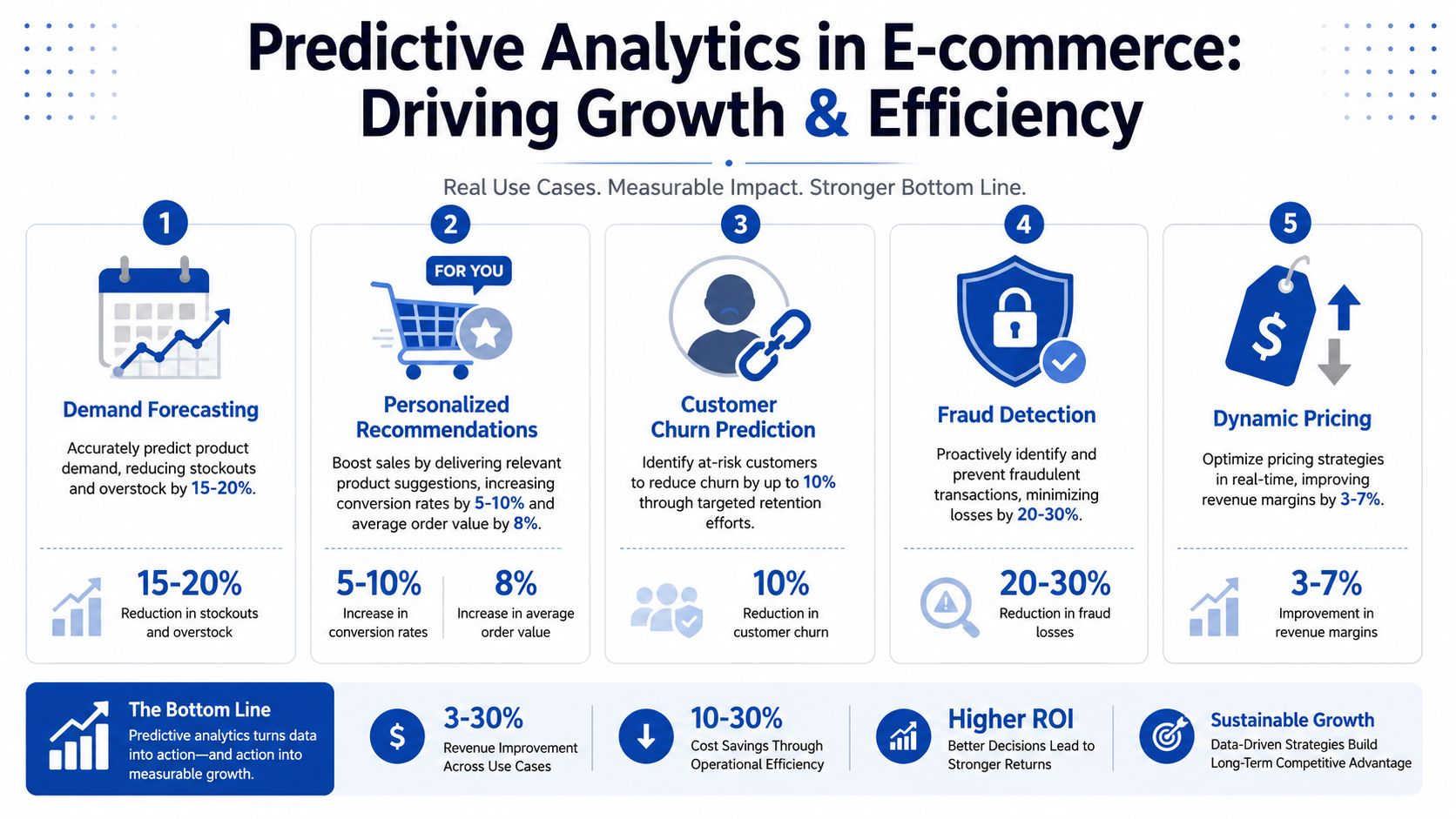
For an online retailer, predictive analytics earns its keep when it changes a decision early enough to affect revenue, margin, or stock position. The practical question is simple. Can the team spot what is likely to happen next, then act before the window closes?
Conversion scoring and paid media
A useful starting point is conversion scoring. Instead of treating every visitor like an equally likely buyer, a retailer ranks visitors by purchase probability and spends more on the groups that look ready to buy.
It works a bit like triage in a busy warehouse. If your team knows which orders need attention first, effort goes to the highest-priority queue. Predictive scoring does the same for marketing spend. A shopper who viewed the same product twice, added it to basket, and returned from a branded search usually deserves different treatment from someone who bounced after ten seconds.
For UK ecommerce brands dealing with rising ad costs, this can improve return on ad spend in a very direct way. Media teams can build higher-intent audiences for Google and Meta, reduce spend on low-probability traffic, and tailor offers by score band instead of sending the same message to everyone. The value is not the score itself. The value comes from bidding, suppressing, or remarketing more intelligently.
Demand planning and inventory
Demand forecasting is often where predictive analytics becomes easiest to explain to commercial teams because the financial effect is visible. Too little stock means missed sales. Too much stock ties up cash, increases markdown risk, and fills warehouse space with slow movers.
A forecast works like a weather report for product demand. It cannot promise the future with perfect accuracy, but it can give buyers a better estimate than a simple average. That matters in ecommerce because demand shifts with seasonality, promotions, payday cycles, weather, and channel activity. In the UK, those swings can be sharp around Black Friday, Boxing Day, bank holiday periods, and back-to-school peaks.
Retailers often use these forecasts to answer concrete questions:
- Which SKUs need replenishment sooner than usual?
- Which products are likely to stall without a promotion?
- How much stock should be placed before a seasonal spike?
- Which categories need tighter purchasing to protect cash flow?
If you want a more detailed walkthrough, Grumspot's guide to demand forecasting for ecommerce stores shows how forecasting links to buying, planning, and promotional decisions.
Retention, recommendations, and fraud signals
Some of the strongest returns come from smaller prediction problems because they slot neatly into daily workflows.
Retention risk helps a retailer identify customers whose behaviour suggests they may lapse. For example, a beauty brand might flag shoppers who usually reorder every six weeks but have now gone ten weeks without a purchase. That creates a timely retention opportunity. The brand can send a replenishment email, offer a subscription prompt, or exclude that customer from broad prospecting campaigns and focus on win-back instead.
Product recommendations answer a different question. What is the next item this shopper is most likely to want? This works well when browsing and purchase history reveal intent patterns, such as customers who buy a phone case soon after ordering a handset, or customers who often add refills after trying a starter product. In commercial terms, the model helps raise basket value and improves the relevance of onsite merchandising.
Fraud screening looks for orders that behave unlike normal customer patterns. A high-value order, unusual delivery address, mismatched location signals, or rapid repeat attempts may deserve manual review. The goal is not to block every unusual order. The goal is to send the right ones to a fraud queue before chargebacks and fulfilment losses pile up.
These use cases do not always require advanced modelling. A well-set-up baseline model, connected to the right action, often produces more value than a technically impressive system that nobody uses.
In ecommerce, ROI usually comes from short prediction loops tied to a clear action: spend more, hold back, reorder earlier, recommend a better item, or review an order before it ships.
That is why the best examples feel operational rather than theoretical. A fashion retailer uses propensity scores to focus remarketing on likely buyers. A homeware brand uses demand forecasts to avoid over-ordering seasonal lines. A subscription business predicts churn risk and intervenes before customers disappear. Different models, same principle. Prediction matters when it improves a real commercial choice.
Implementation Roadmap and Measurement Tips
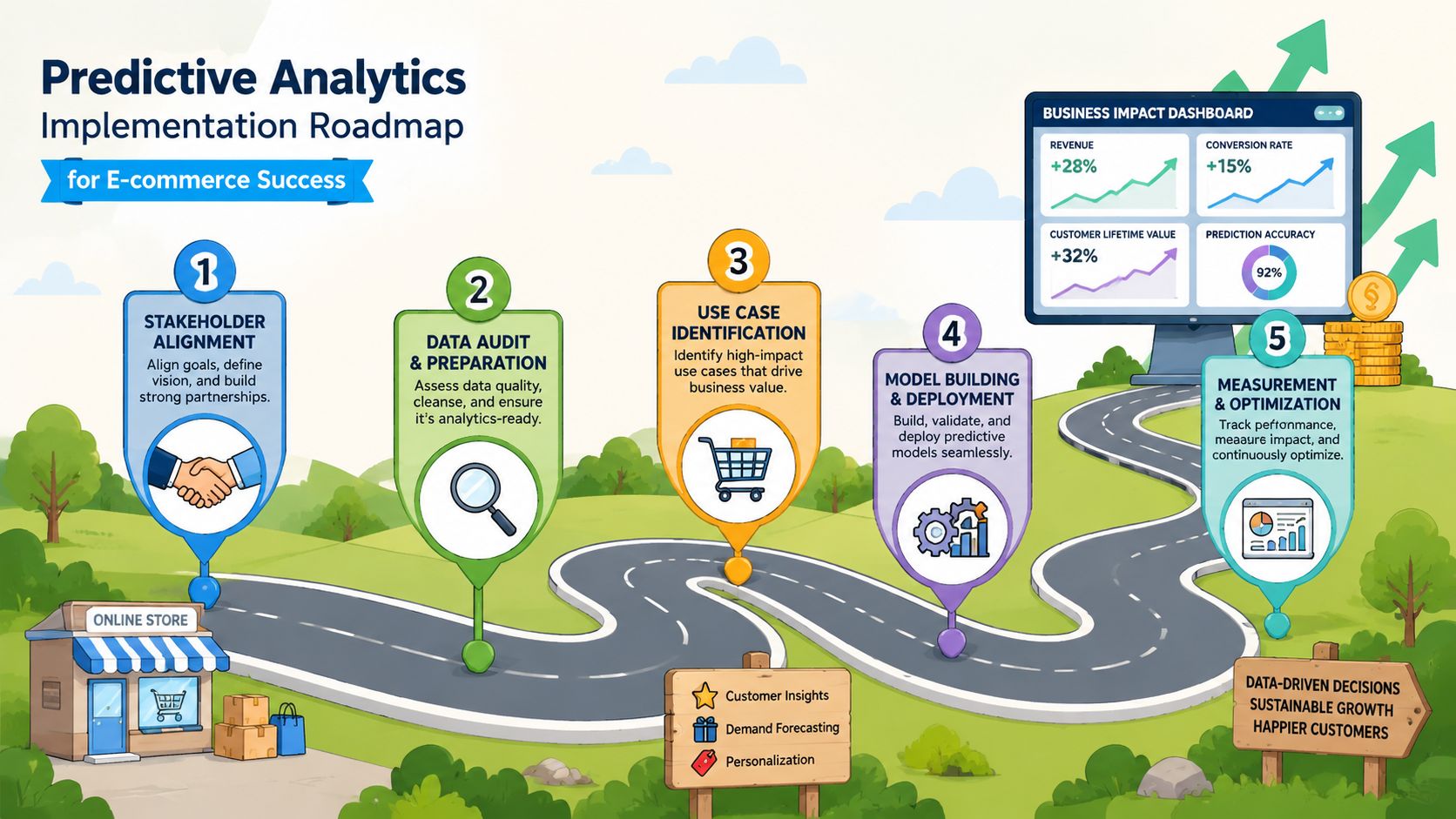
Most ecommerce teams shouldn't begin with a giant platform rollout. They should begin with one business question, one clean dataset, and one way to measure whether the prediction changed an outcome.
A practical rollout sequence
Pick one decision to improve
Start with a narrow use case such as conversion scoring, replenishment planning, or churn risk. Broad ambition usually creates vague outputs.Audit your data quality
Public sector guidance in the UK is especially clear on this point. The Local Government Association's guidance on using predictive analytics highlights nine data quality factors: accuracy, completeness, uniqueness, timeliness, validity, sufficiency, relevancy, representativeness, and consistency.Build a pilot before scaling
Use a proof of concept to test whether the model helps an actual workflow. Keep the business owner close to the process.Validate against holdout data
Don't judge the model only by how well it fits training data. Check whether it performs on data it hasn't seen before.Deploy with monitoring loops
The same UK guidance describes a three-stage framework of development intent, assessment of the model, and deployment with monitoring loops. That sequence is useful in ecommerce too because it forces teams to test fitness before automating action.
What to measure
Two measurement tracks matter:
Model performance
Accuracy, ranking quality, and whether the model stays stable over timeBusiness performance
Better stock decisions, cleaner audience targeting, improved retention actions, or fewer false alarms
That same UK guidance warns that weak validation in fragmented datasets can reduce forecast precision by 15% to 25% without frontline validation. The broader lesson for retailers is simple. If the data isn't trustworthy, the forecast won't be either.
Limitations and Best Practices
Predictive analytics works like a sat nav for your ecommerce business. It can point you toward the most likely route, but it can still send you the wrong way if the map is outdated, incomplete, or biased. That is the core limitation. A prediction is not a fact. It is a probability based on past patterns.
For online retailers, the risks are practical. A model trained on last year's shoppers may miss how today's UK customers respond to price pressure, delivery expectations, or seasonal spikes such as Black Friday and Boxing Day. A churn model can also misread quiet but loyal customers as likely to leave. A product recommendation engine may keep pushing bestsellers and give newer lines little chance to surface. In each case, the forecast can reduce revenue if teams treat the score as an instruction instead of one input into a decision.
The UK governance context adds another layer. Oxford Insights points to a gap under the Data Protection Act 2018: there is no general statutory right for individuals to receive an explanation of how an algorithm produced a specific output, outside intelligence services contexts, as discussed in its analysis of predictive analytics in public services and poverty. For ecommerce brands, that does not remove the need to explain decisions internally. If your retention team cannot explain why a customer was flagged as high risk, they will struggle to judge whether the model is helping or causing harm.
Good practice starts with a simple question. What decision will this model support, and what could go wrong if it is wrong? That framing helps teams choose the right level of oversight. A model that helps rank products for an email campaign carries one kind of risk. A model that changes credit terms, refund handling, or fraud decisions carries another.
A few habits make predictive analytics safer and more useful:
- Use predictions as decision support, not automatic truth
- Check whether certain customer groups are being scored unfairly
- Review model outputs with commercial teams, not only analysts
- Re-test models when prices, channels, or customer behaviour shift
- Keep a human review step for high-impact decisions
The commercial payoff is clearer when teams follow those rules. A UK retailer using demand forecasts to guide stock buys can still let merchandisers override the model when weather, supplier delays, or a national event changes likely demand. A CRM team using churn scores can compare high-risk segments against actual repeat purchase behaviour before increasing discount spend. That is how predictive analytics moves from technical theory to usable ecommerce ROI. It supports sharper decisions, but only when people keep checking whether the prediction matches what is happening in the market.
If you're running a Shopify store and want help turning forecasting, segmentation, or conversion insights into changes that affect revenue, Grumspot works on the design, development, and CRO side of ecommerce execution so predictive ideas can connect to real storefront decisions.
Let's build something together
If you like what you saw, let's jump on a quick call and discuss your project

Related posts
Check out some similar posts.