Customer Segmentation Strategy: A Playbook for E-commerce
- customer segmentation strategy
- ecommerce personalisation
- shopify customer segments
- rfm analysis
- customer lifetime value
Launched
June, 2026
Most Shopify stores don't have a traffic problem. They have a relevance problem.
You've got customers with completely different intent getting the same pop-up, the same welcome flow, the same product recommendations, and the same paid retargeting. The first-time buyer who needs reassurance gets treated like a repeat customer. The high-value customer gets the same discount cadence as someone who only buys on sale. Then the team wonders why Klaviyo performance plateaus and paid media gets more expensive.
A strong customer segmentation strategy fixes that. Not by creating a giant taxonomy nobody uses, but by turning customer data into operational decisions inside Shopify, Klaviyo, your CDP, and your media platforms. The difference between a useful segmentation model and a useless one is simple. Can your team act on it this week?
In UK ecommerce, this has already moved from optional to standard practice. 44% of UK businesses analysed customer data for segmentation in 2020, up from 31% in 2017, and the rate reached 62% among large enterprises according to Amplitude's summary of DCMS figures on customer segmentation strategy. With 84% of UK adults shopping online in 2021, stores now have enough behavioural data to build segments that reflect how people buy, browse, and respond.
Plan Your Strategy and Define Your Objectives
The fastest way to waste time with segmentation is to start with labels instead of outcomes.
“VIPs”, “discount shoppers”, and “loyal customers” sound useful, but those names don't matter unless they're tied to a commercial objective. In practice, most Shopify brands need segmentation to solve one of three problems. Increase repeat purchase rate. Lift average order value. Improve customer lifetime value. Sometimes there's a fourth problem underneath all three, which is reducing wasted spend on broad campaigns.
This is the strategic blueprint any team requires in front of them before they build anything:
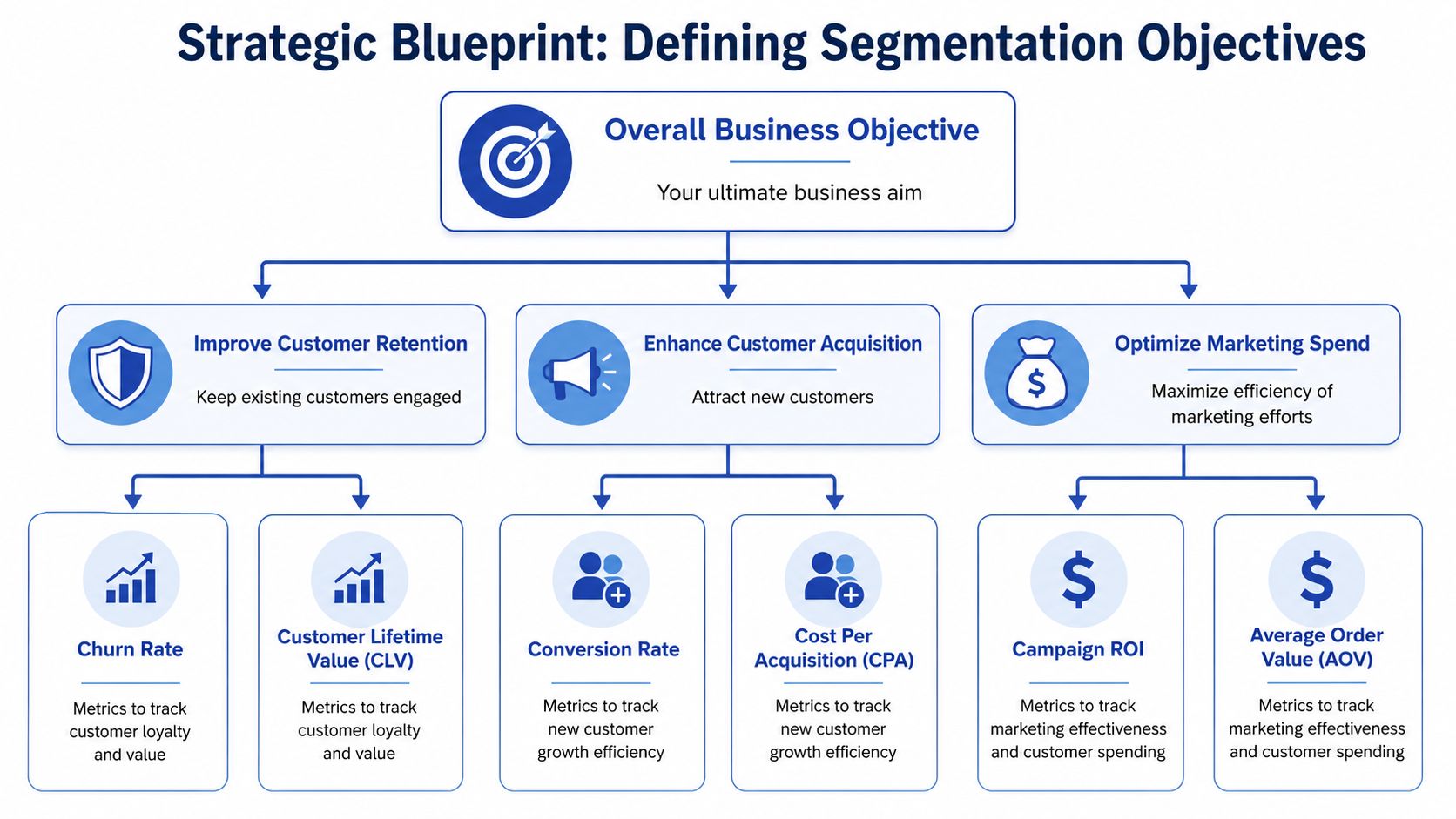
Start with the commercial question
A segmentation model should answer a concrete question such as:
- Retention problem: Which first-time buyers are most likely to place a second order, and what should they see before they lapse?
- AOV problem: Which customers buy one hero product but never attach complementary products, bundles, or subscriptions?
- LTV problem: Which customers show the early signals of becoming high-value accounts, and which ones are fading?
If the question is vague, the segment will be vague. That's why I usually tell teams to write the target in a sentence first. “We want more loyalty” isn't usable. “We want to increase repeat orders among customers who bought once in the last quarter and haven't engaged since” is usable.
Practical rule: Don't create a segment unless someone owns an action for it. If email, onsite content, paid media, or customer service won't behave differently, the segment is just a spreadsheet category.
Choose the model that fits the job
Not every store needs predictive modelling on day one. Most don't. The best model is the one your team can operationalise without delay.
| Model | Best use case | Shopify example |
|---|---|---|
| Behavioural segmentation | Messaging by observed actions | People who viewed a collection repeatedly but never purchased |
| RFM segmentation | Prioritising retention and win-back | Customers with recent purchases, higher order frequency, and stronger spend |
| LTV-led segmentation | Resource allocation and loyalty strategy | Prioritising service, perks, and early access for valuable customers |
| Cohort analysis | Understanding acquisition quality over time | Comparing customers acquired in different campaign periods |
Behavioural segmentation is often the cleanest starting point for Shopify stores because the actions are visible. Product viewed, collection browsed, cart started, checkout reached, order placed, subscription cancelled. These are signals your stack can usually capture today.
RFM works well when a brand has enough order history to separate recent, frequent, higher-spending customers from one-time or lapsed buyers. It's especially useful in repeat-purchase categories like beauty, food, supplements, and replenishable goods.
Predictive LTV becomes more valuable when order velocity is higher and your team has enough historical data to forecast who deserves more aggressive retention treatment. If you're still cleaning customer records and deduplicating profiles, it's too early.
Align the segment with the customer journey
Segments also need context. A first-time buyer in a low-consideration category behaves differently from one in a high-consideration category. Someone buying skincare, pet food, or coffee is entering a different post-purchase journey than someone buying furniture or jewellery.
That's where journey mapping sharpens the strategy. If you're auditing gaps between stages, this guide to customer journey mapping is a useful companion because segmentation works best when each group maps to an actual journey moment, not just a demographic bucket.
A good customer segmentation strategy isn't a data project. It's a prioritisation system. It tells your team who matters most, what they need next, and where to deploy effort for the biggest commercial return.
Gather and Prepare Your E-commerce Data
Most bad segmentation isn't caused by weak ideas. It's caused by messy inputs.
A Shopify merchant usually has enough data already. The primary issue is that it sits in separate systems, uses inconsistent identifiers, and gets pulled into campaigns before anyone checks whether the records are trustworthy. Teams end up segmenting on partial truth. That's how you send a win-back flow to an active subscriber or keep showing a discount banner to someone who already bought at full price.
This is the operational flow you want:
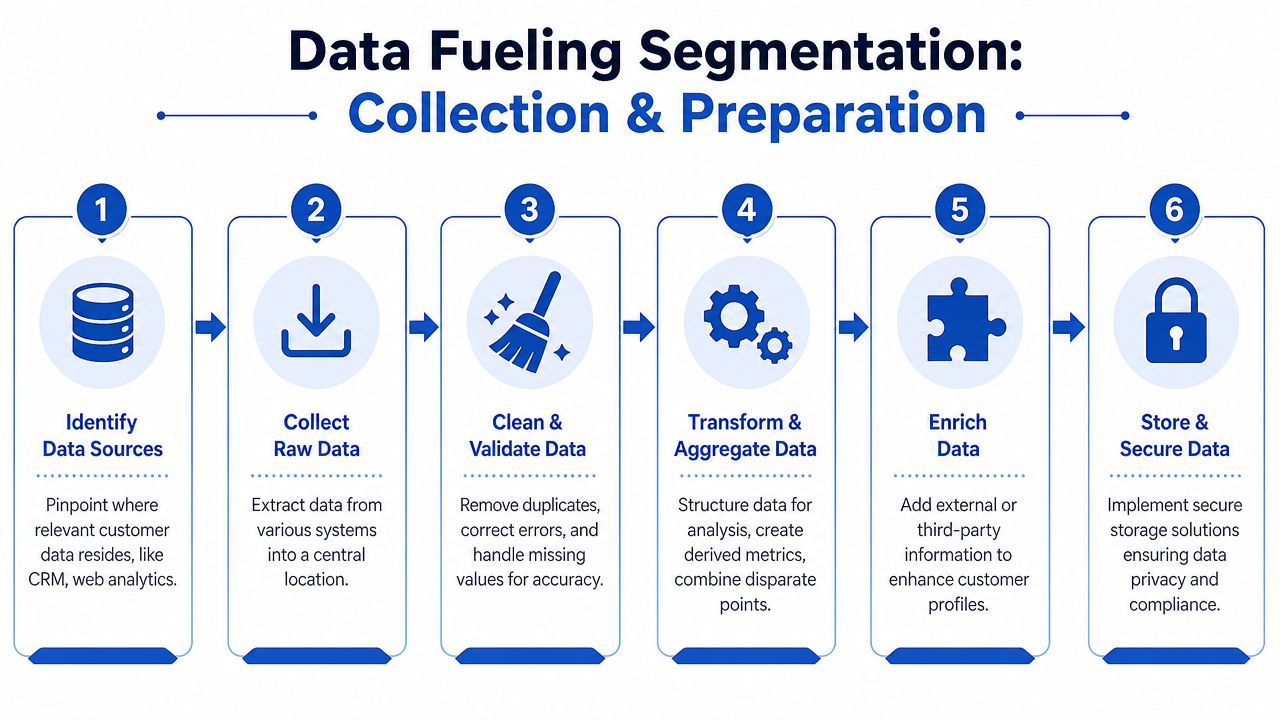
Pull from the systems that hold buying intent
For most Shopify stores, the core sources are straightforward.
- Shopify admin: Order history, product mix, discount usage, returns, tags, subscription status, customer account activity, shipping geography.
- GA4 or equivalent analytics layer: Session source, landing pages, product views, collection depth, cart events, checkout starts.
- Klaviyo or your email/SMS platform: Opens, clicks, flow entry, campaign engagement, channel preference, suppressed profiles.
- Support tools and reviews: Ticket themes, refund reasons, NPS-style feedback, satisfaction signals, repeat complaints.
- CDP or warehouse if you have one: Identity resolution, event stitching, cross-device behaviour, unified profile logic.
The point isn't to collect everything. The point is to collect the fields that support action. Browsing depth matters if you're building a high-intent non-buyer segment. Discount code usage matters if you want to isolate margin-sensitive customers. Product affinity matters if you want post-purchase cross-sell to feel relevant.
Use more than one data type
Broad segments built on age or geography alone usually underperform because they miss context. The better-performing ecommerce setups combine what customers bought, how they behaved, and what they told you.
According to Qualtrics' summary of UK customer segmentation research, UK brands using at least three distinct data types, transactional, web interaction, and preference or feedback data, saw an average 20–30% improvement in campaign conversion rates compared with those relying only on age or geography. The same source notes that over 90% of UK organisations updated data policies and workflows after GDPR requirements took hold, which matters because compliant segmentation depends on consent, lawful use, and disciplined data handling.
If a customer profile combines order data with web behaviour and declared preferences, your campaigns usually get sharper. If that profile combines duplicates, stale tags, and shaky consent history, your campaigns get riskier.
Clean before you cluster
This is the step teams rush, and it's the step that decides whether segmentation works.
Start with a short audit:
- Check identity matching: Are Shopify, Klaviyo, and analytics referring to the same person consistently?
- Remove duplicates: Multiple profiles for one customer will distort frequency, value, and engagement.
- Standardise fields: Country, product category, discount codes, and lifecycle labels should follow one naming logic.
- Review consent status: Marketing eligibility must be current and channel-specific.
- Set refresh rules: Segment logic breaks when the underlying data updates irregularly.
A CDP can help if your stack is fragmented, but plenty of brands can start with cleaner syncs between Shopify, Klaviyo, and a reporting layer. What matters is building a usable customer view, not buying extra software too early.
If you're tying segments back to retention economics, it helps to revisit how customer lifetime value is calculated in ecommerce, because many segment decisions only make sense when you understand what a customer is worth over time.
Build and Validate Your Core Customer Segments
At this stage, segmentation stops being abstract.
Let's build the segments that most Shopify stores can use without turning the marketing calendar into chaos. I'd rather see a team run four segments well than create fifteen segments they can't maintain.
Build the segment set that changes decisions
Start with VIPs or high-value customers. In Shopify terms, these are people with strong recency, strong frequency, and higher spend relative to the rest of your customer base. Don't overcomplicate the first pass. If they buy often, spend meaningfully, and haven't lapsed, they belong in a protected segment.
For this group, look at:
- repeat purchases across a sensible time window
- low reliance on discounts
- broad category adoption, not just one-off hero product buying
- healthy engagement with email or SMS
This segment matters because it should change how you treat people. Better service priority, earlier access, more thoughtful upsell logic, less blunt discounting.
Next, build potential loyalists. These customers usually don't look impressive in raw revenue yet, but their pattern is promising. They bought recently, they've engaged post-purchase, and they're showing signs of category interest beyond the first order. This is the segment many brands ignore because it sits between “new customer” and “VIP”. That's a mistake. A lot of future value is sitting here.
Then define at-risk customers. These are customers who were once active enough to matter but have drifted beyond their normal repurchase cycle. The exact timing depends on your category. Beauty and supplements can use tighter recency windows than furniture or seasonal products. The point is to compare customer behaviour against your normal buying rhythm, not use an arbitrary label.
A fourth segment I often keep in the core set is bargain hunters. These are customers who convert mainly when there's a discount, a bundle, a sale event, or a strong price signal. They're not bad customers. They're just dangerous to misread. If you treat them like loyalty-driven customers, you'll overestimate retention quality and train the list to wait for offers.
Make the segment logic visible
A simple working table helps teams operationalise the model:
| Segment | Common signals | Likely action |
|---|---|---|
| VIP | High recency, repeat orders, stronger spend, lower discount dependence | Protect margin, reward loyalty, prioritise retention |
| Potential loyalist | Recent first or second purchase, good engagement, category interest | Push second and third purchase |
| At-risk | Prior order history but recency slipping beyond normal cycle | Win-back before disengagement hardens |
| Bargain hunter | Sale-led conversion, offer sensitivity, lower full-price response | Use selective offers without setting expectations too low |
Validate before you roll it out everywhere
A segment isn't real because the logic sounds good. It's real when it behaves differently enough to justify distinct treatment.
Ask three questions.
Is it distinct?
If your VIPs and potential loyalists respond to the same message in the same way, your definitions may be too loose.
Is it substantial?
If the segment is tiny, highly volatile, or impossible to target consistently across channels, it might not deserve custom treatment.
Is it reachable? Can Klaviyo, Shopify, Meta, Google Ads, and your support team use the label in a consistent way?
A practical segment should survive contact with operations. If it only works in an analyst's notebook, it won't improve revenue.
For teams that want a broader framing, Headline's insights on Amazon audience segmentation are useful because they show the same underlying principle in another commerce environment. The platform changes. The discipline doesn't. Segments need to be behaviour-led, actionable, and tied to channel execution.
Activate Segments with Personalised Experiences
Segmentation on its own doesn't produce a result. Activation does.
This is the point many brands miss. They build smart segments in a dashboard, maybe sync them into Klaviyo, and then keep sending generic campaigns. If the creative, offer, cadence, and onsite experience don't change by segment, the customer never feels the strategy.
Use the activation framework below as a practical reference:
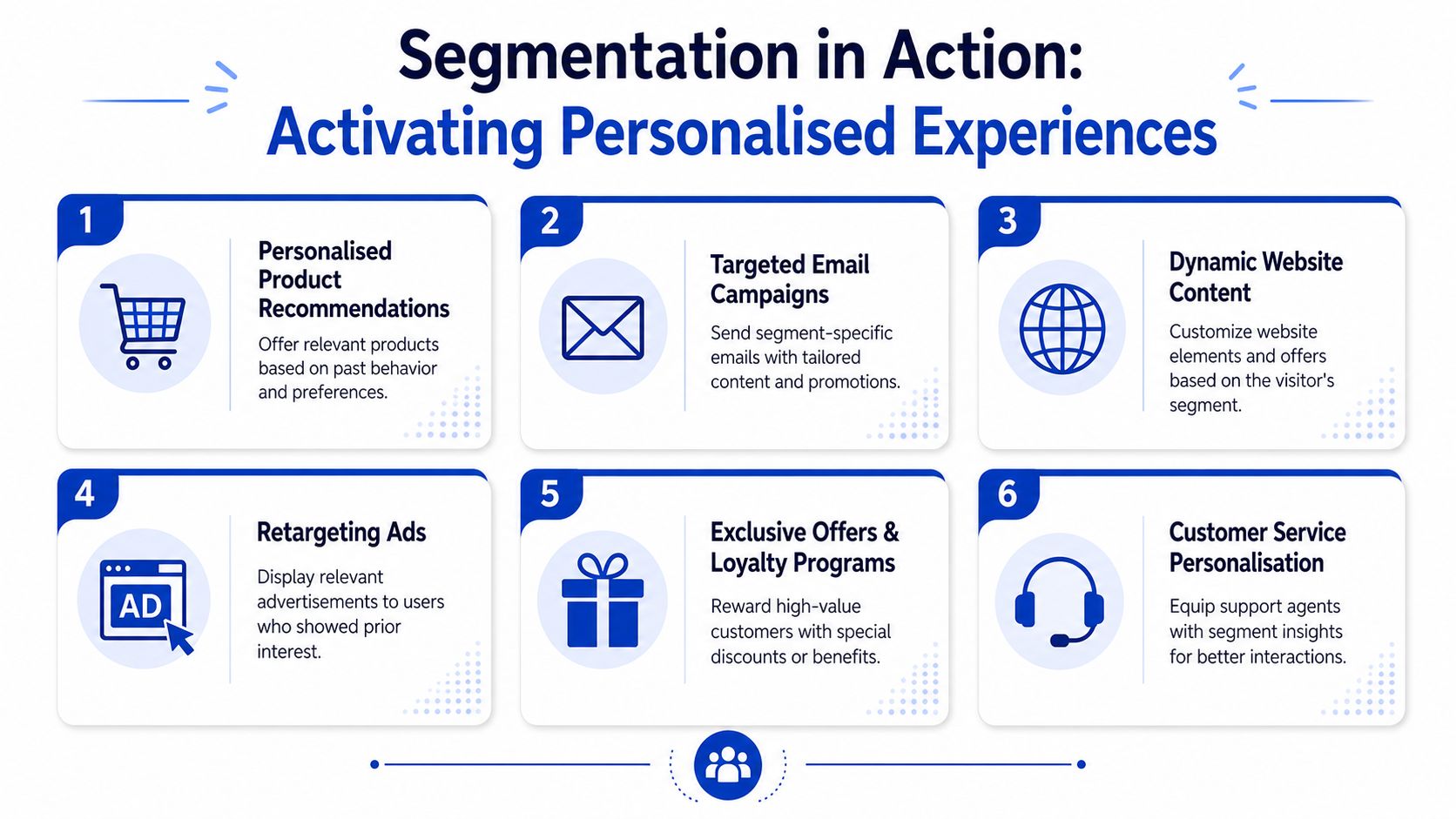
Treat VIPs like people you want to keep
High-value customers usually don't need louder discounts. They need a better experience.
For VIPs, the strongest activation often looks like:
- early access to launches or limited collections
- more refined cross-sell based on category history
- post-purchase messaging that recognises loyalty
- support treatment that feels fast and informed
- paid media exclusions from blunt acquisition or discount campaigns
On Shopify, that might mean personalised blocks for logged-in customers, a loyalty landing page, or curated product recommendations based on past category behaviour. In Klaviyo, it means separate campaign calendars and flows, not just a VIP tag tucked inside the same send.
Push potential loyalists towards the second and third order
This segment deserves some of the best thinking in your stack because the second purchase often changes the economics of the relationship.
Email should focus on confidence and relevance. Show products that naturally attach to the first order. Use educational content if the category needs onboarding. If your store sells skincare, don't just send “you may also like”. Send regimen logic. If you sell coffee, show refill timing and flavour pathways. If you sell apparel, recommend based on fit family or collection affinity, not random new arrivals.
The onsite experience should reinforce the same path. Returning visitors in this segment shouldn't land on a generic homepage if your tech setup can identify them.
A useful implementation walkthrough sits below:
Win back at-risk customers without panicking
At-risk customers are where brands often overreact. They jump straight to a heavy discount and teach customers to disappear until the next offer.
That approach can work in the short term, but it damages the longer-term signal. A better sequence usually escalates:
- reminder of what they bought and why it mattered
- relevant replenishment or complementary recommendation
- content or proof that reduces friction
- only then, a measured offer if the category supports it
SMS can work well here if consent and timing are solid, but don't treat it as a louder version of email. Use it when urgency or replenishment logic is clear.
The best win-back campaigns feel specific. “Still thinking about us?” is weak. “Ready for your next refill?” is stronger when it matches the buying pattern.
Handle bargain hunters carefully
Bargain hunters can be profitable, but they need a different operating model. Don't flood them with every sale if that conditions the rest of your list through forwarding, overlap, or ad exposure. Keep their promotions narrower, use bundles where possible, and limit broad discount dependence.
For paid media, this segment often belongs in separate audiences. Your creative can lead with value, not brand story. Your exclusions should also prevent your premium messaging from getting muddied by sale-led traffic where it doesn't fit.
The key position is simple. A customer segmentation strategy only matters when it changes what the customer sees, when they see it, and what commercial ask you make. Anything less is just classification.
Measure Performance and Test Your Segments
Teams often evaluate segmentation incorrectly. They launch a specific campaign, see decent revenue, and assume the segment worked.
That's not enough. The right question is whether the segmented experience outperformed the non-segmented alternative. Without that comparison, you can't tell whether the lift came from the segment logic, the creative, the offer, or normal purchase behaviour.
Use a baseline before you claim success
Start with a control mindset. If you're sending a win-back sequence to at-risk customers, hold out a portion of that eligible audience from the new treatment. If you're changing onsite content for potential loyalists, compare it against a neutral version. If you're running different offers by segment, keep one comparable group on the standard merchandising path.
Segmentation creates hidden bias. VIPs are more likely to buy anyway. Recently active customers are easier to reactivate anyway. If you don't use holdouts, you'll over-credit the strategy.
A simple dashboard should track:
- segment size over time
- conversion rate by segment
- repeat purchase behaviour by segment
- average order value by segment
- reactivation rate for lapsed groups
- margin impact where discounts are involved
Test the segment logic, not just the creative
Most A/B testing in ecommerce stays at the surface level. Subject line A versus subject line B. Hero image A versus hero image B. That's useful, but segmentation gets better when you test the underlying hypothesis.
For example:
- does an at-risk definition based on a shorter recency window outperform a looser one?
- do VIPs respond better to exclusivity than to monetary offers?
- do potential loyalists convert better from category-based recommendations or bestseller-based recommendations?
- does adding browsing behaviour improve a segment compared with purchase data alone?
Those are better tests because they improve the model, not just the message.
If your team needs a stricter framework for reading results, this guide to statistical significance testing helps avoid the classic mistake of calling a winner too early.
Know when to refine and when to rebuild
Not every weak result means the campaign failed. Sometimes the segment definition is the core issue.
Refine a segment when:
- response is directionally positive but inconsistent
- the audience overlaps too heavily with another segment
- the message seems right but timing looks wrong
Rebuild a segment when:
- the audience can't be identified cleanly across systems
- performance doesn't differ meaningfully from the default audience
- the operational effort to maintain it is higher than the return
A healthy segmentation programme behaves like an operating system, not a one-off project. Teams review movement between segments, pressure-test assumptions, and retire logic that no longer reflects customer behaviour. In Shopify stores, that usually means checking whether recency thresholds, product affinities, and channel engagement rules still line up with how people buy.
Common Segmentation Pitfalls to Avoid
The biggest segmentation mistake isn't doing too little analysis. It's building something your team can't sustain.
I see two opposite failures all the time. One team creates a sprawling matrix of micro-segments with nuanced labels and no execution plan. Another team creates segments so broad that they're barely different from sending to everyone. Both approaches waste effort.
This is the cleaner way to think about the traps:
The subtle mistakes that break performance
- Over-segmentation: If each segment needs bespoke campaigns, audiences, onsite logic, and reporting, complexity can outrun value fast.
- Static segment logic: Customers move. A potential loyalist can become a VIP, or disappear into at-risk, much faster than many teams expect.
- Channel silos: If paid media, email, onsite merchandising, and support all use different definitions, the customer gets a fragmented experience.
- Offer mismatch: Premium customers don't always want the same incentive as discount-led customers. Wrong offer, wrong signal.
A more advanced trap is assuming that better modelling automatically fixes poor execution. It doesn't.
According to Mailchimp's summary of UK customer segmentation analysis, a 2023 CMO Council survey found that UK organisations using advanced behavioural segmentation saw a 10–15% lift in customer lifetime value. But the same source notes a more important warning. Research by the UK Information Commissioner's Office indicates that 42% of data-driven marketing failures in 2022 stemmed from poor data quality or consent issues, not weak models.
Better algorithms won't rescue bad data hygiene. If consent status is unclear, fields are inconsistent, or customer records are duplicated, the segment will look smarter than it behaves.
The practical takeaway is blunt. Keep the model as simple as your team can reliably execute. Refresh the data. Check consent. Revalidate timing. Then improve sophistication only when the current setup is stable.
If your Shopify store has the data but not the operating system to turn it into smarter retention, better personalisation, and cleaner execution, Grumspot can help. The team builds and scales Shopify experiences with the technical integration, CRO thinking, and implementation discipline needed to make segmentation effective in practice, not just in a dashboard.
Let's build something together
If you like what you saw, let's jump on a quick call and discuss your project

Related posts
Check out some similar posts.
- zero party data
Learn what zero party data is, why it matters for ecommerce, and how to collect and use it for perso...
Read more
- customer lifetime value
Learn how to calculate customer lifetime value with proven formulas, worked examples, and practical ...
Read more
- customer lifetime value
Learn customer lifetime value calculation for Shopify stores. Boost profit, cut costs with simple fo...
Read more