Demand Forecasting Ecommerce: Master Models & Reduce
- demand forecasting ecommerce
- inventory management
- shopify forecasting
- ecommerce analytics
- machine learning ecommerce
Launched
June, 2026
You're probably feeling the same tension most fast-growing Shopify merchants hit sooner or later. One SKU sells out just as paid traffic starts working, while another sits in the warehouse long after the promotion has ended. Operations blames marketing. Marketing blames stock planning. Finance sees cash tied up in products that aren't moving quickly enough.
That's the point where demand forecasting stops being a spreadsheet exercise and becomes an operating discipline.
For ecommerce brands, especially in Shopify where promotions, bundles, subscriptions, and multi-channel fulfilment can shift demand quickly, forecasting has to do more than estimate sales. It has to tell you what to buy, when to reorder, where to place stock, and how much risk sits behind each decision.
From Guesswork to Growth Why Demand Forecasting Matters
A familiar pattern shows up after every busy retail period. A brand runs a strong promotion, conversion rate spikes, and the hero product disappears faster than expected. The team scrambles to explain late deliveries, updates product pages, fields customer service tickets, and pushes shoppers towards alternatives. At the same time, a slower line still fills shelves because the buy was based on instinct, not evidence.
That see-saw is expensive in both directions. Stockouts cost revenue and weaken trust. Overstock drains cash, increases storage pressure, and often ends in discounting that chips away at margin.
In the UK, that problem is amplified by market speed. The UK ecommerce market is the world's third-largest, and online sales made up about 27% of all retail sales in 2023, up from 19% before the pandemic, according to the US International Trade Administration's UK ecommerce market overview. The same source notes that accurate forecasting can reduce stock holding costs by 15% to 20%, and that 80% of consumers prioritise availability over brand loyalty.
What this means for a Shopify merchant
If you're running Shopify with multiple sales channels, a 3PL, and purchase orders managed outside the store, “we'll order a bit extra” isn't a strategy. It usually creates two problems at once:
- Too little stock on promoted items and missed sales when demand peaks
- Too much stock on marginal SKUs that looked safe to buy but don't justify the working capital
- Poor timing on replenishment because lead times weren't built into the plan
- Reactive decision-making that forces rush shipping, manual allocation, and customer support clean-up
Gut feel works when the catalogue is small and demand is stable. It breaks once promotions, channels, and fulfilment nodes start interacting.
Good demand forecasting ecommerce practice doesn't promise perfection. It gives you a better range of expected demand, highlights risk earlier, and helps the team act before the problem lands in the warehouse or on the customer's doorstep.
What Is Ecommerce Demand Forecasting Really
Demand forecasting in ecommerce is best understood as a weather forecast for your sales. It won't tell you the future with absolute certainty, but it gives you a much stronger view of what's likely to happen, what could change, and where to prepare.
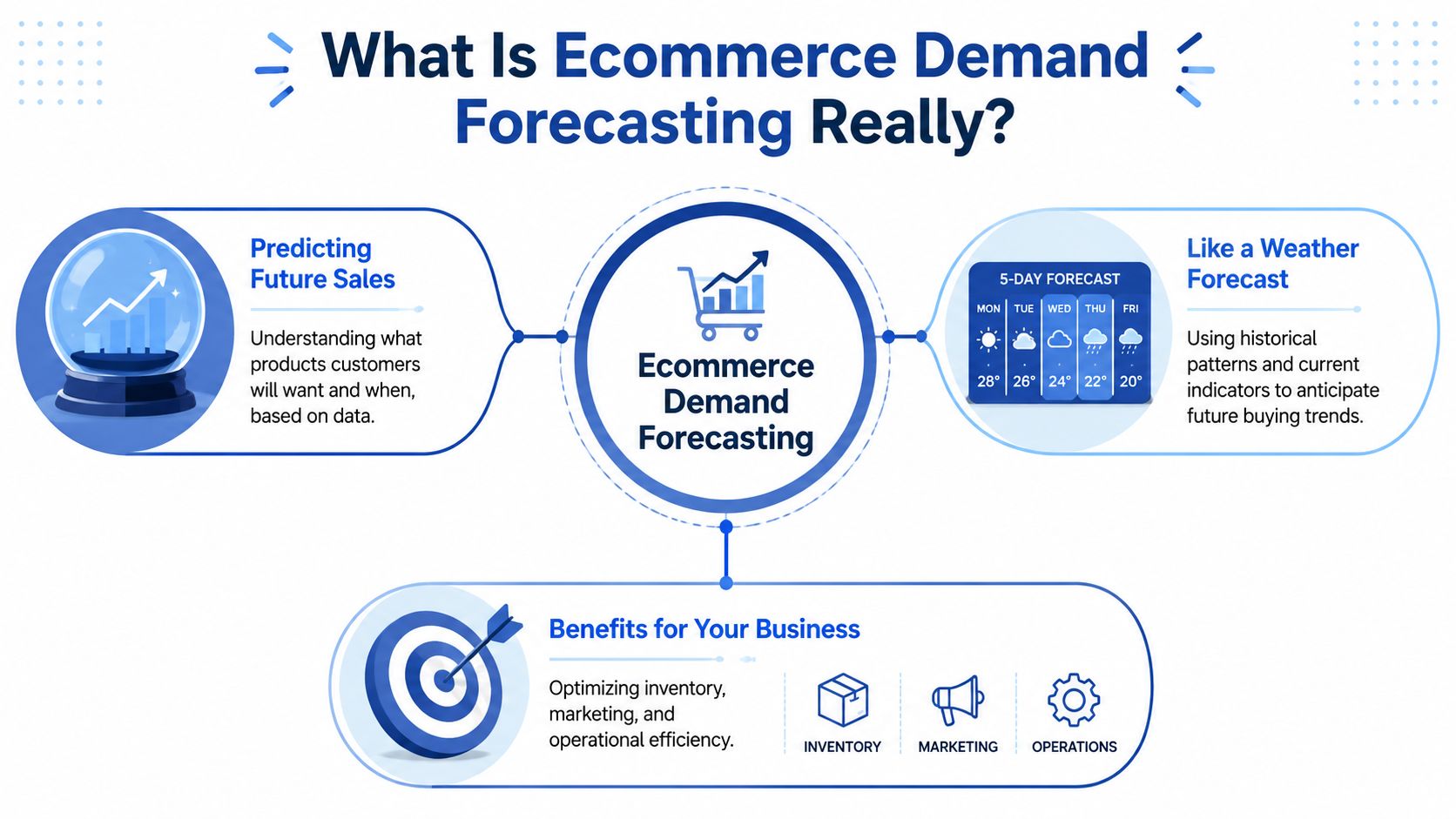
A sales report tells you what happened. A forecast tells you what's likely to happen next, based on the signals you already have. That difference matters because reports are backward-looking, while operational decisions have to be made in advance. You place purchase orders before demand arrives. You schedule warehouse labour before orders spike. You allocate ad budget before the campaign starts.
Forecasting is not a crystal ball
Most founders initially expect forecasting to produce one perfect number. That's usually the wrong expectation. Strong forecasting produces a decision-ready view, not false certainty.
In practice, that means:
- Estimating likely demand by SKU
- Adjusting for timing, such as promotions, holidays, and replenishment windows
- Linking demand to inventory action, so the output can inform buying and allocation
- Updating the view regularly as fresh data arrives
A forecast that sits in a sheet and never affects purchasing isn't doing much work.
What demand forecasting should influence
In a Shopify environment, forecasting should connect directly to day-to-day operations. It should shape:
| Business area | What the forecast helps you decide |
|---|---|
| Inventory buying | How much to reorder and when |
| Channel planning | Which SKUs need region or channel-specific allocation |
| Marketing | Whether demand supports a planned promotion |
| Finance | How much cash is tied up in incoming stock |
| Fulfilment | Which warehouses need coverage for expected sell-through |
A useful forecast is one the buying team, marketer, and operations manager can all act on from the same set of assumptions.
That's why demand forecasting ecommerce work shouldn't live only with analysts. The input may be technical, but the output is operational. If the forecast can't guide a purchase order, a transfer, or a campaign decision, it's still too abstract.
Statistical vs Machine Learning Forecasting Models
Not every brand needs machine learning on day one. Some need cleaner data and better discipline long before they need a more advanced model. The right choice depends on the catalogue, the volatility of demand, and how often external factors shift performance.
Statistical models work well when patterns are stable
Statistical methods rely mainly on historical behaviour. They're useful when demand follows recognisable patterns and the business wants something more reliable than manual estimation.
These models are often a good fit for:
- replenishment-heavy catalogues
- evergreen SKUs
- businesses with relatively stable promotional behaviour
- teams still building forecasting maturity
They're also easier to explain internally. If a buyer asks why the model expects a certain volume, the logic is usually straightforward.
Machine learning is stronger in messy, fast-moving conditions
Machine learning becomes more useful when the catalogue is large, the effects of promotions are uneven, and demand changes quickly. It can absorb more variables and react better when historical averages stop being enough.
For volatile retail moments, real-time demand sensing can materially improve short-term planning. According to JIT Transportation's summary of real-time demand sensing in ecommerce, it can boost short-term forecast accuracy by 30% to 40%, help retailers detect market changes 5x faster, and reduce forecast errors by up to 50%.
That matters most when a Shopify merchant is dealing with event-driven demand rather than steady replenishment.
Statistical vs Machine Learning Forecasting at a Glance
| Attribute | Statistical Models (e.g., ARIMA) | Machine Learning Models (e.g., Gradient Boosting) |
|---|---|---|
| Core input style | Historical patterns | Historical patterns plus broader signals |
| Best fit | Stable products and clearer seasonality | Volatile demand, promotions, and more complex interactions |
| Ease of interpretation | Easier to explain to non-technical teams | Harder to interpret without good reporting |
| Setup complexity | Lower | Higher |
| Data burden | Moderate | Higher, especially when external inputs are added |
| Shopify use case | Core SKU replenishment | Promotion-heavy catalogues and fast-moving trend items |
| Main risk | Too rigid when demand shifts suddenly | Can look sophisticated while hiding poor data quality |
What usually works in practice
Most brands shouldn't treat this as an either-or decision. A practical setup is often hybrid:
- Use simpler statistical logic for steady SKUs.
- Layer more adaptive methods onto high-volatility lines.
- Validate outputs against commercial reality, not just model confidence.
- Review whether apparent improvement is meaningful using sound analysis, not intuition. A grounding in statistical significance testing helps when teams compare forecast versions or evaluate whether a model change actually improved decisions.
The model isn't the strategy. The strategy is choosing the simplest approach that still improves buying, stock allocation, and campaign timing.
Essential Data and Metrics for Accurate Forecasts
Most forecast problems don't begin with the model. They begin with messy inputs. If SKU names don't match, purchase orders are incomplete, or inventory is blended across channels, the output won't help much.
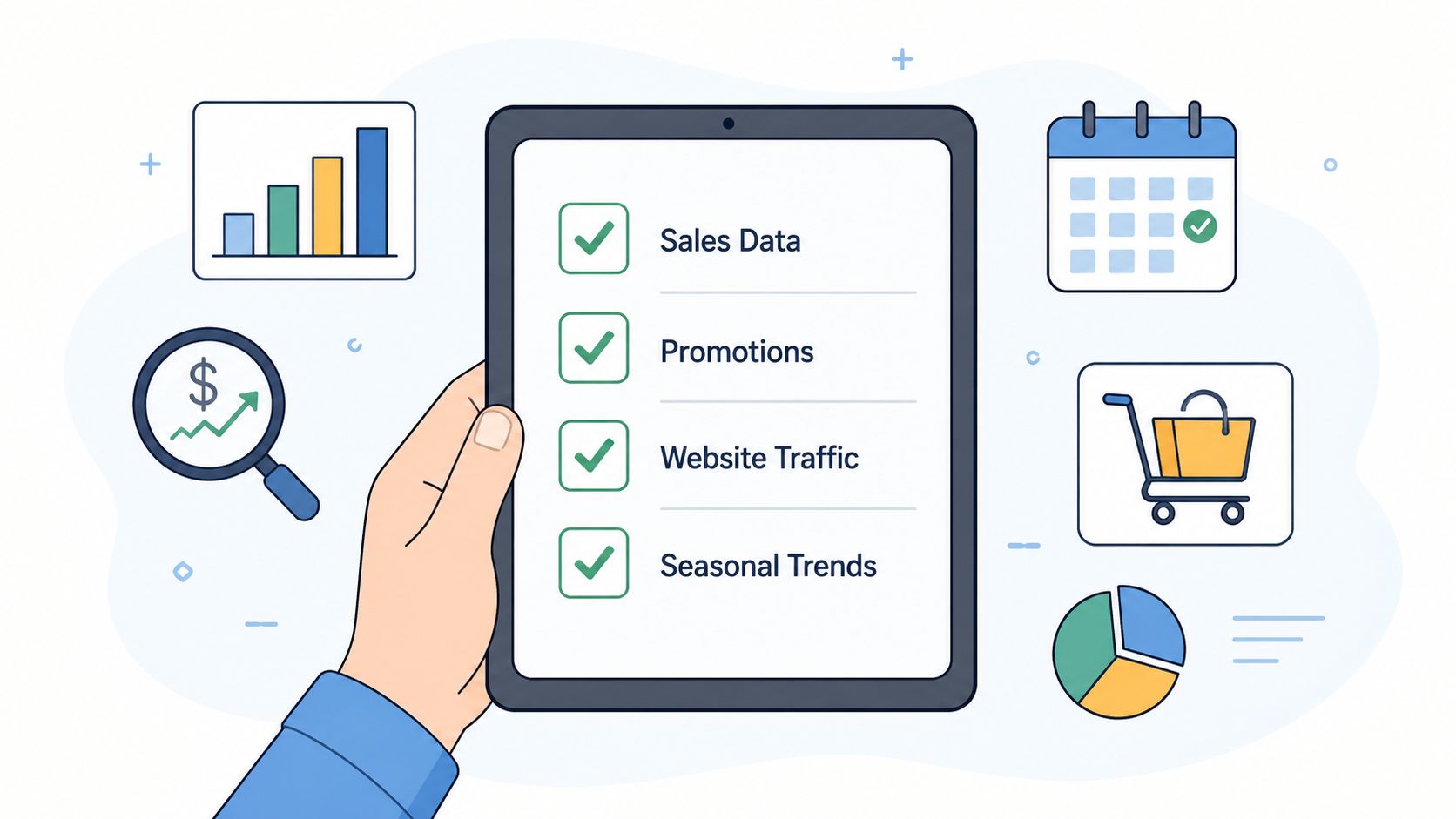
For ecommerce, three inputs are essential: on-hand inventory, inbound purchase orders, and forecasted sales. Saras Analytics also stresses that Shopify merchants need to analyse this at the SKU, region, and channel level, because blended sitewide averages create major inaccuracies in planning, as outlined in its guide to ecommerce forecasting for inventory and operational planning.
The must-have data foundation
If you're setting up demand forecasting ecommerce workflows inside Shopify, start with the operational basics:
- On-hand stock by SKU and location so you know what can fulfil demand
- Inbound purchase orders with expected quantities and arrival timing
- Historical sales at SKU level rather than collection-level rollups
- Channel segmentation so DTC, marketplace, wholesale, and retail don't distort each other
- Regional demand patterns if stock is split across warehouses or delivery zones
- Promotional calendar history so spikes aren't treated as normal baseline demand
If any of those are missing, teams usually compensate with manual overrides, which then makes forecasting feel inconsistent and untrustworthy.
Useful supporting inputs
Once the core data is clean, extra signals become more valuable. Depending on the brand, that may include:
| Data source | Why it matters |
|---|---|
| Website sessions and product page interest | Helps explain demand build-up before sales land |
| Marketing campaign schedule | Stops the model from treating campaign spikes as random events |
| Returns patterns | Prevents inflated assumptions about net sell-through |
| Lead times from suppliers | Converts forecast demand into realistic reorder timing |
| Product lifecycle status | Distinguishes new launches from mature lines |
Metrics that tell you whether the forecast is usable
Forecast quality shouldn't be judged by whether someone “likes” the number. It should be judged by whether the forecast tracks reality closely enough to support buying decisions.
Two practical metrics are:
- MAPE. Mean Absolute Percentage Error. In plain terms, how far off the forecast was from actual demand on average.
- Forecast bias. Whether the forecast consistently leans too high or too low.
A forecast that is slightly imperfect but consistently unbiased is often easier to manage than one that swings between over-ordering and under-ordering.
Clean data beats a clever model fed with unreliable stock and purchase-order records.
A Practical Roadmap for Implementation
Forecasting usually fails at the handover point between theory and operations. The team has a spreadsheet, or a dashboard, or a tool trial, but nothing is connected well enough for buyers and operators to trust the output.
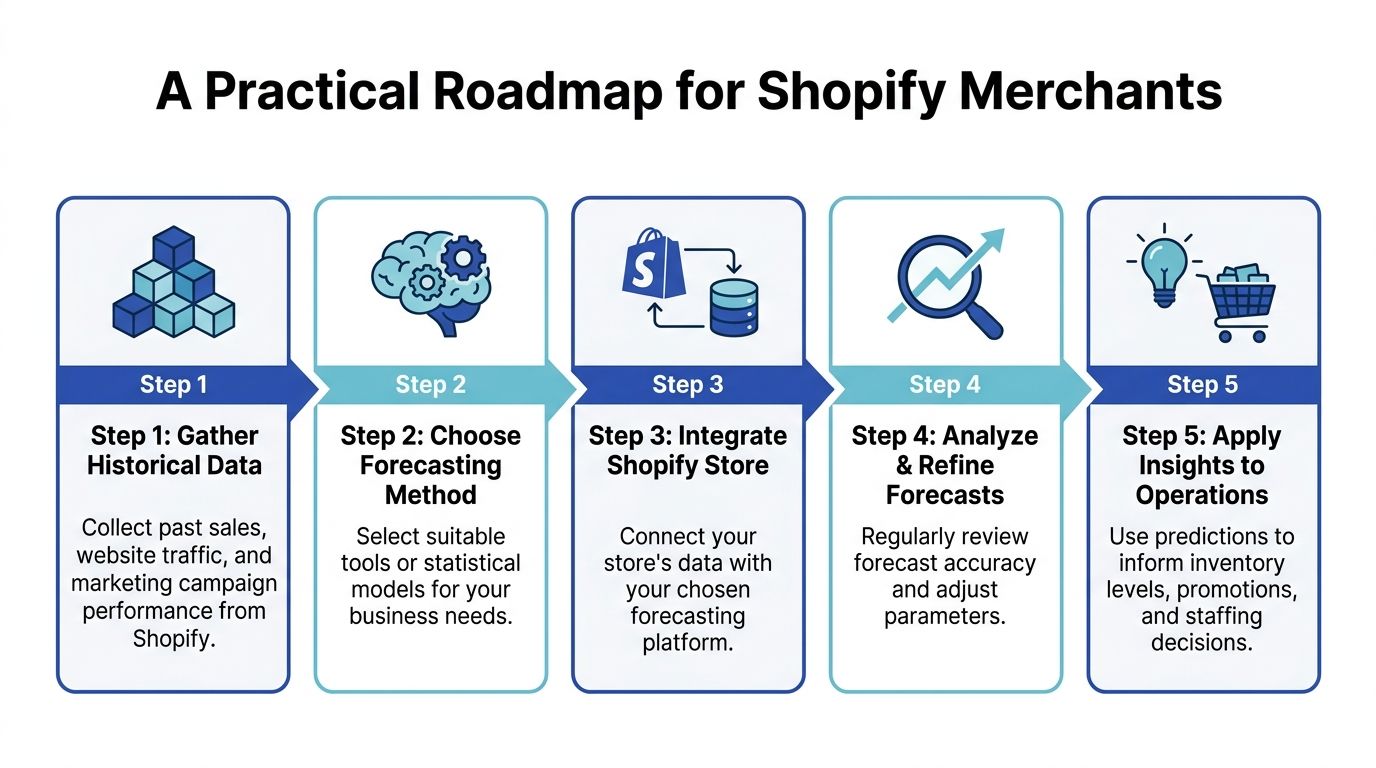
A workable implementation path for Shopify merchants starts with simple discipline and then adds tooling where it removes friction.
Step 1 Clean the data before choosing software
Before comparing apps, audit the raw inputs. Check whether the same SKU appears under multiple names, whether bundles are distorting component demand, and whether purchase-order dates reflect reality.
You need enough history to model seasonality properly. A practical benchmark for UK forecasting is at least two years of historical sales data, with explicit treatment of seasonal indices, promotional calendars, lead-time demand, and safety stock, according to Proactive AI's guide to ecommerce demand forecasting.
Step 2 Choose the tool that matches your stage
A smaller brand may begin with spreadsheets and a disciplined review cadence. A more complex merchant usually needs connected systems.
Common paths include:
- Spreadsheet-led planning for small catalogues and low channel complexity
- Forecasting apps connected to Shopify for merchants that need automation without a full ERP rollout
- ERP or inventory planning modules when purchase orders, suppliers, warehouse logic, and finance all need one source of truth
If Shopify is your commercial front end and planning happens elsewhere, integration becomes the primary project. This guide on Shopify ERP integration is useful if you're working through how product, inventory, and order data should sync operationally.
Step 3 Connect the systems that actually drive decisions
Forecasting becomes useful when Shopify, ERP, WMS, and purchasing workflow talk to each other cleanly. That connection lets the forecast flow into reorder logic instead of staying trapped in reporting.
For teams exploring more advanced methods, this practical piece on implementing AI for demand prediction is a good reference for how AI fits into the workflow rather than sitting as a disconnected experiment.
One option in this part of the stack is Grumspot, which works on Shopify builds and integrations, including ERP and fulfilment connections. That kind of implementation work matters because forecasting only becomes operational when data moves reliably between systems.
Step 4 Turn the forecast into reorder decisions
Forecasting should end in action. A widely used inventory control formula is:
Reorder Point = (Average Daily Sales × Lead Time) + Safety Stock
That formula is valuable because it translates forecast output into a replenishment trigger that can be automated in Shopify-connected systems.
Here's a useful explainer before the next step:
Step 5 Review and refine on a fixed cadence
Don't wait for a crisis to revisit assumptions. Run a regular review that compares forecasted demand with actual outcomes, checks for persistent bias, and updates lead times or promo assumptions where needed.
Common pitfalls
- Ignoring lead times: a demand forecast without supply timing still produces stockouts
- Treating new launches like mature SKUs: low-history products need a different method
- Trusting blended averages: they hide regional and channel-level variation
- Blindly accepting software output: every model needs merchant context and review
Forecasting in Action Real-World ROI Examples
Forecasting pays off when it changes decisions, not when it creates prettier charts. The most useful examples are the ones that show how teams moved from rough planning to specific operational choices.
The image above illustrates common outcomes, but the safer way to think about ROI is qualitatively unless you have your own measured results. Here are three practical scenarios.
The fashion brand that stopped buying seasonality on instinct
A UK apparel merchant had recurring end-of-season problems. Core styles sold through too fast during peak periods, while fringe colourways lingered and forced markdown decisions later.
The fix wasn't a complex model first. It was tighter SKU-level planning, a cleaner promotional calendar, and a forecast segmented by size and colour instead of collection totals. Once the team started buying against actual sell-through patterns, they could place more deliberate bets on depth versus breadth.
The return showed up in healthier stock position, less panic replenishment, and fewer late markdown conversations.
The supplements brand that aligned campaigns with available stock
A subscription-heavy supplements business had a different issue. Marketing could create sharp bursts of demand through creator partnerships and email pushes, but operations often discovered the problem too late.
The team improved planning by feeding campaign schedules and expected demand windows into the forecast review process. Rather than looking only at trailing sales, they used a forward view before launches and adjusted reorder timing around the products likely to be featured.
That changed the commercial conversation. Instead of asking, “Can we restock fast enough after this works?”, they started asking, “Which campaign plan fits the stock position we can support?”
Forecasting is often less about predicting demand perfectly and more about exposing operational risk early enough to do something about it.
The home goods brand that forecast a new collection without history
New product launches are where many forecasting systems break. There's little or no direct sales history, but the business still has to decide how deep to buy.
A practical approach is to use substitutes for missing history. Finale Inventory notes that pre-orders, waitlist sign-ups, qualitative research, and like-for-like analysis from similar products are essential signals for forecasting low-history launches, especially for UK merchants entering seasonal retail windows, as described in its overview of ecommerce demand forecasting methods and trends.
For a home goods merchant, that often means comparing material, price point, category behaviour, and launch timing against similar existing items. It's not perfect, but it's far better than pretending the new line behaves like the site average.
Your Next Steps to Smarter Inventory
Perfect forecasting doesn't exist. Better forecasting does, and that's enough to improve margin, cash flow, and customer experience in a meaningful way.
If your current process depends on one person's instinct, a few export files, and a rush to reorder when stock gets low, the opportunity is straightforward. Build a cleaner planning system before complexity builds around you.
If you're getting started
Begin with the basics:
- Audit SKU data across Shopify, inventory tools, and purchase-order records
- Separate channel and region demand instead of relying on total store averages
- Document your promotional calendar so spikes have context
- Review lead times accurately rather than using optimistic supplier assumptions
If you're levelling up
Move from analysis to system behaviour:
- Create reorder logic that uses forecasted demand and safety stock
- Test a connected forecasting or inventory planning tool
- Bring marketing into the forecasting cycle before major campaigns launch
- Measure forecast error and bias so the team improves based on evidence
A broader read on inventory management in ecommerce can help if you're tightening the operational layer around forecasting, not just the model itself.
If you're more advanced
Focus on the categories where complexity pays back:
- Apply machine learning selectively to volatile lines
- Use launch-specific methods for new products and seasonal collections
- Push forecasts into ERP and WMS workflows so buyers and operators work from the same assumptions
- Review adjacent channel practices too. Even if your core operation is Shopify-first, these Amazon inventory management best practices are useful for thinking about discipline, replenishment, and stock visibility across selling environments.
The biggest shift is mental. Demand forecasting ecommerce work isn't about being right all the time. It's about being less wrong, earlier, and making better decisions because of it.
If your Shopify store has outgrown manual inventory planning, Grumspot can help connect the commercial front end with the systems behind it, including ERP, fulfilment, and operational workflows that make forecasting usable in practice.
Let's build something together
If you like what you saw, let's jump on a quick call and discuss your project

Related posts
Check out some similar posts.

- churn prediction
Discover how churn prediction models work and learn practical steps for feature engineering, evaluat...
Read more
- customer lifetime value
Learn how to calculate customer lifetime value with proven formulas, worked examples, and practical ...
Read more
- customer lifetime value
Learn customer lifetime value calculation for Shopify stores. Boost profit, cut costs with simple fo...
Read more
- seasonal demand forecasting
Master seasonal demand forecasting with our guide. Source data, select models, & integrate with Shop...
Read more