Competitor Benchmarking Analysis: A 2026 Guide
- competitor benchmarking analysis
- ecommerce benchmarking
- Shopify competitor research
- CRO benchmarking
- UX analysis
Launched
July, 2026
You're looking at three tabs full of competitor screenshots, a messy spreadsheet of prices, and a Shopify dashboard that still doesn't answer the question, why are they converting better than us? That's where most competitor benchmarking analysis goes wrong. Teams compare the wrong brands, the wrong metrics, and the wrong level of the market, then wonder why the output feels decorative instead of decisive.
The fix is to benchmark like a practitioner, not a tourist. On UK ecommerce stores, that means comparing direct rivals, but also the adjacent players that shape customer decisions, and grounding the work in UK public data where private financials are opaque. It also means scoring what affects revenue on a Shopify 2.0 store, not just what looks tidy in a slide deck.
Why Most Competitor Benchmarking Analysis Falls Short
Many teams begin with the easiest thing to compare, three direct rivals and their homepage design. That gives you a fast screenshot exercise, not a strategy. You learn who uses a bigger hero banner or more trust badges, but you still don't know why one store wins the same budget while another gets ignored.
The bigger mistake is assuming the competition is only another store that sells similar products. In UK ecommerce, pressure often comes from adjacent layers like search, CRO, analytics, ERP, and fulfilment, because buyers compare the entire workflow, not just the category label. Practitioner frameworks explicitly recommend mapping “also considered”, “integrated with”, and “replaces” relationships, because those are often the options that win the same budget even when they don't look like obvious peers (adjacent-player benchmarking guidance).
Structural benchmarking beats surface comparison
A surface comparison asks whether a competitor has a cleaner PDP or a louder offer. Structural benchmarking asks what alternatives a buyer is weighing, and why the budget leaves. That shift matters because the strongest threat to a Shopify store is often not a prettier homepage, it's a faster checkout path, a better fulfilment promise, or a search-led acquisition model that captures demand earlier in the journey.
UK market structure makes this more important. The Competition and Markets Authority has shown that UK online advertising revenues are concentrated among major platforms, with Google and Meta dominating search and social inventory in the UK market, so raw channel comparisons can mislead if you don't normalise for channel mix and audience intent (market structure and channel mix pitfalls). A store can look weak on traffic quality when the core issue is that it's comparing itself to brands with very different acquisition economics.
Practical rule: if a competitor wins through a different workflow, treat it as a benchmark even when it doesn't look like a direct rival.
The useful question is not, “Who looks like us?” It's, “What non-obvious alternatives win the same customer budget?” Once that question is in place, the rest of the analysis gets sharper, because you stop chasing cosmetic differences and start looking for structural gaps.
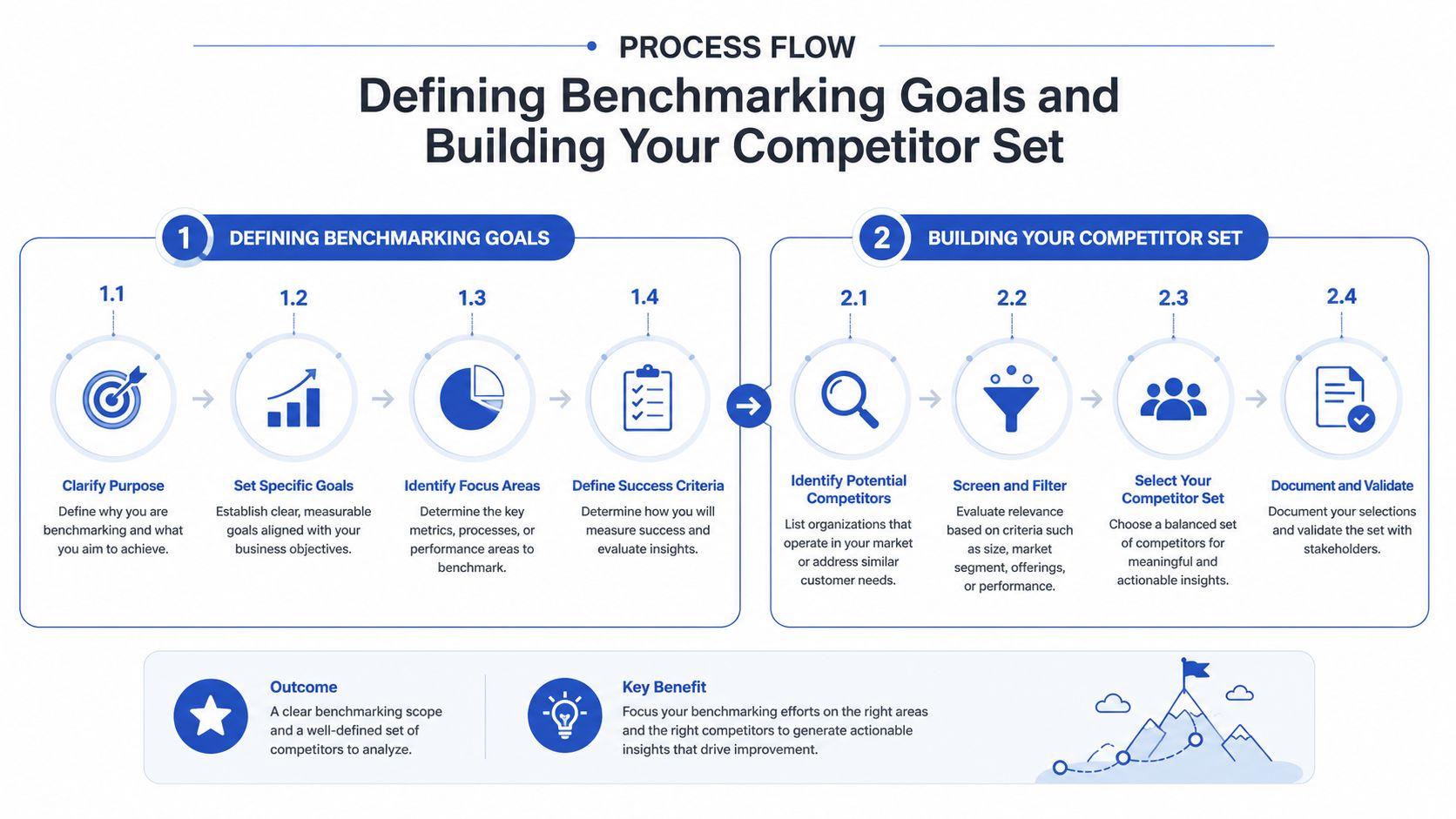
Defining Benchmarking Goals and Building Your Competitor Set
Start with the business outcome, not the competitor list. If the goal is to improve conversion rate, the benchmark set should reflect checkout friction, trust, and offer clarity. If the goal is to raise average order value, the set should emphasise bundles, upsells, and merchandising logic. If the goal is to reduce cart abandonment, benchmark the steps, reassurance, and follow-up flows that remove hesitation.
Build three layers of competitors
A useful set usually includes direct competitors, aspirational brands, and adjacent players. Direct competitors show the current category baseline. Aspirational brands show what “good” looks like when the market is more mature. Adjacent players show where budget leaks to other service layers or alternative workflows.
For a Shopify fashion brand, that might mean one brand with similar price points, one premium label with stronger content and brand trust, and one fulfilment-led or marketplace-style alternative that shapes expectations around delivery and convenience. The point is not to collect a huge list. It's to create a set that helps you distinguish market parity from strategic advantage.
Keep the set tight enough to manage
A competitor set that grows too large becomes a reporting burden. A set that's too small turns into opinion. In practice, a compact group is easier to review consistently, especially if you're collecting manual UX notes, pricing snapshots, SEO observations, and public-data context at the same time. Customer interviews, CRM notes, invoices, and partner feedback can help you surface who matters before you open a market report, which is a stronger starting point than guessing from ad activity alone (practitioner benchmarking approach).
A good brief fits on one page and answers four questions. What outcome are we trying to move, who wins attention today, what alternatives steal the budget, and what evidence will count as a meaningful gap? If those answers aren't clear, the benchmarking exercise will drift into a collection of screenshots with no decision attached.
Metrics and Qualitative Dimensions to Measure
Benchmarking works when you compare the same kinds of evidence across every store. That means mixing quantitative metrics with qualitative observations, then scoring them consistently. If you only look at traffic, you miss the reasons people stay. If you only look at design, you miss whether the store is set up to convert.
Measure the store the way a buyer experiences it
For Shopify stores, the most useful dimensions are usually navigation, product page structure, mobile UX, pricing architecture, checkout flow, SEO content, and performance. Navigation tells you whether shoppers can find the right collection quickly. Product pages reveal whether the store answers objections with clarity or hides behind brand language. Mobile experience matters because a messy touch journey can make a strong offer feel harder than it is.
Pricing analysis needs more than headline comparisons. Look at discount structures, bundle strategies, and whether the merchant uses subscriptions or other recurring models. A competitor may look cheaper at first glance, but a bundle-led structure can change the economics entirely. Checkout flow should be reviewed for the number of steps, trust signals, delivery reassurance, and post-purchase communication. SEO should cover content depth, technical hygiene, and how the brand frames its category, not just whether it ranks for a few obvious terms.
Practical rule: if two competitors have similar prices, the one with cleaner product-page proof and a calmer checkout usually has the easier path to conversion.
A simple scoring model helps keep the work honest. Use a 1 to 5 scale for each sub-dimension, where 1 means weak, 3 means adequate, and 5 means strong relative to the set. Add notes for what created the score, because the reason matters more than the number when you later decide what to fix.
| Dimension | Key Metrics | Tools |
|---|---|---|
| UX | Navigation clarity, PDP hierarchy, mobile usability | Manual review, Hotjar, Chrome DevTools |
| Pricing | Discounting, bundle structure, subscription logic | Manual audit, Shopify storefront review |
| Conversion | Checkout steps, trust signals, post-purchase flow | Manual checkout walkthrough, session recordings |
| SEO | Content depth, technical hygiene, keyword positioning | SEMrush, Google Search Console |
| Performance | Page load, script weight, Core Web Vitals | PageSpeed Insights, Lighthouse |
For customer journey measurement, customer satisfaction measurement is a helpful companion reference because satisfaction signals often explain why similar stores produce different outcomes. That's especially useful when you're trying to distinguish a real competitive gap from a cosmetic one.
The best benchmark sheets don't just capture numbers. They record friction, clarity, proof, and consistency in a way that can be repeated later without interpretation drift.
Data Collection Methods and Tools for Shopify Stores
A benchmark is only useful if the collection process stays consistent. The fastest way to waste time is to gather screenshots, notes, and metrics in different formats and then try to compare them later. A cleaner approach is to assign one method to each dimension, keep the output in the same template, and write down the context behind each observation.
A practical collection stack
Start with BuiltWith for stack analysis, because the tools a competitor runs often explain the behaviour you see on site. Use PageSpeed Insights and Lighthouse for performance, SEMrush for SEO gap checks, and a manual checkout walkthrough for conversion flow. If you are comparing paid acquisition signals, inspect visible channel execution, but keep channel mix and intent in view. Surface metrics on their own can point you in the wrong direction.
For UK-focused benchmarking, public records fill in the gaps that store audits cannot. The ONS Business Insights and Conditions Survey has been running since March 2020 and tracks turnover, cash reserves, staffing, and trading conditions, while Companies House recorded more than 5.5 million registered companies by 2024 (UK competitor benchmarking context). Those datasets will not show product page quality, but they do help you build peer groups by sector, region, and size instead of relying on brand perception alone.
Use UK-native evidence when financials are hidden
When competitor financials are private, use Companies House filings, ONS business population data, and other ONS economic activity datasets to compare establishment counts, growth patterns, and labour inputs. This matters in ecommerce, where online sales still account for a meaningful share of retail spending and seasonality can distort a single snapshot. The goal is to separate structural peers from temporary spikes (UK-native public benchmarking methods). A privately held store can look modest on the surface and still sit in a much stronger operating position.
For ongoing monitoring, a dedicated workflow matters more than a one-off audit. A platform such as effective competitor monitoring can help keep capture consistent, but the underlying discipline still has to stay manual enough to catch context that software misses. I have seen teams over-trust screenshots and ignore the reason behind the change. That usually leads to weak prioritisation later.
A simple collection rhythm
- Day one. Gather public site data, visible pricing, and initial UX notes.
- Day two. Run SEO and performance checks, then log tech stack signals.
- Day three. Pull UK public company context and write the first score pass.
That is enough to produce a useful first benchmark without turning the project into a research programme. If the same inputs are captured for every competitor, in the same order, the later scoring stays clean instead of improvised.
A short audit pass can help here too. A Shopify CRO audit is a useful companion because it surfaces the friction points that usually matter most in the conversion layer.
Scoring Framework and Prioritisation Template
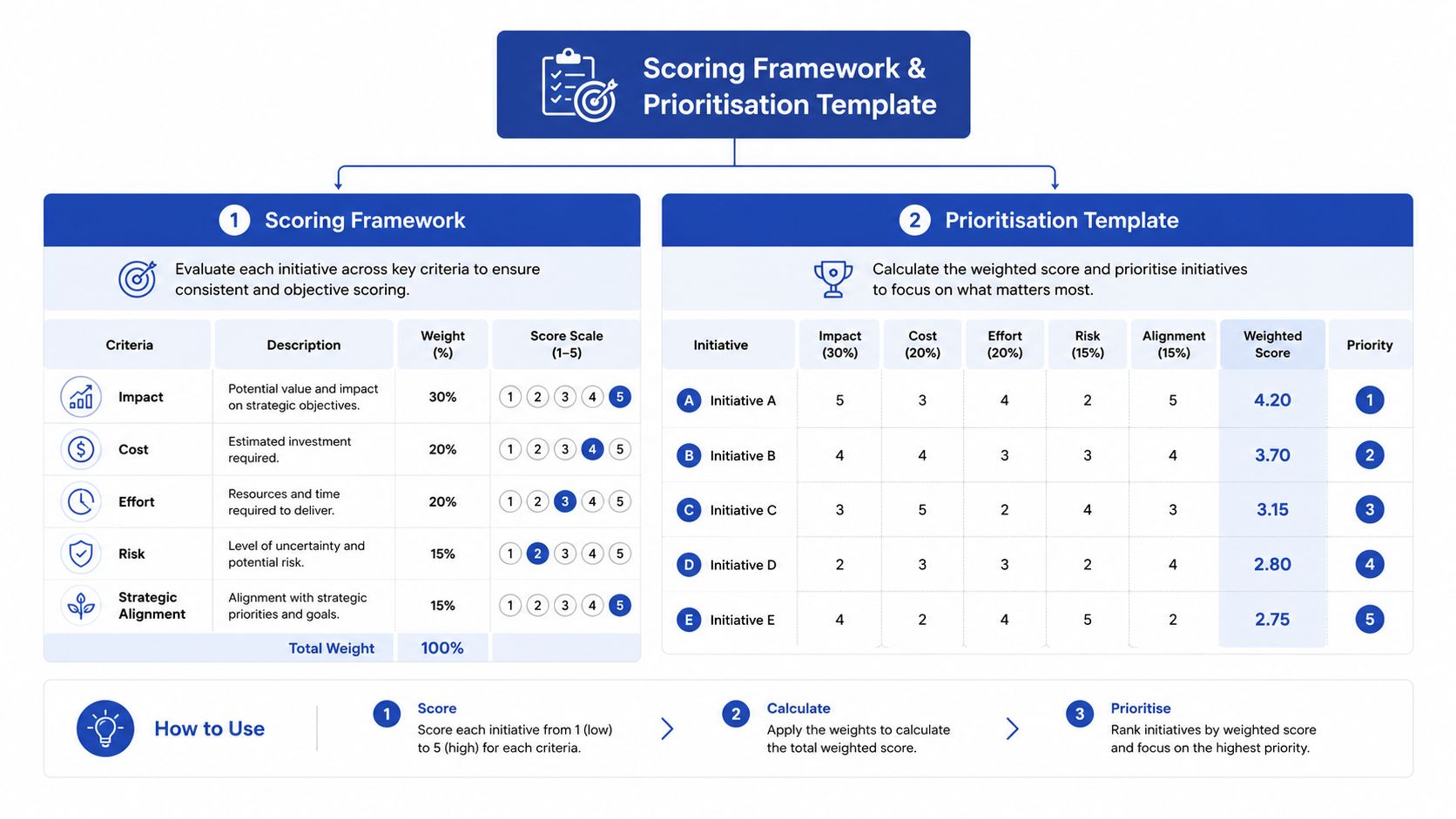
Raw benchmark data only helps if it changes what gets built next. The cleanest way to do that is to weight the dimensions against the business objective, then score every competitor on the same scale. That turns comparison into prioritisation, which is where many teams need help.
Weight what drives the outcome
If the main issue is conversion, Customer Experience and Product & Price should carry more weight than market visibility. If the store already has demand but poor efficiency, a strong top-of-funnel score won't fix the business. The most useful framework is not universal. It reflects the commercial problem in front of you.
A simple template works well:
- Market Position, weight to visibility, share of voice, and category clarity.
- Product & Price, weight to feature parity, pricing structure, and offer strength.
- Customer Experience, weight to UX, trust, checkout, and support signals.
One of the Grumspot resources that fits this stage is a Shopify CRO audit, because a CRO audit naturally surfaces the same friction points you'll want to score in benchmarking.
Separate real gaps from deliberate differences
Not every lower score is a problem. Some brands intentionally trade breadth for focus, or premium pricing for simpler offers. The question is whether the gap is a strategic choice or a competitive disadvantage. That distinction keeps the roadmap from filling up with changes that would dilute the brand.
Practical rule: if a gap doesn't affect the customer's ability to choose, trust, or buy, it probably isn't first on the list.
A prioritisation matrix helps here. Put each issue into one of four buckets, quick win, medium lift, strategic investment, or not a priority. Quick wins are usually messaging, layout, or reassurance fixes. Strategic investments are deeper, like tech restructuring, content architecture, or fulfilment integration. The point is to turn the benchmark into a sequence, not a wish list.
When you present the scores, make the trade-offs explicit. Stakeholders will argue less when they can see why one gap is urgent and another is just different.
Example Analysis for a Shopify Fashion Brand
A mid-market fashion store, call it Brand A, sits between two direct competitors and one adjacent player. The direct rivals are both Shopify brands with similar price points, while the adjacent player is a fulfilment-led alternative that competes on convenience and reliability. That mix matters, because the pressure isn't just from similar-looking sites, it's from the option that makes the buying decision feel easier.
Brand A scores well on product styling but loses ground in the places that shape confidence. Its navigation is cluttered on mobile, collection paths are less obvious than the direct competitors, and the PDP hierarchy buries size guidance lower than it should. One direct rival uses cleaner merchandising and better visual proof, while the adjacent player wins on delivery clarity and post-purchase reassurance. The scorecard shows that Brand A is not weak everywhere, it's leaking trust in a few high-friction moments.
The three gaps that matter most
The first gap is mobile navigation. On smaller screens, users have to work harder to get from the homepage to the right category, and that adds avoidable friction before the first product view. The second gap is product-page clarity, especially around fit and delivery expectations. The third gap is search visibility around intent-led content, where competitors capture shoppers earlier with better category framing.
Those findings translate into a straightforward testing plan. The navigation fix becomes an A/B test on menu order and collection prominence. The PDP issue becomes a redesign of proof blocks, size guidance, and delivery reassurance. The SEO gap becomes a content and internal linking project aimed at the pages that already match high-intent queries. If the store already has the traffic, the fastest gains usually come from removing friction rather than adding more traffic sources.
How to present it to stakeholders
Don't present the analysis as “competitor X is better.” Present it as why shoppers have an easier path elsewhere. That framing gets buy-in because it links the benchmark to user behaviour, not ego. The goal is to show that the market is giving you a map of what buyers already expect.
The most useful close-out is a three-line summary: what the store does well, where it falls behind, and what gets tested first. That's enough to move the discussion from debate to execution.
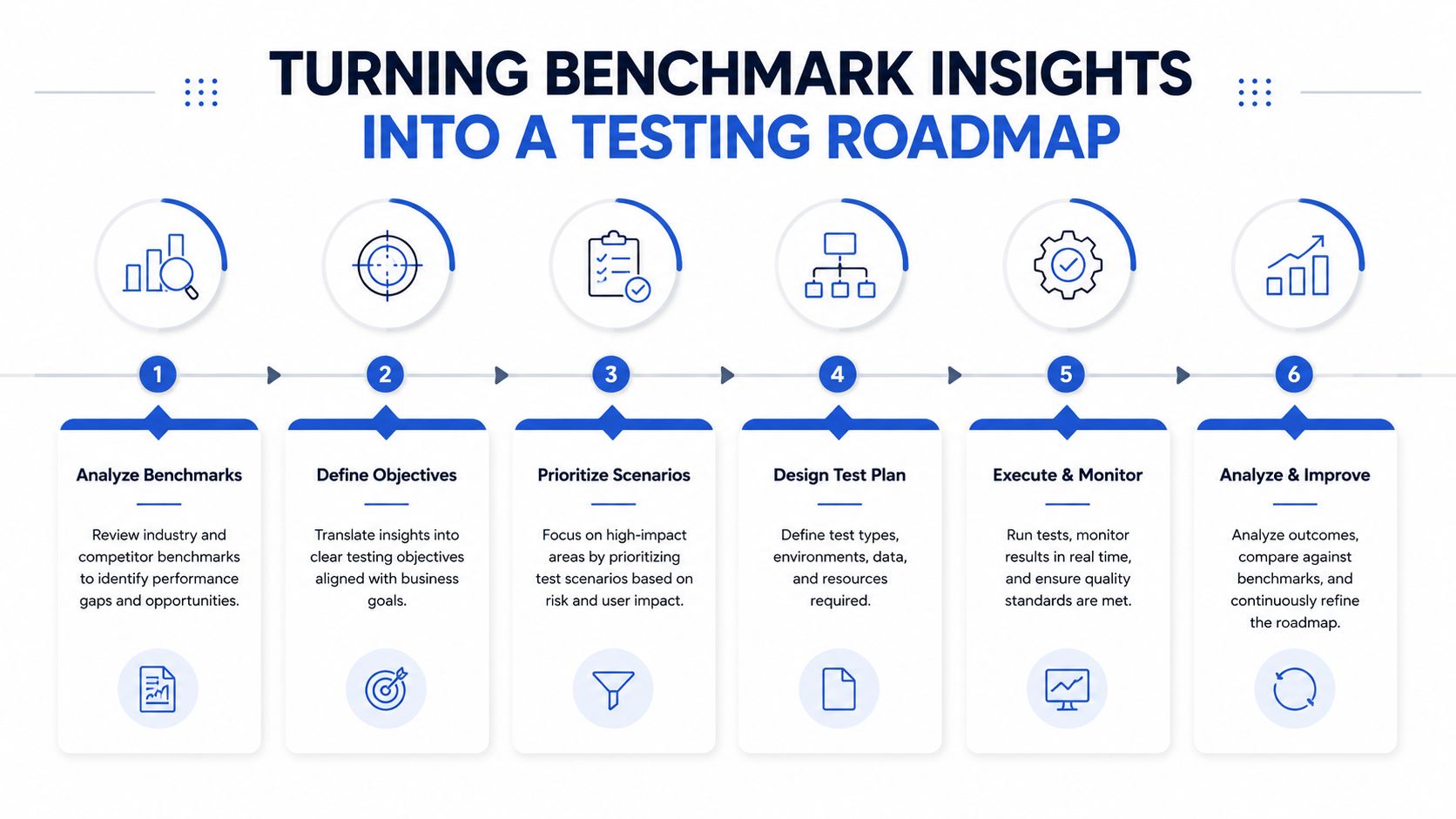
Turning Benchmark Insights into a Testing Roadmap
Benchmarking fails when teams stop at insight. A strong roadmap turns the highest-value gaps into experiments with owners, timelines, and success metrics. Without that step, the workbook gets archived and nothing changes.
Sequence the work in the right order
Start with the changes that improve every other test, usually technical performance and page stability. Then move into UX fixes, conversion flow improvements, and only after that, bigger positioning shifts. If a site loads slowly or behaves inconsistently on mobile, prettier copy won't rescue the experience.
Resource allocation matters too. Some changes can stay in-house, especially layout updates, copy revisions, or collection reordering. More complex work, like Shopify 2.0 rebuilds, custom app logic, or deep CRO work, often needs a specialist team. For that part of the stack, a service like Shopify A/B testing services fits naturally because the benchmarking output should feed straight into controlled tests.
Keep benchmarking continuous
Treat benchmarking as a quarterly discipline, not a one-time project. Markets shift, competitors change offers, and adjacent players become direct threats faster than many teams expect. A fresh review keeps your assumptions honest and stops the roadmap from drifting into old priorities.
A practical cadence is simple. Re-score the same competitor set, review what changed, and move only the gaps that still matter. That keeps the work focused and prevents analysis paralysis.
If you want a benchmarking process that turns into action, Grumspot can help you audit the store, score the gaps, and build the tests that follow from the data. Visit Grumspot to see how a Shopify-focused team approaches CRO, technical fixes, and storefront improvements with a conversion-first lens.
Let's build something together
If you like what you saw, let's jump on a quick call and discuss your project

Related posts
Check out some similar posts.