International Pricing Strategy: A Playbook for Shopify
- international pricing strategy
- ecommerce pricing
- Shopify international
- global ecommerce
- pricing models
Launched
July, 2026

Your store is doing well at home. Paid acquisition still works, your retention flow is healthy, and operations are finally predictable. Then growth starts to flatten. The obvious next move is international, but the first real question usually isn't shipping. It's pricing.
That's where a lot of Shopify brands get stuck. They can technically switch on new countries in Shopify Markets, enable local currencies, and start taking orders. But if the price a customer sees in London, Berlin, or Dubai doesn't make sense for that market, the rest of the setup won't save you.
A solid international pricing strategy is what turns global expansion from a gamble into a managed commercial decision. On Shopify Plus, that strategy has to live in two places at once. It has to make financial sense in the spreadsheet, and it has to work cleanly in the storefront, cart, checkout, taxes, and fulfilment logic.
Going Global Is More Than Just Shipping
A familiar scenario plays out on Shopify Plus. International orders start coming in through the main store, usually from a handful of countries where paid social, search, or word of mouth is already leaking across borders. The team reads that as proof the brand is ready to expand. Then they switch on new markets, convert prices, and assume shipping is the hard part.
Pricing is usually what breaks first.
I see it in audits all the time. A merchant launches the UK and EU with simple currency conversion, then finds out local taxes, duties, return rates, and support volume have changed the margin profile completely. Another brand protects margin too aggressively, lands above local price expectations, and struggles to get enough volume to learn anything useful. A third goes in with heavy discounts, gets orders, and builds the wrong customer behavior from day one.
Those are avoidable mistakes.
On Shopify Plus, international pricing is operational, not cosmetic. It affects the price shown in Shopify Markets, the way discounts behave in checkout, how duties and taxes are presented, whether customers abandon at the cart, and whether the market is still profitable after fulfilment and returns. If the number on the PDP is wrong, the rest of the setup cannot compensate for it.
There is also a legal and financial layer that needs to sit inside the same launch plan. If you are expanding into Europe, price presentation, tax treatment, and customer data handling need to line up early. This GDPR compliance checklist for Shopify stores expanding into the EU in 2026 is a useful starting point for the privacy side. If the UAE is on your roadmap, get expert UAE tax guidance for owners before you set market-specific pricing or checkout rules.
What pricing actually controls
International pricing shapes more than the sticker price. It directly influences:
- Conversion quality: A market can show traffic and still fail if the local price feels off before the customer reaches checkout.
- Margin: Cross-border orders carry extra costs, including duties, payment fees, longer delivery routes, and higher return exposure.
- Brand position: The same product can read as premium in one market and overpriced in another.
- Operational pressure: Poor pricing creates more support tickets, more checkout drop-off, and more refund friction.
- Channel conflict: If distributors, marketplaces, and your own store are priced out of sync, the problem spreads fast.
The better question is simple. What price can this market support, and can Shopify be configured to sell at that price profitably?
That is the starting point for international expansion that lasts.
Laying the Groundwork with Research and Cost Analysis
A common Shopify Plus mistake looks like this. The team enables a new market, turns on local currency, copies domestic pricing, and assumes the numbers will hold. Then CAC comes in higher than planned, duties create support tickets, and margin disappears at checkout.
Set the commercial model first. Then configure Shopify Markets, price lists, duties handling, and checkout logic to match it.
Build market intelligence before you build price lists
Research needs to answer one practical question. Can this brand win in this market at a price that still leaves room for profit after local costs and customer expectations are accounted for?
Bridgehead's guide to international pricing strategy makes the right point here. Price setting has to cover product and service costs, competitor positioning, and what local buyers are willing to pay.
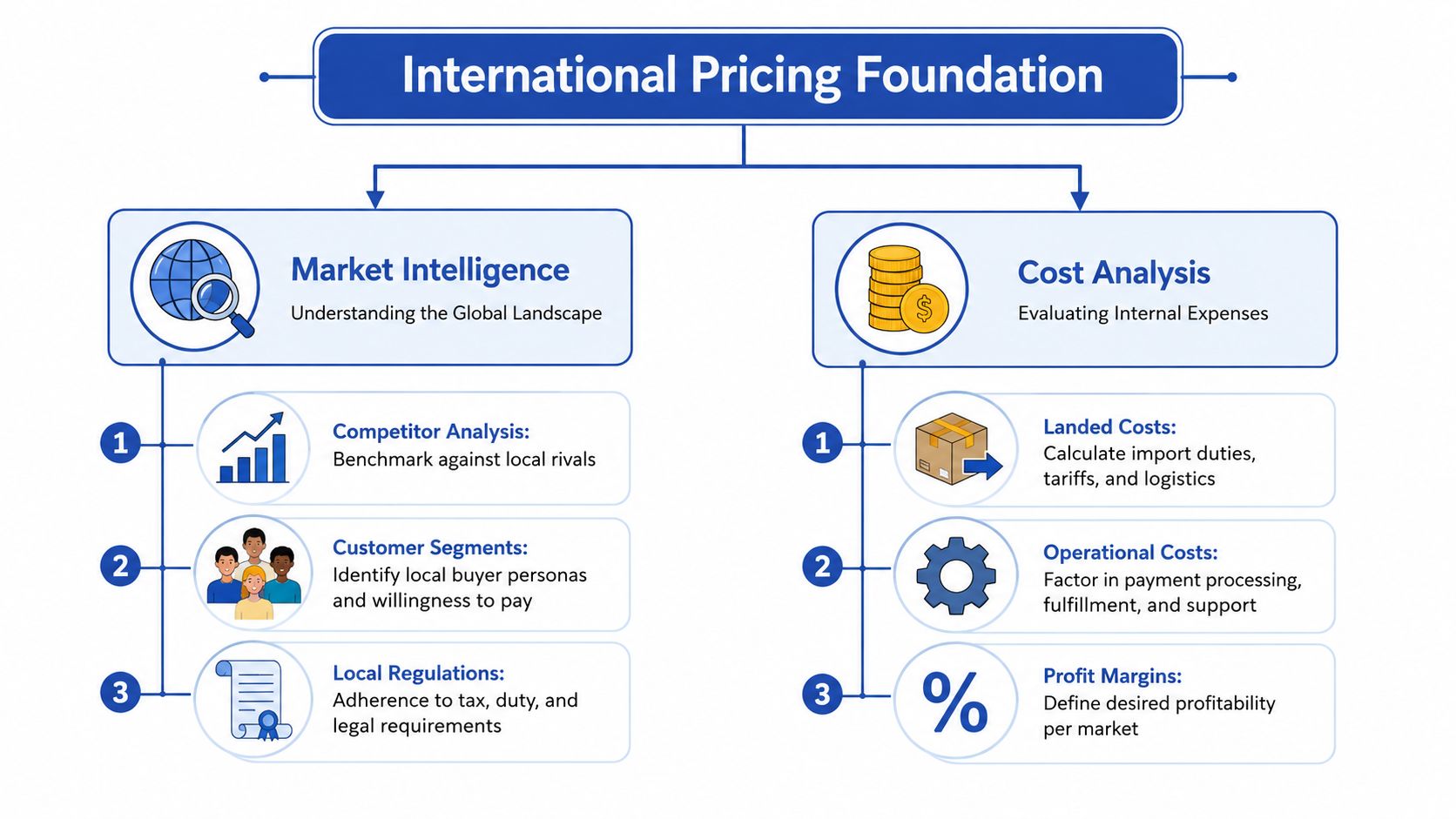
For Shopify merchants, that means checking the market before anyone builds price lists in admin. I usually want clear answers to these questions:
- Which local competitors are winning? Look at the brands showing up in local search, paid ads, marketplaces, and social, not just the global names your team already knows.
- How do they structure offers? Check base price, sale cadence, bundles, subscriptions, free shipping thresholds, and whether they push discount codes or automatic promotions.
- What value story are they selling? Fast delivery, local stock, premium quality, local-language support, exclusivity, sustainability, or price leadership all justify different price positions.
- How is price presented on-site? In many markets, tax-inclusive pricing, familiar currency formatting, and clear import treatment matter as much as the number itself.
- What happens at checkout? If local payment methods are missing or duties appear late, the market may reject an otherwise sensible price.
Teams often miss the operational side. Pricing research is not only a merchandising exercise. It should inform how you set up Shopify Markets, whether you need fixed local prices instead of FX conversion, and which payment and duty options need to be live before launch.
Calculate landed cost properly
The internal side is less glamorous and more important.
Many brands know product cost and outbound shipping. Fewer model the full delivered cost by market, order type, and channel. That gap is where international margin gets overstated.
Your landed cost model should include:
- Core product costs: Development, manufacturing, packaging, and storage
- Movement costs: Distribution, freight, and transport insurance where relevant
- Market entry costs: Tax, customs duty, customs admin, and any extra compliance handling
- Operating costs: Payment processing, fulfilment handling, localisation support, returns, and customer service
- Channel costs: Marketplace fees, retail margin, distributor margin, or partner commissions if you are not selling DTC only
If you sell through multiple channels, build separate margin views. A DTC order shipped from a regional 3PL can work at one price point. The same SKU sold through a distributor or marketplace may need a very different floor price. This is one of the fastest ways to create channel conflict if the pricing team and ecommerce team work from different assumptions.
Tax handling also needs to be settled early, because it changes both displayed price and net margin. If the UAE is on your roadmap, this breakdown of expert UAE tax guidance for owners is useful because tax treatment affects invoicing, margin planning, and what the customer sees on the storefront.
A working research checklist
Keep the first version simple. A spreadsheet is enough if it helps your team make pricing decisions before setup starts in Shopify.
| Research area | What to gather | Why it matters |
|---|---|---|
| Competitors | Local list prices, promotions, bundles, shipping offers | Sets the market reference point |
| Customer expectations | Tax display norms, preferred payment methods, local wording | Reduces distrust before checkout |
| Cost structure | Product, freight, duties, tax, fulfilment, support | Protects margin |
| Legal and compliance | Local pricing, tax, and import requirements | Avoids launch delays and pricing errors |
| Channel strategy | DTC only, retail, marketplace, distributor | Changes the margin required |
Good international pricing usually starts with boring work done well. If the research and cost model are sound, the Shopify setup gets much easier and the first version of your market pricing is far less likely to need a full rebuild.
Choosing Your International Pricing Model
A common failure pattern looks like this. A merchant expands into the UK, EU, and Australia, turns on local currencies, and assumes conversion alone will handle pricing. Orders come in, but margin swings by market, bestseller price points feel off locally, and the team starts patching exceptions product by product.
The pricing model should prevent that mess.
For Shopify Plus merchants, the right choice is usually the model your team can operate consistently for the next 6 to 12 months. Fancy logic is useless if finance cannot approve it, merchandising cannot maintain it, and ecommerce cannot set it up cleanly in Shopify Markets.
The three models in practice
Cost-plus pricing starts with your real landed cost in each market, then adds the margin required to protect the business. I usually recommend this first for premium brands, heavy products, or merchants dealing with unstable freight, duty, or return costs. It gives finance a clear floor and keeps expansion from subtly eroding contribution margin.
Its weakness is conversion. Customers do not care that your spreadsheet says a product needs to be €112 if every credible local alternative sits below €99.
Market-based pricing works from the outside in. The team reviews local competitors, category norms, promotional intensity, and customer price tolerance, then sets a price that fits the market and checks whether the margin still works. This is often the better option for competitive categories where the customer can compare three stores in two minutes.
The risk is operational, not theoretical. Merchants can win traffic and lose profit at the same time if they chase local price parity without a hard margin floor.
Dynamic or geotargeted pricing adds rules on top of either model. That can mean market-specific adjustments, product-level overrides, or a workflow that updates pricing based on exchange movement, stock position, or competitive pressure. On Shopify Plus, this usually makes sense only when the catalogue is large enough and the pricing team is disciplined enough to maintain it. Clickstera Solutions on dynamic pricing gives a useful overview of rule-based pricing logic, even though the examples are Amazon-led.
International Pricing Model Comparison
| Model | Best For | Pros | Cons |
|---|---|---|---|
| Cost-plus | Premium brands, fragile margins, early expansion | Predictable margin control, simpler approvals | Can miss local demand and hurt conversion |
| Market-based | Competitive categories, growth-focused launches | Better local fit, stronger price perception | Requires clear margin floors and regular review |
| Dynamic or geotargeted | Large catalogues, multi-market operations, active pricing teams | Faster response to market conditions, more control by market or SKU | More setup work, more governance, more room for error |
Price architecture matters more than clever theory
The model is only half the decision. The other half is price architecture. Decide which products should hold margin, which products should win the click, and which products can absorb local market pressure.
For example, many Shopify Plus merchants do better with consistent hero-SKU pricing across priority markets, then wider margin variation on accessories, bundles, or low-visibility products. That keeps flagship products competitive without forcing the whole catalogue into the same margin profile.
Local price presentation matters too. A direct currency conversion often creates awkward prices that look imported rather than local. Rounded pricing, market-specific psychological thresholds, and a deliberate premium position can all outperform a mathematically precise conversion if they match customer expectations.
A practical rule for Shopify Plus teams
Start with a hybrid.
Use cost-plus to set the floor. Use market-based review to set the live selling price. Add dynamic rules only where the commercial upside justifies the extra operational work. That approach is easier to maintain inside Shopify Markets, easier to explain internally, and less likely to create pricing exceptions that pile up over time.
If the team is still deciding whether the platform can support this level of market control, this breakdown of the benefits of Shopify Plus for international ecommerce operations is a useful reference.
The Tech Stack Implementing Pricing on Shopify Plus
Pricing strategy gets decided in spreadsheets. It succeeds or fails in configuration.
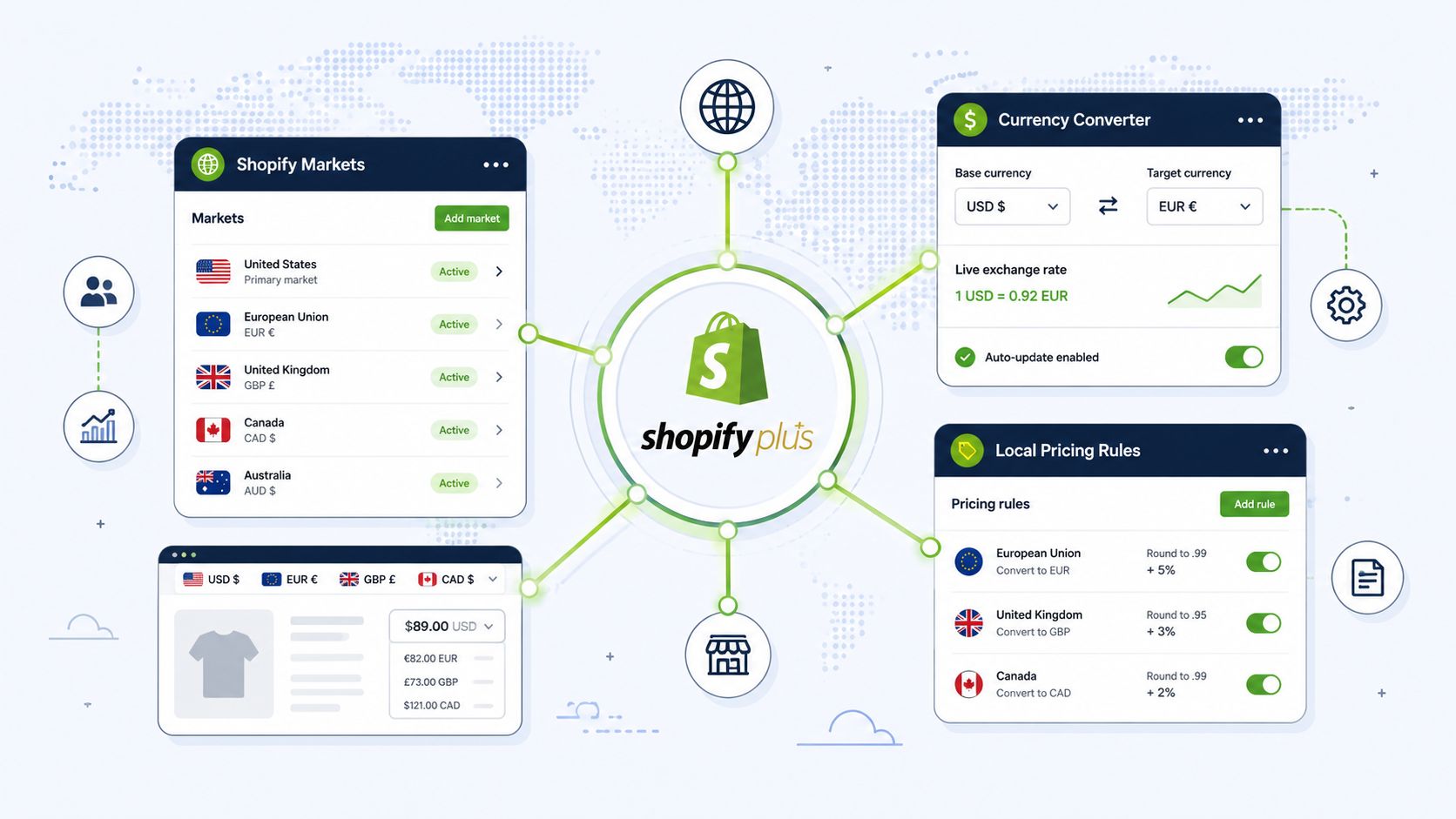
On Shopify Plus, the job is to translate your pricing model into market rules the platform can maintain. That means setting clear market boundaries, choosing where to automate, and deciding which products need manual control. Stores run into trouble when teams set currencies in one place, tax rules in another, and merchandising overrides somewhere else again.
Structure your markets properly
Start with market design, not apps.
In Shopify Markets, separate your home market from expansion markets based on how you operate, not just geography. If the UK has different landed costs, tax treatment, merchandising priorities, or promotional cadence than the EU, it should usually sit in its own market. The same applies to Canada versus the US, or the GCC versus a wider Middle East grouping.
A practical setup often looks like this:
- Primary market: Your home market, where your default catalogue, base pricing logic, and core merchandising rules begin
- Regional expansion markets: UK, EU, North America, GCC, or country-specific markets where buying behaviour and cost structure justify separate treatment
- Test markets: Small launch markets used to validate pricing, payment mix, fulfilment friction, and support load before wider rollout
This is one of the areas where Plus earns its keep. If your team is weighing platform fit, the benefits of Shopify Plus for international ecommerce operations are easiest to see when you compare simple multi-currency selling with actual market-level control.
Choose your pricing method inside Shopify
Shopify Markets gives Plus merchants two practical ways to apply local prices, and most stores end up using both.
Percentage adjustments
Percentage adjustments are the fastest way to get a market live. You set a market-level increase or decrease against your base price, then let Shopify apply that rule across the catalogue.
Use this approach when:
- The catalogue is large
- You need launch speed
- Margin patterns are fairly consistent across product groups
- The first goal is testing demand, not perfect price precision
The trade-off is control. A blanket percentage does not know which SKU drives first-click conversion, which item needs a cleaner psychological threshold, or which bundle can carry more margin.
Fixed prices for key products
Fixed pricing is better for products that shape market perception. Bestsellers, entry-price products, giftable lines, and paid social landing SKUs usually belong here.
Use fixed prices when:
- A hero SKU sets the tone for the brand
- Local price points need to look native
- Specific products have tighter margin constraints
- Campaign traffic is landing on a small set of products
For most Plus builds, the cleanest setup is a hybrid. Apply percentage adjustments to the long tail, then override priority SKUs with fixed local prices. That gives the team speed without giving up control where conversion is won or lost.
Enable local currency and tax handling
Local currency needs to be consistent across the storefront, cart, and checkout. Use Shopify Payments to turn on local currencies where supported, then check how rounding behaves on product pages, collection grids, cart drawers, discount states, and checkout. We regularly find prices that look acceptable on the PDP and awkward everywhere else.
Tax setup needs the same attention. Decide early whether prices should display tax-inclusive or tax-exclusive by market, and test that logic against local expectations. If the storefront says one thing and checkout recalculates another, conversion usually drops.
Legal review matters here too. Tax, import duties, product restrictions, and local pricing rules vary enough by market that merchants should confirm the setup with local advisors before scaling spend. That is especially important in markets where consumer pricing rules are stricter or where duties create a visible gap between advertised and final price.
For implementation, most Plus merchants choose one of two paths:
- Native Shopify tax tooling: A good fit for simpler setups with fewer jurisdictions and lower compliance complexity
- External tax and duty tools such as Avalara: A better fit when the business needs stronger automation, cross-border calculation, or tighter control over import treatment
App layer and operational checks
Native Shopify covers the core pricing framework. The app layer usually handles the gaps between a clean strategy and real operating conditions.
Common additions include:
- Geolocation and market switch tools: To improve country detection and let customers change market without friction
- Rounding and pricing control apps: Useful when native rounding is too broad for your pricing architecture
- Duty and tax estimation tools: To surface a more accurate total before checkout
- ERP or PIM sync: For brands managing market-specific price lists outside Shopify
- B2B pricing logic: For wholesale, distributor, or logged-in account pricing that should stay separate from DTC market pricing
Before launch, run market QA like you expect something to break, because something usually does. Check PDP pricing, collection page price ranges, compare-at logic, discount code behaviour, free-shipping thresholds, gift card handling, refunds, and abandoned checkout flows by market. The strategy is usually sound. The edge cases are where margin leaks and customer trust problems show up first.
Optimising the Checkout Experience for Conversions
A customer in Germany lands on your Shopify store, sees a clean EUR price on the product page, adds to cart, and reaches checkout. Then shipping jumps, tax treatment changes, and duties are still unclear. That is the point where a strong pricing strategy starts losing money.

For Shopify Plus merchants, checkout conversion usually comes down to one thing. Does the final total feel predictable?
If the storefront shows one pricing reality and checkout introduces a different one through taxes, shipping, currency shifts, or import costs, customers pause. In cross-border ecommerce, that pause is expensive. We see this often on Plus builds where Markets is configured correctly at a high level, but the customer-facing details still feel inconsistent.
Make the market and currency obvious
Customers should be able to confirm their market in seconds and change it without friction. In practice, that means a visible country and currency selector in the header or utility navigation, a backup selector in the footer, and geolocation prompts that suggest rather than force a switch.
The key is consistency across the journey. The price on the collection page, product page, cart, and checkout should all feel like part of the same store experience.
Check these points in your Shopify Markets setup:
- Market visibility: Can customers see which country they are shopping in right away?
- Manual switching: Can they change market easily if geolocation gets it wrong?
- Currency formatting: Are symbols, decimal separators, and tax labels familiar for that region?
- Policy localisation: Do shipping, returns, and payment messages reflect the selected market?
A store can be translated and still feel foreign. Checkout is where customers notice the difference.
Surface duties, taxes, and final cost before checkout
Cross-border buyers do not want to estimate the total themselves. They want the store to do that work.
Use cart messaging, duty-inclusive pricing where it fits your model, and clear labels that explain whether taxes and import charges are prepaid or collected later. On Shopify Plus, this often means combining Shopify Markets with a duty and tax app or a cross-border setup that gives customers a realistic landed cost before they enter payment details.
The practical rule is simple. Any charge that appears late in the flow will be treated as a surprise, even if it is technically correct.
If a customer has to stop and calculate the real total, the store has added doubt at the worst possible moment.
Discounting rarely fixes that problem. A promotion can improve click-through or create urgency, but it will not repair a checkout that feels unclear or risky. For most Plus merchants, the better move is to tighten price presentation, make import treatment explicit, and remove unanswered questions before the customer reaches payment.
For teams refining this part of the journey, this guide to Shopify checkout optimization is a useful companion because market pricing, payment options, and checkout UX need to work together.
Checkout details that usually improve trust
Small changes at checkout often produce better results than broad pricing changes.
- Local payment methods: Add regionally trusted options so customers are not forced into a card flow they do not prefer
- Clear shipping windows: Give delivery estimates that match the destination market and fulfillment model
- Returns information: Show the process before purchase, especially if returns are local in one market and international in another
- Plain-language tax and duty copy: Explain charges in a sentence or two, not in policy language
- Order summary accuracy: Keep discounts, shipping thresholds, and compare-at pricing aligned with the selected market
A quick walkthrough helps when you're reviewing your own flow:
The goal is not to add more checkout content. It is to remove uncertainty. If checkout feels local, clear, and consistent with the pricing shown earlier, international customers are far more likely to complete the order.
Testing Iterating and Managing Your Strategy
A market can look healthy on topline revenue and still be the weakest part of your international setup.
I've seen this on Shopify Plus stores where one fast-growing country covers up poor margin, heavy discount reliance, or checkout drop-off in another. If you only review blended performance, you end up protecting volume instead of improving profit.
Review performance by market, not in aggregate
Use Shopify Markets reporting, your analytics platform, and contribution margin reporting to assess each market on its own. The goal is simple. Identify where pricing is working, where it is tolerated, and where it is damaging the business.
Focus on a short list of indicators that help you make decisions:
- Conversion behaviour: Check where shoppers drop. Product page, cart, shipping step, and payment step point to different pricing problems.
- Average order value: Confirm whether your local assortment, bundles, and free shipping thresholds still make sense in that market.
- Gross margin and net profit: Revenue without margin discipline creates false confidence.
- Promotion dependency: Watch whether orders come through at full price or only after discounts, bundles, or threshold offers.
For teams with sales input, align incentives with profitable growth. If a region is hitting revenue goals but eroding margin through discounting, the pricing model needs attention even if order volume looks strong. The ecommerce version of that advice is straightforward. Do not judge a market by orders alone.
Use controlled tests, not sweeping changes
Broad pricing changes create noise. Controlled tests create answers.
Start with a product group that matters, usually hero SKUs, high-traffic products, or the items driving paid acquisition in that market. Change one variable at a time. That could be the local selling price, the rounding logic, the free shipping threshold, or how a bundle is presented. Leave everything else in place long enough to see whether conversion gains hold after margin, returns, and support volume are accounted for.
On Shopify Plus, this usually means adjusting market-specific pricing inside Shopify Markets, then validating results against market-level reports and checkout behaviour. If your catalog is large, a pricing app or ERP feed can help manage tests at scale, but the operating rule stays the same. One test. One hypothesis. One clear review window.
Markets rarely announce that your pricing is now wrong. They show it through weaker conversion, thinner margins, and growing reliance on offers.
Set review triggers before you need them
Pricing reviews should not depend on someone noticing a problem late. Put clear triggers in writing and assign an owner.
A review should happen when:
- Currency movement changes effective margin
- Shipping or fulfilment costs move enough to affect contribution
- A new competitor resets expected price points in the category
- Tax or duty rules change in a target market
- Discounting starts carrying too much of the conversion load
This is also where operating discipline matters on Shopify Plus. Someone on the team should own market settings, price updates, and post-change validation, especially if multiple apps touch prices, promotions, or checkout messaging. Without that ownership, merchants end up with mismatched compare-at prices, outdated thresholds, or prices that changed in the storefront but not in supporting campaign creative.
Good international pricing is managed, not set once. Teams that review by market, test with control, and respond to clear triggers usually improve faster and make fewer expensive reversals.
If your Shopify store is expanding internationally and you need help turning pricing strategy into a clean storefront, checkout, and operational setup, Grumspot can help. They build and optimise Shopify experiences for scaling brands, from market configuration and localisation to checkout UX, custom app work, and conversion-focused implementation.
Let's build something together
If you like what you saw, let's jump on a quick call and discuss your project

Related posts
Check out some similar posts.

- tiered pricing models
Learn how tiered pricing models work in ecommerce and Shopify stores, with examples, KPIs, testing t...
Read more