Mastering Seasonal Demand Forecasting
- seasonal demand forecasting
- inventory management
- ecommerce forecasting
- shopify inventory
- data analysis
Launched
June, 2026
You're probably dealing with one of two pains right now.
Either a seasonal bestseller ran out just as demand peaked, and your team spent the busiest week of the year apologising, expediting, and trying to patch the gap. Or the opposite happened. You bought deep, demand softened, and now you're staring at leftover seasonal stock that has to be discounted before it ages out.
That's the point where seasonal demand forecasting stops being a spreadsheet exercise and becomes an operating system for the business. In ecommerce, especially on Shopify, the forecast isn't just for inventory. It shapes purchase orders, campaign timing, warehouse workload, cash flow, merchandising, and customer experience.
Most advice on forecasting sounds tidy because it assumes tidy data. Real stores don't have tidy data. They have stockouts, bundles, returns, late supplier deliveries, panic promotions, catalogue changes, and teams making fast decisions under pressure. A forecasting process that ignores those realities usually produces confident-looking numbers that aren't commercially useful.
What works is simpler and tougher at the same time. Build a clean demand signal from messy commerce data. Choose a model your team can maintain. Validate it against the past. Then wire the result into the tools and routines your store already uses.
Why Your Ecommerce Store Needs Seasonal Forecasting
The commercial damage from poor forecasting usually shows up in familiar places. Paid traffic keeps running after the hero SKU sells out. Customer service fields avoidable delivery questions. Finance sees cash trapped in slow-moving stock after peak season. Operations gets blamed for problems that started months earlier in planning.
That's why seasonal demand forecasting matters. It gives you a structured way to prepare for predictable shifts in buyer behaviour before they turn into operational noise.
Seasonality in the UK is sharp enough to plan around
In the UK market, the swings aren't subtle. The Office for National Statistics reported that retail sales volumes fell by 3.2% in January 2024 after rising by 3.6% in December 2023, which shows a sharp holiday surge followed by post-peak normalisation in the very next month, as referenced in this UK retail seasonality summary.
If you run an ecommerce store, that kind of reversal changes almost everything. It affects how much stock you buy, when you place the order, how hard you push paid media, and how aggressively you discount through late December and January.
Practical rule: A seasonal spike is only useful if your systems treat it as repeatable demand, not as permanent growth.
Without that discipline, teams make the same mistake every year. They see peak-season performance, assume the run rate will hold, and over-commit inventory or marketing budget into the cooldown.
Forecasting protects margin, not just availability
Most operators think first about stockouts, and fair enough. They're visible and painful. But overstock often causes deeper margin erosion because the damage lands later, after the pressure has moved on.
A sound forecasting process helps you make better calls in three areas:
- Inventory timing: Buy earlier for products with reliable seasonal lift and longer lead times.
- Marketing pacing: Shift spend into periods when demand is likely to convert efficiently.
- Cash control: Avoid tying up working capital in stock that only looked justified because the peak distorted the baseline.
The shift from reaction to planning
The stores that handle seasonality well don't rely on heroic last-minute fixes. They build a repeatable planning rhythm. Merchandising flags seasonal ranges early. Paid media knows when demand should ramp. Operations understands likely volume pressure before the warehouse starts feeling it.
That's its primary value. Forecasting doesn't remove uncertainty. It turns uncertainty into a manageable planning problem.
Gathering and Cleaning Your Forecasting Data
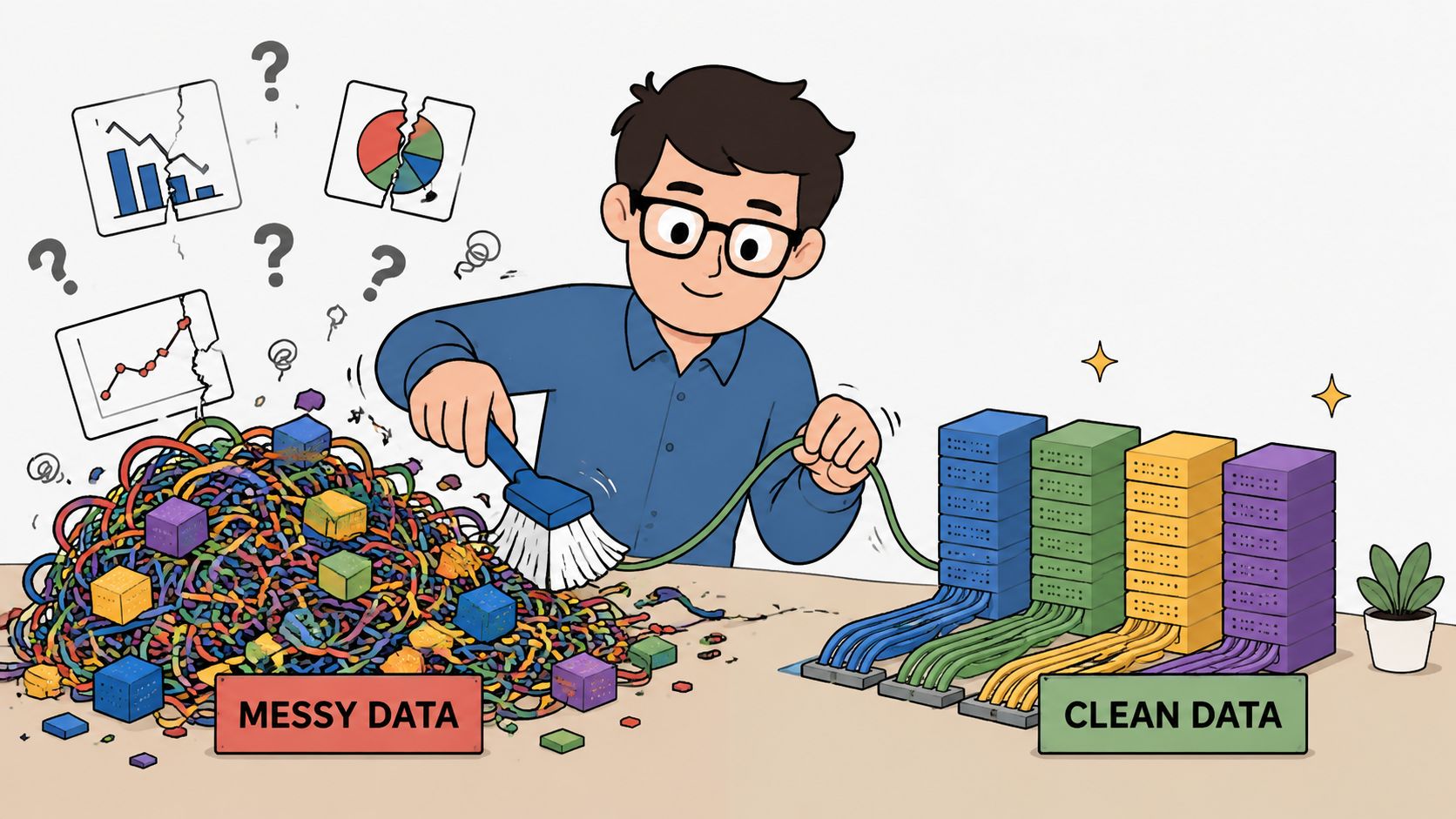
Most forecasting failures start long before the model. They start in the dataset.
A Shopify store can have years of order history and still produce a bad forecast if the inputs are distorted. If a product was out of stock during peak demand, recorded sales won't reflect true demand. If you ran a heavy promotion, the uplift may be real, but it may also be event-driven rather than repeatable. If returns hit later, the apparent success of a launch period may be overstated.
Start with the core inputs
For most ecommerce businesses, the first useful forecasting dataset sits at SKU by week. Daily data is often too noisy for planning unless order volume is high. Monthly data is often too coarse to spot promo effects and stock pressure.
Pull these fields first:
- Order demand: Units sold, gross sales, net sales, refunds, and returns by SKU and date
- Availability status: In stock, out of stock, backorder, preorder, discontinued
- Pricing context: Full price, markdown, bundle inclusion, discount code usage, promotion window
- Channel context: Shopify store, marketplace, wholesale portal, retail partner
- Operational context: Lead time, supplier, inbound date, fulfilment lag
- Calendar signals: Payday periods, bank holidays, Black Friday, Christmas, gifting cut-offs
- Traffic and conversion context: Sessions, product page views, add-to-cart rate, conversion rate by period
If your analytics setup is messy, sort that out early. A strong measurement layer makes demand reconstruction far easier, and wRanks' comprehensive GA4 guide is a useful reference for getting Shopify and GA4 working together properly.
Don't train on constrained sales if demand was higher
This is the mistake most guides skip. If your history includes stockouts, substitutions, or aggressive promotion bursts, clean sales history doesn't exist in the way textbooks imply. One of the most useful framing points on this problem is the idea that the better question isn't which model to use alone, but how to reconstruct demand from messy commerce data, especially when stockouts and promotions have distorted the signal, as discussed in this analysis of seasonal demand forecasting with messy data.
That means you need to annotate the history, not just export it.
If a product sold fewer units because it wasn't available, your model shouldn't learn that lower number as true demand.
In practice, mark and review periods where:
- Stockouts suppressed sales: Product pages still had traffic, but units sold dropped because stock hit zero.
- Promo activity inflated demand: Discount depth or bundle placement created volume that won't recur at full price.
- Catalogue substitutions occurred: Customers bought the nearest alternative because the preferred SKU wasn't available.
- Returns distorted net performance: A launch window looked strong at order level but weakened later on a net basis.
Build a forecasting table your team can maintain
You don't need an enterprise stack to start. You do need structure.
A workable forecasting table often includes:
| Field | Purpose |
|---|---|
| SKU | Forecast at the product or variant level |
| Week start date | Standard time bucket for trend analysis |
| Units sold | Recorded sales |
| Estimated unconstrained demand | Adjusted figure after stockout or promo review |
| Promo flag | Marks discount periods |
| Stockout flag | Marks constrained-demand periods |
| Average selling price | Helps interpret demand shifts |
| Traffic notes | Context for unusual spikes or dips |
| Season tag | Christmas, summer, gifting, clearance, evergreen |
For stores with more moving parts, this data becomes much more reliable when it's synced across commerce and operations systems. If your stock, purchasing, and sales live in separate silos, planning usually breaks at the handoff. That's where tighter system design matters, especially if you're working through Shopify ERP integration.
Clean enough beats theoretically perfect
Don't wait for flawless data. You won't get it.
Instead, aim for a dataset that lets you answer the commercial questions clearly: what demand looked like, what distorted it, and what parts of the pattern are likely to repeat. That's the foundation every useful forecast sits on.
Selecting a Forecasting Model That Fits Your Business
Teams often jump to model selection too early. They hear about ARIMA, Prophet, neural networks, or AI forecasting apps and assume the most advanced option must be best. Usually it isn't.
The right model depends on three things. How stable your demand is. How much clean history you have. How much effort your team can realistically put into maintaining the process.
Use external drivers, not just sales history
A robust workflow should combine internal sales history with external drivers such as economic conditions and weather, then use methods like time series, moving averages, or seasonal indexing, because relying on historical data alone is a common forecasting pitfall, as noted in ISM's demand forecasting best-practices guidance.
That matters because ecommerce demand rarely moves on one signal alone. A seasonal range might be influenced by gifting, payday timing, temperature shifts, competitor discounting, and your own campaign calendar. If the model only sees historic sales, it can misread what caused the pattern.
Three useful model tiers
Most stores can think about forecasting models in three practical tiers.
Simple methods
These are often the best starting point for a growing store.
Examples include seasonal indexing, moving averages, and basic year-on-year trend adjustments. They're easy to explain to non-technical teams, quick to update, and often good enough for products with stable seasonal behaviour.
Best for:
- Stores with a clear annual rhythm
- Teams building forecasting for the first time
- Categories where demand is predictable and promotions are limited
Weak point:
- They can struggle when product mix changes fast or when promos heavily distort history
Advanced statistical models
This tier includes approaches such as ARIMA and other time-series methods. These models are stronger when you have enough historical depth and want the system to capture trend, seasonality, and noise more systematically.
Best for:
- Established stores with repeatable historical patterns
- Larger catalogues with enough demand history at SKU or category level
- Teams that can support regular review and tuning
Weak point:
- They need cleaner data and more technical confidence than simple methods
Machine learning and AI
These models can be powerful when demand is influenced by many non-linear signals, especially across large catalogues. They're often available through specialist forecasting software or inventory planning platforms rather than built fully in-house.
Best for:
- Complex catalogues
- Multi-channel brands with many interacting variables
- Teams that want to combine demand, pricing, promotions, and external signals at scale
Weak point:
- They can become black boxes. If your team can't interpret or challenge the output, accuracy may look better than operational trust in practice.
Forecasting Model Comparison
| Model Type | Best For | Complexity | Data Needs |
|---|---|---|---|
| Seasonal indexing | Stable seasonal categories and early-stage forecasting | Low | Historical sales with clear seasonal pattern |
| Moving average | Short-term planning for relatively steady demand | Low | Consistent recent sales history |
| Time-series models such as ARIMA | Stores with deeper historical patterns and clearer trend structure | Medium | Cleaner history and regular time intervals |
| Machine learning models | Large catalogues with multiple demand drivers | High | Broad internal data plus useful external signals |
Pick the model your business can operate
The strongest forecasting system isn't the cleverest one. It's the one your team will keep using when peak season pressure hits.
Decision test: If buyers, marketers, and operations leads can't understand why the forecast changed, they won't plan confidently against it.
That's why many Shopify brands should start with a layered approach:
- Use simple seasonal indexing at category level.
- Add SKU-level adjustments for stockouts, promos, and launches.
- Introduce advanced models only where the value justifies the upkeep.
This also fits how many businesses work. One model doesn't need to cover everything. Evergreen products may only need a straightforward time-series view. Seasonal gift sets may need stronger event handling. New launches may need manual override supported by analogue products and campaign expectations.
Software can help, but judgement still matters
A lot of forecasting apps promise automation, and many are useful. But the app won't know that a supplier changed pack size, your merchandising team moved a product into a bundle, or your Christmas range was delayed by a photo shoot. Those decisions still need human context.
The practical model choice is the one that balances accuracy, explainability, and maintainability. If you can get those three aligned, your forecast starts helping the business instead of becoming another dashboard people glance at and ignore.
How to Validate Your Forecast and Measure Accuracy
A forecast only becomes credible when you test it against reality.
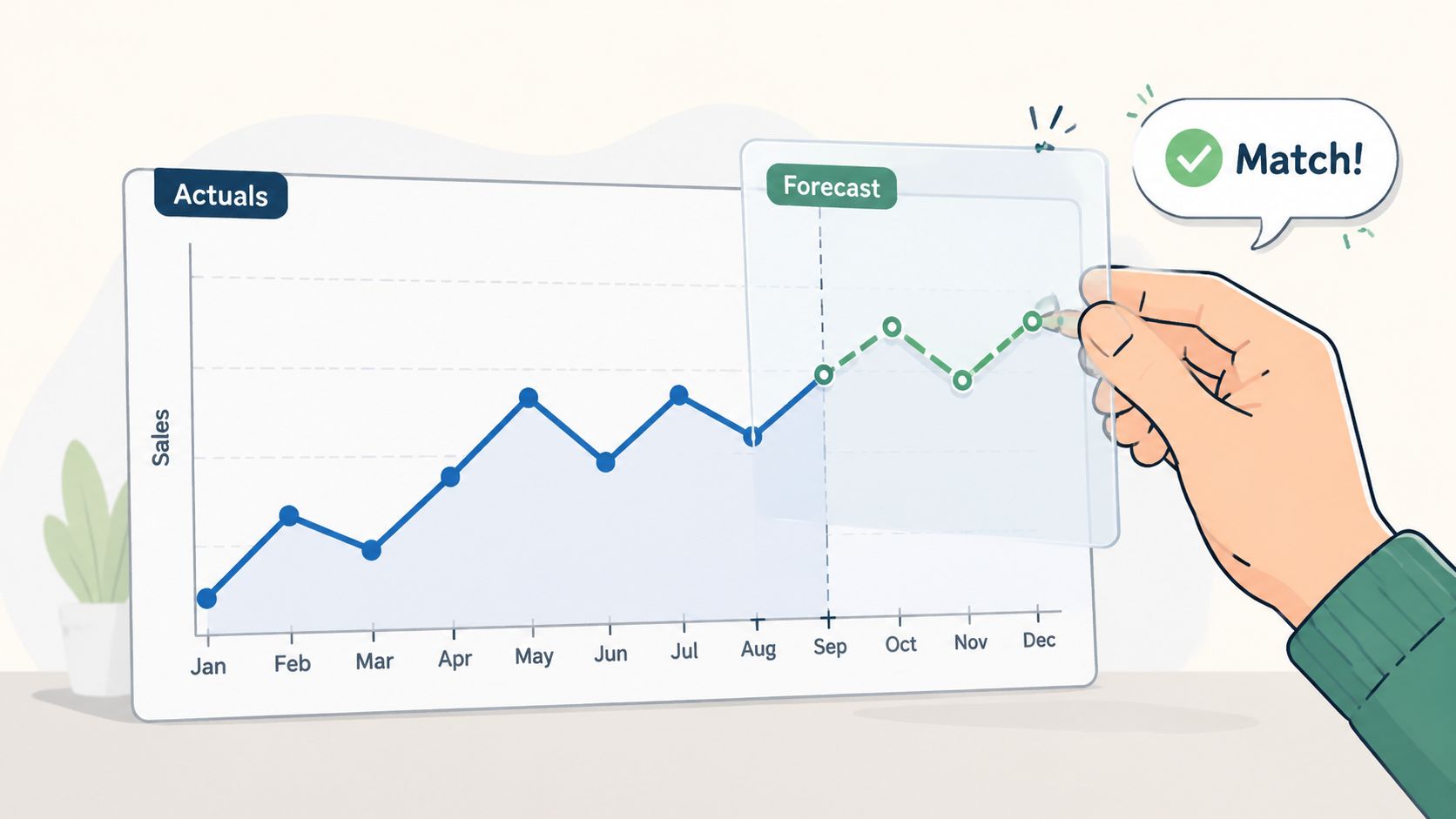
The simplest way to do that is backtesting. Take a past period, hide the actual outcome, and ask your model to predict it using only the information that would have been available at the time. Then compare forecast to actual. That tells you far more than eyeballing a neat trend line.
What to test
Don't validate only at total-store level. A store-wide number can look acceptable while individual categories are wildly off.
Review forecasts at a few levels:
- SKU level for key seasonal items
- Category level for broader buying decisions
- Channel level if demand behaves differently by source
- Weekly view for operational planning
- Monthly view for purchasing and finance
A model that works well for category purchasing may still be too rough for day-to-day fulfilment planning. That's normal. Validation should tell you where the forecast is useful and where it needs a wider buffer.
Use simple error metrics your team understands
You don't need a room full of statisticians. You do need shared language.
- MAE tells you the average size of the miss in unit terms. Helpful for reorder planning.
- MAPE expresses forecast error as a percentage of actual demand. Helpful when comparing products with very different sales volumes.
- Bias shows whether the model tends to over-forecast or under-forecast consistently.
What matters commercially isn't perfect accuracy. It's knowing how wrong the forecast is likely to be, and in which direction.
A forecast with a known margin of error is operationally useful. A forecast that looks precise but hasn't been tested isn't.
That's also where safety stock becomes rational rather than arbitrary. If a product has volatile demand and long lead times, your buffer should reflect that. If a category is stable and replenishes quickly, you can plan leaner.
A short explainer can help teams align on the basics before they start debating outputs:
Validate the process, not just the maths
If actuals miss the forecast badly, don't only ask whether the model failed. Ask whether the business changed the conditions.
Maybe marketing launched an unplanned promotion. Maybe stock arrived late. Maybe pricing moved. Maybe the top-selling variant was unavailable while the parent product still appeared “in stock” in reports.
Those are planning inputs. If they aren't captured, your forecast review will blame the model for operational decisions it never saw.
Turning Your Forecast into Actionable Decisions
A forecast becomes valuable when it changes what the business does next.
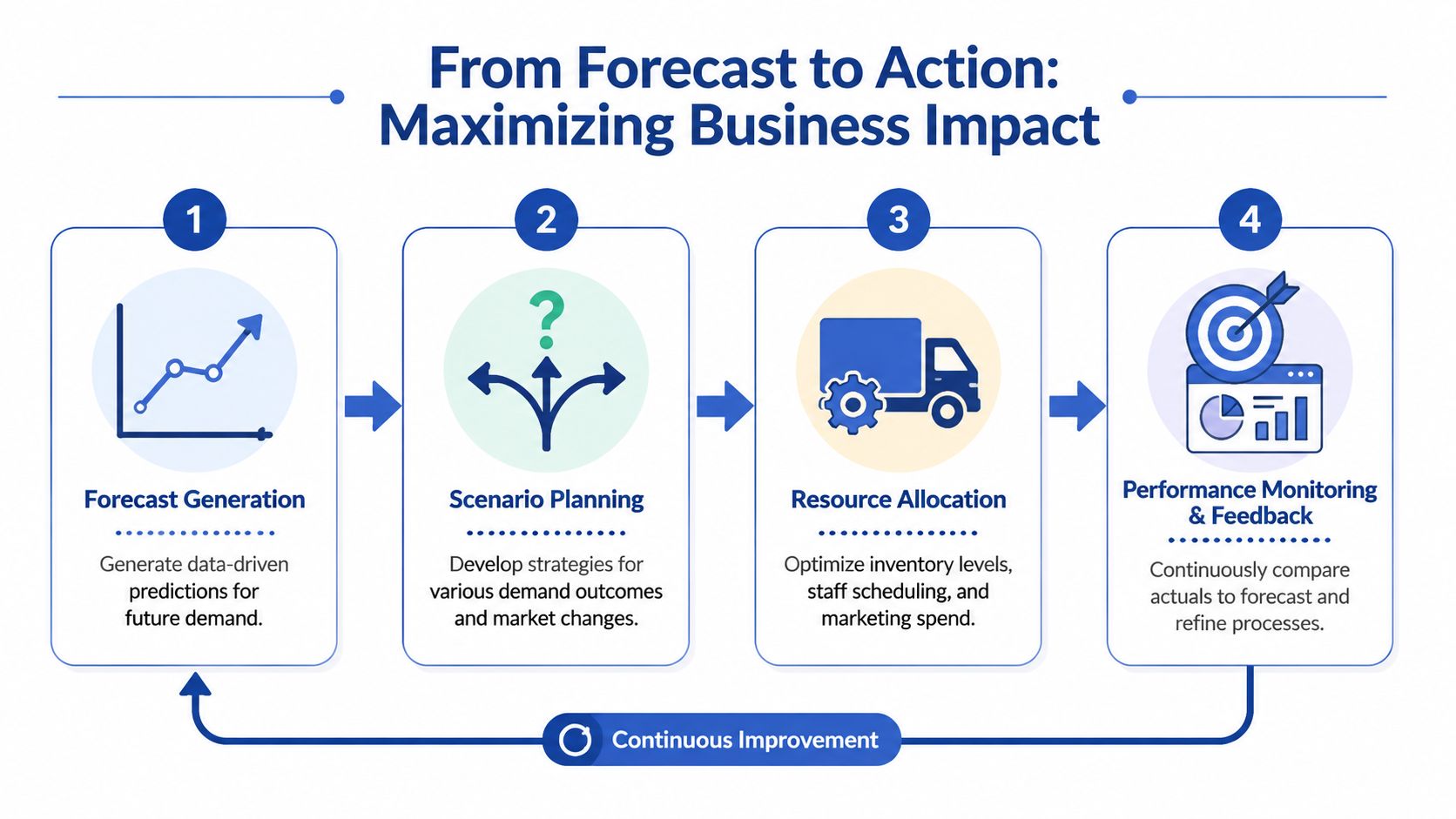
That usually means translating expected demand into clear actions for inventory, marketing, finance, and fulfilment. If the forecast says a category should lift, the team needs to know whether that means raising a purchase order, advancing creative production, reserving warehouse space, or protecting cash for inbound stock.
Translate the number into an operating plan
Here's the practical version.
If a forecast suggests a strong seasonal rise for a product line, ask four questions immediately:
- Do we have enough stock coverage?
- When must the purchase order be placed to land on time?
- Should marketing increase support, hold steady, or protect margin?
- Can fulfilment and customer service handle the volume cleanly?
That's where forecasting stops being analysis and starts becoming management.
A simple if-then planning example
If projected demand for a winter accessory range is materially above the recent baseline, the response shouldn't be “good news”. It should be a sequence.
- If stock cover looks tight, raise a purchase order earlier and review supplier constraints.
- If replenishment risk is high, reduce dependency on one hero SKU by promoting adjacent products.
- If conversion usually peaks during the same window, align paid media and email flows to the expected ramp rather than waiting for sales to prove the pattern in real time.
- If fulfilment volume will bunch into a short period, plan labour, packaging, carrier allocation, and dispatch cut-offs before the crunch.
Operational view: The forecast is an input to a chain of decisions. If nobody owns those decisions, the forecast stays decorative.
Make Shopify workflows reflect the forecast
For Shopify stores, the forecast should influence more than buying.
Use it to shape:
- Collection merchandising, so likely winners get stronger visibility before demand peaks
- Preorder or back-in-stock workflows, where demand is likely to outrun available units
- Bundle planning, if accessory attachment rates rise seasonally
- Campaign calendars, especially email, SMS, paid search, and paid social
- Inventory rules, including transfer decisions between locations and channel allocation
When stores outgrow spreadsheets, they usually need stronger system links between ecommerce, stock, warehouse, and finance. That's where a better grasp of warehouse management systems becomes useful, because forecast-led planning falls apart if the warehouse still works from delayed or partial data.
Don't stop at the warehouse door
A lot of teams forecast demand well enough, then lose control during delivery.
If your peak periods involve local delivery, own-fleet fulfilment, or complex drop scheduling, routing quality affects whether the forecasted demand turns into a good customer experience. For that operational side, it helps to understand how route planning and proof of delivery fit into a delivery workflow, especially when order volume tightens dispatch windows.
Scenario planning beats one-number confidence
The most useful output is rarely a single fixed figure. It's a set of operating scenarios.
Think in terms of:
- Base case, where demand follows the expected seasonal pattern
- Upside case, where marketing, weather, or market timing amplify demand
- Downside case, where conversion softens or inventory lands late
That gives teams room to act without lurching from optimism to panic. Buyers can stage orders. Marketers can pace spend. Finance can protect liquidity. Operations can plan labour and storage without overcommitting too early.
Monitoring and Refining Your Forecasting Process
The first usable forecast is the start of the discipline, not the finish.
Demand changes because your business changes. Product mix evolves. Pricing shifts. Competitors get more aggressive. Suppliers become more or less reliable. Marketing learns what works and pushes harder. If your forecasting process doesn't adapt with those changes, accuracy drifts until the team stops trusting it.
Build a review rhythm
The stores that get real value from seasonal demand forecasting review it on a schedule. Monthly is sensible for many brands. Weekly can make sense in peak windows.
A good review looks at three things:
- Forecast versus actuals: Where did the forecast hold and where did it break?
- Reason for variance: Was it demand, stock availability, pricing, promo activity, or execution?
- Action for next cycle: Adjust the model, improve the data tagging, or change the operating rule
This matters as much as the forecast itself. The review process is where your planning capability matures.
Use a simple checklist
Keep the process practical. A short recurring checklist usually works better than a big post-season debrief nobody revisits.
- Check constrained periods: Did any stockouts suppress sales so the history needs adjustment?
- Review promo effects: Did discounting or bundles create demand patterns that shouldn't be treated as normal seasonality?
- Compare by level: Did SKU, category, and channel accuracy tell different stories?
- Update assumptions: Have supplier lead times, product ranges, or marketing plans changed?
- Feed decisions back: Did your team override the forecast, and was that override justified?
Forecasting improves fastest when teams review misses without trying to defend them.
Keep the system tied to operations
A forecast gets stronger when it's connected to stock, marketing, and fulfilment, not isolated in a planning file. If your store is still trying to reconcile inventory manually across channels, demand forecasting will always be harder than it needs to be. Tightening your foundation with better inventory management for ecommerce makes the forecasting layer far more reliable.
The goal isn't to predict every spike perfectly. The goal is to make better decisions, earlier, with fewer expensive surprises. Do that consistently and forecasting becomes part of how the business grows intelligently, not just how it reports on the past.
If your Shopify store has the demand, but your systems, data flows, or operational setup are making forecasting harder than it should be, Grumspot can help you fix the foundations. From ERP and warehouse integrations to conversion-focused Shopify builds, the team helps ecommerce brands create cleaner operations and better decision-making across the full customer journey.
Let's build something together
If you like what you saw, let's jump on a quick call and discuss your project

Related posts
Check out some similar posts.
- predictive analytics ecommerce
Discover how predictive analytics ecommerce drives revenue through demand forecasting, churn prevent...
Read more
- multi-channel inventory management
Master multi-channel inventory management for Shopify. Learn sync methods, ERP integrations & a road...
Read more
- demand forecasting ecommerce
Master demand forecasting ecommerce. Choose statistical & ML models, integrate with Shopify, & reduc...
Read more
- statistical significance testing
Demystify statistical significance testing. Our practical guide explains p-values, t-tests, and erro...
Read more