Payment Gateway Shopify: A Practical UK Guide
- payment gateway shopify
- shopify payments
- shopify fees
- shopify checkout
- ecommerce payments
Launched
October, 2026
Shopify Payments is the cheapest path for most UK Shopify stores once you factor in Shopify's third-party transaction surcharge, while a second gateway only pays off when it enables a payment method, market, or authorisation profile Shopify Payments can't match. UK cards accounted for 64% of all payments in 2024, so the decision starts with reliable card and wallet acceptance, not an impressive provider feature list.
A familiar problem appears during a Shopify migration. The legacy gateway has a negotiated rate, a dedicated account manager, and years of transaction history, but checkout is slow, reconciliation is awkward, and mobile wallet coverage is incomplete. Shopify Payments looks simpler, yet the finance team worries about international settlement, chargebacks, refunds, or losing a processor that performs well for a particular customer segment.
The right answer isn't “always use Shopify Payments” or “always keep the cheapest processor”. Treat the payment gateway Shopify decision as a total-cost-of-payment decision. Compare processing cost, Shopify surcharges, authorisation quality, payment-method coverage, fraud losses, refunds, settlement, and operational effort together.
What a Payment Gateway Actually Does on Shopify
A UK founder choosing between Shopify Payments and an external gateway is choosing more than a payment app. The gateway sits between the customer's checkout action and the financial institutions that approve, reject, move, and reconcile the money.
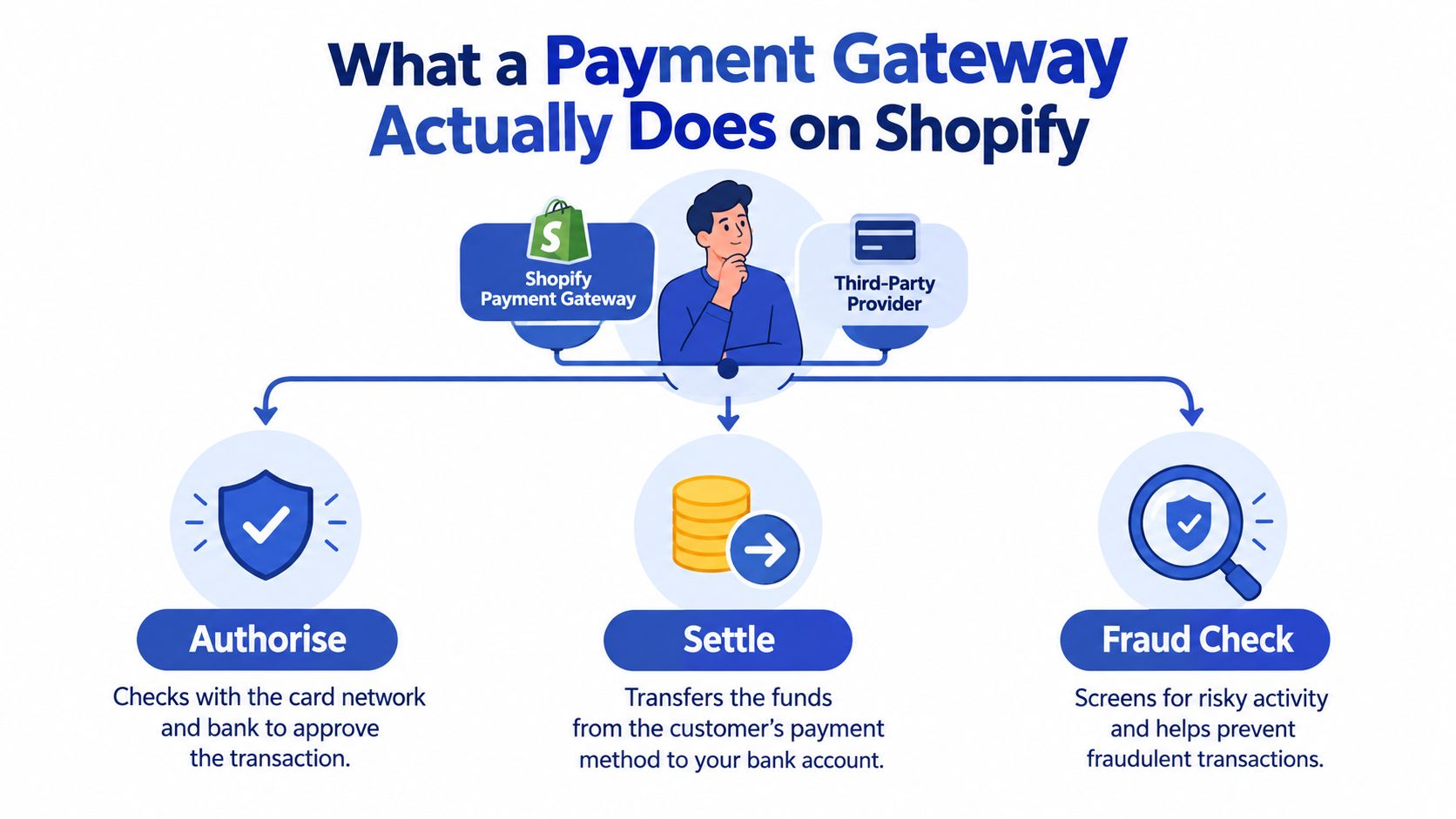
A useful model has three jobs:
- Authorise the transaction. The gateway sends payment details through the card network and acquiring relationship, then returns an approval, decline, or authentication request.
- Settle the funds. After approval, the provider manages the movement of money into a merchant balance or bank account, subject to its payout schedule and controls.
- Present and support payment methods. The integration determines whether customers can use cards, wallets, PayPal, BNPL, recurring payments, or other supported options.
Gateway versus processor
The term payment gateway traditionally describes the technical handshake that securely passes a transaction for approval. The processor or acquirer handles the financial rails, merchant account relationship, settlement, and parts of the dispute process. In practice, providers such as Stripe, Adyen, Worldpay, and Checkout.com may combine several of these functions.
Shopify Payments also presents these capabilities as one native product inside the Shopify admin. That reduces configuration and reporting friction, but it can hide the underlying trade-offs. You still need to ask who authorises the payment, where funds settle, which currencies are supported, who manages disputes, and what happens when an order is refunded.
Shopify is a hosted commerce platform, so most merchants don't need to build a payment page from scratch. The gateway decision instead determines how much of the checkout and payment stack stays inside Shopify and how much you delegate to another provider. Merchants assessing unusual requirements can also review fiat and crypto gateway integration, while technical teams can use this payment processor integration guide to map the system boundaries.
Practical rule: Choose the gateway for the transaction behaviour and operating model you need, not for the label attached to the integration.
How UK Shoppers Actually Pay in 2025
Your customer's wallet should drive gateway configuration. A merchant may prefer one processor because its dashboard is familiar, but shoppers decide whether the payment experience feels normal, trustworthy, and fast.
UK Finance reports that card payments represented 64% of all UK payments in 2025, with debit cards generating 26.6 billion transactions and contactless debit and credit payments reaching 19.2 billion. These figures are published in the UK Finance Payment Markets Report summary. For Shopify, the implication is direct: Visa and Mastercard debit authorisation must work cleanly across mobile and desktop, and contactless behaviour has made wallet-ready checkout a baseline expectation.
Worldpay reports that direct card use represented 46% of UK online spending in 2025, while more than half of UK adults used a digital wallet, with PayPal, Apple Pay, and Google Pay leading online. That makes the checkout test matrix more important than a generic “cards accepted” tick box.
What the baseline means operationally
A serious UK payment gateway Shopify evaluation should test:
- Debit-led card approval, segmented by issuer and device.
- Apple Pay and Google Pay rendering, including supported browsers and mobile operating systems.
- PayPal availability, especially where customers arrive with an existing PayPal preference.
- 3-D Secure 2 behaviour, including challenge handling and soft declines.
- Payment confirmation speed, webhooks, retries, refunds, and recurring billing.
PayPal's UK ecommerce research found that 43% of consumers were more likely to purchase when their preferred payment method was available, while 25% identified PayPal as that preferred method. The PayPal eCommerce Index 2024 UK report also found that 23% of consumers had used BNPL during the previous six months.
Cards are the foundation. Wallets and PayPal remove friction for shoppers who don't want to type card details. BNPL can matter for suitable product categories, but it also adds eligibility, refund, and reconciliation requirements. Configure the mix around your customers, then measure each method separately rather than trusting the blended checkout conversion rate.
Shopify Payments Versus Third-Party Gateways
For most UK-only Shopify stores, Shopify Payments wins because the economic comparison includes Shopify's surcharge for external providers. The native option isn't automatically the lowest processor rate in every scenario, but it often produces the lowest total operating cost once fees, reporting, and support are included.
Shopify's UK pricing lists online card rates starting at 2.0% + £0.25 on Basic, 1.7% + £0.25 on Grow, and 1.5% + £0.25 on Advanced. Shopify lists external-provider transaction fees of 2.0%, 1.0%, and 0.6% on those plans. These figures come from Shopify's UK payments pricing.
At a £50 basket, the listed Shopify Payments processing component is approximately £1.25 on Basic, £1.10 on Grow, or £1.00 on Advanced, before plan-specific adjustments. An external gateway adds its own acquiring and gateway charges on top of Shopify's third-party percentage.
| Gateway | UK card rate | Fixed fee | Shopify 3rd-party fee | Best fit |
|---|---|---|---|---|
| Shopify Payments | 2.0%, 1.7%, or 1.5% by plan | £0.25 | None | Most UK-only Shopify stores |
| Stripe | 1.5% for standard UK cards | £0.20 | Applies when used externally | Teams needing Stripe capabilities or an existing relationship |
| Adyen | Contract pricing | Contract pricing | Applies when used externally | Enterprise multi-market payment operations |
| Worldpay | Contract pricing | Contract pricing | Applies when used externally | Merchants with a negotiated acquiring arrangement |
| Checkout.com | Contract pricing | Contract pricing | Applies when used externally | High-volume brands with specialist processing needs |
The Stripe benchmark of 1.5% + £0.20 for standard UK cards is published in Airwallex's Shopify gateway comparison. Don't compare that headline rate with Shopify Payments in isolation. Add Shopify's surcharge, international card costs, currency conversion, refunds, chargebacks, payout timing, minimum commitments, and the internal cost of reconciling two systems.
Where a second gateway earns its place
A second gateway is justified when it solves a measurable commercial problem:
- Market access: it supports a payment method or region Shopify Payments cannot cover.
- Authorisation quality: it performs materially better for a defined issuer, market, card mix, or high-value order segment.
- Settlement economics: it offers a better multi-currency settlement model after FX and conversion charges.
- Existing enterprise terms: your acquiring relationship creates a genuine blended-cost advantage after Shopify's surcharge.
Shopify states that currency-conversion and card-processing fees aren't returned when an order is refunded, while no additional conversion fee is charged when receiving a chargeback. Model domestic GBP transactions separately from international cards, wallets, and alternative methods.
For a small UK store, native usually wins on simplicity. For a Shopify Plus brand with international volume, multiple legal entities, or a strong acquiring relationship, a second gateway can be defensible, but only after a contribution-margin model proves it.
Checkout Architecture and Integration Impact
Gateway choice becomes more expensive as checkout becomes more bespoke. A standard Shopify checkout is primarily an admin configuration exercise. A headless storefront with custom routing, ERP events, and multiple acquirers is a delivery programme that needs ownership, testing, and monitoring.
Select the checkout path first
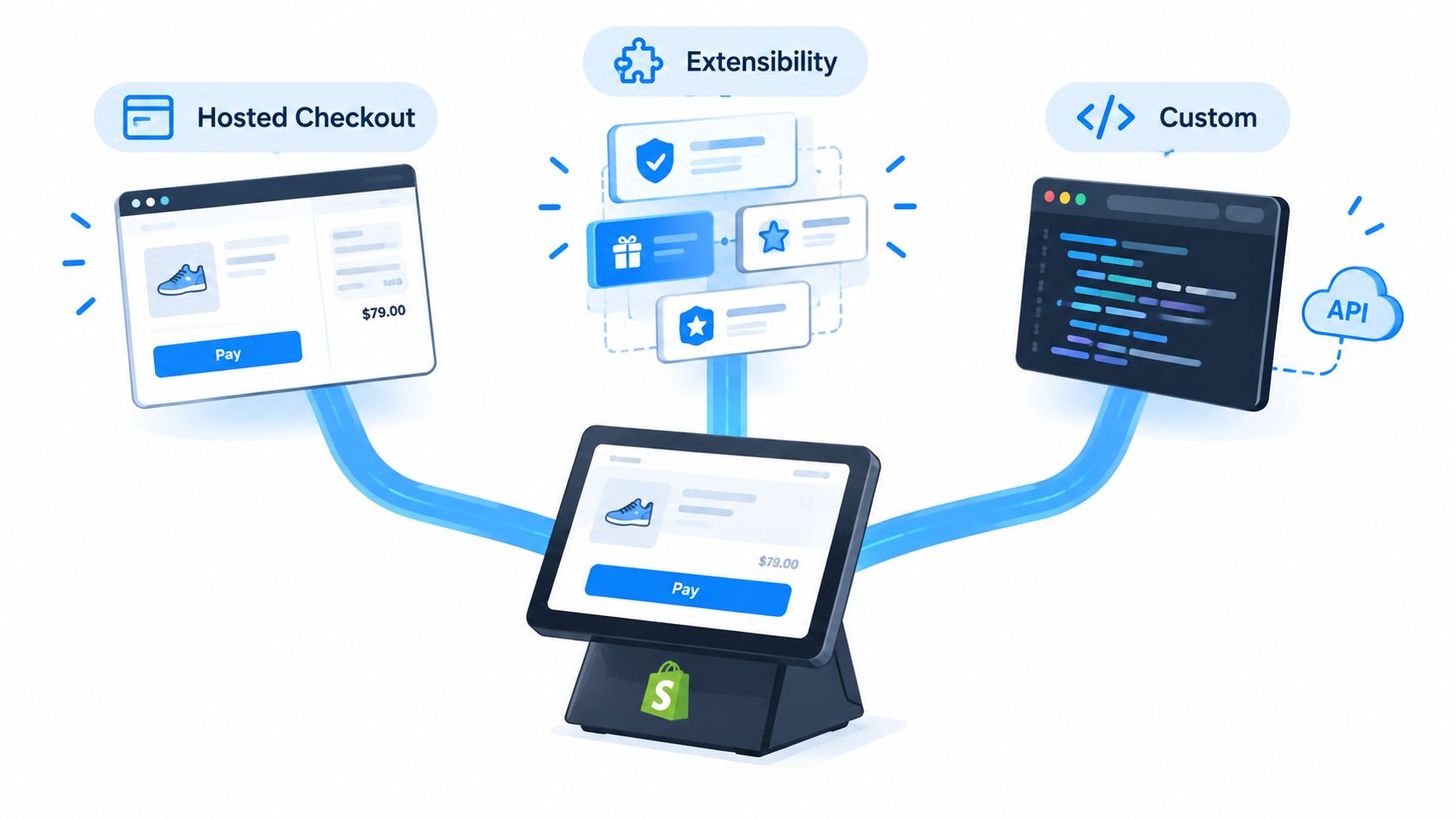
Shopify-hosted checkout keeps the payment experience within Shopify's managed environment. It generally reduces custom code and keeps the merchant's PCI responsibilities narrower because Shopify handles much of the sensitive checkout infrastructure. This is the right default for most DTC brands.
Checkout Extensibility lets a team customise supported checkout surfaces without rebuilding the entire payment flow. It suits merchants that need branded content, validation, delivery logic, or carefully controlled extensions while retaining Shopify's hosted payment foundations. Review the capabilities of each payment provider before assuming every customisation works identically across gateways.
Headless or Hydrogen offers greater control over the storefront and the surrounding commerce experience. It also creates more responsibility for API integration, payment-state management, redirect handling, 3-D Secure, webhook reliability, testing, observability, and fallback behaviour. A custom front end doesn't automatically give you unrestricted control over Shopify's payment rails.
The PCI boundary still matters. Hosted checkout usually keeps sensitive card entry within a provider-controlled environment. Custom payment components can increase the systems, vendors, and processes your team must assess, even when tokenisation reduces direct exposure.
Plan the integration around failure states
A reliable implementation covers more than a successful payment. Test authorisation declines, 3-D Secure challenges, abandoned redirects, duplicate webhooks, delayed confirmation, partial refunds, full refunds, chargebacks, and subscription renewals.
Use one-page checkout guidance for Shopify when evaluating conversion changes, but don't trade away payment-state clarity for fewer visible fields. The gateway must return an unambiguous order status, and your ERP, fulfilment platform, email system, and customer service tools must receive the same outcome.
The more custom the checkout, the more valuable disciplined payment observability becomes.
Choosing the Right Payment Methods for the UK
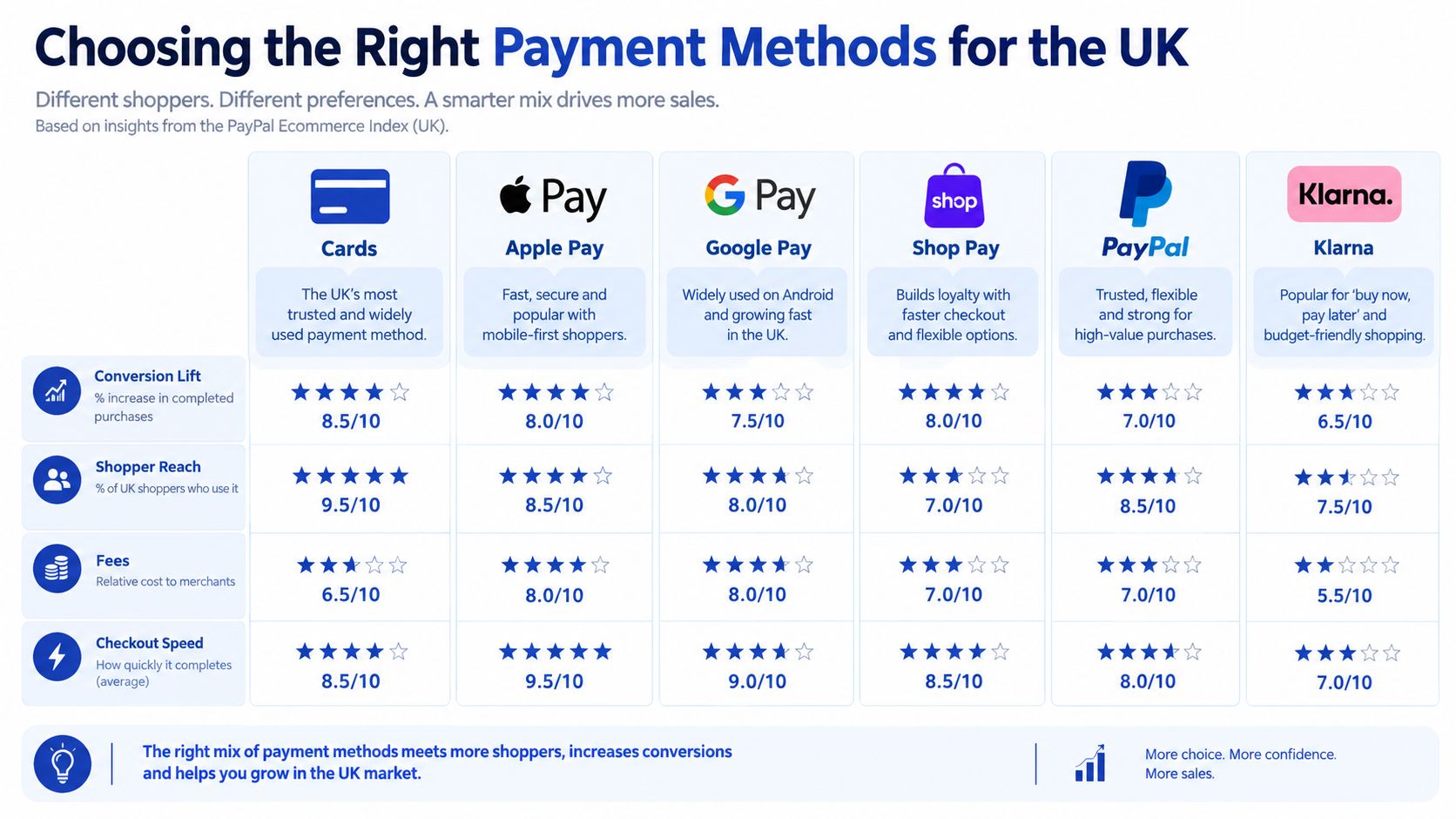
Payment methods should be managed as a portfolio. Each option can improve customer access, but each also carries its own fees, dispute route, refund behaviour, eligibility rules, and support burden.
PayPal's UK research found that 43% of consumers were more likely to purchase when their preferred payment method was available, and 23% had used BNPL during the previous six months. Those figures support broader method coverage, but they don't prove that every store should activate every option.
Make the portfolio earn its space
- Cards: Essential. They provide the core UK payment route, but approval rate, 3-D Secure handling, chargebacks, and refund speed need active monitoring.
- Apple Pay: High priority for mobile-heavy stores. It shortens manual entry and changes the authentication and dispute context, so test device rendering and post-payment reconciliation.
- Google Pay: High priority alongside Apple Pay. It covers a different device ecosystem and should be measured separately rather than grouped under “wallets”.
- Shop Pay: Worth testing where it fits your customer base and Shopify setup. Its value comes from a faster returning-customer experience, but the merchant still needs to inspect the resulting payment and refund workflow.
- PayPal: Strong candidate when customers recognise it as their preferred method. PayPal disputes and refunds follow a separate operational workflow, so customer service and finance teams need clear ownership.
- Klarna: Relevant for suitable higher-consideration purchases. BNPL can help customers spread payment, but eligibility decisions, partial refunds, cancellations, and reconciliation create extra work.
Shopify documents support for cards, Apple Pay, Google Pay, Shop Pay, Klarna, and other location-dependent methods in its UK payment-method documentation.
The priority list for most UK Shopify stores is straightforward: cards first, Apple Pay and Google Pay next, then PayPal where customer preference justifies it. Add Klarna when the product, margin, returns policy, and support operation can absorb it. Don't activate a method merely to populate a checkout screen.
Margin test: A method earns a permanent place only when its incremental contribution survives fees, fraud, disputes, refunds, and support effort.
Fraud Tools, 3-D Secure and Chargeback Reality
More payment options don't automatically create a safer checkout. They create more payment flows to monitor, more dispute rules to understand, and more reconciliation paths for finance.
UK fraud research cited in the supplied brief reports that most UK merchants view first-party fraud as a bigger threat than professional fraudsters, while fraudulent chargeback claims are increasing. That distinction matters. A criminal attack, a customer abusing a refund policy, a cardholder disputing a legitimate purchase, and a BNPL refund issue require different evidence and response processes.
Shopify's fraud analysis can help merchants review available transaction signals inside the order record. It isn't a substitute for a risk strategy. Set rules around order value, delivery address, customer history, product type, and authentication outcomes, then ensure the team knows when to hold, cancel, or fulfil an order.
Treat 3-D Secure as a decision, not a blanket switch
3-D Secure 2 can add authentication when the issuer or risk flow requires it. A challenge may reduce certain forms of fraud exposure, but excessive friction can also interrupt legitimate purchases. Your gateway configuration should support the relevant exemptions and return clear outcomes when an issuer soft-declines a payment.
An external gateway may change who owns the fraud tools, evidence collection, dispute submission, and reporting. Wallet disputes, card chargebacks, and BNPL refunds shouldn't be forced into one generic workflow.
Track the full payment outcome:
- Approval rate, segmented by issuer, device, market, and method.
- 3-D Secure challenge and completion behaviour, not just challenge volume.
- Dispute win rate and the quality of evidence submitted.
- Refund completion time, including partial refunds.
- Net contribution margin after fees, fraud losses, disputes, and service effort.
The strongest recommendation for most UK merchants is to tighten fraud settings and reporting on the existing gateway before adding a second processor. Add another route only when the data shows a defined approval, market, or settlement problem that the current setup cannot solve. Use this ecommerce fraud prevention resource to structure the operational review.
Gateway Setups Matched to UK Merchant Profiles
The right configuration depends on trading footprint, Shopify plan, product economics, and internal operating capacity. These three patterns cover most UK Shopify decisions.
UK-only DTC brand on Basic or Grow
Use Shopify Payments as the primary gateway. Enable cards, Apple Pay, Google Pay, and Shop Pay, then add PayPal if customer research and checkout data support it. Do not add a second card processor just because its published rate looks lower.
The operating model stays compact: one payment dashboard, one primary reconciliation path, one fraud workflow, and fewer refund exceptions. Watch approval rate by device, wallet render rate, soft-decline recovery, refund completion, and payment-related support contacts.
Scaling UK brand on Advanced or Plus
Keep Shopify Payments for domestic GBP trade and add one specialist gateway for a defined international requirement. That requirement might be multi-currency settlement, a market-specific method, or an acquiring relationship that performs better for a known segment.
Do not route everything through both gateways without rules. Document which markets, currencies, order types, and payment methods use the specialist provider. Reconcile gateway payouts to Shopify orders, refunds, chargebacks, tax records, and the ERP every day.
Shopify Plus enterprise with headless commerce
A headless Hydrogen build may justify multiple acquirers, custom routing, and ERP integration, but only with a dedicated payments owner. The team must manage payment intent state, webhooks, retries, 3-D Secure outcomes, refunds, subscriptions, disputes, and reporting across every route.
Use a gateway matrix that compares approval rate, wallet completion, latency, soft-decline recovery, dispute performance, and net margin by market. The architecture should make routing explicit, observable, and reversible. If finance can't explain where a payment settled, the system isn't ready for more complexity.
Implementation FAQ for UK Shopify Merchants
How quickly do Shopify Payments payouts arrive?
Payout timing depends on the provider, account configuration, risk controls, and settlement arrangement. Confirm the actual UK schedule in the Shopify admin and compare it with any external gateway before launch. Don't build cash-flow forecasts around a generic industry assumption.
What happens when we refund an order?
Shopify states that currency-conversion and card-processing fees aren't returned when an order is refunded. Review full and partial refunds separately, then test the accounting entry, customer notification, stock movement, and payout reconciliation.
When does 3-D Secure appear?
The issuer, payment method, transaction context, and configured exemptions influence whether a customer sees a challenge. Test frictionless authentication, challenged authentication, soft declines, failed challenges, and recovery paths before launch.
What does Shopify's fraud analysis show?
It surfaces available risk signals and indicators associated with an order. Use those signals with your fulfilment and customer-service rules, rather than treating the label as an automatic approve or reject decision.
What changes when a second gateway is added?
You now reconcile multiple settlement reports, fee structures, refund records, dispute queues, and payout schedules. For the first month, compare Shopify orders against each provider's transaction and payout data daily, and record every mismatch with an owner and resolution date.
Grumspot provides Shopify and Shopify Plus gateway configuration, migration support, regional payment-method integration, and pre-launch payment testing. Visit Grumspot to discuss a payment setup that connects checkout performance with reconciliation, fraud controls, and total payment cost.
Let's build something together
If you like what you saw, let's jump on a quick call and discuss your project

Related posts
Check out some similar posts.