Project Scope Definition: A Practical Ecommerce Guide
- project scope definition
- scope management
- ecommerce projects
- scope creep prevention
- Shopify development
Launched
August, 2026
The brief for a Shopify Plus migration often sounds reassuring: rebuild the theme, preserve the catalogue, connect the existing tools, and launch before the next campaign. A few weeks later, the project includes a new product configurator, revised checkout behaviour, additional markets, an ERP integration, fresh photography, and a long list of “small” design changes. Nobody formally approved the additions, yet the delivery team is expected to absorb them.
That pattern isn't a failure of effort. It's a failure of project scope definition. When the team treats scope as a document to complete before the actual work begins, stakeholders interpret gaps as permission, developers make assumptions, and agencies end up delivering work that nobody priced properly. A strong scope statement does something more useful. It establishes the boundaries, decisions, responsibilities, and acceptance rules that keep a fast-moving ecommerce project deliverable.
Why Most Ecommerce Projects Derail Before They Start
A Shopify Plus migration can begin as a straightforward theme rebuild and become a six-month saga. The merchant wants the new Online Store 2.0 theme to match the existing brand, the marketing lead asks for more flexible landing pages, the trading team requests merchandising controls, and the operations director adds an ERP requirement during development. Meanwhile, the founder expects the original launch date to remain fixed.
The agency may still have a signed proposal, but the proposal usually describes outcomes at a high level. “Modernise the storefront” doesn't say which templates will be redesigned, which apps will be replaced, how redirects will be handled, or who approves the final experience. “Improve conversion” doesn't define a deliverable that a developer can build or a client can accept.
Practical rule: If two reasonable people can read a deliverable and picture different work, the deliverable isn't scoped tightly enough.
The cost appears gradually. Designers revise screens that were already considered approved. Developers rebuild components after discovering that product data isn't structured for the intended experience. QA tests behaviours nobody identified as a requirement, while stakeholders debate whether a feature belongs in the launch or a later phase. The budget doesn't blow out because one request is catastrophic. It blows out because the team keeps making decisions without a shared boundary.
For ecommerce teams, the risk is amplified by dependencies. A theme change can affect search, subscriptions, reviews, analytics, international pricing, fulfilment, and customer service workflows. A migration guide such as Shopify Plus store build planning can help frame the technical work, but the project still needs its own agreed scope statement.
Scope is a control system
The Association for Project Management defines scope management as identifying, defining, and controlling the outputs, outcomes, benefits, and work required to produce them in its guidance on project scope management. In practice, that means scope isn't a loose wish list. It connects business objectives to deliverables, decision rights, approvals, and change control.
Good project scope definition prevents the team from confusing enthusiasm with authorisation. It also gives the client a fair way to request change without pretending the work is free, immediate, or riskless.
The Core Components of a Strong Scope Statement
A useful scope statement gives the delivery team enough clarity to plan, estimate, build, test, and obtain approval. It should make the intended outcome understandable to a commercial stakeholder and the work package understandable to a specialist.
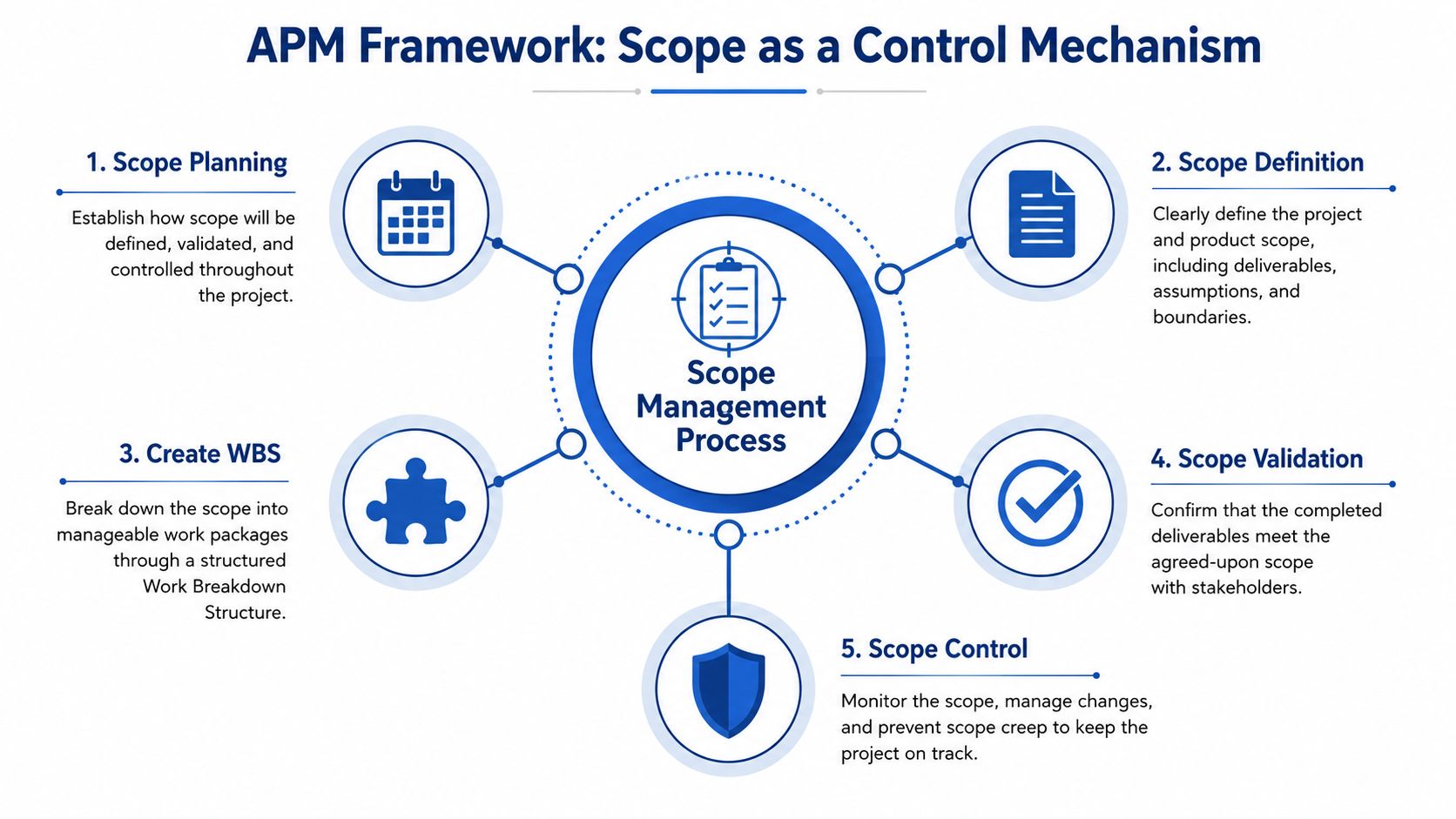
Audit the document against five components.
Deliverables
A deliverable is a tangible result, not an aspiration. “Improve the product page” invites debate. “Build a product configurator that lets customers select approved options, displays the resulting price, adds the configured item to cart, and works on the agreed product templates” gives the team something to design and test.
For a Shopify project, deliverables might include a customised theme, collection templates, a product configurator app, migration scripts, redirect rules, analytics configuration, and launch support. Each should identify the output, its owner, and the point at which the client can review it.
Boundaries
Boundaries define where the project stops. If phase one includes the storefront rebuild but excludes ERP integration, write that plainly. If the team will connect an existing reviews app but won't migrate historical review data, record both statements.
Exclusions matter because adjacent systems create natural pressure. A merchant may reasonably assume that a new storefront includes marketplace feeds, warehouse workflows, or international tax configuration. It may not. A boundary turns that assumption into a decision.
Assumptions
Assumptions are conditions the plan relies on. Examples include the client providing cleaned product data, supplying approved brand assets, making a product owner available for decisions, or retaining an existing subscription platform.
Don't hide assumptions in meeting notes. Put them in the scope statement, assign an owner where possible, and explain what happens if one proves false. Otherwise, the team discovers the dependency only after work has started.
Constraints
Constraints are limits the delivery plan must respect. A hard launch date tied to a seasonal campaign is different from a preferred date. A fixed budget, limited client availability, restricted app choices, and an existing payment setup can all shape the solution.
Record the consequence, not just the restriction. If the launch date can't move, the scope may need a phased release. If the chosen app can't support a required workflow, the team may need custom development or a different commercial decision.
Acceptance criteria
Acceptance criteria define what “done” means. For a Shopify migration, criteria might cover responsive behaviour, supported browsers, product data completeness, checkout flows, redirect validation, transactional emails, and stakeholder sign-off on named templates.
Avoid subjective wording such as “premium”, “fast”, or “on-brand” unless the team translates it into reviewable conditions. A practical guide on how to define project scope can help teams turn broad intentions into structured scope content.
How UK Frameworks Treat Scope as a Control Mechanism
UK project practice treats scope definition as part of governance, not administrative housekeeping. The APM definition links scope to the outputs, outcomes, benefits, and work required to produce them. That framing forces a useful question for ecommerce leaders: what business result is the project accountable for, and what work is necessary to produce it?
UK public-sector guidance applies the principle through concrete controls. Client objectives and stakeholder outcomes come first. Governance, reporting, change control, risk management, and programme controls then need to be established before delivery begins. The sequence matters because a team can't evaluate a change responsibly if nobody has agreed who owns the decision or what baseline the change affects.
From requirements list to baseline
Government project guidance says scope should separate the project from adjacent programmes, define inclusions and explicit exclusions, and create a baseline for change control. It describes unmanaged changes as a route to breaching the project baseline on time and cost, which is directly relevant to agency work.
Consider a Shopify 2.0 migration. The project may include theme architecture, template migration, content modelling, quality assurance, and launch support. A separate CRM replacement programme, warehouse redesign, or international expansion may sit nearby but remain outside the migration. Without that separation, stakeholders can treat the storefront as the delivery vehicle for every related initiative.
The baseline also creates decision rights. The product owner might approve content and merchandising, the technical lead might approve implementation details, and the sponsor might approve changes that affect budget or launch timing. Those roles should be explicit before the first change request arrives.
The UK government project management guidance provides the governance logic behind this approach. Teams working with public-sector procurement, structured agency engagements, or complex enterprise stakeholders can also explore framework opportunities when they need a more formal route to approvals and accountability.
The following video provides another visual explanation of how a scope statement can support controlled delivery:
The principle transfers cleanly to Shopify work. Scope defines the playing field. Governance determines who can move the goalposts.
Drafting Your Scope Statement Step by Step
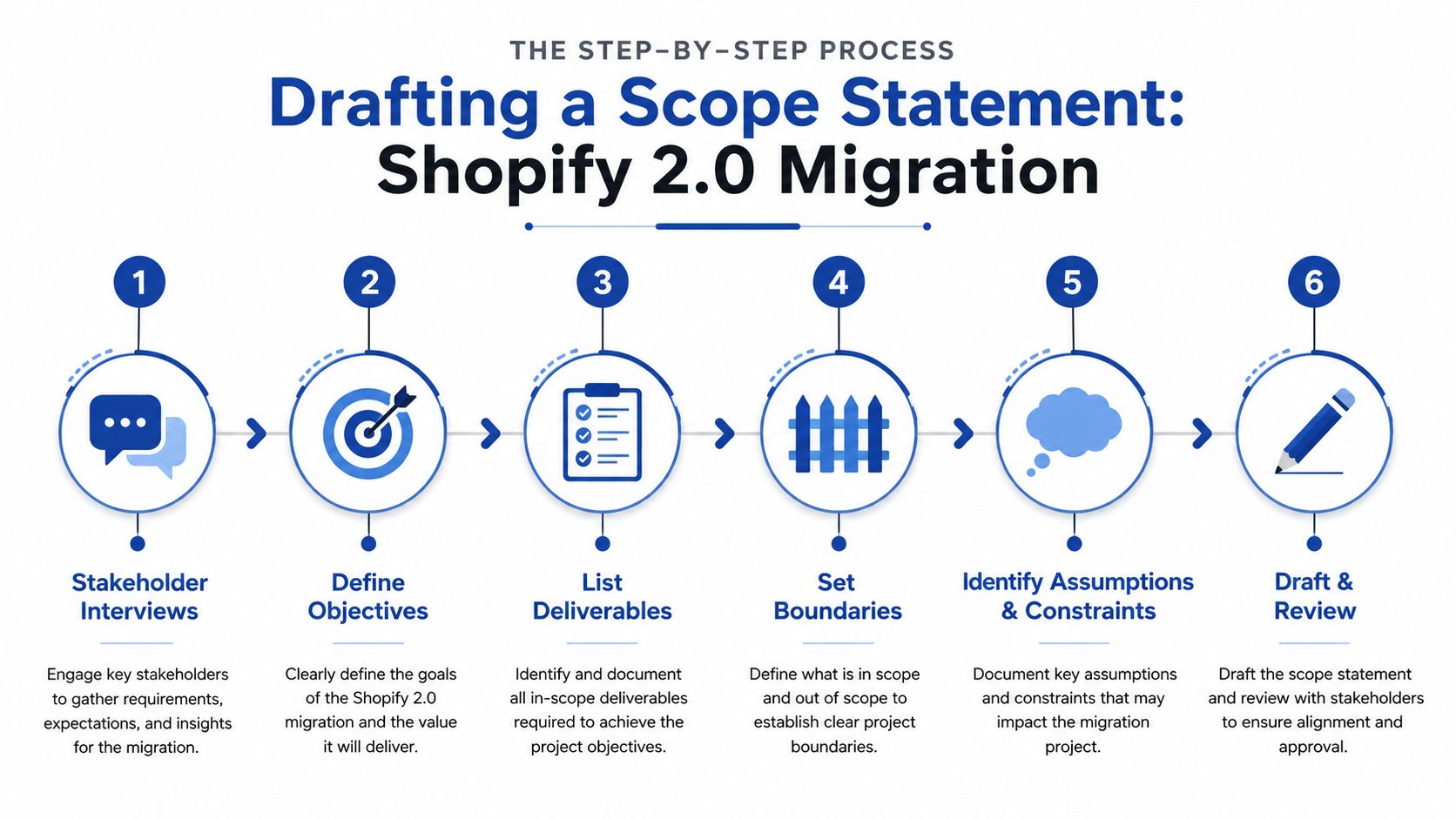
Start with the decision the project must support, not the platform feature someone mentioned in a workshop. A Shopify 2.0 migration may be motivated by maintainability, merchandising flexibility, international growth, or a need to replace a fragile theme. Those objectives determine which work deserves priority.
1. Interview the people who carry the consequences
Speak with the sponsor, ecommerce owner, marketing lead, customer service manager, operations team, analytics owner, and technical stakeholders. Ask what must improve, what must not break, which decisions are already fixed, and what they expect to happen after launch.
Don't rely on one enthusiastic stakeholder. The trading team may ask for flexible collection merchandising while operations focuses on inventory accuracy. Customer service may know about order-editing problems that never appear in the project brief.
2. Turn objectives into observable outcomes
Write objectives that guide choices. “Create a more flexible storefront” is too broad. “Enable the internal team to assemble campaign landing pages from approved sections without developer intervention” is more useful because it points towards a particular content model and delivery outcome.
Keep objectives separate from solutions. If the objective is improved international selling, Shopify Markets may be one option, but the scope still needs to define the markets, currency behaviour, content responsibilities, and operational hand-offs involved.
3. List deliverables, then break them into work packages
For each major output, describe the component work. A migration deliverable might include theme setup, template mapping, section development, content migration, app configuration, redirect preparation, testing, training, and handover.
Acceptance criteria should sit beside the deliverable rather than appearing as an afterthought. “Migration complete” could mean different things to the agency and merchant. “Approved templates rendered across the agreed device set, critical purchase journeys passed QA, and the named product owner has signed off” is testable.
4. Write exclusions with the same care as inclusions
State that ERP integration, new market localisation, or a loyalty programme is excluded when it isn't part of the launch. Also clarify whether the team will advise on those areas, estimate them separately, or leave them for a later phase.
A useful scope template contains:
- Objective: The business outcome and reason for the project.
- Deliverables: The outputs the team will produce.
- Inclusions and exclusions: The precise boundary of the work.
- Assumptions: Conditions the plan depends on.
- Constraints: Time, budget, resource, platform, and compliance limits.
- Acceptance criteria: The conditions for review and sign-off.
- Governance: Decision owners, approval gates, and change route.
5. Record assumptions and constraints as live risks
If the client must provide cleaned product data before content migration, name the dependency and its owner. If a campaign date fixes the launch window, document what gets deprioritised if testing discovers a major issue.
Teams often skip this step because assumptions feel obvious. They aren't obvious once the project crosses departments or suppliers. A documented assumption gives everyone a chance to challenge it before it becomes a delivery problem.
6. Agree the change route before build work starts
Define how someone submits a change, who assesses it, which impacts are recorded, and who approves it. A request for another payment gateway may affect development, testing, fraud controls, reporting, and launch readiness. A request for a new market may affect content, pricing, tax, fulfilment, and customer support.
Use a simple change log with the request, reason, impact assessment, decision, owner, and date. For related supplier decisions, the vendor selection criteria guide offers a useful prompt for documenting requirements before commitments are made.
Finish with a review meeting where stakeholders read the scope as a contract for decisions, not as a presentation. Ask each person what they believe is included, excluded, assumed, and required for acceptance. Differences found before delivery are useful. Differences found during build are expensive.
Common Scope Pitfalls and How to Prevent Them
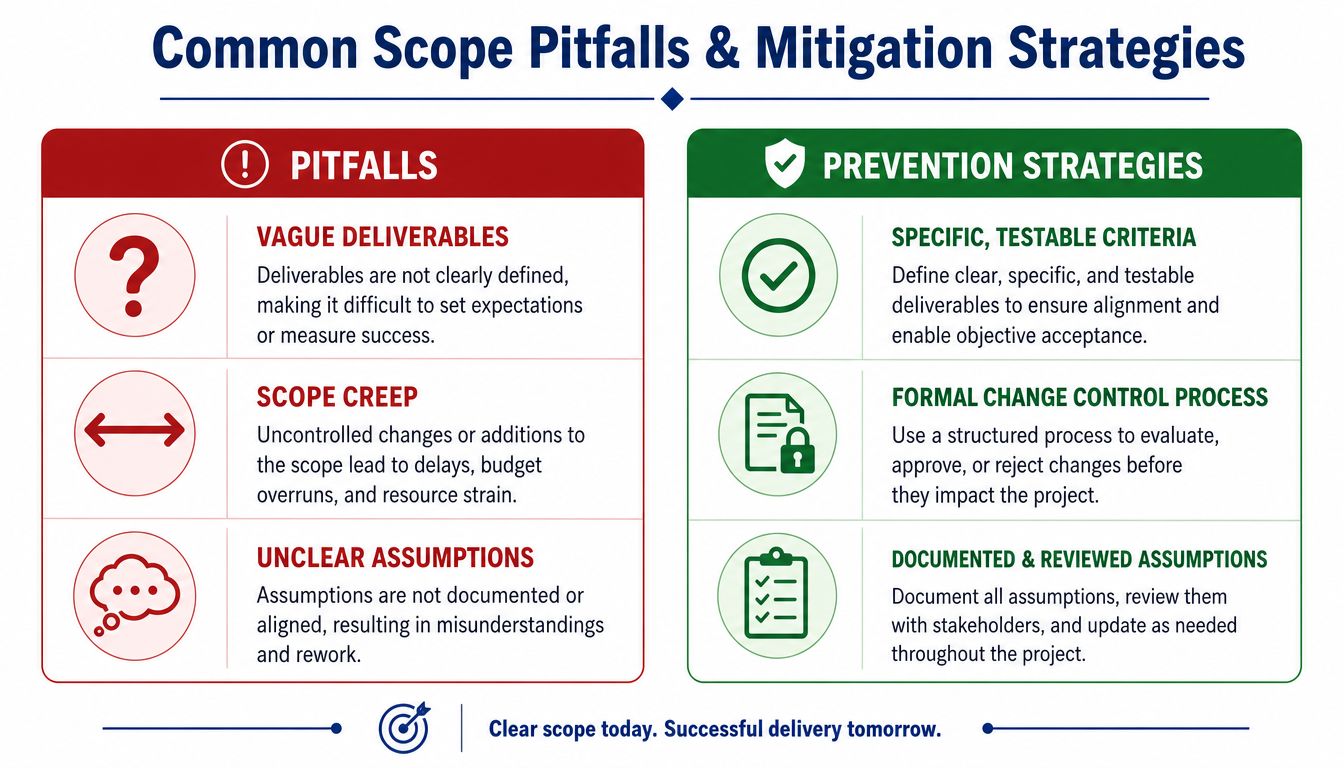
Most scope failures have a recognisable symptom. The practical response is to identify the interpretation gap, locate the missing control, and correct the document before the next milestone.
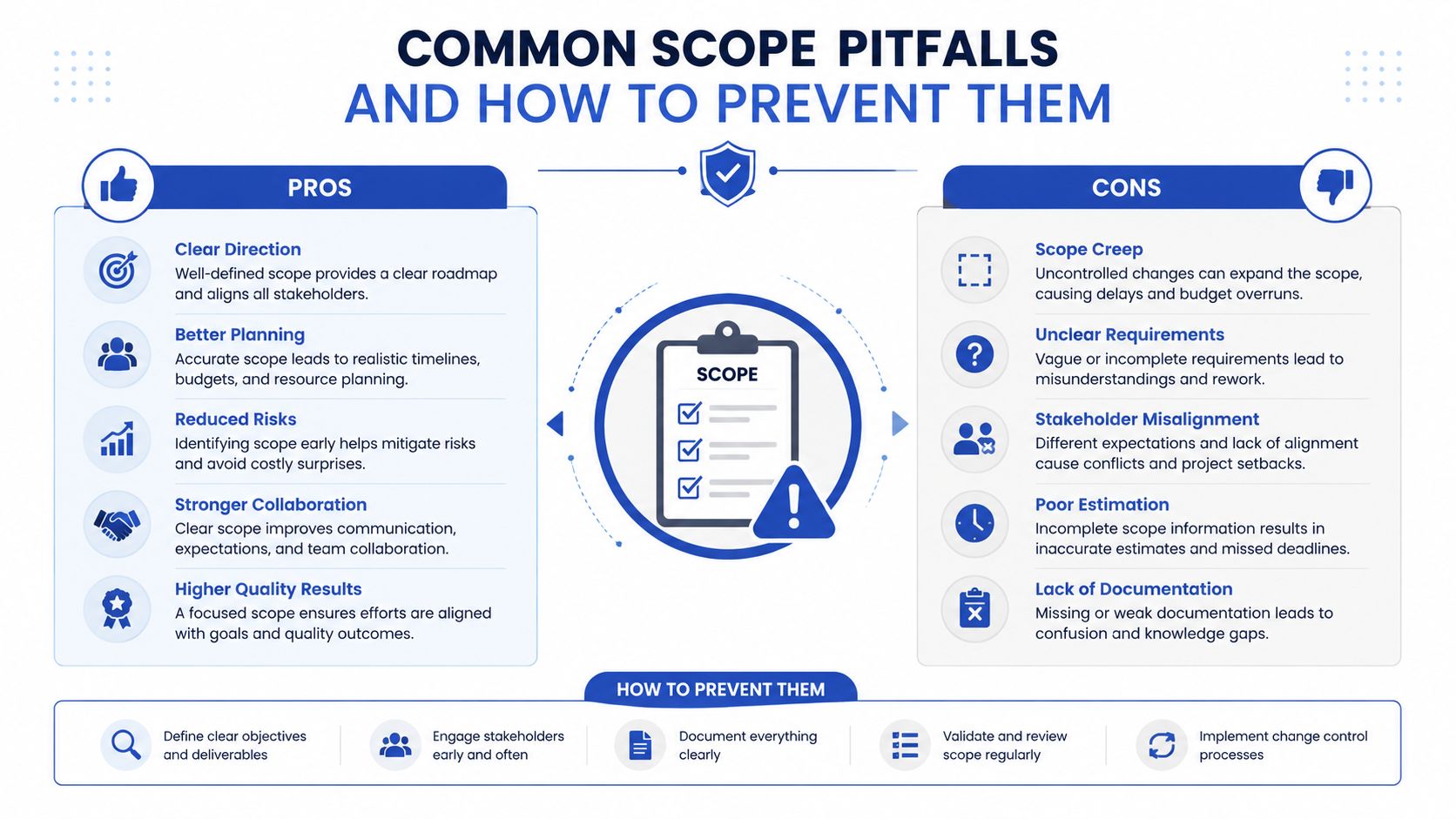
| Pitfall | What it looks like | Practical prevention |
|---|---|---|
| Vague deliverables | “Build a better product experience” appears in the proposal, but nobody can identify the screens, behaviours, or approval point. | Name the output, its component work, owner, and acceptance criteria. |
| Missing exclusions | The client assumes the migration includes ERP work, new markets, app replacement, or post-launch optimisation. | List adjacent work explicitly and assign it to a later phase, separate estimate, or different owner. |
| Unrecorded assumptions | Product data arrives late, brand assets change, or the client expects the agency to supply content. | Record each assumption, owner, dependency, and consequence if it fails. |
| Subjective acceptance | A design is rejected as “not premium enough” after development has begun. | Translate adjectives into reviewable design, content, accessibility, and functional conditions. |
Vague deliverables create parallel interpretations
A merchant may hear “custom search” and expect filters, synonyms, merchandising rules, analytics, and zero-result handling. The agency may have priced a search app installation and styling. Both parties can act reasonably while working towards different outcomes.
Write the feature as a capability with a defined boundary. Identify supported data, key interactions, configuration responsibility, and what testing will confirm.
Exclusions stop scope creep entering through the side door
Teams often document what they will build but not what they won't. That makes every adjacent request feel like a reasonable interpretation of the original brief.
An exclusion doesn't need to be confrontational. “ERP integration isn't included in the migration phase. The team will document the required interface and provide a separate estimate” preserves the relationship while protecting the baseline. Further practical guidance on scope creep prevention strategies can help teams formalise that habit.
Assumptions need owners
“Client will provide content” is incomplete. Which content, in what format, reviewed by whom, and by when? If the answer is missing, the agency may start writing copy, resizing imagery, or restructuring data without a commercial decision.
Assign the assumption to a named role and review it at project checkpoints. An assumption that remains true can disappear from active discussion. One that changes should trigger a documented impact assessment.
Acceptance criteria must survive disagreement
“Looks good on mobile” isn't an acceptance test. Specify the relevant templates, supported devices or browsers, functional journeys, content conditions, and approval owner. Where design judgement is unavoidable, establish the review process and the number of revision rounds within scope.
A strong scope statement doesn't eliminate every disagreement. It makes disagreement actionable. The team can identify whether the issue is a defect, a missed requirement, or a change request.
Managing Scope Changes Without Losing Control
A scope statement earns its value after approval, when someone asks for something new. The correct response isn't an automatic refusal. It's a structured question: what does this change add, what does it displace, and who has authority to decide?
Take a request for an additional payment gateway during a Shopify build. The team should assess implementation effort, checkout implications, testing, reporting, fraud processes, and the effect on the launch path. A request for a new market needs a different assessment, covering localisation, pricing, content, tax, fulfilment, and support.
Use a visible change control path
Every request should move through the same basic route:
- Describe the change: Record what the requester wants and why.
- Compare with the baseline: Identify the relevant inclusion, exclusion, or requirement.
- Assess impact: Consider time, cost, quality, risk, resources, dependencies, and launch readiness.
- Make the decision: Approve, reject, defer, or exchange the change for another item.
- Update the record: Amend the scope baseline, plan, backlog, and stakeholder communications.
The project sponsor should approve changes that affect commercial commitments or the launch date. A product owner can usually make decisions within an agreed budget and priority boundary. The technical lead can recommend implementation choices but should not authorise extra work without explicit approval.
Say yes with consequences attached
A constructive response sounds like this: “We can include the second gateway, but it adds testing and moves the current launch path. We can either approve the revised date, add delivery capacity, or remove the lower-priority localisation work.”
That language protects flexibility without disguising trade-offs. It also prevents the most damaging form of agency scope creep, where a team accepts work in conversation and tries to recover the effort later.
Keep the change log close to the delivery backlog. When a design revision is approved, update the relevant acceptance criteria and notify QA. When a feature is deferred, record its future owner and context. A disciplined knowledge transfer process helps preserve those decisions when team members or suppliers change.
Revisit the baseline at discovery sign-off, design approval, development completion, and launch readiness. The baseline can evolve. It must never evolve invisibly.
Making Scope Definition a Competitive Advantage
Rigorous project scope definition isn't bureaucracy added to slow an ecommerce team down. It helps the team spend effort on the outcomes the merchant commissioned, make trade-offs early, and give stakeholders a reliable basis for decisions.
UK guidance treats scope as a baseline for controlling time and cost, while the UK professional-services estimate cited in the Northumbria research on scope creep claims firms can lose 8–18% of project revenue to undetected scope creep and may deliver 15% more work than contracted. That estimate is commercial rather than governmental, so treat it as a business warning, not a universal benchmark. It still illustrates why disciplined boundaries matter to agency margins and client trust.
The practical standard is straightforward:
- Treat scope as a control mechanism, not a checklist.
- Document exclusions as carefully as inclusions.
- Attach acceptance criteria to every meaningful deliverable.
- Establish change control before delivery begins.
- Recheck assumptions and alignment at each major milestone.
Audit your next Shopify project before work starts. Ask whether a new team member could identify the intended outputs, exclusions, dependencies, approvers, and definition of done without relying on hallway conversations. If they couldn't, the scope needs another working session.
Grumspot supports Shopify Plus builds, Shopify 2.0 migrations, theme customisations, audits, and complex storefront integrations with scope defined around clear deliverables and approval points. Visit Grumspot to discuss your next ecommerce project and turn an unclear brief into a controlled delivery plan.
Let's build something together
If you like what you saw, let's jump on a quick call and discuss your project

Related posts
Check out some similar posts.

- Shopify developer on demand
Find your Shopify developer on demand. This guide compares freelancers, agencies & retainers, covers...
Read more
- Shopify 2.0 theme development
Master Shopify 2.0 theme development. Learn to set up, build, migrate, & optimize themes with JSON t...
Read more
- Shopify Plus custom bundle app
Build a Shopify Plus custom bundle app that drives revenue. Our end-to-end guide covers technical ar...
Read more