Vendor Selection Criteria: A Practical Framework
- vendor selection criteria
- vendor evaluation
- RFP scoring
- supplier scorecard
- ecommerce procurement
Launched
August, 2026
The worst vendor selection mistake is picking a supplier before you have defined what failure looks like.
Many teams still treat vendor selection criteria as a feature checklist with a pricing line at the bottom. In ecommerce, that usually becomes a shiny demo, a few nods about “fit”, then a post-launch scramble when integrations wobble, data syncs break, or the supplier disappears under operational pressure. UK procurement has already moved past that mindset, and the shift toward Most Advantageous Tender thinking makes the point clearly, because the decision has to stand up on quality, delivery confidence, and wider value, not just cost UK Cabinet Office procurement guidance and the Procurement Act context.
A better framework starts before anyone books a demo. If you want a useful external reference on structuring supplier decisions, the Market Edge guide for pricing managers is a solid reminder that vendor management works best when price, risk, and performance sit in the same conversation.
The continuity issue is where many scorecards fail. A vendor can look credible on paper, pass a polished presentation, and still create serious exposure if it cannot survive integration changes, operational spikes, or a messy handover. That risk matters in ecommerce because platform, ERP, fulfilment, payment, and customer service are tightly linked, and the weakest handoff often shows up only after go-live.
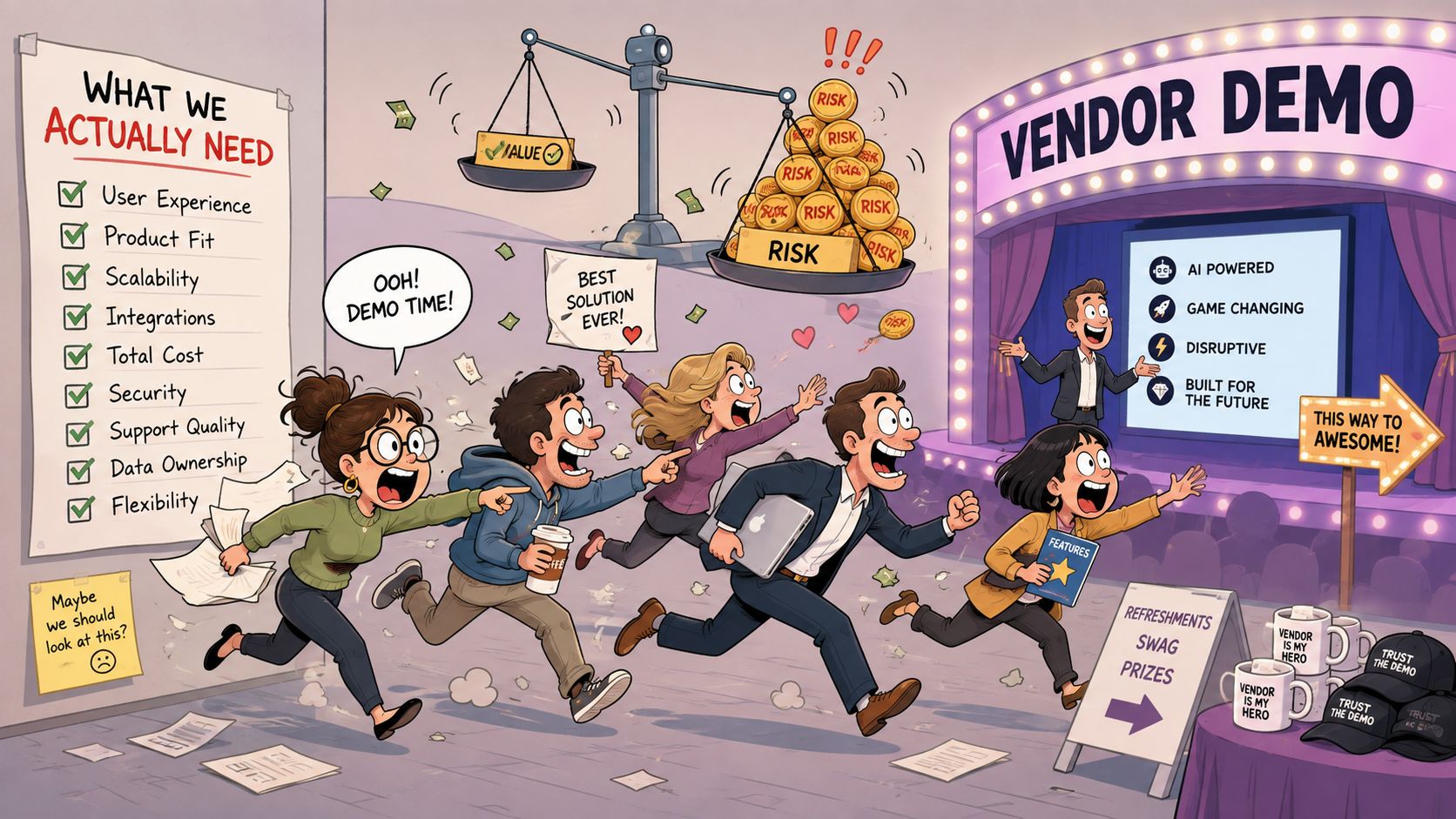
A defensible scorecard has to test more than enthusiasm. It needs a clear way to judge continuity risk, integration fit, and the vendor's ability to keep operating when the easy conditions disappear. That is the difference between a shortlist that looks tidy in procurement and one that still works when the business is under pressure.
Why Most Vendor Selection Processes Fail Before They Start
Most vendor processes fail because the team starts with a demo instead of a definition. A polished presentation can make almost any platform look sensible for 45 minutes, especially when the vendor controls the agenda, the examples, and the timing. That creates recency bias, and in ecommerce it is expensive because the things that matter most, integrations, resilience, operational handover, rarely show up well in a sales deck.
Demos reward theatre, not delivery
A live demo is useful only if you already know what to test. Without that, it becomes a performance where the vendor shows the cleanest path, the neatest dataset, and the least awkward version of the product. The team then confuses confidence with capability, which is how projects get signed that look strong in procurement but fail in implementation.
The UK procurement model pushes against that instinct for a reason. Buyers are expected to justify trade-offs across price, quality, risk, and performance, because the decision is governance as much as commerce. That mindset matters just as much in ecommerce, where the cheapest option can become the most expensive once the platform starts touching checkout, ERP, fulfilment, and customer service.
Practical rule: if a vendor cannot be evaluated against written criteria before the demo, the demo is doing too much work.
Price-only thinking usually hides continuity risk
A low quote is not a procurement win if the supplier cannot survive the contract or support the rollout. In the UK, insolvency data has been a useful reminder that supplier failure is not a theoretical problem, it is a live one UK insolvency data context. In ecommerce, a weak vendor does not just miss deadlines, it can delay trading, break migration windows, and force rework across channels.
That is why the best teams treat vendor selection as a risk screen first and a buying exercise second. For a practical lens on how to compare evidence rather than claims, the Market Edge guide for pricing managers and the Reworx Recycling ITAD checklist both point in the same direction, define the failure modes before you rank the vendors. A scorecard that ignores continuity, integration fit, and operational handover will usually favour the smoothest pitch, not the safest supplier.
Defining Measurable Requirements for Ecommerce Vendors
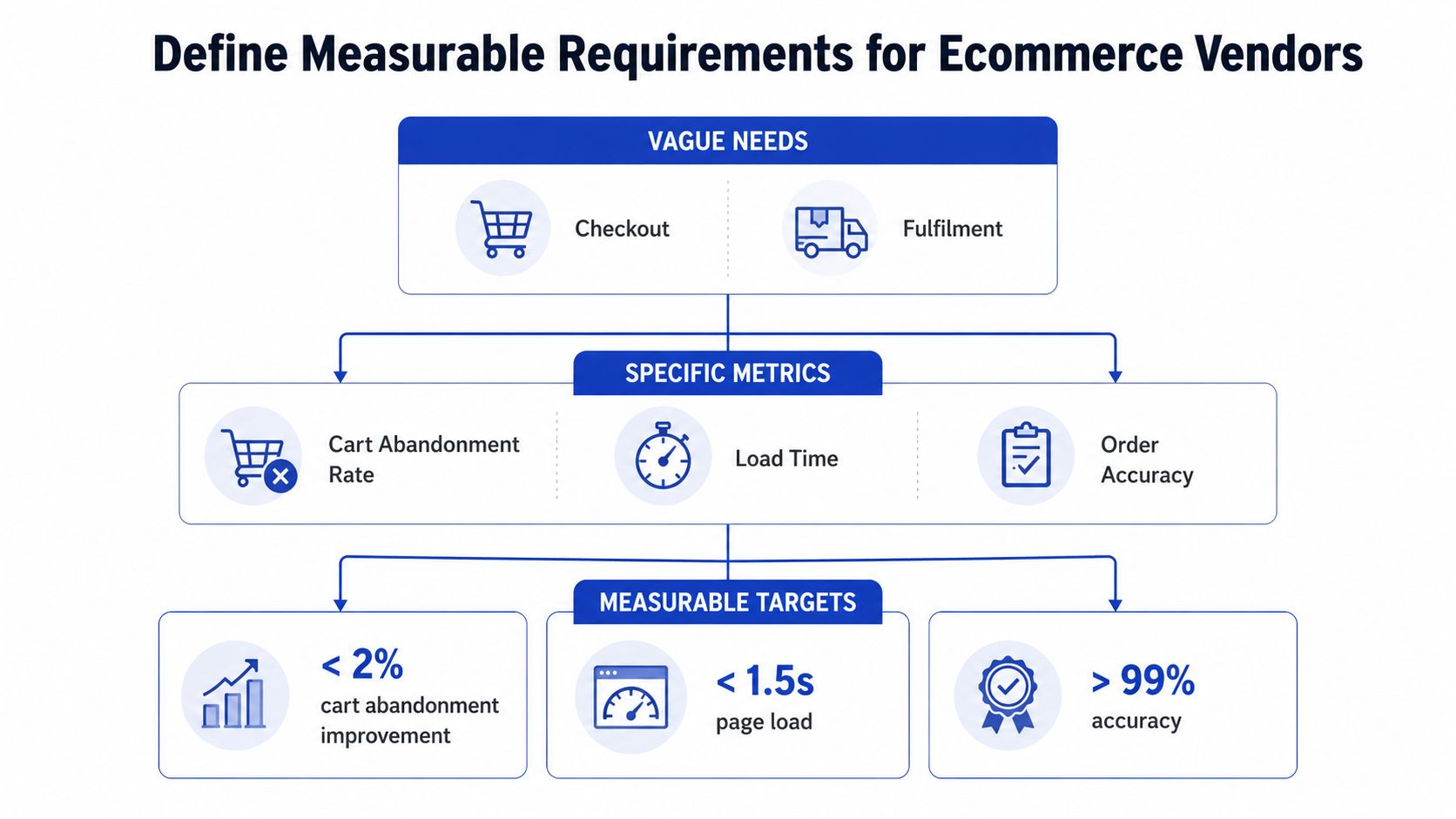
Vague requirements produce vague decisions. “Better checkout”, “faster fulfilment”, and “more flexible integrations” sound sensible in a meeting, then fall apart the moment vendors start answering them in their own language. One supplier talks about design polish, another talks about platform uptime, a third talks about API access, and none of that can be judged fairly unless you have already defined what success looks like.
Split mandatory gates from scored criteria
Start by separating essential requirements from differentiators. Mandatory gates are pass or fail items, such as security requirements, required platform compatibility, or data handling rules that the business cannot compromise on. Scored criteria are the areas where vendors can be compared against one another, such as implementation quality, total cost of ownership, or the strength of their record on similar deployments.
That split stops teams from blending compliance, preference, and convenience into one long wishlist. A Shopify Plus migration should treat store architecture compatibility and required data migration scope as gates, while design flexibility and post-launch support belong in the scored section. The same applies to ERP integrations and subscription platforms, where unresolved integration gaps should remove a vendor from consideration before anyone starts debating colour schemes or roadmap promises. If the relationship must survive a handover, a cutover window, and a support transition, those points need to be written down before the first demo.
Translate business language into testable metrics
A useful requirement is one you can check against a response, a reference, or a technical workshop. “Faster fulfilment” only becomes useful when you define what faster means in your operation, whether that is order processing speed, warehouse handoff reliability, or fewer manual exceptions. “Better checkout” only helps if you tie it to outcomes you can observe, such as fewer abandoned carts, fewer payment errors, or lower support volume.
- Technical fit: Can the platform support your stack, data model, and integration paths without custom work becoming the default?
- Operational capability: Can the supplier manage rollout, training, support, and handover without your team carrying the load?
- Commercial terms: Do the contract, service levels, and renewal terms create predictable ownership?
- Strategic alignment: Does the vendor fit the direction of travel for the business, not just the immediate project?
That discipline also helps when you need to judge whether a metric is separating good vendors from weak ones. The guide on statistical significance testing is useful for that reason, because it forces the same habit of separating signal from noise. The point is not to turn the brief into a research paper; it is to make sure every criterion answers a real operational question.
A requirement that cannot be observed, tested, or evidenced is usually just a preference in disguise.
Building a Weighted Scoring Matrix That Holds Up to Scrutiny
A scoring matrix earns its keep when stakeholders do not agree. If everyone already likes the same vendor, the problem is not comparison, it is documenting why the choice felt easy. The true test comes when finance pushes for lower cost, operations worries about implementation risk, and the ecommerce team is focused on technical fit, support burden, and whether the vendor can stay aligned once the first launch is over.
A weak matrix hides those tensions. A useful one makes them explicit.
Weight the criteria, then test the trade-off
Good weights reflect business risk, not whoever speaks loudest in the room. If a bad implementation would put trading continuity at risk, technical capability and integration history should outweigh a small price difference. If the purchase is closer to a commodity buy, cost can carry more weight, but it still should not dominate the whole evaluation.
| Example Vendor Scoring Matrix for Shopify App Partner | ||||
|---|---|---|---|---|
| Criterion | Weight | Vendor A | Vendor B | Vendor C |
| Technical capability | High | Strong | Moderate | Strong |
| Total cost of ownership | Medium | Moderate | Strong | Moderate |
| Implementation track record | High | Strong | Moderate | Strong |
| Security compliance | Medium | Strong | Strong | Moderate |
A matrix like this does not pretend the numbers are exact. It forces the trade-offs into the open so leadership can challenge the logic without tearing up the whole process. If two vendors end up close on score, do not fake precision. Use the criterion tied to the highest business risk as the tie-breaker, then explain why that risk matters more than the marginal difference elsewhere.
Make the matrix defendable in a post-mortem
The best scorecards survive two questions. Could an auditor or executive see why each weight exists? Can the team explain why a lower-cost vendor lost on total value? That matters because a scorecard creates a record of the actual decision, not just the final answer.
The scoring also needs evidence behind it. Tie the matrix to RFP responses, reference checks, and implementation calls, then review it with people who were not in the vendor meeting. If you want a separate check on whether the gap between vendors is real or just noise, the guide on statistical significance testing is a useful companion. The point is simple, if the difference is small and the evidence is weak, do not present the winner as obvious.
For a practical checklist mindset that fits scorecard discipline, the Reworx Recycling ITAD checklist is a useful reminder that good vendor evaluation depends on traceability as much as choice. The strongest scorecards do not decide for you, they make it hard to cheat the process.
Running Structured Evaluations with RFIs and RFPs
Demos are theatre. RFIs and RFPs are where the truth usually shows up. The reason is simple, a vendor can choreograph a product tour, but it's much harder to fake a written response that has to line up with integration details, support expectations, and real deployment history.
Ask for evidence, not just promises
A useful RFI narrows the field before the deeper RFP work begins. Use it to confirm basics, platform compatibility, support coverage, implementation approach, security posture, and whether the vendor has done this sort of project before. Then use the RFP to demand specifics, not polished language, because polished language rarely tells you how the vendor behaves once the contract is signed.
One practical benchmark is to require verified references from at least three similar deployments. That doesn't guarantee success, but it does give you a better signal than a single happy customer or a glossy case study. In complex ecommerce projects, unresolved integration gaps should be treated as disqualifying, not as “open questions”, because integration failure is one of the most common sources of delivery pain in multi-system environments vendor selection process and project success research.
Keep responses comparable
If every vendor can answer in a different format, your shortlist becomes impossible to compare. Use the same headings, the same evidence request, and the same response limits for all bidders. That structure makes it easier to score implementation realism, support maturity, and commercial assumptions without letting the most articulate salesperson dominate the room.
The most useful RFP questions are boring in the best way. Ask for sample project plans, named roles, integration assumptions, support escalation paths, and what the vendor excludes from scope. Then force the response back into your scoring matrix so that no one can hide behind narrative. For a technical example of why structured evidence matters when integrations are involved, the internal guide on Shopify third-party integration services gives a good sense of the operational detail vendors should be able to discuss.
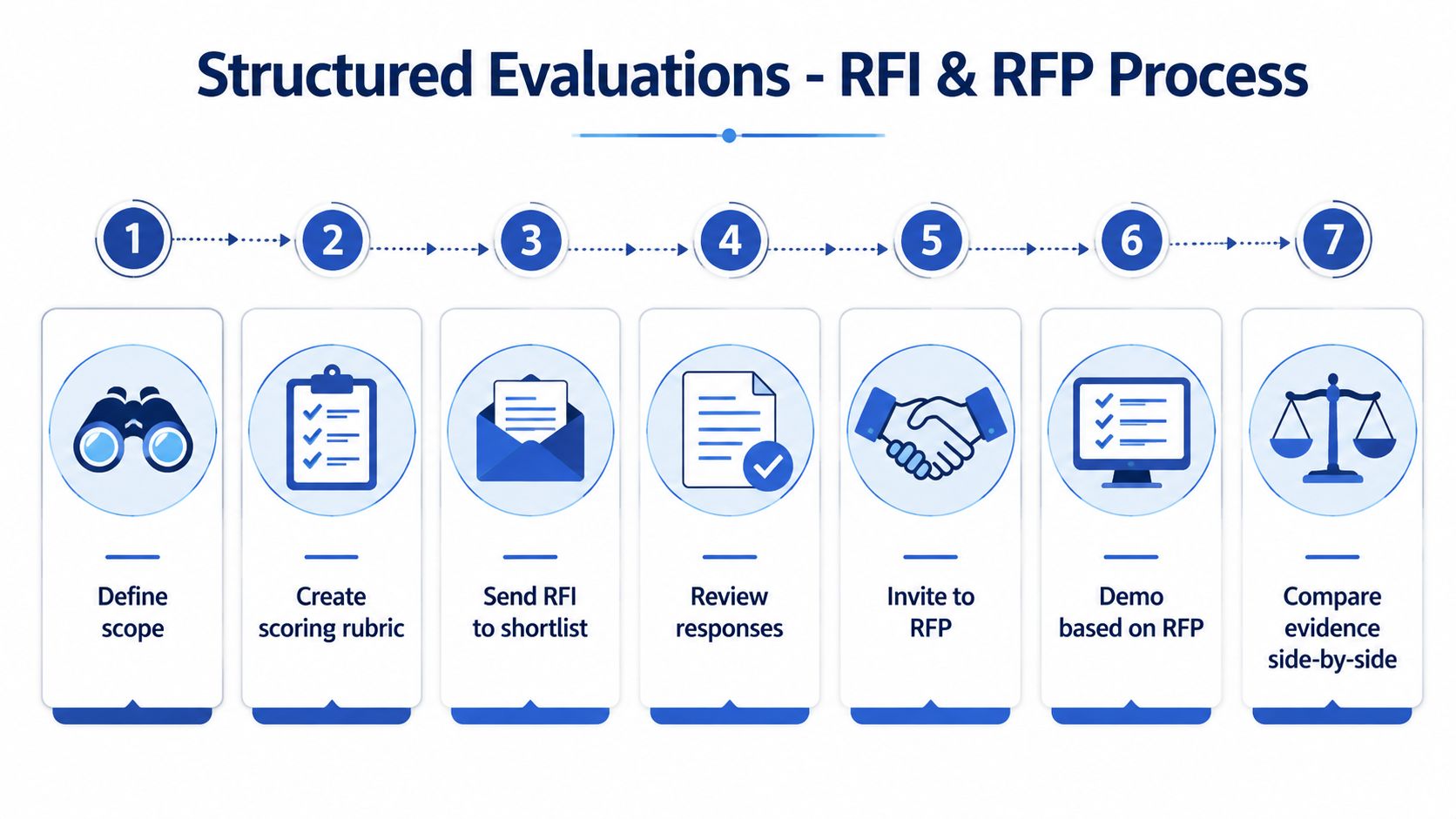
A seven-step process works well in practice, define scope, create the rubric, send the RFI, review responses, invite the shortlist, run the RFP demo, and compare evidence side by side. The video below is a useful companion if your team needs a visual reminder of how structured evaluation keeps the sales narrative under control.
The vendor who answers cleanly in writing usually saves you the most time later.
Assessing Continuity Risk Beyond Financial Headlines
“Financial stability” gets listed on almost every vendor scorecard, then tested with little more than a glance at company size and a reassuring sales pitch. That is weak due diligence, especially in ecommerce, where a supplier's collapse can stall a launch, break fulfilment handoffs, or force an emergency swap during peak trading.
Look for survival signals, not just sales talk
The UK context makes continuity risk a practical issue, not a theoretical one. Insolvency data shows supplier failure is common enough to treat as a live commercial risk, so the question is whether a vendor can keep operating long enough to finish the work and support it after go-live.
Use UK-specific signals wherever you can. Companies House filings show how disciplined an entity is about legal and reporting obligations. Payment behaviour gives a better read on whether they settle their own commitments on time. Sector concentration matters too, because a vendor that depends too heavily on one client type or one dependency chain can look stable until a shift in that market hits. None of these signals is perfect alone, but together they are better than a single “financial health” checkbox.
The red flags in investigations guidance from PartnerScanX is a useful reminder that due diligence works best when you test contradictions, not just accept polished reassurance. If a vendor claims to be scalable, yet its filings, staffing pattern, or references suggest strain, that mismatch belongs in the scorecard.
Give continuity risk its own weight
Continuity risk belongs beside price and quality, not hidden inside a generic risk note. A cheaper vendor that cannot staff the work consistently, manage cash flow, or support integrations can drive higher total cost through rework, delay, and customer impact. Ecommerce teams often discover that the weakest point is not the demo, it is the handover after the contract is signed.
A scorecard that treats continuity seriously needs operational tests, not vibes. Ask who owns the account after signature, how many similar projects the team is carrying, what happens if the named implementation lead leaves, and which dependencies sit outside the vendor's control. The internal knowledge transfer process also matters here, because a poor handover turns a manageable change into a support problem.
I also look for how the vendor behaves under scrutiny. If the answers stay vague, or if the story changes once you start asking about staff turnover, support cover, or contingency plans, that is a warning sign. The right approach is to score continuity on evidence, then challenge the gaps before procurement gets committed.
If the vendor cannot explain how it stays operational under stress, it has not earned a high continuity score. That is just procurement with its eyes open.
Integrating Sustainability and Compliance Into Your Scorecard
Sustainability and compliance shouldn't be bolted on after the commercial debate. In the UK, they've become part of the procurement evidence set, which means they need to be evaluated with the same discipline as technical fit and delivery risk. The trick is to separate minimum compliance from differentiating sustainability capability, otherwise every vendor ends up claiming the same thing and the scorecard loses meaning.
Treat compliance as a gate, not a slogan
A vendor either meets required compliance thresholds or it doesn't. That includes legal and regulatory obligations, relevant data handling expectations, and any sector-specific requirements that apply to the buying organisation. For sustainability, UK buyers are increasingly expected to consider carbon reporting and wider social value expectations, which means vague ESG language isn't enough UK 2024 supplier guidance and reporting context.
The useful question is not “Do you have a sustainability policy?” The useful question is “Can you prove the claims you make, and can you keep proving them during the contract?” That's where requests for UK-relevant disclosures, including Energy and Carbon Reporting data where applicable, give the buyer something concrete to compare.
Score evidence, not ambition
A strong sustainability scorecard rewards verifiable behaviour. Ask for measurable commitments, data access clauses, reporting cadence, and named responsibilities for supplying updates. Broad statements about values or future intent don't help if the implementation team can't access the numbers when the contract is live.
- Minimum compliance: required licences, policy coverage, and mandatory disclosures.
- Reporting discipline: willingness to share data in a usable format during the relationship.
- Commercial alignment: contract terms that preserve access to evidence, not just marketing claims.
- Differentiating capability: operational maturity in reducing waste, emissions, or compliance friction over time.
The point is to keep ESG from diluting the rest of the evaluation. If sustainability is important in the category, it deserves explicit weighting, but only after the vendor proves it can meet the baseline. That keeps the discussion honest, and it stops “green” language from inflating a weak operational offer.
When cost, carbon, and compliance all sit in the same decision framework, the vendor with the prettiest positioning doesn't automatically win. The one with the best evidence does.
If you're reviewing vendors, migrations, or integrations and want a sharper scoring framework, Grumspot can help you stress-test the technical, commercial, and delivery sides of the decision. Visit Grumspot to see how a practical Shopify Plus partner approach can reduce risk and help you choose vendors that hold up after signature.
Let's build something together
If you like what you saw, let's jump on a quick call and discuss your project

Related posts
Check out some similar posts.