How to Do a Skill Gap Analysis: A Complete Practical Guide
- skill gap analysis
- workforce planning
- employee skills
- gap assessment
- training strategy
Launched
August, 2026
A structured skill gap analysis must first separate capability shortages from hiring scarcity and process problems. In the UK, 1.26 million employees had a skills gap in 2024, equal to 4.0% of the workforce, making a reliable baseline more useful than manager intuition alone.
That figure doesn't mean every affected employee needs a course. Some roles need targeted development, others need clearer processes, better tools, job redesign, or an external hire with capability the labour market can supply. The practical value of skill gap analysis lies in making that distinction before an organisation commits budget, time, and management attention.
Why Skill Gap Analysis Matters Now
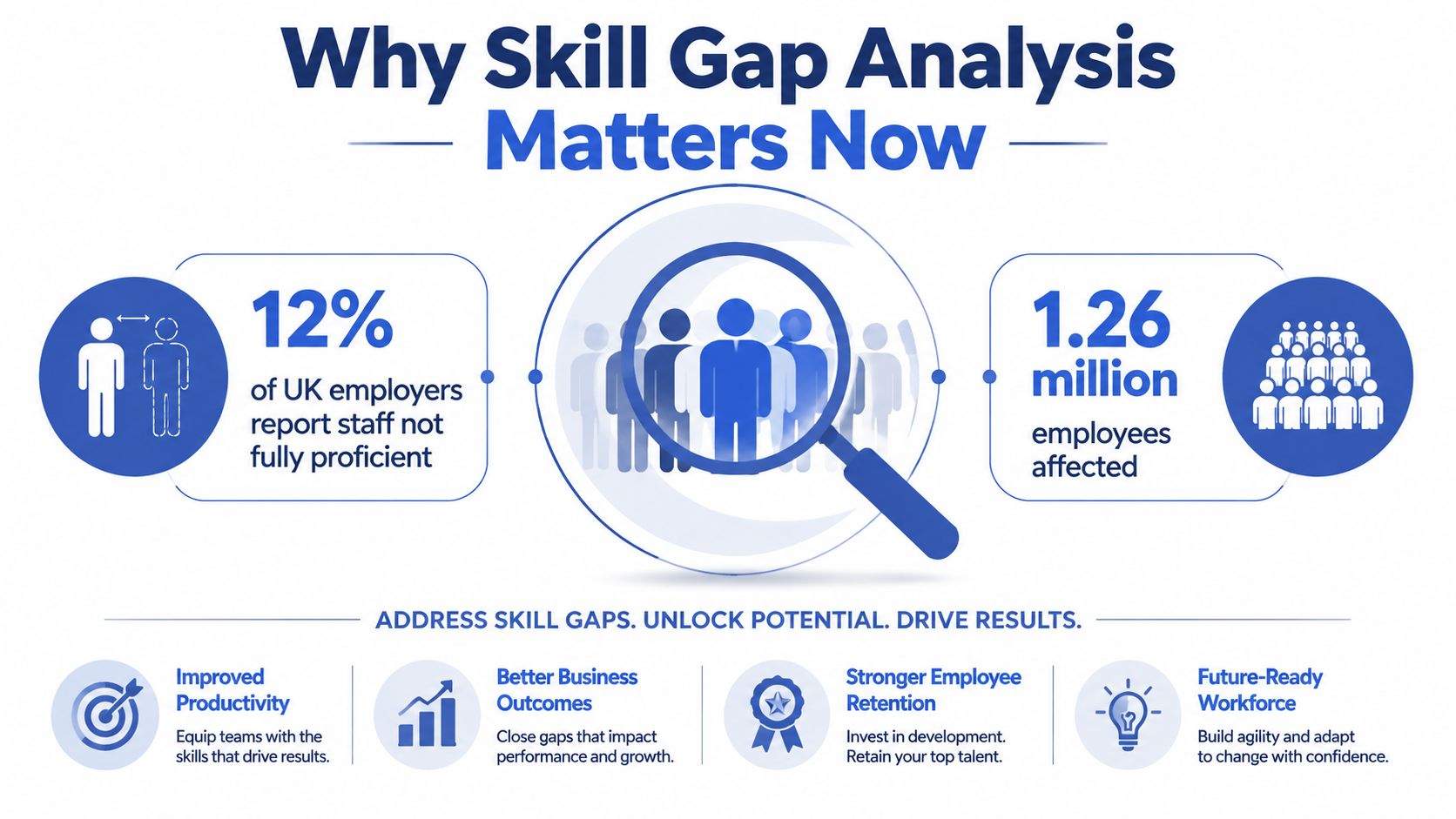
The UK's Employer Skills Survey 2024 found that 12% of employers had at least one staff member who wasn't fully proficient, down from 15% in 2022 and close to 13% in 2017. It also estimated 1.26 million employees with a skills gap, equivalent to 4.0% of the workforce, compared with 1.72 million employees and 5.7% in 2022. These figures give employers a useful baseline, while showing why a national trend cannot diagnose a particular team's problem. The official Employer Skills Survey 2024 results supports a more precise conversation than the familiar claim that “skills are changing fast”.
A skill gap analysis compares the capability a role or business outcome requires with what people can demonstrate today. A useful analysis identifies where the gap sits, how large it is, and what it costs the organisation. It should guide a decision, rather than create a long competency inventory that nobody uses.
The cost of a wrong diagnosis
Managers usually spot the symptoms first. A team misses deadlines, a sales process breaks down, or a new system sees limited adoption. Training becomes the convenient explanation, even when the cause is an unclear workflow, insufficient capacity, poor system design, or a role that combines incompatible responsibilities.
The financial consequences are easy to miss. Training consumes employee time and manager capacity, while the underlying delay, rework, or lost output continues. Recruitment can also waste money when existing employees could close the gap with focused support. Automation may remove repetitive work, but it will not replace judgement, relationship management, or accountability where those capabilities remain necessary.
UK labour-market evidence adds an important test. Skills shortage vacancies rose from 226,500 in 2017 to 531,200 in 2022, then fell to 250,500 in 2024, according to the Employer Skills Survey research report. A hard-to-fill role may reflect an external shortage, not an internal training failure. In that case, job redesign, targeted hiring, or automation can be more sensible than funding a broad upskilling programme.
The practical decision is diagnostic: identify whether the constraint sits with people, process, technology, or the external labour market before choosing the remedy.
Practical rule: Don't approve a learning intervention until you've tested whether training addresses the cause rather than the symptom.
Defining the Competencies You Need to Measure
A gap can't be measured until the required standard is clear. Job descriptions are a useful starting point, but they usually mix essential responsibilities, broad behavioural expectations, and aspirational language. “Strong communication skills” doesn't tell an assessor what good performance looks like.
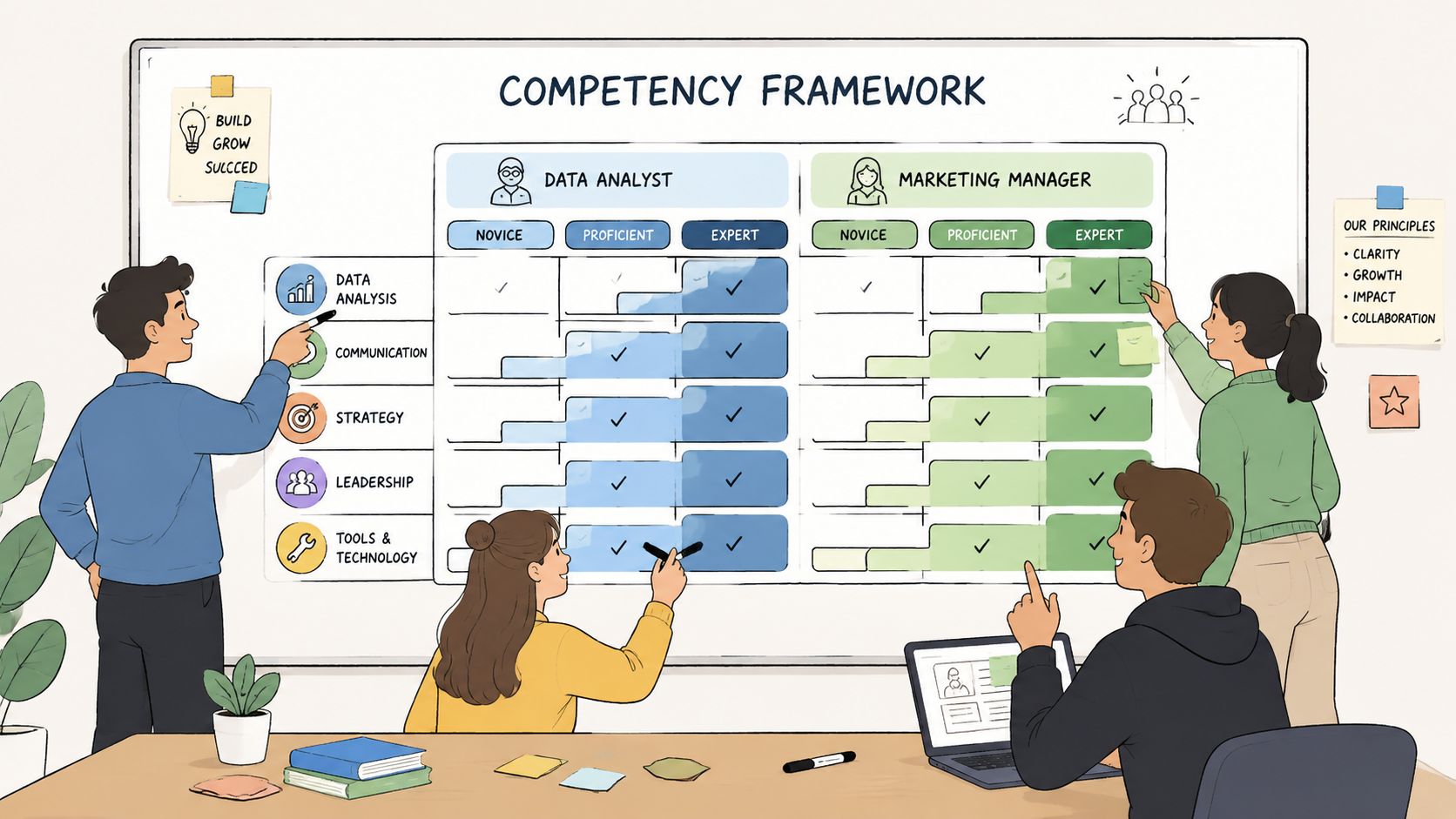
Start with the business outcome, then work backwards to the role behaviours that influence it. If the outcome is reliable management reporting, a data analyst may need to clean source data, select appropriate methods, explain uncertainty, and communicate findings to non-specialists. A marketing manager may need campaign measurement, customer segmentation, channel judgement, and the confidence to challenge weak evidence.
Build a usable framework
Separate competencies into three practical groups:
- Technical capability: Role-specific knowledge that someone must apply accurately, such as SQL, financial controls, product configuration, or regulatory procedures.
- Digital fluency: The ability to use workplace systems, interpret data, work securely, and adopt digital or AI-assisted workflows appropriately.
- Adaptive and interpersonal capability: Behaviours such as prioritisation, collaboration, judgement, customer communication, and problem-solving.
Then classify each competency as critical now, important for near-term change, or useful but optional. This prevents a common failure mode, where organisations assess everything they can think of and lose sight of what constrains performance.
For every critical competency, define observable evidence. Instead of rating “commercial awareness”, ask whether the person can connect customer behaviour to margin, identify a trade-off, and recommend an action supported by evidence. Instead of rating “AI skills”, specify the workflow, such as drafting, checking, documenting, and safely escalating AI-assisted output.
Involve the people closest to the work
Ask line managers and subject matter experts:
- What does competent performance look like in this role?
- Which tasks create the greatest operational or customer risk when done poorly?
- Which capabilities will change as systems, products, or processes change?
- Can the competency be demonstrated through a work sample?
- Is the requirement essential, or does the framework reflect personal preference?
Use a small number of proficiency levels with clear descriptions. A person who can follow a documented procedure shouldn't receive the same rating as someone who can diagnose unusual problems, improve the process, and coach colleagues. Keep the framework short enough for managers to use consistently and specific enough for employees to understand how development will be judged.
Choosing the Right Assessment Methods
No single assessment method gives a reliable picture. Each captures a different part of capability, and each creates its own distortion.
| Method | What it reveals | Main weakness | Best use |
|---|---|---|---|
| Self-assessment survey | Confidence, exposure, and perceived development needs | Overconfidence and modesty can skew results | Initial mapping and employee voice |
| Structured interview | Context, judgement, and barriers to performance | Interviewer bias and inconsistent probing | Explaining why a gap appears |
| Practical work sample | Demonstrated ability in a realistic task | Takes preparation and assessor time | Testing critical technical skills |
| Performance data | Evidence from real work | Results may reflect process or workload, not skill alone | Validating patterns and business impact |
A self-assessment is efficient, especially when you need a broad first view. It shouldn't be treated as proof of proficiency. Someone may report confidence with a reporting system because they can complete familiar tasks, while struggling when the data is incomplete or the request falls outside the standard workflow.
Practical tests provide stronger evidence for tasks that can be observed. A data analyst might be asked to clean a flawed dataset and explain the choices made. A customer service employee might handle a difficult scenario while the assessor scores listening, policy application, and escalation judgement. Keep the exercise close to the actual role, or you'll measure test technique rather than work capability.
Structured interviews work best after an assessment has identified a pattern. Ask the same core questions, request specific examples, and distinguish lack of knowledge from lack of access, time, authority, or usable tools. Performance data can then validate whether the issue affects outcomes, but interpret it carefully. A missed target may reflect poor lead quality, unclear ownership, or an unrealistic workload.
For hiring contexts, teams assessing capability can also review practical guidance on predict sales performance with assessments. The same principle applies internally: use assessments to gather evidence, not to create an impressive-looking score.
Anonymous input can reveal barriers managers won't hear in a formal review, but anonymity must be paired with transparent communication about how findings will be used.
Combine methods rather than averaging incompatible scores blindly. Standardise each result onto a common proficiency scale, document assessor criteria, and use statistical significance testing only where the sample and comparison support it. A numerical difference isn't automatically a meaningful business difference.
Analyzing Results and Visualizing the Gaps
Raw assessment data rarely changes a decision. A manager needs to see which capability is weak, where it sits, what outcome it affects, and what action is available.
Build a matrix with roles or teams on one axis and competencies on the other. Record the required level, observed level, evidence source, confidence in the rating, and business consequence. A heatmap can then make concentrated deficits visible without hiding the detail behind a single average.
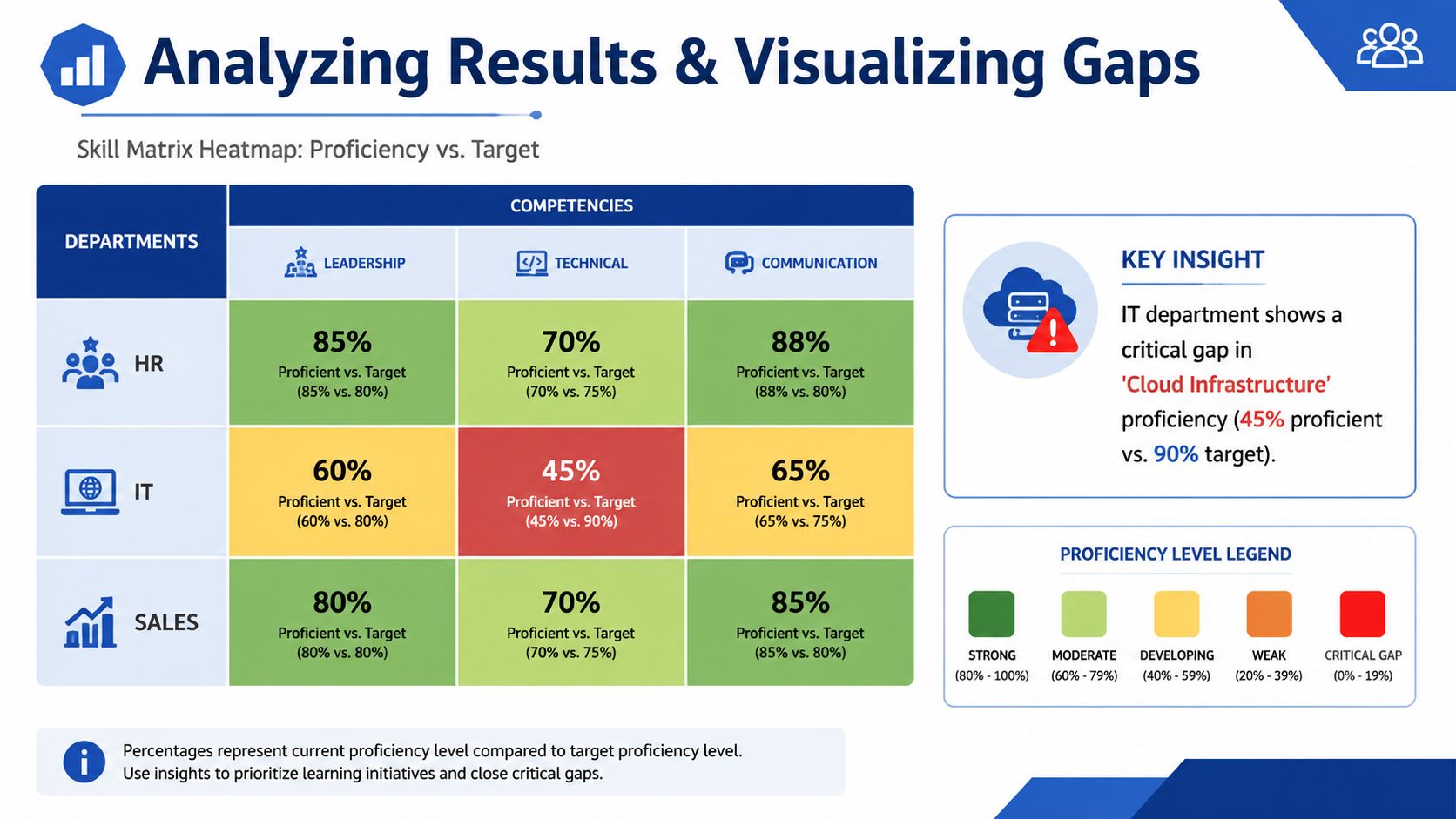
Use colour carefully. Green, amber, and red should represent agreed proficiency bands, not emotional judgement. A red cell means the current evidence is materially below the required level for that role. It doesn't mean the employee is poor, and it shouldn't be used as a public ranking device.
Read patterns, not just scores
A gap concentrated across one role family may indicate a training or hiring priority. A gap scattered across several departments may point to a weak process, poor system adoption, or an organisation-wide digital fluency issue. A gap found only in one individual may require coaching, clearer expectations, or a change in allocation rather than a programme.
Normalise evidence before comparing it. A practical test, manager rating, and self-assessment don't have the same meaning. Preserve the original evidence, convert it to a shared scale for visualisation, and show the source and confidence level beside the result.
A useful prioritisation score can remain qualitative if the data doesn't justify false precision. Label each gap by:
- Business impact: What fails or slows if the gap remains?
- Exposure: How many roles or critical activities depend on it?
- Evidence confidence: Is the finding supported by observed work, performance data, or only self-report?
- Intervention choice: Can the organisation train, hire, redesign, or automate?
A heatmap should lead to a decision log, not sit in a presentation archive. Tools such as automated candidate scorecards can help standardise evidence in assessment workflows, but human review still matters when context determines whether a score represents skill, access, workload, or process friction.
The video below offers a visual supplement to the matrix approach:
Prioritizing Gaps and Choosing Interventions
The Local Government Association skills gaps methodology models workforce supply against demand, then estimates the value exposed when capability falls short. Its method is useful because it separates a genuine capability gap from a shortage that training cannot solve. The source reports that 46% of businesses had difficulty recruiting for roles requiring hard data skills. That distinction affects the decision: hire, redesign the work, automate part of it, or develop existing employees.
A practical decision test
Assess every priority gap against four questions:
- Can existing employees reach the required standard? Adjacent capability may respond well to targeted practice, mentoring, or supervised work. Specialist expertise may take too long to build.
- Is the skill scarce outside the organisation? Internal development can reduce exposure to a constrained labour market, provided the learning curve fits the operating timetable.
- Can the work be redesigned? Remove unnecessary tasks, split responsibilities, or create specialist support rather than loading incompatible demands onto one role.
- Can technology handle the repeatable part? Automation may suit predictable data movement, checks, and administration. Employees can retain judgement and exception handling.
These choices often work in combination. A team might hire one experienced specialist, train existing employees on the surrounding workflow, and automate routine preparation. That approach can cost less and carry less execution risk than expecting a course to create deep expertise or depending entirely on a scarce external hire.
The economic case extends beyond specialist roles. UK evidence identifies a substantial cost from the digital skills gap and shows that many adults lack workplace digital skills. Treat that finding as a design signal, not an instruction to send everyone to training. Digital capability may affect finance, operations, sales, HR, and customer teams, while the right response could be clearer systems, job redesign, selective recruitment, or automation.
A diagnosis also needs a time horizon. Training is reasonable when the capability is close to the required standard and the work can tolerate a learning period. Recruitment is more defensible when the organisation needs proven expertise quickly. Automation deserves consideration when the task is repetitive and rules-based, but not when exceptions, customer judgement, or accountability dominate.
For a focused explanation of how skill development fixes misalignment, compare development activity with the operating problem it is meant to address. An opportunity prioritization matrix can make cost, feasibility, risk, and timing visible to senior leaders. Each recommendation should state what will be trained, hired, redesigned, or automated, and why the alternatives were rejected.
Implementing Plans and Measuring Outcomes
Turn each priority into an owner, intervention, evidence measure, and review point. A training plan without a performance measure is an activity calendar, not a capability programme.
Use this implementation checklist:
- Define the outcome: State what the role or process must do better.
- Choose the intervention: Select training, mentoring, hiring, job redesign, automation, or a combination.
- Set the baseline: Record the current proficiency evidence and relevant operational measure.
- Run a contained pilot: Test the intervention with a clearly defined group or workflow before expanding it.
- Review the evidence: Compare demonstrated capability, work quality, adoption, and manager observations at the agreed review point.
- Adjust the plan: Remove content that isn't used, add practice where errors persist, or change the intervention if the diagnosis was wrong.
Useful KPIs include assessment performance against the required standard, completion of defined work samples, error rates, rework, system adoption, time to independent performance, and successful transfer of knowledge between colleagues. Choose only measures that connect to the original gap. A completion percentage won't prove that an employee can perform the task.
Build repeatable knowledge transfer processes into the plan so capability doesn't remain with one expert. Keep the matrix live, record changes to role requirements, and revisit priorities when strategy, technology, or operating conditions change. The analysis should support decisions throughout the year, not become a report that is forgotten after the workshop.
Grumspot helps ecommerce teams turn capability and process findings into practical Shopify Plus improvements, from storefront builds and migrations to UX, SEO, CRO, and complex integrations. Visit Grumspot to discuss an evidence-led audit, redesign, or development programme that addresses the operational constraints behind your growth goals.
Let's build something together
If you like what you saw, let's jump on a quick call and discuss your project

Related posts
Check out some similar posts.