Opportunity Prioritization Matrix for Shopify Growth
- opportunity prioritization matrix
- shopify CRO
- ecommerce prioritisation
- weighted scoring
- roadmap planning
Launched
August, 2026
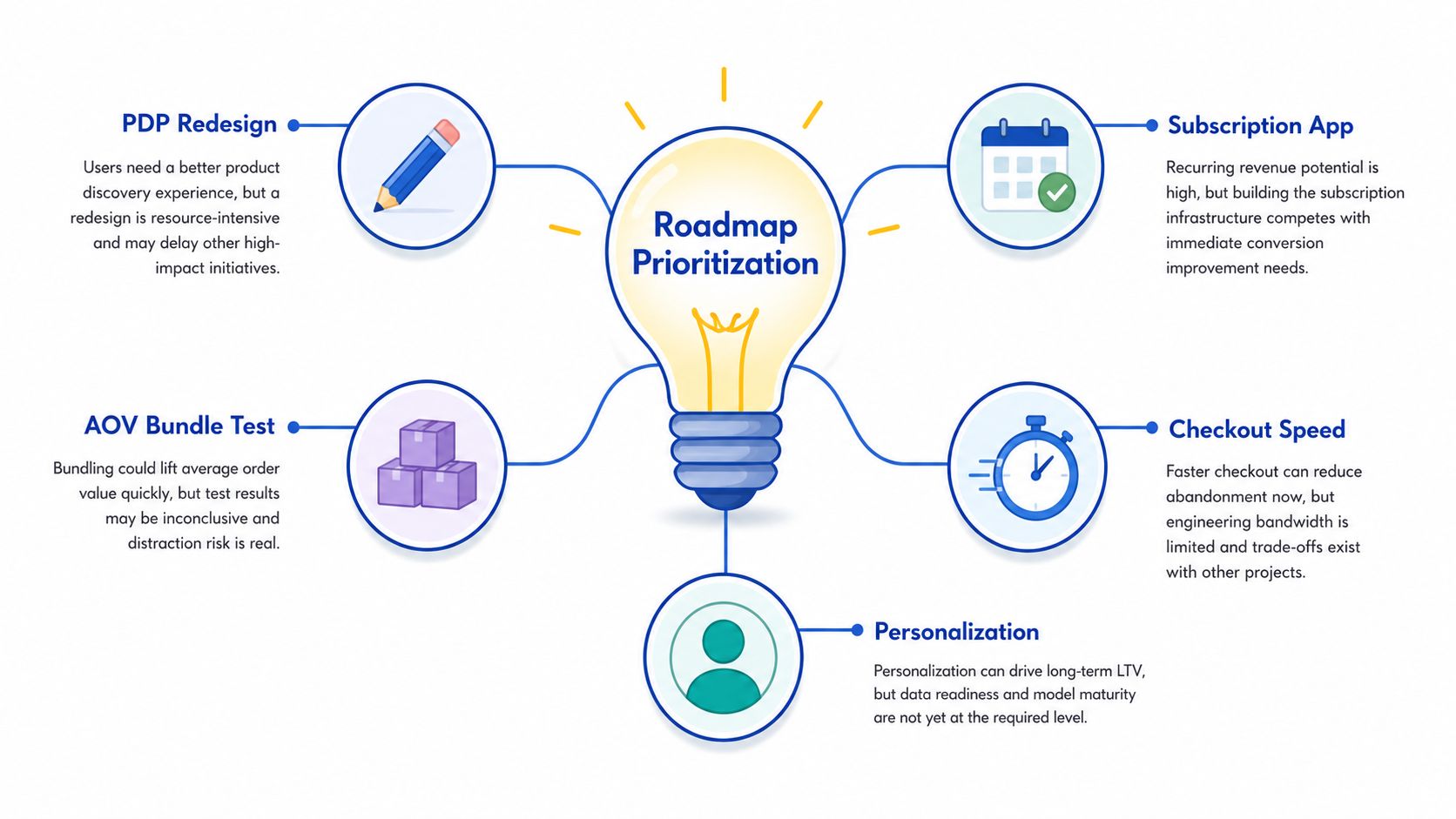
Your Shopify roadmap is probably full of good ideas and bad timing. One Slack thread wants a PDP redesign, another wants a new subscription app, a third is pushing an AOV bundle test, and someone else keeps resurfacing checkout speed because support tickets are piling up. Without a shared way to rank those bets, the loudest argument wins, and the roadmap starts reflecting internal politics rather than store performance.
That's exactly where an opportunity prioritization matrix earns its place. It turns competing ecommerce ideas into something you can compare, score, and defend, instead of debating them ad hoc every Monday morning. For UK teams in particular, that discipline fits the broader shift toward evidence-based planning, which sits behind the scale of the UK market research and opinion polling sector that the Office for National Statistics reported generated about £2.0 billion in turnover in 2022.
If you're already thinking about how to improve Shopify store revenue, this is the missing layer between ideas and execution. The matrix doesn't tell you what to build by intuition. It makes the trade-offs visible, which is what Shopify Plus teams need when every initiative seems urgent and budget only stretches so far.
Why Your Shopify Roadmap Needs a Prioritisation Matrix
A Shopify Plus team can easily end up with five strong-looking initiatives and no clean answer to “what goes next?”. The CRO lead wants a PDP redesign because product pages are leaking conversions. The retention manager wants a subscription app rebuild because churn is creeping. The merchant wants a bundle test because AOV looks flat. Finance wants checkout speed fixed. Marketing wants back-in-stock flows. None of those asks is silly, but not all of them deserve the same slot on the roadmap.
The real problem is not idea quality, it's comparison
An opportunity prioritization matrix solves a comparison problem. It puts each initiative in the same frame, so you can weigh customer impact, effort, and strategic fit together instead of letting each stakeholder argue from their own metric. For ecommerce teams, that matters because one “easy” win can consume the same implementation window as a much bigger improvement.
Practical rule: if two Shopify ideas can't be compared on the same criteria, they're not ready for roadmap debate yet.
The matrix also helps when the backlog mixes CRO work with platform work. A quick A/B test on a bundle offer might feel smaller than a checkout optimisation project, but the decision depends on what each one is likely to move, what it touches in the stack, and how much delivery risk it carries. That's why a structured view beats intuition every time.
Why the matrix is better than the usual Slack consensus
Slack consensus tends to reward confidence, not evidence. The most senior person speaks first, the team anchors on that opinion, and the rest of the discussion becomes a defence of position rather than an assessment of opportunity. A matrix interrupts that pattern because the scoring happens before the debate.
That matters even more on Shopify Plus, where the same store might be balancing subscriptions, internationalisation, app rebuilds, and conversion experiments all at once. Those are different bets with different payback periods, and they shouldn't be judged with the same loose language. If you want a broader view of how prioritisation fits product and feature work, the framework is closely related to the more general prioritisation approaches described by Forrester's opportunity prioritisation matrix overview, which frames the method as a structured way to sort opportunities rather than rely on gut feel.
The practical win is simple. A team stops asking, “Who wants this most?” and starts asking, “Which idea is most attractive, most feasible, and most aligned with where the store is heading?” That shift is where stronger roadmaps start.
The Core Structure Behind an Opportunity Prioritisation Matrix
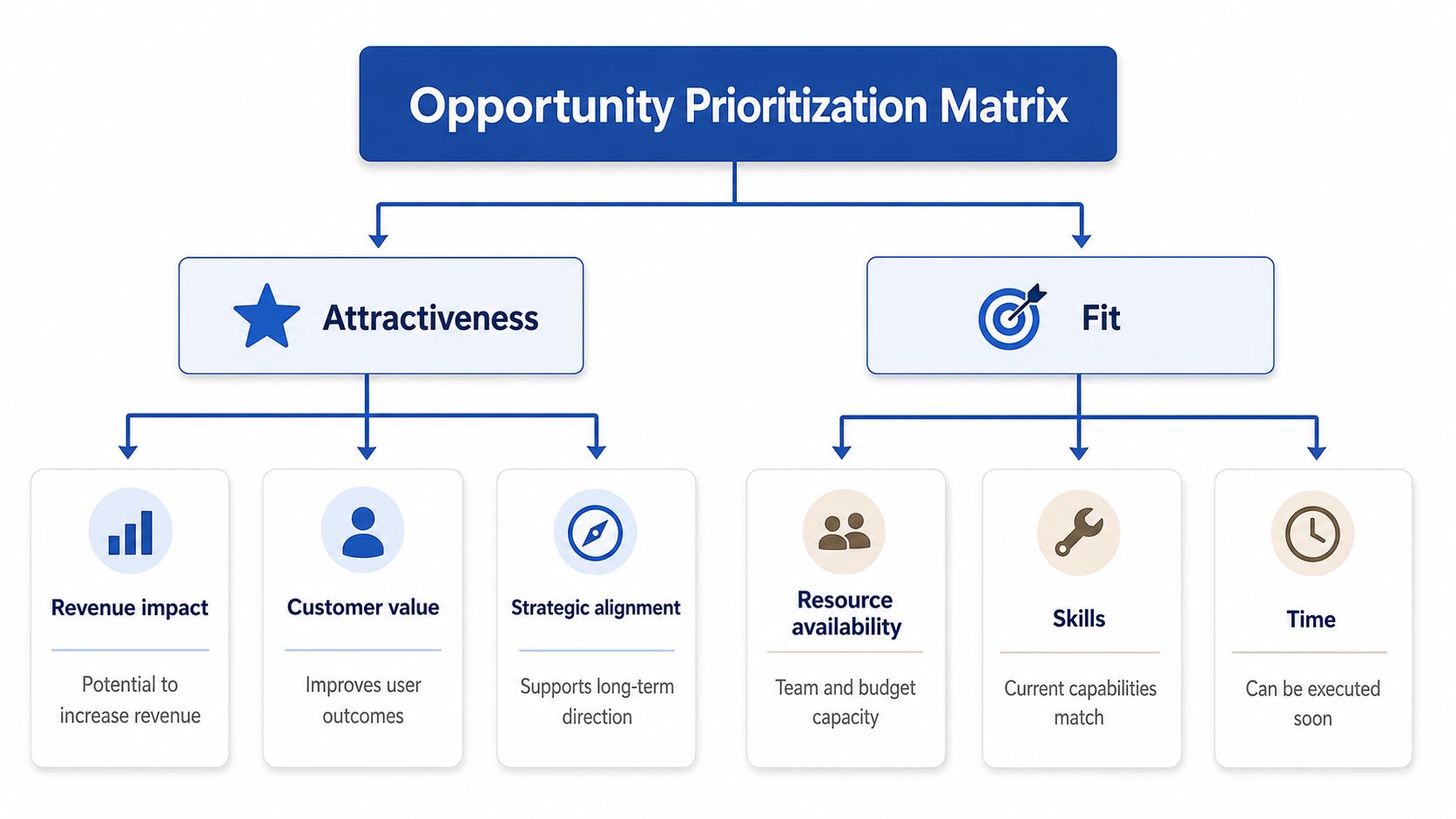
At its simplest, the matrix is a 2x2. One axis is usually attractiveness or impact, the other is fit or effort. That's enough to separate obvious winners from obvious drains, which is why teams use it to shortlist Shopify work before they get lost in the weeds.
The four quadrants tell you what deserves attention
The classic quadrants are easy to understand once you've run a few workshops:
- Quick wins are high value and low effort. A small PDP copy change that lifts add-to-cart behaviour belongs here if the data supports it.
- Major projects are high value and high effort. A subscription billing rebuild might sit here because the upside is real, but the implementation cost is heavy.
- Fill-ins are low value and low effort. These can be useful when you've got spare capacity, but they rarely justify displacing more impactful work.
- Thankless tasks are low value and high effort. These are the ideas that feel busy but don't move the store enough to earn their place.
For a Shopify board, that visual is useful because it makes trade-offs visible in seconds. Teams can see why a nice-to-have theme tweak is not in the same league as a checkout fix that affects the buying path.
The 2x2 is a starting point, not the whole system
A plain quadrant works when the backlog is small and the ideas are fairly comparable. It breaks down when your store has several different types of work competing at once, like CRO tests, app rebuilds, subscription changes, and international expansion. In that situation, the matrix starts to feel too blunt.
That's where weighted scoring comes in. Instead of asking only whether an idea is “high” or “low” on an axis, you score it against several criteria and give each criterion a weight. The result is more auditable, less dependent on whoever talks the loudest, and much easier to revisit later. It also fits the reality that some Shopify opportunities are attractive for revenue but weak on fit, while others are modest in upside but excellent in execution speed.
A useful way to think about it is this. The 2x2 helps you sort the pile. Weighted scoring helps you defend the order of the pile.
Choosing the Right Criteria and Weights for Your Shopify Store
The most useful criteria for Shopify work are usually expected revenue impact, customer reach, implementation effort, and strategic fit. That set is broad enough to cover CRO, subscriptions, and platform work, but narrow enough to stay usable in a workshop. If you're trying to approximate revenue value, it's worth aligning that thinking with a customer lifetime lens, which is why many teams keep a simple calculator like this customer lifetime value guide close at hand when they score ideas.
Keep the criteria independent
The biggest mistake is letting two criteria measure the same thing. Value and revenue, for example, often collapse into one another. Once that happens, the matrix stops showing trade-offs and starts pretending to be a ranking spreadsheet in disguise.
A better setup is to separate benefit from feasibility. A PDP redesign might have strong customer reach and decent revenue impact, but weak fit if it depends on a theme rebuild and several app changes. A bundle test might have modest reach, but excellent implementation speed and strong strategic fit if AOV is a near-term priority.
Use weights to reflect your current stage
Weights should reflect the kind of store you're running right now, not the kind of store you wish you had. A scaling subscription brand may give more weight to strategic fit and retention. A pure ecommerce brand pushing average order value might weight customer reach and expected revenue impact more heavily. The point is not to make everything equal. The point is to make your priorities explicit.
Here's a simple scoring table you can reuse.
| Criterion | Weight | What 1 Means | What 5 Means |
|---|---|---|---|
| Expected revenue impact | 35 | Minimal commercial effect | Clear commercial upside |
| Customer reach | 20 | Narrow segment only | Broad share of eligible customers |
| Implementation effort | 20 | Large rebuild or many dependencies | Fast, contained, low-risk work |
| Strategic fit | 25 | Weak fit with current roadmap direction | Strong fit with current growth plan |
A score only becomes useful when the team agrees what the numbers mean before scoring starts.
Prevent the loudest voice from setting the weights
Weighting fails when one stakeholder rewrites the model to protect their favourite project. The cleanest safeguard is to set the criteria first, then ask domain owners to score only within their lane. Engineering should speak to effort and reversibility. CRO should speak to expected lift and customer friction. Merchandising should speak to assortment and bundle fit. Nobody should get to change the meaning of the scale halfway through the workshop.
A limited vote budget also helps. If everyone gets too many votes, the discussion turns into a popularity contest. If they get too few, they default to politics. The sweet spot is enough pressure to force trade-offs without turning the workshop into a negotiation about who gets the final word.
A Worked Shopify Example With Real Scores and Decisions
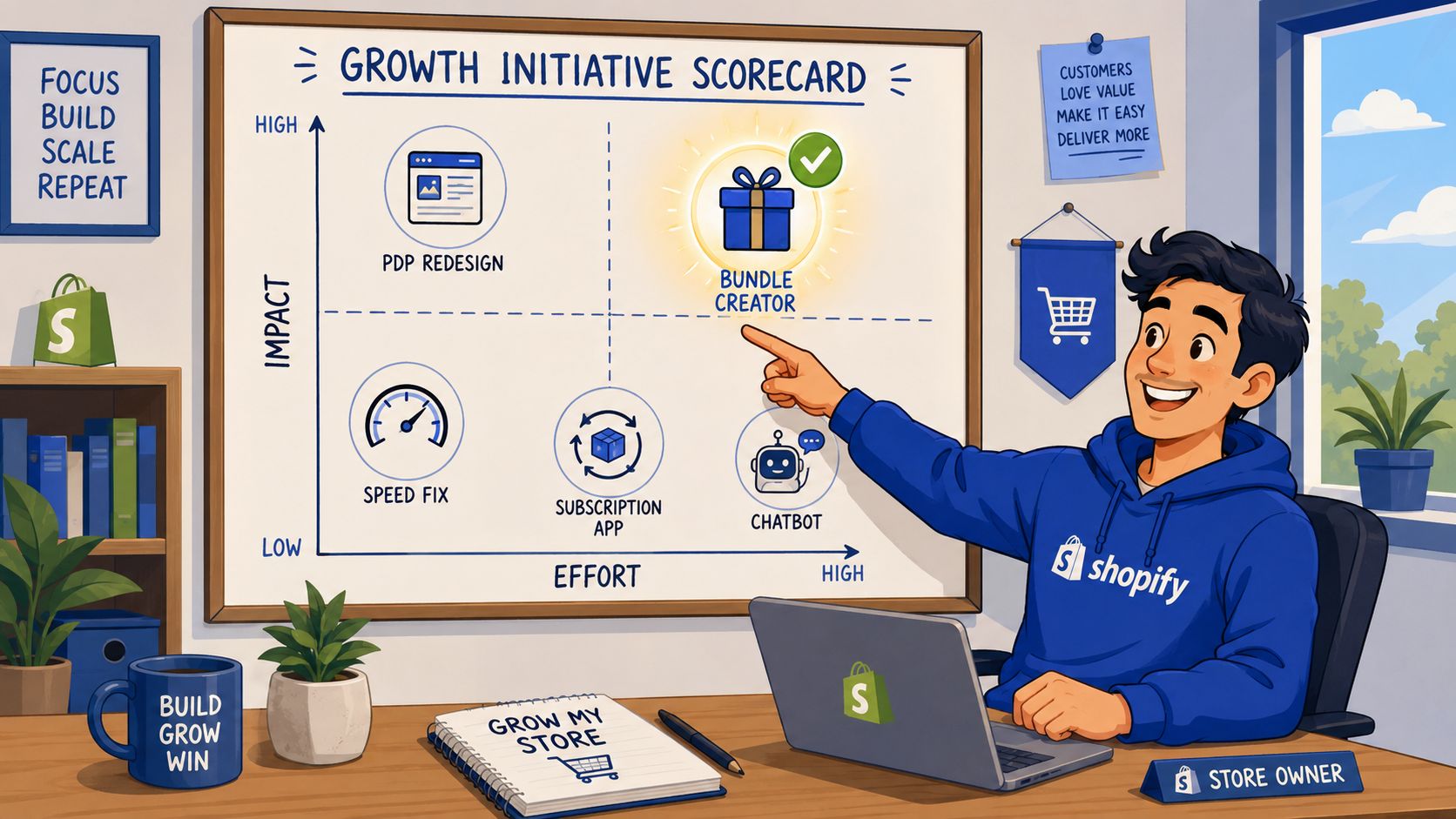
A realistic Shopify Plus backlog often looks like this. The team has a PDP redesign, an AOV bundle creator, a checkout speed fix, a loyalty programme, and a subscription billing rebuild. All five are worth considering. Not all five deserve the same level of urgency.
Score the initiatives against the same rubric
Using the weights from the earlier table, each initiative gets a score from 1 to 5 on each criterion.
| Initiative | Revenue Impact | Customer Reach | Implementation Effort | Strategic Fit | Weighted Total | Rank |
|---|---|---|---|---|---|---|
| AOV bundle creator | 5 | 4 | 4 | 4 | 4.35 | 1 |
| Checkout speed fix | 4 | 5 | 3 | 4 | 4.05 | 2 |
| Loyalty programme | 3 | 4 | 3 | 3 | 3.20 | 3 |
| PDP redesign | 4 | 3 | 2 | 4 | 3.15 | 4 |
| Subscription billing rebuild | 4 | 2 | 1 | 5 | 2.95 | 5 |
The exact math matters less than the pattern. The bundle creator ranks first because it offers a strong commercial case, broad enough reach, and manageable delivery cost. Checkout speed comes close behind because it affects a large part of the buying journey and is usually hard to argue against once the bottlenecks are clear. The loyalty programme ranks third, which is exactly the kind of result that surprises teams when the request has been loudest in meetings.
The useful part is not the score, it's the decision
A matrix like this changes the conversation from “why didn't we build the loyalty programme?” to “what evidence would move it up?”. That's a much better question. It tells the team the idea isn't rejected forever, just ranked behind stronger opportunities right now.
Practical rule: document the reason for the score, not just the score itself. Future you will care more about the rationale than the decimal place.
That note becomes especially important when two items are close. If the checkout fix and bundle creator are nearly tied, the team can look at dependencies, launch risk, or commercial timing before deciding. If the subscription rebuild is strategically important but scores low on implementation effort, that doesn't mean “never”. It means “not before the business is ready to fund the cost.”
If you want to pressure-test the logic behind the ranking, a good companion exercise is statistical significance testing for the experiments that follow. The matrix decides what deserves a test or a build. The experiment decides whether the bet paid off.
Plugging the Matrix Into Your Shopify CRO and Roadmap Workflow
A prioritisation matrix only becomes valuable when it shapes how work moves. On Shopify Plus, that means turning ranked opportunities into quarterly themes, sprint-sized delivery, and a CRO loop that feeds fresh evidence back into scoring. A board that sits in a deck and never touches the roadmap is just decoration.
Use the matrix to set the roadmap shape
A clean workflow starts with three layers. First, score the ideas. Second, group the top items into quarterly themes. Third, break each theme into executable work that can be handled in weeks, not vague “big project” language. That keeps the roadmap readable for merchants, designers, developers, and CRO leads.
The other advantage is that it makes dependency chains visible. A taxonomy migration might gate a PDP redesign. A subscription app rebuild might need product data clean-up before the customer journey can improve. If you try to schedule those as standalone items, the roadmap looks neat and behaves badly.
Keep quick wins inside the top quadrant
The matrix should never become an excuse to ignore small, fast opportunities. If a bundle test or product page tweak lands in the quick wins quadrant, it should move quickly. The right discipline is to reserve a slice of capacity for those items so the team doesn't spend months on one major project and starve the easier wins.
A weekly prioritisation meeting works well here because it keeps fresh information in play. A session recording may reveal friction on mobile PDPs. Support may spot a recurring subscription question. Merchandising may see a product set that's perfect for bundling. Those inputs should flow back into the matrix, not sit in a separate thread nobody revisits.
Feed CRO results back into the next scoring cycle
The best Shopify teams treat the matrix as a live input, not a static document. After a test or rollout, the result should affect the next round of scoring. If a bundle concept underperforms because buyers don't respond to the offer structure, that changes how similar ideas are scored later. If a checkout fix improves usability but exposes a data issue, that should affect future effort and risk estimates.
For the same reason, customer research should not sit outside the prioritisation process. Survey comments, on-site behaviour, and session evidence all help the next scoring round. The matrix becomes more accurate when it learns from what shipped.
If you need a practical CRO reference point while wiring this into your roadmap, the conversion rate optimisation guidance from Grumspot is a useful companion for turning prioritised ideas into measurable tests.
Common Pitfalls That Break the Matrix in Ecommerce Teams
The first failure mode is passive scoring. Someone fills in the matrix, then a senior stakeholder rewrites the result after the meeting. That defeats the whole point. If the rubric can be changed after the fact, the matrix is just theatre with columns.
The second problem is stale weights. A store in a growth sprint should not use the same weighting it used when the business was still stabilising operations. What matters most changes with stage, margin pressure, app complexity, and roadmap maturity. If the weights don't move, the matrix keeps rewarding last quarter's priorities.
Watch for effort estimates that sound convenient
Shopify teams often underrate implementation effort. A “small” app install can still mean a theme rebuild, QA across devices, tagging changes, subscription logic, and a long round of regression fixes. Low effort is only low effort if the dependencies are already understood.
Practical rule: if an idea touches theme code, checkout logic, or app integrations, assume the first estimate is optimistic.
The third mistake is over-indexing on revenue while ignoring fit. A feature can be commercially attractive and still be the wrong move if it pulls the team away from a strategic direction that matters more. That's especially true for merchants balancing subscriptions, international growth, and core conversion work at the same time.
The fix is process, not drama. Keep an individual scoring step before group discussion. Limit how much the team can vote. Revisit the rubric on a regular cadence. And make sure the matrix is used in the same meeting where roadmap decisions are made, not in a disconnected workshop nobody references again.
Refreshing the Matrix and Making It a Living CRO Asset
A good matrix ages quickly if the market shifts, and ecommerce never sits still for long. Rescore it on a regular cadence, then update the weights when commercial reality changes. If an experiment changes what you know about a page, a bundle, or a subscription flow, that evidence should feed back into the next round.
In UK ecommerce especially, the point of refresh matters because regulation, retail conditions, and platform changes can move priorities mid-quarter. A static matrix becomes stale fast. A living one keeps the roadmap honest.
Quick FAQ
How often should the matrix be refreshed?
When the roadmap changes meaningfully, or whenever a round of CRO testing gives you new evidence that affects the ranking.
How big does the team need to be?
Big enough to cover product, design, development, and commercial input. Smaller teams can still use it, but the scoring is stronger when each discipline has a voice.
What about squishy ideas that are hard to score?
Park them until you can define the customer problem more clearly. If they still matter, they'll become easier to rank once the opportunity is better framed.
Does this work for Shopify Plus only?
No. Larger merchants need more structure because the backlog is noisier, but the same logic also helps smaller teams avoid random acts of optimisation.
If your Shopify roadmap needs sharper prioritisation, Grumspot can help you turn competing ideas into a clear CRO plan. Visit Grumspot if you want a team that can score the opportunities, build the right experiments, and execute the work without the usual agency drag.
Let's build something together
If you like what you saw, let's jump on a quick call and discuss your project

Related posts
Check out some similar posts.