Web Design Agency Cardiff: Find Your Perfect Partner 2026
- web design agency cardiff
- cardiff web design
- hire web designer cardiff
- shopify agency cardiff
- ecommerce web design
Launched
May, 2026
Your inbox has three proposals. One agency talks about “beautiful design”. Another promises a “bespoke digital experience”. The cheapest one says they can get started next week.
Looking for a web design agency Cardiff right now, you're probably not short of options. You're short of clarity.
That's the problem. Most businesses don't need another website vendor. They need a partner who can help the site earn its keep. If your website doesn't generate enquiries, support sales, reduce friction, or strengthen the brand in a way that helps revenue, it's just overhead with nicer typography.
First Define Your Website's Real Job
Most Cardiff businesses start in the wrong place. They think about colours, layout, and examples they like. That's backwards.
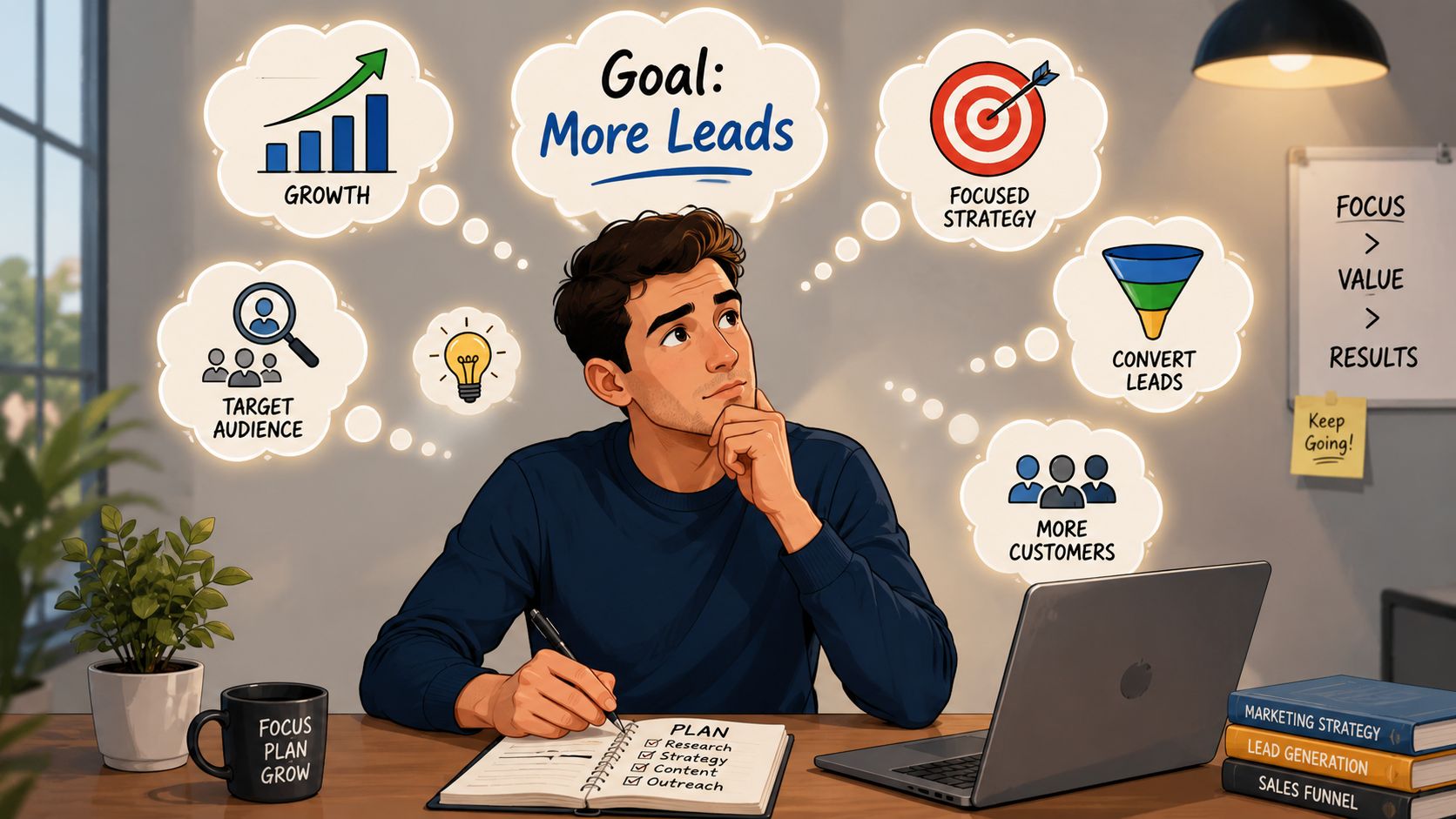
Start with the commercial job of the site.
A good agency should help you think beyond a brochure site, but many agency pages in Cardiff still lean on broad claims like bespoke design, responsiveness, and conversion-led builds without clearly explaining what you're buying in business terms. That gap matters because buyers often need clearer thinking around platform migration risk, analytics setup, ongoing CRO, and technical SEO maintenance, not just polished visuals, as noted by The Web Designer Cardiff.
Decide the primary outcome
Your website should have one primary job. Not five.
Pick the main one:
- Lead generation: for service firms, consultants, trades, legal, healthcare, B2B.
- Direct sales: for ecommerce brands selling products.
- Bookings: for clinics, salons, venues, classes, hospitality.
- Authority building: for firms where trust and credibility drive later sales.
- Customer support: for businesses trying to reduce admin and inbound queries.
If you can't name the primary job in one sentence, your brief is too vague.
Practical rule: If your homepage message can't answer “what do you want the visitor to do next?”, the project isn't ready for agency outreach.
Write a brief that agencies can actually price properly
A weak brief creates bad proposals. Agencies fill the gaps with assumptions, and you end up comparing quotes that aren't remotely comparable.
Your brief should include these core points:
Business goal
Be blunt. Do you want more qualified enquiries, more completed checkouts, fewer drop-offs, or better local visibility?Audience
Who are you selling to, and what do they need before they trust you?Offer structure
What are the main services, product categories, locations, or customer journeys?Current problems
Slow updates, poor mobile experience, weak enquiries, messy navigation, poor tracking, migration risk, or a site your team hates using.Success measures
Don't ask an agency to “make it modern”. Ask how success will be measured after launch.
What success metrics actually make sense
Your metrics depend on the site's job. Keep them tied to outcomes, not vanity.
| Website type | Useful KPI | Weak KPI |
|---|---|---|
| Lead gen site | qualified enquiries, booked calls, form completion quality | page views |
| Ecommerce site | conversion rate, checkout completion, average order flow quality | “looks premium” |
| Local service site | calls, location landing page performance, enquiry intent | impressions alone |
| Brand-led site | branded search lift, sales-assisted journeys, content engagement quality | homepage likes |
If you want a practical way to pressure-test your thinking, review these effective website strategies. They're useful because they force clarity before design gets in the way.
You should also understand what a site built for action looks like in practice. This guide to conversion-focused web design is worth reading before you contact agencies, especially if your current site gets traffic but doesn't turn enough of it into business.
Know what you're buying
A website project often includes more than design and build. It may also involve:
- Content structure: deciding what pages need to exist and in what order.
- Analytics setup: so you can measure enquiries, purchases, and user paths.
- SEO foundations: making sure the site can support search visibility.
- Platform decisions: choosing a CMS or commerce stack your team can live with.
- Post-launch optimisation: fixing what user behaviour exposes after launch.
That's why I push businesses to think like investors, not shoppers. You're not buying pages. You're commissioning a business asset.
Navigating the Cardiff Web Design Scene
Cardiff isn't a small or fragile market for web design. That's good news for buyers.
One Cardiff company states it has been building websites since 2005, and directories still showed multiple active agencies in the city in May 2026. Clutch's Cardiff rankings list firms including Duck.Design, DigiMantra, Illustrate Digital, Rant, DabApps, and Box UK, which shows the local market includes both specialist studios and broader digital consultancies, according to Thrive's Cardiff web design market overview.
That matters because you have real choice. You don't need to settle for the first agency with a clean homepage.
The three types of provider you'll usually find
Most businesses looking for a web design agency Cardiff will end up choosing between three broad models.
Solo freelancers
Freelancers can be a good fit when the project is simple, the business moves quickly, and you want direct access to the person doing the work.
They're often best for:
- small brochure sites
- early-stage businesses
- straightforward redesigns
- limited budgets with low integration complexity
The trade-off is capacity. If you need strategy, copy support, CRO, technical SEO, and post-launch development, one person usually can't cover all of it well.
Boutique studios
Boutique studios often offer the best balance for growing businesses. You usually get stronger design thinking than with a solo freelancer, and better access to senior people than with a large agency.
They fit well when you need:
- stronger brand presentation
- a clearer messaging structure
- a custom feel without enterprise process
- collaborative planning and tighter creative control
The risk is specialism gaps. A studio may be excellent at design and weaker on data, search, integrations, or ongoing optimisation.
Full-service digital agencies
These are better suited to complex sites, ongoing growth work, and businesses that need design connected to SEO, paid media, content, or engineering.
They're usually the right fit when:
- your site is part of a larger growth plan
- you need migrations or deeper integrations
- multiple stakeholders need reporting and process
- you want one team accountable across several channels
The downside is obvious. You can end up paying for process you don't need.
A good agency model is the one that matches your operational reality. Don't hire a large digital consultancy to build a simple lead-gen site unless you need what comes with it.
Match the provider to the business stage
Use this quick comparison:
| Business situation | Best fit | Why |
|---|---|---|
| New local service business | freelancer or small studio | speed, direct contact, lower complexity |
| Established SME with weak current site | boutique studio | balance of strategy and execution |
| Ecommerce brand scaling across markets | full-service specialist agency | complexity, integrations, optimisation |
| Rebrand plus site rebuild | studio or larger agency | messaging, visual system, rollout support |
If local visibility matters heavily to you, your site partner should also understand how web structure supports search intent and nearby demand. This overview on how to optimize local search performance is a useful reference when you're judging whether an agency actually understands local commercial discovery, not just design language.
My view on local versus remote
Being in Cardiff helps. It isn't the deciding factor.
Local agencies can make workshops easier, move discovery faster, and understand the local market context better. But proximity doesn't compensate for weak thinking. A remote team with stronger strategic discipline will outperform a local team that only sells aesthetics.
Pick for capability first. Then weigh convenience.
How to Vet and Shortlist Your Top Agencies
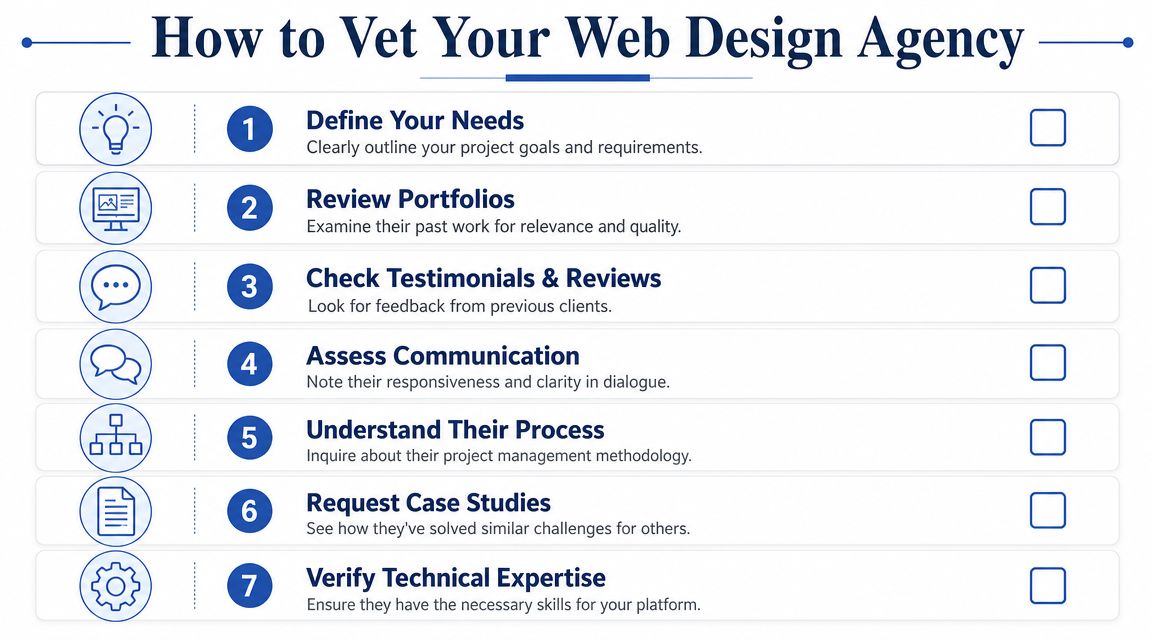
Don't shortlist agencies because their own site looks expensive. Shortlist them because they show evidence of judgement.
Cardiff buyers aren't treating web design as cosmetic anymore. A Cardiff-focused case-study page reports that 50% of customers consider website design essential to company branding, while small business owners expect to spend 43% of their budget on online activities, which tells you buyers are linking web design to commercial performance, not decoration, according to The Web Designer Cardiff case study page.
What to look for in portfolios
A portfolio should answer more than “can they make things look polished?”
Look for signs that the team can solve business problems:
- Relevant work: Have they built for businesses with similar sales cycles, customer types, or site complexity?
- Clear hierarchy: Do their sites make actions obvious, or are they just visually busy?
- Content discipline: Is the messaging sharp, or does the site rely on generic headings and stock phrases?
- UX maturity: Can users find the next step quickly?
- Platform suitability: If you need Shopify, WordPress, or custom functionality, can they show it?
If every project looks the same, that's not a design signature. It's a template habit.
Read case studies like a buyer, not a fan
Case studies are sales documents. Read them critically.
Good case studies usually show:
- the original business problem
- the constraints
- what changed structurally
- how launch was handled
- what happened after launch
Weak case studies obsess over homepage mock-ups and skip outcomes, operations, and measurement.
Shortlist test: If an agency can't explain the business problem behind a project, they probably solved for appearance first and performance second.
Score agencies with a simple framework
Use a weighted shortlist instead of trusting instinct alone.
| Criteria | What to check |
|---|---|
| Strategic thinking | Do they talk about goals, journeys, tracking, and growth? |
| Relevant experience | Have they handled your type of site or business model? |
| Process clarity | Can they explain discovery, content, design, build, QA, and launch? |
| Technical confidence | Can they discuss platform limits, migrations, integrations, and SEO basics clearly? |
| Communication | Are replies sharp, specific, and on time? |
| Post-launch support | Do they offer optimisation, maintenance, or just handover? |
Create a shortlist of 3 to 5 agencies. More than that wastes time. Fewer than that leaves you with weak comparison.
Extra checks for ecommerce businesses
If you run ecommerce, your standard should be higher. You're not buying a brochure. You're buying revenue infrastructure.
Ask whether they can handle:
- theme customisation without breaking maintainability
- app integration and subscription logic
- checkout and funnel friction analysis
- product template structure
- migration planning
- analytics and event tracking
- international or multi-market complexity
For Shopify projects, one option in the market is Grumspot, which focuses on Shopify design, development, migrations, audits, and CRO work. That's relevant if your shortlist needs a specialist rather than a broad generalist. Before choosing any partner, use a proper comparison process like this guide on how to choose a web design agency.
Key Questions to Ask Before You Hire
The interview stage matters more than the proposal deck.
Anyone can polish a deck. Fewer agencies can answer sharp questions without slipping into vague language. That's where you find out whether they think like operators or presenters.
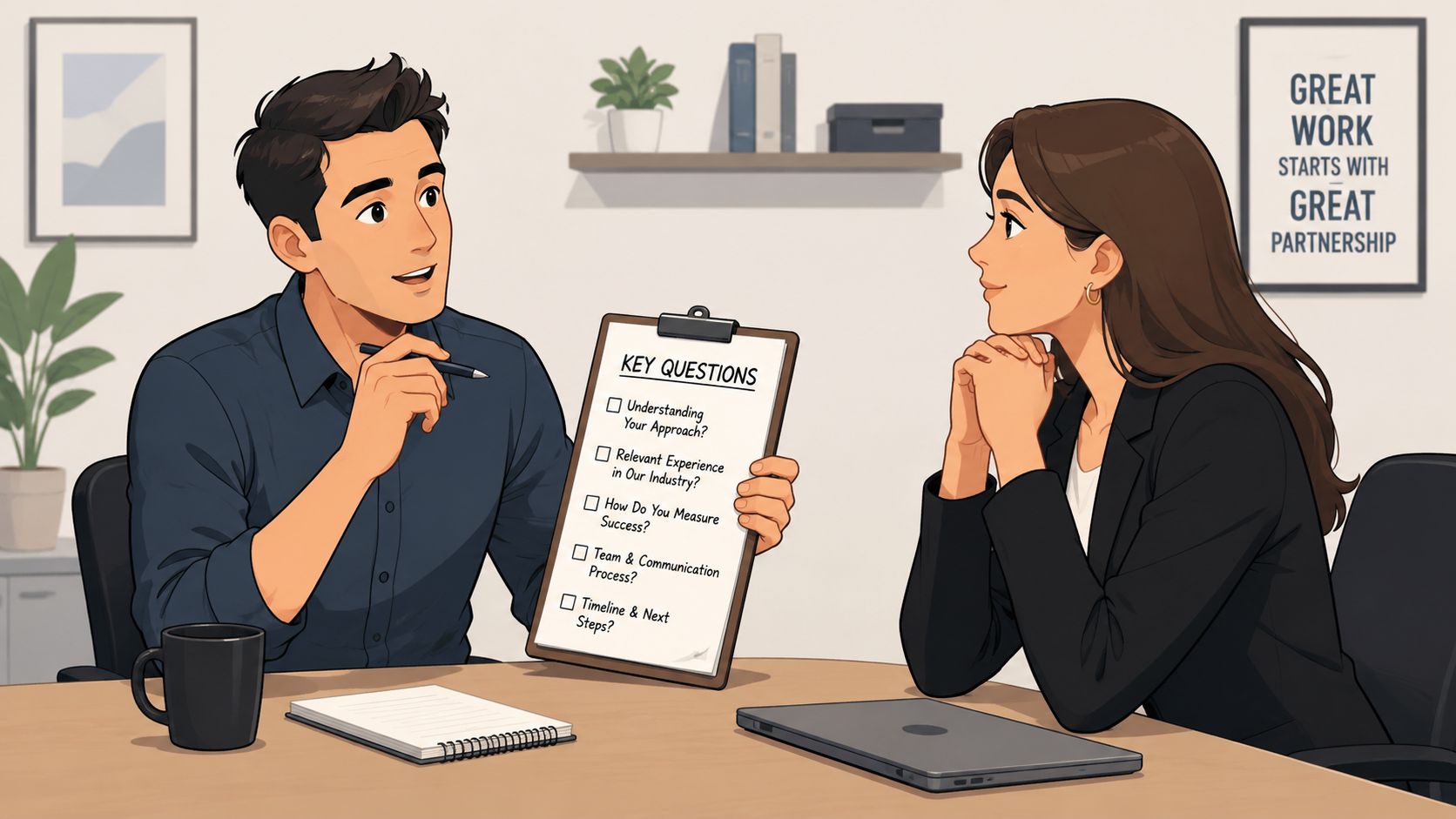
For ecommerce and lead-generation sites, the biggest mistake is treating launch as the finish line. Independent Cardiff agency rankings cite agency-reported outcomes such as a 64% lift in organic traffic and 260% growth in new leads, but those gains usually come from ongoing technical improvements, content alignment, responsive UI work, and post-launch optimisation rather than a single redesign event, according to Clutch's Cardiff web design rankings.
Ask process questions that expose how they think
Start here:
What happens before design starts?
If they jump straight to wireframes without proper discovery, they're rushing.How do you define success for a project like ours?
You want specificity. Not “better engagement”. Actual business outcomes.How do you handle content planning and information architecture?
This reveals whether they understand that structure drives performance.Who will work on the project day to day? Sales leads often vanish once the contract is signed.
How do you manage feedback and revisions?
You need a workable system, not chaos by email.
Ask smarter SEO and performance questions
Don't ask, “Do you do SEO?” That's too easy.
Ask this instead:
- How will you structure the site so it supports our organic growth goals?
- What technical SEO elements do you handle during build, and what sits outside scope?
- How do you approach internal linking, page templates, and crawlable content structure?
- How do you make design decisions without hurting usability or speed?
An agency that answers clearly will talk about structure, content logic, page intent, and measurement. A weak one will say “we optimise for Google” and hope you move on.
If they can't explain their SEO and UX decisions in plain English, they probably don't understand them well enough.
Questions that separate growth partners from website vendors
These are the questions I'd insist on asking:
What are the biggest risks in this project?
Serious agencies will mention content delays, stakeholder bottlenecks, migration issues, tracking gaps, or approval lag.What do you need from us for this to succeed?
Good partners know client-side delays kill projects.What happens in the first ninety days after launch?
This is one of the most important questions in the whole process.How do you use analytics after launch to prioritise improvements?
If there's no answer, there's probably no optimisation culture.What would make you advise against a full redesign?
Honest agencies sometimes recommend fixing structure and conversion issues before rebuilding from scratch.
Ecommerce-specific questions
If you sell online, push harder.
Ask:
- How have you handled platform migrations with product, customer, and order data complexity?
- How do you approach collection structure, filters, and search UX?
- What's your process for CRO after launch?
- How do you decide whether a custom feature should be an app, theme logic, or a deeper build?
- How do you handle third-party systems like ERP, CRM, subscription, and fulfilment tools?
You're listening for trade-offs, not buzzwords. The right agency will talk about complexity openly. The wrong one will promise smooth delivery on everything.
Watch behaviour, not just answers
The interview is also a live test of what it'll be like to work together.
Pay attention to:
- whether they listen before pitching
- whether they answer directly
- whether they challenge weak assumptions
- whether they stay commercially focused
- whether they explain constraints without hiding behind jargon
A good agency doesn't just reassure you. They sharpen your thinking.
Decoding Proposals and Spotting Red Flags
A proposal is not a creative document. It's a risk document.
You're using it to see what the agency has understood, what they've left out, and where future disputes will start. Price matters, but proposal quality matters more.
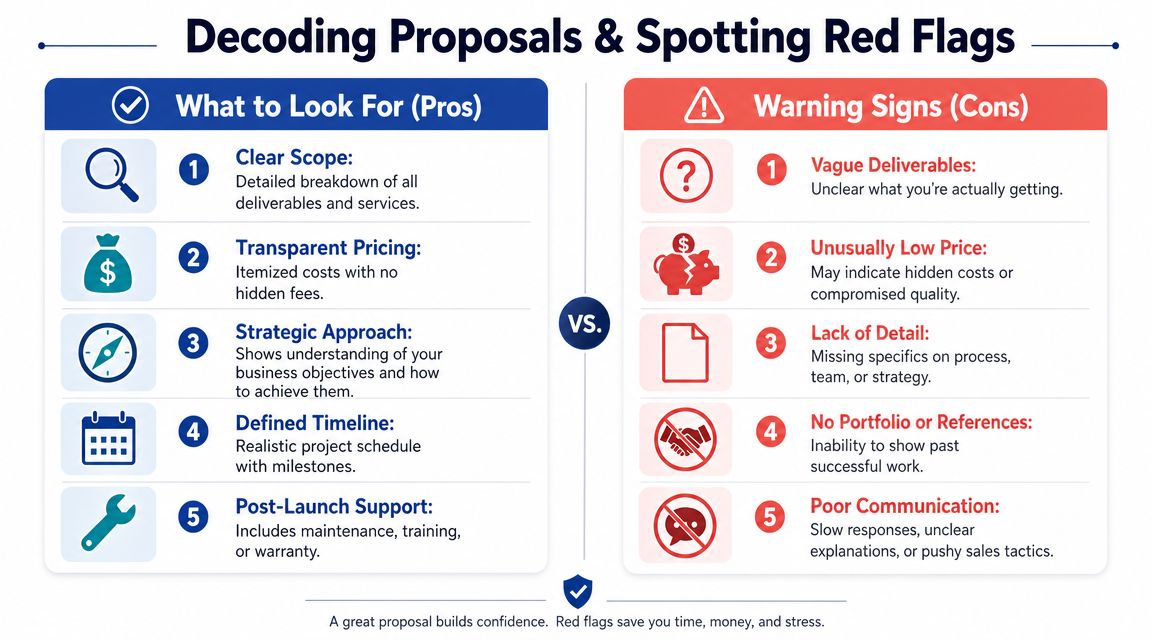
Compare proposals on scope, not headline price
Put proposals side by side and review them across the same headings:
| Area | Strong proposal | Weak proposal |
|---|---|---|
| Scope | lists deliverables in detail | vague references to “design and development” |
| Strategy | connects work to business goals | talks only about visuals |
| Timeline | includes milestones and dependencies | gives broad dates with no process |
| Team | names roles and ownership | hides who's doing the work |
| Support | explains post-launch options | stops at handover |
A lower quote often means one of three things. The scope is thinner, the process is weaker, or the agency plans to recover margin later through change requests.
Red flags I wouldn't ignore
Some problems show up before the project starts.
Watch for these:
- Vague deliverables: If you can't tell what pages, templates, integrations, tracking, or QA are included, don't sign.
- No mention of content: Content delays wreck timelines. Agencies that ignore this usually create chaos later.
- Design-heavy, strategy-light language: If the document is full of “premium”, “engaging”, and “bespoke” but thin on outcomes, be careful.
- Missing post-launch plan: Good agencies know launch creates new work.
- Pushy pricing pressure: If they rush you before clarifying scope, they're selling capacity, not fit.
A clear proposal lowers risk for both sides. A vague one protects the agency and exposes the client.
Green flags worth paying for
The best proposals usually include:
- a sharp summary of your business problem
- assumptions and dependencies
- a staged roadmap
- who owns what
- what isn't included
- how change requests are handled
- what support looks like after go-live
That kind of clarity is valuable because it prevents confusion, protects timelines, and gives you an advantage when delivery drifts.
If you're comparing ecommerce proposals specifically, this breakdown of Shopify website design cost helps you think in terms of scope and complexity rather than just staring at the total.
Frequently Asked Questions About Hiring an Agency
Should I choose a Cardiff agency over a remote agency?
Choose the stronger partner. Local access is useful, especially for workshops and early alignment, but it's secondary. If a Cardiff agency understands your business, communicates well, and can prove commercial thinking, great. If not, don't force the local angle.
Should I pay a one-off project fee or a monthly retainer?
Use a project fee for a defined build with a clear end point. Use a retainer when the site needs ongoing iteration, support, CRO, development, or campaign landing pages. If growth matters, a retainer often makes more sense after launch than before it.
Who should own the website when the project ends?
You should own the core assets you've paid for, subject to any third-party tools, platform terms, and licensed components. Get this in writing. Ask specifically about design files, code access, CMS ownership, accounts, hosting control, and analytics ownership.
What if I already have a website and hate my current agency?
Don't rebuild by default. Start with an audit. Work out whether the problem is strategy, content, performance, process, platform limitations, or a bad working relationship. Sometimes the right move is a full rebuild. Sometimes it's a focused fix.
How many agencies should I speak to?
Three is usually enough if you've written a proper brief and shortlisted carefully. Five is the upper limit before comparison quality drops and the process becomes noise.
How involved do I need to be?
More than you think. Good agencies can lead, but they still need timely feedback, commercial context, approvals, and internal access. The worst website projects usually fail because the client disappears, not because the agency can't design.
What if I don't know the right platform?
That's fine. You don't need to show up with a technical answer. You do need to show up with business clarity. A capable agency should help you choose the platform based on operating needs, growth plans, content workflows, and integration demands.
What matters most when choosing a web design agency Cardiff businesses can trust?
Three things. Strategic clarity. Evidence of commercial thinking. A credible post-launch plan.
Everything else is secondary.
If you're reviewing options and want a second opinion before you commit, Grumspot is one agency worth considering for Shopify and ecommerce projects where design, development, migration, and CRO need to work together. Even if you don't hire them, use their standard as your benchmark: clear scope, conversion thinking, and a plan for what happens after launch.
Let's build something together
If you like what you saw, let's jump on a quick call and discuss your project
Related posts
Check out some similar posts.