Top Web Design Agency Coventry: Your 2026 Guide
- web design agency coventry
- shopify agency coventry
- ecommerce web design
- hire web designer
- coventry business
Launched
May, 2026
Your website probably isn't failing in an obvious way. It still loads. It still has your logo. It still gives prospects a way to contact you.
But it may be doing a poor job at the things that matter. It may be leaking leads because forms are clunky on mobile. It may be hard to update, so your team avoids publishing anything new. If you run ecommerce, it may look polished while creating friction in navigation, search, checkout, and organic visibility.
That's why searching for a web design agency in Coventry gets frustrating fast. You'll find plenty of agencies with attractive homepages, broad promises, and portfolios full of screenshots. What you need is a partner that can connect design choices to commercial outcomes. More enquiries. Better-qualified leads. Cleaner migrations. Stronger search performance. Higher conversion intent from the traffic you already have.
For a local business owner, this is rarely just a branding project. It's often your most important digital investment for the next few years.
Finding Your Next Web Design Agency in Coventry
A familiar scenario plays out all the time. A Coventry business owner knows the site needs work, searches Google, opens ten agency tabs, and within twenty minutes every agency starts sounding the same. Everyone says they build modern websites. Everyone says they care about results. Everyone says they're strategic.
The problem is volume. The UK web design industry generated £621.3 million in revenue in 2023 and had over 2,000 agencies operating nationally, which means even a local search sits inside a crowded, competitive market rather than a small local niche, according to Made By Shape's UK web design industry research.
That matters because bad selection usually doesn't look bad on day one. It looks polished at launch, then problems appear later. Rankings dip after a rebuild. Forms break after content edits. Product filters don't match how customers shop. Your team still needs developer help for basic updates.
Practical rule: Don't hire a web design agency because their own brand looks impressive. Hire them because they can explain how your website will make or save money.
A better approach is to treat this like commercial due diligence, not creative browsing. That means defining what the site must achieve, shortlisting agencies that fit that type of work, and then testing whether their process, technical depth, and communication hold up under scrutiny.
If you want a useful outside perspective on how to evaluate agencies through a business lens, Fypion Marketing's agency guide is worth reading. It's aimed at startup decision-making, but the same discipline applies to any Coventry company choosing a digital partner.
Before You Search Define Your Website's Real Job
Most weak agency projects start with a weak brief. The brief says things like “modernise the site”, “improve the branding”, or “make it cleaner”. None of that tells an agency what the website is supposed to do.
A good website has a clear job. Sometimes that job is lead generation. Sometimes it's ecommerce revenue. Sometimes it's helping a sales team close deals by making the company look credible and easy to evaluate. If you don't define that first, agencies fill the gap with assumptions.
Start with outcomes not pages
Before you ask for a homepage redesign or a Shopify rebuild, write down the commercial outcome you want. Keep it plain.
For example:
- Lead generation site: You want more qualified enquiries, fewer irrelevant form submissions, and clearer paths to contact.
- Ecommerce site: You want smoother product discovery, cleaner collection structure, better mobile buying journeys, and less migration risk.
- Service business site: You want the site to support quoting, consultations, credibility, and local search visibility.
That forces a better conversation. An agency can challenge or support a business goal. It can't do much with “we want something nicer”.
Build a brief your finance team would respect
A practical brief doesn't need to be long. It needs to answer the right questions.
Who is the site for
Don't say “everyone”. Name the buyer types. Existing customers, procurement teams, first-time visitors, repeat purchasers, trade buyers, local service prospects.
What is the primary action
Choose the main action you want users to take. Enquiry. Booking. Purchase. Sampling. Phone call. Store locator use.
What must the site include
Split this into must-haves and nice-to-haves. Product filters, quote forms, trade pricing, subscriptions, ERP integration, multilingual content, booking tools, gated downloads.
What can't go wrong
Business-critical risks include: Losing rankings during migration. Breaking paid landing pages. Making the CMS harder for staff. Slowing the site down with visual effects.
What budget range is realistic
If your real budget sits at the lower end of the market, say so early. If your scope involves ecommerce, integrations, or complex content architecture, pretending you want all of that on a starter budget wastes everyone's time.
Separate platform choice from agency choice
A common mistake is assuming every agency can handle every platform equally well. They can't. Some are strong on brochure sites in WordPress. Some are capable with Shopify theme customisation. Fewer are set up for complex rebuilds, migration planning, or conversion-led ecommerce work.
The platform is not the strategy. It's the operating environment for the strategy.
Your brief should answer platform questions only where they affect business needs. If you already know you need Shopify because of product catalogue, apps, and operations, say that. If you're unsure, frame the problem instead: “We need a store our internal team can manage without developer dependency.”
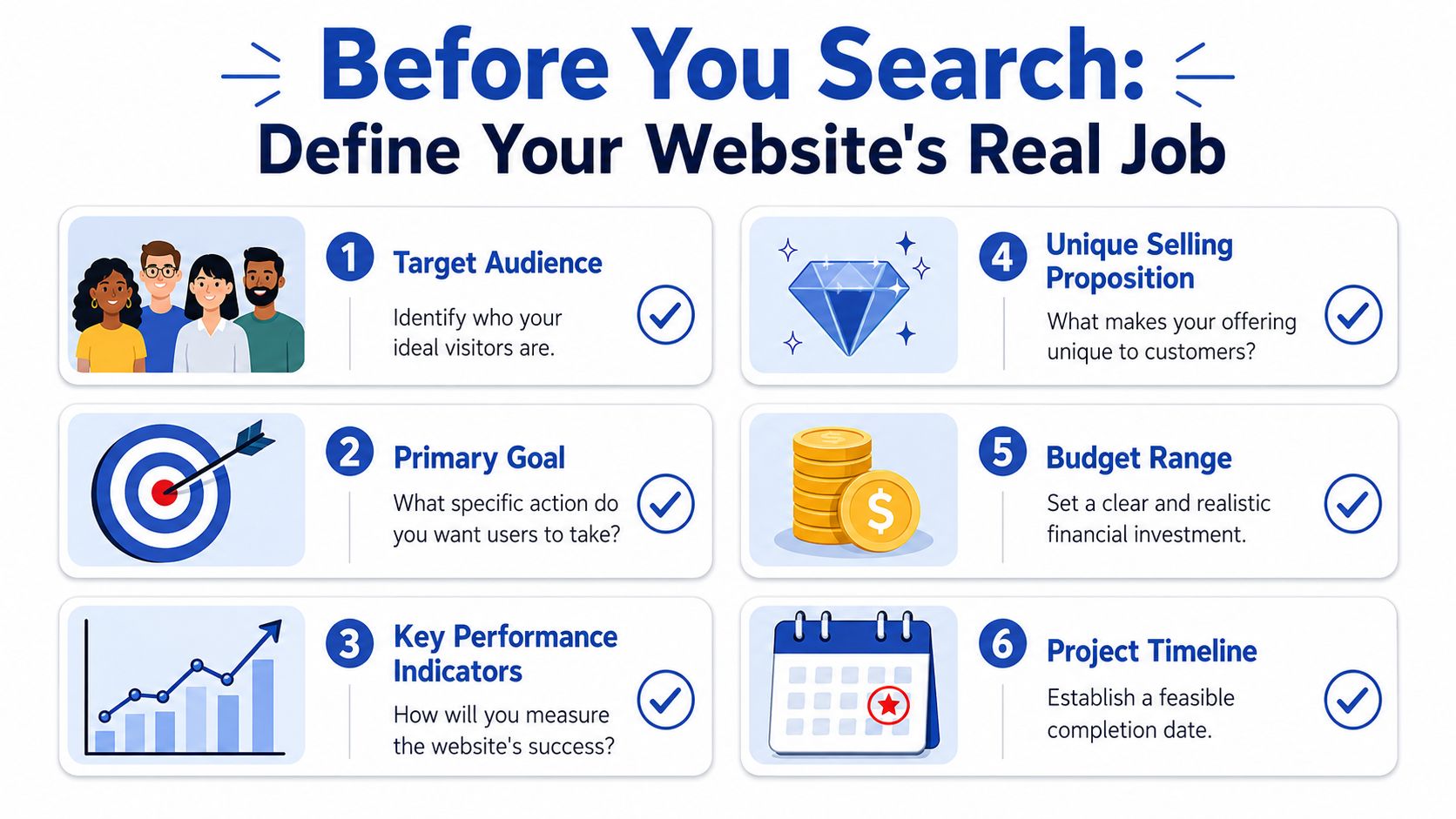
The six-point pre-agency checklist
- Audience clarity: Write down your ideal visitors and what they need from the site.
- Commercial priority: Define the single most important action the website must drive.
- Measurement: Decide what success looks like in business terms, not just visual approval.
- USP: State why a customer should choose you over a nearby competitor.
- Budget band: Give a realistic investment range.
- Timing: Note hard deadlines, but don't force an unrealistic launch date that compromises quality.
If you bring that to first meetings, agencies will usually reveal their level quickly. Strong ones ask sharper questions. Weak ones jump straight to moodboards.
Finding and Shortlisting Coventry Agencies
A Coventry business owner can lose weeks here. Three calls with polished agencies, a few attractive proposals, and you still have no clear view of who can build a site that brings in leads or supports revenue growth.
Shortlisting works better when treated as commercial filtering, not creative shopping.
The aim is simple. Get to a list of agencies that fit your business model, your platform needs, and the level of risk in the project. A five-page brochure site for a local service firm is one thing. A Shopify Plus rebuild with migration, search traffic to protect, and conversion targets is another. If you mix those up, the shortlist becomes noise.
Build your longlist from buying signals
Start with Google, local referrals, and the sites of Coventry businesses doing a good job online. Then look for evidence that an agency handles the kind of problem you have.
Good early signals include:
- Relevant project type: Lead generation, ecommerce, brochure sites, or multi-location businesses
- Platform focus: WordPress, Shopify, Shopify Plus, or custom builds
- Commercial services around the build: SEO, tracking setup, CRO, paid landing pages, content structure
- Proof of real delivery: Named clients, live websites, case studies with outcomes, or a clear process
- A credible own website: Clear messaging, working forms, sensible page structure, and no obvious quality issues
This saves time fast.
An agency can be local and still be wrong for the job. I have seen manufacturers shortlist agencies that mostly build restaurant and salon websites, then wonder why the proposal talks about visuals but says nothing useful about lead quality, CRM integration, or technical SEO.
Filter for fit before you look for flair
At shortlist stage, sector fit matters more than broad claims. “We design beautiful websites” tells you almost nothing. “We help B2B firms simplify complex services and increase qualified enquiries” is far more useful because it hints at how they think.
Use first-pass elimination if you spot any of these issues:
- No clear specialism or target client
- Portfolio examples that cannot be visited live
- Vague service pages with no explanation of process or scope
- No sign they handle content, SEO, measurement, or post-launch support
- Platform language that feels generic rather than specific
- Case studies focused only on appearance
For ecommerce projects, the gap gets wider. A general web studio may produce a decent-looking storefront, but that is not the same as handling catalogue logic, collection structure, redirects, app conflicts, checkout constraints, or migration risk. If that is your brief, this guide on how to hire the right Shopify agency in 2026 is a useful filter before you book meetings.
Keep the shortlist tight enough to compare properly
Three to five agencies is usually enough. Beyond that, decision quality drops because every conversation starts to blur into the next.
Use a simple comparison sheet. The point is not to score agencies with false precision. The point is to make trade-offs visible.
| Agency check | What to look for |
|---|---|
| Business model fit | Have they worked with similar sales cycles, margins, or customer questions? |
| Platform fit | Do they build regularly on the platform your project requires? |
| Search and conversion awareness | Do they talk about enquiries, revenue, search visibility, and user journeys, not just design? |
| Delivery credibility | Can you see live work, real examples, and a process that matches the size of your project? |
| Team access | Will you speak to the people doing the work, or only to sales? |
| Support after launch | Is there a clear plan for fixes, improvements, and ownership once the site goes live? |
One more practical point. If an agency seems capable but cannot explain who will manage content migration, QA, redirects, or analytics setup, leave them off the shortlist for any serious rebuild. Those are the parts that affect performance after launch, and they are often where expensive problems start.
A good shortlist should leave you with real options, not polite maybes.
The Deep Dive Vetting Portfolios and Technical Skills
Most buyers get misled. They look at screenshots, react to visual style, and assume design quality equals commercial quality.
It doesn't.
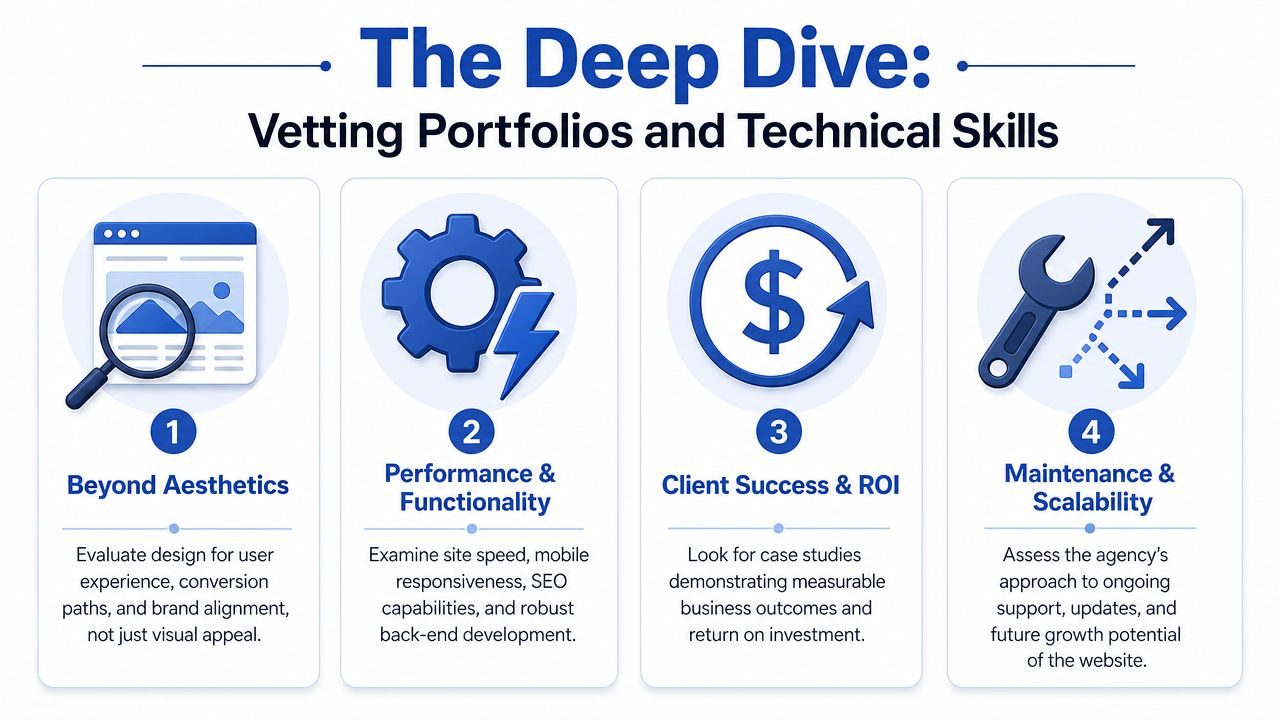
A strong agency portfolio should answer harder questions. Can this team organise information clearly? Can they design a journey that helps users complete a task? Can they handle platform constraints, search visibility, and future updates without creating chaos later?
Visit the live sites not just the portfolio page
A screenshot hides the hard parts. A live site exposes them.
Open portfolio examples on your phone. Explore collection pages. Test menus. Click forms. Try filtering products. Read a long page. Look at the footer. Search for policies, delivery information, or service details. If it's a lead generation site, ask yourself whether the path to contact is obvious. If it's ecommerce, ask whether buying feels easy or effortful.
A portfolio earns trust when the live work feels considered under normal use, not just when viewed as a glossy tile on an agency homepage.
Good design is visible. Good decision-making is testable.
Look for technical competence in plain sight
You don't need to be a developer to assess technical depth. You need to listen for specifics.
For ecommerce work, one of the biggest hidden risks is hiring a generalist team for a specialist problem. Dreamscape Design's discussion of web design highlights that the core challenge is often technical, especially around SEO-safe migrations and post-launch CRO, rather than broad claims about “brand visibility”.
That distinction matters a lot on platforms like Shopify and Shopify Plus, where projects often involve more than theme styling. They involve navigation architecture, template logic, app overlap, content migration, tracking setup, search preservation, and experimentation after launch.
What strong ecommerce capability sounds like
An agency with real ecommerce depth usually speaks clearly about issues like:
- Migration planning: How URLs will be handled, how redirects are mapped, how category structures are preserved, and how launch risk is controlled.
- Theme strategy: Whether they're adapting an existing theme responsibly or building a more bespoke front end for specific business needs.
- App and integration discipline: Which features need apps, which should be built more carefully, and where operational systems like ERP or CRM affect storefront design.
- Post-launch testing: How they validate that key journeys still work after release and what gets reviewed first.
If their answer is mostly about fonts, animations, and homepage banners, they're probably not the right fit for a commercially serious store.
Ask for proof in the right format
Many agencies don't publish full case studies with metrics, and you shouldn't force them to invent them. But you can still ask for evidence in practical forms.
Ask them to show:
- A before-and-after explanation: What changed and why.
- A walkthrough of business constraints: Legacy platform, product complexity, poor CMS setup, search concerns.
- A sample decision: Why they changed collection navigation, form structure, PDP layout, or content hierarchy.
- What happened after launch: What they monitored, fixed, or improved.
If you want a structured way to review agencies during this stage, this guide on how to choose a web design agency is a useful checklist for comparing process, capability, and fit.
Maintenance and scale matter more than the pitch deck
Websites rarely fail at launch. They fail six months later when nobody can safely update them.
Ask who will maintain templates, how components are documented, how non-technical staff are expected to use the CMS, and what support looks like when your team needs changes. Ignoring these factors often leads to many stylish projects becoming expensive liabilities.
One practical example is a Shopify store with custom sections that only the original developer understands. It might look excellent, but if every merchandising update needs technical support, your internal team loses speed. That's a design problem, not just a development problem.
For businesses reviewing specialist ecommerce partners, agencies such as Grumspot work specifically on Shopify design, development, migrations, audits, and CRO-focused rebuilds. That kind of narrower service model is often more relevant for a scaling store than a general local agency that mainly produces brochure sites.
The Consultation Key Questions and Critical Red Flags
Shortlist calls should feel like a working conversation, not a performance. You're not there to be dazzled. You're there to find out how this agency thinks, how clearly they communicate, and whether they can spot risks before they become your problem.
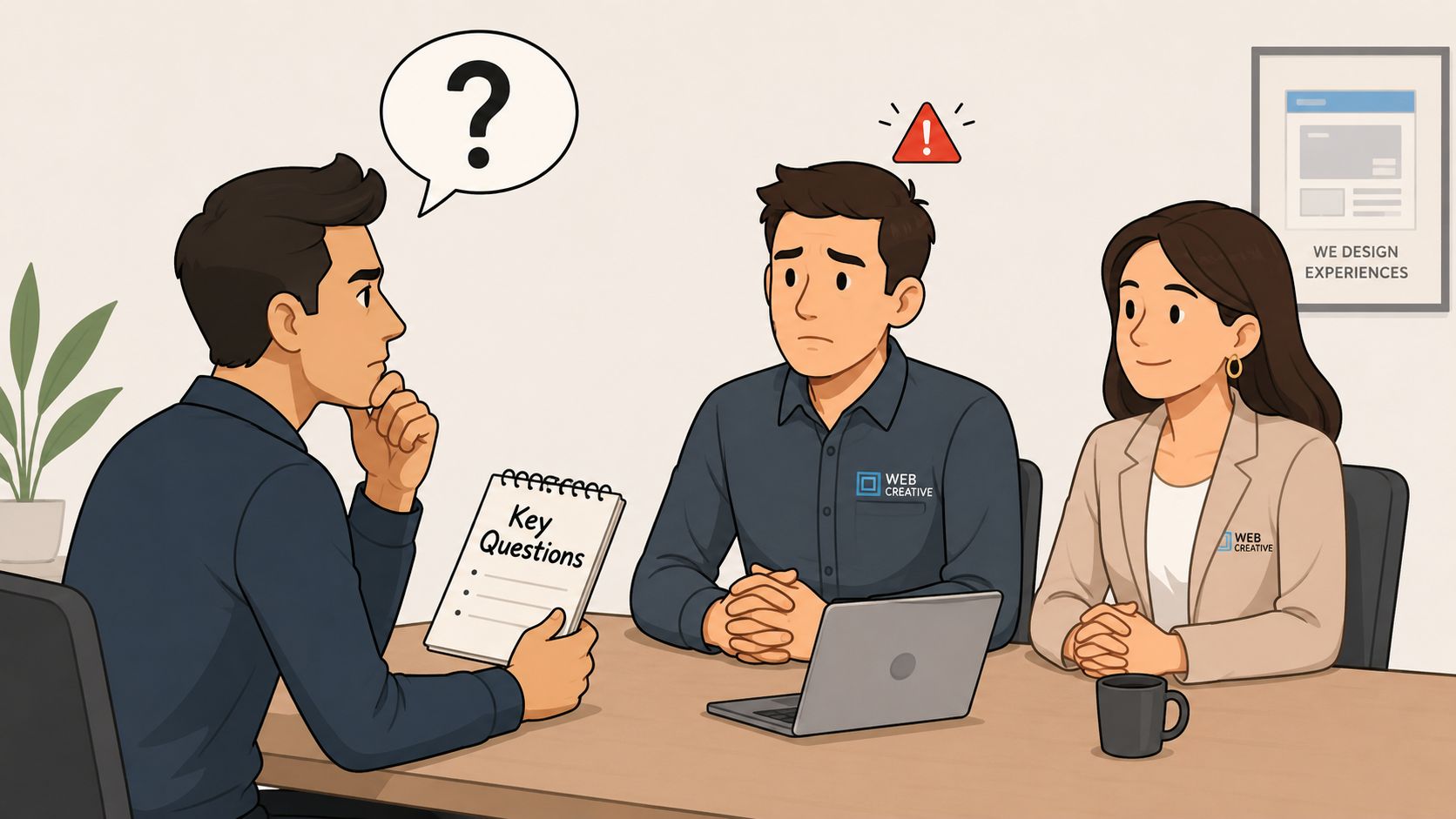
A useful consultation usually becomes more specific as it goes on. Weak agencies stay broad. Strong agencies narrow the conversation into actual decisions, trade-offs, and responsibilities.
Questions that reveal how they really work
Ask direct questions, then stay quiet long enough to hear whether the answer has substance.
Who will work on this project? You want names or roles, not just “the team”.
Who owns strategy, design, development, QA, and content population?
If nobody owns something, it will drift.How do you handle mobile-first design decisions?
This matters for both lead generation and ecommerce journeys.How do you protect SEO during a rebuild or migration?
Listen for process, not promises.What happens after launch?
Ask what they monitor, what support is included, and what their handover looks like.How do you make sure internal staff can update the site safely?
A good CMS setup should reduce dependence on the agency for routine changes.
Accessibility is not an optional extra
A lot of Coventry agency content still leads with visuals and responsiveness, but the more revealing test is accessibility and compliance. Honcho's Coventry web design page points to a useful due-diligence question here. With 16.1 million disabled people in the UK in 2022/23, around 24% of the population, asking an agency how they prove a site works for screen reader users or keyboard navigation is a serious commercial and legal question, not a niche one.
Ask them things like:
- How do you test keyboard navigation?
- How do you handle contrast, form labels, alt text, and heading structure?
- Do you build accessibility checks into QA or treat them as a bolt-on?
- How do you review accessibility after content updates or template changes?
Ask, “How do you prove this site works for screen reader users?” A vague answer usually means accessibility wasn't built into their workflow.
An agency with real technical discipline should be able to describe a process. Auditing templates. Checking mobile journeys. Using semantic HTML correctly. Testing with assistive technology and automated tools. Re-checking after updates. If they only say “we make sites responsive”, that's not enough.
Watch how they handle difficult trade-offs
The best consultation question is often a scenario question.
Ask what they'd do if:
- Your current rankings are valuable but the site structure is poor
- You need a faster launch but there's a backlog of product data issues
- Marketing wants more visual flair but performance is already fragile
- Your internal team needs editing flexibility but brand consistency is slipping
Good agencies won't pretend every goal can be maximised at once. They'll explain what they'd prioritise and why.
Here's a useful reference point before or after your calls:
Red flags worth taking seriously
Some warning signs are obvious. Others are easy to rationalise when you like the agency.
Be cautious if they:
- Guarantee rankings or “number one on Google”
- Quote confidently before understanding your scope
- Avoid discussing accessibility, SEO risk, or CMS governance
- Refuse to let you speak with past clients
- Push hard for a quick signature
- Talk mostly about visual trends and very little about business outcomes
A good consultation leaves you clearer about the work. A bad one leaves you excited but still unsure what you're buying.
That difference matters more than chemistry.
Decoding Proposals Pricing Timelines and Contracts
A Coventry business owner gets three proposals for the same rebuild. One is cheap and vague. One is expensive and polished. One sits in the middle but spells out who is doing what, when content is due, how redirects will be handled, and what happens after launch. The third proposal usually gives you the best buying position, even if it is not the lowest fee.
That matters because proposals are not design documents. They are commercial risk documents. They show whether an agency understands the job as a business asset that needs to preserve rankings, improve enquiries, or grow ecommerce revenue, not just produce a nicer homepage.
Compare scope before cost
Read proposals in this order:
- Deliverables
- Assumptions
- Timeline
- Responsibilities
- Price
Price only makes sense once scope is clear.
A proposal for a brochure site and a proposal for a conversion-led ecommerce rebuild can both say “website redesign” and mean completely different things. One may include strategy workshops, wireframes, technical SEO planning, product data handling, analytics setup, redirect mapping, QA, training, and a post-launch support period. Another may cover design and build only, leaving your team to sort the risky parts later.
That is where overruns start. Not because the agency is always acting in bad faith, but because buyers sign off before the work is defined tightly enough.
Use a simple test. If you gave the proposal to another agency, could they understand exactly what has been sold? If not, you do not have enough detail yet.
A quick benchmark helps frame expectations, but treat ranges as directional, not a quote.
| Project Type | Estimated Cost | Typical Timeline |
|---|---|---|
| Basic business website | Lower four figures | Often shorter if content and approvals are ready |
| Advanced ecommerce or custom web project | Mid to high four figures, sometimes more | Usually longer where integrations, migration, or large catalogues are involved |
For Shopify work, the biggest pricing swings usually come from catalogue complexity, custom theme requirements, third-party apps, ERP or warehouse integrations, and migration risk. If you need a clearer commercial baseline, this guide to Shopify website design cost breaks down how scope changes the budget.
Fixed fee or retainer
Both models can work. The wrong model creates friction fast.
A fixed-project fee suits a defined rebuild with clear outputs, approval stages, and limited moving parts. It gives budget certainty, but only if the proposal is specific about rounds of revisions, who supplies content, and what counts as out of scope.
A retainer suits businesses treating the website as an active sales channel. That is common with Shopify Plus and other ecommerce setups where the main return comes after launch through landing page tests, merchandising changes, conversion work, performance fixes, and ongoing technical support.
I usually advise Coventry firms to be cautious with a retainer that starts before the agency has shown a clear operating plan. A monthly fee only makes sense if you know what work will be delivered, how results will be measured, and who on the agency side is assigned to the account.
Contract terms that protect you
Contracts need to answer ownership, accountability, and delay risk in plain English.
Check these points carefully:
- IP ownership: Confirm you own the finished site assets and agreed deliverables once payment terms are met.
- Payment schedule: Tie payments to real milestones such as approved designs, staging sign-off, or launch readiness.
- Change control: Make sure there is a written process for pricing extra requests before work starts.
- Support window: Define how long bug fixing lasts after launch and what is classed as a bug.
- Dependencies: State what your team must supply, including content, product data, approvals, access, legal sign-off, and feedback times.
- Exit position: Confirm what happens if the relationship ends early, including access to files, code, hosting, domains, and admin accounts.
One clause deserves extra attention on ecommerce projects. Ask who carries the risk if product data, tracking, redirects, or payment integrations are incomplete at launch. If the contract is silent on that point, the problem usually lands on your side later.
Good proposals reduce ambiguity. Good contracts reduce surprise.
If your project involves Shopify, a complex rebuild, migration risk, or conversion-led ecommerce design, Grumspot is one option to consider. The team works on Shopify design and development, storefront rebuilds, migrations, audits, and ongoing support for brands that need more than a visual refresh.
Let's build something together
If you like what you saw, let's jump on a quick call and discuss your project
Related posts
Check out some similar posts.

- web design agency leicester
Find the best web design agency leicester for your ecommerce brand. Our 2026 guide covers Shopify ex...
Read more
- web design agency southampton
Find the best web design agency Southampton. Our 2026 guide covers vetting, pricing, red flags & cho...
Read more
- web design agency sheffield
Find the best web design agency Sheffield. Our 2026 guide covers vetting portfolios, pricing, Shopif...
Read more
- web design agency leeds
Our 2026 guide helps you find & hire the best web design agency leeds. Get checklists, pricing bench...
Read more