Find Your Web Design Agency Leicester: Top Partner Guide
- web design agency leicester
- shopify agency leicester
- ecommerce web design
- leicester web design
- cro agency
Launched
July, 2026

A lot of Leicester business owners start looking for a web design agency when the website problem has already become expensive.
The site looks acceptable. It even gets traffic. But product pages feel clunky, mobile browsing is awkward, the checkout journey leaks intent, and every change turns into a workaround. If you're running an ecommerce brand, that gap matters. A website isn't a brochure. It's your sales environment, your merchandising layer, your operational bridge into stock, fulfilment, CRM, subscriptions, and customer retention.
That's where many searches for a web design agency Leicester go slightly off course. The local market has plenty of capable generalists. But if your store needs platform migration, conversion work, or deeper Shopify architecture, a generic build can lock you into the wrong stack and the wrong process.
Finding the Right Web Design Partner in Leicester
The usual starting point is frustration.
Your current site may be slow, hard to update, visually dated, or not built for how people buy online. Teams often tell me the same thing in different words: “We've outgrown what we have, but we're not sure whether we need a redesign, a rebuild, or a different platform entirely.”
That uncertainty is normal. It's also where many businesses make a costly decision. They hire the nearest agency that can produce a polished homepage mock-up, without digging into platform fit, checkout behaviour, product data structure, or what the site needs to support six months from now.
Start with the business problem
Before you compare portfolios, get clear on the issue. In practice, it usually sits in one of these areas:
- Platform mismatch: The site was built on a CMS that's easy to launch on, but awkward to scale.
- Conversion friction: Buyers can browse, but the path to basket and checkout feels heavier than it should.
- Operational drag: Product updates, promotions, bundles, subscriptions, and integrations all require manual effort.
- Technical weakness: Search visibility suffers because the site underperforms on speed and user experience.
A serious partner should be able to separate those issues. If they can't diagnose the problem properly, they'll default to what they already sell.
Local access matters less than specialist fit
For a service business or brochure site, local proximity can be useful. For ecommerce, specialist capability usually matters more. The right question isn't “Are they in Leicester?” It's “Have they solved this exact ecommerce problem before?”
That's also why it helps to understand the wider decision beyond agencies alone. If you're weighing a freelancer, internal hire, or outside team, this breakdown of hiring models for software engineers is a useful way to think about responsibility, speed, and technical depth.
Practical rule: Don't buy a website. Buy the capability your next stage of growth needs.
What good selection looks like
A strong agency conversation should quickly move beyond colours and layout.
You want to hear questions about catalogue complexity, customer journeys, mobile behaviour, app bloat, content migration, SEO preservation, merchandising control, and how your team will manage the store after launch. If the discussion stays at “we can build you a modern site”, keep looking.
What to Expect from a Standard Leicester Agency
Leicester sits inside a very competitive national market. The UK web design industry includes 2,041 actively operating web design agencies, according to Made By Shape's industry statistics and trends summary. That matters because choice isn't the problem. Fit is.
Most standard agencies in Leicester offer a familiar package. They build brochure sites, business websites, and general-purpose CMS projects. For many companies, that's perfectly reasonable. A local accountancy firm, consultancy, or trades business doesn't necessarily need a specialist commerce stack.
The standard local offer
A typical agency package often includes:
- Custom WordPress builds: Flexible content management, page templates, and editable sections.
- Branding and visual design: Logo work, colour systems, typography, and general design cleanup.
- Basic SEO setup: Metadata, page structure, mobile responsiveness, and local search foundations.
- Ongoing maintenance: Hosting support, plugin updates, content changes, and occasional landing pages.
None of that is bad. In fact, for the right project, it's enough.
The issue starts when a growing ecommerce brand buys a standard agency service and expects specialist commerce outcomes from it.
Where standard delivery tends to stop
A general agency usually optimises for launch, not for retail complexity. That means the work often centres on appearance, CMS usability, and broad digital marketing support. What it may not cover in depth is the engineering and experimentation required for an online store that needs to scale cleanly.
Here's the practical difference:
| Need | Standard agency response | What scaling ecommerce often needs |
|---|---|---|
| Product catalogue changes | Manual CMS updates | Structured merchandising logic |
| Checkout improvement | Theme tweaks | Platform-aware conversion work |
| Systems integration | Limited plugins | ERP, CRM, fulfilment integration planning |
| Growth testing | General advice | Ongoing CRO with design and dev support |
That gap is easy to miss in a sales call because both types of agency can say they “build ecommerce websites”. But the phrase covers very different levels of technical depth.
Why local reputation alone isn't enough
Leicester has recognised providers and a healthy digital ecosystem. That gives businesses plenty of options. It doesn't guarantee that the agency you shortlist is right for Shopify architecture, migration planning, or a conversion-led rebuild.
A beautiful site can still underperform if the platform, data model, and checkout experience were the wrong choices from day one.
If you're comparing agencies, treat “full-service” carefully. In many cases it means the team can handle a broad range of tasks. It doesn't always mean they have deep expertise in the one platform your revenue depends on.
Solving Ecommerce Challenges Generic Agencies Cannot
At this point, the split becomes obvious.
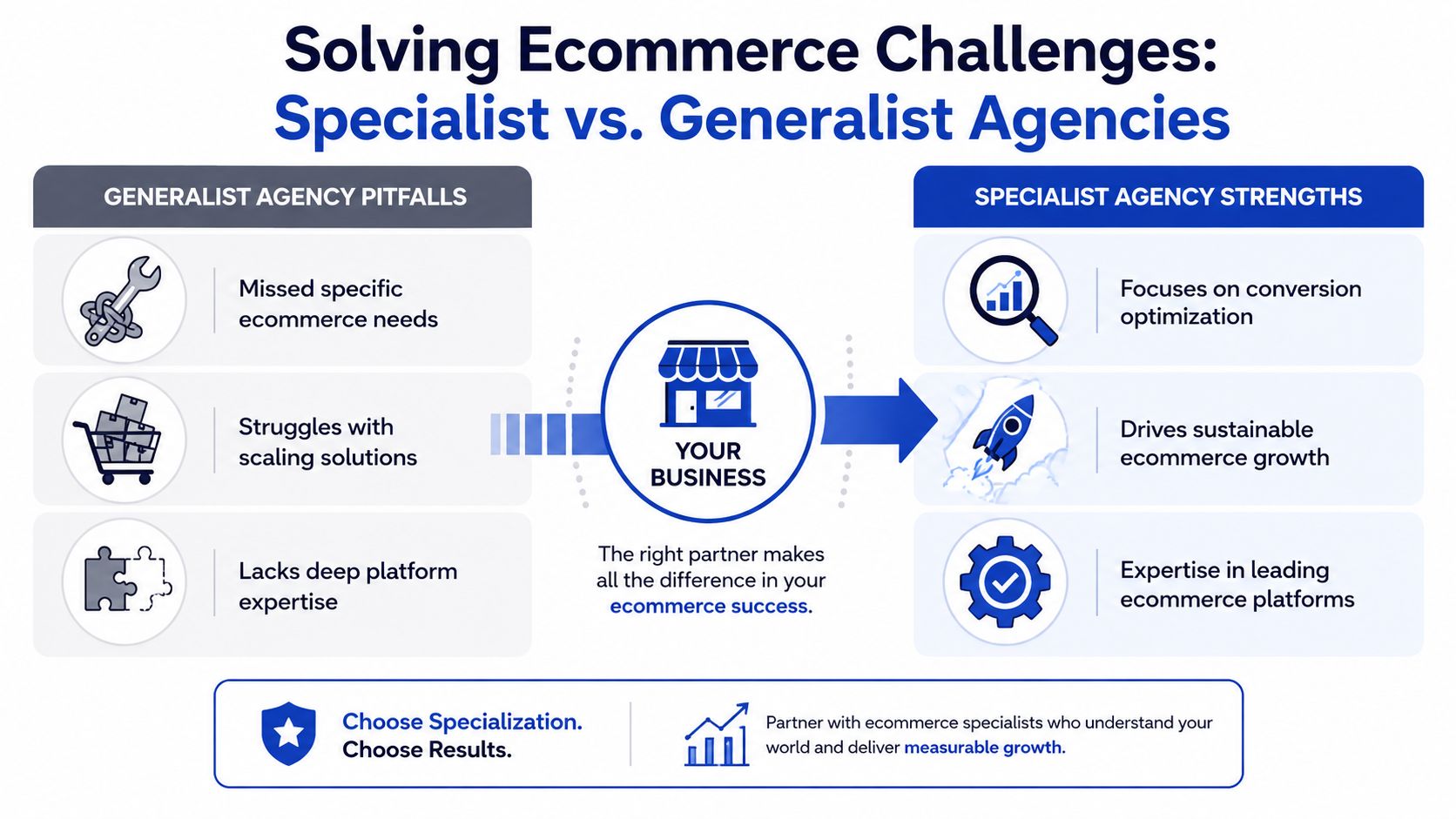
Many top-ranking Leicester agencies present themselves around bespoke WordPress or broader digital marketing services. That leaves a gap for merchants who need Shopify Plus capability, especially when the job involves Shopify 2.0 migrations, complex integrations, or custom app work. DesignRush's Leicester agency market also highlights that mismatch, and cites UK data showing 68% of ecommerce businesses using generic platforms like WordPress fail to achieve the conversion rates of Shopify Plus merchants because of plugin limitations and slower checkout speeds in this context of agency fit and platform choice, as referenced in DesignRush's Leicester web design agency listing and market view.
Migration is not just moving pages
A lot of merchants come from WordPress, WooCommerce, or a heavily modified legacy setup. They assume migration means exporting products, importing content, and applying a new theme.
That's the easy part.
The hard part is preserving what already works while removing what doesn't. That includes collection logic, redirect mapping, on-page SEO equity, variant structures, filtering behaviour, customer accounts, subscription rules, app replacement, and internal workflows for the team that runs the store every day.
If an agency treats migration like a design project, the launch often creates new problems. Rankings disappear from poorly handled URL changes. Product data becomes inconsistent. Staff lose confidence in the admin. Apps get piled on to fill gaps the build should have solved natively.
Shopify Plus changes the design brief
On higher-growth stores, the brief isn't “make it look better”. It's closer to this:
- Reduce friction in the path to purchase
- Support merchandising without constant developer intervention
- Connect the storefront to operational systems cleanly
- Create room for testing, internationalisation, bundles, subscriptions, and repeat purchase flows
That's why Shopify Plus work needs specialists who understand the platform as a commerce system, not just a visual front end.
A generic agency may be comfortable with templates and page builders. A specialist ecommerce team should be comfortable with product architecture, liquid logic, app ecosystems, theme performance, checkout constraints, and platform-native trade-offs.
CRO work depends on the right foundation
Conversion rate optimisation is often misunderstood. It isn't just button colour tests or swapping headlines around.
Real CRO starts with diagnosing intent leaks. Are product pages doing enough to answer objections? Is mobile media helping or slowing decisions? Is the cart clear? Are variant choices intuitive? Are trust signals placed where hesitation happens? Does the architecture encourage discovery without creating clutter?
Those are design questions, but they're also development questions.
The wrong platform forces teams into workarounds. The right platform gives them control.
That's why a specialist partner matters. CRO only works properly when design, development, analytics, and platform capability are aligned. If the stack is fighting the strategy, every improvement takes longer and costs more than it should.
If you're evaluating what that specialist layer looks like in practice, this guide on ecommerce development in the UK is a useful reference point.
A Checklist for Choosing Your Web Design Partner
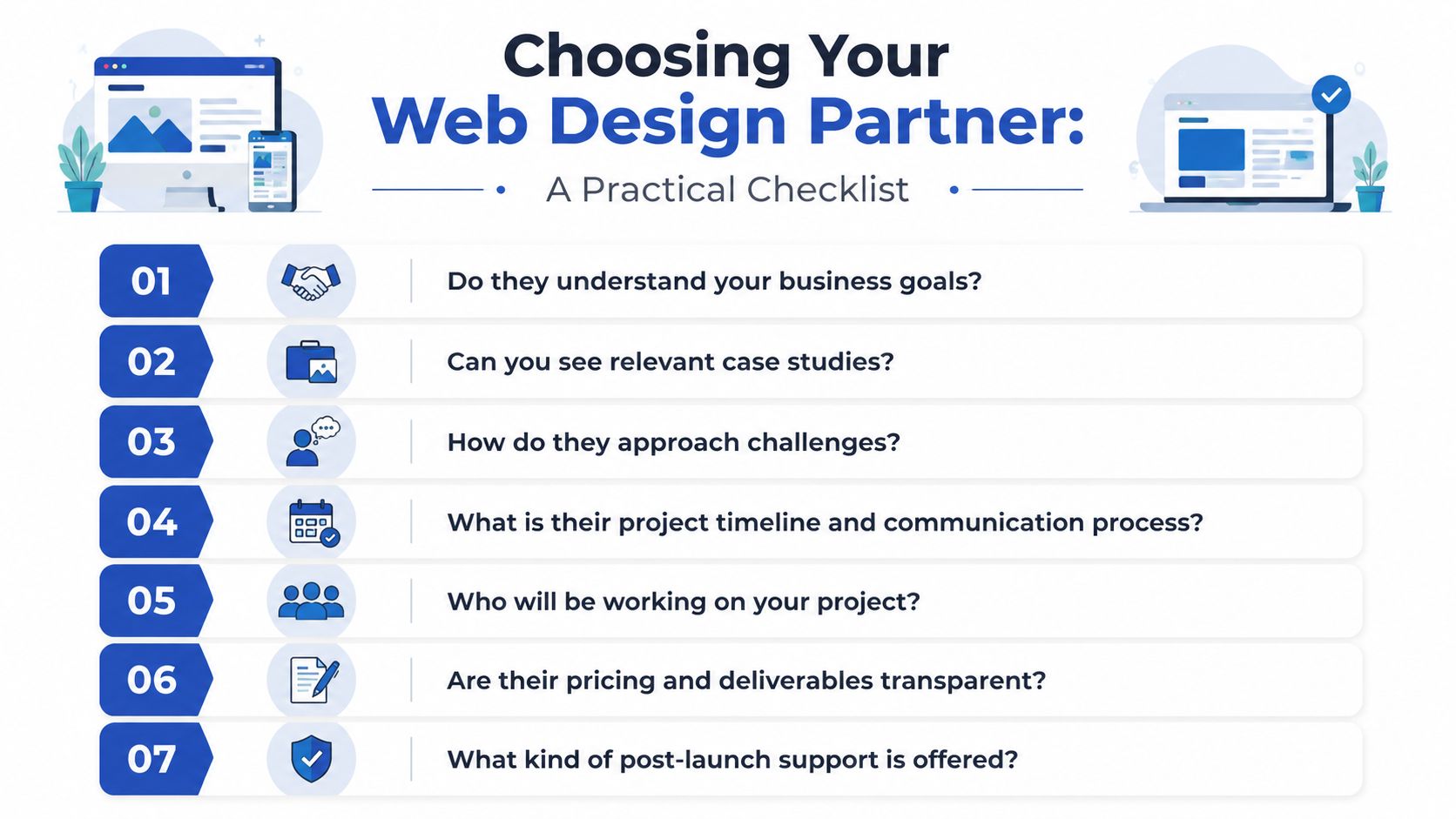
Most agency selection mistakes happen before the project even starts. The business asks to see a portfolio, gets a price, likes the design direction, and moves ahead. That's not enough for ecommerce.
You need to test how the agency thinks, what they measure, and whether they can handle the technical reality behind the visuals.
The technical baseline
For UK web design agencies, the 2026 baseline for technical performance is Google Lighthouse Performance scores above 90 and full Core Web Vitals compliance, according to FactoryJet's 2026 agency selection checklist. If an agency can't talk clearly about performance budgets, render-blocking assets, media handling, and Core Web Vitals trade-offs, that's a warning sign.
Ask direct questions.
- Performance standard: Will they build toward Lighthouse scores above 90 and explain how they'll protect Core Web Vitals?
- Platform judgement: Can they explain why your business should stay on the current platform or move away from it?
- Integration depth: Have they handled ERP, CRM, subscription, or fulfilment system requirements before?
- Testing process: What happens before launch, and who signs off key flows like navigation, cart, and checkout entry points?
A strong agency won't dodge those questions. They'll welcome them.
Here's a useful video if you want another perspective on evaluating agencies before you commit:
The commercial questions most buyers forget
Technical quality matters, but the commercial side matters just as much. Ask how the engagement is run.
Who does the work? Sales-led agencies sometimes win projects and hand them to a junior team. You need clarity on designers, developers, strategists, and who owns delivery.
How are decisions documented?
If scope, milestones, and responsibilities stay vague, timelines drift and accountability disappears.What happens after launch?
Some agencies are good at delivery and weak at support. Ecommerce sites need post-launch iteration, not a handover and silence.How do they approach change requests?
Good partners don't panic when priorities shift. They explain impact on cost, timing, and dependencies.
Ask for process, not promises. “We care about quality” means nothing unless they can show how quality is checked.
A practical shortlisting filter
Use this quick filter before any proposal stage:
| Question | Good sign | Weak sign |
|---|---|---|
| Do they discuss business goals early? | They ask about revenue model, margin, operations, and customer journey | They focus on visual style first |
| Can they explain platform trade-offs? | They compare constraints honestly | They recommend their default stack immediately |
| Do they define post-launch support? | Clear support model and optimisation path | Vague maintenance language |
| Can they show relevant thinking? | They explain why decisions were made | They only show polished screenshots |
If you want a deeper framework for vetting options, this article on how to choose a web design agency gives a useful decision lens.
Our Project Process From Discovery to Launch
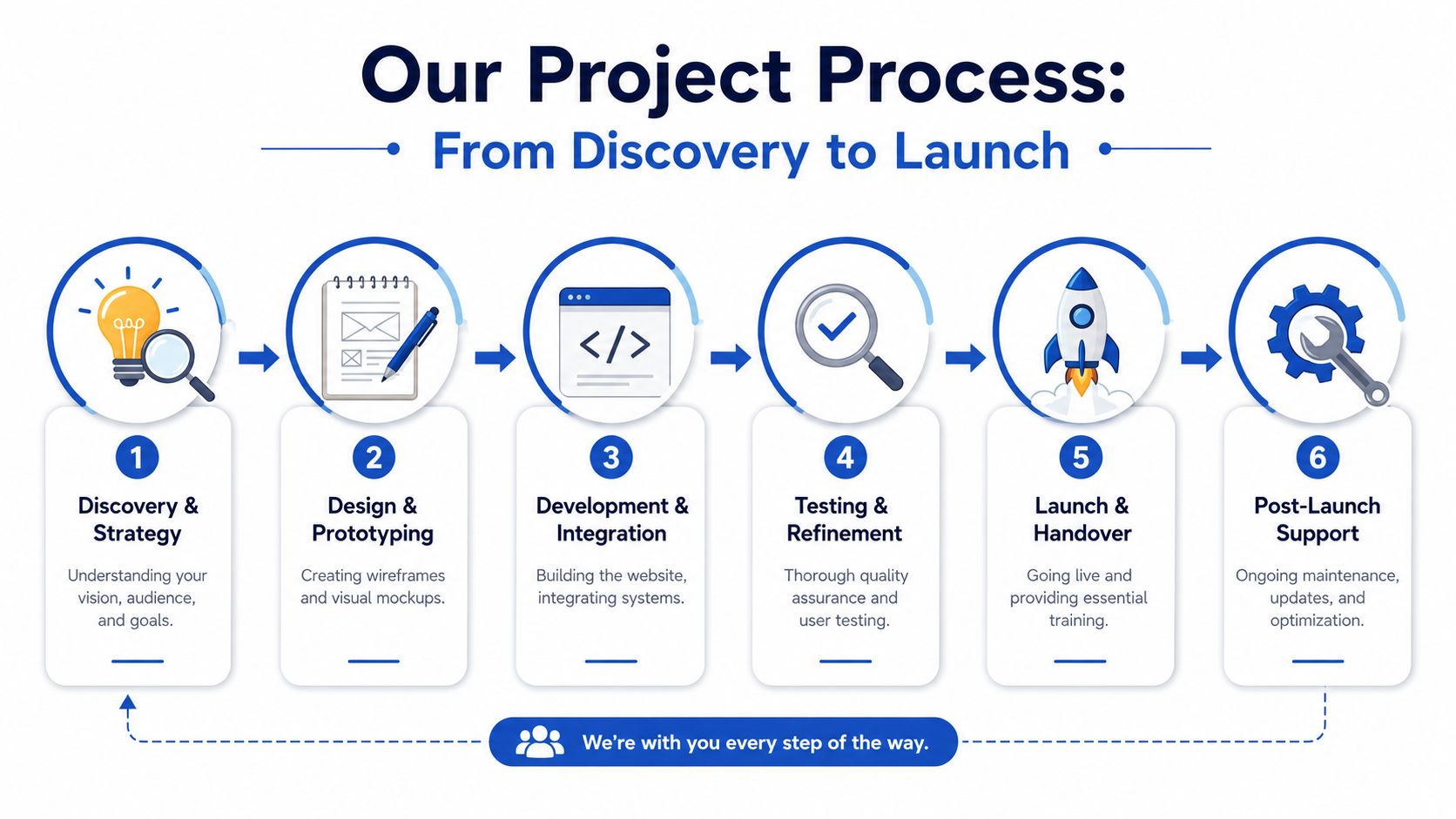
A good project process removes ambiguity early. It tells the client what decisions are needed, when feedback matters, and how the build moves from strategy into a working store without chaos.
The strongest ecommerce projects I've seen all share one trait. They don't jump into Figma on day one. They start by getting the commercial and operational picture right.
Discovery and strategy
At this stage, the project either becomes focused or starts drifting.
The first phase should surface product structure, customer behaviour, key pages, technical constraints, integrations, and business priorities. If subscriptions, bundles, trade pricing, multi-market setup, or fulfilment rules matter, they need to shape the build from the start.
A useful discovery phase also identifies what shouldn't be carried over. Not every content block, plugin, or historic page deserves to survive a rebuild.
Design and prototyping
Strong design work solves commercial problems. It doesn't just create a cleaner interface.
That means wireframes should clarify hierarchy, product discovery, decision support, and mobile interaction before visual polish is layered in. By the time high-fidelity design appears, the team should already understand how users move from landing page to product page to basket.
Good ecommerce design reduces hesitation. It doesn't add decoration and hope for the best.
Development and integration
This is usually where agency quality becomes visible.
A disciplined build phase keeps theme logic clean, avoids unnecessary app dependence, and makes room for integrations without turning the storefront into a patchwork. Product templates, collection behaviour, metafields, search, filtering, and merchandising controls should all be shaped around how the business operates.
For stores with operational complexity, development also needs close coordination with stock systems, CRMs, fulfilment platforms, or internal workflows. If those conversations happen too late, the build becomes reactive.
Testing, launch, and support
Pre-launch testing needs to cover more than broken links and spelling.
Use a structured sign-off process for mobile UX, navigation states, collection filtering, product variants, cart behaviour, customer journeys, content formatting, and analytics setup. The goal is simple: no surprises after go-live.
After launch, the project shouldn't stop. Early post-launch work often reveals what customers hesitate on, where merchandising needs refinement, and which parts of the site deserve another round of iteration.
A reliable agency treats launch as the start of live optimisation, not the finish line.
Web Design Pricing in Leicester and Project FAQs
Price matters, but the cheapest mistake in web design is often the brief, not the invoice. If the project is underscoped or pushed onto the wrong platform, the business usually pays again later through rebuilds, workarounds, and lost sales opportunities.
For Leicester, regional pricing gives a useful baseline. According to RR Web Design's Leicester pricing overview, simple brochure sites typically cost around £500, most small business websites fall within the £1,500 to £5,000 range, and complex e-commerce stores exceed £10,000 in 2026 projections for the local market.
How to interpret those price bands
Those ranges make sense if you look at project type rather than just page count.
| Project type | What that usually covers | What often pushes cost higher |
|---|---|---|
| Brochure site | Basic pages, contact forms, light content setup | Custom design, copy support, SEO structure |
| Small business website | More tailored UX, stronger branding, better content hierarchy | Custom functionality, landing pages, advanced integrations |
| Complex ecommerce build | Product architecture, custom UX, integration work, conversion-focused design | Data migration, subscriptions, internationalisation, app or system complexity |
A common mistake is comparing a standard business website quote with a specialist ecommerce proposal as if they're the same thing. They aren't. One is primarily publishing and presentation. The other is part storefront, part sales engine, part operations layer.
FAQs buyers usually ask
Do I need a Leicester agency specifically
Not always. If your business depends on local meetings and you're buying a brochure site, local can be convenient. If you're running a growth-focused ecommerce store, specialist capability is usually more important than postcode.
How long does a project take
It depends on scope, approvals, content readiness, migration complexity, and integrations. A lean brochure project moves differently from a custom ecommerce rebuild. The useful question isn't “How fast can you build it?” It's “How much decision-making and technical complexity sits inside the scope?”
What should be included in the quote
At minimum, look for clarity around scope, platform, design rounds, development tasks, migration handling, QA, launch support, and what happens after go-live. If those items are vague, the quote is likely to expand later.
What makes ecommerce pricing rise quickly
The biggest cost drivers are usually custom design depth, catalogue complexity, migrations, integrations, and ongoing optimisation requirements. Businesses often underestimate the effort involved in preserving SEO structure and rebuilding operational workflows cleanly.
Is there a good way to compare packages
Yes. Compare them by business outcome, not by line count. A helpful reference if you're trying to frame package value is Sensoriium's guide to web design, especially for understanding how scope changes what a project should include.
How should I budget for a Shopify build
Don't budget only for launch. Budget for build, migration, testing, and the first round of post-launch improvement. This breakdown of Shopify website design cost is useful when you want to understand what shapes the price.
If you're looking for a partner that specialises in Shopify design, development, migrations, and conversion-focused ecommerce work, Grumspot is built for that kind of brief. Reach out if you need a store rebuilt properly, a migration handled without unnecessary risk, or a faster route from underperforming storefront to scalable ecommerce system.
Let's build something together
If you like what you saw, let's jump on a quick call and discuss your project
Related posts
Check out some similar posts.
- ecommerce ux agency
Find the right ecommerce UX agency for your brand. Learn what these agencies do, how to hire one, an...
Read more
- web design agency cardiff
Find the best web design agency Cardiff has to offer. Our guide covers vetting agencies, key questio...
Read more
- web design agency coventry
Find your ideal Web Design Agency Coventry. Our 2026 guide covers vetting, pricing, Shopify, key que...
Read more
- conversion rate optimization agency
Unlock growth with a trusted conversion rate optimization agency. Learn how data-driven testing and ...
Read more