What Is Disaster Recovery Planning and Why It Matters
- disaster recovery planning
- business continuity
- RTO RPO
- cyber resilience
- backup strategy
Launched
August, 2026
Disaster recovery planning is the structured process of restoring critical IT systems, data, and operations after a disruption, with clear RTO and RPO targets. It sits inside broader business continuity, but its job is narrower, it gets the technology and connected services back within an acceptable time and data-loss window.
A checkout page freezes at peak trading. Payment authorisation stalls, orders stop flowing into fulfilment, and customer service starts taking calls it can't answer because the order system is unavailable. That is the moment many teams realise that backups are not the same as recovery, and a proper disaster recovery plan is what turns panic into a sequence of decisions that can be executed.
When Systems Fail and Backups Are Not Enough
A retailer can have backups running every night and still be unable to take orders when the site goes dark at lunchtime. The gap is usually not the backup itself, it's the missing sequence, the missing owner, or the missing test that proves the business can come back in time.
That is why what is disaster recovery planning matters as a practical question, not a glossary term. In UK guidance, recovery planning is about identifying critical services, setting recovery time objectives, and rehearsing response procedures, while the NCSC treats business continuity and incident response as core preparation measures rather than optional extras. For a deeper baseline on structuring that plan, this disaster recovery plan for your site is a useful reference point for the mechanics of recovery, not just the theory.
Recovery planning is a service problem, not a backup problem
A backup can exist and still leave you exposed if the restored system can't support live trading. The primary question is whether the business can resume the right services in the right order, with acceptable data loss and acceptable disruption.
Practical rule: if the checkout, identity provider, DNS, and fulfilment integration can't be recovered together in the right sequence, the business still isn't recovered.
That's the distinction between disaster recovery and broader business continuity. Business continuity covers the wider organisation, people, premises, suppliers, communications, and customer handling, while disaster recovery is the technical and operational subset focused on systems restoration. In UK practice, that's why recovery plans are measured with RTO and RPO, because the goal is not just to store copies of data, it's to bring the business back inside an agreed window.
Why leaders feel the pain before IT does
When a store is offline, the first visible damage is often commercial. Orders stop, support queues grow, and teams start improvising on email, chat, or social channels because the usual tools are unavailable. The plan is only useful if it tells those people what to do before the pressure starts.
That's also why disaster recovery can't live as a static document on a shelf. It has to work as a set of testable capabilities tied to named services, defined recovery order, and real operational dependencies. If a recovery step cannot be performed by the team on duty, in the time available, it isn't a control yet, it's just a note.
Why Disaster Recovery Planning Matters Financially and Operationally
UK cyber breach data makes the case for recovery planning plain. The government's Cyber Security Breaches Survey reports that around four in ten businesses and a similar share of charities experienced a cyber security breach or attack in recent years, so disruption is common enough that recovery demands routine attention, not occasional review. That frequency is why planning has moved from an IT hygiene task to a governance issue, especially for organisations that need to keep trading, keep serving customers, and keep evidence for auditors or regulators. UK government cyber security surveys have repeatedly framed recovery as part of routine resilience, and not as a once-in-a-decade exercise.
The timing side matters too. Wider outage research used by risk teams often points to downtime lasting hours rather than minutes, and one widely cited benchmark puts the average outage at 196 minutes, while some firms need days or weeks to recover lost SaaS data. Those conditions force teams to set short RTOs for the systems that generate revenue or control fulfilment. Outage and recovery benchmarks help explain why short targets and tested failover matter more than a large backup archive.
The financial risk is layered, not single-threaded
A serious outage doesn't only reduce sales. It can interrupt customer service, delay fulfilment, create compliance issues, and force manual workarounds that slow the whole operation. For larger organisations, those effects can hit revenue, trust, and supply chain performance at the same time. PTL Insurance Associates coverage tips can help leaders connect recovery planning with the business interruption risk that follows an outage.
A recovery plan is strongest when leadership treats it as a business control, not a technical side project.
That shift also changes how organisations fund resilience. If the board sees recovery as optional, the team usually gets a backup policy and a few informal notes. If the board sees recovery as operational risk, the team gets approval to document dependencies, test failover, validate communication paths, and review assumptions after changes.
Testing is what turns concern into capability
Many teams discover their weak point only during the first real incident. The restore job runs, but identity access is missing, the wrong database is promoted, or third-party integrations do not reconnect in the right order.
That is why recovery planning has to be operationalised, tested, and updated regularly. A plan that has never been rehearsed does not tell you whether the business can survive a real disruption, it only tells you that a document exists.
Core Components of a Disaster Recovery Plan
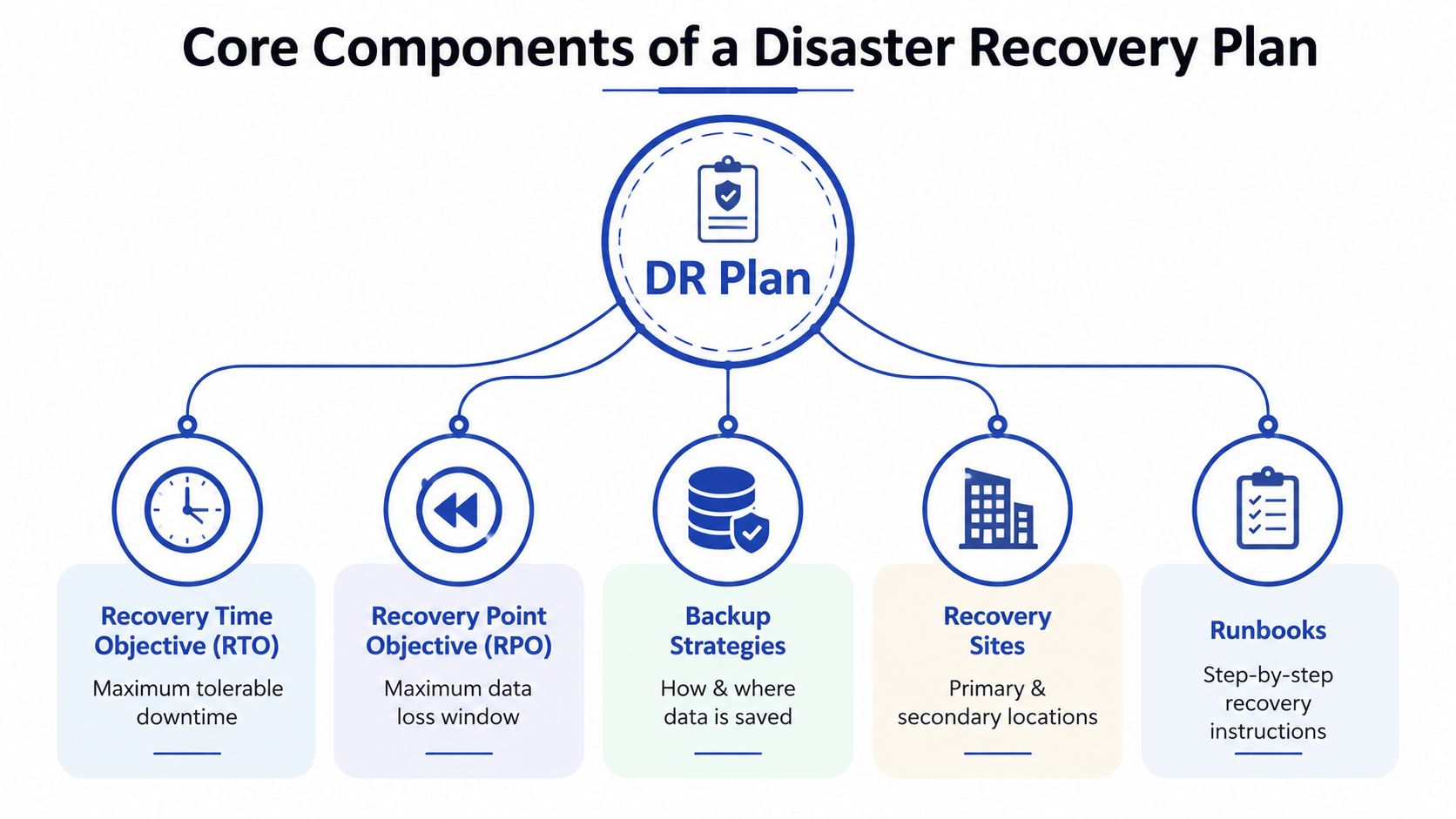
The core of a solid plan is the relationship between RTO, RPO, backups, recovery sites, and runbooks. In UK disaster recovery practice, those pieces are usually set after a business impact analysis, because the same outage affects different workloads in different ways. A product catalogue can tolerate a longer interruption than payment authorisation, and analytics can usually wait longer than order capture.
RTO and RPO set the recovery shape
Recovery Time Objective is the maximum tolerable downtime for a system. Recovery Point Objective is the maximum data-loss window the business can accept. Those two targets drive almost every other decision, from backup frequency to replication design and recovery order.
For ecommerce, service tiers should be explicit. Checkout, payment authorisation, inventory sync, and order processing need tighter recovery targets than reporting or archived analytics, because downtime in those core services directly affects customer experience and revenue flow. If the team sets the same recovery target for every workload, the plan becomes expensive where it doesn't need to be and weak where it does.
Backups, sites, and runbooks work together
Backups protect data, but they don't restore a business on their own. Recovery sites determine where the systems will run after an incident, and runbooks tell the team what to do in sequence, who approves each step, and how to confirm that the service is usable.
A useful way to think about the technical stack is to map the full dependency chain before choosing the recovery model. That means applications, databases, identity providers, DNS, CDN, ERP, and fulfilment integrations, all treated as one recoverable path rather than separate islands. The sequencing matters because a restored storefront still fails if authentication, payment, or inventory sync is missing.
Decision rule: if a workload has a tight RTO, it usually needs faster failover and more automation than a low-priority reporting system.
Ecommerce tiers should be designed around business impact
The same plan shouldn't treat every service equally. Customer checkout may need a warm or cloud-failover design, while reporting could sit behind a slower restore model if the business can tolerate delay. The right mix depends on how much interruption the business can absorb, not on what is easiest to describe in a policy.
That's also where the operational gap appears. Teams often say they have backup coverage, but they haven't proven that the restored systems can meet the actual recovery window. The plan only becomes real once the team can show that each tier, each dependency, and each runbook step works together under pressure.
How to Build and Test a Disaster Recovery Plan
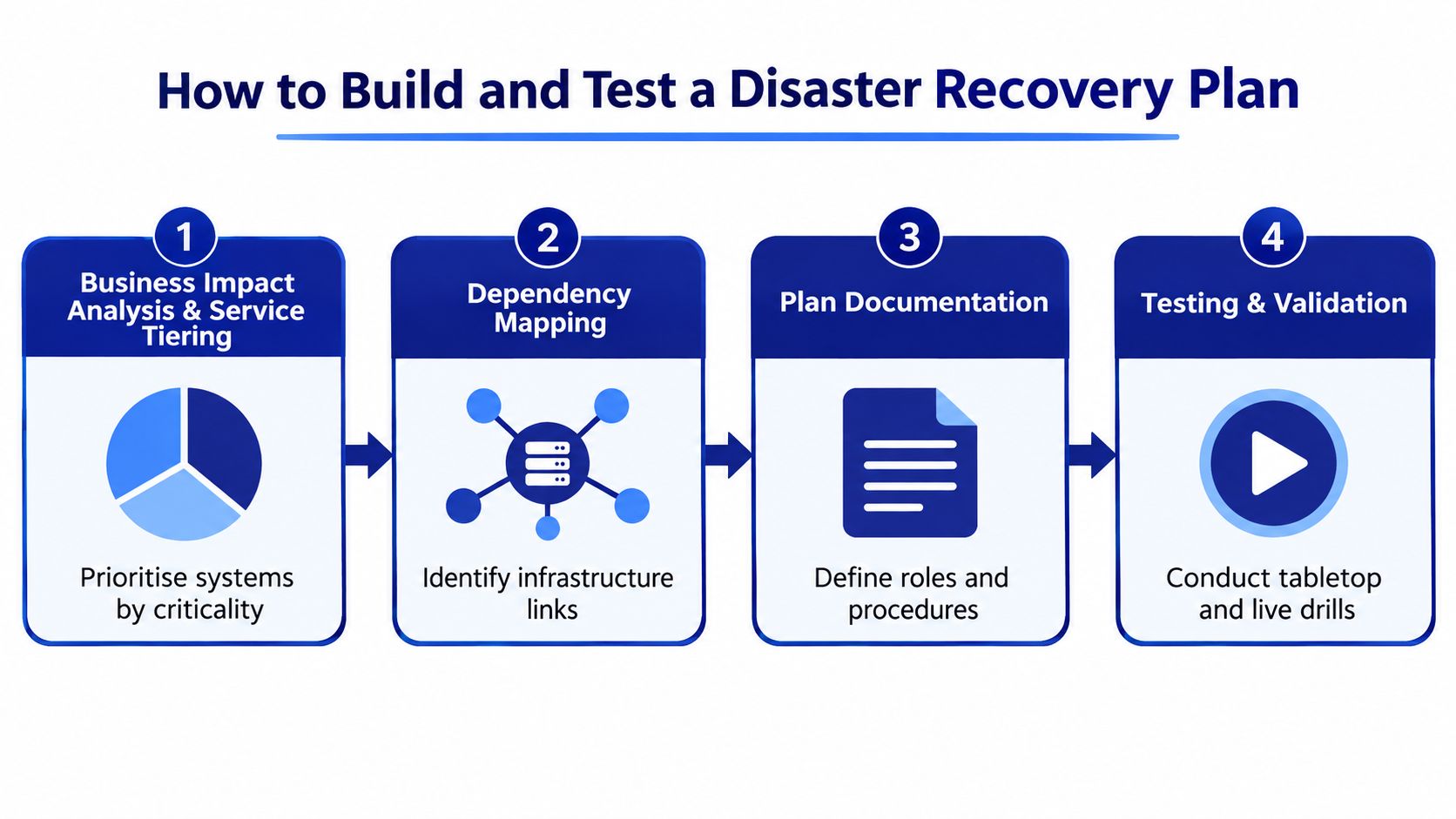
Building a plan starts with business impact, not tools. First, rank the services that keep the organisation trading, then map which systems support those services, and only then decide how each part should recover. If the recovery sequence starts with infrastructure before identity, payments, or data dependencies, the team will waste time fixing the wrong layer first.
The planning step should end with clear ownership and a written recovery order. Who declares the incident, who approves failover, who validates the checkout path, and who communicates with suppliers all need to be defined before anyone is under pressure. The linked incident response planning guide is useful if you want to separate response responsibilities from the recovery mechanics that follow.
Testing has to prove the plan, not admire it
The biggest mistake is treating testing as a box-ticking exercise. A tabletop discussion can expose missing contacts or unclear authority, but it won't prove that the recovery path meets your RTO and RPO targets. Live drills, partial failovers, and modular tests are what reveal the gaps.
A strong test checks whether the team can restore the most important service chain in the right order and with the right handoffs. It should also verify third-party coordination, because vendors, payment providers, and fulfilment partners often sit inside the recovery path. If their own processes are slow or opaque, your plan inherits that delay.
Runbooks are the difference between knowledge and execution
Runbooks should be written for the people who will use them at 2 a.m. They need step-by-step actions, acceptance checks, escalation points, and a clear stop condition if something doesn't behave as expected. The goal isn't elegance, it's repeatability under stress.
Good testing updates the runbooks immediately. If a step was skipped, a contact was wrong, or a dependency wasn't documented, the next version of the plan should reflect that change before the memory fades. That's how a recovery document becomes an executable system instead of a static binder.
Common Disaster Recovery Approaches and Tools
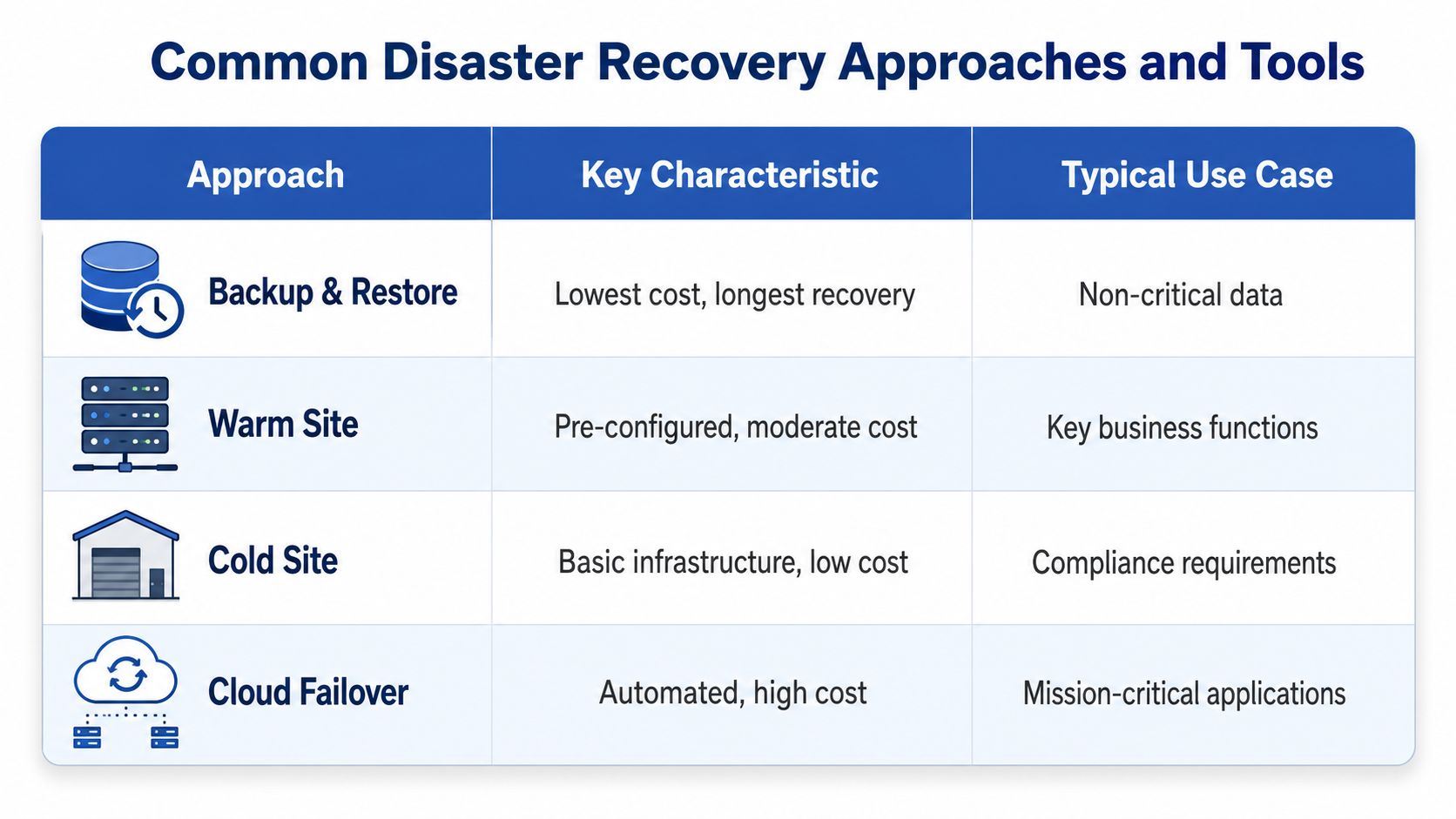
Backup and restore is the simplest option, and it usually gives the slowest return to service. It can work for non-critical data or for workloads that can stay offline while the team rebuilds the environment, but it does not suit systems where every minute of downtime affects trading, customer service, and order handling.
Warm sites and cloud failover sit higher on the resilience ladder because they preserve more of the recovery environment. A warm site is already partly prepared, so the team can recover faster than from raw backups alone. Cloud failover goes further by automating more of the switchover, which is why it is often chosen for mission-critical applications that need a quicker handover and less manual coordination under pressure.
The right tool depends on how much business pain you can absorb
Cold sites are cheaper to maintain, but they leave more reconstruction work for the incident itself. That can fit compliance-driven use cases or lower-priority workloads, but it is a poor match for revenue-critical commerce systems. The practical question is not which method sounds strongest, it is which one matches the service tier you defined earlier.
A Shopify Plus store, for example, may treat checkout, payment handoff, inventory sync, order processing, and fulfilment integrations as the live path that must come back first. A headless commerce setup can spread that risk differently, because the frontend, APIs, search, and content layers may fail or recover on separate timelines. If you choose the wrong recovery model, you may bring the site back before the order pipeline or customer messaging is ready, which creates a false sense of recovery.
Modern SaaS-heavy environments change the choice again. If a business relies on third-party platforms for storefront, payments, communications, or fulfilment, and a CDN for performance and resilience is part of that stack, then the provider's resilience and service commitments affect recovery outcomes directly. A recovery strategy that ignores those dependencies is incomplete by design.
Teams choose too slowly when they shop for tools before they define service tiers. Define the tier first, then select the recovery model that can actually support it.
Managed services can reduce execution risk
Managed disaster recovery services can help organisations that do not have the internal skills or capacity to design and maintain complex failover paths. They are most useful when the internal team needs support with orchestration, testing discipline, or recovery maintenance across multiple systems.
The main trade-off is control. The more a business outsources, the more important it becomes to understand how the provider tests, documents, and validates recovery. If the service does not align to your RTO, RPO, and escalation needs, it may look strong on paper while still failing the business during an incident.
Disaster Recovery Planning for Ecommerce Operations
An ecommerce outage usually starts with one visible failure, then spreads into a wider operational mess. Checkout stops working, customer orders pile up, support gets swamped, and staff start using whatever channel still works to tell customers what's happening. A good plan assumes that systems, partners, and people may all be affected in different ways, especially when access to transport, childcare, devices, or help is uneven during a disruption.
That equity issue matters because recovery isn't only a server problem. Some staff can jump onto a laptop from home, some can't. Some customers will understand an email update, others will need plain language, multiple channels, or a phone fallback. Recovery planning should account for that gap and make the response usable by the people who have to carry it out. The research on equitable disaster recovery makes that broader point clearly.
A Shopify Plus store should tier the live path first
For a Shopify Plus merchant, the highest-priority chain is usually checkout, payment gateway handoff, inventory synchronisation, order processing, and fulfilment integration, the same systems a Shopify maintenance agency would monitor and support on an ongoing basis. Those services keep money flowing and customers informed, so they need the tightest recovery objectives and the clearest escalation path.
A slower layer can sit underneath that live path. Marketing pages, reporting, and some back-office analysis may recover later if the trading path is stable first. The aim is to protect the transaction flow before the supporting functions, because recovery that brings up the wrong layer first can still leave the business unable to take or fulfil orders.
The plan should include recovery communication, not just systems
During a trading disruption, the business needs a pre-agreed message for customers, suppliers, and staff. That message should explain what's affected, which channel to use for updates, and what the team is doing next. If the storefront is down, a staffed fallback channel can keep service moving while technical work continues.
The internal checklist should also verify backups before the incident, not during it. That means checking that restore jobs are usable, recent, and aligned to the systems that matter most. A plan that exists only in technical language won't help the operations team when the warehouse is waiting for orders and the finance team is waiting for clean status updates.
Practical insight: ecommerce recovery succeeds when the business can still communicate, even if the primary platform is offline.
Your Disaster Recovery Planning Checklist
Start with the systems that would hurt the most if they were unavailable today. Define RTO and RPO for those services, then map every dependency they need to function, including identity, payment, DNS, and fulfilment links.
Next, verify that backups are restorable, not just present. Write runbooks for the recovery order, assign owners for each step, and test the plan in a way that proves the business can meet its targets.
- Identify critical services: Rank the systems that keep trading, serving customers, and moving orders.
- Set recovery targets: Assign realistic RTO and RPO values for each service tier.
- Map dependencies: Trace applications, databases, third parties, and communication channels end to end.
- Document runbooks: Write the exact recovery steps, approvals, and validation checks.
- Test the plan: Run tabletop exercises first, then partial or live recovery drills.
- Review after change: Update the plan whenever systems, vendors, or business priorities shift.
If you want help turning that checklist into something your team can run, Grumspot can support the Shopify side of the work with the same practical focus they bring to builds, audits, and technical fixes. Visit Grumspot to talk through the recovery gaps in your ecommerce stack and get a plan that's designed to hold up when systems go down.
Let's build something together
If you like what you saw, let's jump on a quick call and discuss your project
Related posts
Check out some similar posts.
- incident response planning
Build a robust incident response planning strategy with our step-by-step guide. Learn to define role...
Read more