Shopify Maintenance Agency: Your Guide to Store Stability
- Shopify maintenance agency
- Shopify support
- ecommerce maintenance
- Shopify developer
- UK ecommerce
Launched
May, 2026
You launch a sale, traffic picks up, and then something small breaks. A new app injects code into the theme. The mini cart stops updating. Checkout starts behaving oddly on mobile. Paid traffic is still landing, customer support is getting screenshots, and nobody on your team knows whether to roll back the app, edit the theme, or wait for a developer.
That situation is common because a Shopify store isn't a finished brochure site. It's a live operating system with moving parts: theme code, apps, scripts, feeds, product data, tracking, consent tools, payment settings, and third-party integrations. Every change touches something else.
A good Shopify maintenance agency exists to stop those failures becoming routine. Their fundamental job isn't just fixing bugs after they appear. It's protecting revenue, preserving trust, and keeping the store operational as teams ship changes.
Your Shopify Store Is an Engine Not a Static Website
The stores that struggle most with maintenance usually treat Shopify like a one-time build. They launch a theme, install a few apps, and assume the hard part is over. Then the business grows. Merchandising becomes more complex, tracking gets messier, and marketing asks for faster experiments than the storefront can safely absorb.
That's when maintenance stops looking optional.
In the UK, that matters because ecommerce already carries serious weight in retail. UK retail internet sales accounted for 27.8% of total retail sales in January 2026, after averaging 27.5% across 2025, according to the Office for National Statistics data cited in this UK Shopify maintenance cost guide. When more than a quarter of retail sales happen online, uptime and checkout reliability aren't technical nice-to-haves. They sit directly on top of revenue.
Where stores usually start to fail
Most problems don't begin with a dramatic outage. They begin with ordinary changes:
- App installs: A review app, bundle tool, or upsell widget adds scripts that slow key pages or clash with existing code.
- Theme edits: A quick homepage adjustment accidentally affects collection templates or product variants.
- Tracking changes: Marketing adds pixels, events, or tag manager updates that interfere with consent handling or checkout reporting.
- Operational shortcuts: Nobody owns QA, so changes go live without proper testing on mobile, tablet, and common browsers.
A growing store doesn't break because Shopify is unstable. It breaks because too many operational decisions happen without a control layer.
That control layer is what a Shopify maintenance agency should provide. Not just a help desk. More like a pit crew for a performance engine. The work is ongoing because the store is ongoing.
If you're comparing tools, agencies, and specialist providers, a useful starting point is a discovery platform for new business tools that helps you survey the wider software market before you commit to another stack addition.
What changes when maintenance is taken seriously
Teams stop shipping blind. They document what changed, who approved it, what was tested, and how to roll it back. They monitor the pages that affect conversion. They catch theme regressions before customers do. They stop assuming legal compliance will somehow survive every new app install.
That's the mindset shift. Your Shopify store is not a finished asset. It's a live commercial system that needs governance.
What a Shopify Maintenance Agency Actually Does
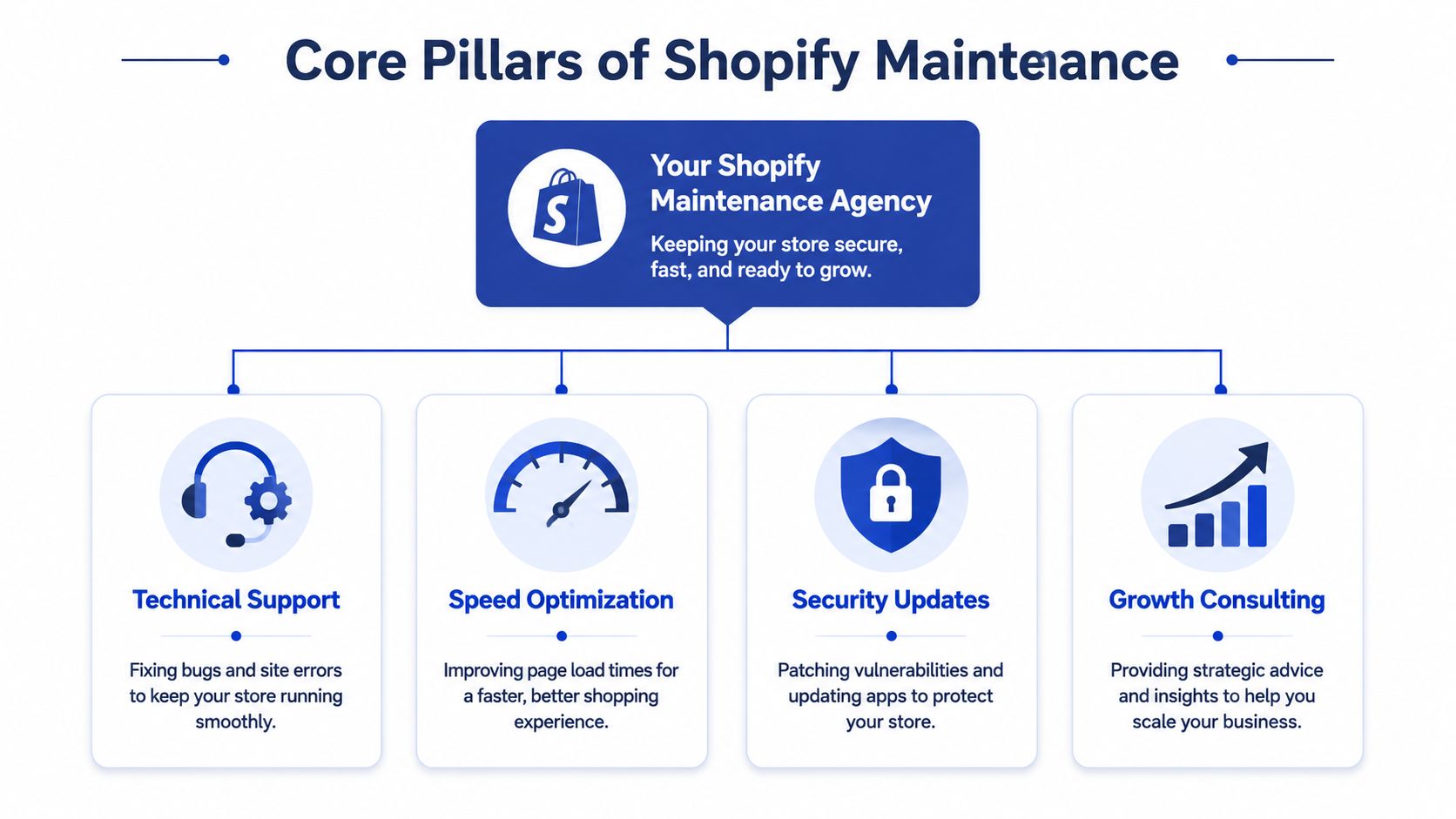
Most merchants hear “maintenance” and think of minor edits, plugin-style updates, and bug fixes. That's too narrow. A capable Shopify maintenance agency operates across support, prevention, performance, and controlled growth.
At the enterprise end, agencies commonly use a three-layer support structure consisting of technical support, maintenance, and troubleshooting, and they establish a performance baseline across conversion-critical pages such as the homepage, product detail pages, cart, and checkout. Slower checkout experiences directly correlate with cart abandonment, which is why tuning cycles and incident response matter so much, as described in this Shopify Plus support and maintenance overview.
Technical support and issue resolution
This is the most visible part of the job because it's where merchants feel pain fastest. Something breaks, and the agency needs to diagnose it properly.
That often includes:
- Theme conflict resolution: Fixing section rendering issues, broken variant selectors, layout shifts, or template errors after edits.
- App conflict management: Identifying whether a wishlist tool, subscription app, review app, or bundling tool is injecting conflicting scripts.
- Checkout-adjacent troubleshooting: Is the issue in cart logic, payment settings, shipping rules, customer accounts, or tracking code?
- Browser and device checks: Reproducing bugs on Safari, Chrome, iPhone, Android, and common screen sizes.
Good support teams don't just patch symptoms. They document root cause. If the same issue keeps returning, the store has a process problem, not a one-off bug.
Performance work that protects conversion
Performance maintenance is where many agencies become vague. They say they “optimise speed” but don't define where, how, or why.
In practice, performance work should begin with a baseline. The agency should know how the homepage, collection pages, product pages, cart, and checkout-adjacent flows behave before making changes. Then it can track regressions when a team adds apps, scripts, image-heavy sections, personalisation widgets, or AI-generated merchandising assets.
Useful maintenance work here includes:
- Script control: Removing unnecessary app code, deferring what can safely wait, and reducing duplicate scripts.
- Theme clean-up: Refactoring Liquid, trimming bloated sections, and fixing assets that load when they aren't needed.
- Image and media governance: Checking file handling, crop consistency, and page behaviour when richer media is added.
- Search and filter stability: Making sure collection pages still work smoothly after merchandising changes.
If you want to assess these issues before hiring support, a structured Shopify technical audit is often the most honest first step because it shows whether the store's problems are isolated defects or recurring operational failures.
Practical rule: If a maintenance partner can't tell you which pages they monitor and what “normal” performance looks like for your store, they're reacting, not maintaining.
Security and release discipline
Shopify handles platform-level infrastructure well. That doesn't remove store-level risk. The weak points usually sit in custom code, app integrations, theme edits, tracking scripts, and deployment habits.
A maintenance agency should bring release discipline:
- Test before launch: New app features, scripts, or theme edits should be checked in a safe workflow before they reach live traffic.
- Use QA as a gate: Changes should be validated against UX, functionality, and critical journeys.
- Prepare rollback paths: If a release causes problems, the team needs a fast way to revert or isolate it.
- Watch integrations: ERP, CRM, PIM, subscription, shipping, and search tools all create potential points of failure.
Maintenance overlaps with operations in this context. The agency does more than just edit code. It reduces the risk that a modification in one area of the stack causes a commercial issue in another part.
Growth support, not just break-fix support
The strongest maintenance partnerships don't stop at keeping the lights on. They use the maintenance retainer to improve the store gradually and safely.
That can include:
- merchandising improvements to collection and product pages
- conversion-focused iteration on cart and pre-checkout flows
- cleaner app architecture
- improved international storefront behaviour
- support for Shopify 2.0 migrations and section flexibility
- integration work for subscriptions, ERP, CRM, or fulfilment systems
This is the difference between an agency that preserves a store and one that helps it move forward without creating chaos.
Choosing Your Engagement and Pricing Model
The pricing model changes the relationship more than most merchants expect. Two agencies can offer similar technical skills and still produce very different outcomes because the engagement structure pushes them towards different behaviours.
An hourly arrangement usually rewards reaction. A retainer rewards continuity. A project model rewards delivery against a defined scope. None is automatically right. The right choice depends on how often your store changes, how many people touch it, and how costly failure feels when it happens.
The three common models
| Model | Best For | Pricing Structure | Key Benefit |
|---|---|---|---|
| Monthly Retainer | Stores with ongoing changes, multiple stakeholders, or recurring technical and operational needs | Fixed recurring fee for agreed capacity or service scope | Predictable support and proactive maintenance |
| Hourly or Ad hoc | Stores with infrequent issues and limited development activity | Pay for time used | Flexibility without long-term commitment |
| Project-Based | Well-defined work such as a theme rebuild, migration, or integration rollout | Fixed fee or scoped project budget | Clear deliverables and timeline |
When a retainer makes sense
A retainer works best when the store is active every week. That usually means merchandising updates, campaign landing pages, app evaluations, tracking changes, integration requests, or repeated testing needs.
You're not only paying for task execution. You're paying for continuity of context. The agency already knows your theme structure, app stack, approval process, and failure history. That cuts delay when something breaks and improves judgment when something new is proposed.
For merchants weighing this model, a detailed look at a Shopify monthly development plan is useful because it shows how retainers are typically structured around ongoing priorities rather than disconnected tickets.
When hourly support is enough
Ad hoc support can work for a small store with few customisations and a stable operating rhythm. It's sensible when changes are rare and the internal team can handle most day-to-day decisions.
But it has limits.
- Response time varies: You may not get fast help during busy periods.
- Context is thin: The agency often starts each task by rediscovering how your store works.
- Prevention is weak: Nobody is paid to look for issues before they become incidents.
That model tends to frustrate scaling brands because the hidden cost isn't the hourly rate. It's the repeated reset.
Hourly support solves tickets. Retained support solves systems.
Where project work fits
Project-based work is right when the scope is known. A Shopify 2.0 rebuild. A B2B feature rollout. A subscription migration. A redesign of product pages. A feed or ERP integration.
This structure works well if you can clearly define:
- what is being delivered
- what is excluded
- who signs off each stage
- what support happens after launch
The mistake is expecting project work to double as maintenance. It rarely does. Once the project ends, ownership becomes fuzzy unless support terms are written in.
A simple way to choose
Pick the model that matches your current operational reality, not your ideal one.
- Choose a retainer if the store changes often and mistakes are expensive.
- Choose hourly support if activity is light and your team can absorb some risk.
- Choose a project if the work is discrete and the outcome is already defined.
The best decision usually comes from looking at your last few months objectively. How many urgent fixes did you need? How many people requested changes? How often did one adjustment create another problem? The pattern will tell you which model fits.
How to Evaluate and Vet a Potential Agency
A polished portfolio won't tell you how an agency behaves when checkout breaks on a Friday afternoon, when a consent banner stops firing properly, or when a new app creates accessibility issues. Vetting a Shopify maintenance agency means checking process maturity, not just design taste.
One of the most overlooked evaluation questions is whether the agency handles compliance and legal-risk upkeep, not only performance and security. UK merchants increasingly need support around GDPR, UK cookie rules, and accessibility, yet many agency pages barely mention them. Theme changes and app installs can introduce risk without notice, as noted in this Shopify maintenance service discussion of compliance gaps.
Questions that expose real process quality
Ask direct questions. If the answers stay vague, keep digging.
How do you test before releasing changes?
You want to hear about staging workflows, QA checklists, browser testing, and approval steps. “We test everything” isn't enough. The agency should explain what gets tested, who signs it off, and how rollback works if something slips through.
What do you monitor regularly?
A serious partner can tell you which journeys they watch. Product page behaviour, add-to-cart actions, collection filtering, consent behaviour, search, cart, and checkout-adjacent functionality should all be on the radar.
How do you handle app governance?
Apps create a large share of storefront instability. Ask how they assess app fit, what happens before installation, and how they decide whether an app should be removed, replaced, or isolated.
The compliance questions most merchants forget to ask
Weak maintenance plans become obvious at this point.
Ask whether the agency covers:
- Cookie consent drift: If marketing adds scripts or apps, who checks whether consent settings still behave correctly?
- Accessibility regression checks: If a theme section is edited, who confirms keyboard use, contrast, focus states, and form usability still hold up?
- Tracking and legal alignment: If pixels or analytics tools change, who checks whether the implementation still matches the site's stated consent behaviour?
- Content risk review: If AI-generated copy or imagery is introduced, who checks for misleading claims, inconsistent branding, or low-quality output?
A maintenance partner doesn't need to replace legal counsel. But they should absolutely function as an operational safeguard against avoidable drift.
If an agency only talks about uptime and speed, they may be ignoring the risks that usually arrive through apps, scripts, and content workflows.
Look for operational fit, not just technical skill
A technically capable developer can still be a poor maintenance partner if they're chaotic. Ongoing support needs habits.
Here's what to check:
- Communication cadence: Will you get daily updates, weekly reviews, or only replies when something breaks?
- Ticket handling: Do they prioritise by business impact or by queue order?
- Documentation: Do they keep change logs and issue histories?
- Decision-making: Can they explain trade-offs clearly to non-technical stakeholders?
- Ownership boundaries: Who owns the store roadmap, who approves releases, and who handles emergency sign-off?
If you're comparing broader service models, this overview of working with a Shopify development agency can help frame the difference between build-focused teams and those set up for ongoing operational support.
Ask for examples of controlled judgment
Case studies are often too polished. Ask for practical examples instead.
For example:
- Tell me about a time you advised against an app install.
- Tell me about a release you delayed and why.
- Tell me how you handled a conflict between marketing speed and store stability.
- Tell me what happens when a stakeholder wants to launch something that hasn't been tested properly.
The answers show whether the agency acts like an operator or a task taker.
A short video overview can also help you compare how agencies talk about their process, not just their output.
Red flags that usually become expensive later
Some warning signs appear early:
- No mention of QA
- No clear SLA or incident workflow
- No questions about your app stack
- No interest in compliance or accessibility
- No structured onboarding
- No distinction between urgent incidents and routine requests
If an agency can't explain how it protects the store when many people are making changes, it isn't offering maintenance. It's offering spare developer time.
Onboarding and Key Contract Terms to Look For
Once you've chosen an agency, the quality of onboarding will shape the relationship quickly. Weak onboarding creates confusion, duplicated effort, missed permissions, and risky assumptions about who owns what. Strong onboarding creates visibility and control from the first week.
This matters even more for larger stores. Shopify Plus is used by over 60,268 websites globally, and high-volume brands in the UK are a top market. For these stores, maintenance often includes deep ERP, CRM, and subscription integrations, which makes structured onboarding and clear contract terms critical from day one, as outlined in this discussion of why Shopify maintenance is essential.
What good onboarding looks like
A solid onboarding process usually starts with access, context, and risk mapping.
Access and systems
The agency should request only the access needed to do the job safely. That often includes Shopify admin permissions, theme access, analytics visibility, app access where relevant, and a shared communication channel.
They should also ask for:
- current app inventory
- known bugs or recurring issues
- recent theme changes
- campaign calendar
- integration map
- internal approvers
Initial audit and priority setting
The first review should separate urgent risks from routine improvements. If the agency immediately starts taking random design requests without understanding the stack, that's a bad sign.
A sensible early phase usually covers:
- Store health review: Theme condition, app bloat, integrations, speed-sensitive pages, and known breakpoints.
- Operational review: Who requests work, how work gets approved, and how urgent incidents are escalated.
- Risk review: Compliance-sensitive areas, tracking changes, app governance, accessibility concerns, and release habits.
Watch for this: The first month should produce a clear priority list, not just a list of completed tickets.
Contract terms worth reading carefully
Many maintenance disagreements come from unclear wording, not bad intent. The contract should remove ambiguity.
Scope of services
The agency should define what “maintenance” includes. Bug fixing? Performance tuning? App support? Content updates? CRO input? Compliance checks? Emergency troubleshooting? If it isn't written, don't assume it's included.
Response expectations
Look for a practical SLA. The contract should explain how urgent incidents are classified and how response differs from resolution. Fast acknowledgement matters, but so does clarity about what happens next.
QA and deployment responsibility
Someone needs to own testing standards and release discipline. The agreement should say whether the agency tests on staging, whether approvals are required before launch, and who accepts risk if a client insists on pushing untested changes.
Ownership and termination
Check who owns code, documentation, design outputs, and custom app work after the engagement ends. Also check the exit terms. A maintenance partner should be able to hand over cleanly if the relationship ends.
A simple first-30-days checklist
Use this as a baseline for onboarding:
- Access is provisioned correctly
- Communication channels are set
- Critical journeys are audited
- Known risks are logged
- Priorities are ranked
- Approval workflow is agreed
- Emergency contact path is documented
- Reporting cadence is scheduled
The first month shouldn't feel dramatic. It should feel organised.
Calculating the True ROI of Proactive Maintenance
Many merchants evaluate maintenance by asking a narrow question: what does the retainer cost? The better question is what the business loses when maintenance is weak, delayed, or purely reactive.
That's especially relevant in the UK, where a common commercial question is how much revenue is at risk if maintenance is only ad hoc. Slow page speed, broken search, and checkout friction directly affect sales, and the strongest business case ties maintenance to revenue protection rather than generic support, as discussed in this analysis of Shopify maintenance and support.
Revenue protection is the first return
When maintenance works, the gain often looks invisible because the disaster never arrives. The flash sale doesn't fail. Search still works after a theme change. Cart logic survives a promotion. Consent tooling still behaves after new tracking scripts are added.
That isn't abstract value. It's protected trading time.
A practical ROI conversation usually starts with these questions:
- What happens if product discovery breaks for a busy campaign?
- What happens if checkout friction appears and nobody catches it quickly?
- What happens if the team spends half a day chasing an app conflict instead of merchandising the next launch?
Time saved is operational ROI
Founders and ecommerce managers often underestimate how expensive firefighting is. When the store is unstable, senior people get dragged into avoidable work. Marketing waits. Customer support escalates screenshots. Development effort gets consumed by rework instead of improvement.
Good maintenance buys back operational capacity.
That includes time saved through:
- fewer emergency investigations
- cleaner release workflows
- faster diagnosis because the agency already knows the stack
- less internal debate about who owns a problem
- fewer repeated issues caused by weak documentation
Maintenance ROI is often strongest when the team stops losing momentum.
Governance work also has commercial value
This is the area many ROI conversations miss. Compliance checks, accessibility reviews, app governance, and AI-content control all protect the store from slow-burning damage.
For example, if you sell B2B or mixed VAT flows, operational details such as validating UK VAT IDs on Shopify can become part of the wider governance layer that keeps checkout and tax handling aligned with business rules.
The same applies to AI-assisted merchandising. Faster content production is useful, but only if someone reviews output quality, approves what goes live, and watches how changes affect conversion behaviour. Otherwise, speed just creates more mess to clean up later.
What usually destroys ROI
Three patterns show up repeatedly:
- Choosing on price alone: Cheap support often means weak QA, slow diagnosis, and poor ownership.
- No clear priorities: If everything is urgent, the agency can't protect what matters most.
- No governance mindset: Stores that ignore compliance, app sprawl, and content quality end up paying for it indirectly.
The best maintenance spend is rarely the lowest line item. It's the one that reduces recurring operational drag while protecting the journeys that make the store money.
Your Next Steps Toward a More Stable and Profitable Store
A Shopify maintenance agency should do more than keep your storefront online. It should reduce operational risk, protect conversion-critical journeys, and stop ordinary store changes from turning into revenue problems.
That means looking beyond tickets and bug fixes. The right partner brings structure to releases, discipline to app usage, visibility into performance, and governance for the areas many teams neglect: consent, accessibility, tracking drift, and AI-assisted content quality.
If you're deciding what to do next, keep it simple.
Start with these three actions
List your recurring pain points
Look at the last few months. Where did the team lose time? App conflicts, checkout issues, broken filters, consent problems, reporting drift, slow launches.Decide what kind of support you need If the store changes constantly, ad hoc help probably won't hold. If changes are rare, a lighter model may be enough.
Vet agencies on process, not polish
Ask how they test, monitor, document, govern apps, and handle compliance-sensitive changes. Those answers matter more than a pretty proposal.
A stable store usually isn't the result of one big rebuild. It's the result of disciplined ongoing care. That's what maintenance is supposed to provide.
If you want a practical second opinion on your store's current risks, Grumspot offers Shopify design, development, audits, migrations to Shopify 2.0, and monthly support for brands that need ongoing technical and operational help. It's a useful option if you want a team that can review theme health, integrations, conversion bottlenecks, and maintenance workflows before problems stack up.
Let's build something together
If you like what you saw, let's jump on a quick call and discuss your project
Related posts
Check out some similar posts.

- ecommerce replatforming agency
Choosing an ecommerce replatforming agency? Learn what they do, replatforming signs, costs, timeline...
Read more
- print and mail API
Learn how a print and mail API works, what to look for in a UK-ready provider, and how to integrate ...
Read more
- Shopify monthly development plan
Learn how a Shopify monthly development plan works to scale your store. Our 2026 guide covers pricin...
Read more
- Shopify AOV optimization
Boost your revenue with our Shopify AOV optimization guide. Discover actionable tactics, Plus-specif...
Read more