Lifecycle Email Marketing for Ecommerce Success
- lifecycle email marketing
- email automation
- shopify marketing
- ecommerce retention
- customer lifecycle
Launched
July, 2026
Your Shopify store is sending emails. Revenue from email exists. But the programme still feels patchy.
One flow was built during launch. Another was copied from a Klaviyo template. Campaigns go out when the team remembers, or when stock needs shifting. Meanwhile, subscribers join the list, browse products, abandon carts, place a first order, then disappear without any coordinated follow-up.
That's where lifecycle email marketing changes the game. It replaces random sends with a system. On Shopify, that system can be built around the customer data you already have, the actions shoppers already take, and the commercial moments that already matter.
What Is Lifecycle Email Marketing
Lifecycle email marketing is behaviour-based email communication tied to where a customer is in their relationship with your brand.
A simple way to think about it is this. A generic promo blast acts like a town crier shouting the same message to everyone in the square. Lifecycle email acts like a strong shop assistant who recognises what a customer just did, remembers what they bought, and responds accordingly.
If someone signs up but hasn't purchased, they need a different email from a customer who placed their second order last week. If someone viewed a product three times but never added it to cart, they need different messaging again. Good lifecycle email marketing respects that context.
It's not the same as promotional email
Promotional campaigns still matter. You'll still send launch emails, seasonal offers, category pushes, and clearance messages. But those are usually date-led. Lifecycle emails are trigger-led.
That distinction matters on Shopify because your store constantly generates intent signals:
- Signup behaviour tells you someone has raised a hand
- Browse activity suggests interest without commitment
- Cart activity shows buying intent
- Purchase history tells you what they trust you for
- Inactivity often signals friction, boredom, or churn risk
When merchants rely only on campaigns, they leave these signals untouched. The result is usually wasted list value. New subscribers go cold. First-time buyers never get educated. Existing customers hear from the brand only when there's a sale.
Practical rule: If an email could have been sent to everyone on your list without changing a word, it probably isn't lifecycle email.
Why it matters more on Shopify
Shopify gives merchants a practical advantage. Product catalogue data, order history, customer tags, discount logic, app events, and ESP integrations make it possible to build flows that are commercially useful, not just theoretically personalised.
A skincare brand on Shopify, for example, can send a first-time buyer education sequence based on the exact collection purchased. A supplements store can trigger replenishment messaging based on expected usage timing. A fashion brand can split post-purchase flows between customers who bought full-price hero products and customers who only bought from sale categories.
That's where lifecycle work becomes revenue work. You're not just “nurturing” people. You're moving customers towards first purchase, second purchase, stronger average order value, and longer retention.
For a broader strategic perspective, the overview of Ecommerce Boost email marketing expertise is a useful companion read, especially if you want to compare lifecycle thinking with more traditional campaign planning.
What works and what usually doesn't
What works is relevance, timing, and a clear commercial job for each email.
What doesn't work is over-automating vague brand content. Too many stores build flows filled with soft messaging, generic founder notes, and endless “just checking in” emails that never answer the critical question. Why should this person buy again, buy now, or stay engaged?
Lifecycle email marketing works best when each flow has a job, each segment has logic behind it, and each message reflects actual customer behaviour.
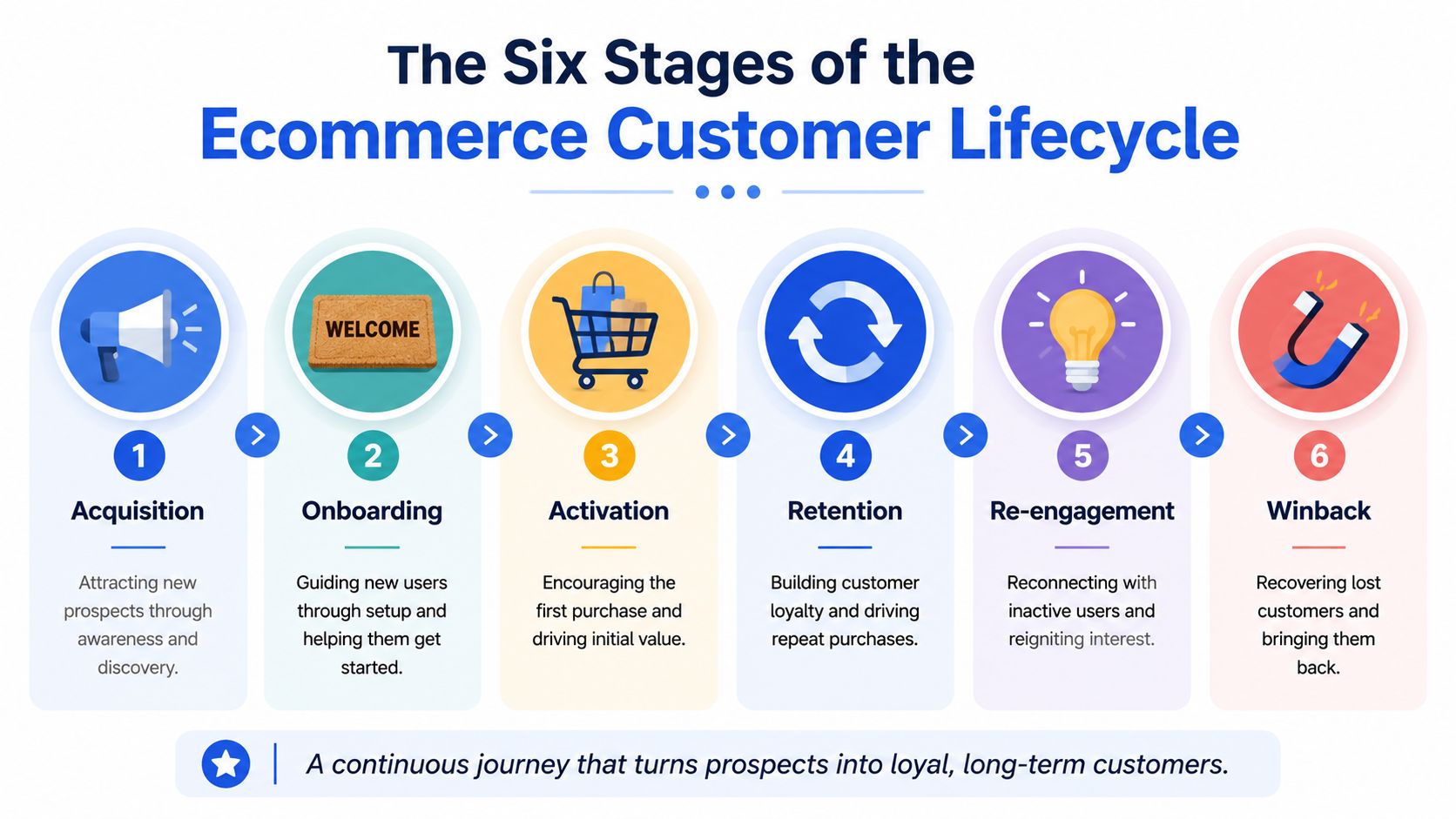
The Six Stages of the Ecommerce Customer Lifecycle
Most Shopify stores don't have an email problem. They have a stage-matching problem. The message is often fine, but it's being sent at the wrong moment.
The customer lifecycle gives you a cleaner way to organise communication. Instead of treating the list as one audience, you break it into relationship stages and build around what shoppers need next.
Acquisition
This stage starts before purchase. The shopper has discovered the brand, visited the site, followed on social, or joined the list through a popup, quiz, or checkout opt-in.
Their mindset is cautious. They're asking basic questions. Is this brand credible? Is the product relevant? Is there a reason to act now?
On Shopify, common acquisition signals include:
- Email signup from popup or footer form
- Lead capture from quiz tools such as Octane AI
- First tracked site session through your ESP or connected CDP
Onboarding
Onboarding begins when someone has just entered your ecosystem in a meaningful way. Often that means a new subscriber, but it can also mean a fresh buyer who needs guidance.
At this point many brands waste momentum. The shopper is paying attention now. If your welcome or first-buyer experience is bland, attention fades quickly.
Typical Shopify signals include account creation, subscription signup, or first order placed.
Activation
Activation is the move from interest to meaningful action. In ecommerce, that usually means the first purchase, though some merchants also use micro-conversions like product views, cart additions, or wishlist activity as leading signals.
For a homeware brand, activation might mean pushing a browser towards their first order. For a subscription brand, it might mean getting a new buyer to complete a build-a-box or choose their recurring plan.
Retention
Retention starts after the first successful purchase experience. The customer already trusted you once. The question now is whether they'll come back.
The strongest retention emails help the customer get value from what they bought, reduce buyer's remorse, and present the next logical product or category. For Shopify stores, this is often where segmented cross-sell and replenishment logic starts to outperform broad promotions.
Re-engagement
Re-engagement applies when a customer or subscriber has gone quiet but still shows some recoverable potential. They may not be lost, but they're drifting.
Signals often look like this:
- No recent site visits
- No campaign engagement
- No repeat purchase after first order
- Lapsed interest in a previously active segment
Re-engagement should feel useful before it feels desperate. Start with relevance, not discounting.
Winback
Winback is for customers who have crossed into likely churn. They haven't purchased for a meaningful period relative to your buying cycle, and softer nudges haven't moved them.
For a coffee subscription store, winback timing will look different from a furniture brand. That's why rigid “one-size-fits-all” inactivity definitions rarely work. The right threshold depends on catalogue type, order frequency, and the natural buying rhythm of the product.
These six stages aren't just labels. They're an operating model. When a Shopify team maps flows, segments, and reporting to these stages, lifecycle email stops feeling abstract and starts becoming manageable.
Building a Data-Driven Segmentation Strategy
A lifecycle strategy falls apart fast without segmentation. You can map every stage neatly, but if the same emails still go to everyone, nothing meaningful changes.
On Shopify, segmentation should start with the data merchants already own. That includes product views, checkout behaviour, order history, discount usage, subscription status, tags, location, and on-site engagement pulled into Klaviyo, Omnisend, or Shopify Email. The goal isn't to create endless audiences. It's to create commercially useful groups that justify different messaging.
Start with buying behaviour, not demographics
Age and gender can be useful in some categories, but they rarely drive the strongest lifecycle decisions on their own. Buying behaviour does.
A better segmentation foundation often includes:
- Recent buyers who need post-purchase education or a second-order path
- One-time customers who haven't yet formed a habit
- Repeat customers who can handle stronger cross-sell and loyalty messaging
- High-intent non-buyers who clicked products or started checkout
- Inactive customers who need re-engagement or winback logic
For example, a Shopify pet brand might segment buyers of dog supplements separately from buyers of grooming products. Both are customers, but the replenishment logic, educational content, and follow-up offers should differ.
Use Shopify data the way operators actually need it
The practical question isn't “what data do we have?” It's “what decision does this data help us make?”
A few useful examples:
| Shopify signal | Segment use | Email angle |
|---|---|---|
| Purchased from a specific collection | Category affinity | Related products, use cases, bundles |
| Used discount on first order | Price sensitivity | Margin-aware follow-up, not immediate full-price assumptions |
| Ordered twice in a short period | Early loyalty signal | VIP treatment, referral ask, early access |
| Viewed the same product multiple times | High consideration | Objection handling, reviews, product detail |
| Bought a giftable item near gifting periods | Occasion-led behaviour | Timely reminder for future gifting moments |
That's why broad “engaged subscribers” segments are often too blunt. They mix people who need different treatment.
A stronger segmentation framework usually combines recency, frequency, and category behaviour with engagement signals from your ESP. If your platform supports predictive fields such as expected next order date or churn risk, use them carefully. They're helpful inputs, but they shouldn't replace common sense about your catalogue.
For a deeper breakdown of segment design, this guide to customer segmentation strategy is worth reading alongside your flow planning.
What merchants often get wrong
The biggest mistake is over-segmenting before core flows are working. Teams build dozens of micro-audiences, then realise none are large enough to matter and no one can maintain the logic cleanly.
The second mistake is using static segments for dynamic problems. A list of “customers who bought shoes” is useful. A live segment of “customers who bought shoes, haven't bought accessories, and opened recent product emails” is much more operational.
Segments should change when customer behaviour changes. If the audience definition stays frozen, the strategy usually does too.
Good segmentation doesn't create complexity for its own sake. It creates sharper decisions. Which products to show. Which offer to hold back. Which customers should get education, urgency, reassurance, or silence.
Essential Automated Flows for Every Lifecycle Stage
A shopper lands on your Shopify store from a paid social ad. They browse a hero collection, sign up for the popup, leave, come back from a welcome email, add a product to cart, abandon checkout, return later, buy, receive the product, then vanish for a while.
That's a normal ecommerce journey. The email programme should be ready for each step.
The core flows that pull the most weight
The strongest lifecycle setups usually begin with a small set of flows that match clear buying moments.
| Lifecycle Stage | Essential Automated Flow | Primary Goal |
|---|---|---|
| Acquisition | Welcome series | Turn subscriber interest into first purchase |
| Activation | Browse abandonment | Recover product interest before it fades |
| Activation | Abandoned cart or checkout | Convert high-intent shoppers |
| Retention | Post-purchase series | Drive product satisfaction and repeat purchase |
| Retention | Replenishment or cross-sell flow | Encourage the next relevant order |
| Re-engagement | Dormant subscriber flow | Restart interaction without burning margin |
| Winback | Churn-risk customer flow | Recover lapsed customers |
A practical Shopify journey
Take a hypothetical merchant selling premium haircare on Shopify.
A new visitor joins the list through a quiz popup. That should trigger a welcome series. Usually this works best as a short sequence rather than a single email. The first email introduces the brand promise and strongest category. The next one handles trust. A later email can use social proof, a product finder, or a first-order incentive if the margin allows it.
Then the shopper views a treatment mask twice but leaves. A browse abandonment flow should pick that up, ideally featuring the exact product viewed, a concise reason to buy, and a clean path back to the PDP.
If they add the item to cart but don't check out, the logic shifts. A cart or checkout abandonment flow can be more direct because intent is stronger. If you're reviewing triggered flow ideas beyond the usual ecommerce staples, this breakdown of payment-event triggered emails is useful for thinking about operational moments many brands ignore.
Once the first order is placed, the post-purchase series starts doing the heavy lifting. That series shouldn't just say thanks. It should set delivery expectations, explain product use, reduce support load, and open the door to the next order.
What to trigger and when
A few broad rules work well on Shopify:
- Welcome flow should trigger on list signup, not just account creation
- Browse abandonment should trigger only after meaningful product interest, not every casual page view
- Cart abandonment should trigger after cart or checkout inactivity, with suppression rules for purchasers
- Post-purchase should branch by first-time versus repeat buyer
- Winback should trigger relative to your normal reorder window, not an arbitrary calendar gap
A lot of merchants ask whether they really need both browse and cart flows. Usually yes. The customer psychology is different.
For stores with persistent checkout drop-off, this guide on how to reduce Shopify cart abandonment is a strong operational companion because it links email recovery to the actual checkout friction causing the problem.
The best automated flow isn't the fanciest one. It's the one tied to a real customer action, with one clear next step.
What tends not to work is cloning template libraries and turning everything on at once. Build the core flows first. Make sure trigger logic, exclusions, product feeds, discounts, and attribution are clean. Then expand.
High-Converting Emails for Shopify Stores
Most lifecycle emails underperform for a simple reason. They sound like marketing emails, not purchase-driving messages.
The fix usually isn't clever copy. It's structure. Good lifecycle emails are easy to scan, specific about the next step, and tied to what the shopper just did.
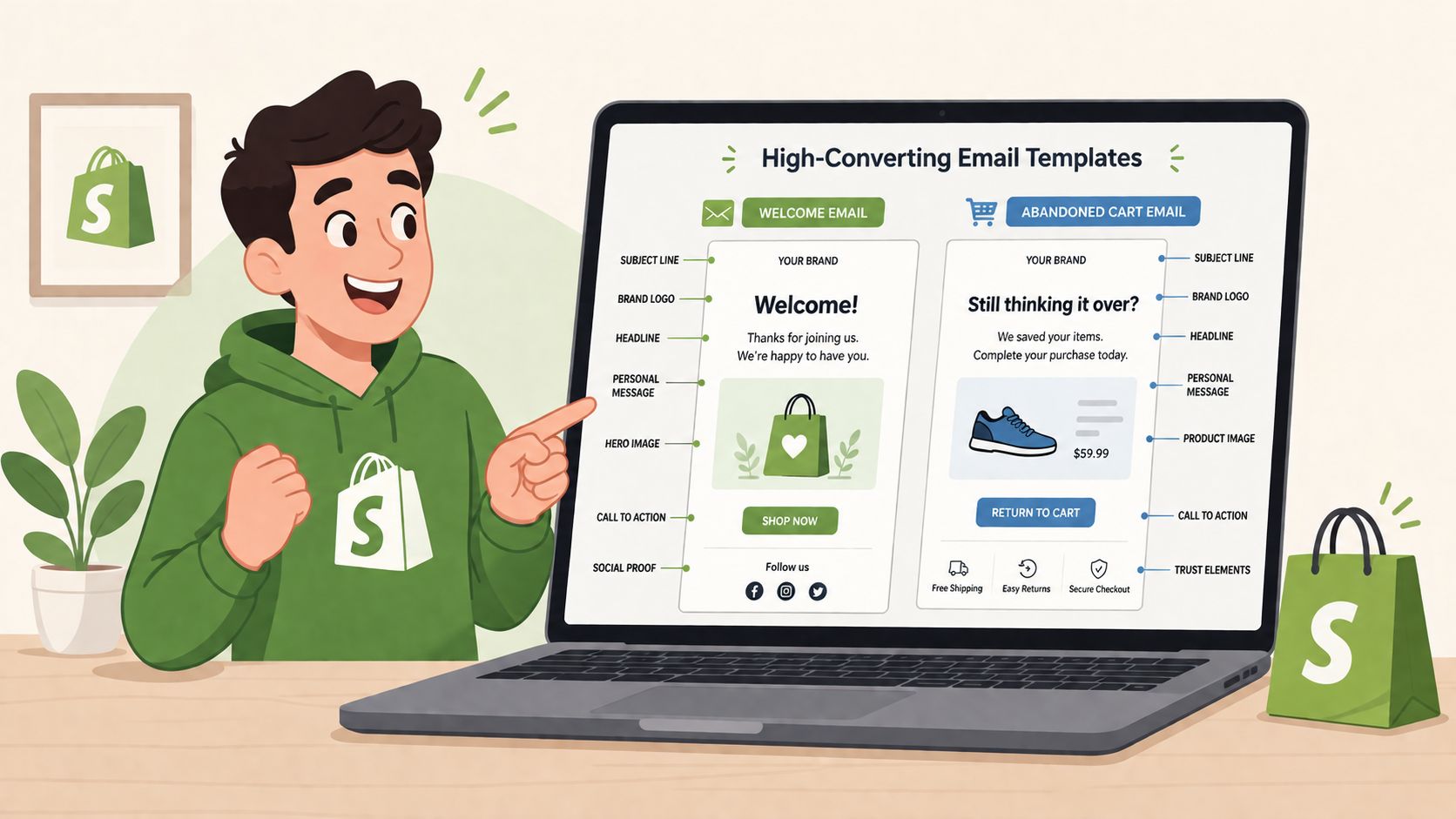
Welcome email template
For a Shopify welcome email, the first job is simple. Confirm the signup mattered.
Subject line options
- Welcome to {{ shop.name }}
- You're in. Start with our bestsellers
- A better place to start than the homepage
Recommended structure
Headline
Welcome, {{ customer.first_name | default: "there" }}Opening
Thank them for joining. Set expectations. Tell them what kind of value they'll get from future emails.Middle section
Lead with one of these, not all three at once: bestseller collection, starter bundle, or quiz-guided product path.Trust section
Include review language, ingredient or material highlights, shipping reassurance, or category-specific proof points.CTA
Shop bestsellers
For a Shopify apparel brand, don't send people to the homepage if the signup source was a dresses popup. Deep-link to that collection instead.
Abandoned cart email template
The middle email in a cart flow usually performs better when it stops begging and starts resolving hesitation.
Subject line options
- Still thinking it over?
- Your basket is waiting
- A quick reminder before it's gone
Recommended structure
Headline
You left something worth another lookProduct block
Pull in abandoned item image, variant, and price dynamically through Klaviyo or Shopify EmailBody copy
Focus on one objection. Delivery speed. Fabric feel. compatibility. returns. social proof. Pick the objection that matters most for that product type.Supportive content
Add reviews, FAQs, or short reassurance bulletsCTA
Return to basket
A skincare example might include “Best for dull or uneven texture” under the product image. A tech accessory store might include “Fits your selected model” to reduce compatibility doubt.
Here's a useful visual walkthrough before you build your own versions:
Winback email template
Winback email should feel deliberate. If every brand sends “We miss you” with a discount, your customer has seen that film already.
Subject line options
- It's been a while
- Ready to restock or try something new?
- A reason to come back to {{ shop.name }}
Recommended structure
Headline
Since your last order, here's what's worth seeingOpening
Reference the prior relationship without sounding needyOffer section
Either present a selective incentive or lead with product news, upgraded formulation, new arrivals, or improved bundlesProduct recommendation block
Base this on previous category purchase where possibleCTA
Come back and shop
Good winback copy respects the possibility that the customer didn't leave because of price. Sometimes they left because they forgot, got distracted, or didn't know what to buy next.
The strongest templates are the ones your team can repeat. Keep modules consistent, make product personalisation dynamic, and write every email around one conversion task.
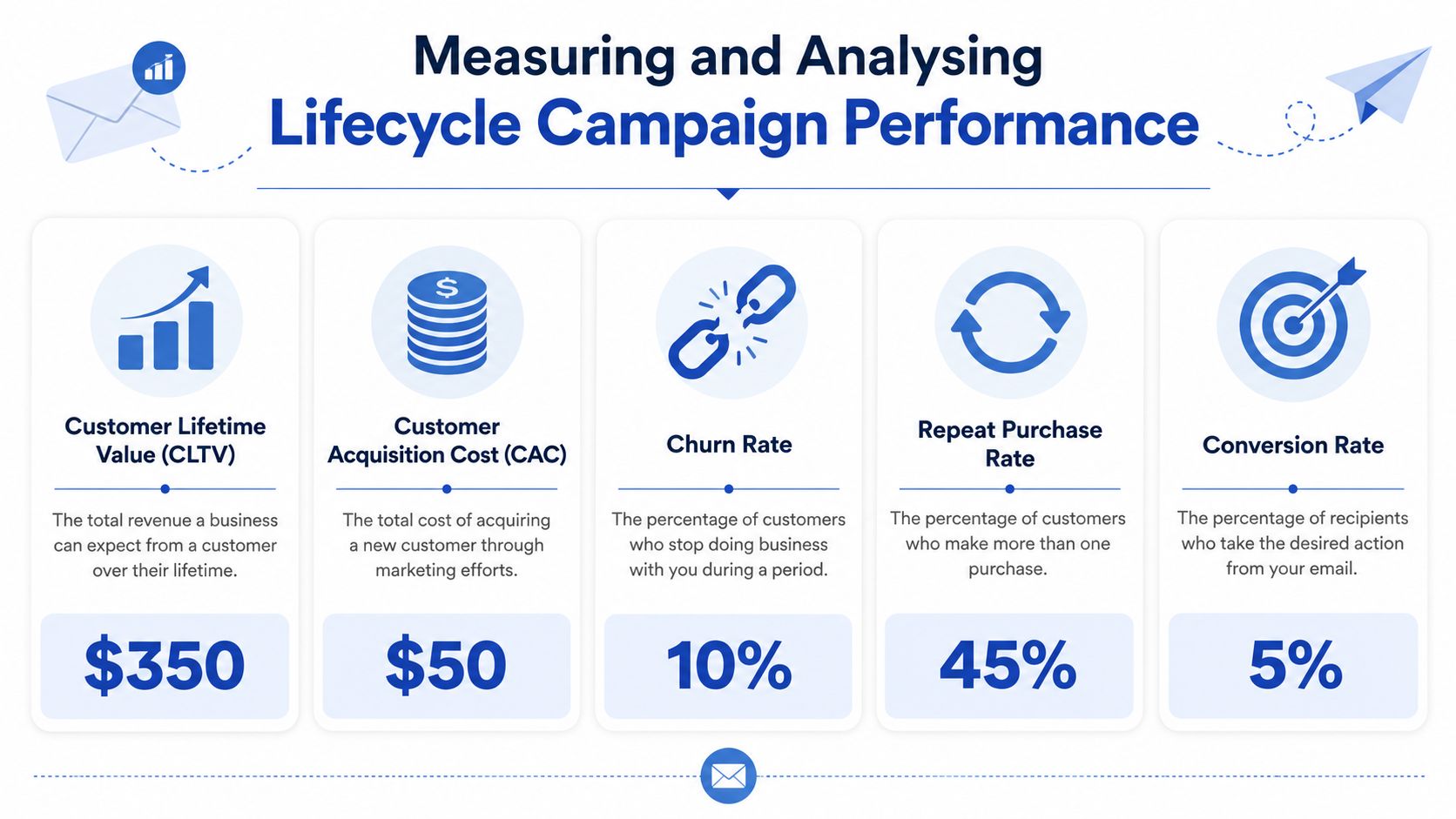
Measuring and Analysing Lifecycle Campaign Performance
Open rate can tell you whether a subject line earned attention. It doesn't tell you whether your lifecycle strategy is improving the business.
The right measurement approach asks a harder question. Are these flows changing customer behaviour in ways that matter commercially?
Start with business outcomes
For Shopify merchants, the most useful lifecycle reporting usually sits across three layers.
First, there's flow-level performance. Revenue, placed order rate, click rate, unsubscribe rate, and time-to-conversion by email or flow.
Second, there's segment behaviour. Do first-time buyers exposed to your post-purchase flow come back differently from first-time buyers who weren't? Do customers from one category respond better to replenishment than cross-sell?
Third, there's account-level customer health. Are more customers placing a second order? Are lapsed customer groups shrinking? Is average order quality improving among retained cohorts?
Questions that lead to better analysis
The most useful reviews usually sound like this:
- Did the welcome series improve first-order conversion from new subscribers?
- Did browse abandonment pull back qualified shoppers, or mostly low-intent traffic?
- Did the post-purchase sequence change what customers bought next?
- Did the winback flow recover good customers, or only discount-seekers?
That's a better operating model than staring at opens and clicks in isolation.
For example, if a post-purchase flow gets modest click engagement but the exposed group returns to buy complementary products more often, the flow is doing its job. If a winback campaign drives orders but those customers never buy again without another offer, you may be training weak behaviour rather than restoring loyalty.
Watch deliverability before blaming the strategy
When a solid flow suddenly drops in performance, the issue isn't always copy or creative. Sometimes the emails aren't landing where they should.
If sends are reaching spam folders or getting filtered in promotions more aggressively than usual, performance analysis gets distorted. In those cases, a practical guide to diagnose email deliverability issues can help you rule out inbox placement problems before changing the lifecycle logic itself.
The metrics that matter most on Shopify
A useful reporting stack often includes:
- Repeat purchase behaviour by customer cohort and source
- Average order value by lifecycle segment
- Revenue contribution by core automated flow
- Time between first and second purchase
- Unsubscribe and complaint trends by flow, not just account-wide
For broader retention measurement, understanding what customer lifetime value means in practice helps merchants connect email activity to the bigger financial picture rather than treating automation as a silo.
If a lifecycle email gets engagement but doesn't improve the next customer action, it may be interesting content, not effective marketing.
The best teams review flows like product funnels. They compare cohorts, check whether progression improved, and decide what to change based on customer movement, not vanity metrics.
A Practical Implementation and Optimisation Checklist
Most stores don't need a bigger lifecycle strategy. They need a cleaner rollout.
The fastest route to results is to build in phases. Start with the flows that protect obvious revenue, then layer segmentation, then test the details that lift performance. That sequence keeps the team focused and stops automation from turning into a messy side project no one owns.
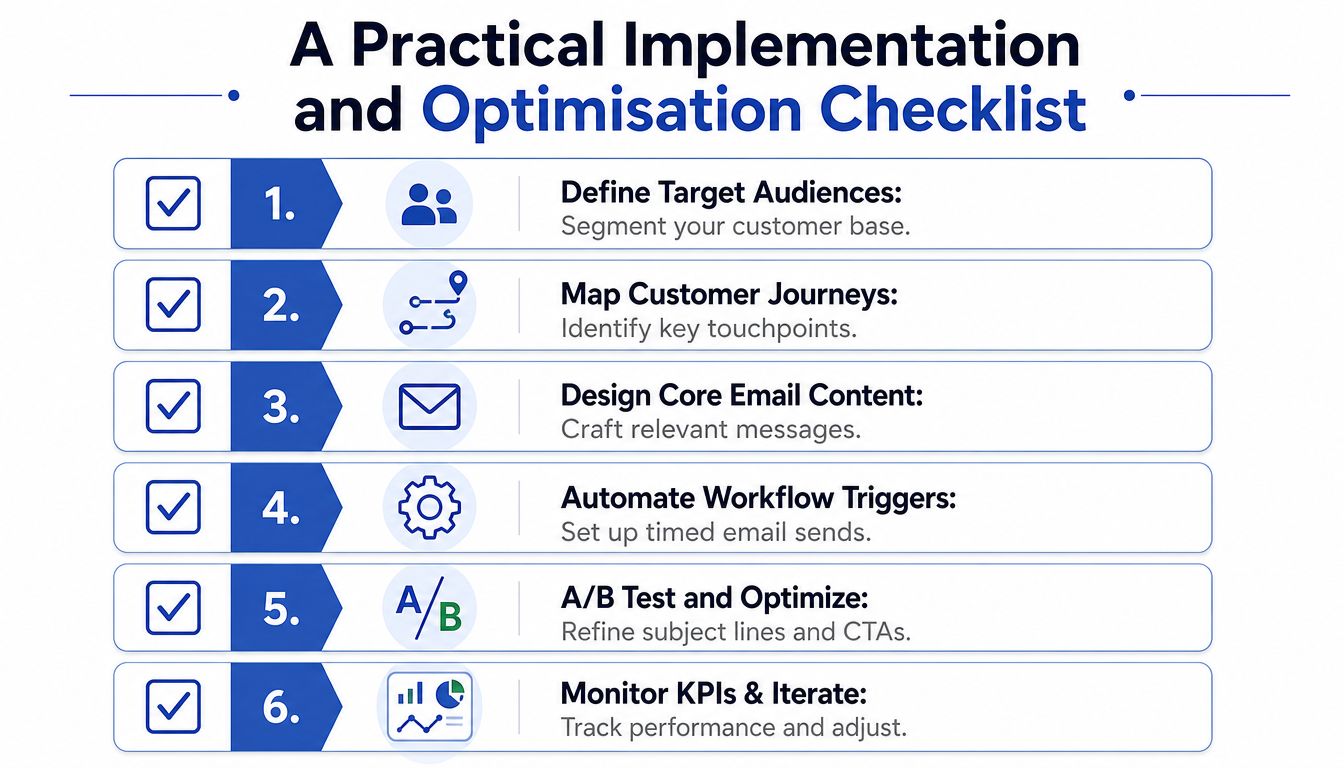
Phase one gets the foundations right
Start with the operational basics:
Connect Shopify cleanly
Make sure your ESP receives product catalogue data, customer events, order data, and consent status correctly.Audit existing flows
Pause duplicate automations, broken triggers, outdated offers, and conflicting suppressions.Build the core four
Launch or rebuild welcome, browse abandonment, cart abandonment, and post-purchase first.Check mobile rendering
Most Shopify email traffic is mobile-heavy in practice, so test every email on small screens before it goes live.
If the foundation is messy, optimisation won't save it.
Phase two sharpens targeting
Once core flows are stable, improve who sees what.
- Split first-time and repeat buyers so post-purchase messaging reflects relationship depth
- Segment by category purchased so recommendations feel coherent
- Separate engaged subscribers from inactive ones before sending heavier campaigns
- Create lapsed customer definitions by product cycle instead of using one blanket rule
A mattress brand and a supplements brand should not share the same winback timing. Their purchase rhythms are different, so the segmentation logic must be different too.
Phase three focuses on conversion testing
Many merchants jump too early in the testing process. Testing only works well when the underlying flow already has enough signal and stable logic.
Run tests like these:
- Subject line test in the welcome flow, brand-led versus product-led
- Offer test in cart recovery, incentive versus no incentive
- Timing test for browse abandonment, earlier reminder versus later reminder
- CTA test in post-purchase, education-led versus product-led next step
- Winback angle test using new arrivals, restock reminder, or selective offer
Don't test five things at once in one email. You won't know what changed the outcome.
Operator note: Start by testing the decision points closest to revenue. Subject lines matter, but audience logic and offer strategy usually matter more.
Phase four turns lifecycle into an ongoing system
Once flows are live and tested, treat them like trading assets. Review them regularly.
A simple recurring checklist works well:
- Check attribution quality so flows aren't claiming revenue they didn't influence
- Review discount usage to spot margin leakage
- Update product blocks when collections, pricing, or bestseller priorities shift
- Refresh copy and creative when engagement decays
- Compare cohorts over time to see whether customer behaviour is improving
Lifecycle email marketing is never “done”. Product mix changes. Customer intent changes. Your Shopify store changes. The email system has to keep up.
If your Shopify store has flows running but they're not pulling their weight, Grumspot helps merchants fix the underlying problem. From conversion-focused audits to full Shopify builds and retention-minded CRO work, the team turns patchy ecommerce systems into cleaner, higher-performing revenue engines.
Let's build something together
If you like what you saw, let's jump on a quick call and discuss your project
Related posts
Check out some similar posts.
- subscription service
Learn how to set up a subscription service with proven pricing, billing, churn and compliance strate...
Read more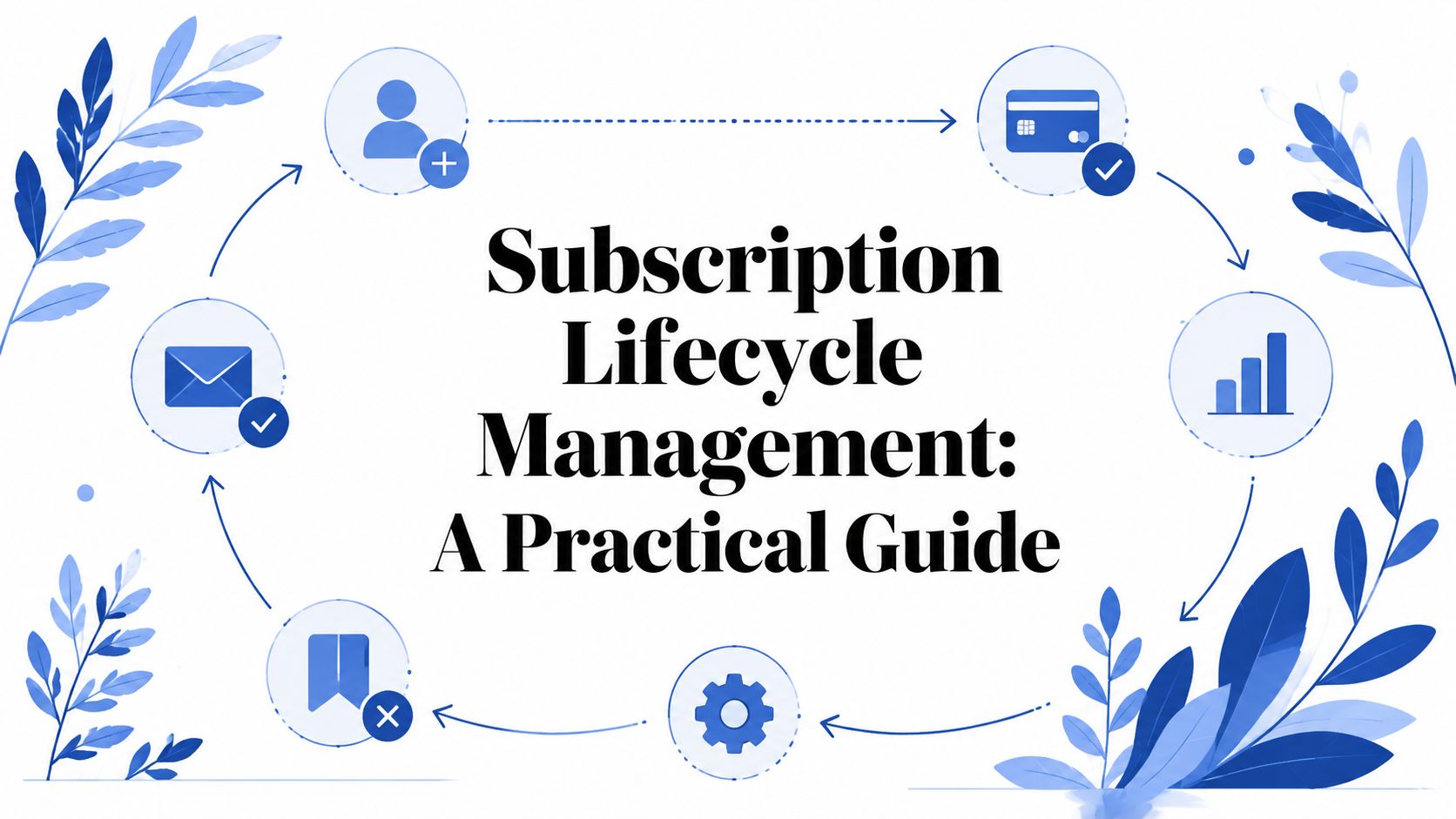
- subscription lifecycle management
Master subscription lifecycle management with stages, metrics and best practices that lift retention...
Read more
- google shopping optimization
Unlock growth with our guide to Google Shopping optimization. Learn technical feed setup, campaign s...
Read more