What Is Customer Lifetime Value: A 2026 Guide for Ecommerce
- what is customer lifetime value
- clv
- ecommerce metrics
- shopify
- customer retention
Launched
June, 2026
A lot of Shopify founders hit the same wall. Revenue looks healthy. Orders are coming in. Paid social is busy, search is spending, and the dashboard gives you enough green arrows to feel like growth is happening.
Then a few months later, margins feel tight, repeat purchase rates look soft, and support tickets keep rising. You realise many of the customers from that “great” month bought once, used a discount, and never came back. The business grew, but the customer base didn't get stronger.
That's where customer lifetime value changes the conversation. Instead of asking what a customer spent today, it asks what that relationship is worth over time. That shift matters because ecommerce isn't built on isolated transactions. It's built on whether customers return, buy profitably, and stay long enough to justify what you spent to win them.
For store operators, this isn't just a finance metric. It shapes how you judge paid acquisition, how you design product pages, how you build post-purchase flows, and how you think about retention. If your email programme is mostly promotions, for example, you may be missing the relationship-building side that supports repeat buying. A useful primer on that is CleanMyList's guide to nurturing email strategies, because CLV rises when communication keeps customers engaged after the first sale.
From Transactions to Relationships An Introduction
A founder checks Shopify every morning. Yesterday's sales are up. The week is pacing well. Ads are working well enough to keep the acquisition machine moving.
But there's a blind spot in that daily habit. Revenue dashboards reward immediacy. They don't tell you whether those customers will buy again, whether they'll return half the order, or whether the margin survives shipping, support, and discounting. A business can look busy while stacking low-value customers.
That's why customer lifetime value, often shortened to CLV, matters so much in ecommerce. It turns attention away from one-off order wins and towards the quality of the customer relationship. The question stops being “How many orders did we get?” and becomes “What kind of customers are we acquiring, and are they becoming more valuable over time?”
The healthiest stores don't just convert traffic. They build systems that make the second, third, and fourth purchase easier than the first.
In practice, CLV is the metric that connects teams that often operate separately. Marketing uses it to decide how aggressively to acquire. Retention uses it to decide where to invest in flows, loyalty, and support. Merchandising uses it to identify which products attract repeat buyers rather than bargain hunters. UX teams use it to reduce friction that kills confidence after the first order.
For a Shopify brand, this changes planning. A paid campaign that looks expensive on first-order return can still make sense if it consistently brings in customers who come back and buy full price. A discount-led campaign that inflates top-line revenue can be a bad trade if those customers churn after one order.
Once you start looking through a CLV lens, you stop treating customers like transactions on a spreadsheet. You start treating them like assets the business either strengthens or wastes.
What Is Customer Lifetime Value Really
A founder checks yesterday's sales and sees a strong day. Then the follow-up questions start. How many of those customers will buy again? Which ones came in on heavy discounting? Which first orders will turn into profitable repeat business six months from now?
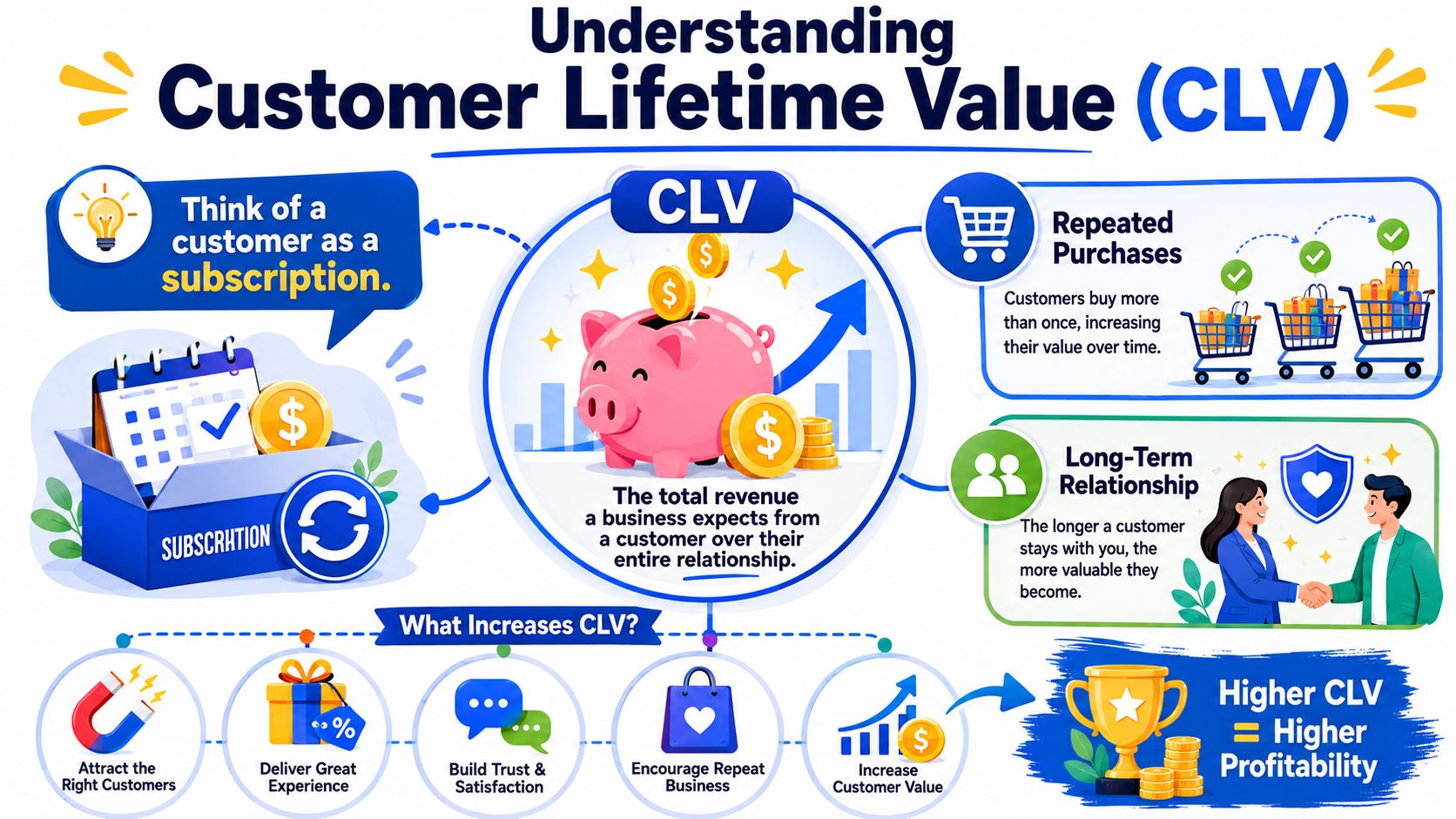
That is what customer lifetime value measures. It estimates the total revenue or profit a store can expect from a customer over the full relationship, not just the first checkout. The common starting formula is average order value x purchase frequency x customer lifespan. Useful teams stop there only briefly. In practice, stores get better decisions from CLV models that also account for margin, returns, fulfilment costs, and retention patterns.
The shift matters because ecommerce operators do not run businesses on top-line sales alone. They run them on what each customer contributes after the obvious costs and the less obvious ones.
The simple definition founders need
For a Shopify brand, CLV answers a practical question. What is this customer worth if the relationship works the way your store is designed for it to work?
A first-time buyer of supplements might reorder every month. A first-time buyer of apparel might come back seasonally if sizing, delivery, and post-purchase experience are handled well. Another customer may place a healthy opening order, use a discount code, return half the basket, and never come back. First-order revenue treats those customers too similarly. CLV separates them.
That is where academic definitions often lose operators. They describe CLV correctly, but too abstractly to guide day-to-day choices. On a working ecommerce store, CLV is an operating metric. It helps teams judge whether the current acquisition mix, offer strategy, onsite experience, and retention setup are producing durable customers or expensive one-time buyers.
Revenue CLV versus profit CLV
The costly mistake is treating revenue as if it were value. It isn't.
Revenue-based CLV is fine for a rough read on customer quality. It becomes less useful the moment margin varies by product, returns are high, or support and shipping costs differ meaningfully across segments. A more decision-useful version uses contribution after cost to serve. Salesforce makes the same distinction in its explanation of customer lifetime value.
Here is the practical difference:
- Revenue-based CLV is fast and directionally useful. It helps spot trends in repeat buying.
- Profit-based CLV is better for budgeting. It reflects what the business keeps after the costs tied to serving that customer.
- Margin-aware CLV is the version operators should use for channel mix, discount strategy, and retention investment.
One sentence can change how a team behaves: a customer who buys three times is not automatically a good customer if each order arrives through paid discounts, creates return risk, and carries weak margin.
For Shopify stores, this shows up in specific ways. Fashion brands see it in return rates and exchange costs. Low-AOV brands feel it in pick, pack, and payment fees. Subscription brands see it in churn, failed rebills, and save attempts. Agencies like Grumspot use CLV in this operational sense, tying it back to CRO and retention work such as reducing post-purchase friction, improving reorder paths, lifting account area usage, and designing bundles that increase second-order value rather than just first-order conversion.
If you want another practical breakdown that stays closer to growth decisions than textbook formulas, Refgrow has a useful piece on Refgrow on customer lifetime value.
CLV, used properly, is a way to value the customer relationship as a future cash flow stream shaped by your store experience, offer strategy, and retention systems. That makes it far more useful than a tidy formula on a dashboard.
Why CLV Is a Critical Metric for Ecommerce Stores
A founder sees a paid campaign hit target CPA, revenue jumps for the week, and the dashboard looks healthy. Two months later, repeat orders are flat, support tickets are up, and margin is thinner than expected. That gap is where CLV earns its place.
For ecommerce operators, CLV matters because it changes the unit of analysis from the order to the relationship. That shift affects real decisions. How much to spend to acquire a customer. Which products to push in paid traffic. Whether a free shipping threshold helps or hurts. Where to invest in site UX after the first purchase.
It makes acquisition spending more rational
Teams that judge performance on first-order revenue alone usually favour what looks efficient in the moment. That often means discount-led campaigns, aggressive prospecting, and landing pages built to close the first sale at any cost.
The problem is quality.
Some channels bring in buyers who purchase once and disappear. Others produce slower payback but stronger repeat behaviour. CLV helps separate cheap customers from good customers. That distinction matters on Shopify, where a campaign can look profitable in-platform while returns, discount dependency, and low second-order rate tell a different story.
This is also where agencies like Grumspot tend to use CLV as an operating metric rather than a finance concept. If a cohort from Meta buys again within 45 days and a cohort from affiliates does not, budget allocation changes. If a landing page lifts conversion but lowers repeat purchase rate by attracting the wrong buyer, that page needs to be reworked, not celebrated.
It gives retention work a clear commercial case
Retention rarely wins internal arguments if the only scoreboard is daily sales. Welcome flows, replenishment reminders, loyalty mechanics, account-area improvements, and post-purchase education usually pay back over months, not overnight.
CLV puts those projects on firmer ground because it ties them to future gross profit, not just engagement metrics.
That changes the conversation. Better reorder UX is no longer a nice extra. It can justify design and development time if it shortens the path to the second order. Clearer shipping communication is not just a support fix. It can reduce anxiety that leads to cancellations, chargebacks, or one-and-done behaviour.
For brands that want a more practical framework, this guide to customer lifetime value calculation for ecommerce stores is useful once you start turning the metric into budgets and retention targets.
It improves CRO, merchandising, and site experience
CLV is also one of the best filters for CRO work because it forces a harder question than "did conversion go up?" It asks whether the store is attracting and keeping the right customer.
That changes how strong teams approach optimisation:
- Merchandising: Feature products that lead to healthy repeat behaviour, not just high click-through during promotions.
- Bundles and upsells: Increase order quality in ways that support future purchases instead of training customers to wait for discounts.
- Product pages: Set expectations clearly so customers buy the right item the first time, which lowers returns and protects margin.
- Account and reorder flows: Make it easy for existing customers to come back, manage subscriptions, reorder favourites, and solve small issues without friction.
A short explainer can help if you want a visual walkthrough of the commercial logic behind the metric.
Stores that optimise around customer lifetime value make better trade-offs. They can accept slower first-order payback, invest more confidently in retention, and design the site for repeatable profit instead of one-off conversion spikes.
When founders ask what customer lifetime value is really for, the practical answer is simple. It helps decide where to put money, time, and optimisation effort so growth holds up after the first sale.
How to Calculate Customer Lifetime Value
You don't need a complicated data stack to start. You need a clean method and the discipline to separate rough estimation from decision-grade calculation.
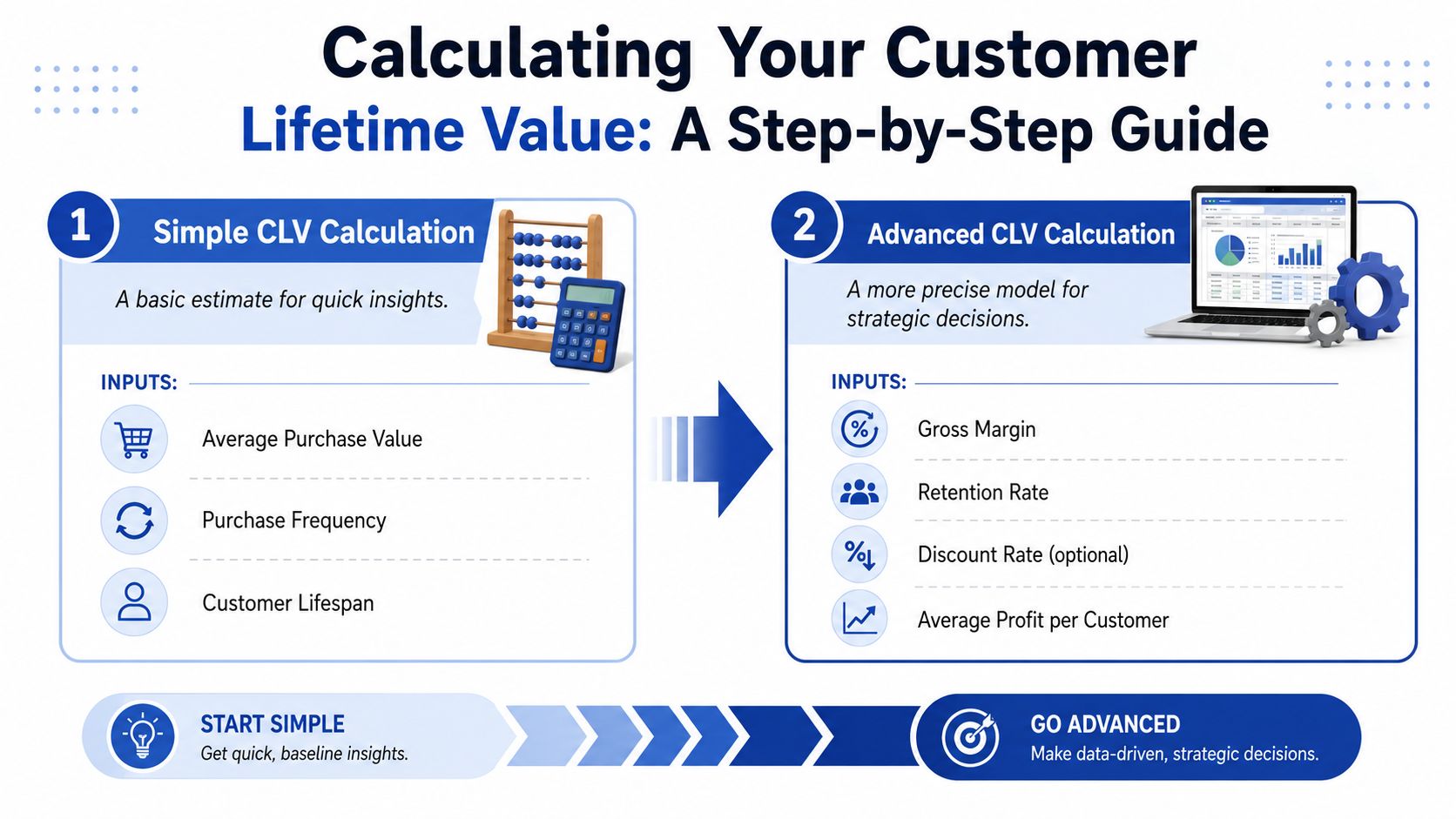
A common framework expresses CLV as average transaction size × number of transactions × retention period, and stronger versions add gross margin and discount rate to reflect the present value of future cash flow, as described in the Wikipedia explanation of customer lifetime value.
Start with the simple model
The practical starter formula is:
CLV = Average order value × Purchase frequency × Customer lifespan
For a Shopify store, each part means:
- Average order value is the average amount spent per order.
- Purchase frequency is how often a customer buys in a given period.
- Customer lifespan is how long the average customer relationship lasts.
This version is useful because it's easy to build from Shopify Analytics, order exports, or a reporting layer.
Here's how to use it operationally:
- Pull average order value from your store data.
- Calculate purchase frequency by looking at repeat purchase behaviour across customer cohorts.
- Estimate lifespan based on how long customers keep buying before they go inactive.
- Multiply the three figures to get a directional CLV estimate.
This model won't give you the full financial truth, but it will give you a working baseline. That's enough to compare segments, channels, products, and campaigns.
Move to the advanced model
The stronger version treats CLV as a discounted cash-flow metric. In plain English, it values the customer based on the present value of expected future gross margin, not just future revenue.
That means your advanced calculation should account for:
- Gross margin rather than sales alone
- Retention or churn because customer lifespan isn't fixed
- Discount rate because future cash is worth less than cash today
- Cost to serve where possible, especially in categories with meaningful returns, shipping, or support costs
A technically simple way to think about the upgrade is this: the basic model asks how much a customer might spend, while the advanced model asks what those future purchases are worth to the business.
CLV Formula Comparison
| Component | Simple CLV Formula | Advanced CLV Formula |
|---|---|---|
| Focus | Revenue estimate | Profit-oriented value estimate |
| Core inputs | Average order value, purchase frequency, customer lifespan | Gross margin, retention or churn, discount rate, expected future contribution |
| Best use | Quick reporting and trend spotting | Budgeting, segmentation, acquisition planning |
| Limitation | Can overstate value | Requires cleaner data and stronger assumptions |
If you're making channel budget decisions, the advanced model is the safer one. If you're trying to establish a first benchmark, the simple model is enough to get moving.
For Shopify operators who want a store-focused walkthrough, Grumspot has a more detailed guide to customer lifetime value calculation that expands on these methods.
One last practical point. Don't blend unlike customers together if you can avoid it. UK cohort data is more useful than broad averages, and segment-specific inputs are better than one global figure. CLV gets more useful as it gets more local.
Practical Tactics to Increase Your CLV
Raising CLV isn't about finding one magic retention hack. It's about improving the underlying drivers of value. Customers need to convert cleanly, receive a good experience, come back without friction, and remain profitable when they do.
Predictive CLV is more useful than historical CLV for decision-making because it estimates future value from observed behaviour, which helps retailers forecast by cohort and set acquisition ceilings by segment, as explained in Qualtrics on predictive customer lifetime value.
Improve UX so the first order leads to the second
Many stores treat conversion rate optimisation as a checkout problem. It isn't. The first purchase sets the tone for whether the second purchase feels natural or risky.
Focus on the friction points that undermine confidence:
- Product page clarity: Better sizing guidance, ingredient details, material information, and delivery expectations reduce buyer hesitation and post-purchase disappointment.
- Mobile usability: If a customer struggles to browse, filter, or add to basket on mobile, repeat buying becomes less likely.
- Account and reorder journeys: Returning customers shouldn't have to hunt through the site to buy again.
A cleaner UX doesn't just help conversion. It improves the quality of the customers you retain.
Extend customer lifespan through retention systems
Retention work is where CLV usually becomes operational rather than theoretical.
The strongest tactics are often the least glamorous:
- Welcome flows: Teach customers how to use the product, what to expect next, and when to reorder.
- Post-purchase education: Reduce regret and increase product adoption.
- Reactivation campaigns: Bring back customers before they forget why they bought in the first place.
- Customer support quality: Fast, clear resolutions protect relationships that would otherwise fade.
If your team wants better follow-up structure, these proven lead nurturing best practices are helpful because many of the same principles apply after first purchase too.
A customer rarely leaves because of one dramatic failure. More often, they drift because no one gave them a clear reason to return.
Increase average order value without damaging trust
Higher CLV doesn't always require a longer lifespan. Sometimes the fastest gain comes from improving order quality.
Effective methods include:
- Bundles that solve a complete use case rather than just stacking products together
- Cross-sells placed where they support the purchase, not interrupt it
- Thresholds for shipping or gifts that encourage a sensible basket increase
- Merchandising by intent so returning customers see relevant add-ons quickly
What doesn't work well is aggressive upselling that feels detached from the customer's goal. That can raise short-term order value while lowering long-term loyalty.
Build repeat purchase mechanics into the store
If repeat buying depends on the customer remembering you at the right moment, CLV will stay fragile.
Create systems that prompt return behaviour:
- Subscriptions where the product cadence supports it
- Replenishment reminders tied to expected usage cycles
- Personalised recommendations based on previous purchases
- Loyalty logic that rewards continued engagement without training customers to wait for discounts
For teams refining the wider experience around repeat customers, this guide to customer satisfaction measurement is useful because service quality, expectation setting, and retention usually move together.
The main principle is straightforward. Don't chase CLV directly. Improve the experiences and systems that make customers worth more over time.
CLV and Customer Acquisition Cost The Perfect Pair
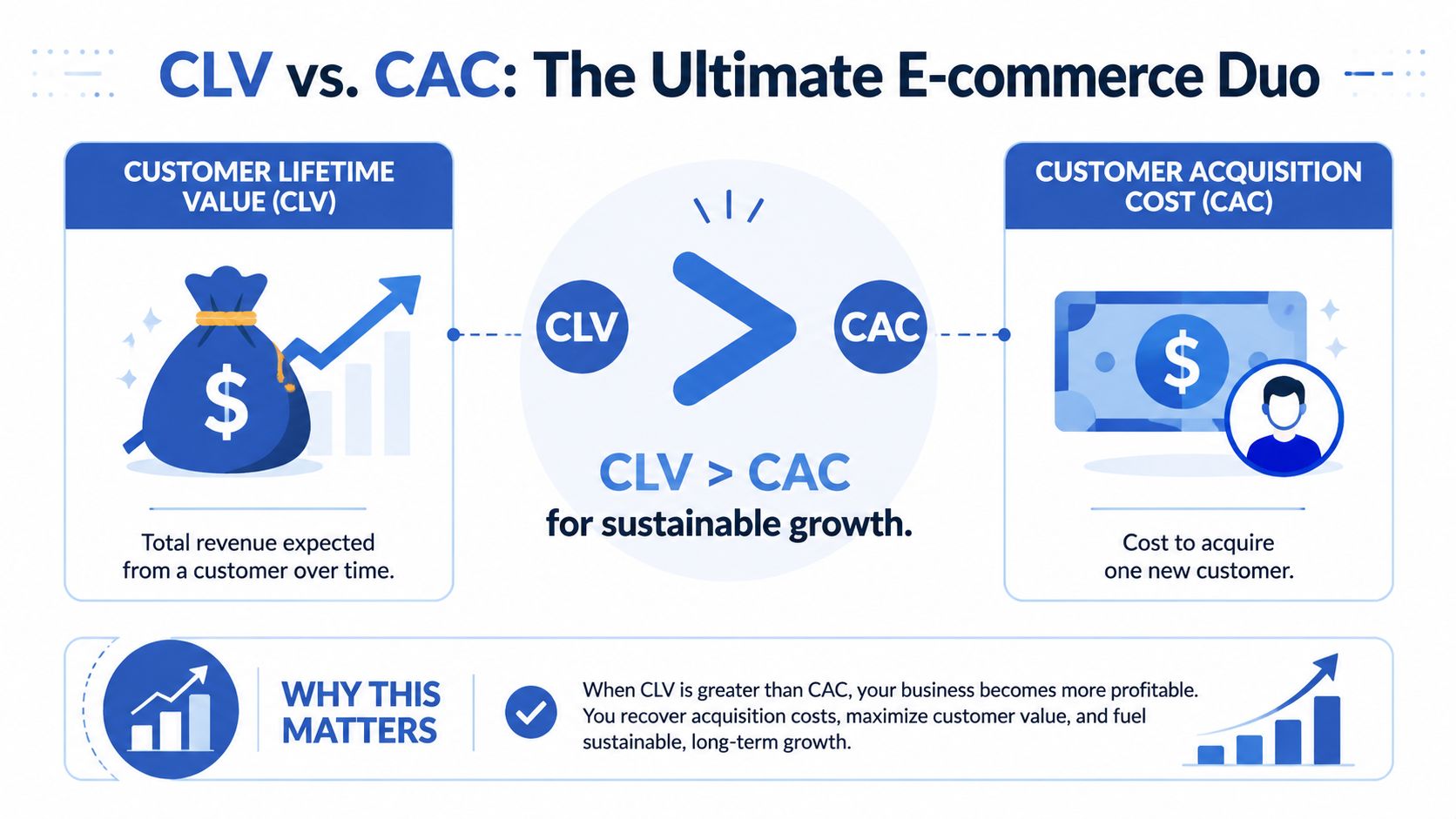
Knowing CLV in isolation is helpful. Pairing it with customer acquisition cost, or CAC, is what turns it into a commercial decision tool.
A standard benchmark is that a healthy CAC:CLV ratio is 1:3, meaning a company should aim to earn about three times what it spends acquiring each customer, according to CustomerGauge's explanation of average customer lifetime value by industry.
Why the ratio matters
This ratio answers a practical question every founder faces. Are we buying growth profitably, or are we paying too much for customers who don't stay long enough?
If acquisition costs rise while customer value stays flat, the business gets less efficient. Revenue may still grow, but the economics worsen underneath it. That's why CLV and CAC need to be reviewed together, not in separate reports owned by different teams.
How to use it in the real world
The ratio works best as a decision threshold:
- Paid media: Set channel and campaign ceilings based on what the expected customer is worth.
- Offer strategy: If heavy discounts reduce long-term value, the acquisition cost may no longer be justified.
- Retention investment: Improving customer lifespan or order quality can make existing CAC levels sustainable again.
A useful way to think about it is this. CAC tells you what you paid to start the relationship. CLV tells you whether the relationship paid you back.
For brands looking at broader planning beyond channel metrics alone, Grumspot's article on ecommerce growth strategies complements this nicely because CLV:CAC only improves when acquisition, UX, merchandising, and retention work together.
Putting CLV into Practice Your Next Steps
If you've been asking what is customer lifetime value, the simplest answer is this: it's the metric that tells you whether your store is building durable customer relationships or just processing orders.
The practical shift is from transaction thinking to relationship thinking. Once you make that shift, the next moves are usually clear.
Start here:
- Measure the basics first: Pull average order value, repeat purchase behaviour, and customer lifespan from your existing store data.
- Segment your customers: Separate first-time buyers, repeat buyers, high-margin buyers, and discount-led customers so you can see where value originates.
- Choose one lever to improve: Fixing product page clarity, tightening post-purchase email, improving bundles, or making reordering easier are all realistic starting points.
- Track profit, not just revenue: If returns, fulfilment, and service costs are meaningful, don't let revenue CLV mislead you.
- Use tools that fit your stage: Shopify Analytics is enough for many early decisions. As complexity grows, tools such as Glew or Triple Whale can help you model cohorts and channel quality more clearly.
CLV doesn't need to become an academic exercise. It just needs to become part of how the business decides where to spend, what to improve, and which customers it wants more of.
If you want help turning CLV into actual store improvements, Grumspot works on the parts that usually move it in practice: Shopify UX, CRO, retention-oriented design, merchandising, subscriptions, and technical fixes that make repeat buying easier.
Let's build something together
If you like what you saw, let's jump on a quick call and discuss your project

Related posts
Check out some similar posts.
- subscription examples
Explore 7 subscription examples across Shopify, pricing and retention models, with practical lessons...
Read more
- churn prediction
Discover how churn prediction models work and learn practical steps for feature engineering, evaluat...
Read more
- retention marketing strategies
Boost ecommerce repeat purchases with 10 actionable retention marketing strategies. Implement on Sho...
Read more
- churn reduction strategies
Discover 10 expert churn reduction strategies for your ecommerce business. Learn to cut customer chu...
Read more