Predictive Analytics Ecommerce: A Practical Guide 2026
- predictive analytics ecommerce
- ecommerce forecasting
- Shopify analytics
- demand prediction
- customer churn
Launched
August, 2026
You're probably looking at a Shopify dashboard that tells you what happened last week, while your inbox is already full of questions about next week's stock, next month's spend, and which customers are about to disappear. That gap between reporting and decision-making is where predictive analytics ecommerce becomes practical, because it turns historical behaviour into forward-looking calls on demand, churn, and conversion. In the UK, that matters more than ever, because internet sales accounted for 27.9% of all retail sales in December 2024 according to the Office for National Statistics via the referenced source on UK ecommerce market context, which means a large share of revenue now lives inside the channels where forecasting can influence real money.
A lot of merchants still try to manage that channel with spreadsheets, instinct, and a weekly stock review. That can work for a while, until a product runs hot, a campaign lands differently than expected, or a replenishment order arrives too late. Predictive models don't remove judgement, they make judgement faster and better informed, especially when the underlying data is clean enough to trust.
For teams also exploring autonomous tooling, AI agents for ecommerce is a useful adjacent read, because the same data foundations that support predictions also support more automated operational decisions.
Why Predictive Analytics Matters for Modern Ecommerce
A merchant I worked with recently had the familiar setup, one person exporting Shopify data, another pulling ad platform numbers, and someone in operations maintaining a spreadsheet that only looked reliable on Monday mornings. By the time the team spotted a trend, they'd already missed the window to act on it. Predictive analytics is the systematic alternative to that pattern, it uses historical and real-time transaction data to forecast likely future outcomes so teams can act before revenue slips away.
From reactive reporting to proactive decisions
The biggest shift is not technical, it's operational. Traditional reporting tells you that a SKU sold out, a segment churned, or a campaign underperformed, while predictive analytics helps you decide what to reorder, who to target, and when to spend before the outcome is locked in. In UK ecommerce, that shift is especially valuable because online retail is no longer a side channel, it's a major commercial surface where forecasting demand, churn, and conversion can directly affect profit.
The UK's AI adoption base gives that shift more momentum. The government's 2025 AI sector study reported that the UK AI market generated £11.8 billion in revenue in 2024, and that 39% of UK businesses had adopted at least one AI technology by 2024. Those figures matter because predictive ecommerce depends on more than a clever model, it depends on a business already being comfortable with data, tooling, and operational change. For a Shopify merchant, that means the question isn't whether predictive analytics exists, it's whether the store has enough maturity to use it well.
Why UK ecommerce is a strong fit
The UK market gives models something useful to learn from, a dense stream of purchases, promotions, and fulfilment signals. When more than a quarter of retail sales happen online, predictions around stock, campaign timing, and lifecycle management have a real commercial surface to influence. That's why the category is becoming more economically significant, not because AI is fashionable, but because the commercial payoff now sits in digital channels that are measurable and continually refreshed.
Practical rule: If a prediction won't change a stock order, a campaign, or a retention action, it's probably reporting dressed up as intelligence.
The best use cases start where the business already feels pain. If operations are firefighting stock-outs, start with demand planning. If repeat purchase is weak, start with churn or lifecycle forecasting. If media spend is broad and inefficient, start with customer value modelling and move from there.
How Predictive Models Actually Work in Ecommerce
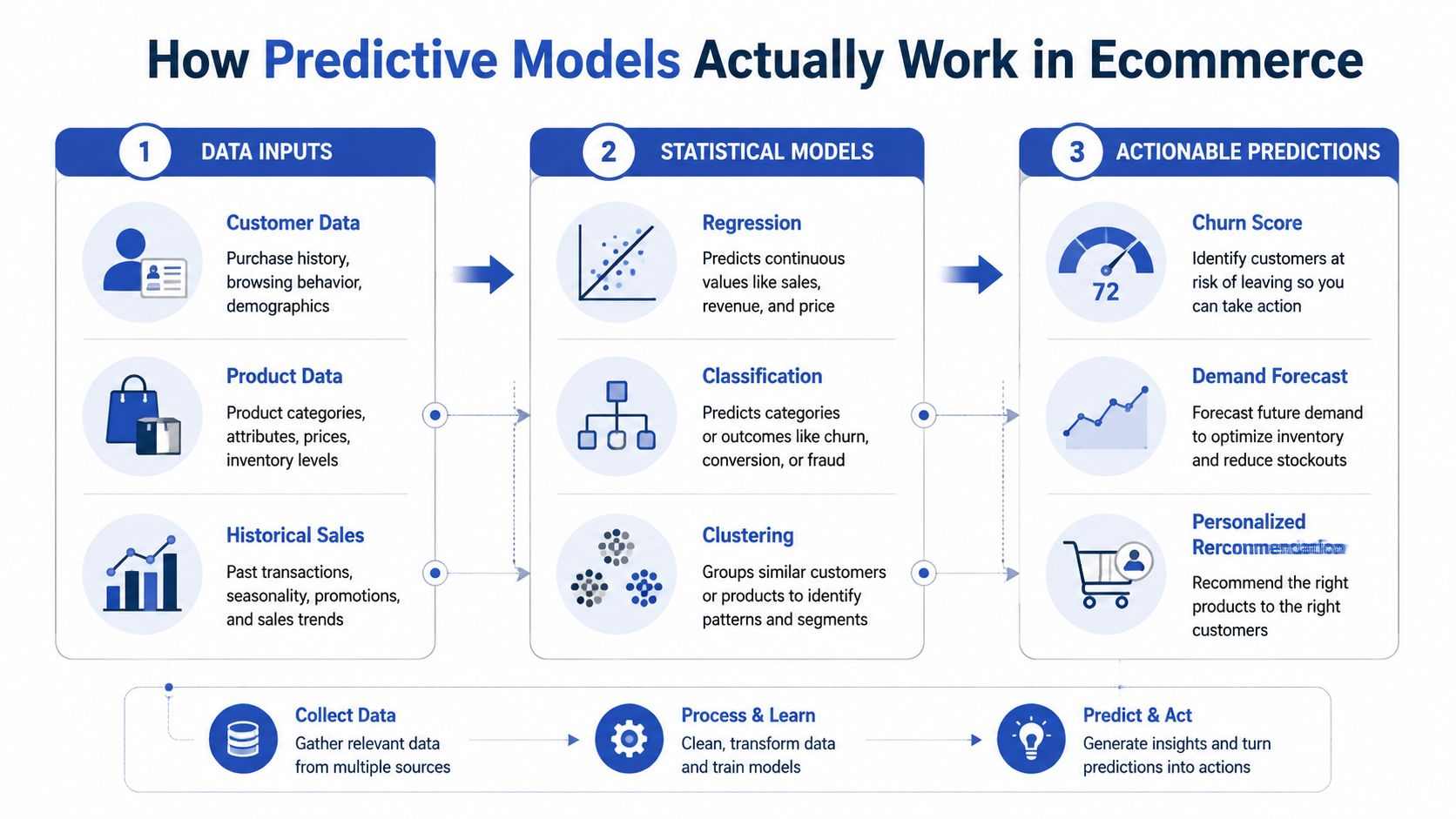
A good model isn't magic, it's a structured way of teaching a system to notice patterns humans miss. It works like onboarding a sharp new planner, except instead of sitting them down with a few examples, you show them years of sales history, promotion timing, stock levels, and customer behaviour. Over time, they learn which signals matter and which ones are noise.
The three moving parts
Predictive systems usually need three things. First, they need data inputs, such as purchase history, browsing behaviour, product attributes, fulfilment data, and campaign activity. Second, they need a statistical model, which could be a regression model for pricing response, a classification model for churn risk, or a time-series approach for demand planning. Third, they produce output predictions, such as a churn score, a demand forecast, or a recommendation ranking.
The quality of the output depends heavily on the quality of the inputs. If product categories are inconsistent, customer identities are fragmented across devices, or transaction records are incomplete, the model learns the wrong lessons. That's why data cleaning isn't admin work, it's the core of the modelling process.
What the common model types do
For ecommerce, time-series forecasting is usually the first model merchants understand because it matches the business question, what will sell next week, next month, or next season? Classification works better when the question is yes or no, such as whether a customer is likely to churn. Regression is useful when the goal is estimating a numeric outcome, like the likely impact of price changes or spend allocation.
The mechanics matter less than the discipline around them. As the MLOps lifecycle discussion in MLOps lifecycle and deployment strategies makes clear, models need deployment, monitoring, and retraining, not just training. That same principle applies in ecommerce, because shopping behaviour changes, promotional patterns shift, and a model that was useful last quarter can drift fast if nobody is watching it.
The cleanest way to think about it is this, models learn from the past, but merchants act in the present. That means the core job isn't building an elegant prediction in isolation, it's wiring it into the workflow where a buyer, planner, or marketer can use it.
Operational reality: Data quality matters more than algorithm sophistication when the business process around the model is weak.
One useful way to structure the work is to connect the model to a use case rather than to a data science ambition. If the output can't feed inventory, CRM, or paid media decisions, the project stays theoretical. The best teams start with a business question and force the data architecture to answer it.
For segmentation work that often sits next to predictive modelling, Grumspot's customer segmentation strategy is relevant because the same customer identity and event structure usually supports both.
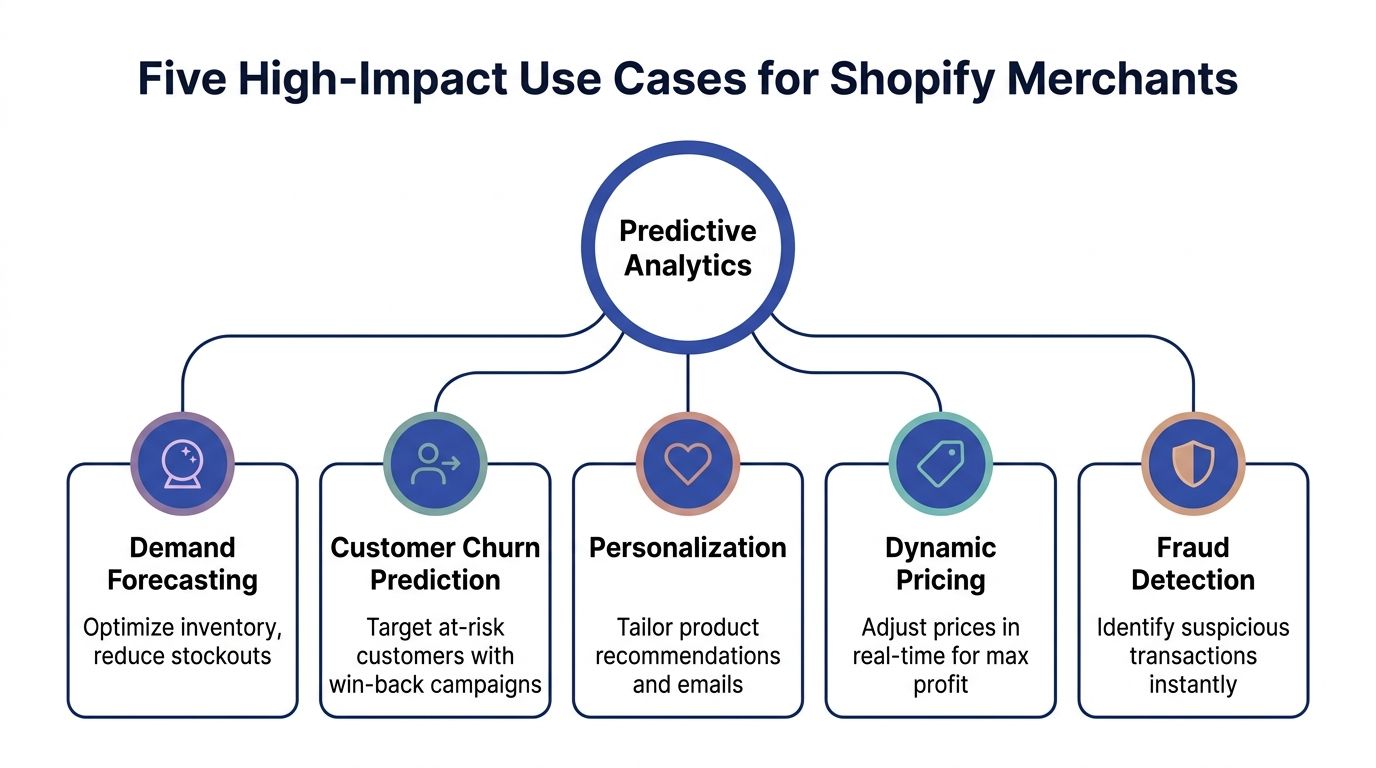
Five High-Impact Use Cases for Shopify Merchants
Demand forecasting
This is usually the first place to invest because the business decision is obvious. You combine sales history, promotion calendars, and supplier lead times, then use the forecast to guide reordering and allocation. The strongest short-horizon signals are usually near-term, and the supplied technical benchmark shows 0 to 30 day forecasts at 85 to 95% accuracy, 31 to 90 day forecasts at 70 to 85%, and 91 to 180 day forecasts at 55 to 70%. Those ranges come from the referenced ecommerce forecasting benchmark, and they explain why planners should treat long-range demand output as guidance, not gospel.
For Shopify merchants, a lot of value sits here because it reduces the number of decisions made on gut feel. It also works well with category-level planning, especially when SKU-level demand is noisy and category totals are more stable.
Customer churn prediction
Churn models help you spot customers who are drifting away before they disappear completely. The inputs usually include purchase cadence, time since last order, session behaviour, support tickets, and response to previous campaigns. The output is a risk score that tells CRM teams who should get a retention offer, who only needs a reminder, and who's already gone cold.
Personalisation
Personalised recommendations can lift conversion, but only when the underlying catalogue and event data are reliable. The model needs product relationships, browsing paths, and enough order history to infer intent. If product tagging is messy or the feed is poorly maintained, the recommendation engine ends up surfacing irrelevant items and hurting trust rather than helping it.
Dynamic pricing
Pricing models are more delicate than they sound. Merchants often want a simple answer, but price changes affect margin, conversion, and brand perception at the same time. A useful model needs historical price response, promo history, inventory pressure, and competitive context, then it should be constrained by guardrails so the business doesn't optimise one metric while damaging another.
Customer lifetime value modelling
CLV modelling helps acquisition teams decide how much to bid, where to spend, and which segments deserve more aggressive investment. It's especially useful when the store has varied repeat behaviour across cohorts. The trick is to avoid using CLV as a vanity metric, it should shape budget allocation, retention priority, and segmentation.
For merchants who want the same logic applied directly to stock decisions, demand forecasting ecommerce is a practical companion resource because it stays close to SKU-level operations.
What to start with
The right order is usually simple.
- Start with demand forecasting if stock-outs, over-ordering, or replenishment timing are your biggest pain points.
- Move to churn prediction if repeat purchase is weak and CRM still works from broad segments.
- Use personalisation later if your catalogue, tagging, and feed hygiene are already strong.
- Treat dynamic pricing cautiously unless you have tight commercial controls.
- Adopt CLV modelling when acquisition spend needs sharper segment-level direction.
Each use case has a different data burden, and the wrong one to begin with is usually the one that looks most impressive in a demo.
Building Your Implementation Roadmap
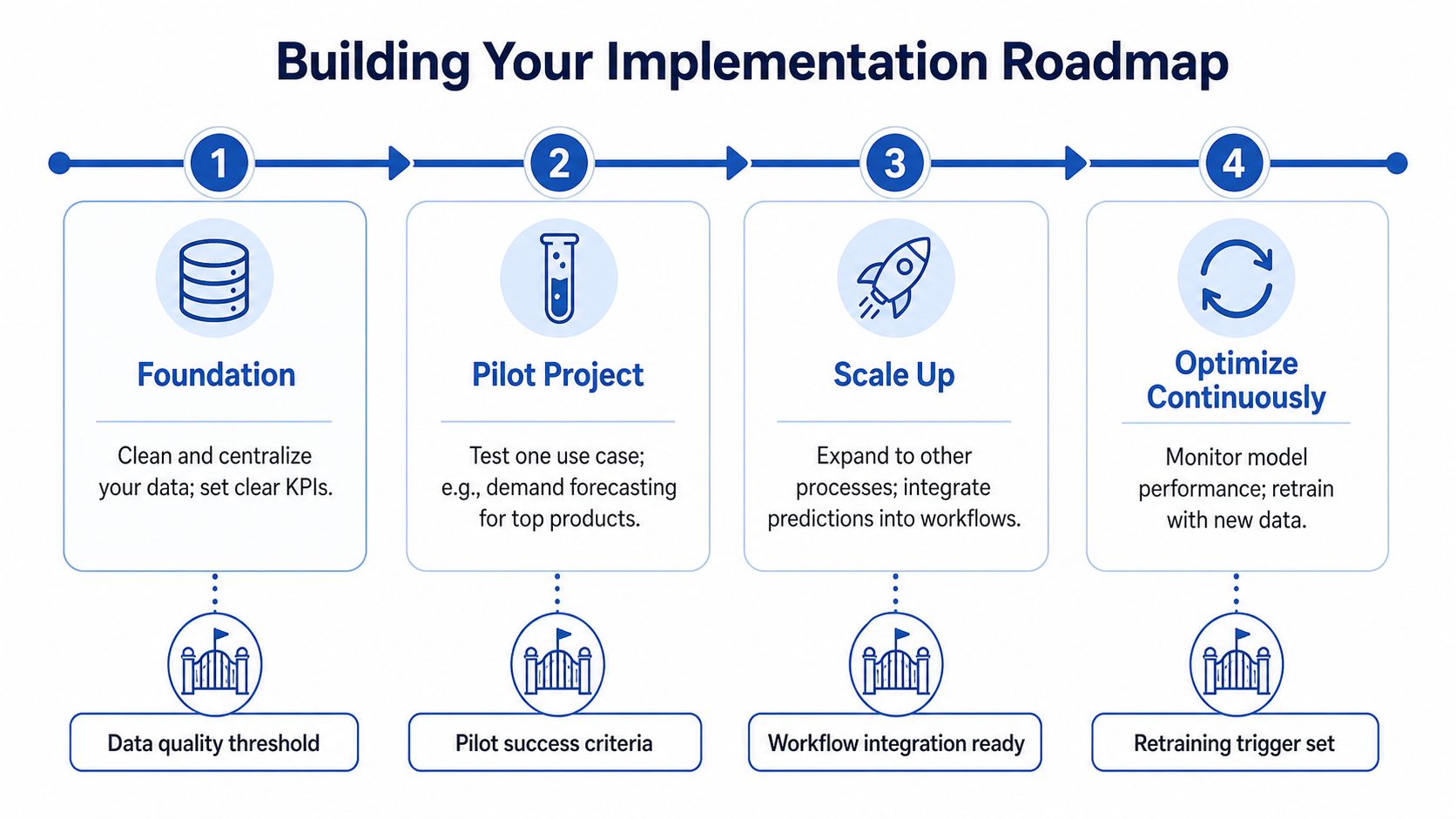
A project only works when the data stack, the operating process, and the measurement plan are aligned before the model goes live. The failure I see most often is not weak machine learning, it is a team trying to automate a messy workflow and calling the result progress. A useful roadmap needs gates, clear owners, and a hard look at whether the underlying systems are ready.
Foundation first
Start with a data audit. Check whether GA4 ecommerce events are implemented correctly, whether Shopify, CRM, ERP, and fulfilment data can be matched, and whether customer identities stay stable across devices and channels. If the store cannot trust the underlying events, the model will automate confusion.
The local context matters too. Seasonality, channel mix, and fulfilment behaviour should shape the first use case, especially for merchants selling across regions or through more than one channel. Before adding machine learning, confirm where the signal is clean enough to support it.
Pilot one high-confidence use case
Keep the pilot narrow. A near-term reorder model for top products usually makes more sense than a broad predictive overhaul because the output is easier to validate and the financial effect is visible. Vendor tools often win at this stage, since the goal is to prove that a prediction can change an operational decision, not to build the perfect model architecture on day one.
If you want a broader implementation lens, the Algomizer guide to AI adoption is useful because it focuses on operational fit rather than novelty. That is the right framing for ecommerce too.
Practical rule: If you cannot define the decision the model will change, you are not ready to build it.
Scale only after measurement is proven
Once the pilot works, connect the output to ERP, inventory planning, email automation, or paid media workflows. That is where predictions start to matter in daily operations, because teams do not need to log into a separate dashboard to act on them. From there, monitoring becomes the main job.
The integration layer is where many Shopify merchants hit real friction. Forecasts can be accurate and still fail if they never reach the systems that place POs, adjust campaign bids, or trigger retention flows. A prediction that sits in a report is interesting, but it does not change operations.
Keep the loop closed
Models should be retrained as data changes, and performance should be checked against actual outcomes, not only correlation. Incrementality testing matters because a model can look accurate while still failing to drive real lift. Teams that handle this well treat predictive analytics as a managed system, not a one-off launch.
For merchants mapping AI adoption more broadly, the Algomizer guide to AI adoption is useful as a reference point for what operational deployment looks like in practice. It helps teams avoid confusing experimentation with work that is wired into the business.
Vendor Solutions Versus In-House Development
For most Shopify Plus merchants, this is less about ideology and more about timing. Vendor tools can get you moving quickly, while custom development gives you control, but only if you already have the data maturity to support it. The wrong choice is usually the one that asks for more engineering than the problem justifies.
Where SaaS platforms make sense
SaaS platforms, including native Shopify analytics and third-party apps, are usually the better fit when the use case is standard. Demand forecasting, churn scoring, and basic segmentation can often be handled without a dedicated data science team. The main advantages are faster deployment, lower upfront complexity, and less maintenance overhead.
That's also where a service partner like Grumspot can fit naturally, because it works on Shopify storefronts, data integrations, and operational improvements without requiring a merchant to build a full internal analytics function. It's one option among several, not a default answer, but it becomes relevant when the issue is connecting predictions to the store's actual systems.
Where in-house builds earn their keep
Custom development makes more sense when the business has a unique data advantage or a workflow that SaaS tools can't support. That might include bespoke inventory logic, unusual bundle behaviour, or a complex cross-border catalogue. In those cases, the extra control can justify the longer build and the ongoing maintenance burden.
Questions worth asking vendors
- What data do you need before the model performs properly? A vendor that avoids this question is hiding a dependency.
- How do you handle model drift and retraining? If the answer is vague, the tool may not stay useful for long.
- Can the predictions connect to Shopify, CRM, ERP, and fulfilment systems? A dashboard without workflow integration is a report, not an operating tool.
- What proves incremental lift? Correlation alone doesn't justify spend.
- How do you handle identity resolution and channel overlap? Weak identity logic leads to weak predictions.
A red flag is any platform that promises outcomes without discussing data cleanliness, event tracking, or operational fit. Another is a tool that looks clever in a demo but can't explain how it behaves when product ranges change, promotions get more aggressive, or customer behaviour shifts.
The decision shouldn't be framed as vendor versus in-house in the abstract. It should be framed as which option gets you to a reliable decision loop fastest, with the least long-term drag on the team.
Common Pitfalls and How to Avoid Them
A merchant can buy predictive software and still get poor results if the underlying operation is messy. That happens often. If product categorisation is inconsistent, customer IDs do not line up across channels, or transaction history is incomplete, the model usually reflects those gaps instead of correcting them.
The hidden prerequisites
A lot of guides skip the setup work, but that is what decides whether the project holds up in practice. Teams usually need clean transaction history, proper GA4 ecommerce event tracking, unified customer identity across devices and channels, and enough operational discipline to test whether the prediction changes results. Without those foundations, the model can still produce outputs, but those outputs will not be dependable enough for trading decisions.
Identity resolution deserves attention before any forecast work starts. If a customer appears as one person in email, another in paid social, and a third in Shopify, prediction quality drops fast because the model is learning from fragmented behaviour. That is why first-party data collection needs to be handled carefully before machine learning is layered on top.
Privacy also needs a clear answer. UK merchants have to account for GDPR, consent management, and the way personalisation logic uses customer data. Predictive targeting can be useful, but only if the team stays inside a clear ethical and compliance boundary and can explain how the data is being used.
Drift is normal, not exceptional
Models lose accuracy when the business changes. New ranges launch, promotions shift, competitors alter pricing, and customer preferences move. That is model drift, and it is the normal operating environment for ecommerce.
Models do not fail all at once. They usually become a little less useful, then a little more dangerous, and eventually the team starts trusting them too much.
The practical fix is ongoing monitoring, retraining, and a willingness to retire models that no longer match reality. If nobody owns that process, the system turns into shelfware with a dashboard.
Measurement has to prove lift
Incrementality testing matters because a prediction that correlates with success is not necessarily causing it. A retention email may go to customers who would have repurchased anyway, and a stock recommendation may match what the planner already knew. Testing has to isolate the effect of the model, otherwise the business ends up funding software that only looks effective.
The same discipline applies to workflow integration. A model that sits in a dashboard and never reaches Shopify, CRM, ERP, or fulfilment systems creates reporting, not action. Merchants need a clear owner who will use the output, a defined decision rule, and a way to see whether the recommendation changed the result. Without that loop, even a good prediction becomes another unused report.
Assessing Your Readiness and Next Steps
Readiness isn't about ambition, it's about whether the store can support a prediction with clean inputs and an actual decision path. The UK's strong AI adoption base means predictive analytics is no longer experimental in principle, but implementation still depends on whether the merchant has the right foundations in place. The best next step depends on data maturity, not enthusiasm.
A simple readiness check
Use four questions. Can the team trust its ecommerce events? Can customer identities be matched across channels? Is there enough transaction history to spot meaningful patterns? Is there a clear operational owner who will act on the output?
If the answer to most of those is no, focus on data infrastructure first. If the answers are mostly yes, a vendor pilot is usually the smartest next move. If the store already has mature data pipelines, disciplined testing, and a clear commercial question, a custom model may be worth the effort.
The three practical paths
- Foundational work first: clean tracking, unify identities, and fix product and customer data structures.
- Pilot with a vendor: choose one narrow use case, usually demand or churn, and prove lift.
- Build custom: only when the process is distinctive enough to justify the added complexity.
None of those paths are inferior. They just fit different stages of maturity.
What matters most is matching the solution to the current state of the business. A Shopify merchant with messy data doesn't need a more advanced model, it needs cleaner signals and sharper measurement. A merchant with good data but no predictive layer doesn't need a rethink of the stack, it needs a tightly scoped first use case.
For teams ready to move, Grumspot builds and connects Shopify storefronts, data integrations, and conversion-focused workflows, which makes it a practical partner for merchants who need the operational side of predictive analytics put in place. Visit Grumspot to discuss how your store could move from reporting to reliable forecasting.
Let's build something together
If you like what you saw, let's jump on a quick call and discuss your project

Related posts
Check out some similar posts.