Search Relevance and Ranking: Boost Your E-commerce Sales
- search relevance and ranking
- ecommerce seo
- shopify search
- relevance engine
- search algorithms
Launched
June, 2026

A customer lands on your Shopify store, types “black leather ankle boots”, and hits search. You stock exactly that product. But the results page puts suede knee boots first, a blog post second, and a sold-out category page third. The customer doesn't study your information architecture or admire the complexity of your catalogue. They leave.
That moment is what search relevance and ranking really controls. Not an abstract algorithm score. A sale, a dead end, or a frustrating extra minute that sends someone back to Google.
For ecommerce teams, on-site search sits in the middle of the customer journey. It often catches shoppers who already know what they want, shoppers narrowing options, and shoppers trying to recover after poor navigation. If search works, it shortens the path to basket. If it fails, it turns high intent into abandonment.
A lot of guides treat relevance and ranking like search-engine theory. Useful, but incomplete. In a store, these systems decide whether a shopper finds the right product quickly, whether new launches get seen, and whether regional intent is handled sensibly. If your Shopify search feels “mostly fine”, that may still mean money is leaking through edge cases, messy product data, weak synonym handling, and poor ordering in the top few results.
Why Your Site Search Might Be Losing Sales
The usual failure mode isn't that search returns nothing. It's that search returns something close enough to look plausible, but wrong enough to lose trust.
A shopper searches “women's waterproof trail jacket”. Your store has the right item. Search instead shows a general jackets collection, a men's shell, and a fleece because the word “jacket” appears everywhere and “waterproof trail” isn't weighted properly. The customer now has work to do. They must filter, scroll, compare, and hope the right product appears. Many won't bother.
That's why poor search is so expensive. It hits visitors who often have stronger intent than browsers using navigation menus. They've already told you what they want. If the system still misses, the experience feels broken.
Where stores usually go wrong
Three patterns show up again and again:
- Weak product language: Titles, descriptions, tags, and attributes don't reflect how customers search.
- Bad ordering at the top: Relevant products exist in the result set, but they sit too low to be seen.
- No handling for real-world phrasing: Shoppers type “trainers”, “trousers”, “gift set”, “new in”, brand shorthand, abbreviations, and misspellings.
Search quality isn't just about retrieving matching products. It's about reducing the effort between intent and purchase.
On Shopify, this matters even more because catalogue structure, merchandising, and app configuration all shape the result page. A search system can only rank what it understands. If your product data is vague, inconsistent, or missing key attributes, ranking has to guess. And guessing is where conversion friction begins.
Search Relevance Versus Ranking An Analogy
Think of your store search like an expert librarian helping a customer in a large bookshop.
The customer asks for “introductory cookbooks for vegetarian Italian food”. The librarian's first job is to gather the books that could plausibly fit. The second job is to put the most helpful one on top.
Those are related jobs, but they aren't the same.
Search relevance is the system's ability to identify which items are actually related to the query.
Ranking is the system's decision about the order those relevant items should appear in.
The librarian test
If the librarian brings only one book, and it's excellent, that feels good in the moment. But if they missed other strong options, the retrieval step was weak.
If the librarian brings twenty suitable books, but puts the most useful one near the bottom of the stack, retrieval was decent and ranking was poor.
That distinction helps clear up a common product conversation. Teams often say, “Search is bad,” when the underlying problem is one of two things:
| Problem type | What it looks like in a Shopify store | Likely issue |
|---|---|---|
| Relevance problem | The right products don't appear at all | Missing attributes, weak indexing, no synonym handling |
| Ranking problem | The right products appear, but too low | Poor weighting, over-boosting, weak business rules |
Why this matters in retail
In ecommerce, ranking often decides the winner because users rarely inspect long result lists. The top positions carry most of the burden. That's true in category pages, paid search, and internal search alike. If you want a useful wider view of how product discovery differs across channels, Reddog Group CPG search insights offers a practical perspective on how intent and placement shape visibility.
A better mental model is this: relevance gets candidates onto the pitch, ranking decides who starts the match.
A simple store example
Query: “blue linen shirt”
A healthy search system should understand that:
- “blue” is a colour attribute
- “linen” is a material
- “shirt” is the product type
If it returns blue cotton shirts, linen trousers, and a “summer blues” editorial page, relevance is too loose. If it includes the correct blue linen shirt but buries it below broader matches, ranking needs work.
Inside the Search Engine Pipeline
When a shopper presses Enter, the search engine doesn't magically “know” the answer. It runs a sequence of decisions. In practice, a modern on-site search stack behaves like a pipeline.
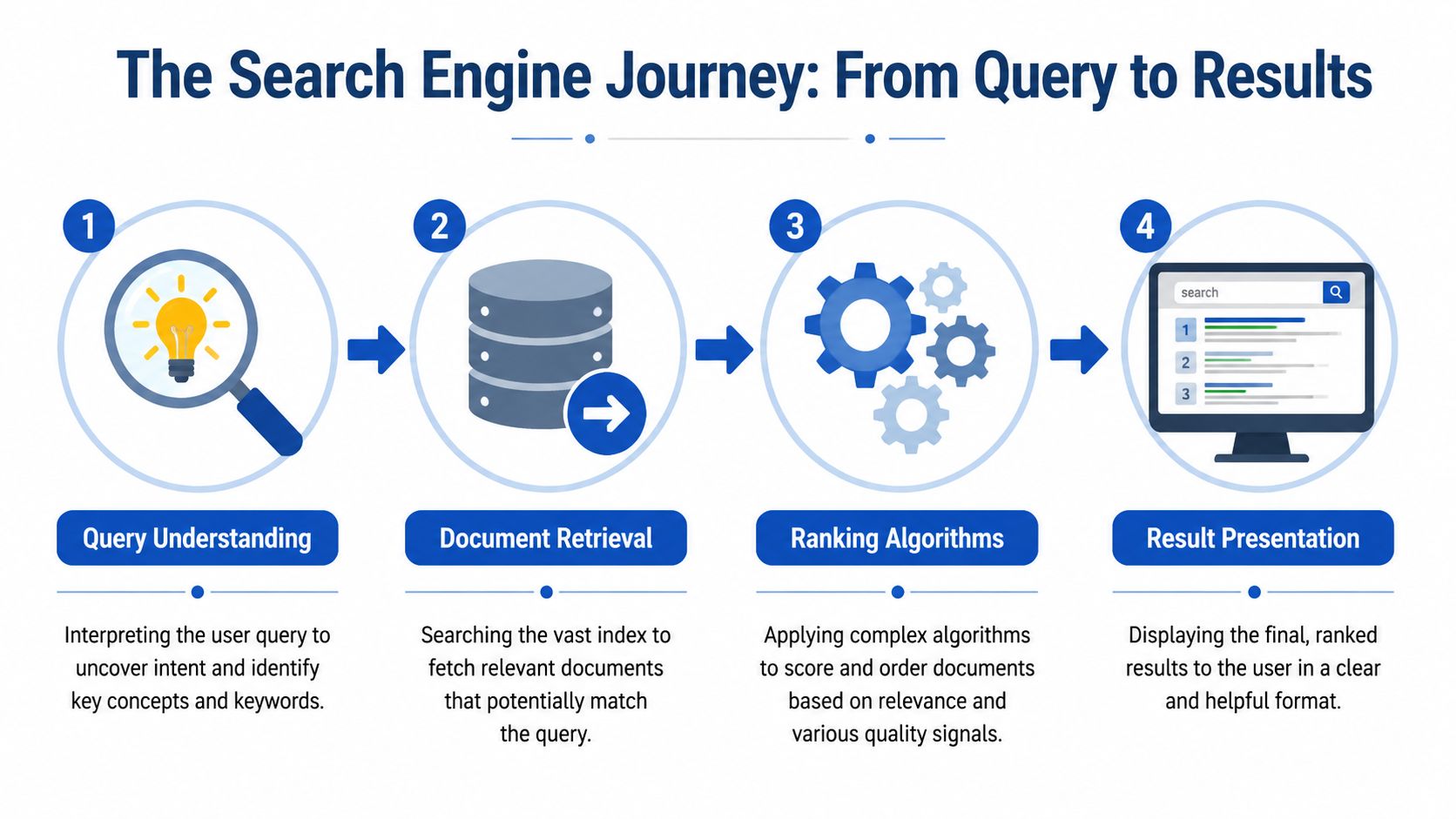
Query understanding
The first step is interpreting the words the shopper typed. That can include splitting the query into tokens, correcting spelling, expanding synonyms, and inferring intent.
If someone types “winter wellies kids”, the system should recognise a product class, a season cue, and an audience. It shouldn't treat that as three isolated words with equal value. Good query understanding reduces the burden on exact keyword matching.
A few common examples:
- “Trainers” and “sneakers” may need synonym logic.
- “Navy” might need to map to a colour family that includes “dark blue”.
- “Gift for runner” may imply category intent rather than an exact product title match.
Indexing and retrieval
Next, the engine looks through its index. An index is a fast, structured version of your catalogue designed for search. It stores product fields like title, description, tags, vendor, collections, metafields, availability, and often variant data.
Retrieval is the stage where the engine pulls back a candidate set. Not the final answer. Just the shortlist.
This stage tends to fail when stores have:
- inconsistent naming across products
- missing product attributes
- poorly configured variants
- content trapped in fields the search app doesn't index
Relevance scoring
Each candidate item then gets a score based on how well it matches the query. In this context, field weighting matters.
A match in the product title usually deserves more weight than a loose mention in a long description. A match on a structured material field can be more reliable than a casual mention in marketing copy. Search teams often tune these weights because not all text carries equal meaning.
Practical rule: Treat structured product data as cleaner evidence than promotional copy.
Final ranking
The final ordering may adjust those raw scores using broader signals. Business rules often show up here. In-stock items may rise above sold-out ones. Margin, seasonality, newness, collection priority, and customer context can also influence the final order.
That doesn't mean the system is “cheating”. It means ranking is balancing user intent with store logic.
For a Shopify merchant, the key lesson is simple. Search quality isn't one setting. It's the output of product data, query understanding, candidate retrieval, scoring choices, and commercial rules acting together.
Key Signals That Determine Search Results
When people say “the algorithm”, they usually mean a bundle of signals. Search engines don't rank products using one universal score. They combine different types of evidence.
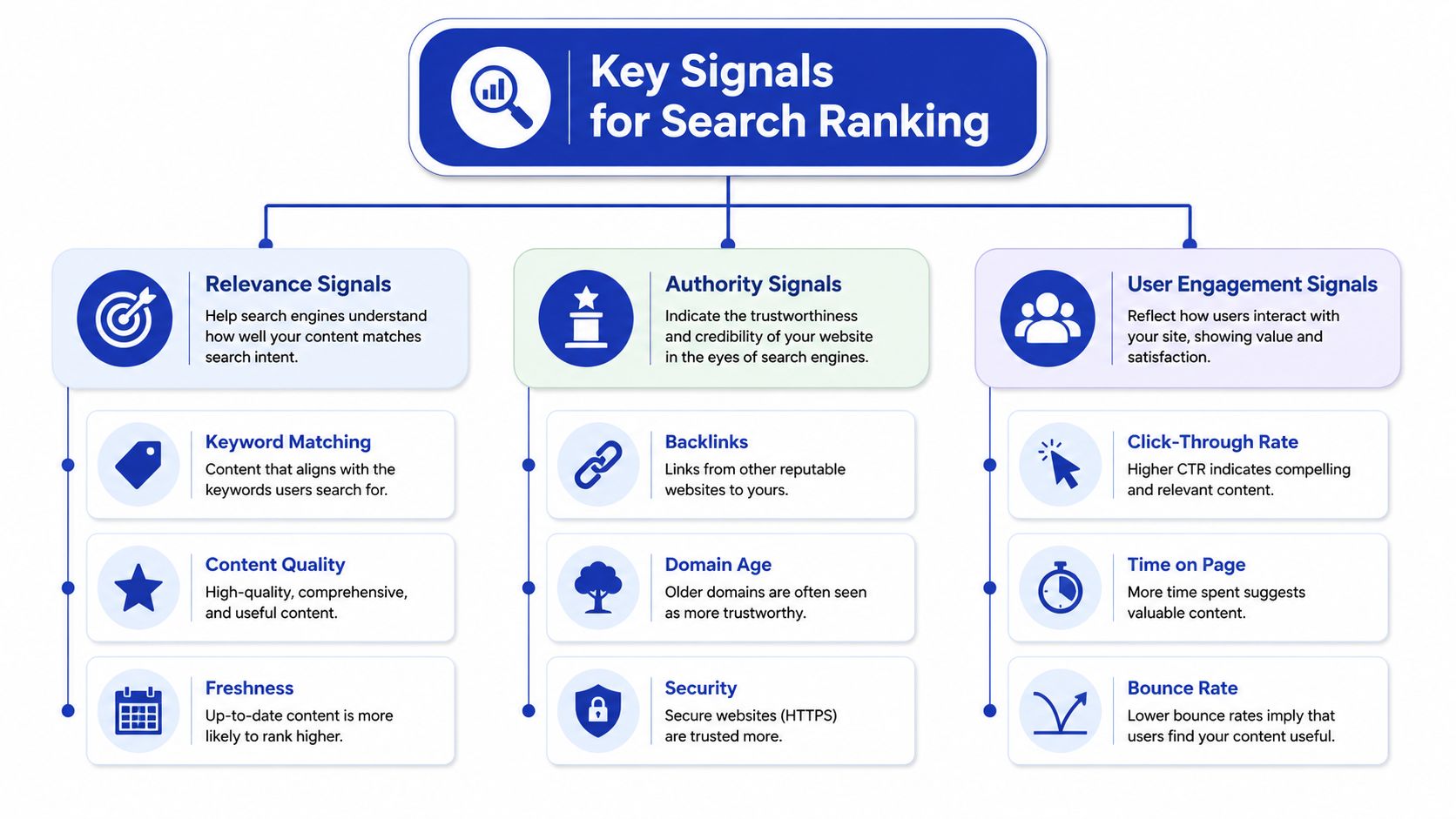
Textual signals
These are the most obvious inputs. They come from the words and attributes attached to a product.
A product with a clear title like “Women's Waterproof Trail Jacket” gives the engine better evidence than one called “Storm Pro 2.0”. Branded naming may work for merchandising, but search still needs descriptive fields.
Useful textual inputs include:
- Product titles: Strong for product type, brand, model, colour, size cues
- Descriptions: Helpful for supporting detail, though often noisy
- Tags and metafields: Strong when they capture structured attributes cleanly
- Category and variant data: Useful for narrowing intent such as material, fit, or use case
Freshness can also matter, especially when “new” is part of the customer's intent.
Behaviour and engagement signals
Search systems also learn from what people do after results are shown. Clicks, refinements, add-to-cart actions, and repeat searches can all act as feedback.
If many shoppers searching “running socks” consistently skip a generic accessories page and click a specific product line, that behaviour suggests the ranking should change. Behaviour signals are useful because they reveal whether the result set merely contains matching words or satisfies intent.
Teams often confuse visibility with relevance. A result can get impressions because it technically matches. That doesn't mean it deserves its position.
Context and personalisation
Modern ranking systems also use context. According to Elastic's explanation of search relevance, modern systems combine retrieval with personalisation signals such as location, search and purchase history, and behaviour, then tune relevance at the query level or index level using NLP, machine learning, and embeddings. For UK-focused experiences, geography is a direct relevance signal, so UK users can see different result ordering from non-UK users for the same query.
That matters in ecommerce because “relevant” often depends on who is searching:
- A UK user may need UK spelling and local stock.
- A returning customer may respond better to brands they've browsed before.
- A mobile shopper may need tighter ranking because visible slots are fewer.
For teams thinking beyond on-site search, off-site authority can still influence discoverability strategies. A curated dofollow directories list can be useful when you're reviewing how broader visibility and citation sources fit into your search presence, though that's a separate layer from internal ranking.
How Search Engine Quality Is Measured
If you can't measure search quality, you'll end up arguing from anecdotes. One stakeholder remembers a bad query. Another points to revenue from search users. Both may be right, but neither view is enough.
Search teams usually measure quality on two levels. First, they evaluate the ranking system itself. Second, they check whether shoppers find the right outcome.
The engineering view
Engineers use ranking metrics because relevance isn't binary and position matters. MongoDB's guide to search relevance metrics highlights precision, recall, reciprocal rank, MAP, and nDCG as core measures. It also explains why nDCG matters. Lower-ranked items receive a logarithmic position penalty, so moving a highly relevant result from position 8 to position 2 can materially improve perceived quality.
Here's the plain-English version:
- Precision: Of the results shown, how many were useful?
- Recall: Of all the useful results available, how many did the system find?
- Reciprocal rank: How high did the first very good result appear?
- MAP and nDCG: Did the system order the whole results page sensibly, not just retrieve plausible matches?
A search engine can have decent recall and still feel poor if the best result is buried too low.
The business view
Product and ecommerce teams usually care about behaviour after the search. Do people click a result? Do they refine the query? Do they add something to basket? Do they convert?
That's why technical metrics and commercial metrics need to live together. A search improvement that makes the top few results sharper often changes user behaviour before it changes aggregate reporting. The system gets easier to use first. Revenue impact follows through reduced friction.
A practical workflow is to pair offline relevance testing with store analytics. Review judged query-result sets, then compare them with your search usage patterns and broader ecommerce SEO best practices. That combination helps you avoid two traps: tuning only for engineer-friendly metrics, or relying only on revenue data that hides query-level failure.
What to watch for
A healthy measurement setup usually answers three questions:
- Did the engine retrieve the right candidates?
- Did it order the strongest options near the top?
- Did shoppers complete the next step with less effort?
If you can't answer all three, your search reporting is incomplete.
The Ecommerce Impact for Shopify Stores
In a Shopify store, search relevance and ranking isn't a side system. It's a merchandising engine hidden inside a utility feature.
The reason is simple. Search users often arrive with clearer intent than category browsers. They know the product type, the use case, the colour, the fit, or the season. If your search meets that intent cleanly, the path to purchase shrinks. If it doesn't, every weakness in your catalogue becomes visible at once.
What Shopify merchants can actually control
You have more levers than many teams realise.
At the catalogue level, you can improve:
- Titles and product types: Make them descriptive enough for retrieval.
- Tags and metafields: Add structured signals for material, audience, fit, style, and occasion.
- Variant naming: Ensure colours and sizes are indexed in a usable way.
- Synonyms and redirects: Map common language differences such as “trousers” and “pants”.
At the ranking level, you can use search apps and merchandising rules to boost or suppress products based on stock, season, margin, or launch priority. Merchants often use tools such as Searchanise or Algolia for finer control than the native experience allows. For stores doing broader technical and performance work alongside search, Shopify performance optimisation guidance is relevant because slower, cluttered result pages can undermine otherwise solid ranking.
Freshness versus authority in seasonal search
This is one of the hardest ecommerce trade-offs. Established products and category pages often build stronger authority inside the catalogue. New products need visibility fast.
A 2025 report from the UK Office for National Statistics on digital commerce found that 74% of UK consumers specifically search for “new” or “latest” seasonal items between October and December, while 82% of UK retailers still see established, high-authority pages ranking first for new seasonal queries due to over-weighted authority signals. The gap is especially painful for holiday launches, gift edits, and limited collections.
That means a Shopify merchant can't rely on authority alone. If someone searches “new Christmas candle set” and your search keeps surfacing last year's evergreen collection page, ranking is fighting the customer journey.
A useful way to think about it is this:
- authority helps when intent is broad and stable
- freshness matters when intent includes recency, season, or launch timing
For a practical walkthrough, this video covers useful Shopify search and ecommerce considerations:
Common Shopify search mistakes
- Over-relying on collection pages: Collections can swamp more precise product matches.
- Ignoring zero-result queries: These reveal vocabulary gaps and missing inventory signals.
- Treating search like navigation: Search should respond to intent, not mirror menu structure.
- Leaving sold-out products too visible: Result quality drops when unavailable items dominate top slots.
Actionable Checklist for Your Search Audit
You don't need a full replatform to improve search. Most stores can find useful gains by auditing queries, product data, and ranking rules in a disciplined way.
A 2024 UK-focused study by the Digital Commerce Institute found that 68% of UK online shoppers abandoned search results when the top 3 matches lacked semantic proximity to their query, even if keywords matched exactly. That's the clearest argument for looking beyond surface-level keyword overlap.
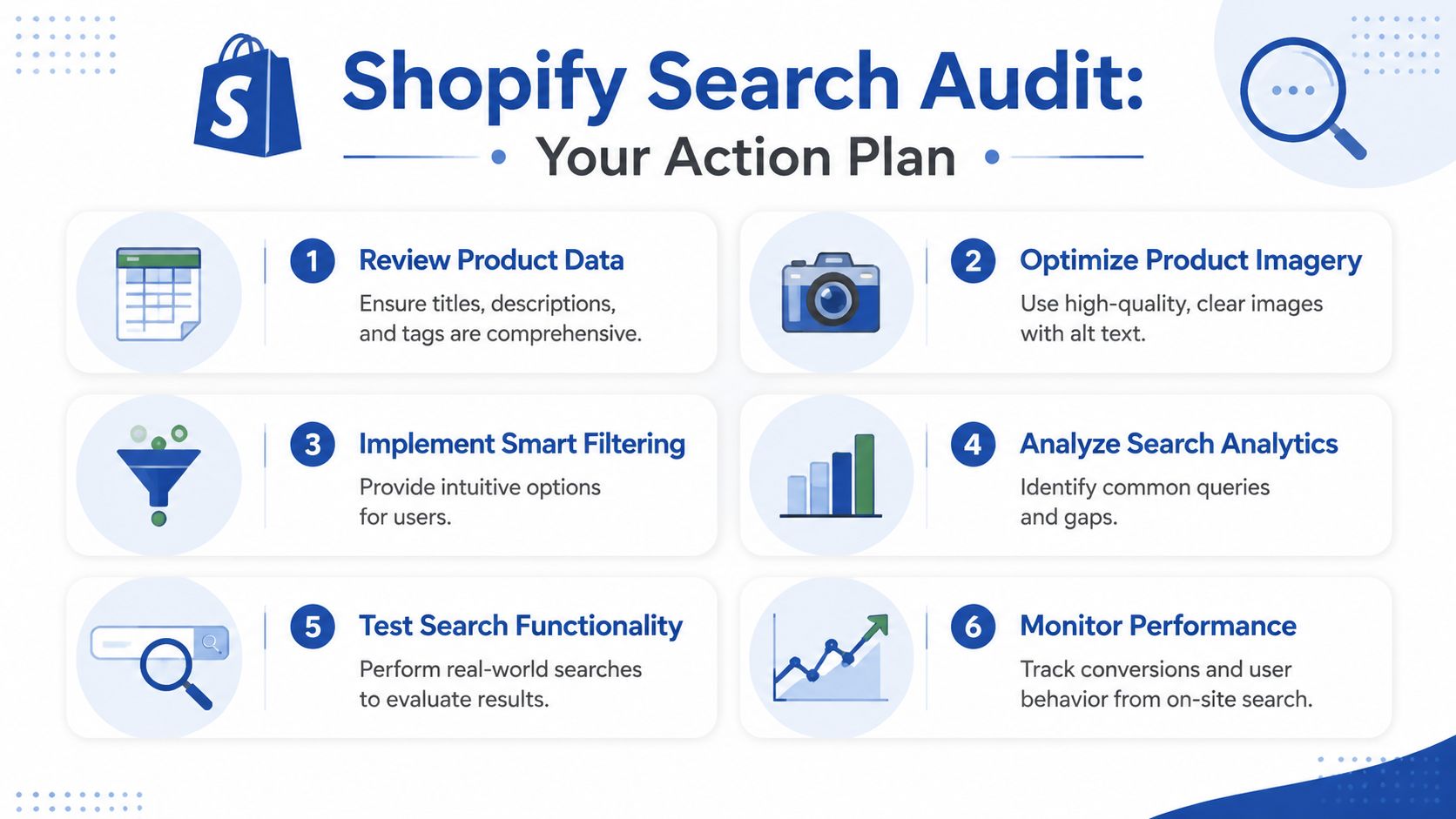
Start with real queries
Pull your top site-search terms and inspect the result pages manually.
- Review the top searches: Check whether the top three results match actual intent, not just keywords.
- Look for phrasing gaps: Compare customer language with your product titles, tags, and metafields.
- Study zero-result searches: These often point to synonym issues, misspellings, or range gaps.
Check the catalogue inputs
Search can only rank what your data makes visible.
- Clean product titles: Include product type, distinguishing attribute, and brand where useful.
- Audit structured fields: Make sure material, colour, fit, size, and audience aren't hidden in vague copy.
- Index variants properly: If shoppers search by size or colour, those attributes must be searchable.
Test ranking logic like a merchandiser
Don't stop at “does it appear”. Ask whether the order makes commercial sense.
- Compare precise products against broad collections: Exact matches should usually beat generic category pages.
- Review stock handling: In-stock items should normally outrank unavailable ones for transactional queries.
- Check launch queries: New products need enough visibility when shoppers explicitly seek recent items.
If you also sell on marketplaces, the discipline transfers well. Teams trying to improve my Amazon catalog often work through the same fundamentals: clearer attributes, better titles, stronger relevance signals, and tighter alignment between customer phrasing and product data.
Validate the experience on mobile
A ranking flaw hurts more on a small screen because fewer products appear before the first scroll.
- Test autocomplete: Suggestions should reduce effort, not distract.
- Run searches with filters: Make sure faceting helps narrow intent instead of resetting it.
- Track behaviour after search: Clicks, refinements, and basket actions reveal whether result quality is improving.
For a broader operational framework, use an ecommerce audit checklist alongside your search review so search issues are considered with UX, performance, and catalogue quality.
Good search audits focus on the first few results, because that's where customer trust is won or lost.
If your Shopify store's search feels unpredictable, Grumspot can help you audit the experience, identify ranking and data issues, and turn those findings into concrete fixes across search UX, product structure, and store performance.
Let's build something together
If you like what you saw, let's jump on a quick call and discuss your project

Related posts
Check out some similar posts.
- technical seo audit
What Is Technical SEO Audit. Learn what a technical SEO audit is, its core components, and how it dr...
Read more
- shopify seo
Choosing the right SEO app for Shopify means weighing features against speed, scripts, and plan limi...
Read more
- shopify plus seo agency
Learn how to choose the right Shopify Plus SEO agency for your store. Covers evaluation criteria, pr...
Read more
- keyword research for ecommerce
Unlock revenue with our 2026 guide on keyword research for ecommerce. Learn to find, map & prioritiz...
Read more