SEO Audit Cost UK: 2026 Pricing Guide
- seo audit cost
- seo audit uk
- shopify seo audit
- ecommerce seo
- seo pricing
Launched
July, 2026

A professional SEO audit in the UK typically ranges from £500 for a basic check to over £25,000 for an in-depth enterprise audit. That spread exists because you're not buying one standard service. You're buying a certain depth of analysis, a certain level of expertise, and a certain amount of strategic value.
If you're pricing a new ecommerce project right now, you've probably already seen the problem. One provider offers an audit for a few hundred pounds. Another wants a few thousand. A third sends a proposal that looks more like a consulting engagement than a report.
That doesn't mean one of them is automatically wrong. It means “SEO audit” is one of the least standardised services in digital marketing.
For an ecommerce manager, that's where budgeting gets messy. You're not trying to buy a PDF full of warnings. You're trying to work out whether your store has ranking blockers, wasted category pages, indexing problems, weak product content, poor internal linking, or authority gaps that are suppressing revenue. The right audit helps you decide what to fix first. The wrong one gives you a checklist your team never uses.
This is the practical way to think about SEO audit cost. Not as a price list, but as a value spectrum. At the low end, you get surface-level diagnostics. In the middle, you get prioritised insight. At the high end, you get a strategic growth plan for a complex store.
Why SEO Audit Quotes Vary So Wildly
A common scenario goes like this.
An ecommerce brand asks for three quotes. The first is a low-cost “SEO audit” that promises a fast turnaround and a long list of issues. The second sits in the middle and includes technical review, content analysis, and recommendations. The third is much higher and asks for access to Search Console, GA4, Shopify, and sometimes development documentation before the work even begins.
All three call it an audit. They are not the same thing.
The label means less than the deliverable
Some providers sell an audit that is mostly a tool export. It might come from Screaming Frog, Ahrefs, or another crawler, with a few comments added around the edges. That can be useful for spotting obvious faults, but it rarely answers the commercial question behind the brief, which is usually: what's stopping this store from growing through organic search?
Other providers treat the audit as a diagnosis and planning exercise. They look at the store's templates, collection structure, duplicate content patterns, crawl paths, internal linking, faceted navigation, product page quality, and indexation behaviour. Then they rank issues by likely business impact and implementation effort.
Practical rule: If two proposals have the same service name but one includes prioritisation, business context, and implementation guidance, they are not equivalent offers.
Cheap reports solve one problem. Expensive audits solve another
A cheaper audit can help when you need a sanity check. Is the site crawlable? Are key pages indexable? Are there obvious metadata or heading problems? For a small store or a very specific issue, that may be enough.
A higher-cost audit earns its fee when the business problem is broader:
- Revenue is flat from organic search
- Collections aren't ranking despite strong products
- Traffic reaches blogs, not commercial pages
- A redesign or migration may have created hidden losses
- The store has grown messy with apps, filters, and duplicate URLs
Those are not checklist problems. They need interpretation.
Why savvy buyers should be sceptical of “free”
Free audits exist, and some are useful as lead generation tools. But when SEO professionals discuss market pricing, the consistent pattern is that free audits are often sales techniques rather than substantive evaluations, while a decent professional audit for a mid-sized site usually sits in a paid range tied to scope and complexity, as noted by Polaris on SEO audit pricing in the UK.
That's the key budgeting shift. Don't ask, “What's the lowest SEO audit cost?” Ask, “What decision am I trying to make with this audit?”
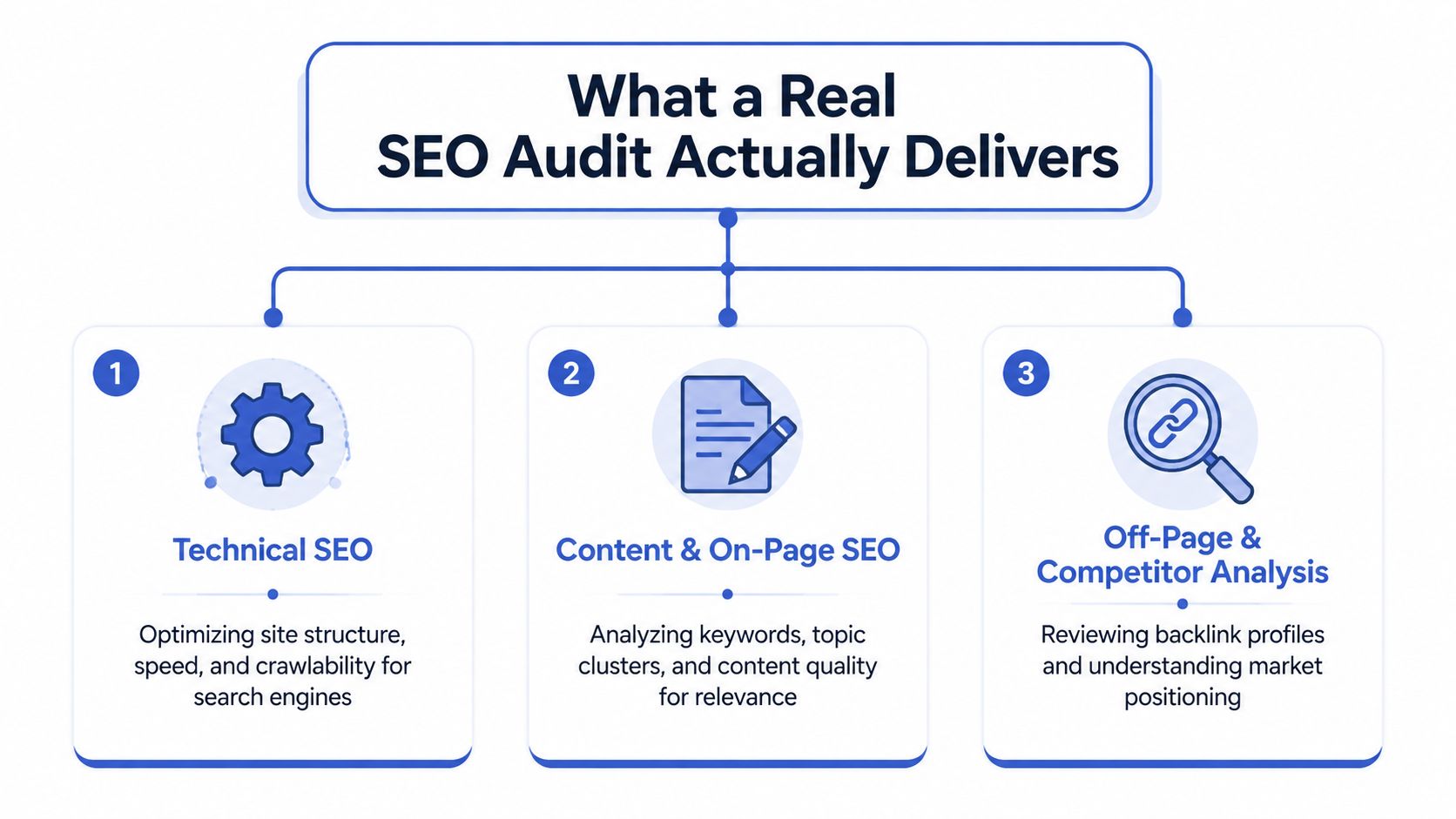
What a Real SEO Audit Actually Delivers
A real audit works like a proper vehicle inspection. A quick check looks at the tyres and warning lights. A serious inspection checks the engine, the transmission, the frame, and whether the parts work together under load.
Ecommerce SEO is the same. A superficial scan might tell you that title tags are missing on some pages. A real audit tells you whether your store architecture, content, and authority are strong enough to support growth.
Technical SEO
This is the foundation. If search engines can't crawl the right pages, ignore key templates, or get trapped in duplicate URL patterns, content improvements won't carry nearly as far.
A strong technical audit usually checks:
- Crawl behaviour through tools such as Screaming Frog
- Indexation patterns in Google Search Console
- Site speed and mobile rendering
- Canonical handling
- Pagination and filtered collection URLs
- Schema markup and template consistency
- Broken internal pathways and orphan pages
Technical work tends to cost more because it's labour-heavy. A Reddit discussion on technical SEO audit pricing notes that a technical SEO audit specifically commands a one-time pricing of $2,500–$15,000 globally, reflecting the labour involved in analysing site architecture, indexing errors, and mobile-friendliness.
Content and on-page SEO
Many stores commonly underperform. They may have products people want, but category intent is weak, collection pages are thin, and internal search demand isn't mapped cleanly to landing pages.
A proper content and on-page review looks at things like:
| Area | What a useful audit checks |
|---|---|
| Collection pages | Whether they target clear search intent and avoid duplication |
| Product pages | Whether they support discovery, not just conversion |
| Internal linking | Whether authority flows to priority categories and subcategories |
| Metadata | Whether titles and descriptions support relevance and clicks |
| Content gaps | Whether important buying journeys lack indexable pages |
For teams that want a technical benchmark of what a specialist deliverable can look like, DigiVisi expert SEO audits are a useful reference point because they show the difference between a generic scan and a more solution-oriented review. If you want to understand the mechanics before hiring anyone, this guide on how to conduct an SEO audit is also a solid primer.
Off-page SEO and competitor analysis
This pillar is often misunderstood. A real off-page review isn't just “how many backlinks do we have?” It's whether your authority profile supports the categories you want to win, and whether competitors have a structural advantage in visibility.
A report becomes valuable when it tells your team what to do first, what can wait, and what will actually change rankings or revenue.
In practice, the final deliverable should include:
- A prioritised action plan
- Issue severity and likely commercial impact
- Notes for developers, content teams, and merchandisers
- Clear distinction between quick wins and structural fixes
If the output is only a list of errors, it's not really an audit. It's a scan.
Typical SEO Audit Cost Ranges in the UK
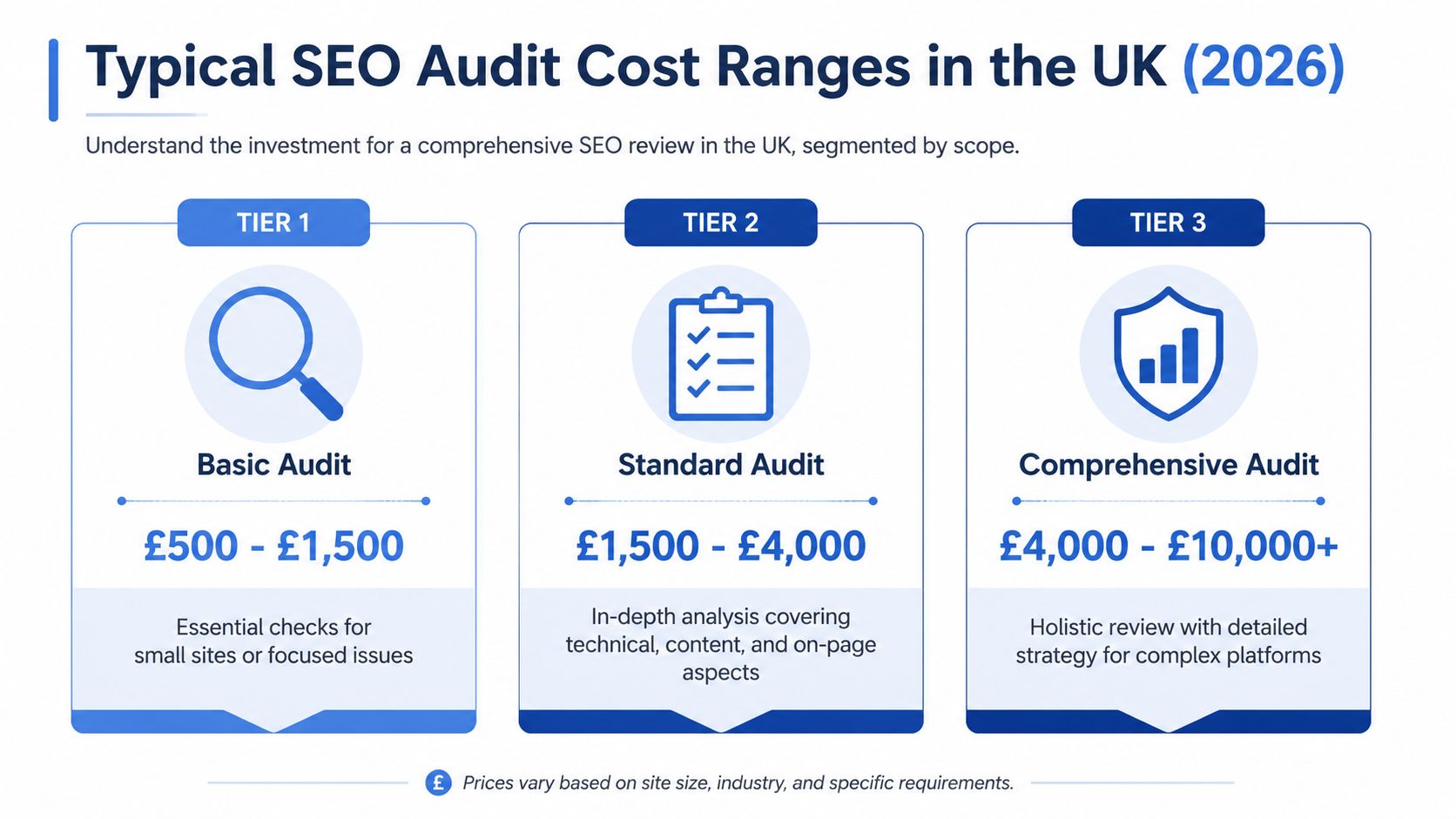
A £600 audit and a £12,000 audit can both be sold as “full SEO audits.” For an ecommerce manager, that is where the confusion starts. The cheaper option usually answers, “Are there obvious problems on the site?” The expensive option should answer, “What is stopping category growth, where is revenue being lost, and what should each team fix first?”
Entry level pricing
At the low end, UK audits often start around the few-hundred-pound mark and are usually bought by smaller sites that need a basic health check. In practice, this tier suits businesses trying to confirm whether indexing, crawlability, metadata, or obvious technical faults are holding the site back.
What you are buying here is triage.
A lower-cost audit can be good value if the store is small, the site has not been reviewed in a while, or the business needs a quick decision on whether to invest further. It usually helps answer questions like:
- Are key pages indexable?
- Are there obvious duplicate or missing metadata issues?
- Is the site carrying visible crawl waste or broken internal paths?
- Are there major technical blockers that need developer time?
What it usually will not do is map out a category growth plan, diagnose template-level weaknesses across a large catalogue, or tell your content and dev teams how to sequence fixes around commercial priorities.
Mid-range pricing
For many ecommerce stores, this is where an audit starts becoming operationally useful. The report moves beyond tool exports and starts connecting SEO issues to trading outcomes such as poor visibility on category pages, weak rankings for non-brand searches, or wasted crawl budget across faceted URLs.
This tier often suits stores that already know the site is not in good shape, but need clarity on why performance is uneven.
A solid mid-range audit usually includes:
- technical review across a meaningful sample of templates and key page types
- category and collection analysis tied to search demand
- stronger prioritisation by impact and effort
- competitor checks to show where the store is structurally behind
- clearer implementation notes for internal teams or external developers
Here's a useful video if you want another perspective on how agencies frame the cost conversation:
If your store runs on Shopify and you're balancing broader ecommerce costs alongside SEO, this overview of Shopify website design cost helps put the audit line item in context.
Enterprise ecommerce pricing
Higher audit fees usually make sense when the business problem is larger than “find the errors.” Large catalogues, layered navigation, international targeting, migration history, and inconsistent templates create revenue risk that a basic review will miss.
At that point, the audit is closer to a strategic consulting project.
Polaris's UK audit pricing research places the market from entry-level work through to large ecommerce audits at roughly £500 at the low end to £25,000+ for enterprise-level projects, depending on scope and complexity. That spread is wide because the deliverables are wide. A checklist report and a cross-functional growth plan are different products.
Budget test: If your store has complex collections, filter-driven URL expansion, multiple templates, or legacy SEO decisions from past migrations, budget for analysis that explains business impact and implementation order, not just issue detection.
At the top end, you are paying for diagnosis, prioritisation, and decision support. The provider should be able to tell you which fixes affect category revenue, which issues can wait, and where your team would waste money if it acted on every warning from a crawler.
For a broader view of how agencies structure retainers, project fees, and specialist work around audits, this breakdown of SEO agency pricing is a useful comparison point.
The Five Key Factors That Drive Your Audit Cost
Two stores can have the same platform and roughly the same revenue band, yet receive very different quotes. That's normal. Audit pricing is driven by complexity, not just by brand size.
Website size and crawl scope
A small site is faster to diagnose. A large site takes longer to crawl, validate, and interpret.
That sounds obvious, but the difference isn't just the page count. It's how pages are generated, how many templates exist, and how many URLs search engines can discover beyond the obvious product and collection pages. A brochure site with a small catalogue is one type of job. A store with extensive collections, variant-driven URLs, and app-generated pages is another.
Technical complexity
Some stores are easy to review because the technical stack is predictable. Others have years of layered decisions underneath them.
Common complexity drivers include:
- Heavy app usage that affects performance or injects duplicate elements
- Legacy theme logic that creates inconsistent metadata or schema
- JavaScript-dependent content that complicates crawl analysis
- Migration history that leaves redirect chains or indexing residue
This is why senior expertise costs more. Dhillons Digital's UK SEO pricing overview notes that high-quality audit work ranges from £150 to £300 per hour for expert consultants, while top-tier specialists command £300 to £1,000 per hour, and the average day rate for an SEO freelancer is £350.
Ecommerce functionality
Ecommerce adds its own layer of audit work because revenue pages are interconnected.
A five-product store is fairly straightforward. A store with large collections, faceted navigation, sorting parameters, stock status changes, review widgets, subscription apps, and bundle tools is not. Every extra function can affect crawl efficiency, duplicate URLs, internal linking, structured data, or page speed.
Here's where SEO buyers often underestimate the work. The audit isn't just checking search visibility. It's checking whether commercial pages can rank without technical friction.
Internationalisation and multiple storefronts
If a store targets more than one country or language, the audit scope rises quickly. Teams then need to review regional targeting, duplicate content risks, localisation gaps, and whether each storefront supports the right search intent.
That doesn't always mean the audit must be enterprise-level. But it usually means a simple template review won't be enough.
Depth of analysis and output quality
This is the biggest hidden factor.
Some providers price the audit around running tools and writing findings. Others price it around diagnosing causes, validating patterns manually, and producing implementation-ready guidance. That second version takes longer, and it's usually the one that helps teams move faster afterwards.
The report isn't the product. The useful part is the judgement behind it.
A quick way to sense where a proposal sits is to ask what happens after the issues are found. If the answer is vague, you're probably buying detection, not direction.
For a broader reference point on how service levels affect fees across providers, this guide to SEO agency pricing is useful reading.
How to Compare Proposals and Estimate ROI
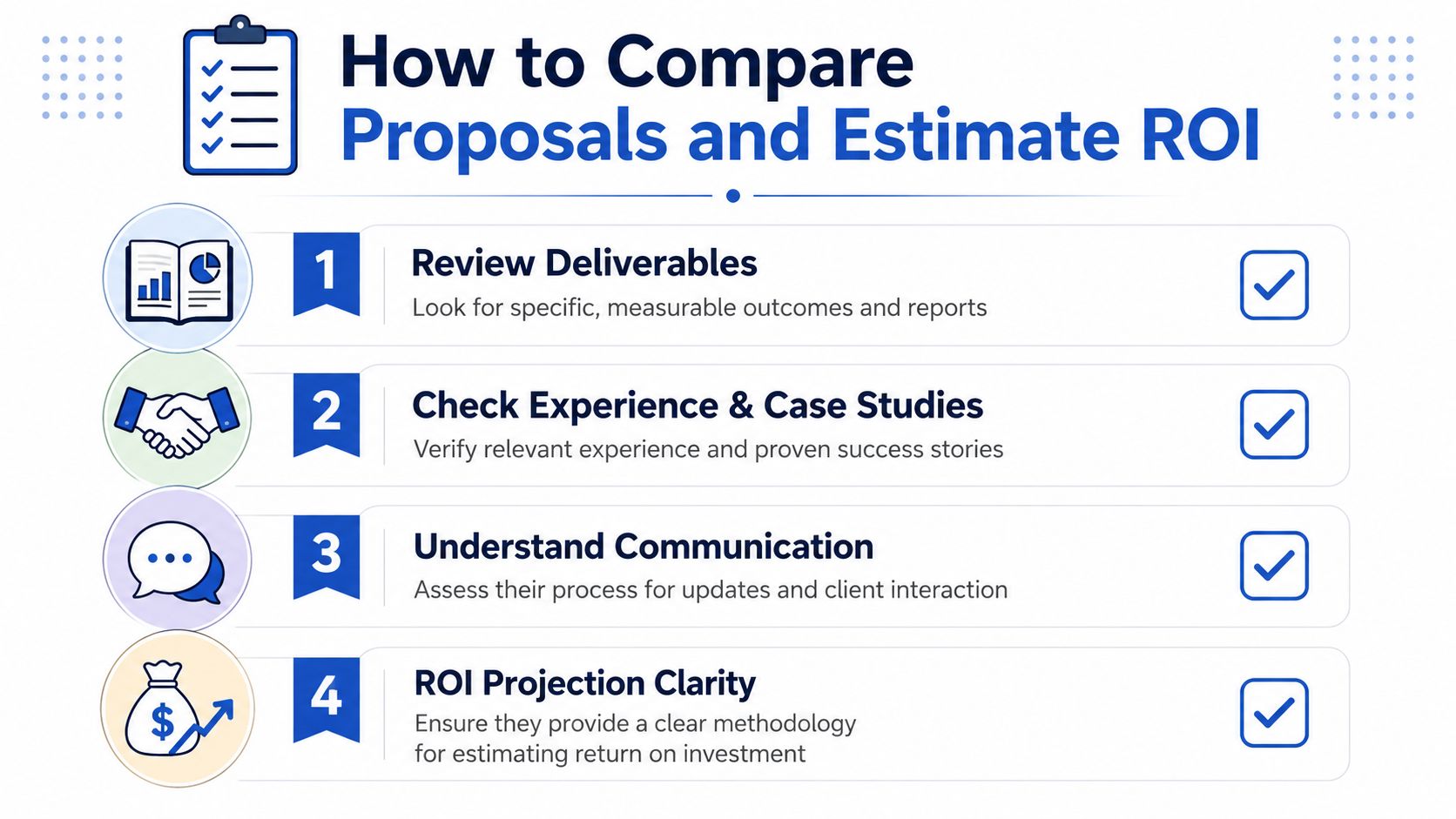
The cheapest proposal often wins the spreadsheet comparison and loses the implementation phase. That's because a weak audit creates extra work for your team. Someone still has to interpret it, sort priorities, and translate findings into development, content, and merchandising tasks.
What a proposal should make clear
A solid audit proposal should answer a few practical questions without hedging.
- What exactly is being audited. Technical only, or technical plus content and off-page.
- Which tools and data sources are used. For ecommerce, that often includes Screaming Frog, Search Console, GA4, and backlink tools.
- What the deliverable looks like. Slide deck, spreadsheet, annotated crawl, implementation notes, or workshop.
- How priorities are ranked. Severity alone isn't enough. Business impact matters.
- Whether follow-up is included. Some audits stop at the report. Others include review calls or clarification sessions.
If those points are missing, the quote may be cheaper because important work has been left out.
The easiest way to compare value
Put proposals side by side and score them against business usefulness, not presentation polish.
| Question | Low-value proposal | Strong proposal |
|---|---|---|
| Does it explain scope? | Broad and vague | Specific about pages, templates, and analysis areas |
| Does it prioritise issues? | Long list of faults | Ranked by impact and effort |
| Does it connect to ecommerce outcomes? | Mostly technical language | Ties issues to ranking, traffic quality, and conversion paths |
| Can your team implement it? | Generic advice | Clear actions for dev, content, and SEO teams |
A pretty audit deck can still be operationally useless if nobody knows what to fix next.
Estimating ROI without inventing numbers
You don't need a complicated forecasting model to judge whether the spend makes sense.
Start with the pages that matter most commercially. Usually that means top collection pages, priority product ranges, and revenue-driving search terms. Then ask:
- If those pages are underperforming, what is the likely cause?
- Can an audit uncover and prioritise the fix?
- Would solving that problem improve qualified traffic, conversion flow, or both?
For example, if an audit reveals that important collection pages aren't being indexed properly, that's not just a technical bug. It's a visibility and revenue issue. If it shows that app scripts are hurting mobile performance on product pages, that's not just a development note. It may affect both rankings and sales efficiency.
Questions worth asking before you sign
Use these in procurement calls or review meetings:
- Which ecommerce issues do you see most often on stores like ours?
- How do you separate noise from real ranking blockers?
- Will recommendations be written for marketers, developers, or both?
- What part of the work is manual rather than tool-generated?
- How will you handle Shopify-specific constraints if they exist?
The right provider should answer clearly. If the proposal sounds impressive but the implementation path still feels fuzzy, keep looking.
Audits for Shopify Stores What to Expect and Next Steps
Shopify changes the audit conversation because the platform solves some technical problems for you, but it also creates its own patterns that generic audits often miss.
What a Shopify-focused audit should look for
A Shopify store audit should go beyond generic SEO hygiene and look closely at platform-specific risk areas:
- Collection page duplication from tags, filters, and automated structures
- Theme-level metadata or schema inconsistencies
- App conflicts that slow pages or inject messy markup
- Internal linking gaps between collections, products, and editorial content
- Thin product or collection templates that limit search relevance
- Pagination and canonical behaviour across category structures
Specialised ecommerce knowledge matters. The audit needs to reflect how Shopify generates URLs and templates, not how a generic CMS behaves.
What pricing and tooling often look like
For UK-based Shopify stores, a detailed SEO audit costs approximately $1,499 as a one-time payment, excluding later fixes, according to GoldenWeb's Shopify SEO cost guide. The same source notes that the technical toolkit commonly includes Screaming Frog, Ahrefs, and Plug In SEO.
That tooling mix makes sense. Screaming Frog helps diagnose crawl and template issues. Ahrefs supports authority and competitor review. Plug In SEO helps surface Shopify-native concerns. But tools alone don't make the audit useful. The value comes from how findings are prioritised for a live store with merchandising, development, and conversion goals.
For brands also thinking beyond classic rankings into emerging discovery channels, e-commerce AI search optimization is worth reviewing because it reflects where product-led search visibility is expanding.
What the next step should be after the audit
A good Shopify audit should end with action paths, not just observations.
That usually means:
- Immediate fixes for hard technical blockers
- Template updates for collection and product page consistency
- Content decisions around category depth, internal links, and search intent
- Development tickets tied to measurable priorities
If you want to see the sort of output structure that helps teams move from diagnosis to implementation, this SEO audit example is a useful reference.
The audit is the first serious decision point. It tells you whether the next investment should go into technical remediation, content expansion, CRO work, or a broader store rebuild. Without that diagnosis, teams often spend money in the wrong order.
If you need a Shopify-focused team to turn audit findings into fixes, redesigns, and conversion-led development, Grumspot is built for that kind of work. They help ecommerce brands diagnose what's holding performance back, then implement the technical, UX, and CRO changes needed to scale.
Let's build something together
If you like what you saw, let's jump on a quick call and discuss your project

Related posts
Check out some similar posts.
- technical seo site audit
Run a technical SEO site audit that finds what matters. A practical ecommerce workflow covering craw...
Read more
- shopify seo
Choosing the right SEO app for Shopify means weighing features against speed, scripts, and plan limi...
Read more
- shopify plus seo agency
Learn how to choose the right Shopify Plus SEO agency for your store. Covers evaluation criteria, pr...
Read more
- keyword research for ecommerce
Unlock revenue with our 2026 guide on keyword research for ecommerce. Learn to find, map & prioritiz...
Read more