Keyword Research for Ecommerce: Drive Sales in 2026
- keyword research for ecommerce
- ecommerce seo
- shopify seo
- keyword strategy
- seo guide
Launched
July, 2026
You've probably done this already. You open Shopify, look at products you know customers love, then open Search Console or Analytics and see a flat line where demand should be. Traffic is weak, product pages aren't pulling their weight, and the keywords you do rank for don't seem to bring buyers.
That usually isn't a product problem. It's a keyword strategy problem.
Most SEO advice treats keywords as a publishing exercise. Ecommerce doesn't work like that. On a store, every keyword has to earn its place by helping someone move towards a purchase. If it can't support discovery, comparison, or transaction, it's noise.
Why Ecommerce Keyword Research Is Different
A Shopify store can add 10,000 sessions and still miss its revenue target. That happens when SEO brings in searches with weak buying intent, sends them to the wrong page type, or ranks pages that cannot move a shopper any closer to checkout.
Ecommerce keyword research has a stricter job than content SEO. It has to support product discovery, comparison, and purchase across collections, products, and supporting content. If a term cannot reasonably lead to a sale, an assisted conversion, or a stronger path into the catalogue, it should not lead the strategy.
Revenue matters more than raw traffic
A store selling leather boots can rank for “how boots are made” and see decent traffic. That term may still have a role, but it is not the commercial centre of the account. Revenue usually comes from searches tied to product type, attributes, use case, brand, and immediate purchase intent, such as “women's waterproof leather boots” or “black leather Chelsea boots size 7”.
That is the trade-off. Informational traffic can help with reach and remarketing, but collection and product page visibility usually does the heavy lifting on ecommerce growth.
For a wider view of what strong store SEO covers beyond keyword selection, see these comprehensive ecommerce SEO insights.
Query intent has to match page type
On ecommerce sites, the same topic can split into very different search intents. “Best running shoes for flat feet” often deserves an editorial or hybrid collection page. “Men's stability running shoes” belongs on a category or collection page. “ASICS Gel Kayano 30 mens size 10” belongs on a product page.
The mistake I see most often is forcing one page type to rank for every variation. That creates weak relevance signals, thin category pages, and blog posts that attract visitors who never enter the buying path.
A keyword only has value if the destination page helps the visitor do the next thing they came to do.
Ecommerce keywords affect site structure, not just copy
On a Shopify store, keyword research shapes more than titles and headings. It influences collection architecture, product naming conventions, filter strategy, internal links, and whether search demand should be served by a collection, a product, or supporting content.
That connection is where many generic SEO guides fall short. Stores do not just need a keyword list. They need a keyword-to-page plan that fits how shoppers browse and how Shopify handles collections, tags, templates, and navigation. The mechanics of search relevance and ranking on ecommerce stores matter here because weak relevance usually starts with weak structure.
What tends to work, and what wastes time
| Approach | Likely outcome |
|---|---|
| Traffic-first keyword targeting | More impressions, weaker commercial impact |
| Intent-led keyword targeting | Better alignment between landing pages and sales outcomes |
| One master keyword list for the full site | Cannibalisation, unclear page roles, messy architecture |
| Keyword mapping by funnel stage and page type | Cleaner collection strategy and stronger conversion paths |
The standard question in content SEO is whether a site can rank for a term. Ecommerce teams need a harder filter. If the page ranks, what buying journey does it support, and how will that flow into revenue?
Building Your Keyword Intelligence Foundation
Keyword research for ecommerce starts with the store you already run. On Shopify, that means pulling search demand, on-site behaviour, and sales data into one view before you open a keyword tool. Otherwise, teams end up chasing terms that look promising in Ahrefs but have no clean landing page, weak margins, or poor conversion history.
Connect the three systems that matter
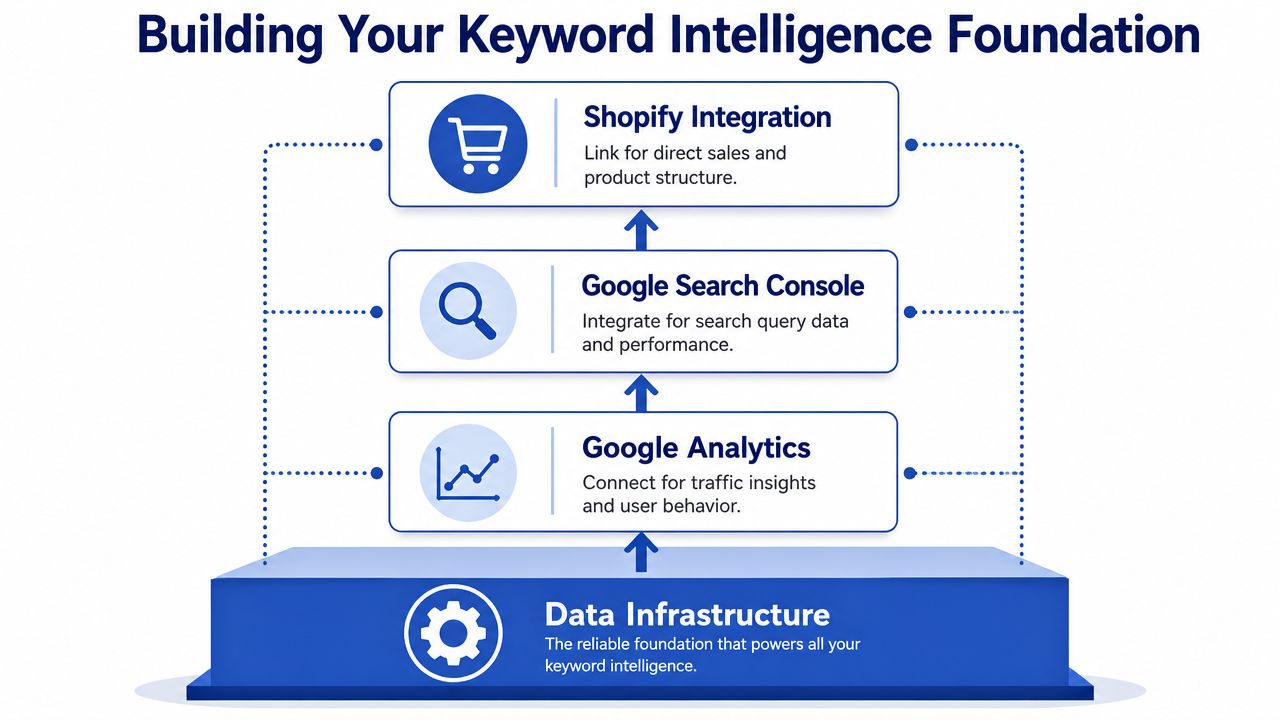
For a Shopify store, the working setup is straightforward:
- Google Search Console for queries, impressions, clicks, and page-level visibility
- Google Analytics for landing page engagement, assisted journeys, and conversion patterns
- Shopify for collection structure, product catalogue logic, average order value, and sales by product group
Each platform answers a different commercial question. Search Console shows where demand already exists. Analytics shows whether that traffic progresses toward a sale. Shopify confirms whether the traffic is landing on products and collections that matter to revenue.
That combination is the foundation. Without it, keyword research turns into topic collection instead of merchandising strategy.
What to review in Search Console
Open the Performance report and review queries by page type, not just by sitewide totals. A collection page sitting on page one with a weak click-through rate needs a different response from a product page ranking for the wrong modifier.
Start with:
- Collection pages earning impressions but underperforming on clicks
- Product pages appearing for broad or mismatched queries
- Queries in positions where stronger titles, copy, and internal links could improve visibility
- Brand plus product-type searches that signal high purchase intent
- Long-tail phrasing that reflects spoken search behaviour, which often overlaps with voice search keyword patterns on ecommerce stores
The goal is not to collect every term. The goal is to find page-query pairs that can drive more qualified sessions without forcing Shopify into awkward page creation.
What to pull from Analytics and Shopify
Google Analytics fills in the part keyword tools miss. It shows what happens after the click.
Review:
- Organic landing pages with traffic but weak revenue per session
- Internal site search terms that reflect customer language
- Journeys from blog content into collections or products
- Mobile landing page performance, especially on collection templates with heavy filtering
Then line that up with Shopify data:
- Which collections convert well
- Which products drive repeat purchases
- Which categories have enough depth to justify dedicated collection pages
- Where product naming conventions break consistency and dilute relevance
One pattern comes up often. Customers search one way, while the catalogue is named another way. If shoppers search "black running vest mens" in internal search and the store labels the same products as "men's performance gilets," the keyword problem and the UX problem are the same issue.
A useful companion to this process is comprehensive ecommerce SEO insights, especially for technical setup, content planning, and store growth considerations around ecommerce SEO.
Build a revenue-focused baseline
Start with a baseline sheet before expanding into new keyword sets. I prefer a simple working document over a huge export because it forces clearer decisions.
Use columns like these:
| Column | Why it matters |
|---|---|
| Current page | Identifies where the term should live |
| Current query | Shows existing relevance and demand |
| Page type | Separates product, collection, blog, home, and support intent |
| Commercial value | Keeps attention on terms tied to revenue |
| Observed issue | Captures low CTR, weak conversion, mismatch, or cannibalisation |
The keyword strategy then becomes Shopify-ready. You can see which opportunities belong on existing collections, which need product page refinement, and which deserve new category pages because the current architecture cannot serve the query well.
Once that baseline exists, expansion gets easier and cleaner. Without it, keyword research for ecommerce usually becomes a long export with no page plan, no prioritisation, and no reliable path to revenue.
Uncovering How Your Customers Actually Search
A blank keyword tool is a terrible place to start. Customers don't think in neat taxonomies, and they don't search the way merchants label products in a backend. They search in fragments, comparisons, symptoms, use cases, and local phrasing.
Take a fictional Shopify store selling sustainable yoga mats across the UK. The owner starts with “yoga mat” because that's the obvious head term. Fair enough. But that phrase alone tells you almost nothing about the buyer. Are they looking for cork, non-slip, extra thick, Pilates-friendly, eco-friendly, travel size, or something suitable for hot yoga?
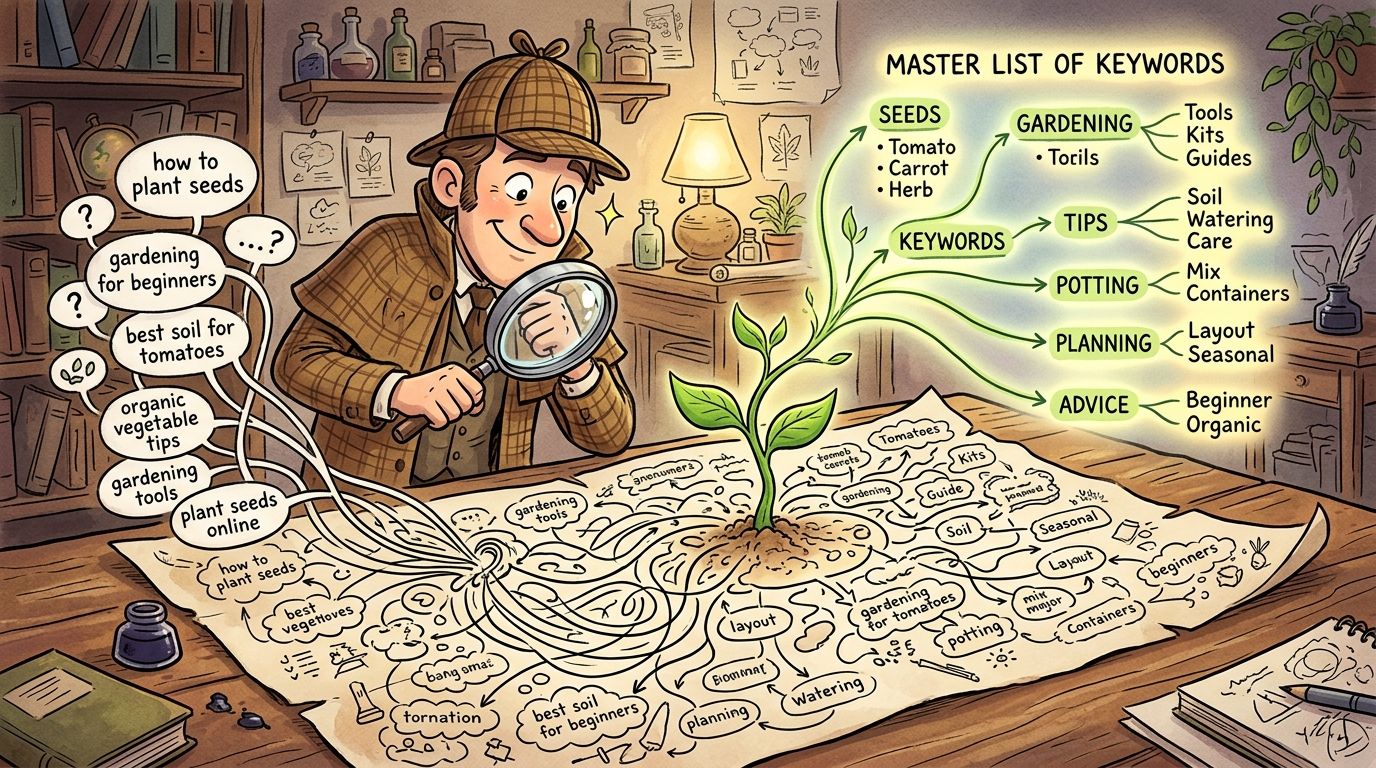
Start with seed terms, then break them open
For the yoga mat store, the first seed list might look like this:
- Core product terms such as sustainable yoga mat, cork yoga mat, natural rubber yoga mat
- Feature-led phrases like non-slip yoga mat, thick yoga mat, travel yoga mat
- Audience terms such as beginner yoga mat, yoga mat for hot yoga
- Buying modifiers including buy, best, eco-friendly, UK delivery
That's the raw material. It isn't the final list.
The next move is to search those terms manually and study what ranks. Collection pages? Product pages? Listicles? Comparison content? Google is already telling you which page type matches each intent.
Competitors leave clues in plain sight
Now check competing stores. Not just their homepage. Look at:
- Collection page titles
- Product names
- filters and facets
- FAQ blocks
- review language
- autocomplete suggestions in their internal search
You're not copying their keyword set. You're identifying the phrases they've already operationalised in category structure and merchandising.
For the yoga mat example, a competitor might expose demand for:
- cork yoga mat UK
- yoga mat for sweaty hands
- non-toxic Pilates mat
- extra long yoga mat
- eco yoga mat with strap
Those phrases are useful because they reveal how people qualify a product before buying.
Mine conversational language
The strongest ecommerce lists usually separate from generic SEO lists. Searchers often describe the problem before they describe the product.
Use:
- Reddit threads
- customer reviews
- support tickets
- your own site search terms
- Google's People Also Ask boxes
- autocomplete and related searches
If people ask, “what yoga mat doesn't slip on wooden floors?” that language should influence your keyword map, product copy, and collection naming. It's closer to revenue than a sterile head term.
A UK-specific methodology highlighted in Shopify's keyword research guide for ecommerce recommends prioritising long-tail keywords with conversational intent, using tools like SEMrush or Ahrefs to identify competitor gaps, then filtering for Monthly Search Volume at or above 1,000, Keyword Difficulty below 40, and high commercial relevance.
That filter is useful because it forces discipline. Plenty of keywords sound good until difficulty makes them unrealistic.
Long-tail terms usually tell you more
The yoga mat store learns more from “best non-slip cork yoga mat UK” than from “yoga mat”.
Why? Because long-tail queries carry context:
- material preference
- performance need
- purchase geography
- buying stage
That's also why voice and natural-language patterns matter more than many stores think. Customers increasingly search in full questions and local phrasing, which is one reason voice search optimisation for ecommerce should influence keyword collection and not just technical SEO.
Don't just collect nouns. Collect the adjectives, complaints, comparisons, and contexts shoppers use before they buy.
Build a master list you can actually use
Organise keywords in groups, not one giant sheet.
A clean structure for the yoga mat store would be:
| Group | Example phrases |
|---|---|
| Product type | cork yoga mat, rubber yoga mat |
| Use case | yoga mat for hot yoga, yoga mat for beginners |
| Feature | non-slip yoga mat, extra thick yoga mat |
| Comparison | cork vs rubber yoga mat, best eco yoga mat |
| Transactional | buy cork yoga mat UK, sustainable yoga mat UK delivery |
At this stage, don't over-edit. Gather broadly, then sort ruthlessly. Discovery works best when you let the language expand before you start narrowing it into page targets.
Mapping Keywords to Your Ecommerce Store Structure
Most stores don't struggle because they lack keywords. They struggle because they aim the right keywords at the wrong pages. That's where rankings stall, clicks stay weak, and conversions don't follow.
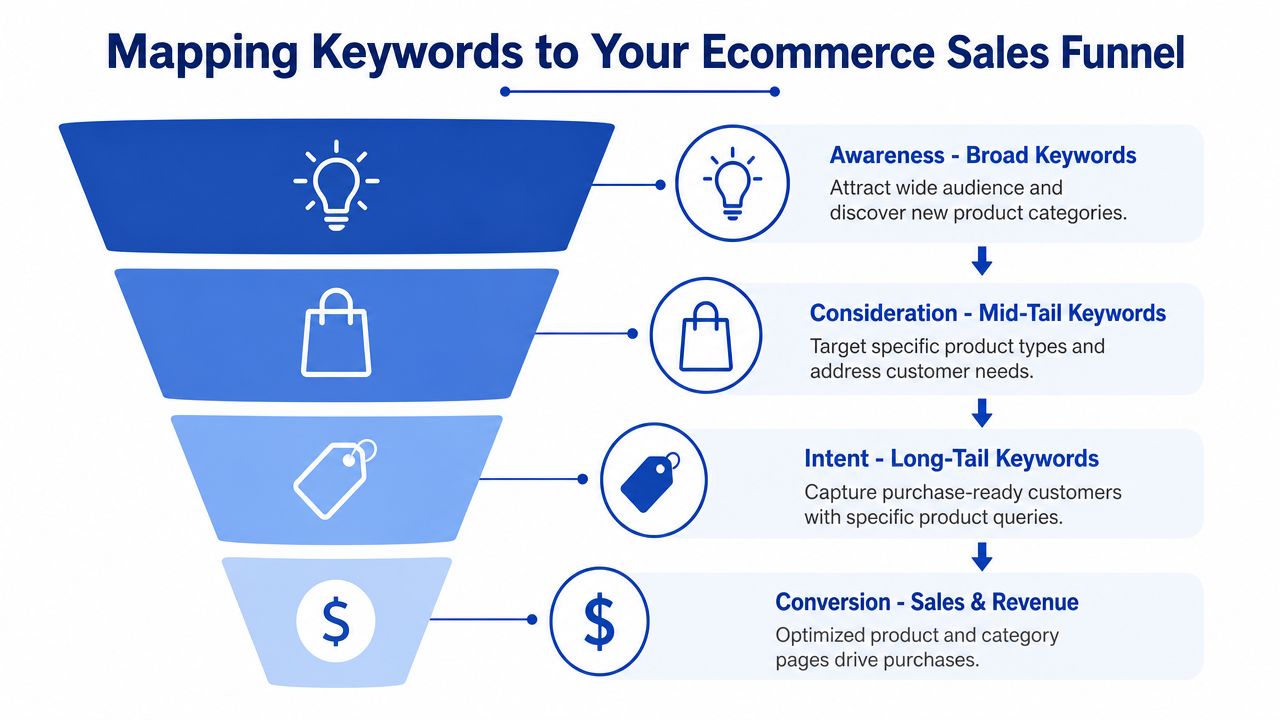
Search intent solves that problem. In ecommerce, four intent types matter most: informational, commercial investigation, transactional, and navigational. The job isn't to force all of them onto product pages. The job is to give each intent the right destination.
Match intent to page type
For the yoga mat store, the mapping looks like this:
| Intent | Example keyword | Best page type |
|---|---|---|
| Informational | how to clean a cork yoga mat | Blog or guide |
| Commercial investigation | best non-slip yoga mat for hot yoga | Collection page or comparison guide |
| Transactional | buy cork yoga mat UK | Product or collection page |
| Navigational | brand name cork yoga mat | Homepage, collection, or specific product page |
Much keyword research for ecommerce goes awry. Merchants often take a strong informational query and stuff it into a collection page. Or they try to rank a blog post for an obvious transactional phrase. Google usually resists that because the page doesn't satisfy the searcher's next step.
One page, one primary keyword intent.
That rule prevents cannibalisation, weak rankings, and muddled copy.
Group by intent before you write anything
Intent grouping also improves click performance. The top organic result earns a 39.8% click-through rate according to ecommerce keyword intent research from Zakeke. That's why grouping terms like buy, review, and compare by intent isn't a tidy spreadsheet exercise. It affects who clicks and what they expect after the click.
For the yoga mat example:
- Terms with “buy”, “shop”, “UK delivery” belong close to products and collections.
- Queries with “best”, “top”, “vs”, “review” usually need comparison-led collection pages or editorial support.
- Searches beginning with “how”, “why”, “what” belong in educational content that links into product discovery.
Store architecture should reflect demand
If your store structure doesn't have a natural home for an intent group, that's a site architecture problem.
A good Shopify setup often includes:
- broad collections for primary product categories
- narrower sub-collections for high-value feature or use-case terms
- product pages targeting exact product and variant-level phrases
- blog or advice content supporting informational searches
- internal links that move users from education into commerce
This matters even more when you use product schema and collection enhancements properly. If your product and collection pages are structurally weak, even good keywords won't carry enough relevance. That's where Shopify structured data setup becomes part of keyword execution, not a separate technical project.
A quick visual can help when you're mapping page roles:
A simple mapping example
For the yoga mat store, a sensible structure might be:
- Collection page for “Sustainable Yoga Mats”
- Sub-collection for “Non-Slip Yoga Mats”
- Sub-collection for “Cork Yoga Mats”
- Blog guide for “How to choose a yoga mat for hot yoga”
- Product page for a specific cork non-slip mat
That setup gives each keyword cluster a proper destination. It also creates a cleaner path from discovery to purchase.
If multiple pages compete for the same commercial phrase, rankings often wobble because search engines can't tell which URL should win. Clear mapping avoids that before it becomes a reporting problem.
Prioritisation and Shopify Implementation
Once the keyword map exists, the next mistake is obvious. Merchants go after the biggest terms first. That usually means the hardest terms, the vaguest intent, and the slowest route to revenue.
Prioritisation should be harsher than that. You don't need the biggest keyword first. You need the keyword that can produce commercial movement on a page you can realistically improve now.
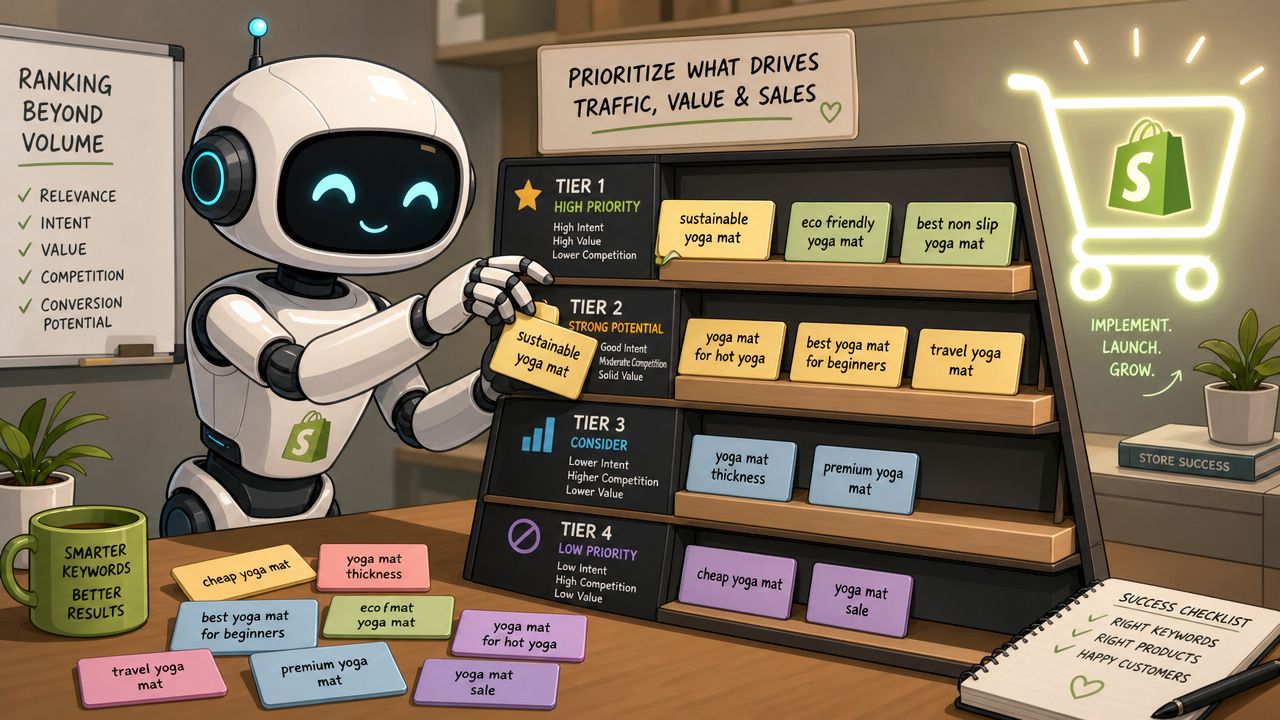
Score keywords like a merchant, not a publisher
A practical model uses three factors:
| Factor | What to ask |
|---|---|
| Relevance | Is this tightly aligned to products or collections you actually sell? |
| Commercial intent | Does the query suggest buying, comparing, or finding a store-ready option? |
| Difficulty | Can your current site realistically compete for this term with the right page? |
This shifts the conversation. A medium-volume phrase tied to a profitable collection can matter more than a broad head term that's difficult and vague.
For UK ecommerce, this trade-off is especially clear. Long-tail alternatives can offer a more realistic entry point than highly competitive generic phrases. That's often the difference between a strategy that ships this quarter and a strategy that lives in a slide deck.
The first targets should be keywords that can change revenue, not keywords that merely look impressive in a rank tracker.
Prioritise quick wins and money pages
For a Shopify store, I'd usually sort opportunities into three tiers.
- Tier one goes to existing collection and product pages that already have some visibility but weak CTR, weak copy, or unclear targeting.
- Tier two covers new collection pages for clear commercial demand, such as feature-led or use-case-led searches.
- Tier three is supporting content for educational and comparison terms that feed the buying journey.
That order matters because page authority, internal linking, and crawl focus are finite. If a collection page can win commercial traffic sooner, it usually deserves attention before a top-of-funnel article.
Where to implement keywords in Shopify
Execution on Shopify should be boring and precise. No stuffing. No awkward titles written for robots.
Focus on these fields:
Product title
Put the primary product phrase first, then key differentiators if they matter. Keep it readable.Meta title and meta description
Use the target keyword naturally, but write for clicks. If the snippet doesn't promise a useful outcome, rankings won't help enough.Collection title and description Many stores overlook commercial terms. Collections often deserve stronger copy, subheadings, and internal links.
URL handles
Keep them clean and descriptive when creating new pages. Don't keep revising them casually after pages are indexed.Image alt text
Describe the product and context accurately. Alt text should support accessibility first, relevance second.Internal links
Link from guides and comparison content into collections and products using natural anchor text.
Local and regional modifiers on Shopify
For UK merchants, local intent can be highly valuable. According to research on advanced ecommerce keyword techniques, integrating city-level keywords such as “near me” or regional names like London and Manchester into product titles and meta tags is increasingly important in 2026 projections, with over 40% of UK voice searches being location-based. The same source notes this is particularly important for Shopify Plus merchants using niche targeting to stand out.
That doesn't mean every store should force city names onto every page. It means regional relevance should appear where it's most useful:
- location-specific landing pages
- delivery messaging
- collection copy for regional demand
- metadata for stores with local fulfilment or physical presence
What doesn't work
Three implementation habits waste time fast:
- Targeting one head term across dozens of pages
- Writing product titles that read like keyword lists
- Ignoring collection pages because product pages feel more important
Collection pages usually carry more strategic SEO value than merchants expect. They sit at the point where comparison intent turns into product discovery. If you optimise them properly in Shopify, they often become the strongest organic revenue drivers on the store.
Tracking Success and Avoiding Common Pitfalls
Keyword research isn't finished when pages go live. It only becomes useful when you can see which pages gain visibility, which queries shift, and which changes affect sales.
Track pages, not just rankings
A ranking report on its own doesn't tell you enough. Track performance at page level.
Watch:
- organic sessions to collection and product pages
- click-through rate from search results
- conversion rate by landing page
- revenue from organic landing pages
- assisted conversions from blog and guide content
If a page ranks better but conversion stays weak, the keyword might be wrong, the intent match may be off, or the page experience may still be poor.
Ranking is a signal. Revenue is the verdict.
Run a quarterly review
Every quarter, review the keyword map against what happened.
Check for:
- pages that gained impressions without clicks
- pages that get clicks without sales
- queries triggering the wrong page
- emerging search language from site search, reviews, and support queries
This creates the feedback loop most stores never build. The keyword plan improves because the store keeps learning from real customer behaviour.
The mistakes that cost stores the most
The recurring issues are usually predictable:
Cannibalisation
Two or more pages target the same intent, so neither performs as strongly as it should.Difficulty blindness
Teams chase broad competitive terms and ignore specific phrases they could realistically win.Weak mobile intent match
A page may be technically indexed, but mobile users can't quickly find the product, filter options, or delivery details they need.Orphaned informational content
Guides bring visitors in but don't link shoppers into collections or products.
The strongest ecommerce SEO work is cyclical. Research informs structure. Structure shapes implementation. Performance data sharpens the next round of research. That's how keyword research for ecommerce becomes a revenue system instead of a one-off SEO task.
If your Shopify store has solid products but organic search still isn't pulling its weight, Grumspot can help turn keyword strategy into an execution plan that fits your storefront, collections, and conversion goals. They build, fix, and scale Shopify experiences with a conversion-first approach, so your SEO work doesn't stop at rankings.
Let's build something together
If you like what you saw, let's jump on a quick call and discuss your project
Related posts
Check out some similar posts.
- seo and subdomains
Learn how SEO and subdomains interact, from indexing and authority to internationalisation. A practi...
Read more
- technical seo audit
What Is Technical SEO Audit. Learn what a technical SEO audit is, its core components, and how it dr...
Read more
- help center shopify
Learn how to build a help center Shopify merchants trust. Covers native pages vs apps, article struc...
Read more
- shopify seo
Choosing the right SEO app for Shopify means weighing features against speed, scripts, and plan limi...
Read more