7 Subscription Examples and the Strategies Behind Them
- subscription examples
- subscription models
- Shopify subscriptions
- customer retention
- LTV and AOV
Launched
October, 2026
Recurring billing doesn't create predictable growth on its own. A customer can subscribe today and still cancel after the first delivery, ignore a failed-payment email, or discover that the plan's value no longer justifies its place in the household budget. The strongest subscription examples combine the right product model with retention mechanics, customer controls, merchandising logic and pricing that protects margin.
That matters in a UK market where roughly three-quarters of adults held at least one subscription contract, with average annual spending of about £660 in non-regulated markets, according to the UK government's subscription-contract impact assessment. The comparison below assesses each platform by product fit, pricing mechanics, retention capability, operational complexity, AOV opportunity and the Shopify implementation support it may require. It also connects each tool to a commercial mechanism, from replenishment and churn prevention to offer experimentation and omnichannel scale. Understanding recurrence patterns in Shopify helps, but choosing the right commercial system matters more.
1. Recharge
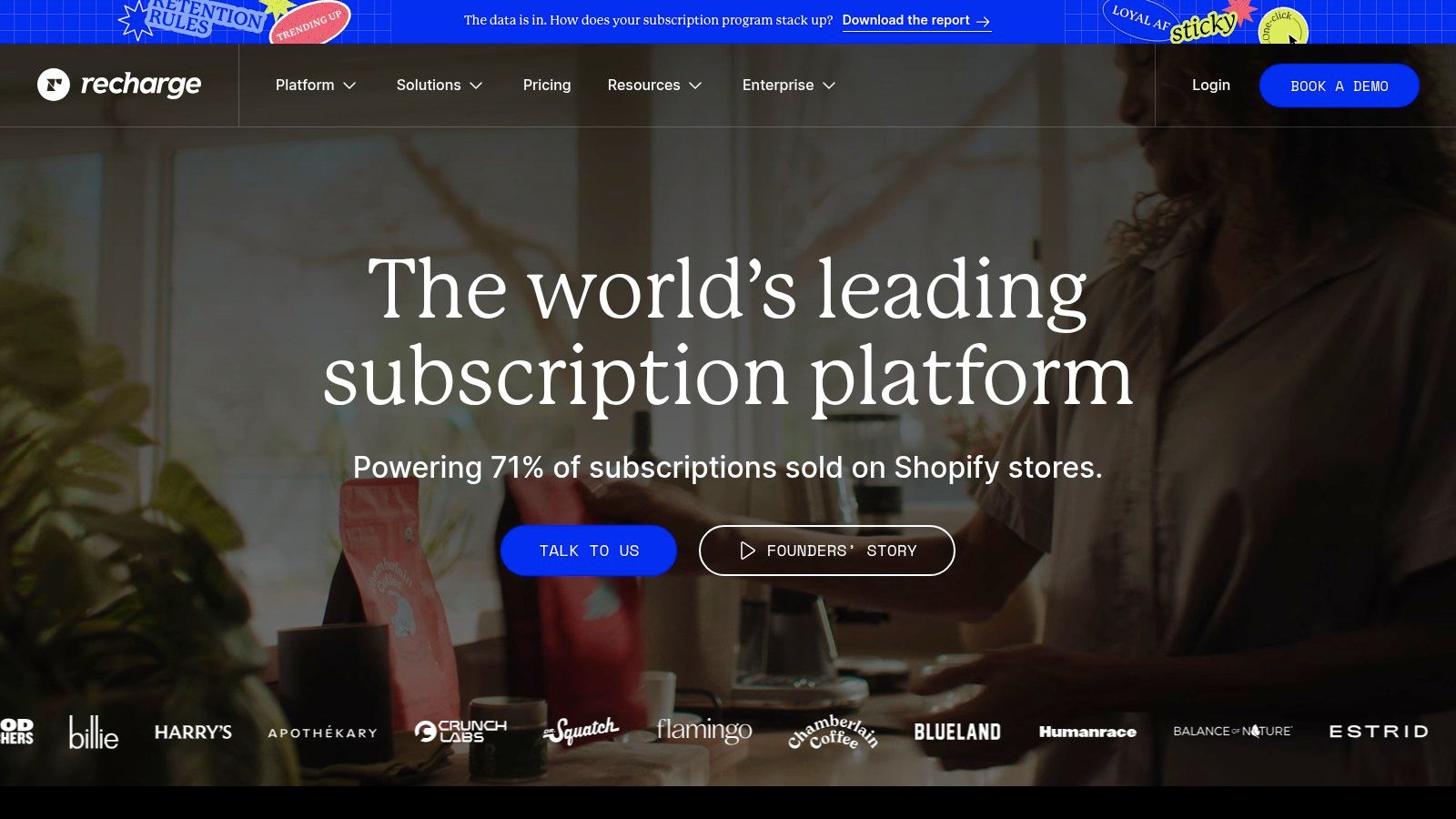
Recharge is the strongest fit when replenishment reliability is the primary commercial objective. Food, supplements, personal care and household products can use recurring delivery, bundles and customer-managed schedules without forcing the merchant to build a subscription engine from scratch. Its Shopify Checkout integration, customer portal, analytics and failed-payment recovery support the operational layer that turns a first order into repeat revenue.
The platform's commercial value isn't limited to billing. Bundles can increase the number of products in each recurring order, while rewards and referrals can give customers a reason to maintain a plan rather than buying intermittently. That creates an AOV opportunity, but merchants should test whether bundle discounts preserve contribution margin instead of treating every larger basket as profitable growth.
Best for scalable replenishment
Recharge's mature API, headless support and migration tooling make it a sensible choice for brands moving from another subscription provider or connecting subscriptions to a broader technology stack. Its partner and agency ecosystem can reduce implementation risk when the storefront needs custom account experiences, fulfilment rules or ERP connections. The trade-off is greater commercial complexity. Metered pricing can become more expensive as subscription volume grows, and advanced custom work may require higher-tier plans or engineering time.
Practical rule: Model platform fees, payment charges, fulfilment exceptions and discount leakage against contribution margin before committing to a high-volume subscription architecture.
A Shopify brand comparing providers should assess the full funnel, not only subscription starts. A UK coffee-subscription CRO case study reported an 88% increase in site-wide conversion rate and a 22% rise in recurring revenue during a five-week programme against a trailing 60-day baseline, as documented by Being Ecom's conversion case study. That result isn't a guarantee for every merchant, but it supports measuring product-page selection, checkout completion, first renewal and recurring revenue separately. Shopify subscription platform guidance is useful when those implementation choices need to connect.
2. Loop Subscriptions
A flat fee on every order can burden a brand still testing recurring demand. Loop Subscriptions addresses that risk through per-month plus percentage pricing, linking platform cost to subscription revenue. That structure gives smaller merchants a lower entry point, while the variable fee requires modelling at scale. The commercial question is whether improved retention and higher recurring revenue offset the percentage charge.
Loop supports prepaid, gift and trial subscriptions, build-a-box merchandising, and subscription shipping profiles. Each option strengthens a different mechanism. Prepaid plans bring cash forward, gifts create an acquisition path, and build-a-box can raise AOV by letting shoppers assemble a more relevant recurring order. Product fit is strongest where a merchant needs offer experimentation rather than a single subscribe-and-save configuration.
Strong controls can protect LTV
Retention is the platform's clearest commercial focus. Its customer portal, automation flows, smart dunning and A/B-tested cancellation journeys give merchants several intervention points before a subscriber leaves. Customers can change frequency, pause, skip or swap products themselves, reducing cancellations caused by an unsuitable order rather than genuine loss of demand.
Implementation effort also matters. White-glove migration on paid plans can reduce the work involved in moving from an existing subscription tool, particularly when customer records and recurring orders need careful handling.
UK subscription research recorded average customer tenure of nine months in 2021, compared with 5.6 months in 2017, and household subscription penetration increased from 65% in 2020 to 81% in 2021, according to Whistl's subscription-box research. Loop's controls map directly onto the behaviour those figures describe: pause, skip, frequency and product-swap options address common lapse points. Its free tier supports up to 50 active subscriptions, giving smaller merchants a way to test the account experience before expanding, as documented in Loop's platform information. The platform's image and product examples are shown in 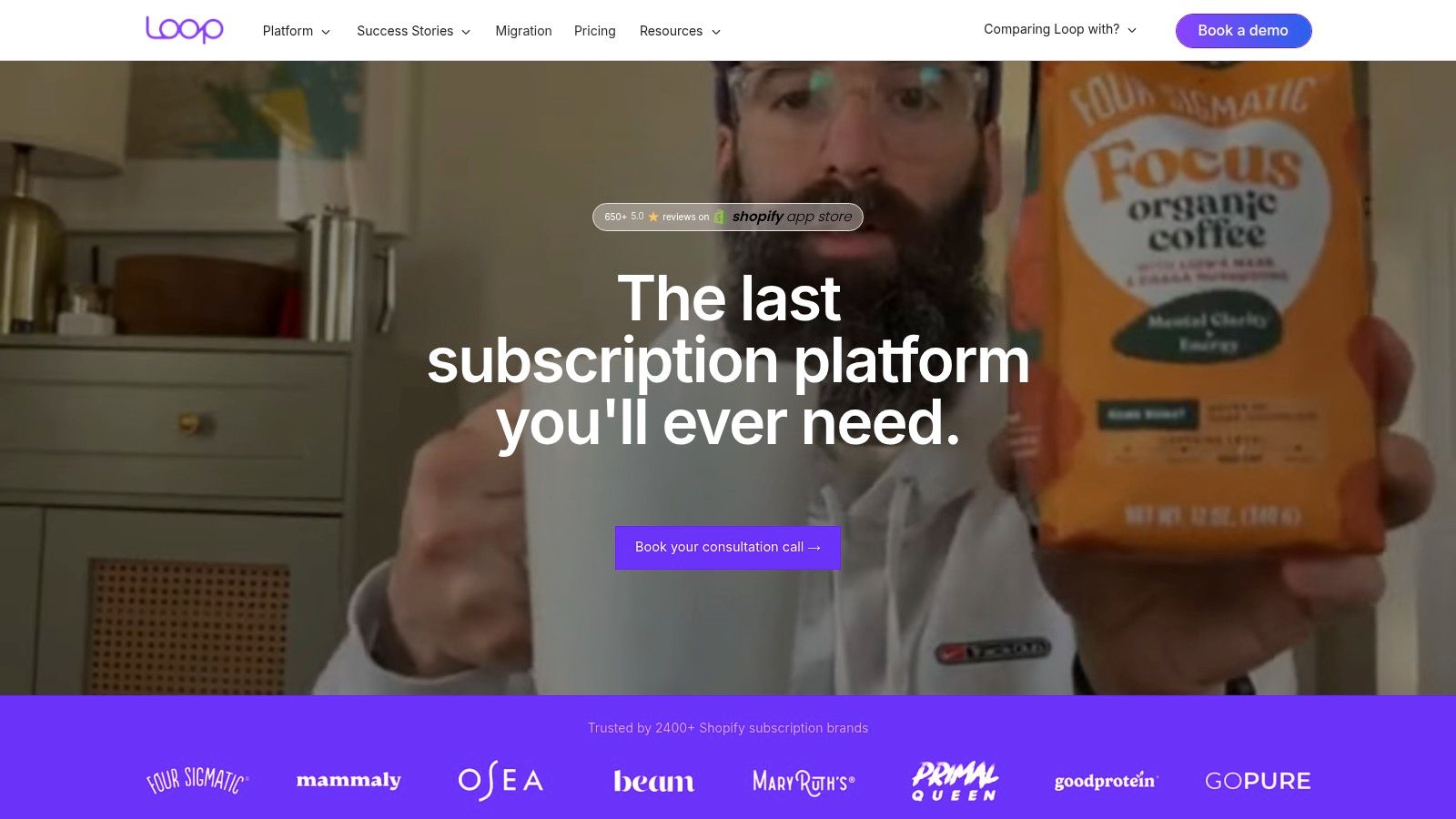 .
.
3. Skio
When a subscriber's routine changes, Skio's Journeys can present a product swap, pause or frequency change before cancellation becomes the default. This makes the platform most relevant to growth-stage brands that treat churn prevention as more important than the lowest possible platform cost. Its lifecycle Journeys, segmentation, advanced bundle and box experiences, and no-code customer portal create several intervention points. Used well, they can extend subscriber LTV by matching the offer to changing demand.
Skio also supports prepaid, multi-market and bundle-led subscription models. AI translations and international functionality help present a recurring proposition across markets, while tax, payment, fulfilment and customer-service requirements still need local configuration. The platform therefore suits brands testing pricing complexity or cross-border expansion, rather than merchants seeking only basic recurring billing.
Retention needs a usable account area
Skio's portal and hands-on onboarding can make subscription management feel like part of the storefront. Rewards and referrals give customers additional reasons to remain subscribed, while visual bulk operations can reduce the work involved in changing products or plans across a large customer base. Webhooks and API access pass subscription events to other services, although higher-tier limitations and technical requirements should be reviewed before development starts.
Bundle-led merchandising can also raise AOV by grouping products into recurring orders. That benefit depends on sufficient product breadth and margin to support the offer. Skio's higher base fee than many smaller alternatives, together with a transaction fee on subscription orders, makes the platform harder to justify for a narrow refill programme. Its economics become more defensible when preventable churn, larger baskets or multi-market operations represent meaningful growth opportunities.
Design every cancellation flow around a relevant alternative: a different product, a lighter plan or a pause. The offer should match the reason the customer is leaving.
Make cancellation visible and straightforward. UK consumer evidence found that 23% of consumers had paid for a bill or subscription they no longer wanted, rising to 35% among Gen Z, based on a Visa-commissioned Basis survey of 4,152 UK adults conducted in November and December 2024, reported in Ofcom's customer-service report. Skio's save flows work only when renewal terms and cancellation paths are plainly communicated. Make both visible before layering automation on top. For implementation guidance, see this practical guide to Shopify subscription services.
4. Smartrr
Retention Actions are where Smartrr earns its fee. Automated interventions can respond to churn signals before a subscriber reaches the cancellation page, turning the subscriber account experience as a retention product into a measurable commercial system. Unwanted renewals usually mean the plan no longer matches consumption. Smartrr's controls let customers resize the plan and continue the relationship.
A practical flow could pair a failed-payment email with a downgrade offer, then present a pause or frequency change if the customer does not recover payment. That sequence addresses involuntary churn and plan mismatch through separate actions, giving merchants clearer tests for renewal success, save rate and net churn. Build-a-box, loyalty and referrals sit on higher tiers. Build-a-box can raise AOV by consolidating several products into one recurring order, provided the catalogue and margins support the offer.
A clear plan ladder reduces implementation friction
Smartrr offers month-to-month billing, a 14-day Shopify trial and plans without a long-term commitment. Merchants can test the portal, notifications and cancellation flow before committing to a full migration. The percentage of subscriber GMV applies across tiers, however, and feature gating may make the apparently simplest plan unsuitable for a growing brand's merchandising or loyalty model.
Unlimited API calls can simplify connections between subscription events, CRM, fulfilment and customer-support systems. Engineering work remains. Product swaps, tax treatment, inventory reservations and payment updates must stay consistent across the storefront and back office.
The account area should put skip, pause, frequency changes, quantity changes and payment updates within easy reach. Whistl reports that companies averaging one customer-initiated subscription change grew at almost three times the rate of companies without such changes and had lower churn, based on an analysis of 90 million subscriptions in its subscription research. For Smartrr, the implication is practical: use Retention Actions to test which intervention preserves contribution margin, then measure whether flexibility improves LTV rather than treating every account change as a save.
5. Bold Subscriptions
Document subscription states before anything else. Bold's free migration is only an advantage when active plans, prepaid balances, discounts, payment tokens, next-charge dates and cancellation reasons survive the move intact. Missing context can create support problems even after the storefront appears to migrate successfully.
Bold's strongest commercial case comes from connecting subscription billing needs to reinforce an existing upsell and pricing stack. Merchants already using Bold tools can link recurring plans with upsell logic, custom pricing and support workflows instead of adding another commercial system. The subscription decision becomes a merchandising opportunity, potentially raising AOV while giving customers a reason to consolidate more of their recurring purchases.
The platform supports prepaid and pay-as-you-go plans, cancellation flows, dunning and common payment methods. Prepaid billing can improve cash flow, while pay-as-you-go reduces commitment for customers still assessing a recurring relationship. Compare each model against retention, refunds, fulfilment planning and contribution margin before choosing a default.
Entry cost isn't the whole decision
Bold promotes a low monthly entry price and free migrations from other apps, which can suit smaller brands testing subscription demand. A percentage transaction fee applies across tiers, and mid-market requirements may require add-ons. The starting fee therefore provides limited guidance on long-term cost, especially as subscriber volume grows.
An API-first approach can support custom product logic and connections between subscription events, merchandising and customer support. Implementation still requires a documented migration plan and checks for payment, discount and fulfilment states. The team should also confirm that pricing rules remain consistent when customers change plans or products.
Commercial test: Bold pays for itself when the recurring offer lifts the whole basket. Attach an upsell or custom-pricing rule to the subscription decision itself, then measure the effect on AOV, retention and LTV.
Choose Bold for ecosystem fit. A retention-focused platform justifies its variable fee more clearly when Bold's upsell and pricing tools are absent from the existing stack. When those tools already shape merchandising, Bold can reduce disconnected systems for customers and operations teams.
6. Stay AI
Most subscription tools optimise the plan already launched. Stay AI is built for testing the offer itself, including subscriber-only promotions, targeted lifecycle offers and different save paths. Its offer experimentation and retention intelligence suit brands whose churn varies by product, tenure, acquisition source or customer behaviour.
ExperienceEngine supports controlled retention tests, while the flexible no-code portal lets teams change the account experience without rebuilding it. The Product Catalog helps keep pricing consistent when subscribers switch products or plans. That matters for brands managing multiple discounts, bundles and subscription actions, because an inconsistent price can erase margin or create contradictory offers.
Experimentation needs disciplined measurement
The platform is most useful when a merchant has enough variation in customers and products to test specific interventions. A pause offer can be compared with a product swap. A subscriber-only promotion can be tested against a frequency change, while failed-payment recovery can use a different message or incentive. These tests connect directly to churn prevention and offer design, with potential effects on LTV, discount cost and AOV.
Stay AI's flat fee and metered charges require volume modelling before implementation. Advanced capabilities may also take time for the team to learn, document and operate consistently. The account area must present price, renewal timing and available actions clearly, since confusing choices can weaken the retention benefit of a well-designed offer.
The UK government's telecoms and pay-TV complaints announcement offers adjacent context on friction in recurring services, but it does not support claims about household subscription spending. For Stay AI, the practical question is how clearly customers can understand and change their recurring commitment.
Choose Stay AI when testing value presentation, downgrade paths, bundles and pause options is part of the retention strategy. Judge each ExperienceEngine test on contribution margin per cohort, not save rate alone. A pause offer that halves discount cost can outperform one that doubles saves if retained customers generate stronger net value.
7. Ordergroove
A subscriber collects an order in store, pays with Shop Pay, and retains a promotional price agreed two months earlier. That is the type of workflow Ordergroove is designed to run. Its Shopify integration supports recurring gateways such as Shop Pay, Apple Pay and PayPal, while the wider platform covers digital memberships, rotating product programmes, in-store pickup and complex promotional flows.
Ordergroove targets retailers running subscriptions alongside physical retail, memberships and promotional calendars. This scope reaches beyond a DTC refill programme and makes the platform relevant when subscription revenue must work across channels. The commercial mechanism is pricing complexity and omnichannel scale: price protection can support retention and LTV, while coordinated promotions and product rotation may increase AOV without breaking the customer promise.
Its Flex Incentives supports price-locking, best-price logic based on a lookback window and gifts with recurring orders. A retailer can protect a subscriber's price, attach an incentive to a renewal or rotate products within a recurring programme. Each rule affects margin, tax, inventory allocation and customer service, so the commercial case depends on governance as much as feature coverage.
Enterprise flexibility brings enterprise effort
Ordergroove expresses complicated commercial policies across multiple channels, but those policies require discovery, ownership and testing. Pricing is custom and generally higher than SMB-focused applications. UK merchants will need a sales conversation to establish the relevant quote and regional terms.
The implementation plan should cover inventory allocation, fulfilment timing, refunds, payment retries, customer-service permissions and reporting across every channel. It should also map how promotional rules affect contribution margin, renewal behaviour, LTV and AOV before launch.
Every additional pricing rule adds exception cases. Budget testing time for edge cases, including lookback windows, stacked incentives and partial returns, before launch, not after the first support ticket.
Ordergroove's enterprise migration capability can reduce the risk of moving a complex programme, while the merchant remains responsible for the commercial design. Subscription lifecycle management guidance can help map acquisition, activation, renewal, changes, pauses, recovery and cancellation before configuration begins.
Top 7 Subscription Platforms Comparison
| Solution | Implementation complexity 🔄 | Resource requirements ⚡ | Expected outcomes 📊 | Ideal use cases 💡 | Key advantages ⭐ |
|---|---|---|---|---|---|
| Recharge | Medium→High, robust API, checkout integration, migration tooling | Moderate engineering + possible higher plan costs at scale | 📊 Proven scalable retention & replenishment → ⭐⭐⭐⭐ | Startups → Enterprise needing a proven, scalable subscription engine | Mature feature set, strong partner ecosystem |
| Loop Subscriptions | Low→Medium, Shopify-native, easy portal & migrations | Low ongoing ops; transparent month+% pricing (free tier available) | 📊 Strong LTV & cancellation-save performance → ⭐⭐⭐⭐ | SMBs/mid-market focused on LTV and UX with predictable pricing | Clear pricing, excellent portal UX, free tier |
| Skio | Medium, no-code portal with hands-on onboarding | Higher base fee + transaction fee; high-touch onboarding | 📊 Focused churn reduction & sophisticated bundles → ⭐⭐⭐⭐ | Growth-stage brands investing in retention automation and UX | Advanced retention automations, polished no-code portal |
| Smartrr | Low→Medium, branded portal, retention toolkit | Predictable month-to-month plans; some features on higher tiers | 📊 Better self-serve retention via account UX → ⭐⭐⭐ | Mid-market merchants prioritizing customer account experience | Branded portals, retention actions, clear plan ladder |
| Bold Subscriptions | Low→Medium, API-first, developer-friendly tooling | Low entry price; transaction fee applies; works with Bold stack | 📊 Reliable basic subscriptions + upsells → ⭐⭐⭐ | Merchants already using Bold apps or needing developer control | Low entry cost, integrates with Bold upsell/pricing tools |
| Stay AI | Medium, AI-driven ExperienceEngine and experimentation | Flat fee + metered charges; ramp-up for advanced features | 📊 Experimentation-driven retention & targeted offers → ⭐⭐⭐⭐ | Merchants wanting AI-led personalization and offer tests | AI orchestration, drag-and-drop portal, robust experimentation |
| Ordergroove | High, enterprise onboarding, custom pricing & omnichannel flows | High / custom pricing and dedicated sales discovery | 📊 Enterprise-grade omnichannel subscriptions & pricing → ⭐⭐⭐⭐⭐ | Large retailers or brands needing complex pricing, in-store + online | Complex pricing/promotions, omnichannel and enterprise-scale support |
Turn the Right Example Into a Growth System
There isn't one universal winner among these subscription examples. The right platform depends on the constraint limiting the business today. Recharge is a strong candidate when the priority is scalable replenishment infrastructure. Loop is better suited to a merchant that wants a clear entry cost model and strong customer controls. Skio prioritises retention automation and high-touch growth support, while Smartrr puts the branded account experience at the centre of the relationship.
Bold makes more sense when upselling and custom pricing already sit inside the Bold ecosystem. Stay AI is designed for merchants that want to experiment with retention offers and subscriber experiences. Ordergroove earns consideration when pricing rules, digital memberships, store operations and omnichannel journeys create complexity that an SMB-oriented app can't comfortably handle.
The commercial mechanism should guide the decision:
- Replenishment: Choose a platform that handles recurring fulfilment, failed payments and product changes without operational workarounds.
- Churn prevention: Prioritise portals, pause flows, cancellation saves, dunning and cohort-level retention reporting.
- Offer experimentation: Use controllable promotions, segmentation and testable lifecycle journeys.
- AOV growth: Compare build-a-box, bundles, prepaid plans, gifts and upsells against contribution margin.
- Omnichannel scale: Validate store pickup, payment methods, membership logic, inventory and pricing consistency across channels.
Before launch, test the complete customer journey. Review plan selection, subscription messaging, portal usability, cancellation saves, payment recovery, bundle merchandising, AOV opportunities, data flows, tax treatment, fulfilment exceptions and migration requirements. A customer who can't change a delivery date may cancel. An operations team that can't reconcile a product swap may create avoidable refunds. A finance team that can't separate recurring revenue from discounts may misjudge LTV.
The UK subscription-box market illustrates why retention deserves equal weight to acquisition. Industry research reported growth from £332 million in 2020 to £395 million in 2021, with a projection of £1.8 billion by 2025, as detailed in Whistl's subscription-box fact sheet. A larger market doesn't make every subscription profitable. It increases the need for clear value, flexible controls, accurate renewal communication and systems that protect margin as the programme grows.
Grumspot can help Shopify and Shopify Plus brands implement subscription boxes, memberships and product refills, including build-a-box journeys, product swaps, subscriber portals, recurring-payment setup and ERP or CRM integrations. The agency can also support bespoke storefront work, platform migrations, technical audits and conversion-focused optimisation when the subscription app alone doesn't solve the customer or operational problem.
Grumspot offers Shopify subscription implementation, bespoke storefront development, integrations and CRO support for brands building replenishment, membership or subscription-box experiences. Visit Grumspot to discuss the right platform, customer journey and technical setup for your recurring-commerce model.
Let's build something together
If you like what you saw, let's jump on a quick call and discuss your project

Related posts
Check out some similar posts.
- ecommerce subscription platform
Learn how an ecommerce subscription platform works, which models drive retention, and how to choose,...
Read more
- subscription service
Learn how to set up a subscription service with proven pricing, billing, churn and compliance strate...
Read more
- subscription lifecycle management
Master subscription lifecycle management with stages, metrics and best practices that lift retention...
Read more
- churn prediction
Discover how churn prediction models work and learn practical steps for feature engineering, evaluat...
Read more